

 management
Similar presentations:









Debounce: Optimizing Performance by Controlling Function Execution
1.
Debounce: OptimizingPerformance by Controlling
Function Execution
by Myself
2.
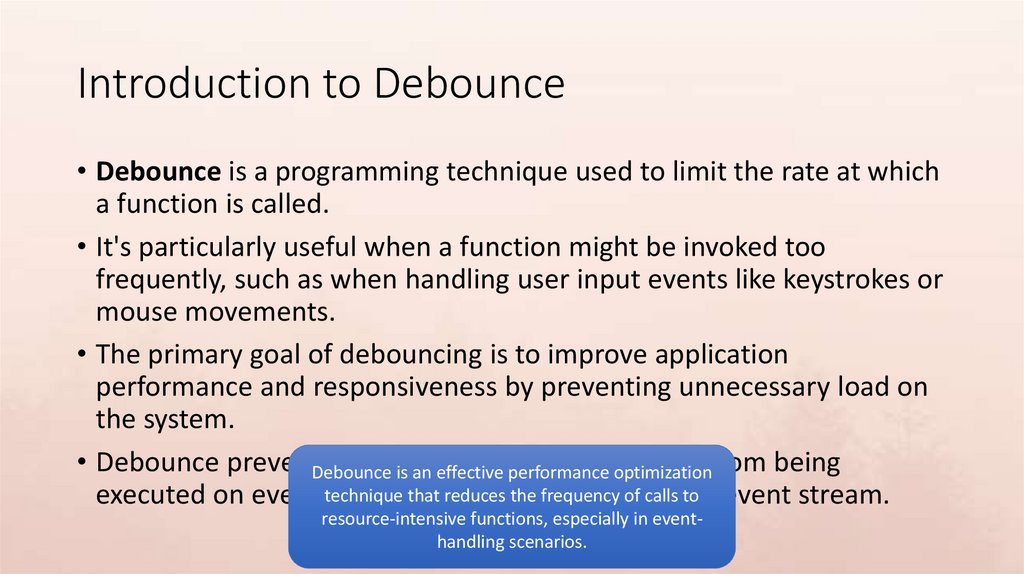
Introduction to Debounce• Debounce is a programming technique used to limit the rate at which
a function is called.
• It's particularly useful when a function might be invoked too
frequently, such as when handling user input events like keystrokes or
mouse movements.
• The primary goal of debouncing is to improve application
performance and responsiveness by preventing unnecessary load on
the system.
• Debounce prevents
resource-intensive
operations
Debounce
is an effective performance
optimizationfrom being
reducesfor
the frequency
to event stream.
executed on every technique
event, that
waiting
a pauseof calls
in the
resource-intensive functions, especially in eventhandling scenarios.
3.
Debounce: Key Concepts Illustrated4.
Debounce and Throttling: Side-by-SideComparison
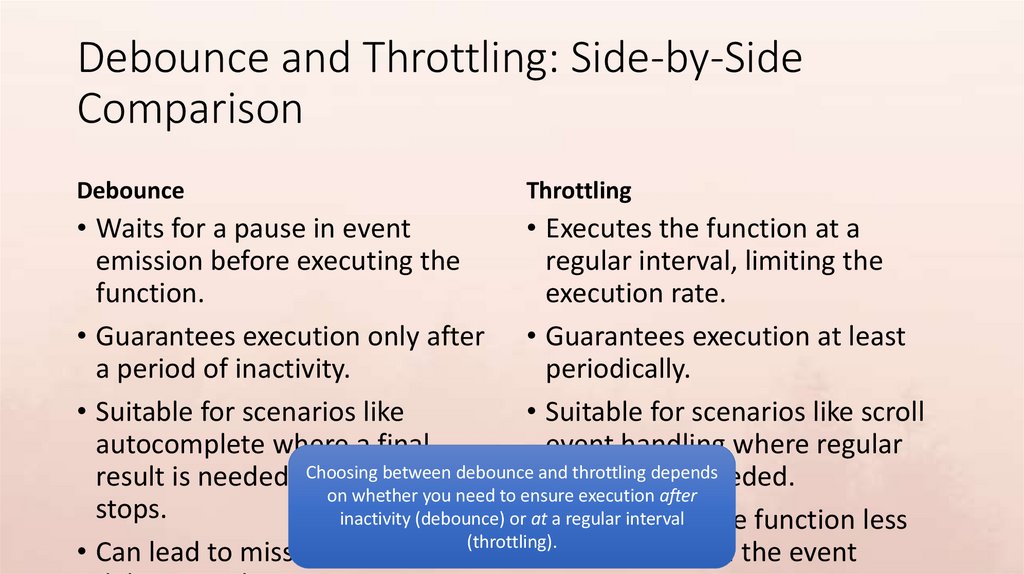
Debounce
Throttling
• Waits for a pause in event
• Executes the function at a
emission before executing the
regular interval, limiting the
function.
execution rate.
• Guarantees execution only after • Guarantees execution at least
a period of inactivity.
periodically.
• Suitable for scenarios like
• Suitable for scenarios like scroll
autocomplete where a final
event handling where regular
Choosing
between debounce and
throttling are
depends
result is needed after
typing
updates
needed.
on whether you need to ensure execution after
stops.
inactivity (debounce) or•atMay
a regular
interval the function less
execute
• Can lead to missed events if the(throttling).frequently than the event
5.
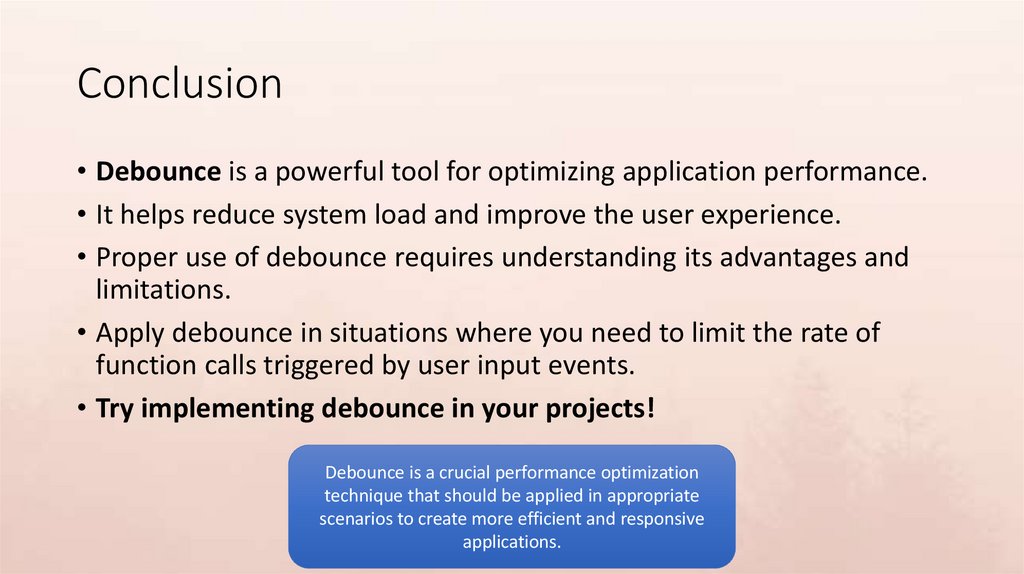
Conclusion• Debounce is a powerful tool for optimizing application performance.
• It helps reduce system load and improve the user experience.
• Proper use of debounce requires understanding its advantages and
limitations.
• Apply debounce in situations where you need to limit the rate of
function calls triggered by user input events.
• Try implementing debounce in your projects!
Debounce is a crucial performance optimization
technique that should be applied in appropriate
scenarios to create more efficient and responsive
applications.