 management
Similar presentations:






Segmentation and Targeting Rationale
1.
Driving Growth: StrategicSegmentation & Targeting
This presentation explores how strategic customer segmentation and precise
targeting can unlock new growth opportunities for your products and campaigns.
2.
Agenda: Unlocking Customer-Centric Growth01
02
Why S egmentation & Targeting?
Key Benefits
Understanding the foundational importance.
Exploring the tangible advantages for marketing and product
development.
03
04
S egmentation Approaches
Effective Targeting S trategies
Diving into different methodologies for defining customer groups.
How to reach your most valuable segments.
05
06
Implementation Best Practices
Interactive Quiz
Practical steps for putting it into action.
Test your knowledge and reinforce key learnings.
3.
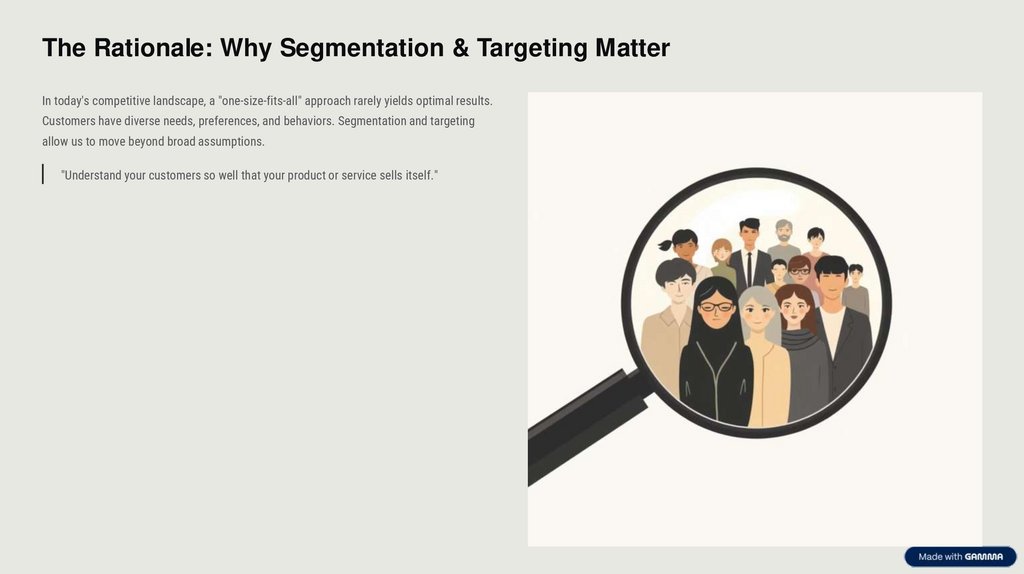
The Rationale: Why Segmentation & Targeting MatterIn today's competitive landscape, a "one-size-fits-all" approach rarely yields optimal results.
Customers have diverse needs, preferences, and behaviors. Segmentation and targeting
allow us to move beyond broad assumptions.
"Understand your customers so well that your product or service sells itself."
4.
Key Benefits: Driving Performance & R OIEnhanced R elevance
Improved R OI
Tailor messages and offerings to specific needs, increasing
Optimize marketing spend by focusing on the most profitable
engagement.
segments.
Higher Customer S atis faction
Better Product Development
Deliver personalized experiences that foster loyalty and
Inform product roadmaps with deep insights into segment
advocacy.
demands.
5.
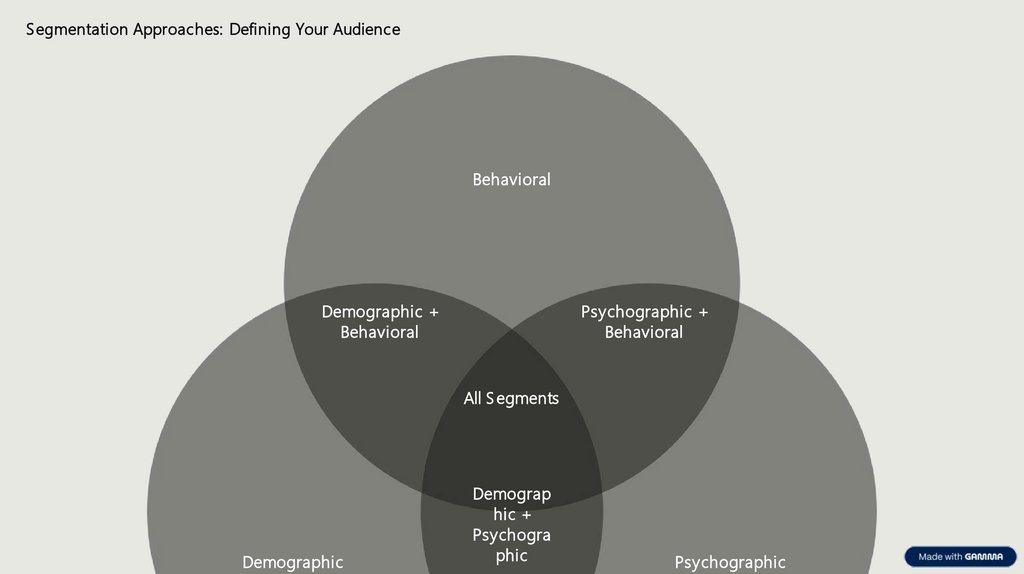
S egmentation Approaches: Defining Your AudienceBehavioral
Demographic +
Behavioral
Psychographic +
Behavioral
All S egments
Demographic
Demograp
hic +
Psychogra
phic
Psychographic
6.
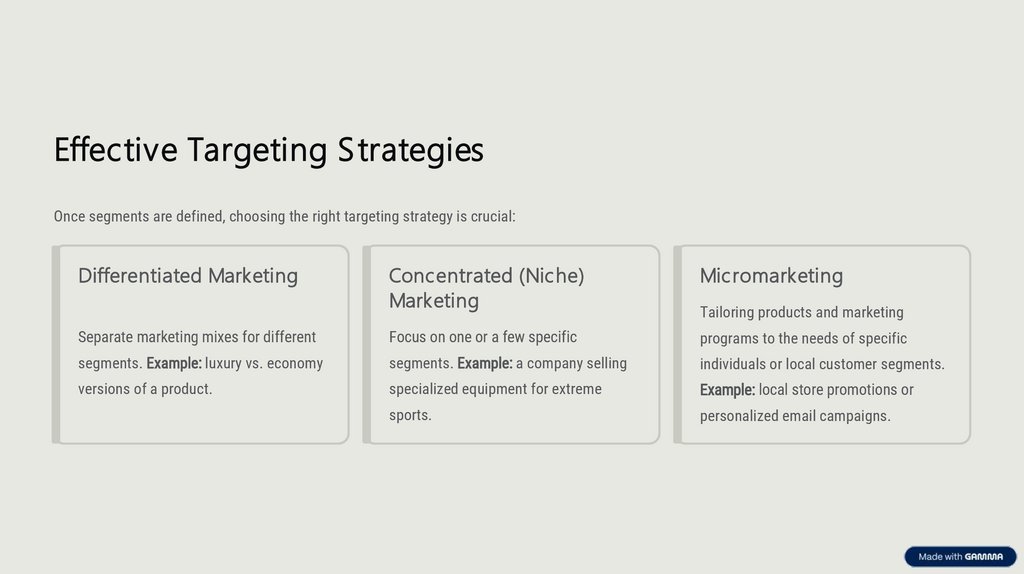
Effective Targeting S trategiesOnce segments are defined, choosing the right targeting strategy is crucial:
Differentiated Marketing
Concentrated (Niche)
Marketing
Micromarketing
Separate marketing mixes for different
Focus on one or a few specific
programs to the needs of specific
segments. Example: luxury vs. economy
segments. Example: a company selling
individuals or local customer segments.
versions of a product.
specialized equipment for extreme
Example: local store promotions or
sports.
personalized email campaigns.
Tailoring products and marketing
7.
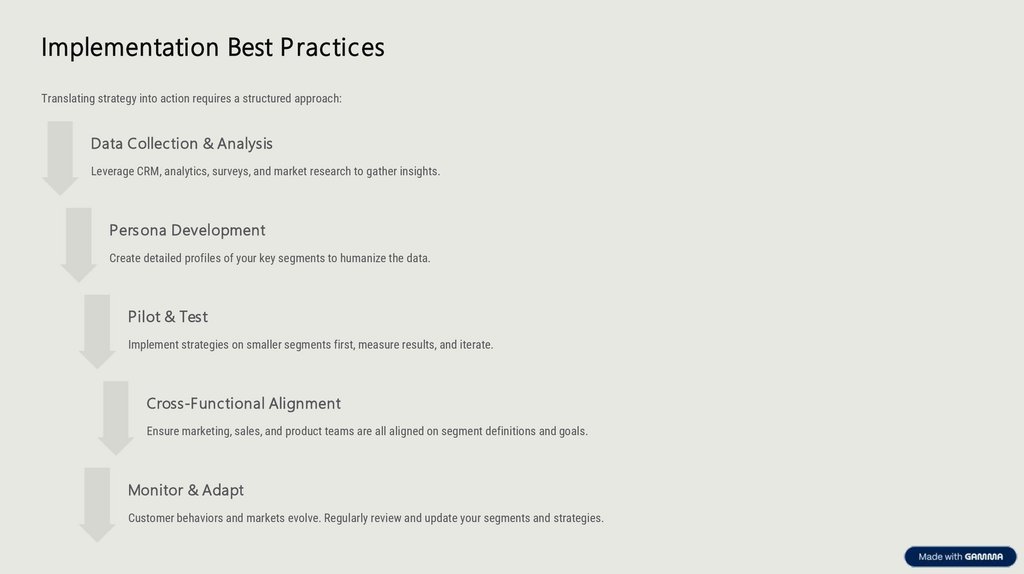
Implementation Best PracticesTranslating strategy into action requires a structured approach:
Data Collection & Analysis
Leverage CRM, analytics, surveys, and market research to gather insights.
Pers ona Development
Create detailed profiles of your key segments to humanize the data.
Pilot & Test
Implement strategies on smaller segments first, measure results, and iterate.
Cross-Functional Alignment
Ensure marketing, sales, and product teams are all aligned on segment definitions and goals.
Monitor & Adapt
Customer behaviors and markets evolve. Regularly review and update your segments and strategies.
8.
Interactive Quiz: Test Your Knowledge!Let's check your understanding of today's key concepts.
1. Which of the following is NOT a primary benefit of customer segmentation?
A) Enhanced marketing relevance
B) Reduced overall marketing budget
C) Improved customer satisfaction
D) Better product development
2. What type of segmentation focuses on a customer's values, attitudes, and lifestyle?
A) Demographic
B) Geographic
C) Psychographic
D) Behavioral
9.
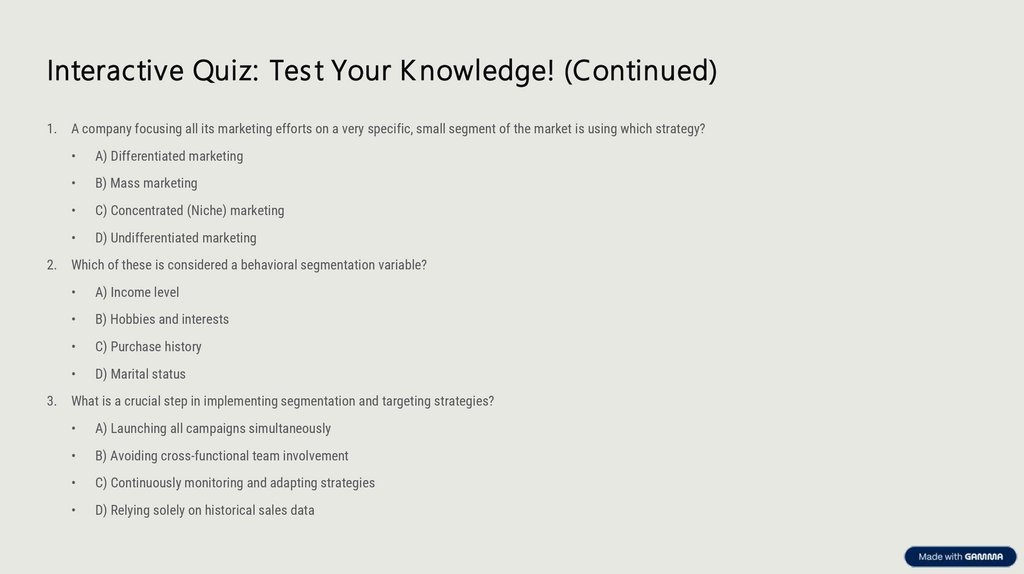
Interactive Quiz: Tes t Your K nowledge! (Continued)1. A company focusing all its marketing efforts on a very specific, small segment of the market is using which strategy?
A) Differentiated marketing
B) Mass marketing
C) Concentrated (Niche) marketing
D) Undifferentiated marketing
2. Which of these is considered a behavioral segmentation variable?
A) Income level
B) Hobbies and interests
C) Purchase history
D) Marital status
3. What is a crucial step in implementing segmentation and targeting strategies?
A) Launching all campaigns simultaneously
B) Avoiding cross-functional team involvement
C) Continuously monitoring and adapting strategies
D) Relying solely on historical sales data
10.
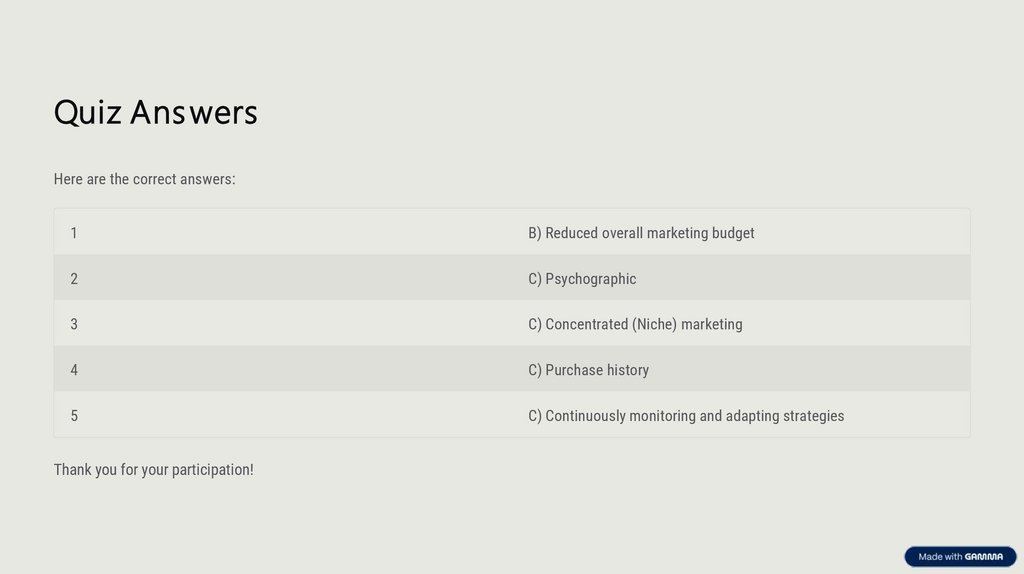
Quiz Ans wersHere are the correct answers:
1
B) Reduced overall marketing budget
2
C) Psychographic
3
C) Concentrated (Niche) marketing
4
C) Purchase history
5
C) Continuously monitoring and adapting strategies
Thank you for your participation!