 english
Similar presentations:







Week 1.Lesson 3. Reading (asynchronous lesson)
1. Week 1.Lesson 3. Reading (asynchronous lesson)
Astana IT UniversityDepartment of General Disciplines
English for Academic Purposes.
B1 level
Week 1.Lesson 3.
Reading (asynchronous lesson)
Robot Sophia Delivers Speech at
D'Youville University Graduation
2025-2026 academic year
2.
Lesson Objectives:• Expand and practice vocabulary related to
technology in education.
• Read about robot Sophia and complete related
tasks.
3. Think about your own experience with robots. Have you ever seen or used one? Reflect on the following questions on your own
(5 minutes).Think about your own experience with robots. Have
you ever seen or used one?
Reflect on the following questions on your own before
moving on:
1. What tasks do you think robots are good at?
2. In what ways could robots help people in their daily
lives?
3. Would you like to have a robot at home? Why or
why not?
4.
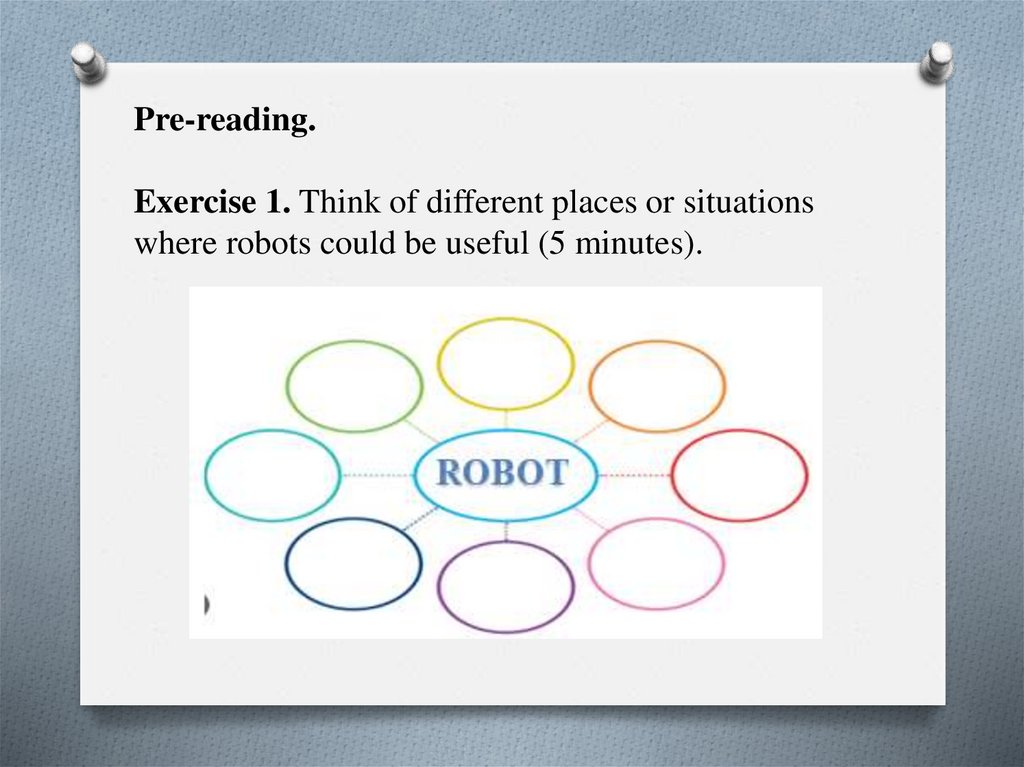
Pre-reading.Exercise 1. Think of different places or situations
where robots could be useful (5 minutes).
5.
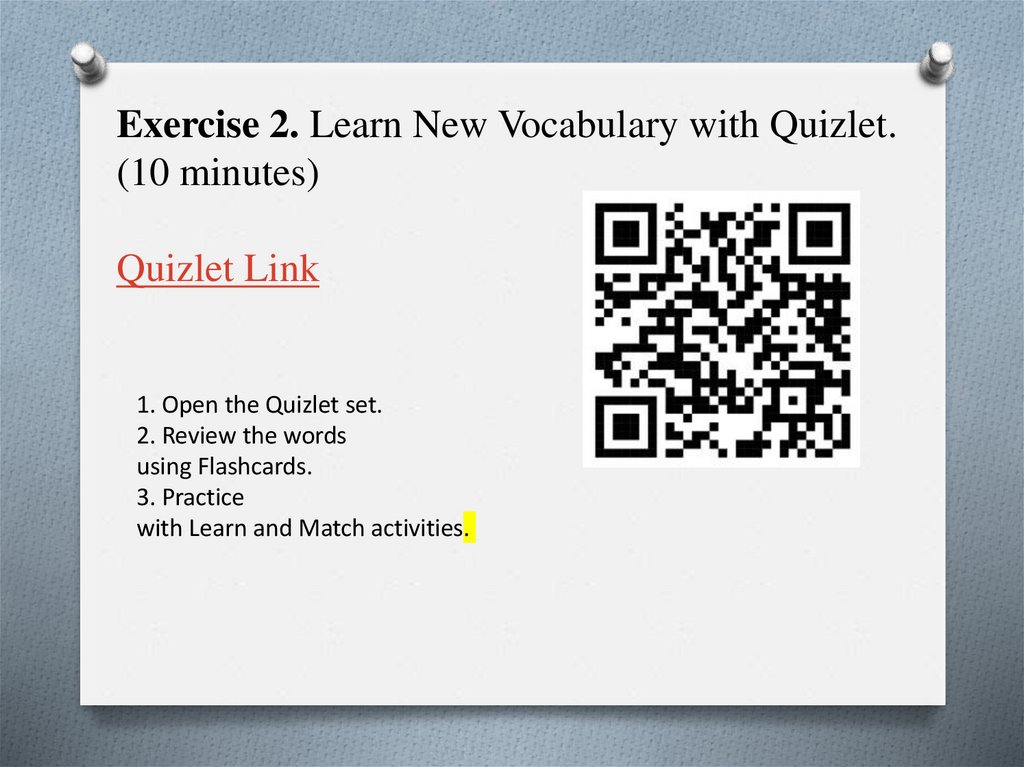
Exercise 2. Learn New Vocabulary with Quizlet.(10 minutes)
Quizlet Link
1. Open the Quizlet set.
2. Review the words
using Flashcards.
3. Practice
with Learn and Match activities.
6.
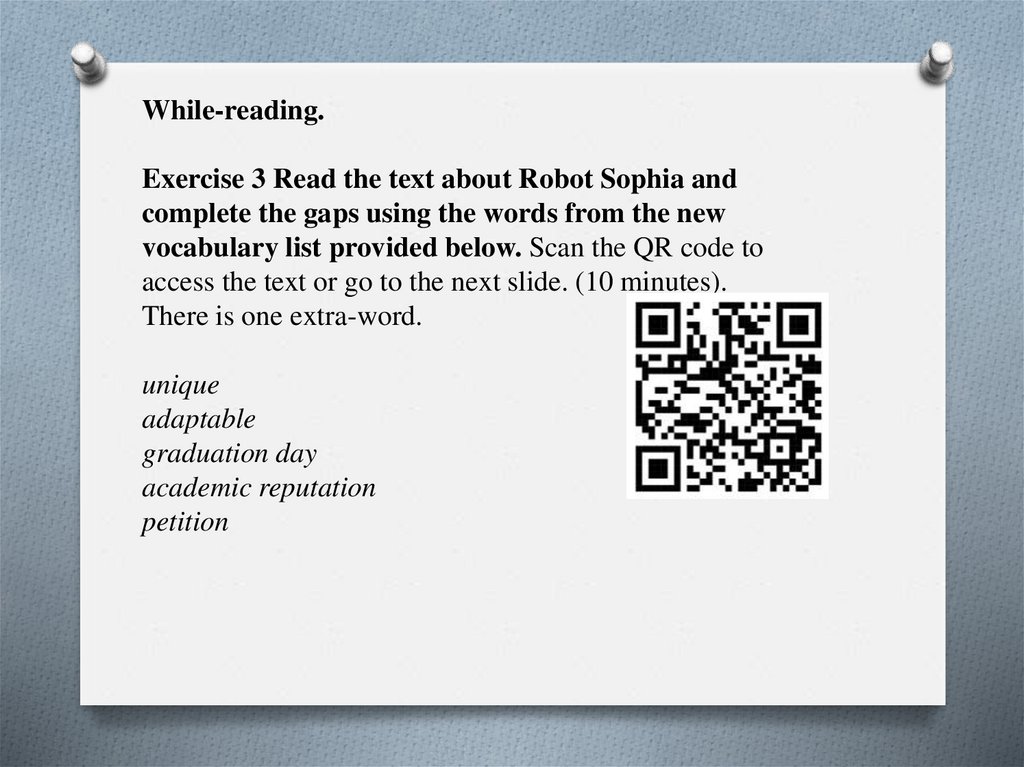
While-reading.Exercise 3 Read the text about Robot Sophia and
complete the gaps using the words from the new
vocabulary list provided below. Scan the QR code to
access the text or go to the next slide. (10 minutes).
There is one extra-word.
unique
adaptable
graduation day
academic reputation
petition
7.
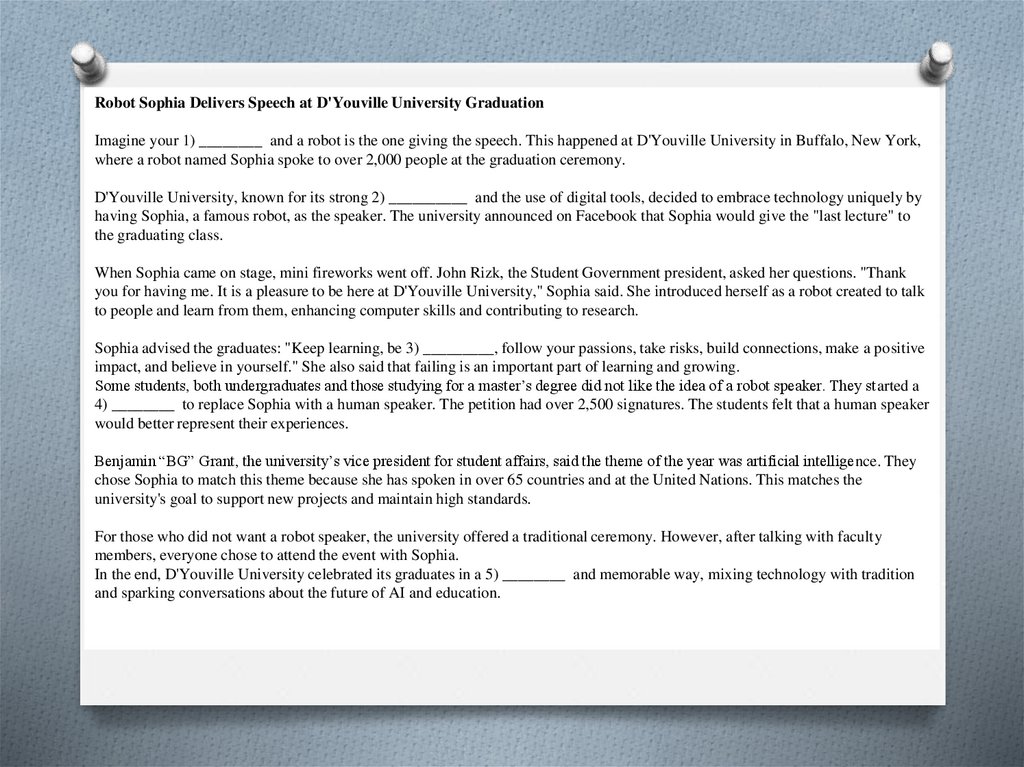
Robot Sophia Delivers Speech at D'Youville University GraduationImagine your 1) ________ and a robot is the one giving the speech. This happened at D'Youville University in Buffalo, New York,
where a robot named Sophia spoke to over 2,000 people at the graduation ceremony.
D'Youville University, known for its strong 2) __________ and the use of digital tools, decided to embrace technology uniquely by
having Sophia, a famous robot, as the speaker. The university announced on Facebook that Sophia would give the "last lecture" to
the graduating class.
When Sophia came on stage, mini fireworks went off. John Rizk, the Student Government president, asked her questions. "Thank
you for having me. It is a pleasure to be here at D'Youville University," Sophia said. She introduced herself as a robot created to talk
to people and learn from them, enhancing computer skills and contributing to research.
Sophia advised the graduates: "Keep learning, be 3) _________, follow your passions, take risks, build connections, make a positive
impact, and believe in yourself." She also said that failing is an important part of learning and growing.
Some students, both undergraduates and those studying for a master’s degree did not like the idea of a robot speaker. They started a
4) ________ to replace Sophia with a human speaker. The petition had over 2,500 signatures. The students felt that a human speaker
would better represent their experiences.
Benjamin “BG” Grant, the university’s vice president for student affairs, said the theme of the year was artificial intelligence. They
chose Sophia to match this theme because she has spoken in over 65 countries and at the United Nations. This matches the
university's goal to support new projects and maintain high standards.
For those who did not want a robot speaker, the university offered a traditional ceremony. However, after talking with faculty
members, everyone chose to attend the event with Sophia.
In the end, D'Youville University celebrated its graduates in a 5) ________ and memorable way, mixing technology with tradition
and sparking conversations about the future of AI and education.
8.
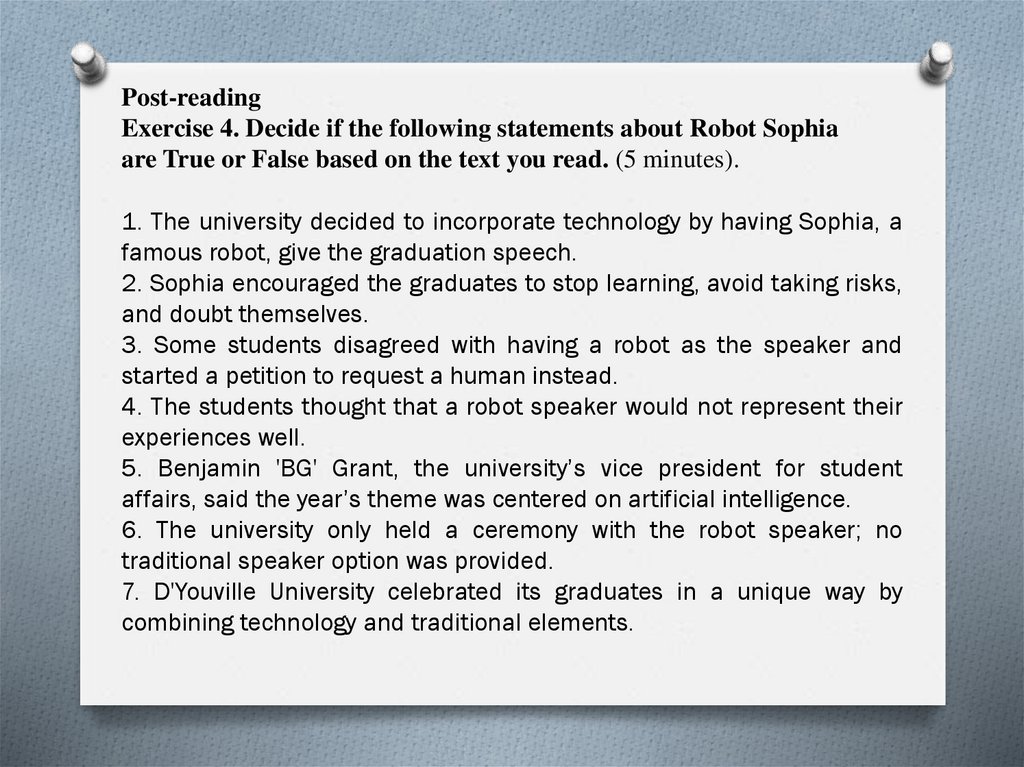
Post-readingExercise 4. Decide if the following statements about Robot Sophia
are True or False based on the text you read. (5 minutes).
1. The university decided to incorporate technology by having Sophia, a
famous robot, give the graduation speech.
2. Sophia encouraged the graduates to stop learning, avoid taking risks,
and doubt themselves.
3. Some students disagreed with having a robot as the speaker and
started a petition to request a human instead.
4. The students thought that a robot speaker would not represent their
experiences well.
5. Benjamin 'BG' Grant, the university’s vice president for student
affairs, said the year’s theme was centered on artificial intelligence.
6. The university only held a ceremony with the robot speaker; no
traditional speaker option was provided.
7. D'Youville University celebrated its graduates in a unique way by
combining technology and traditional elements.
9.
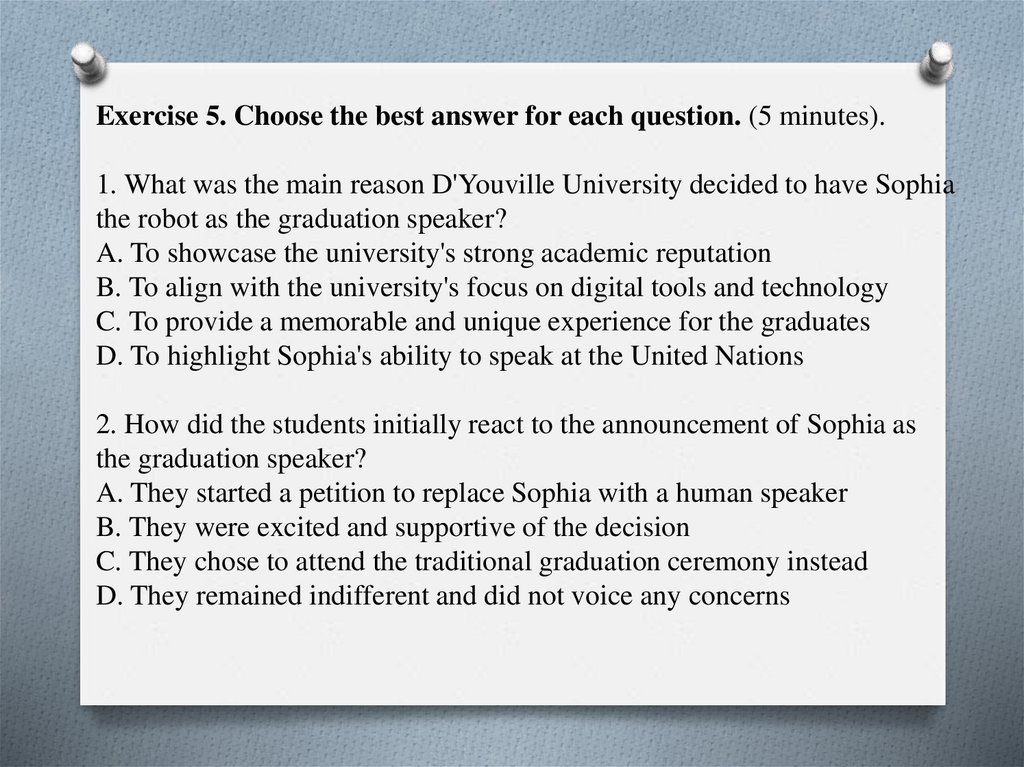
Exercise 5. Choose the best answer for each question. (5 minutes).1. What was the main reason D'Youville University decided to have Sophia
the robot as the graduation speaker?
A. To showcase the university's strong academic reputation
B. To align with the university's focus on digital tools and technology
C. To provide a memorable and unique experience for the graduates
D. To highlight Sophia's ability to speak at the United Nations
2. How did the students initially react to the announcement of Sophia as
the graduation speaker?
A. They started a petition to replace Sophia with a human speaker
B. They were excited and supportive of the decision
C. They chose to attend the traditional graduation ceremony instead
D. They remained indifferent and did not voice any concerns
10.
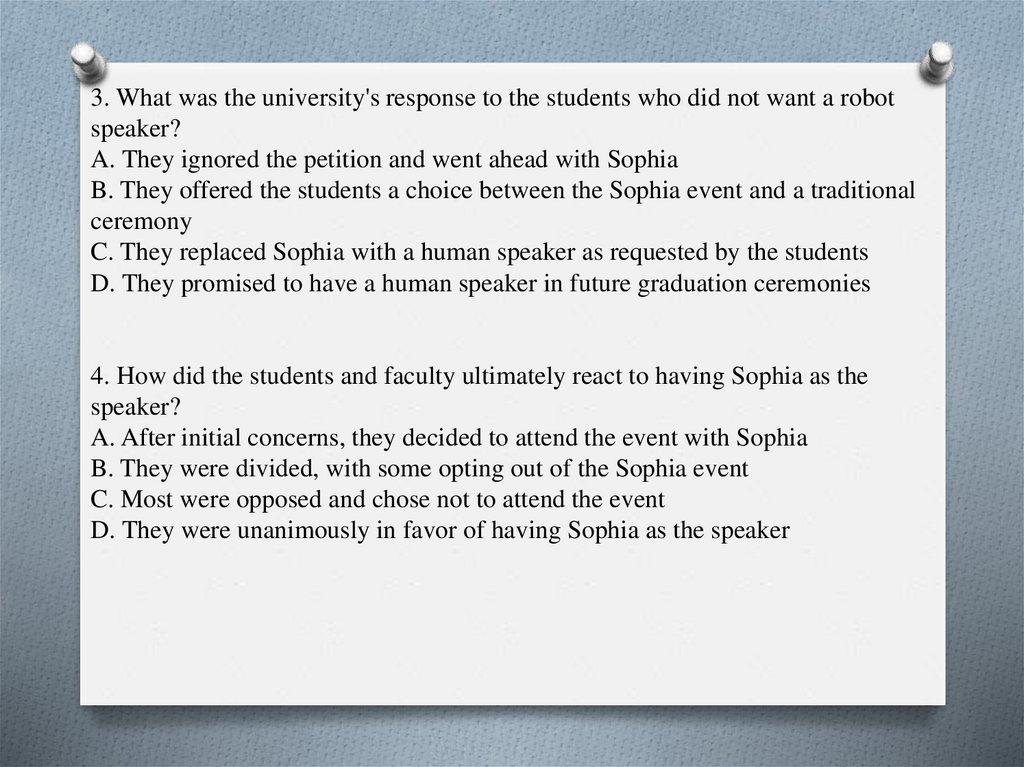
3. What was the university's response to the students who did not want a robotspeaker?
A. They ignored the petition and went ahead with Sophia
B. They offered the students a choice between the Sophia event and a traditional
ceremony
C. They replaced Sophia with a human speaker as requested by the students
D. They promised to have a human speaker in future graduation ceremonies
4. How did the students and faculty ultimately react to having Sophia as the
speaker?
A. After initial concerns, they decided to attend the event with Sophia
B. They were divided, with some opting out of the Sophia event
C. Most were opposed and chose not to attend the event
D. They were unanimously in favor of having Sophia as the speaker
11.
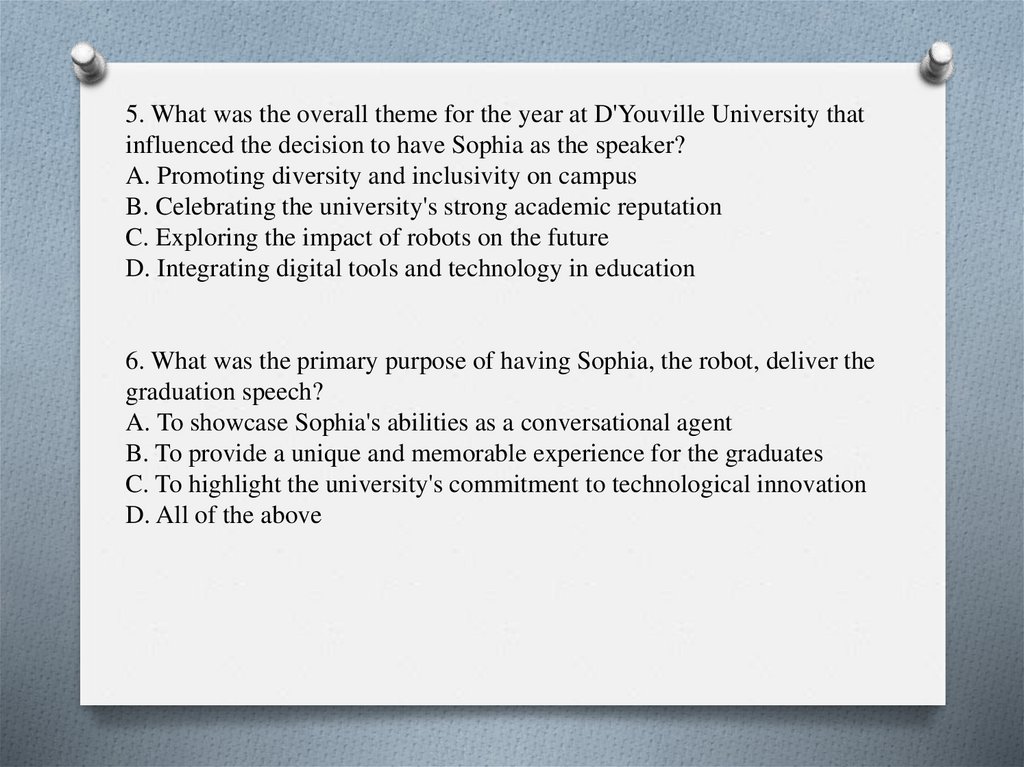
5. What was the overall theme for the year at D'Youville University thatinfluenced the decision to have Sophia as the speaker?
A. Promoting diversity and inclusivity on campus
B. Celebrating the university's strong academic reputation
C. Exploring the impact of robots on the future
D. Integrating digital tools and technology in education
6. What was the primary purpose of having Sophia, the robot, deliver the
graduation speech?
A. To showcase Sophia's abilities as a conversational agent
B. To provide a unique and memorable experience for the graduates
C. To highlight the university's commitment to technological innovation
D. All of the above
12.
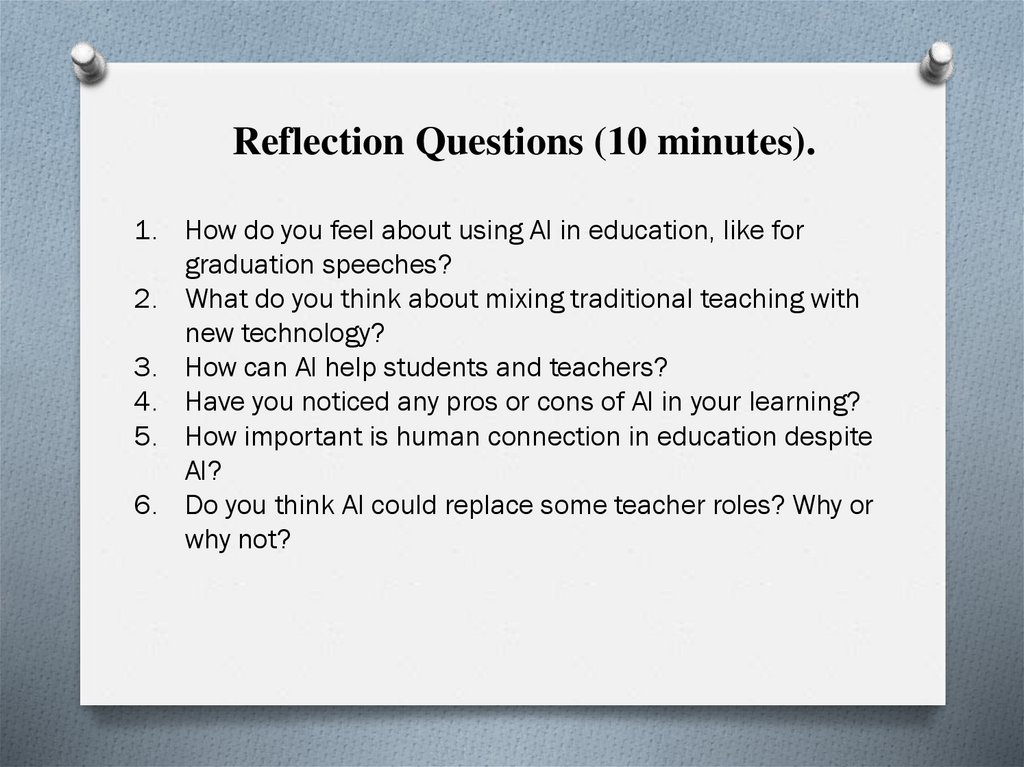
Reflection Questions (10 minutes).1. How do you feel about using AI in education, like for
graduation speeches?
2. What do you think about mixing traditional teaching with
new technology?
3. How can AI help students and teachers?
4. Have you noticed any pros or cons of AI in your learning?
5. How important is human connection in education despite
AI?
6. Do you think AI could replace some teacher roles? Why or
why not?
13.
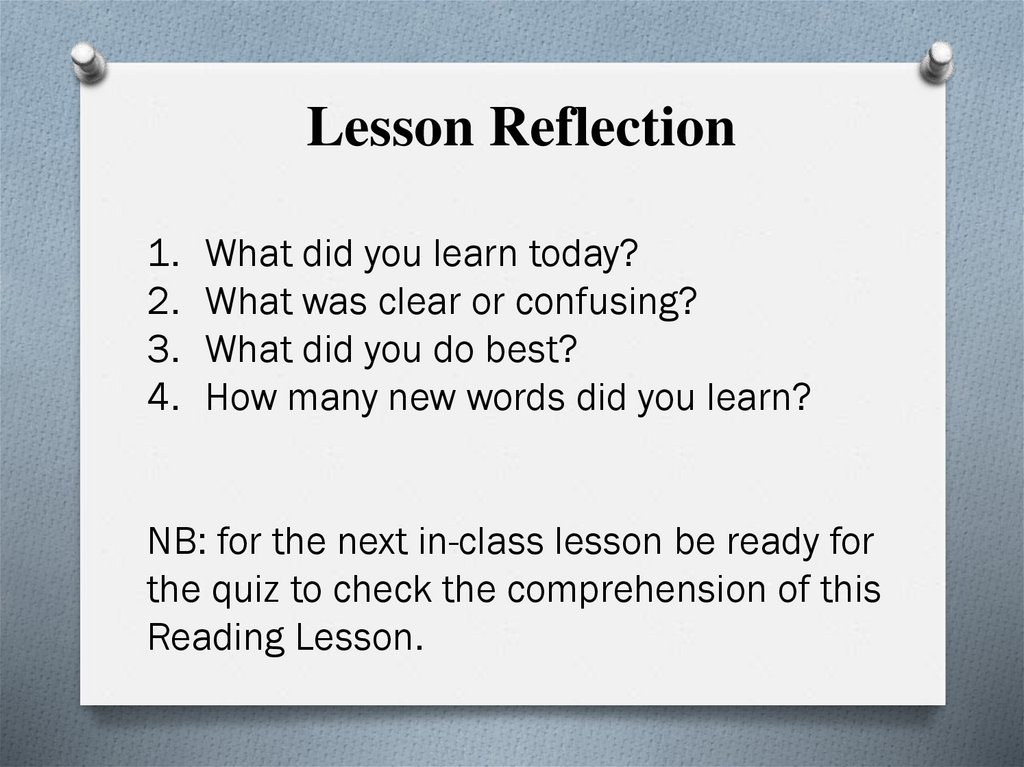
Lesson Reflection1. What did you learn today?
2. What was clear or confusing?
3. What did you do best?
4. How many new words did you learn?
NB: for the next in-class lesson be ready for
the quiz to check the comprehension of this
Reading Lesson.
14. References:
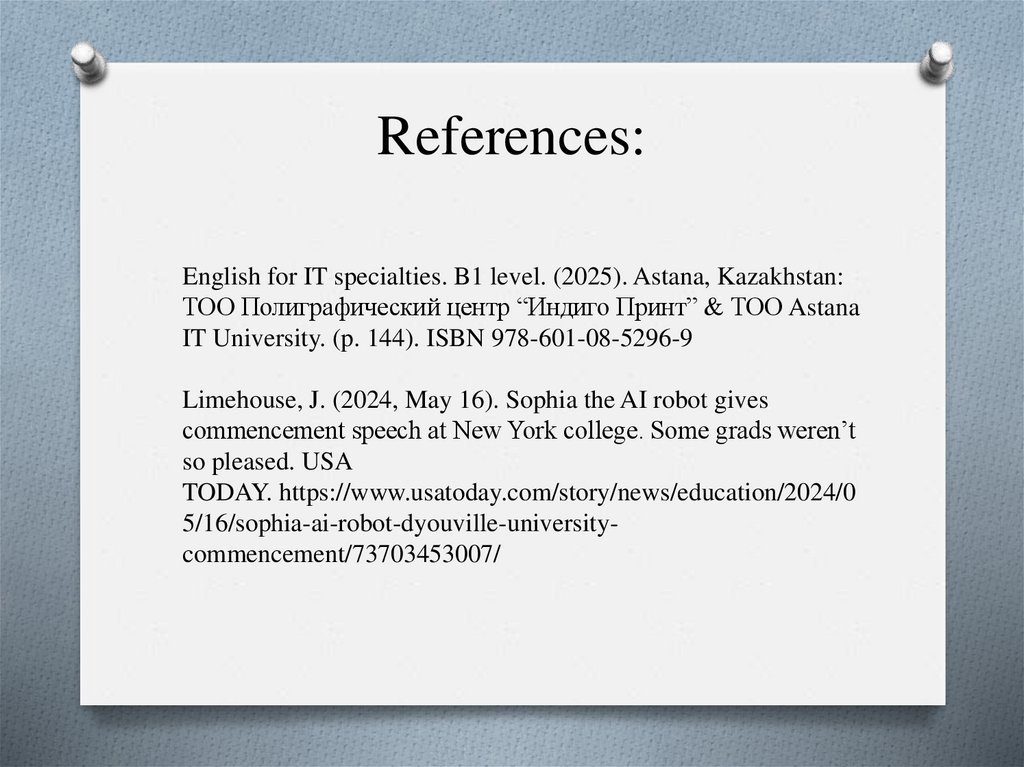
English for IT specialties. B1 level. (2025). Astana, Kazakhstan:ТОО Полиграфический центр “Индиго Принт” & ТОО Astana
IT University. (p. 144). ISBN 978-601-08-5296-9
Limehouse, J. (2024, May 16). Sophia the AI robot gives
commencement speech at New York college. Some grads weren’t
so pleased. USA
TODAY. https://www.usatoday.com/story/news/education/2024/0
5/16/sophia-ai-robot-dyouville-universitycommencement/73703453007/
15. Answer keys
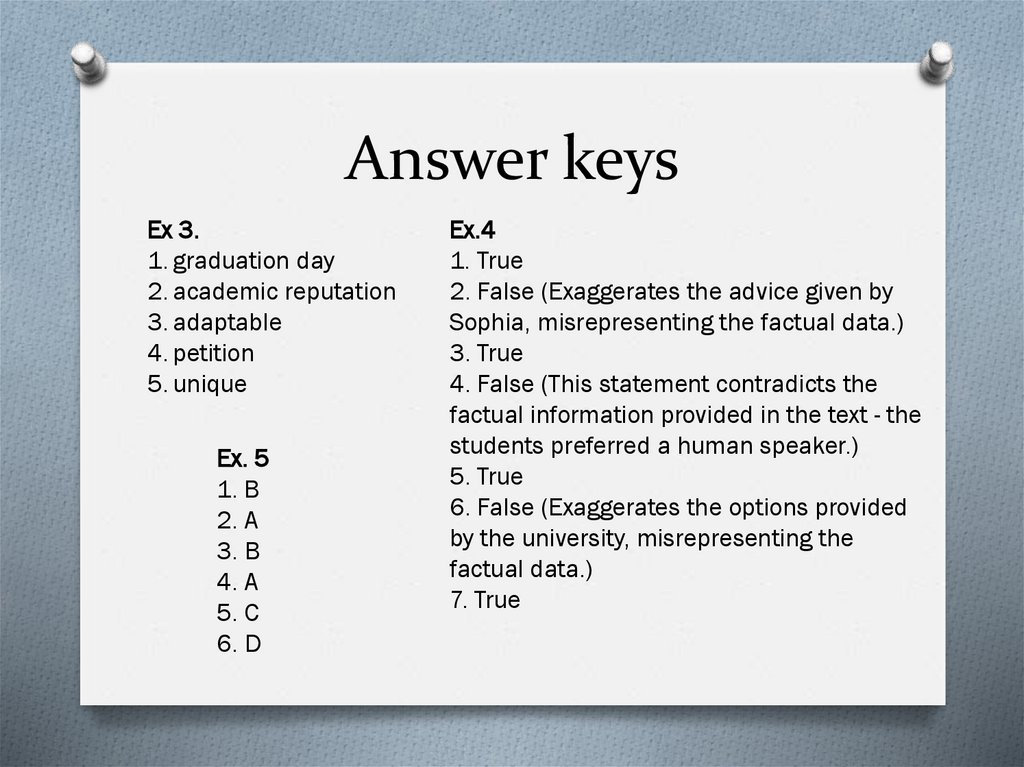
Ex 3.1. graduation day
2. academic reputation
3. adaptable
4. petition
5. unique
Ex. 5
1. B
2. A
3. B
4. A
5. C
6. D
Ex.4
1. True
2. False (Exaggerates the advice given by
Sophia, misrepresenting the factual data.)
3. True
4. False (This statement contradicts the
factual information provided in the text - the
students preferred a human speaker.)
5. True
6. False (Exaggerates the options provided
by the university, misrepresenting the
factual data.)
7. True