 english
Similar presentations:







Lesson 27 S (phrasal verbs)
1.
2.
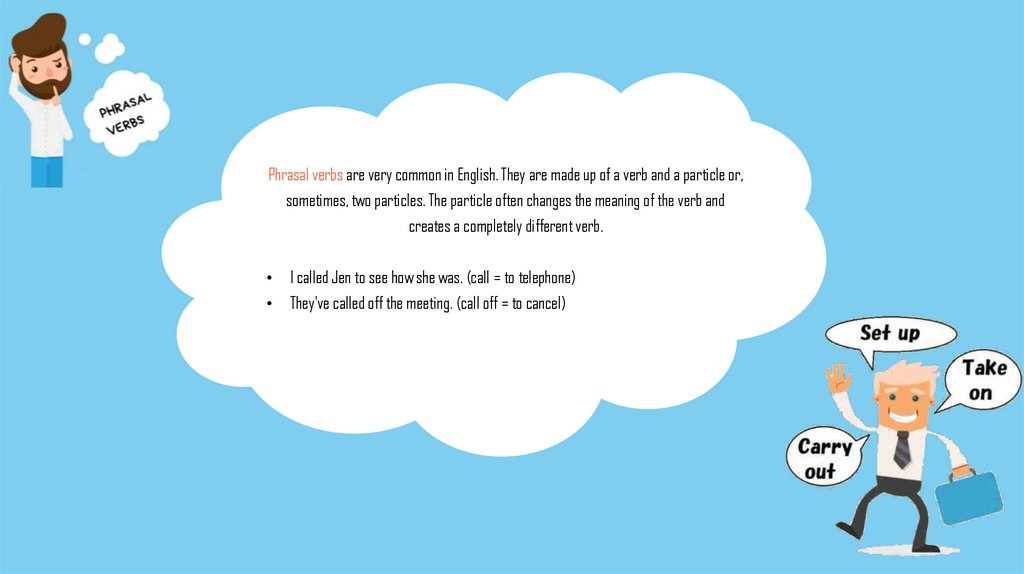
Phrasal verbs are very common in English. They are made up of a verb and a particle or,sometimes, two particles. The particle often changes the meaning of the verb and
creates a completely different verb.
I called Jen to see how she was. (call = to telephone)
They've called off the meeting. (call off = to cancel)
3.
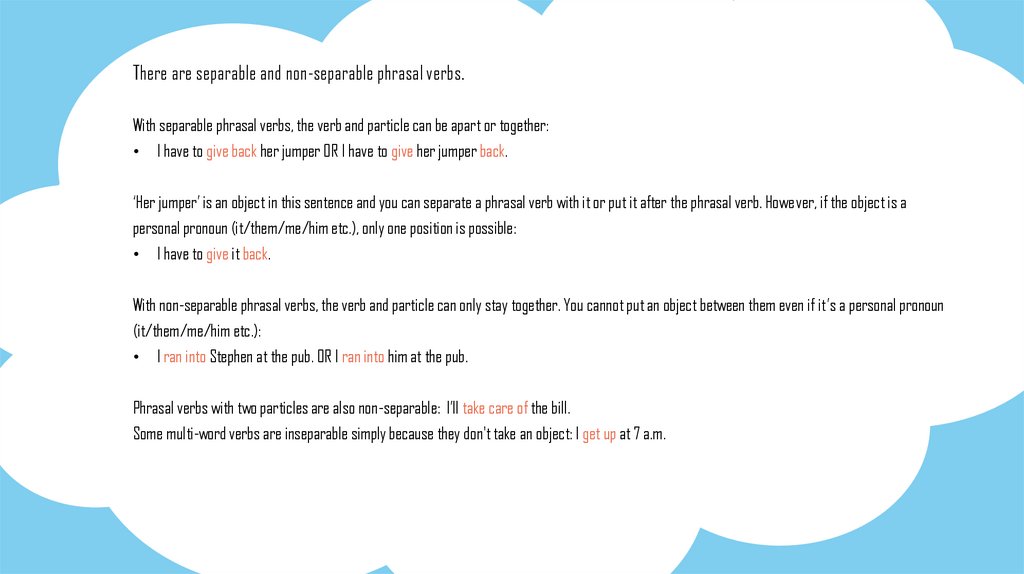
There are separable and non-separable phrasal verbs.With separable phrasal verbs, the verb and particle can be apart or together:
I have to give back her jumper OR I have to give her jumper back.
‘Her jumper’ is an object in this sentence and you can separate a phrasal verb with it or put it after the phrasal verb. However, if the object is a
personal pronoun (it/them/me/him etc.), only one position is possible:
I have to give it back.
With non-separable phrasal verbs, the verb and particle can only stay together. You cannot put an object between them even if it’s a personal pronoun
(it/them/me/him etc.):
I ran into Stephen at the pub. OR I ran into him at the pub.
Phrasal verbs with two particles are also non-separable: I’ll take care of the bill.
Some multi-word verbs are inseparable simply because they don't take an object: I get up at 7 a.m.
4.
CommonPhrasal Verbs
5.
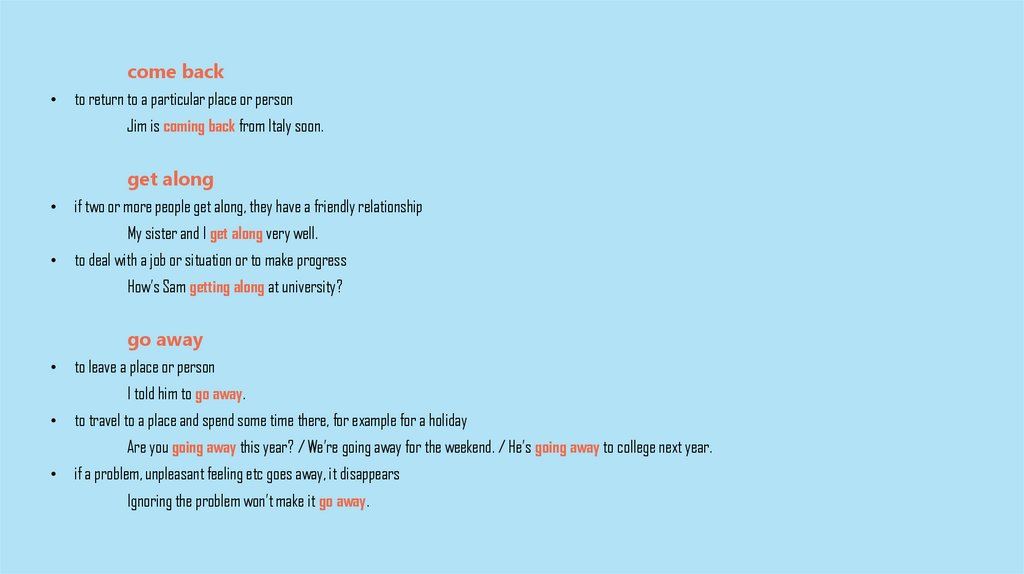
come backto return to a particular place or person
Jim is coming back from Italy soon.
get along
if two or more people get along, they have a friendly relationship
My sister and I get along very well.
to deal with a job or situation or to make progress
How’s Sam getting along at university?
go away
to leave a place or person
I told him to go away.
to travel to a place and spend some time there, for example for a holiday
Are you going away this year? / We’re going away for the weekend. / He’s going away to college next year.
if a problem, unpleasant feeling etc goes away, it disappears
Ignoring the problem won’t make it go away.
6.
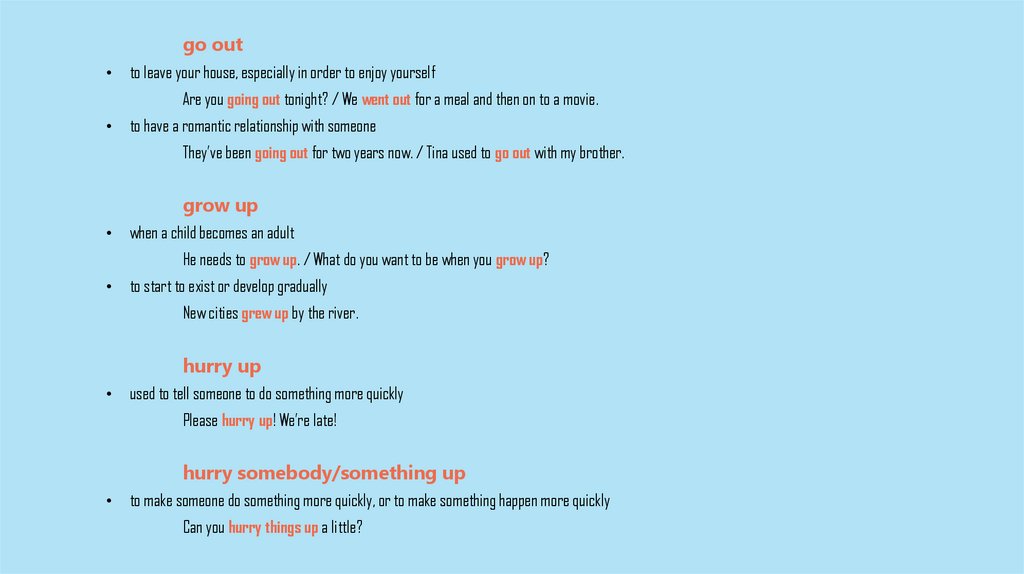
go outto leave your house, especially in order to enjoy yourself
Are you going out tonight? / We went out for a meal and then on to a movie.
to have a romantic relationship with someone
They’ve been going out for two years now. / Tina used to go out with my brother.
grow up
when a child becomes an adult
He needs to grow up. / What do you want to be when you grow up?
to start to exist or develop gradually
New cities grew up by the river.
hurry up
used to tell someone to do something more quickly
Please hurry up! We’re late!
hurry somebody/something up
to make someone do something more quickly, or to make something happen more quickly
Can you hurry things up a little?
7.
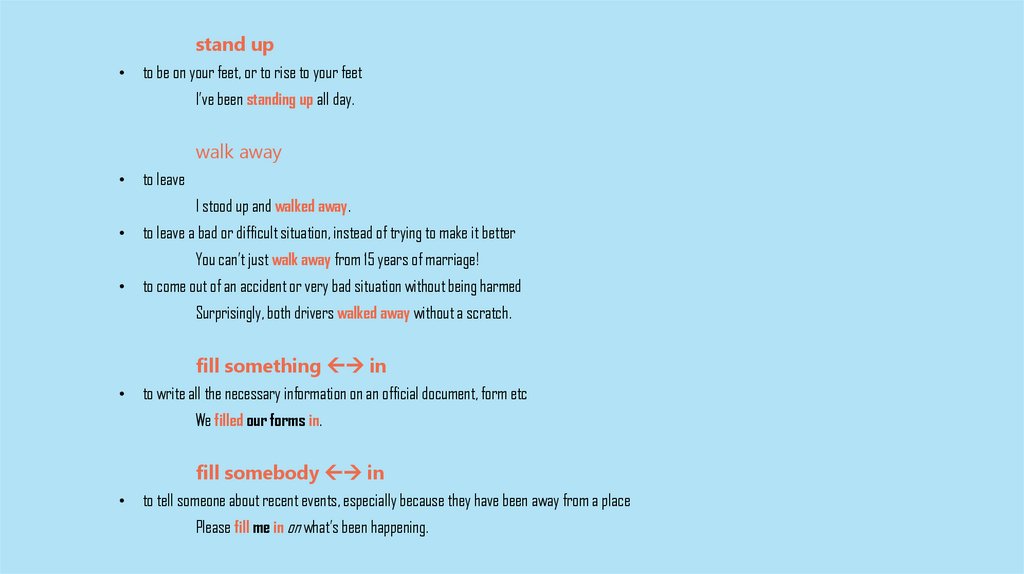
stand upto be on your feet, or to rise to your feet
I’ve been standing up all day.
walk away
to leave
I stood up and walked away.
to leave a bad or difficult situation, instead of trying to make it better
You can’t just walk away from 15 years of marriage!
to come out of an accident or very bad situation without being harmed
Surprisingly, both drivers walked away without a scratch.
fill something in
to write all the necessary information on an official document, form etc
We filled our forms in.
fill somebody in
to tell someone about recent events, especially because they have been away from a place
Please fill me in on what’s been happening.
8.
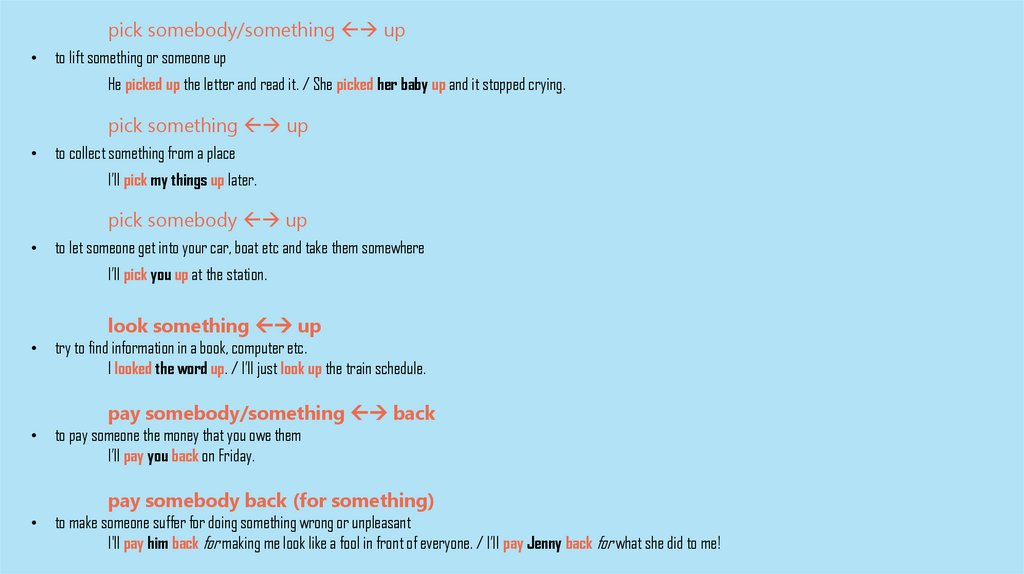
pick somebody/something upto lift something or someone up
He picked up the letter and read it. / She picked her baby up and it stopped crying.
pick something up
to collect something from a place
I’ll pick my things up later.
pick somebody up
to let someone get into your car, boat etc and take them somewhere
I’ll pick you up at the station.
look something up
try to find information in a book, computer etc.
I looked the word up. / I’ll just look up the train schedule.
pay somebody/something back
to pay someone the money that you owe them
I’ll pay you back on Friday.
pay somebody back (for something)
to make someone suffer for doing something wrong or unpleasant
I'll pay him back for making me look like a fool in front of everyone. / I’ll pay Jenny back for what she did to me!
9.
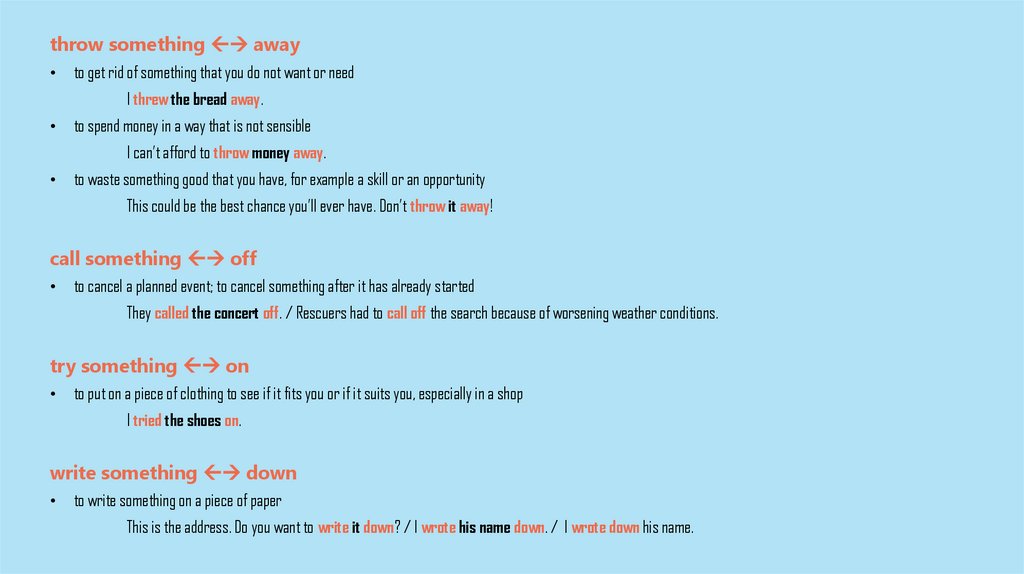
throw something awayto get rid of something that you do not want or need
I threw the bread away.
to spend money in a way that is not sensible
I can’t afford to throw money away.
to waste something good that you have, for example a skill or an opportunity
This could be the best chance you’ll ever have. Don’t throw it away!
call something off
to cancel a planned event; to cancel something after it has already started
They called the concert off. / Rescuers had to call off the search because of worsening weather conditions.
try something on
to put on a piece of clothing to see if it fits you or if it suits you, especially in a shop
I tried the shoes on.
write something down
to write something on a piece of paper
This is the address. Do you want to write it down? / I wrote his name down. / I wrote down his name.
10.
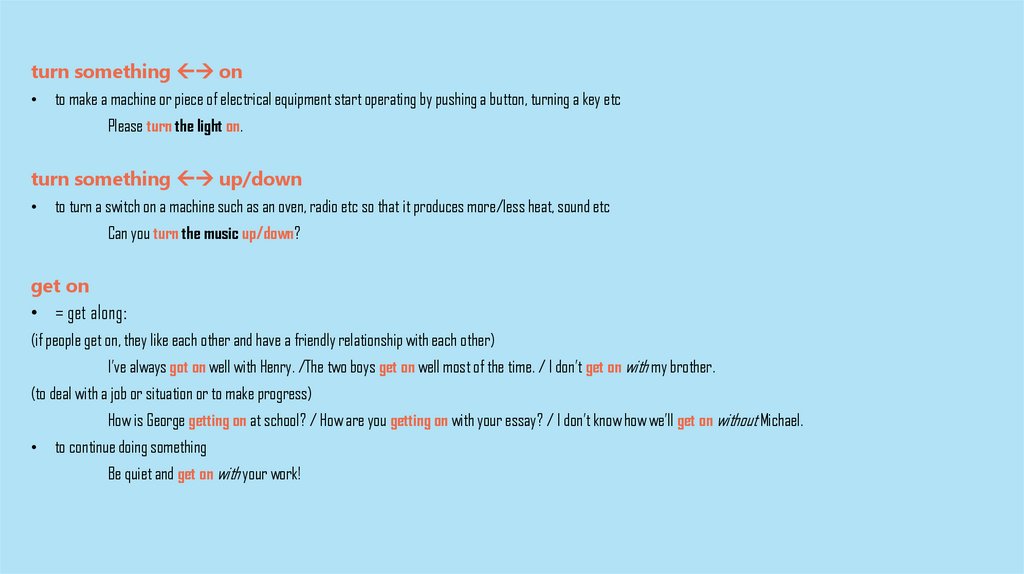
turn something onto make a machine or piece of electrical equipment start operating by pushing a button, turning a key etc
Please turn the light on.
turn something up/down
to turn a switch on a machine such as an oven, radio etc so that it produces more/less heat, sound etc
Can you turn the music up/down?
get on
• = get along:
(if people get on, they like each other and have a friendly relationship with each other)
I’ve always got on well with Henry. /The two boys get on well most of the time. / I don’t get on with my brother.
(to deal with a job or situation or to make progress)
How is George getting on at school? / How are you getting on with your essay? / I don’t know how we’ll get on without Michael.
to continue doing something
Be quiet and get on with your work!
11.
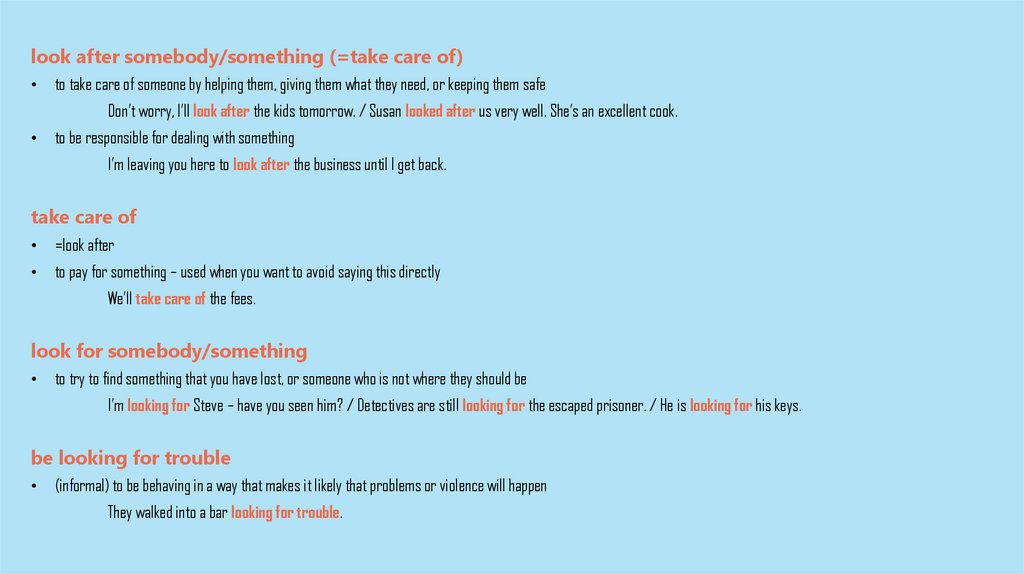
look after somebody/something (=take care of)to take care of someone by helping them, giving them what they need, or keeping them safe
Don’t worry, I’ll look after the kids tomorrow. / Susan looked after us very well. She’s an excellent cook.
to be responsible for dealing with something
I’m leaving you here to look after the business until I get back.
take care of
=look after
to pay for something – used when you want to avoid saying this directly
We’ll take care of the fees.
look for somebody/something
to try to find something that you have lost, or someone who is not where they should be
I’m looking for Steve – have you seen him? / Detectives are still looking for the escaped prisoner. / He is looking for his keys.
be looking for trouble
(informal) to be behaving in a way that makes it likely that problems or violence will happen
They walked into a bar looking for trouble.
12.
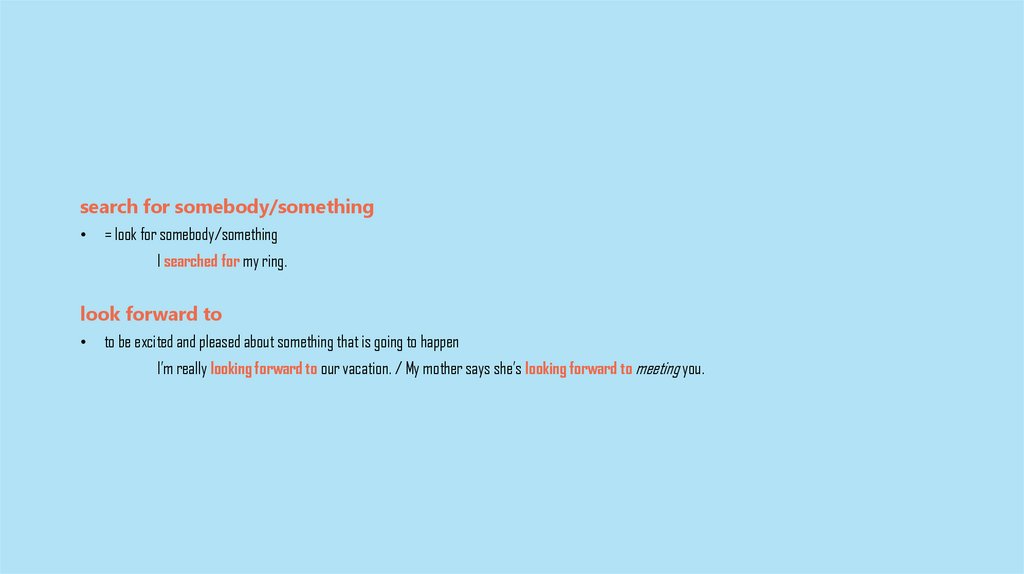
search for somebody/something= look for somebody/something
I searched for my ring.
look forward to
to be excited and pleased about something that is going to happen
I’m really looking forward to our vacation. / My mother says she’s looking forward to meeting you.