 informatics
Similar presentations:

An ICT role in key sectors of development of society. Standards in the field of ICT. Lecture 1
1.
Lecture 1An ICT role in key sectors of
development of society. Standards in the
field of ICT.
2.
Purpose: To prepare students using of modern computerinformation technology.
Plan:
1.Definition of ICT. Subject ICT and its purposes. An ICT role
in key sectors of development of society.
2.Standards in the field of ICT. Communication between ICT
and achievement of the objectives of a sustainable
development in the Millennium Declaration.
3.
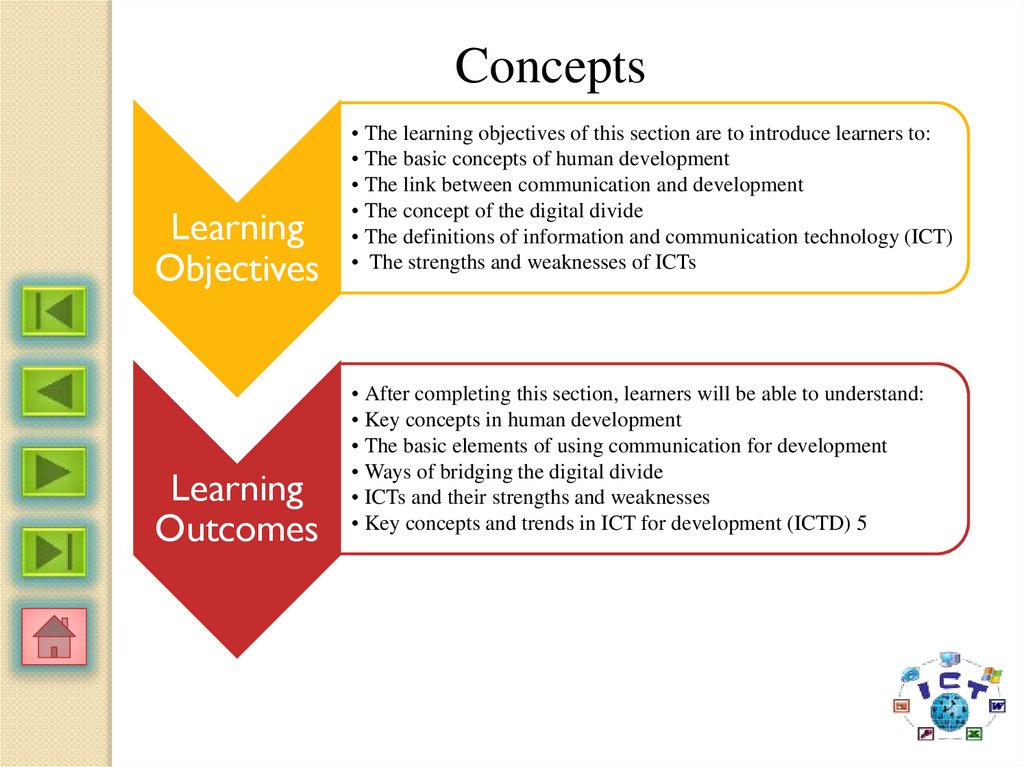
ConceptsLearning
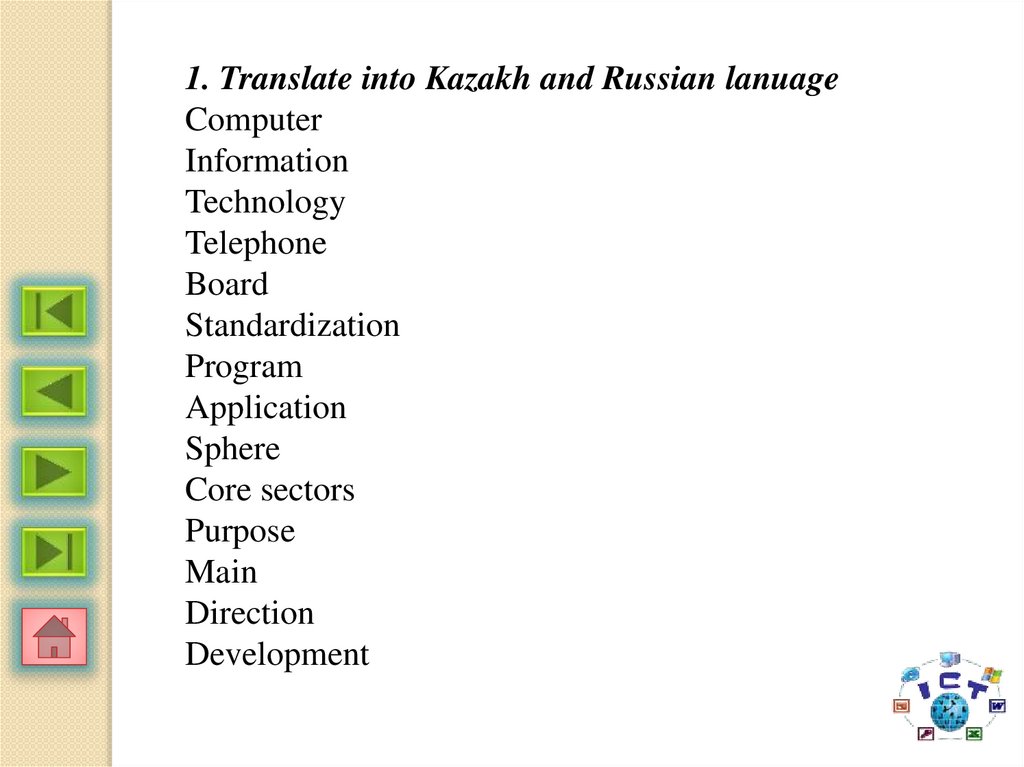
Objectives
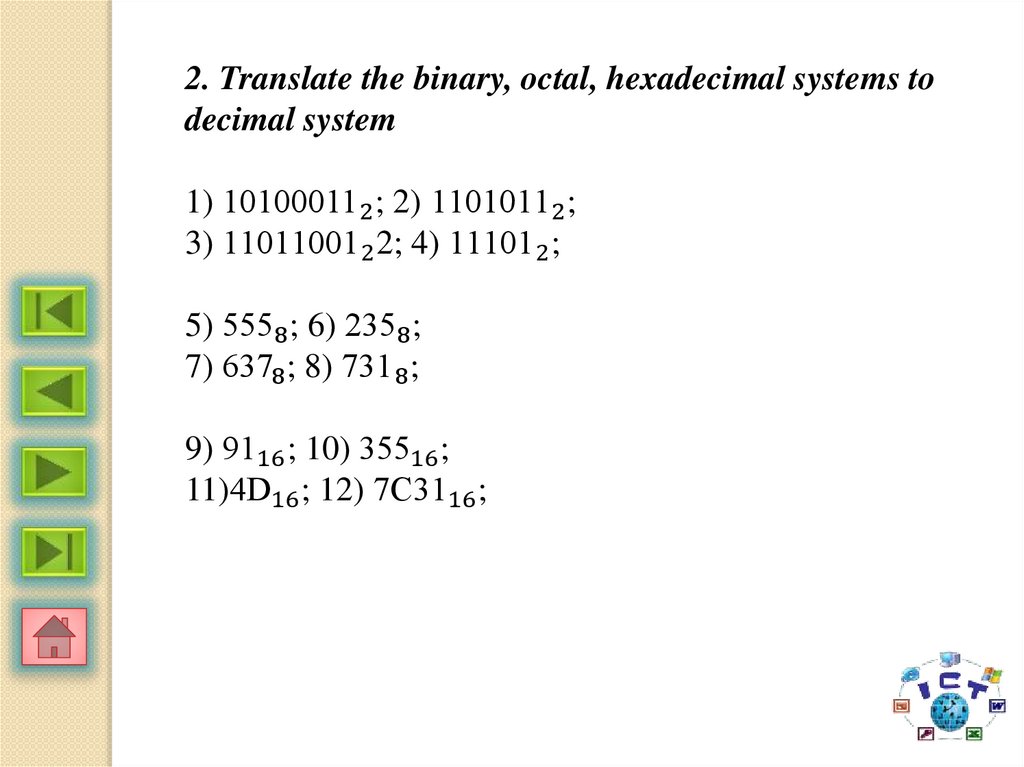
Learning
Outcomes
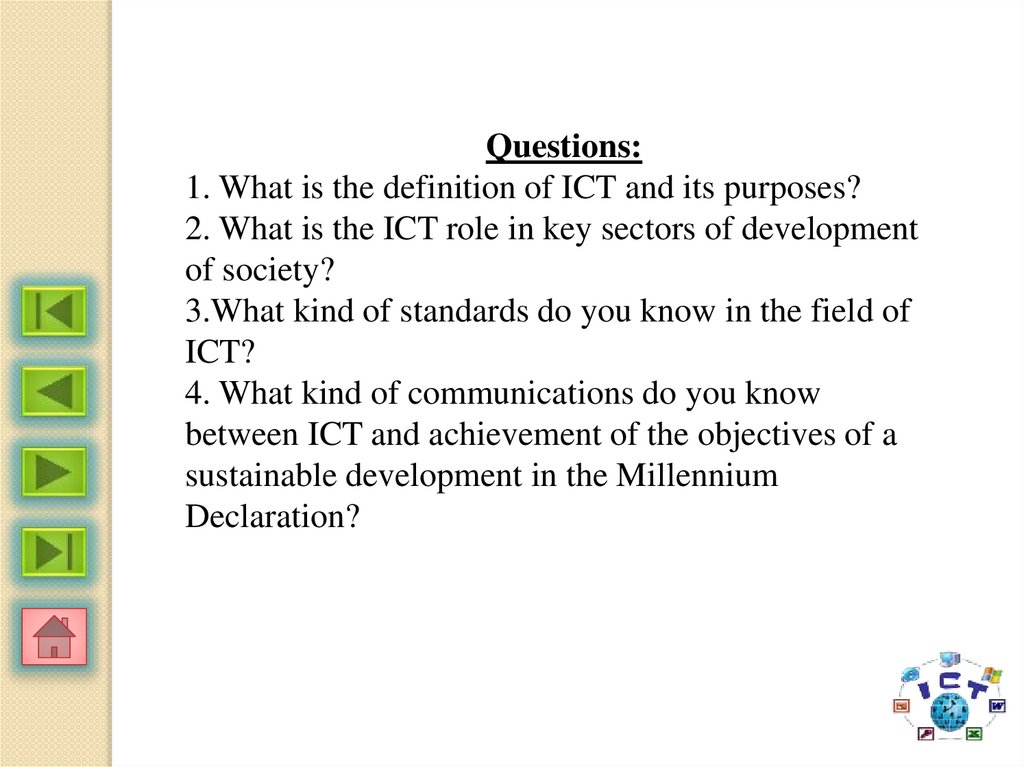
• The learning objectives of this section are to introduce learners to:
• The basic concepts of human development
• The link between communication and development
• The concept of the digital divide
• The definitions of information and communication technology (ICT)
• The strengths and weaknesses of ICTs
• After completing this section, learners will be able to understand:
• Key concepts in human development
• The basic elements of using communication for development
• Ways of bridging the digital divide
• ICTs and their strengths and weaknesses
• Key concepts and trends in ICT for development (ICTD) 5
4.
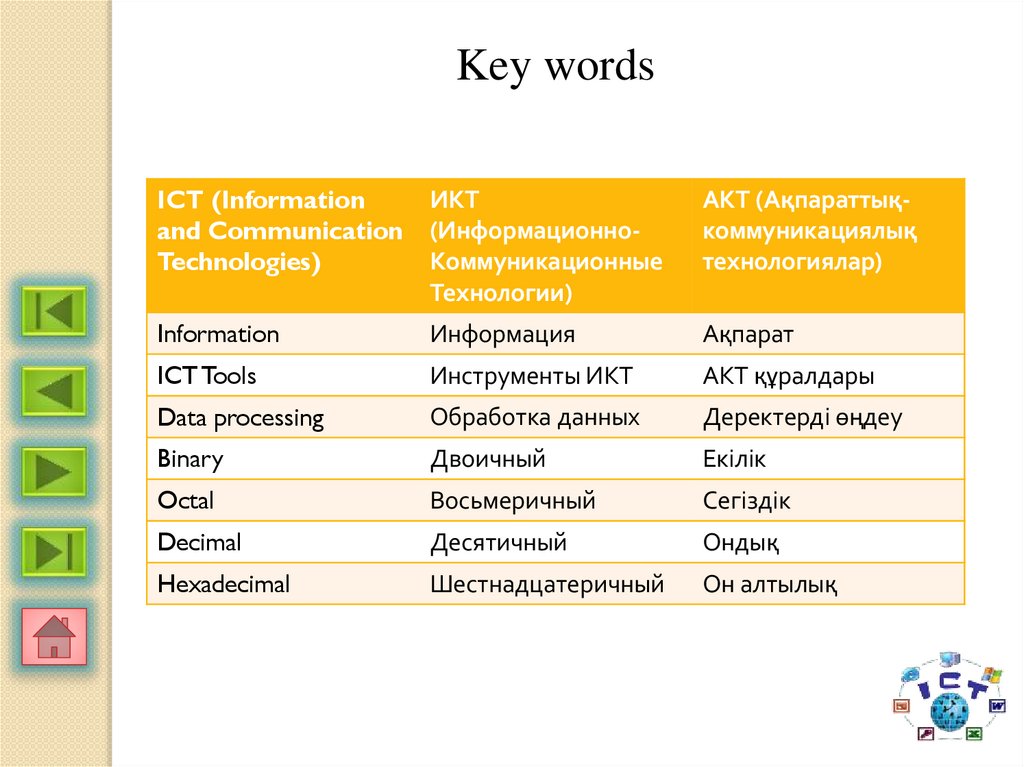
Key wordsICT (Information
and Communication
Technologies)
ИКТ
(ИнформационноКоммуникационные
Технологии)
АКТ (Ақпараттықкоммуникациялық
технологиялар)
Information
Информация
Ақпарат
ICT Tools
Инструменты ИКТ
АКТ құралдары
Data processing
Обработка данных
Деректерді өңдеу
Binary
Двоичный
Екілік
Octal
Восьмеричный
Сегіздік
Decimal
Десятичный
Ондық
Hexadecimal
Шестнадцатеричный
Он алтылық
5.
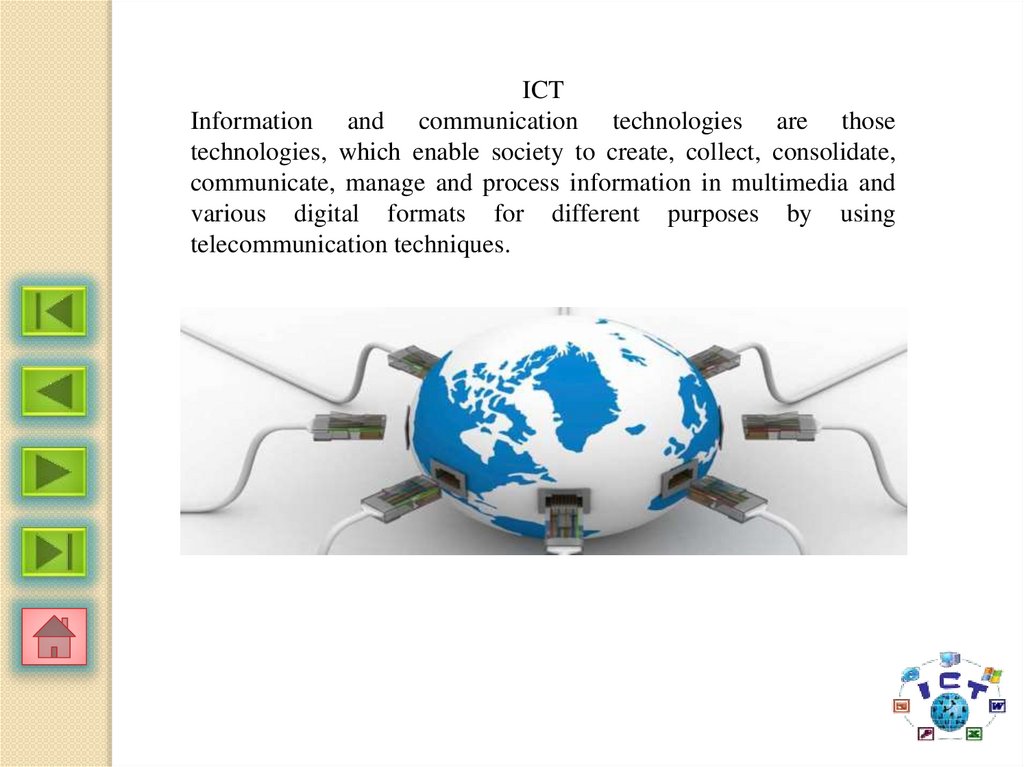
ICTInformation and communication technologies are those
technologies, which enable society to create, collect, consolidate,
communicate, manage and process information in multimedia and
various digital formats for different purposes by using
telecommunication techniques.
6.
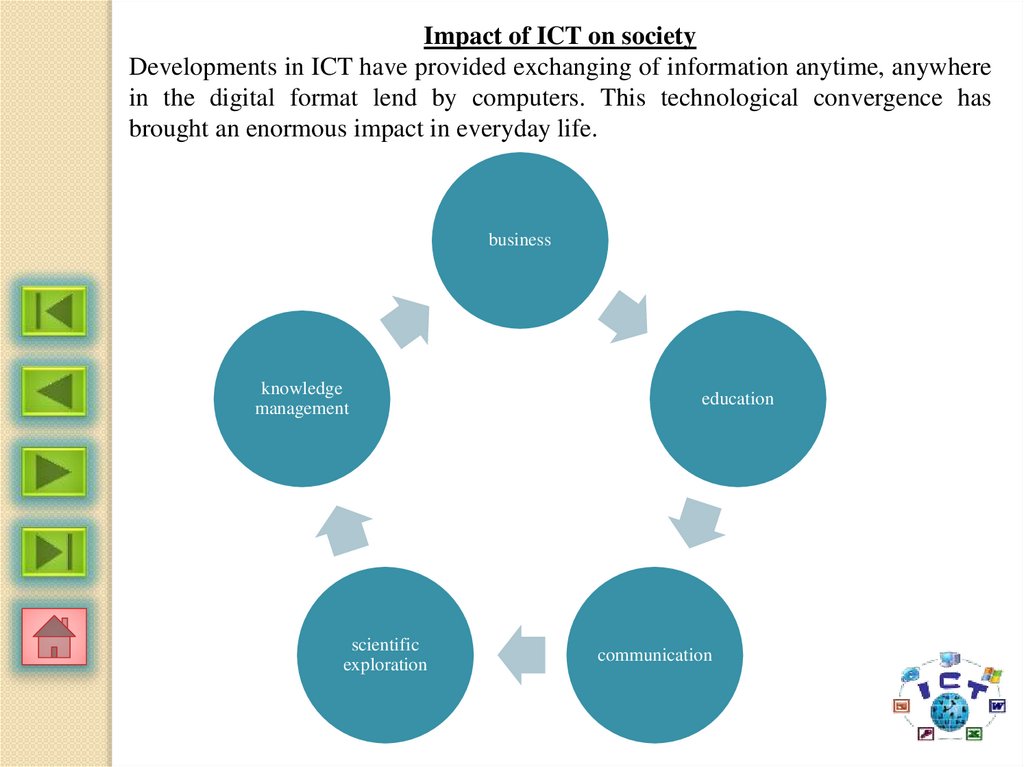
Impact of ICT on societyDevelopments in ICT have provided exchanging of information anytime, anywhere
in the digital format lend by computers. This technological convergence has
brought an enormous impact in everyday life.
business
knowledge
management
scientific
exploration
education
communication
7.
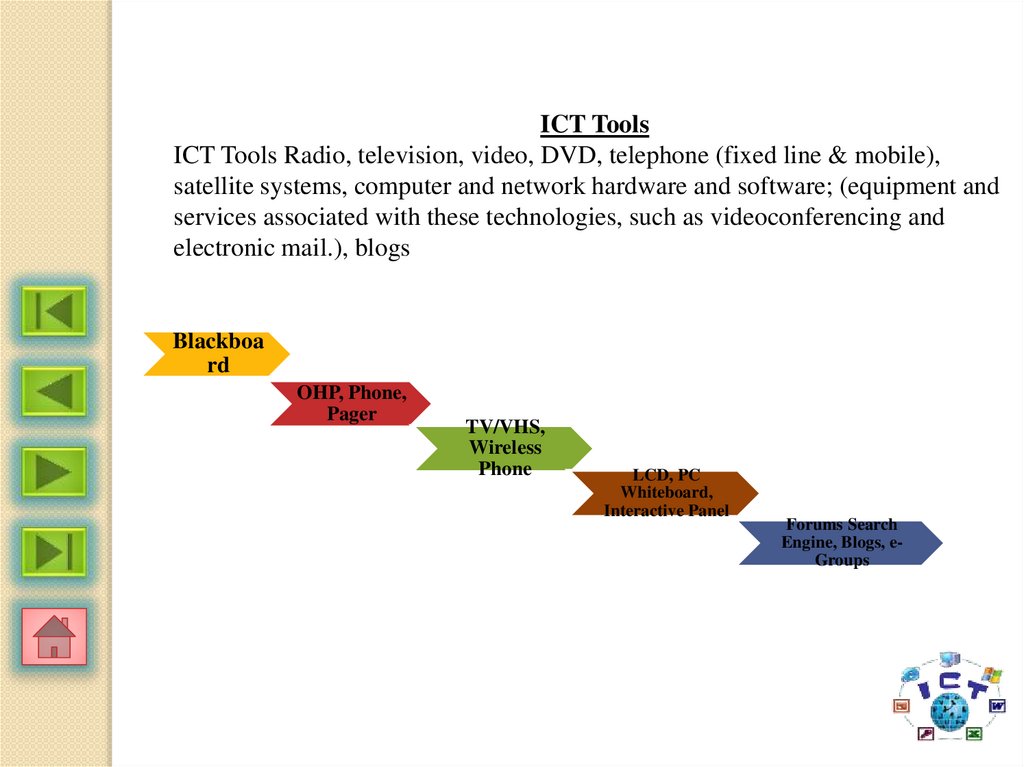
ICT ToolsICT Tools Radio, television, video, DVD, telephone (fixed line & mobile),
satellite systems, computer and network hardware and software; (equipment and
services associated with these technologies, such as videoconferencing and
electronic mail.), blogs
Blackboa
rd
OHP, Phone,
Pager
TV/VHS,
Wireless
Phone
LCD, PC
Whiteboard,
Interactive Panel
Forums Search
Engine, Blogs, eGroups
8.
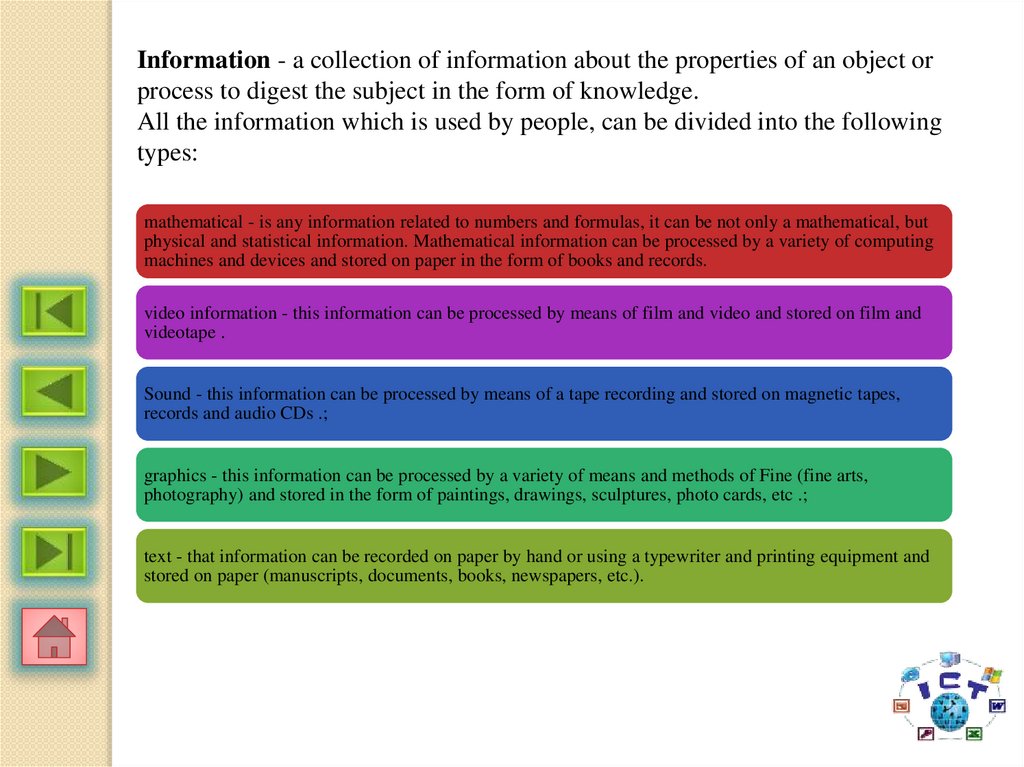
Information - a collection of information about the properties of an object orprocess to digest the subject in the form of knowledge.
All the information which is used by people, can be divided into the following
types:
mathematical - is any information related to numbers and formulas, it can be not only a mathematical, but
physical and statistical information. Mathematical information can be processed by a variety of computing
machines and devices and stored on paper in the form of books and records.
video information - this information can be processed by means of film and video and stored on film and
videotape .
Sound - this information can be processed by means of a tape recording and stored on magnetic tapes,
records and audio CDs .;
graphics - this information can be processed by a variety of means and methods of Fine (fine arts,
photography) and stored in the form of paintings, drawings, sculptures, photo cards, etc .;
text - that information can be recorded on paper by hand or using a typewriter and printing equipment and
stored on paper (manuscripts, documents, books, newspapers, etc.).
9.
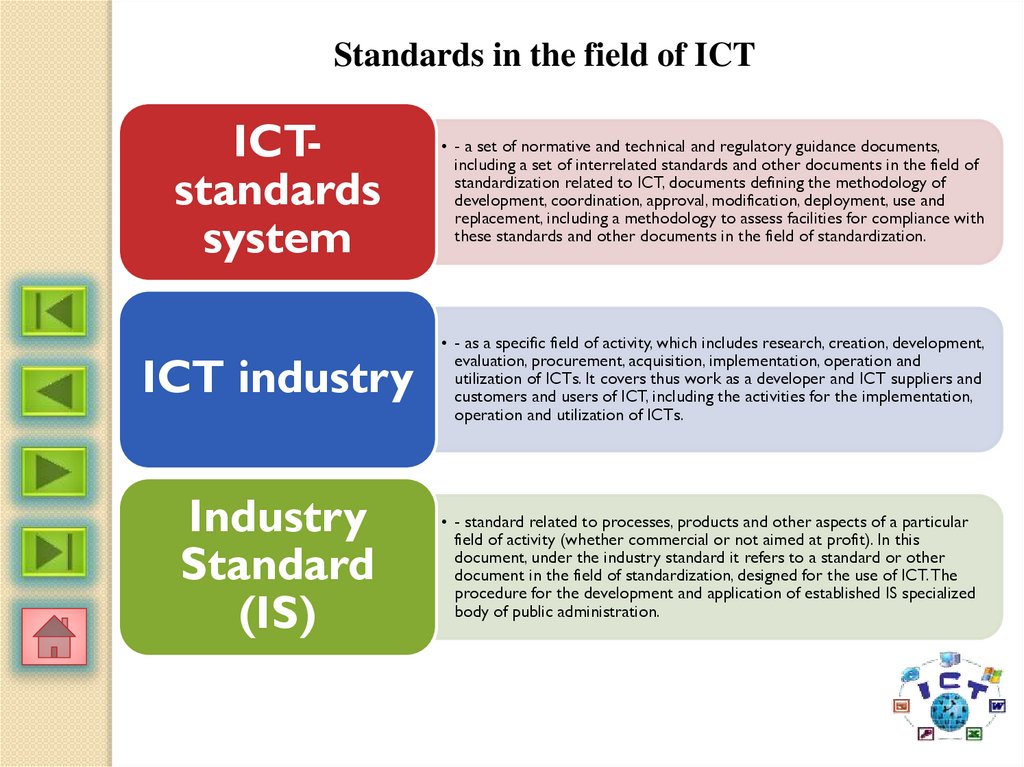
Standards in the field of ICTICTstandards
system
• - a set of normative and technical and regulatory guidance documents,
including a set of interrelated standards and other documents in the field of
standardization related to ICT, documents defining the methodology of
development, coordination, approval, modification, deployment, use and
replacement, including a methodology to assess facilities for compliance with
these standards and other documents in the field of standardization.
ICT industry
• - as a specific field of activity, which includes research, creation, development,
evaluation, procurement, acquisition, implementation, operation and
utilization of ICTs. It covers thus work as a developer and ICT suppliers and
customers and users of ICT, including the activities for the implementation,
operation and utilization of ICTs.
Industry
Standard
(IS)
• - standard related to processes, products and other aspects of a particular
field of activity (whether commercial or not aimed at profit). In this
document, under the industry standard it refers to a standard or other
document in the field of standardization, designed for the use of ICT. The
procedure for the development and application of established IS specialized
body of public administration.
10.
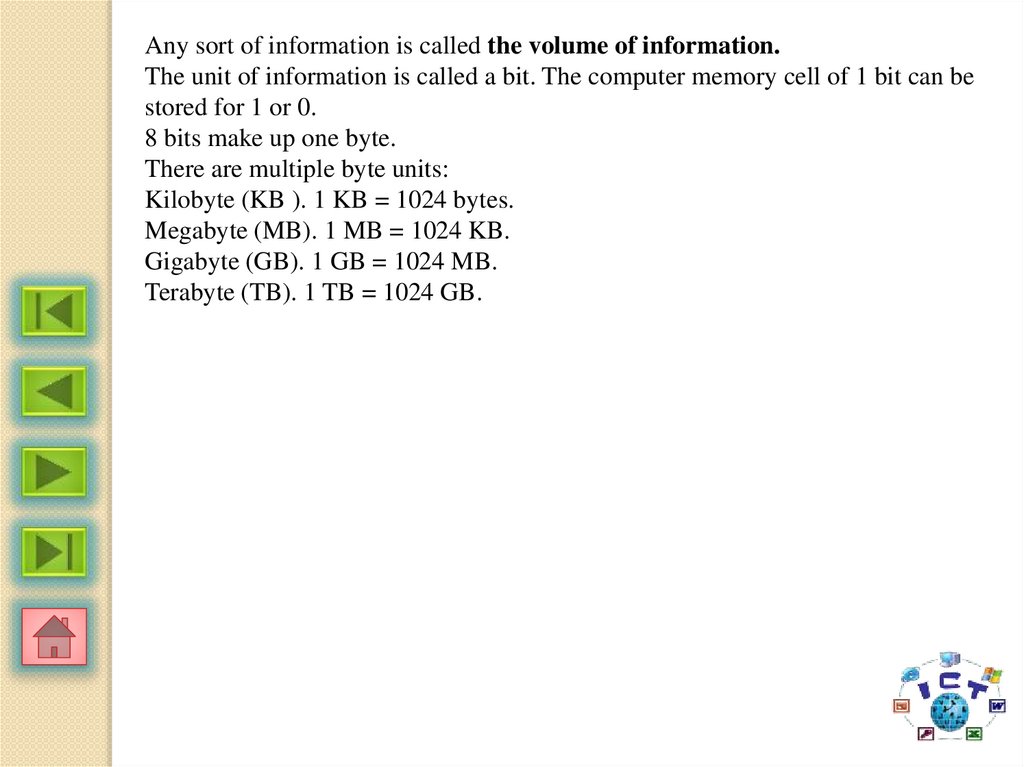
Any sort of information is called the volume of information.The unit of information is called a bit. The computer memory cell of 1 bit can be
stored for 1 or 0.
8 bits make up one byte.
There are multiple byte units:
Kilobyte (KB ). 1 KB = 1024 bytes.
Megabyte (MB). 1 MB = 1024 KB.
Gigabyte (GB). 1 GB = 1024 MB.
Terabyte (TB). 1 TB = 1024 GB.
11.
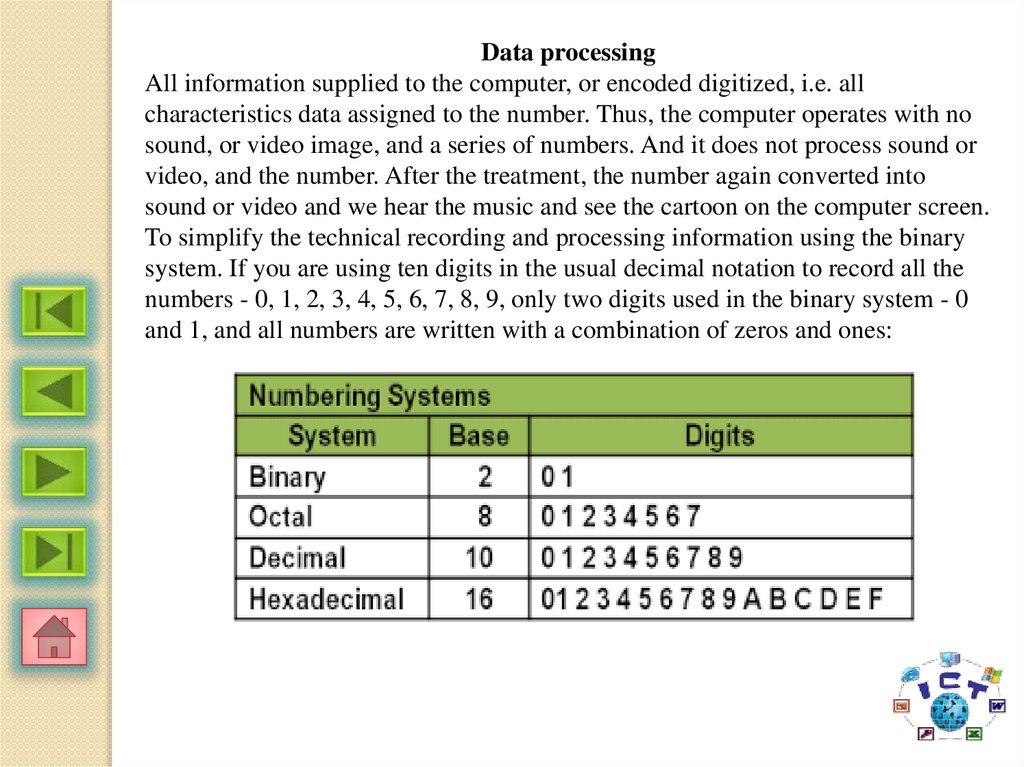
Data processingAll information supplied to the computer, or encoded digitized, i.e. all
characteristics data assigned to the number. Thus, the computer operates with no
sound, or video image, and a series of numbers. And it does not process sound or
video, and the number. After the treatment, the number again converted into
sound or video and we hear the music and see the cartoon on the computer screen.
To simplify the technical recording and processing information using the binary
system. If you are using ten digits in the usual decimal notation to record all the
numbers - 0, 1, 2, 3, 4, 5, 6, 7, 8, 9, only two digits used in the binary system - 0
and 1, and all numbers are written with a combination of zeros and ones:
12.
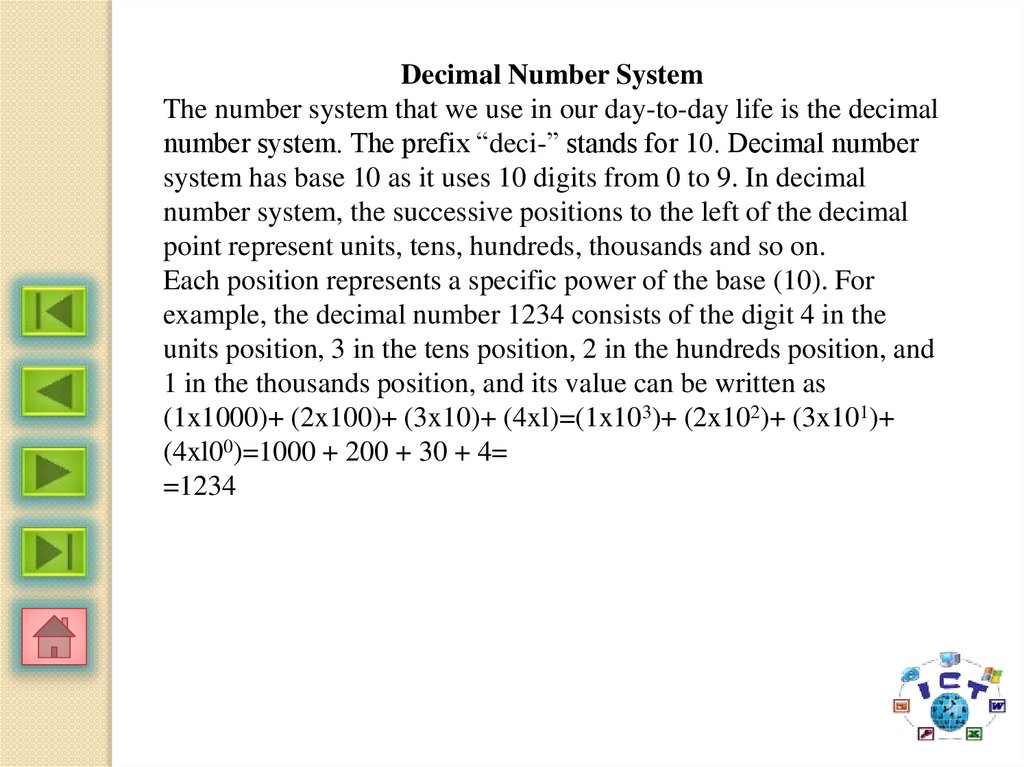
Decimal Number SystemThe number system that we use in our day-to-day life is the decimal
number system. The prefix “deci-” stands for 10. Decimal number
system has base 10 as it uses 10 digits from 0 to 9. In decimal
number system, the successive positions to the left of the decimal
point represent units, tens, hundreds, thousands and so on.
Each position represents a specific power of the base (10). For
example, the decimal number 1234 consists of the digit 4 in the
units position, 3 in the tens position, 2 in the hundreds position, and
1 in the thousands position, and its value can be written as
(1x1000)+ (2x100)+ (3x10)+ (4xl)=(1x10³)+ (2x10²)+ (3x101)+
(4xl00)=1000 + 200 + 30 + 4=
=1234
13.
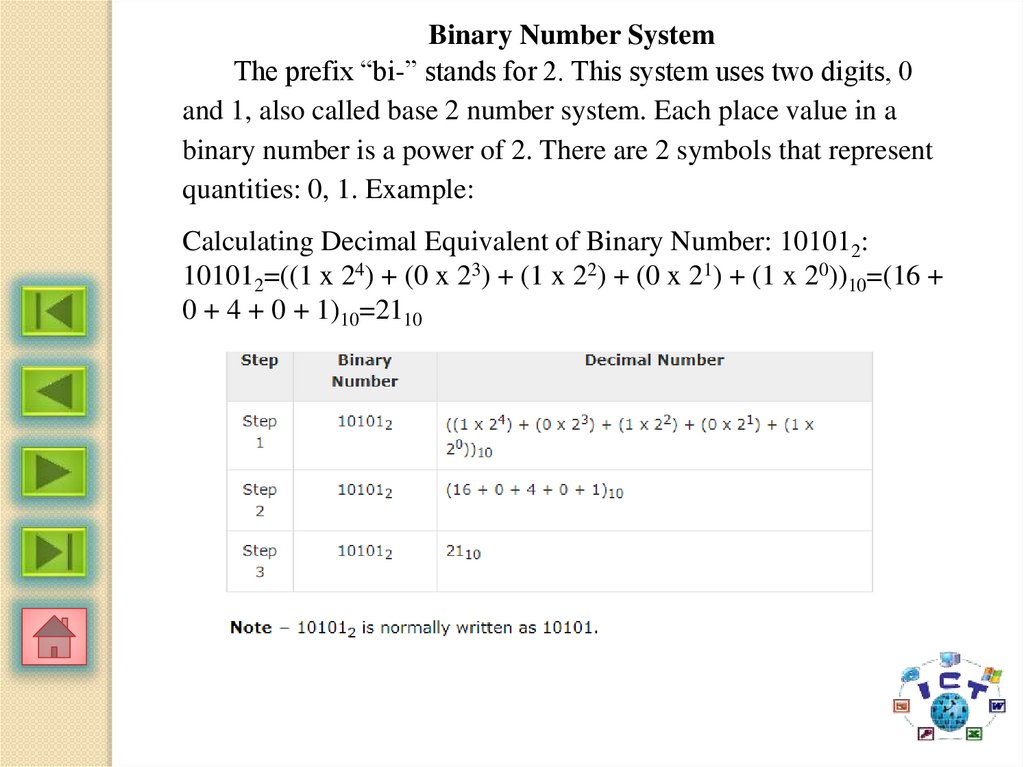
Binary Number SystemThe prefix “bi-” stands for 2. This system uses two digits, 0
and 1, also called base 2 number system. Each place value in a
binary number is a power of 2. There are 2 symbols that represent
quantities: 0, 1. Example:
Calculating Decimal Equivalent of Binary Number: 101012:
101012=((1 x 24) + (0 x 23) + (1 x 22) + (0 x 21) + (1 x 20))10=(16 +
0 + 4 + 0 + 1)10=2110
14.
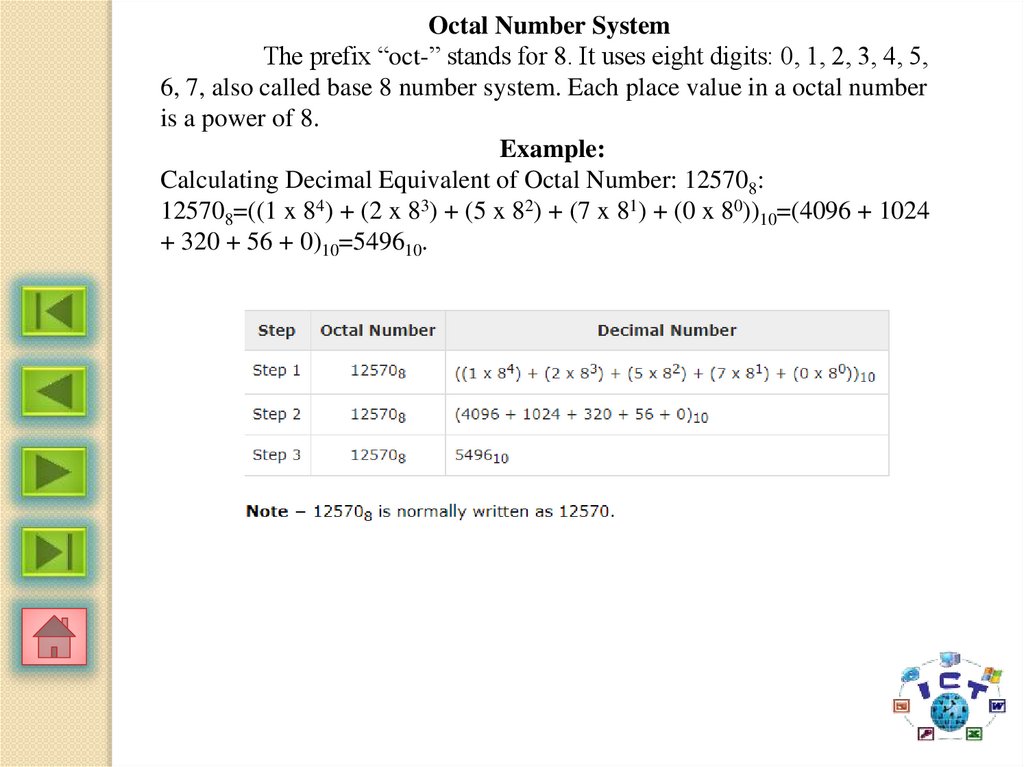
Octal Number SystemThe prefix “oct-” stands for 8. It uses eight digits: 0, 1, 2, 3, 4, 5,
6, 7, also called base 8 number system. Each place value in a octal number
is a power of 8.
Example:
Calculating Decimal Equivalent of Octal Number: 125708:
125708=((1 x 84) + (2 x 83) + (5 x 82) + (7 x 81) + (0 x 80))10=(4096 + 1024
+ 320 + 56 + 0)10=549610.
15.
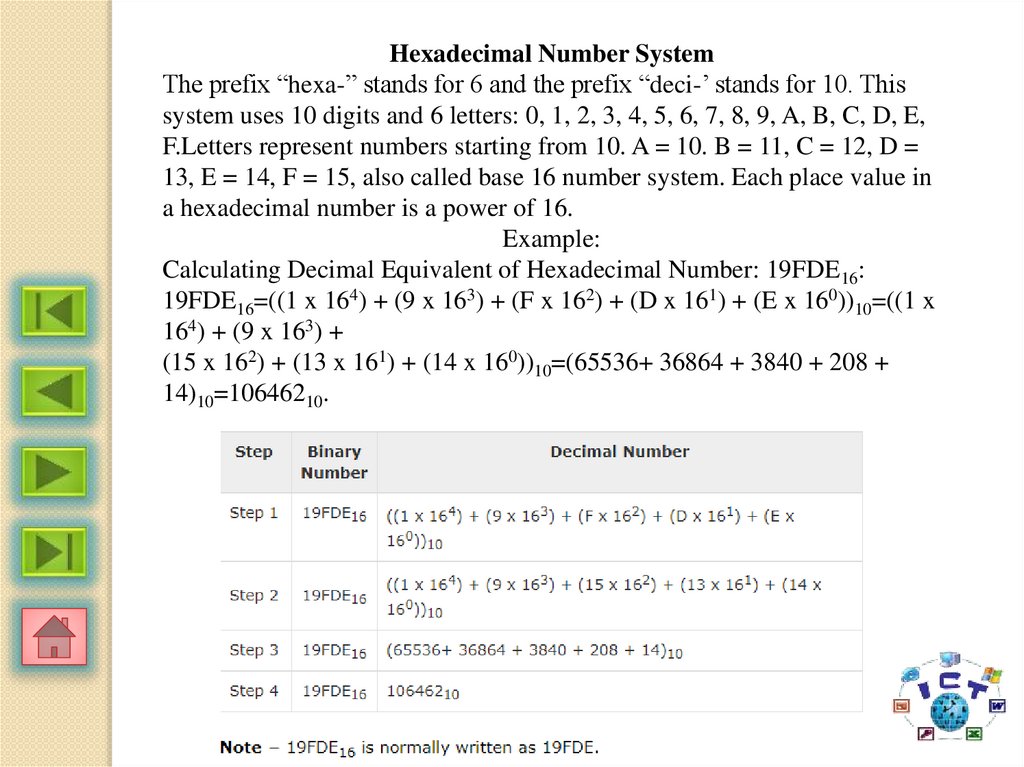
Hexadecimal Number SystemThe prefix “hexa-” stands for 6 and the prefix “deci-’ stands for 10. This
system uses 10 digits and 6 letters: 0, 1, 2, 3, 4, 5, 6, 7, 8, 9, A, B, C, D, E,
F.Letters represent numbers starting from 10. A = 10. B = 11, C = 12, D =
13, E = 14, F = 15, also called base 16 number system. Each place value in
a hexadecimal number is a power of 16.
Example:
Calculating Decimal Equivalent of Hexadecimal Number: 19FDE16:
19FDE16=((1 x 164) + (9 x 163) + (F x 162) + (D x 161) + (E x 160))10=((1 x
164) + (9 x 163) +
(15 x 162) + (13 x 161) + (14 x 160))10=(65536+ 36864 + 3840 + 208 +
14)10=10646210.
16.
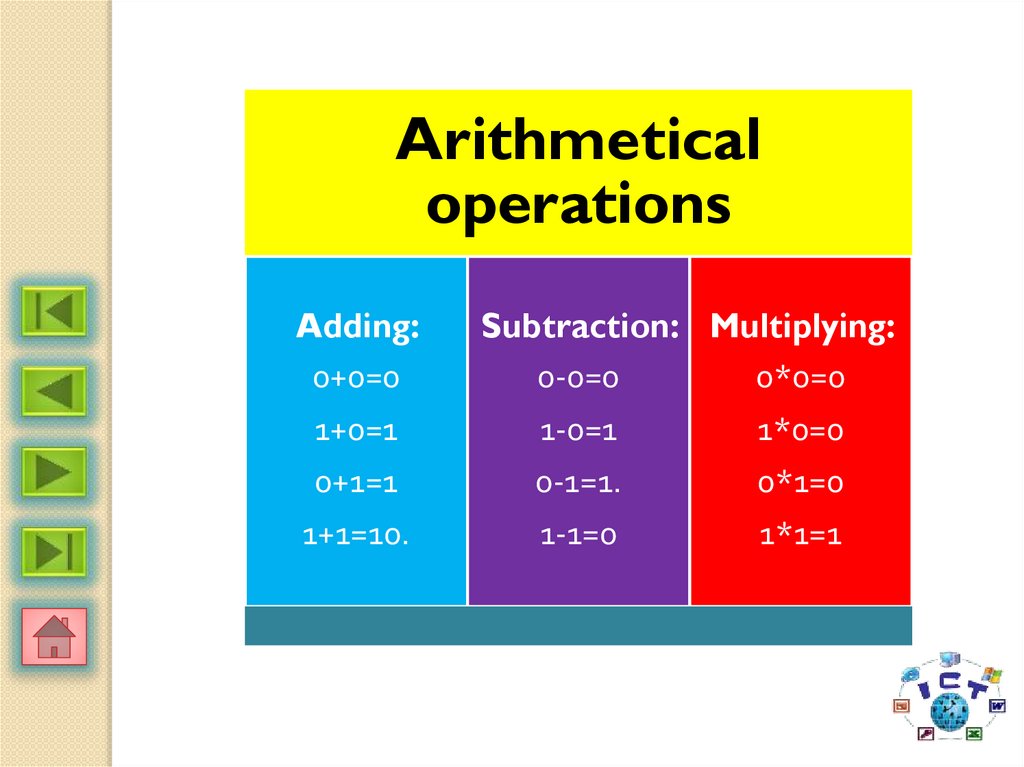
Arithmeticaloperations
Adding:
0+0=0
Subtraction: Multiplying:
0-0=0
0*0=0
1+0=1
1-0=1
1*0=0
0+1=1
0-1=1.
0*1=0
1+1=10.
1-1=0
1*1=1
17.
1. Translate into Kazakh and Russian lanuageComputer
Information
Technology
Telephone
Board
Standardization
Program
Application
Sphere
Core sectors
Purpose
Main
Direction
Development
18.
2. Translate the binary, octal, hexadecimal systems todecimal system
1) 101000112 ; 2) 1101011 2 ;
3) 11011001 2 2; 4) 11101 2 ;
5) 5558 ; 6) 2358 ;
7) 6378 ; 8) 7318 ;
9) 9116 ; 10) 35516 ;
11)4D16 ; 12) 7C3116 ;
19.
20.
Questions:1. What is the definition of ICT and its purposes?
2. What is the ICT role in key sectors of development
of society?
3.What kind of standards do you know in the field of
ICT?
4. What kind of communications do you know
between ICT and achievement of the objectives of a
sustainable development in the Millennium
Declaration?
21.
References1. June J. Parsons and Dan Oja, New Perspectives on Computer Concepts
16th Edition - Comprehensive, Thomson Course Technology, a division of
Thomson Learning, Inc Cambridge, MA, COPYRIGHT © 2014.
2. Lorenzo Cantoni (University of Lugano, Switzerland) James A.
Danowski (University of Illinois at Chicago, IL, USA) Communication
and Technology, 576 pages.
3. Craig Van Slyke Information Communication Technologies: Concepts,
Methodologies, Tools, and Applications (6 Volumes). ISBN13:
9781599049496, 2008, Pages: 4288
4. Utelbaeva A.K.,Utelbaeva A.K. Study guide for lectures on discipline
“Computer science”, Shimkent 2008, 84 pages.
Resources:
1.http://www.intuit.ru/studies/courses/3735/977/lecture/14671