

 english
Similar presentations:




Investigation of crimes in the economic sphere
1. Investigation of crimes in the economic sphere
Prepared by: Podomarev A.SNB2302
2. Plan
1. Introduction2. Main part
a) Types of economic crimes
b) Criminal liability
3. Conclusion
4. List of sources
3. Introduction
In today's world, the prevalence of economic crimes, including scamsand money laundering, poses a significant threat to financial systems
and societal integrity.
The rise of digital technology has facilitated an increase in
sophisticated scams that target vulnerable individuals and businesses,
leading to substantial financial losses.
Money laundering schemes have become increasingly complex, often
involving international networks that exploit legal loopholes to conceal
the origins of illicit funds.
Economic crimes not only undermine public trust in financial
institutions but also divert critical resources from legitimate economic
activities, hindering overall economic growth.
Governments and law enforcement agencies are challenged to keep
pace with the evolving tactics of criminals, making it imperative to
strengthen regulations and enhance collaboration on a global scale.
4. Types of economic crimes
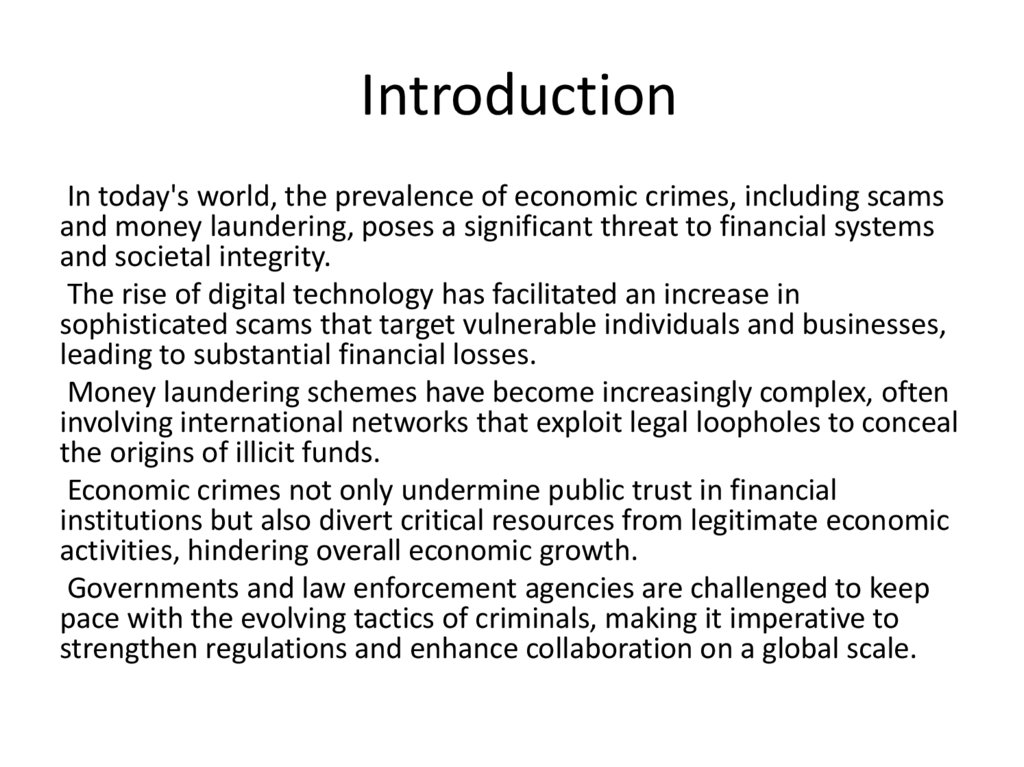
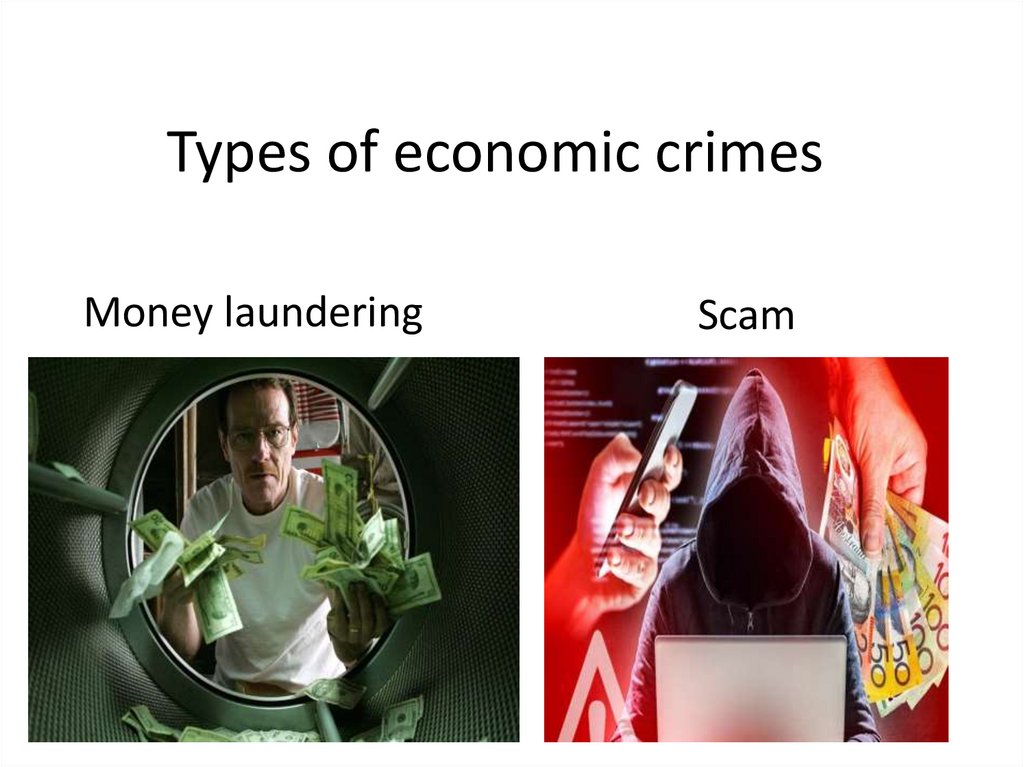
Money launderingScam
5. Scam
• A "scam" is a fraudulent scheme or deceptivepractice designed to con people out of their
money or personal information. Scammers often
use various tactics to manipulate victims,
promising unrealistic returns, prizes, or services
to lure them in. Scams can take many forms,
including Ponzi schemes, phishing emails, lottery
frauds, investment fraud, and online dating
scams. The main goal of a scam is to exploit trust
and take advantage of individuals, often leading
to significant financial loss and emotional
distress for the victims. It is important for
individuals to be aware of common scam tactics
and to exercise caution when sharing personal
information or making financial decisions.
6. Money laundering
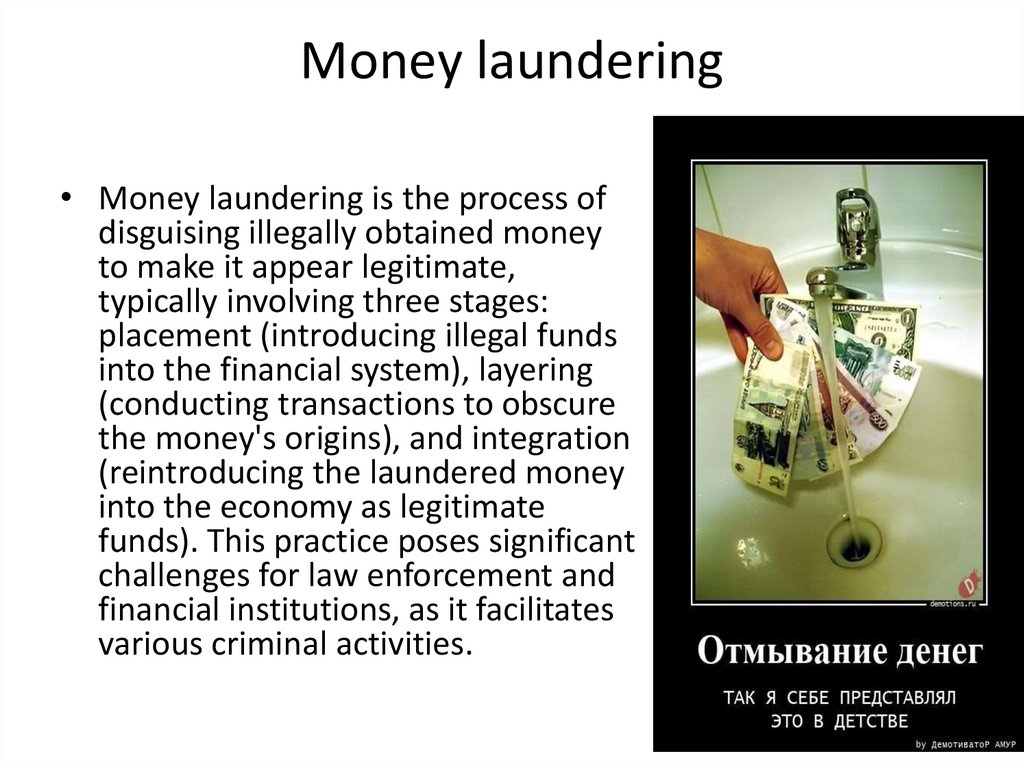
• Money laundering is the process ofdisguising illegally obtained money
to make it appear legitimate,
typically involving three stages:
placement (introducing illegal funds
into the financial system), layering
(conducting transactions to obscure
the money's origins), and integration
(reintroducing the laundered money
into the economy as legitimate
funds). This practice poses significant
challenges for law enforcement and
financial institutions, as it facilitates
various criminal activities.
7. Criminal liability
• Article 174 Criminal code of the RussianFederation
• Article 159 Criminal code of the Russian
Federation
8. Conclusion
• In general, the sphere of economic crimes is avery broad layer of modern crime, which
requires careful study, both by legislative
bodies and the civilian population as a whole,
since these crimes are mainly aimed at the
civilian population.