


 business
Similar presentations:









Small Innovative Business and Its Impact on National Economic Development
1.
Small Innovative Businessand Its Impact on National
Economic Development
Author: Shen Wen
Supervisor: Yu.V. Krupenko
2.
What Are Small Innovative Enterprises?Independent economic entities that develop
and implement intellectual activity results.
Aimed at obtaining additional profit and
effectively implementing scientific and practical
work.
Flexible decision-making, strong innovation
ability, and fast market response.
3.
Key Characteristics of Small Innovative EnterprisesCapture profitable niches in the market with
unique products.
Minimize production costs by sourcing
components from large specialized companies.
Focus on one product type and maximize
consumer functions for different markets.
Attract minimal external capital to preserve
independence and intellectual property rights.
4.
Features of Small Innovative EnterprisesDevelopment and promotion of new products
and advanced technologies.
High proportion of R&D work to create
competitive products and services.
Large-scale impact of innovations on
profitability.
Significant investments in the scientific and
research sector.
High proportion of technical workers and
equipment in fixed assets.
High risk associated with innovative projects.
5.
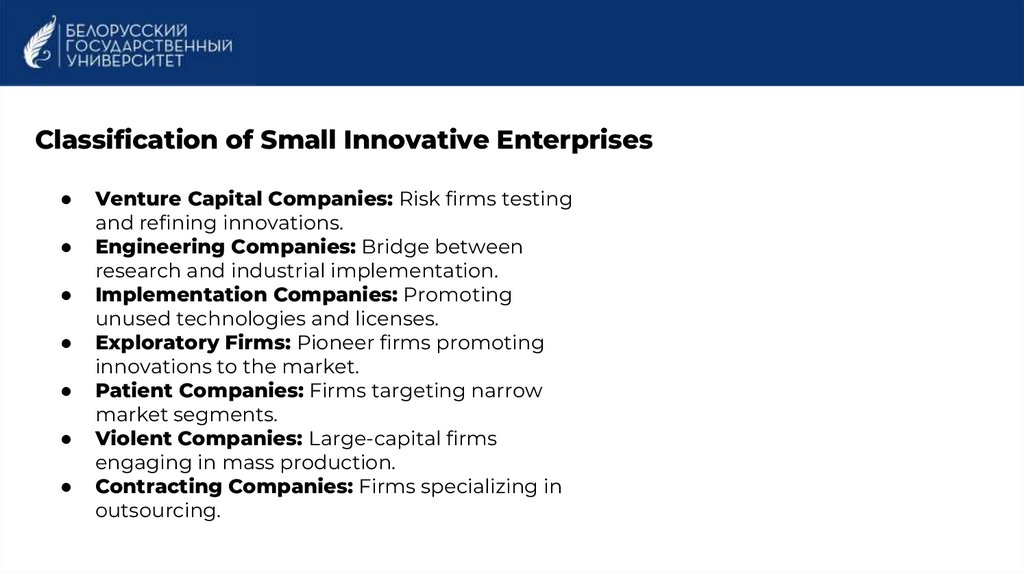
Classification of Small Innovative EnterprisesVenture Capital Companies: Risk firms testing
and refining innovations.
Engineering Companies: Bridge between
research and industrial implementation.
Implementation Companies: Promoting
unused technologies and licenses.
Exploratory Firms: Pioneer firms promoting
innovations to the market.
Patient Companies: Firms targeting narrow
market segments.
Violent Companies: Large-capital firms
engaging in mass production.
Contracting Companies: Firms specializing in
outsourcing.
6.
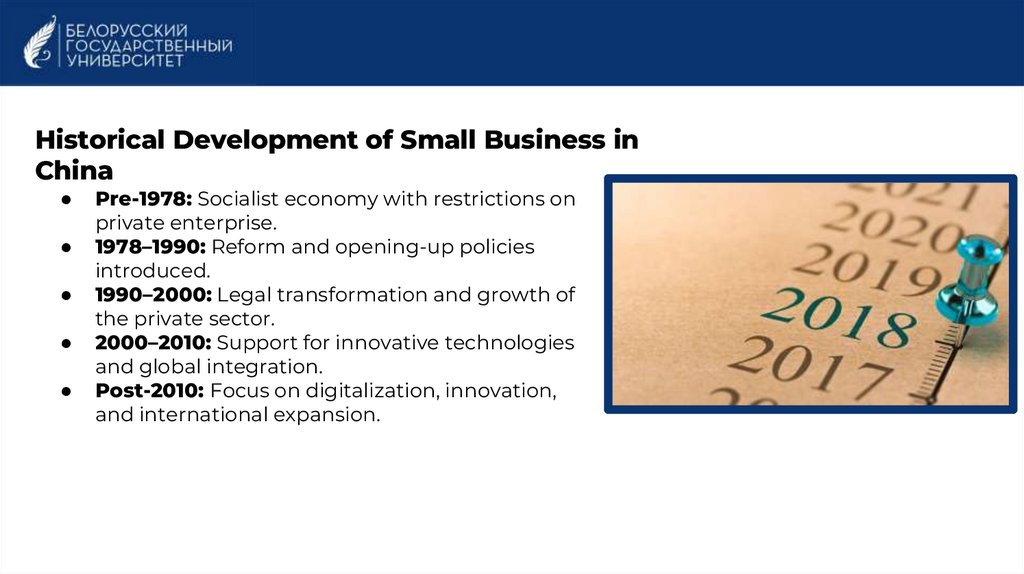
Historical Development of Small Business inChina
Pre-1978: Socialist economy with restrictions on
private enterprise.
1978–1990: Reform and opening-up policies
introduced.
1990–2000: Legal transformation and growth of
the private sector.
2000–2010: Support for innovative technologies
and global integration.
Post-2010: Focus on digitalization, innovation,
and international expansion.
7.
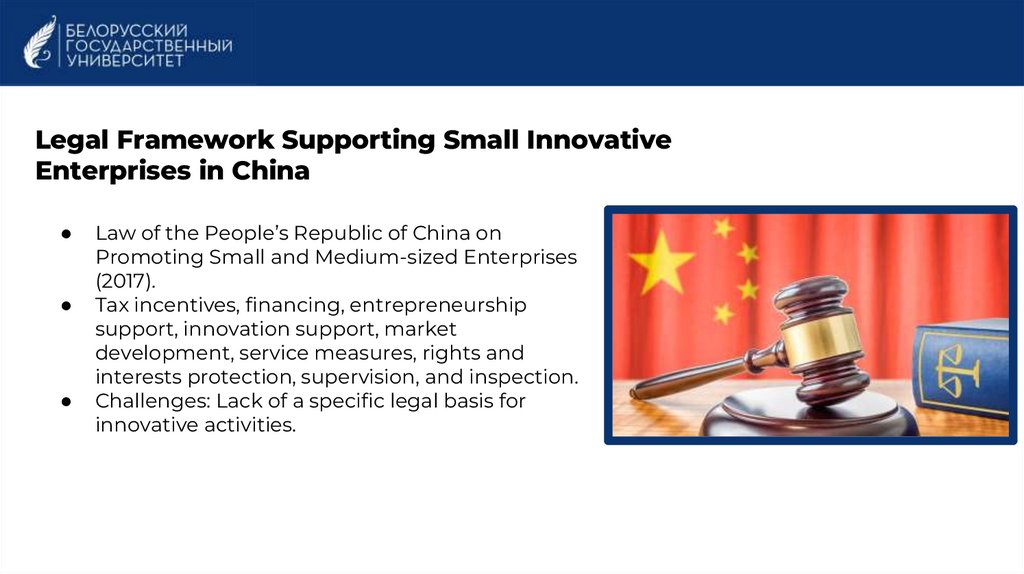
Legal Framework Supporting Small InnovativeEnterprises in China
Law of the People’s Republic of China on
Promoting Small and Medium-sized Enterprises
(2017).
Tax incentives, financing, entrepreneurship
support, innovation support, market
development, service measures, rights and
interests protection, supervision, and inspection.
Challenges: Lack of a specific legal basis for
innovative activities.
8.
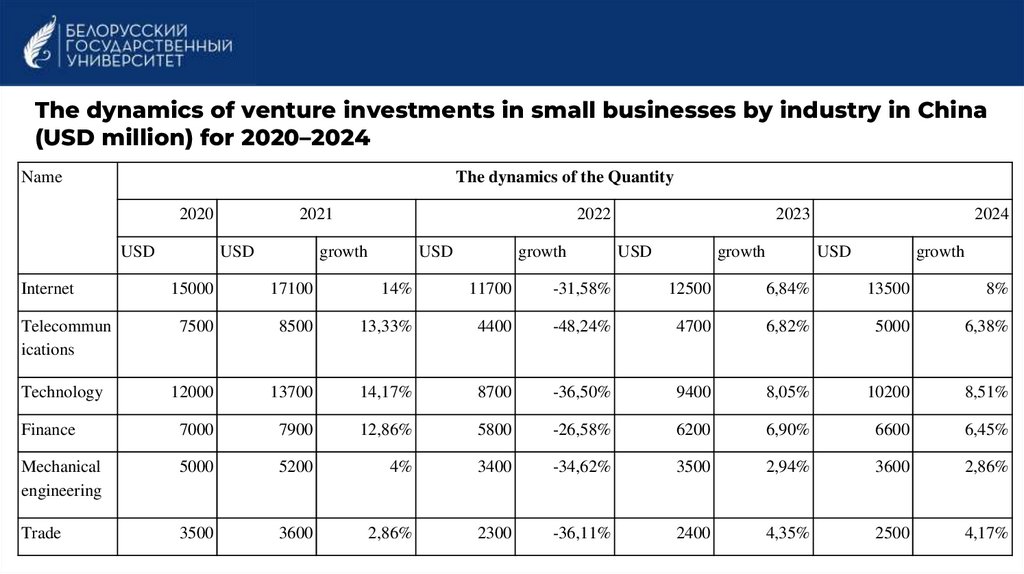
The dynamics of venture investments in small businesses by industry in China(USD million) for 2020–2024
Name
The dynamics of the Quantity
2020
USD
2021
USD
2022
growth
USD
growth
2023
USD
growth
2024
USD
growth
Internet
15000
17100
14%
11700
-31,58%
12500
6,84%
13500
8%
Telecommun
ications
7500
8500
13,33%
4400
-48,24%
4700
6,82%
5000
6,38%
Technology
12000
13700
14,17%
8700
-36,50%
9400
8,05%
10200
8,51%
Finance
7000
7900
12,86%
5800
-26,58%
6200
6,90%
6600
6,45%
Mechanical
engineering
5000
5200
4%
3400
-34,62%
3500
2,94%
3600
2,86%
Trade
3500
3600
2,86%
2300
-36,11%
2400
4,35%
2500
4,17%
9.
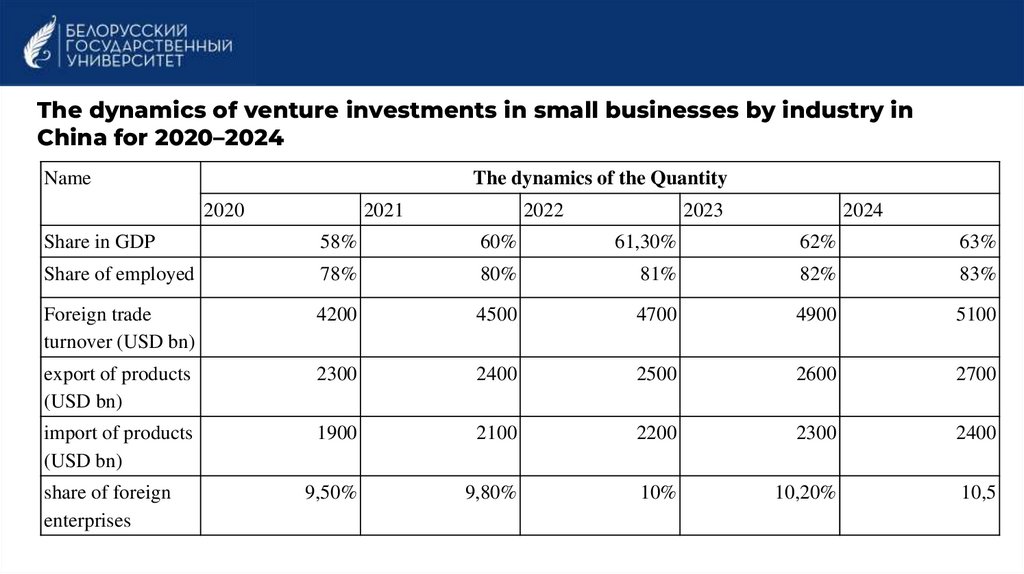
The dynamics of venture investments in small businesses by industry inChina for 2020–2024
Name
The dynamics of the Quantity
2020
2021
2022
2023
2024
Share in GDP
58%
60%
61,30%
62%
63%
Share of employed
78%
80%
81%
82%
83%
Foreign trade
turnover (USD bn)
4200
4500
4700
4900
5100
export of products
(USD bn)
2300
2400
2500
2600
2700
import of products
(USD bn)
1900
2100
2200
2300
2400
share of foreign
enterprises
9,50%
9,80%
10%
10,20%
10,5
10.
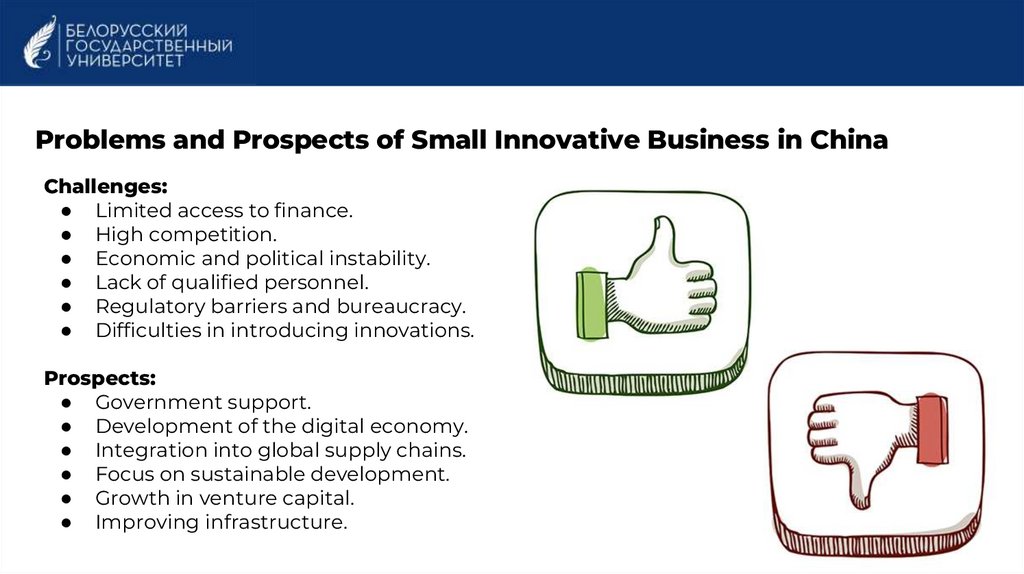
Problems and Prospects of Small Innovative Business in ChinaChallenges:
● Limited access to finance.
● High competition.
● Economic and political instability.
● Lack of qualified personnel.
● Regulatory barriers and bureaucracy.
● Difficulties in introducing innovations.
Prospects:
● Government support.
● Development of the digital economy.
● Integration into global supply chains.
● Focus on sustainable development.
● Growth in venture capital.
● Improving infrastructure.
11.
International Models for Supporting Small InnovativeEnterprises
United States: Robust venture capital
ecosystem and flexible regulatory environment.
Europe: Public-private partnerships and longterm funding.
Israel: Integrated innovation ecosystem and
government grants.
Japan: Keiretsu networks and stable corporate
ties.
South Korea: Chaebol-driven innovation and
mentorship programs.
12.
Strategies to Strengthen Small Innovative Enterprises inChina
Expand and diversify financing mechanisms.
Develop a specialized legislative framework.
Invest in human capital development.
Accelerate digital transformation.
Foster public-private partnerships and
innovation clusters.
Promote sustainable innovation.
Enhance international collaboration.
Strengthen risk management and resilience.