
 business
Similar presentations:





Fundamentals of business and the role and promise of entrepreneurship
1. Fundamentals Of Business and The Role and Promise of Entrepreneurship
There are risks and costs to a program of action. Butthey are far less than the long-range risks and costs of
comfortable inaction.
John F. Kennedy
2. LEARNING OBJECTIVES
1.1 Understand the logic and mechanics of a businessenterprise
1.2 Appreciate the role of value in business and
economics
1.3 Identify roles and responsibilities of business in
society
1.4 Entrepreneurship in Context
1.5 Economics and the Firm
1.6 Creative Destruction
1.7 Innovation and Technology
1.8 The Technology Entrepreneur
3. Fundamentals Of Business
What is a Business?Business that provide goods and services to the community
with the goal of getting profit.
An organized and purposeful human activity designed to
create value for others and to exchange that value for
something else of equal or greater value (usually, money), and
that is intended to continue to provide such value over
time as a going concern.
4. Fundamentals Of Business
1. Business as an Organized Activity:Where an individual or a group combine and deploy
resources, such as land, labour, and capital, to use toward a
productive activity.
2. Business as an Purposeful Human Activity:
Businesses are founded on the belief that an innovation
can be converted to value that is wanted or needed by a
market or markets.
Some innovations are centred on new products, or
extensions of existing products.
5. Fundamentals Of Business
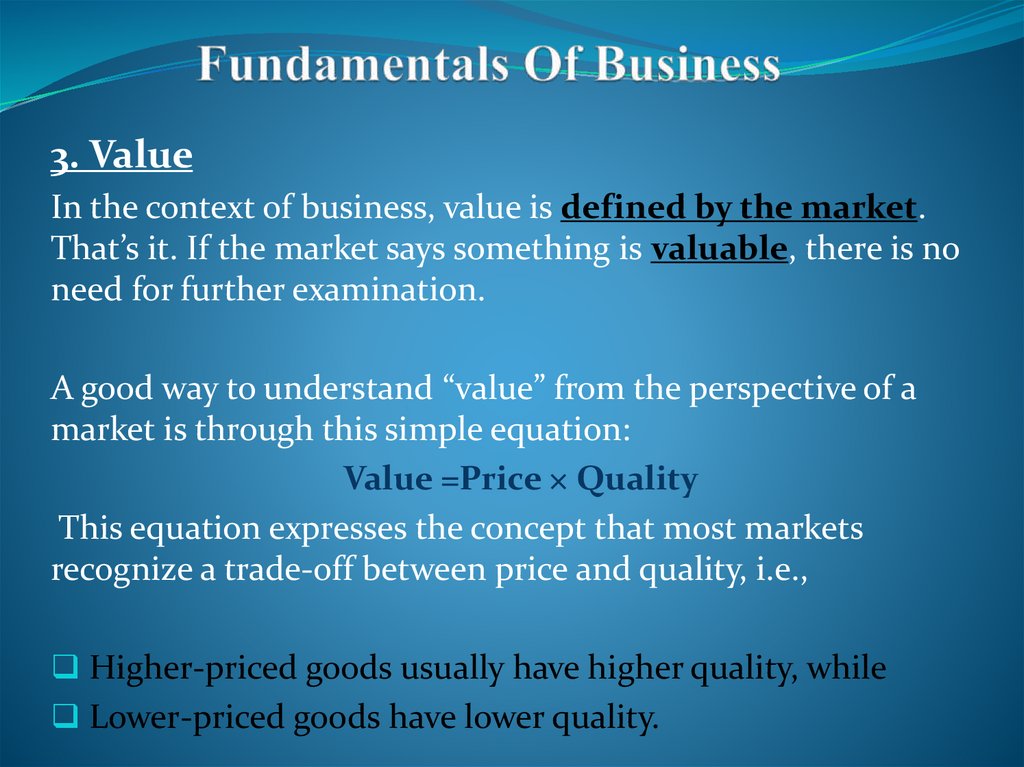
3. ValueIn the context of business, value is defined by the market.
That’s it. If the market says something is valuable, there is no
need for further examination.
A good way to understand “value” from the perspective of a
market is through this simple equation:
Value =Price × Quality
This equation expresses the concept that most markets
recognize a trade-off between price and quality, i.e.,
Higher-priced goods usually have higher quality, while
Lower-priced goods have lower quality.
6. Fundamentals Of Business
o Value CreationIt is the entrepreneurial activity of the businessman to
• Organize and
• Deploy resources
that leads to the creation of value for the market .
The resources required to launch a venture can vary greatly,
and they can be obtained from a wide range of sources.
o Value Protection
Technologists create value for markets in multiple ways.
Each of these types of ventures develops intellectual
property.
Understanding how to protect the intellectual property
that one creates, or that is created by the venture, is an
important part of success in technology entrepreneurship.
7. Fundamentals Of Business
o Value CaptureValue capture refers to the process of exiting a venture via a
Sale, Merger, or Public Stock Offering.
If sufficient equity is retained through the fundraising and
distribution to others, the technology entrepreneur, upon
exit, will capture the value that has been created in the
venture.
8. Fundamentals Of Business
oValue PropositionIt is the story that a venture tells its market about what it
intends to provide.
For example, YouTube’s value proposition is:
“Broadcast yourself”—a simple statement.
Value propositions are important for a venture because they not
only communicate what the venture intends to provide, but
also help guide the decision-making process.
For example, the value proposition for well-known consumer products
company Procter & Gamble (P&G) is “Touching lives, improving lives.”
This value proposition functions as a goal for P&G scientists and product
developers on
How to structure their research and develop resources and
investment.
9. Fundamentals Of Business
4. Business as a “Going Concern.”A going concern means that the business will continue into
the indefinite future, with no clear end date or precise
definition of “success.”
A business is usually said to be successful if it continues to
make profits over time— usually increasing profits relative to
industry averages.
The manner in which a business makes profit is deemed its
Business Model. Business models vary across and within
industries.
“Business Model” defines as the way the business
makes money.
10. Fundamentals Of Business
The Mechanics of a “Going Concern”Establishing a going concern usually requires establishing
systems that are Repeatable and Scalable.
Repeatable simply means that the processes designed to
produce valuable output for a market can be repeated
indefinitely.
Scalability means that the repeatable processes can handle
increasing market demand over time.
11. Fundamentals Of Business
The Mechanics of a “going concern”1. Repeatable Processes
The principle of a going concern is most evident in repeatable
processes that cover production in a factory, no matter what it
produces.
Forces that include the mechanics of a going concern are both
Physical, i.e., the machinery and tools of the factory floor, and
Tacit, i.e., the policies and rules that workers follow.
Within this challenge is
The need to align the organization toward common goals and objectives,
Provide individualized and substantial incentives that motivate people to
perform at high levels, and
Promote openness and collaboration for future growth.
12. Fundamentals Of Business
The Mechanics of a “going concern”2. Scalability
It means to adjust their output to meet market demand.
Scalability relies on a variety of factors, including
Qualified labour to operate machinery or deliver services,
An access to capital to purchase new equipment, and
The presence of standard operating procedures that limit
variability of output across different production lines or service
providers.
Growing too fast may lead to quality problems that turn customers away.
Growing too slowly may lead to opportunities for competitors to race
into the market and steal potential new customers.
13. Fundamentals Of Business
Role Of Business In A SocietyCommonly said that the role of business is creating wealth and
prosperity.
More recent history has seen this debate crystallize around two
dominant modes of thought: Capitalism And Socialism.
Capitalism
Capitalism forms the economic foundation of the Western
world, including the United States, the European Union, and
Australia, as well as much of Southeast Asia.
The principles of capitalism uphold freedom and individual
choice as the drivers of prosperity. Business is seen as a
noble undertaking where humans freely enter into exchange
relationships to maximize their individual and, as a result, their
collective prosperity.
14. Fundamentals Of Business
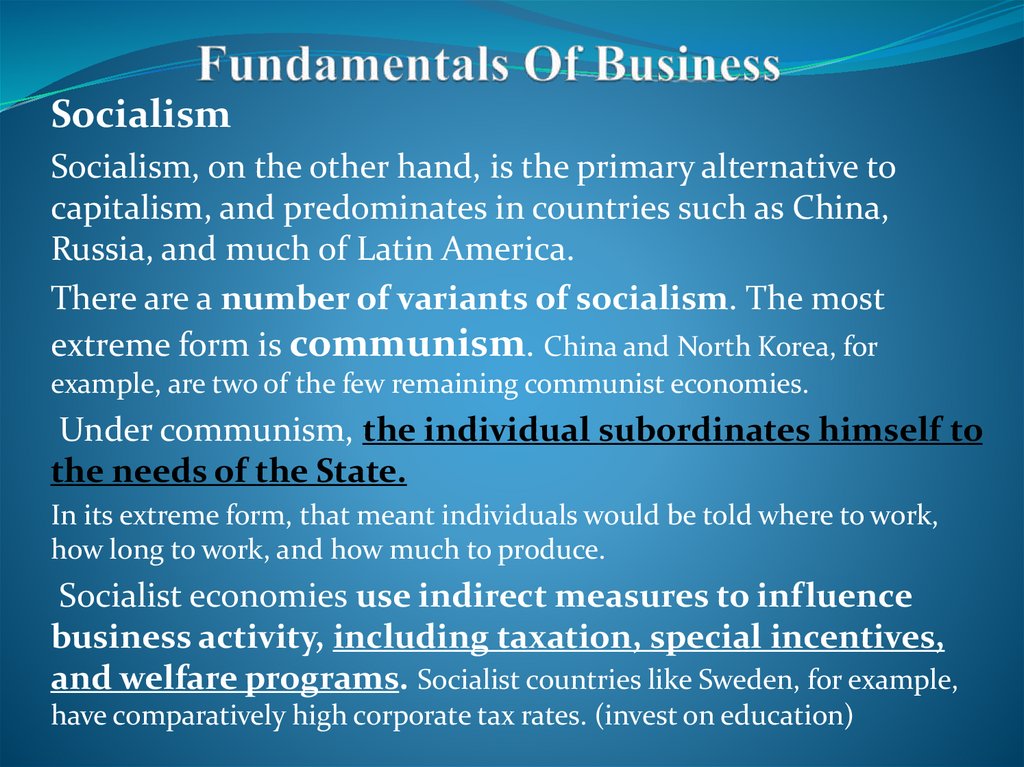
SocialismSocialism, on the other hand, is the primary alternative to
capitalism, and predominates in countries such as China,
Russia, and much of Latin America.
There are a number of variants of socialism. The most
extreme form is communism. China and North Korea, for
example, are two of the few remaining communist economies.
Under communism, the individual subordinates himself to
the needs of the State.
In its extreme form, that meant individuals would be told where to work,
how long to work, and how much to produce.
Socialist economies use indirect measures to influence
business activity, including taxation, special incentives,
and welfare programs. Socialist countries like Sweden, for example,
have comparatively high corporate tax rates. (invest on education)
15. Fundamentals Of Business
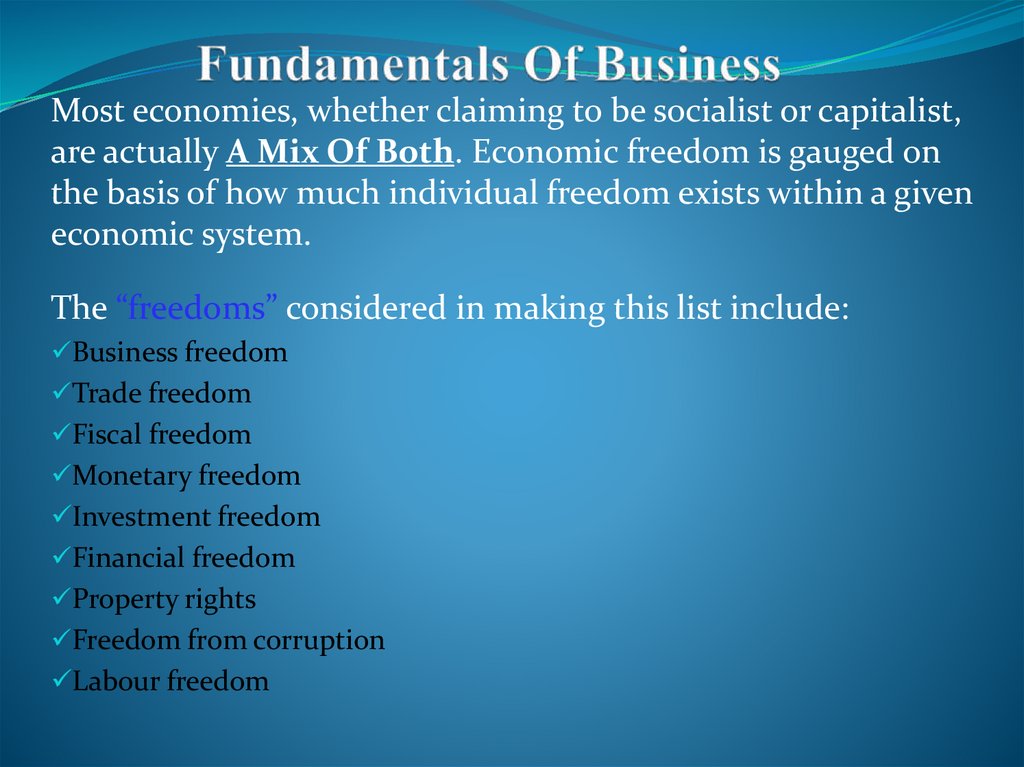
Most economies, whether claiming to be socialist or capitalist,are actually A Mix Of Both. Economic freedom is gauged on
the basis of how much individual freedom exists within a given
economic system.
The “freedoms” considered in making this list include:
Business freedom
Trade freedom
Fiscal freedom
Monetary freedom
Investment freedom
Financial freedom
Property rights
Freedom from corruption
Labour freedom
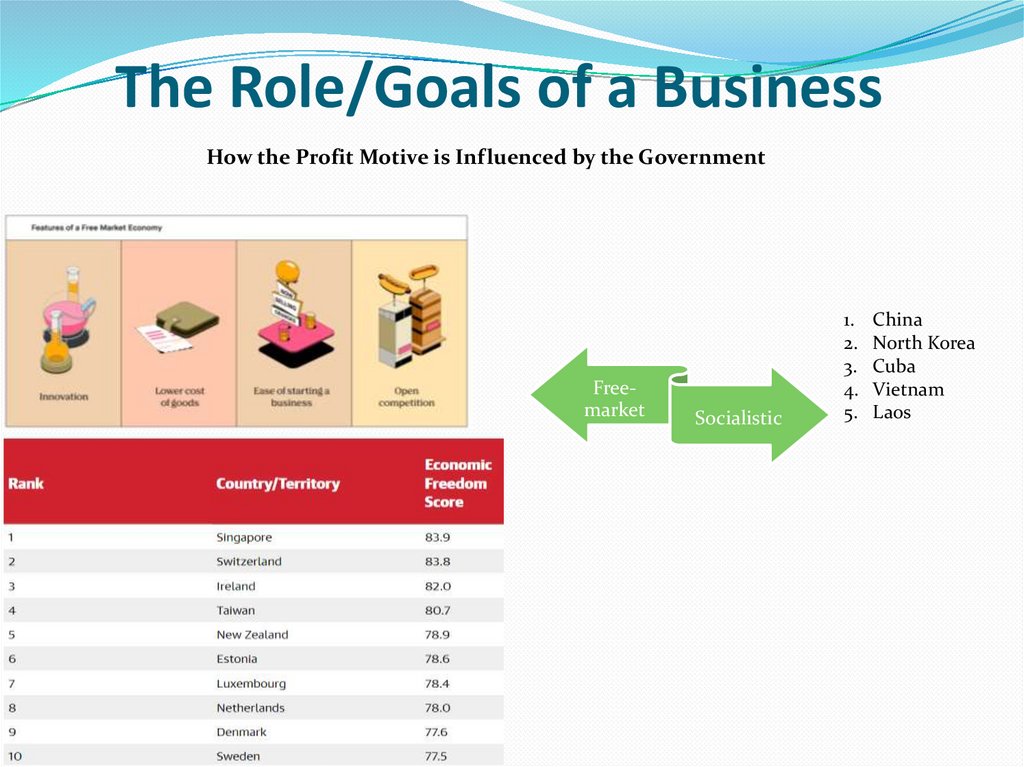
16. The Role/Goals of a Business
How the Profit Motive is Influenced by the GovernmentFreemarket
Socialistic
1.
2.
3.
4.
5.
China
North Korea
Cuba
Vietnam
Laos
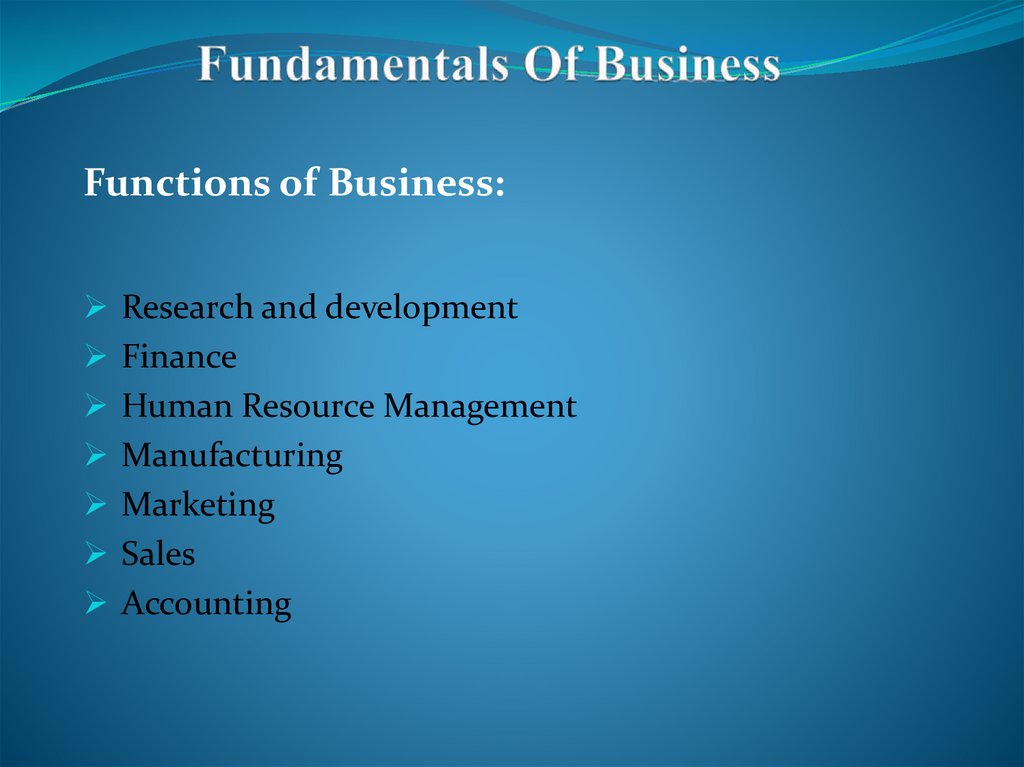
17. Fundamentals Of Business
Functions of Business:Research and development
Finance
Human Resource Management
Manufacturing
Marketing
Sales
Accounting
18.
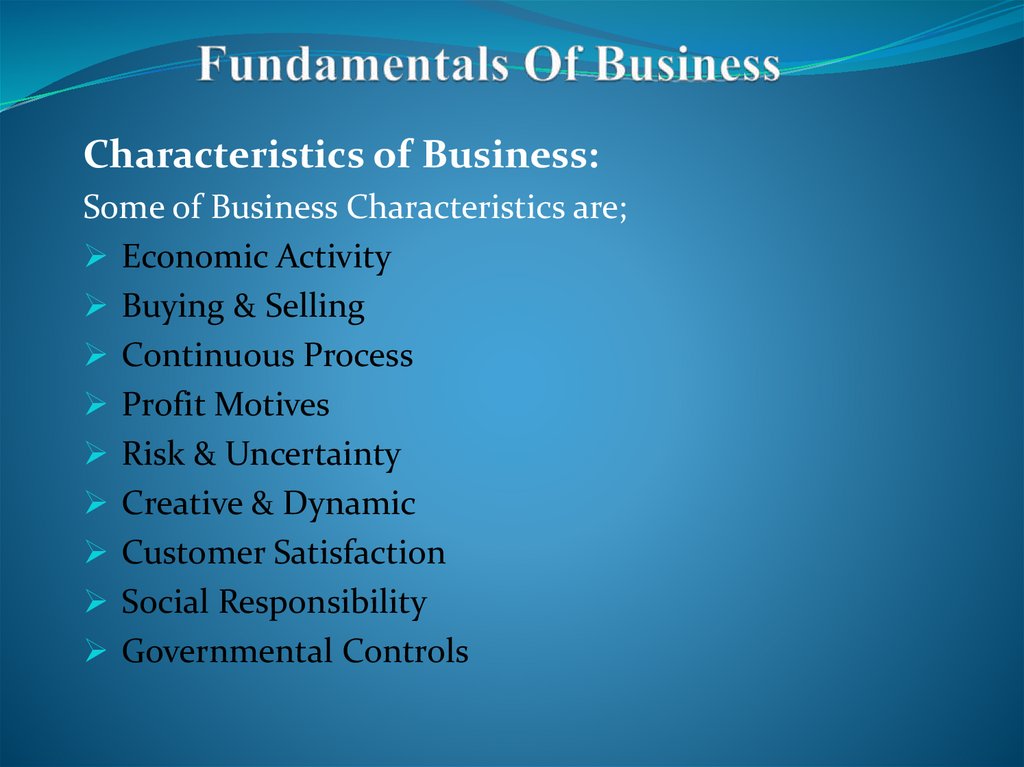
Characteristics of Business:Some of Business Characteristics are;
Economic Activity
Buying & Selling
Continuous Process
Profit Motives
Risk & Uncertainty
Creative & Dynamic
Customer Satisfaction
Social Responsibility
Governmental Controls
19. Decisions considered to initiate a Business
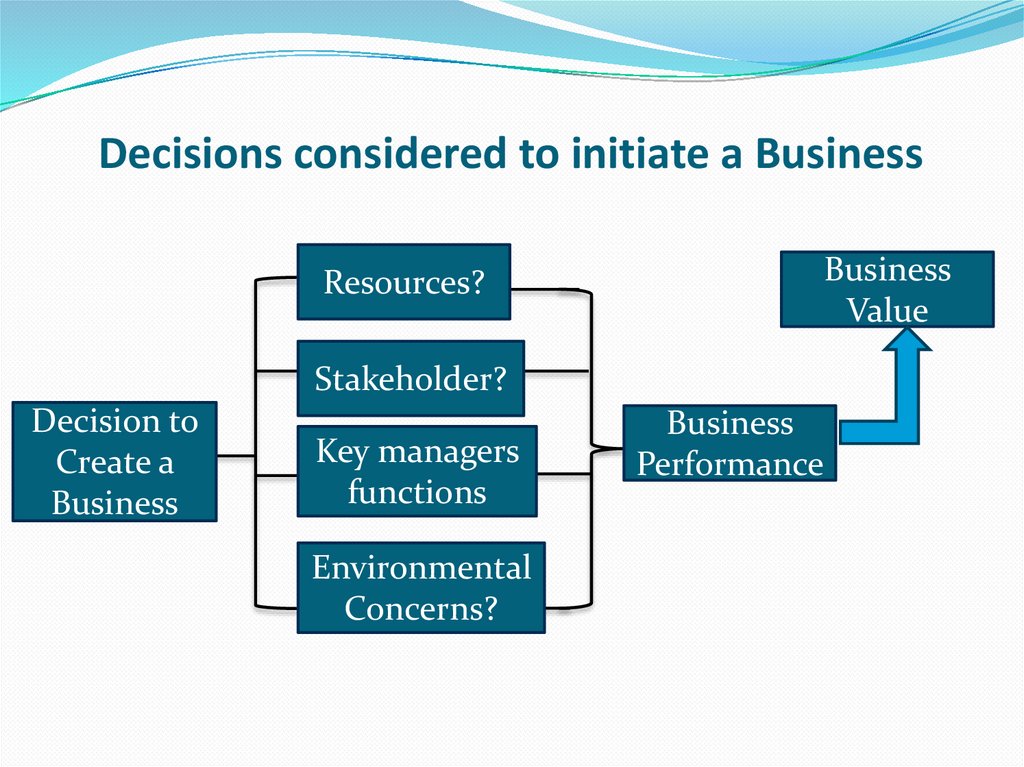
Resources?Business
Value
Stakeholder?
Decision to
Create a
Business
Key managers
functions
Environmental
Concerns?
Business
Performance
20. 2. Key resources
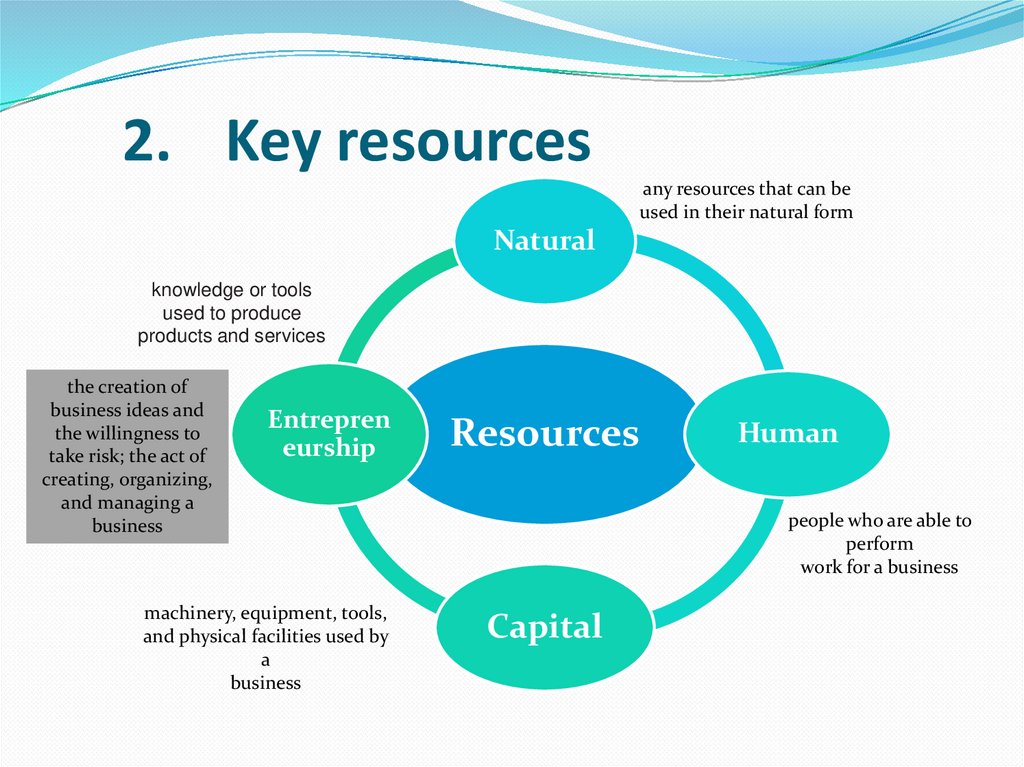
any resources that can beused in their natural form
Natural
knowledge or tools
used to produce
products and services
the creation of
business ideas and
the willingness to
take risk; the act of
creating, organizing,
and managing a
business
Entrepren
eurship
machinery, equipment, tools,
and physical facilities used by
a
business
Resources
Human
people who are able to
perform
work for a business
Capital
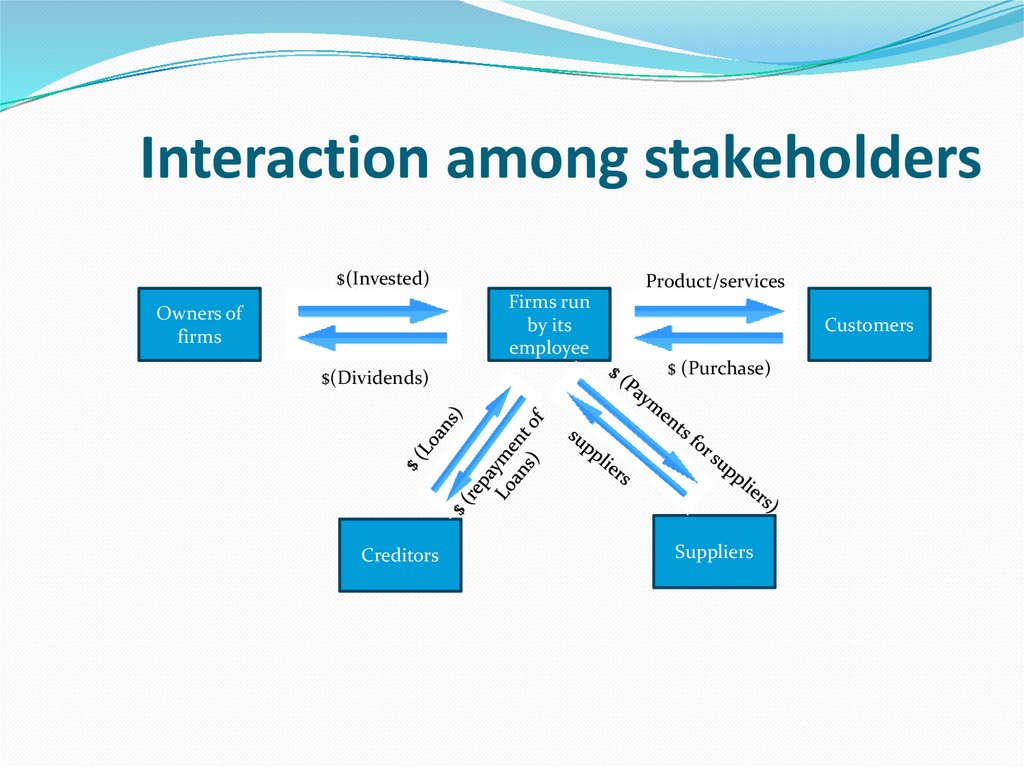
21. 3. Key Stakeholders
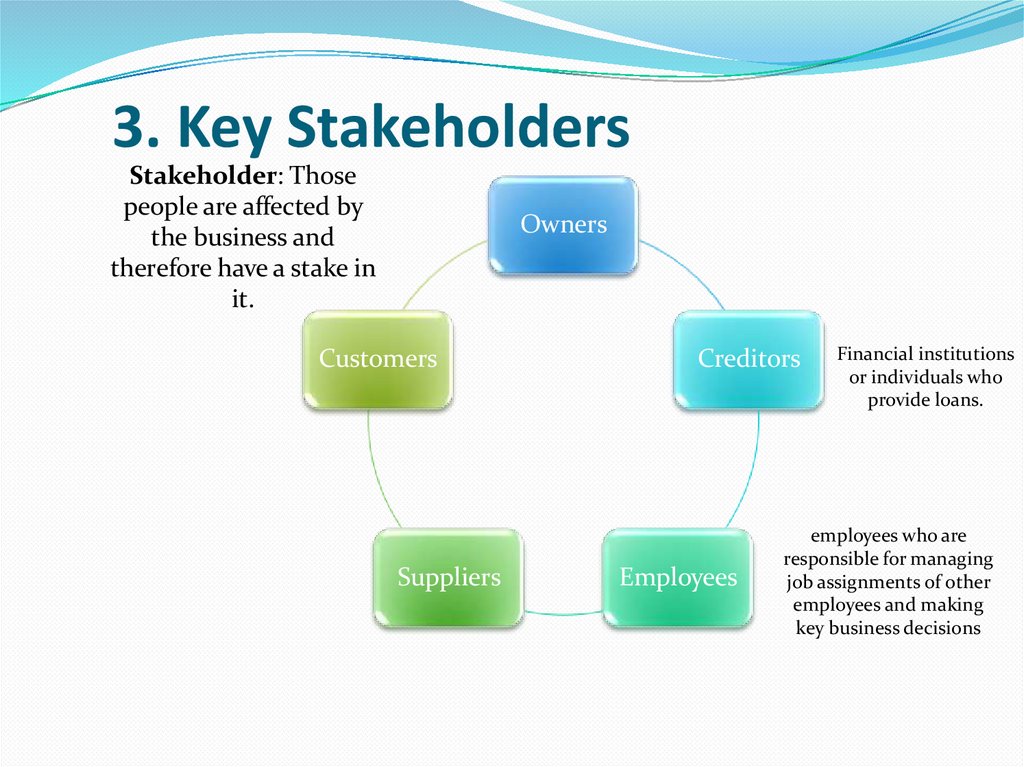
Stakeholder: Thosepeople are affected by
the business and
therefore have a stake in
it.
Owners
Customers
Suppliers
Creditors
Employees
Financial institutions
or individuals who
provide loans.
employees who are
responsible for managing
job assignments of other
employees and making
key business decisions
22. Interaction among stakeholders
$(Invested)Product/services
Firms run
by its
employee
Owners of
firms
$(Dividends)
Creditors
Customers
$ (Purchase)
Suppliers
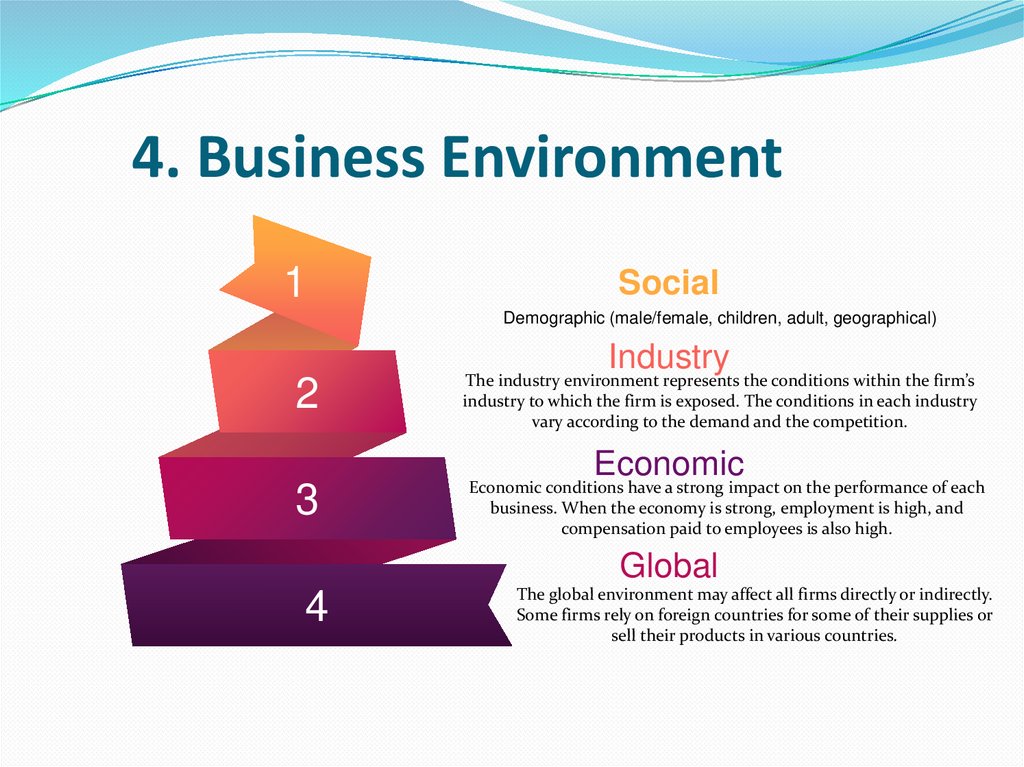
23. 4. Business Environment
1Social
Demographic (male/female, children, adult, geographical)
Industry
2
The industry environment represents the conditions within the firm’s
industry to which the firm is exposed. The conditions in each industry
vary according to the demand and the competition.
3
Economic conditions have a strong impact on the performance of each
business. When the economy is strong, employment is high, and
compensation paid to employees is also high.
Economic
Global
4
The global environment may affect all firms directly or indirectly.
Some firms rely on foreign countries for some of their supplies or
sell their products in various countries.
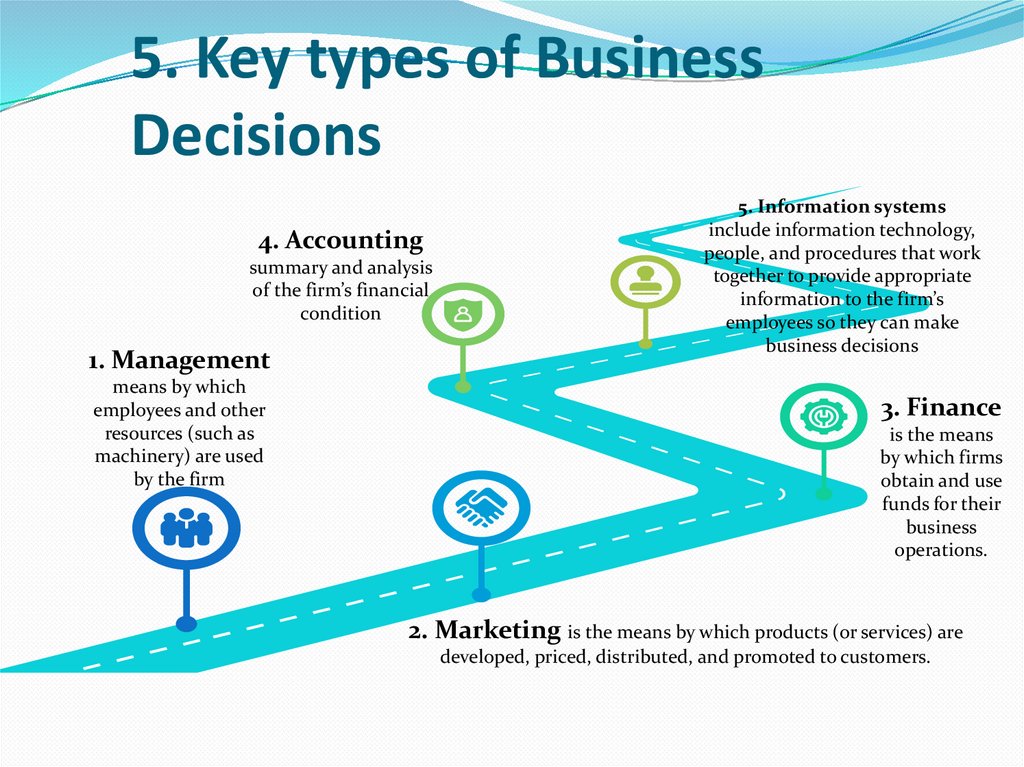
24. 5. Key types of Business Decisions
4. Accountingsummary and analysis
of the firm’s financial
condition
1. Management
means by which
employees and other
resources (such as
machinery) are used
by the firm
5. Information systems
include information technology,
people, and procedures that work
together to provide appropriate
information to the firm’s
employees so they can make
business decisions
3. Finance
is the means
by which firms
obtain and use
funds for their
business
operations.
2. Marketing is the means by which products (or services) are
developed, priced, distributed, and promoted to customers.
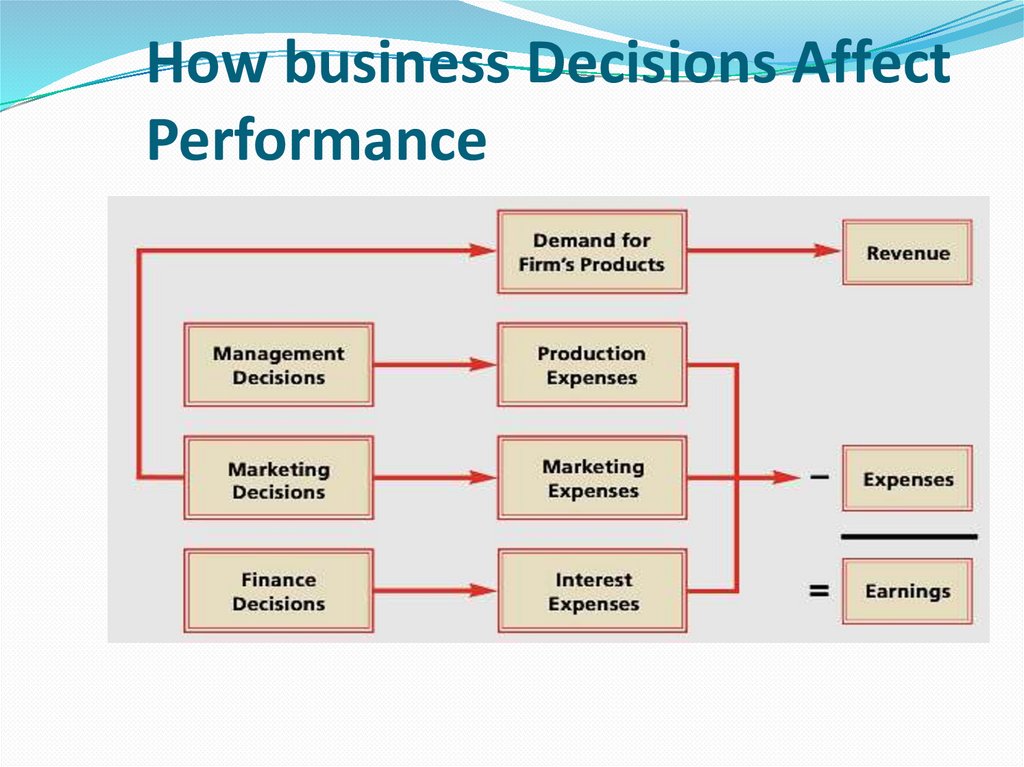
25. How business Decisions Affect Performance
26.
27.
Who are Entrepreneurs?Entrepreneurs are resilient people who jump on challenging
problems, determined to find a solution.
They combine important capabilities and skills with interests,
passions, and commitment.
Entrepreneurs are the critical people
who combine their technical knowledge
with business practices
to foster innovation.
28.
Entrepreneurs Working for Betterment of Society:Entrepreneurs are to create new enterprises /
businesses with the goal of betterment of society.
Entrepreneurs are the engine of economic growth.
Entrepreneurs are the people who arrange novel
solutions to social and economic problems. They
are the people who make our economic system
thrive.
29. The Role and Promise of Entrepreneurship
Economics and the Firm:Entrepreneurs are workers in the world of economics
and business.
Economics is the study of the production,
distribution, and consumption of goods and services.
Entrepreneurs are who arrange new organizations
or solutions to social and economic problems.
Entrepreneurs have a tremendous impact on economic
growth.
Existing firms are job destroyers
New firms are job creators
30. The Role and Promise of Entrepreneurship
Creative Destruction:Described this process of new entrepreneurial firms and waves
of change as creative destruction.
e.g The recorded music industry
Dynamic capitalism is the process of wealth creation
characterized by
New and creative firms forming and growing
Old and large firms declining and failing.
Creative destruction is destroying the old structure and
creating a new one.
31. The Role and Promise of Entrepreneurship
Economic progress is measured by rising output whichenhances people’s standard of living
Sources of Rising Output:
Rising output per worker comes from two sources:
(1) new technology and
(2) smarter ways of doing work (innovation).
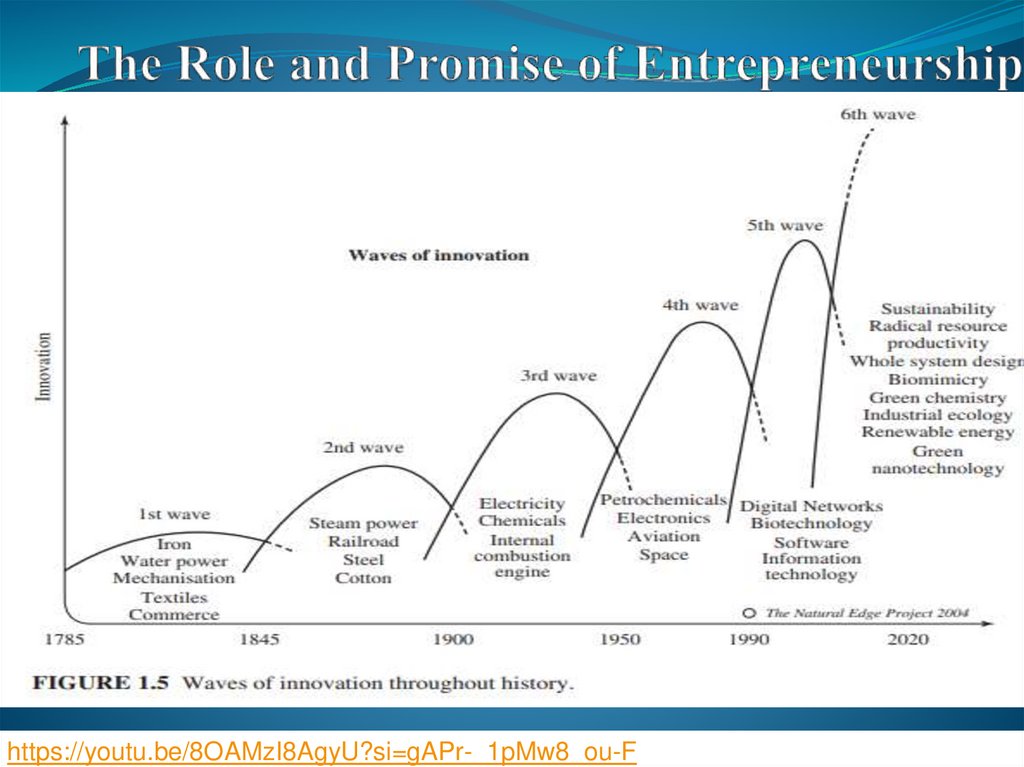
32. The Role and Promise of Entrepreneurship
Innovation & Technology:Technology includes
devices,
processes,
tools and
methods,
that can be applied to industrial and commercial
purposes.
e.g Microsoft, Apple.
Modern entrepreneurial firms breed a constant flow of
high-impact products that create value and stimulate
economic growth by bringing new technologies, and
ideas to the global marketplace.
33. The Role and Promise of Entrepreneurship
Innovation & Technology:One hundred years ago, successful companies such as
U.S. Steel were primarily managing physical assets. By
contrast, today’s successful firms, such as Microsoft and
Genentech, manage knowledge and intellectual
capital.
For many firms, intellectual capital is the organization’s
most important asset, more valuable than its other
physical and financial assets.
Thus, knowledge has become the most important factor
of production.
34. The Role and Promise of Entrepreneurship
Innovation & Technology:https://youtu.be/8OAMzI8AgyU?si=gAPr-_1pMw8_ou-F
35. The Role and Promise of Entrepreneurship
The Technology Entrepreneur:The critical people at the centre of all of these activities
are Entrepreneurs.
Entrepreneurs flourish in response to challenges and
look for unconventional solutions.
They apply creativity, create visions, and build stories
that explain their visions, and then act to be part of the
solution.
They forge new paths and risk failure, but
persistently seek success.
36. The Role and Promise of Entrepreneurship
The Technology Entrepreneur:Entrepreneurs distinguish themselves through their
ability to accumulate and manage knowledge, as well
as their ability to mobilize resources to achieve a
specified business or social goal.
Entrepreneurs exhibit robust confidence, sometimes
bordering on overconfidence.
Entrepreneurial innovators tend to exhibit high selfefficacy—the belief that they can organize and effectively
execute actions to produce desired attainments.
The best entrepreneurs combine both
experience and talent.
37. The Role and Promise of Entrepreneurship
WHY DO PEOPLE BECOMEENTREPRENEURS??