
 biography
Similar presentations:



Robert Hooke
1.
PRESENTATION ON THETOPIC «ROBERT HOOKE»
Astakhov Daniil SNA-116
2.
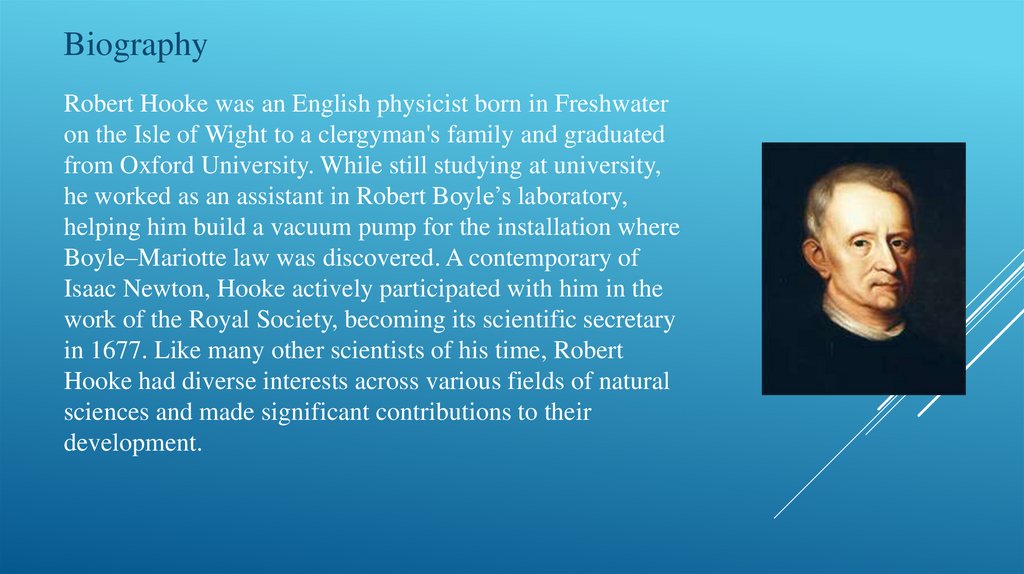
BiographyRobert Hooke was an English physicist born in Freshwater
on the Isle of Wight to a clergyman's family and graduated
from Oxford University. While still studying at university,
he worked as an assistant in Robert Boyle’s laboratory,
helping him build a vacuum pump for the installation where
Boyle–Mariotte law was discovered. A contemporary of
Isaac Newton, Hooke actively participated with him in the
work of the Royal Society, becoming its scientific secretary
in 1677. Like many other scientists of his time, Robert
Hooke had diverse interests across various fields of natural
sciences and made significant contributions to their
development.
3.
Scientific achievementsMicroscopy and Biology
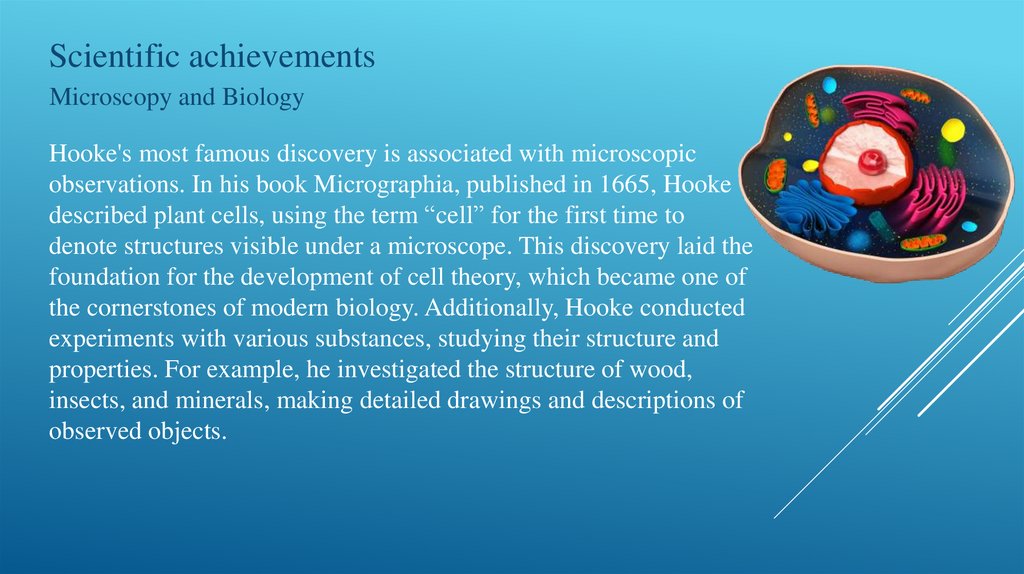
Hooke's most famous discovery is associated with microscopic
observations. In his book Micrographia, published in 1665, Hooke
described plant cells, using the term “cell” for the first time to
denote structures visible under a microscope. This discovery laid the
foundation for the development of cell theory, which became one of
the cornerstones of modern biology. Additionally, Hooke conducted
experiments with various substances, studying their structure and
properties. For example, he investigated the structure of wood,
insects, and minerals, making detailed drawings and descriptions of
observed objects.
4.
Physics and MechanicsHooke also made a significant contribution to the development of
physics and mechanics. Among his best-known discoveries are:
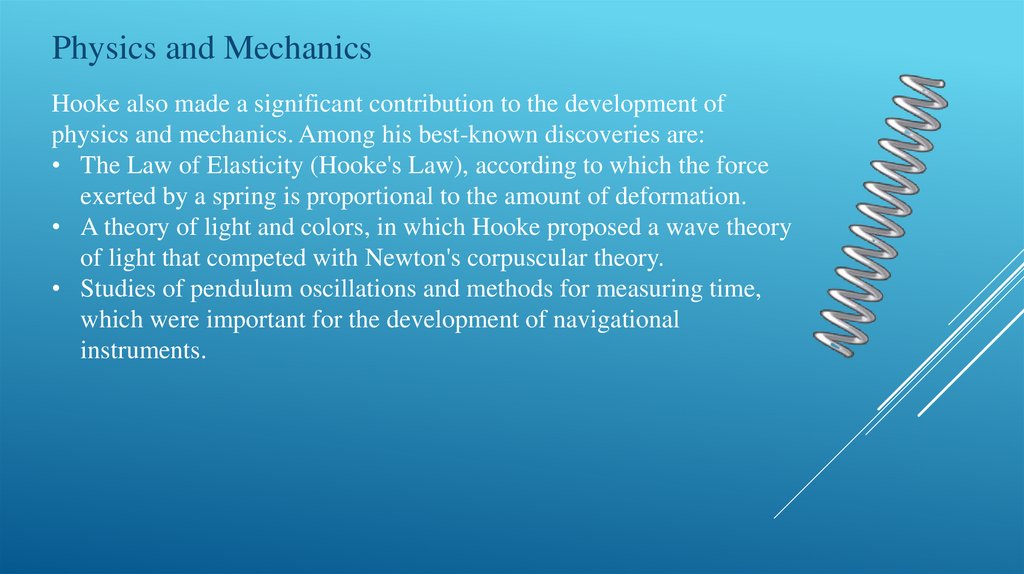
• The Law of Elasticity (Hooke's Law), according to which the force
exerted by a spring is proportional to the amount of deformation.
• A theory of light and colors, in which Hooke proposed a wave theory
of light that competed with Newton's corpuscular theory.
• Studies of pendulum oscillations and methods for measuring time,
which were important for the development of navigational
instruments.
5.
Astronomy and architectureHooke also engaged in astronomical research. He built telescopes
and carried out observations of celestial bodies, particularly the
Moon and planets. His drawings of the lunar surface, made using a
telescope, were among the finest of his time.
In addition to his scientific activities, Hooke took part in the
reconstruction of London after the Great Fire of 1666. Together with
Christopher Wren, he developed plans for rebuilding the city,
including new buildings and streets.
6.
ConclusionThe scientific legacy of Robert Hooke is vast and varied. His
works have had a significant impact on the development of
many areas of science, ranging from biology to architecture.
Although some of his ideas were later challenged or
supplemented, his contribution to shaping the modern
scientific method remains undisputed.