 english
Similar presentations:









Grammar B1 future tenses
1. Grammar B1 future tenses
Recommended for:Gold Experience
Focus
High Note
2019
1
2. There are a number of different ways to talk about the future in English.
Let’s look at:1.
How we use will for the future.
2.
How we use going to for the future.
3.
How we use the present continuous for the future.
4.
How we use the present simple for the future.
5.
How we make sentences with will and going to.
When do we use them?
Copyright © 2019 by Pearson Education
Gold Experience | Focus | High Note
3. Function: When do we use them?
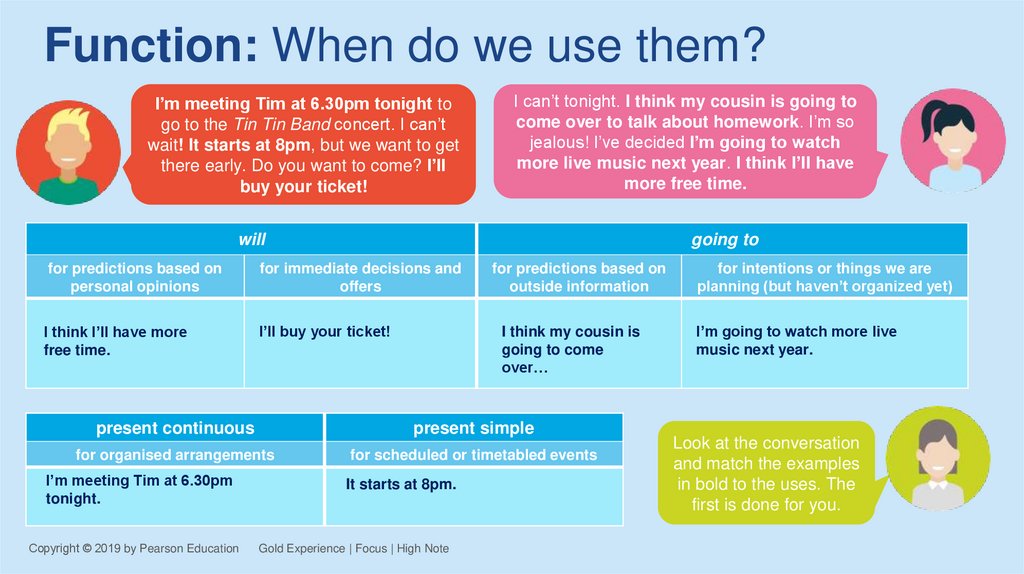
I’m meeting Tim at 6.30pm tonight togo to the Tin Tin Band concert. I can’t
wait! It starts at 8pm, but we want to get
there early. Do you want to come? I’ll
buy your ticket!
I can’t tonight. I think my cousin is going to
come over to talk about homework. I’m so
jealous! I’ve decided I’m going to watch
more live music next year. I think I’ll have
more free time.
will
going to
for predictions based on
personal opinions
for immediate decisions and
offers
for predictions based on
outside information
for intentions or things we are
planning (but haven’t organized yet)
I think I’ll have more
free time.
I’ll buy your ticket!
I think my cousin is
going to come
over…
I’m going to watch more live
music next year.
present continuous
present simple
for organised arrangements
for scheduled or timetabled events
I’m meeting Tim at 6.30pm
tonight.
It starts at 8pm.
Copyright © 2019 by Pearson Education
Gold Experience | Focus | High Note
Look at the conversation
and match the examples
in bold to the uses. The
first is done for you.
4. Function: When do we use them?
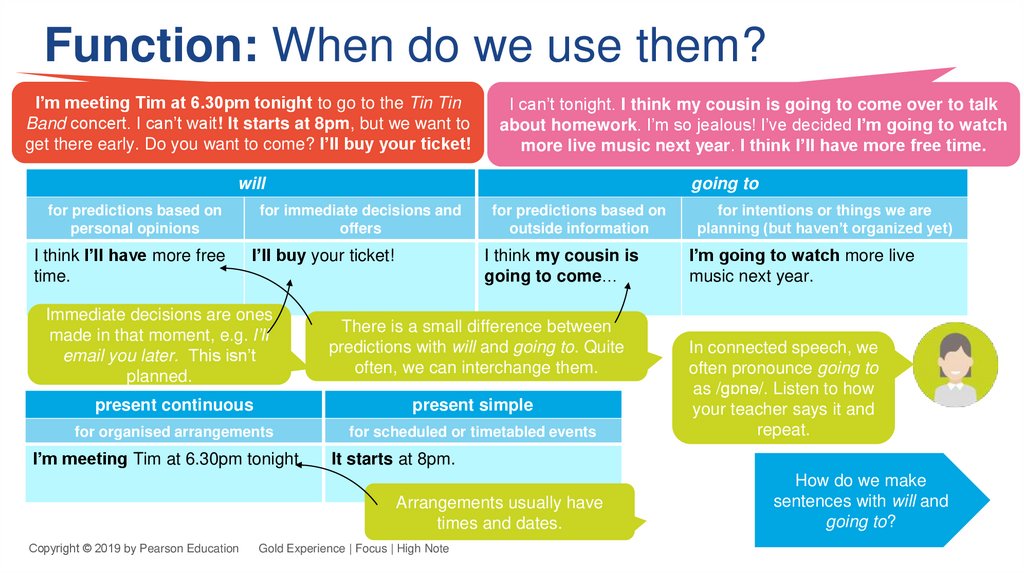
I’m meeting Tim at 6.30pm tonight to go to the Tin TinBand concert. I can’t wait! It starts at 8pm, but we want to
get there early. Do you want to come? I’ll buy your ticket!
I can’t tonight. I think my cousin is going to come over to talk
about homework. I’m so jealous! I’ve decided I’m going to watch
more live music next year. I think I’ll have more free time.
will
for predictions based on
personal opinions
I think I’ll have more free
time.
going to
for immediate decisions and
offers
for predictions based on
outside information
for intentions or things we are
planning (but haven’t organized yet)
I’ll buy your ticket!
I think my cousin is
going to come…
I’m going to watch more live
music next year.
Immediate decisions are ones
made in that moment, e.g. I’ll
email you later. This isn’t
planned.
There is a small difference between
predictions with will and going to. Quite
often, we can interchange them.
present continuous
present simple
for organised arrangements
for scheduled or timetabled events
I’m meeting Tim at 6.30pm tonight.
It starts at 8pm.
Arrangements usually have
times and dates.
Copyright © 2019 by Pearson Education
In connected speech, we
often pronounce going to
as /gɒnə/. Listen to how
your teacher says it and
repeat.
Gold Experience | Focus | High Note
How do we make
sentences with will and
going to?
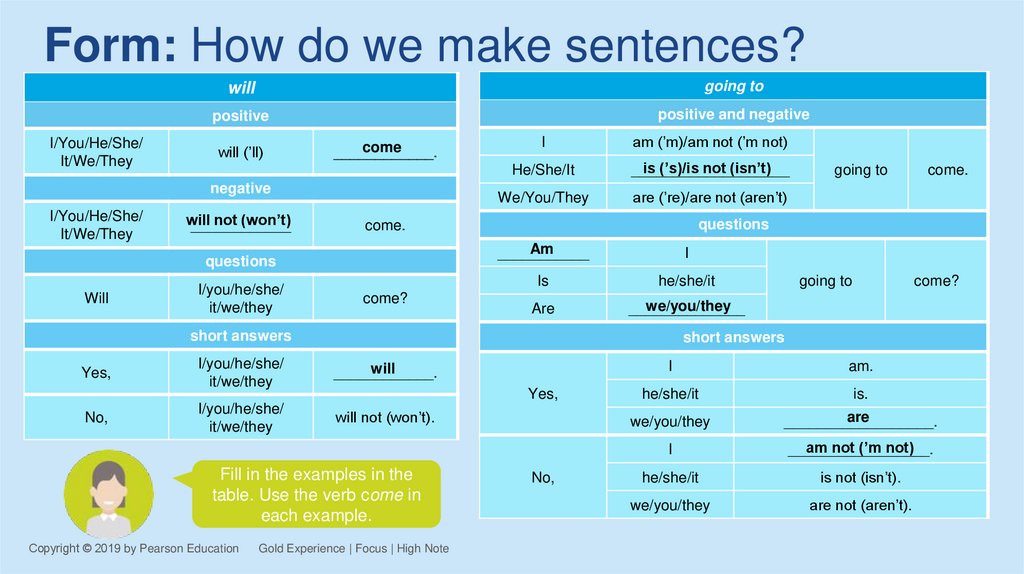
5. Form: How do we make sentences?
I/You/He/She/It/We/They
will
going to
positive
positive and negative
will (’ll)
come
____________.
negative
I/You/He/She/
It/We/They
will
not (won’t)
____________
Will
am (’m)/am not (’m not)
He/She/It
is (’s)/is not (isn’t)
___________________
We/You/They
are (’re)/are not (aren’t)
come?
Am
___________
I
Is
he/she/it
Are
we/you/they
______________
short answers
Yes,
No,
come.
going to
come?
short answers
I/you/he/she/
it/we/they
will
____________.
I/you/he/she/
it/we/they
will not (won’t).
Yes,
Fill in the examples in the
table. Use the verb come in
each example.
Copyright © 2019 by Pearson Education
going to
questions
come.
questions
I/you/he/she/
it/we/they
I
Gold Experience | Focus | High Note
No,
I
am.
he/she/it
is.
we/you/they
are
__________________.
I
am not (’m not)
_________________.
he/she/it
is not (isn’t).
we/you/they
are not (aren’t).
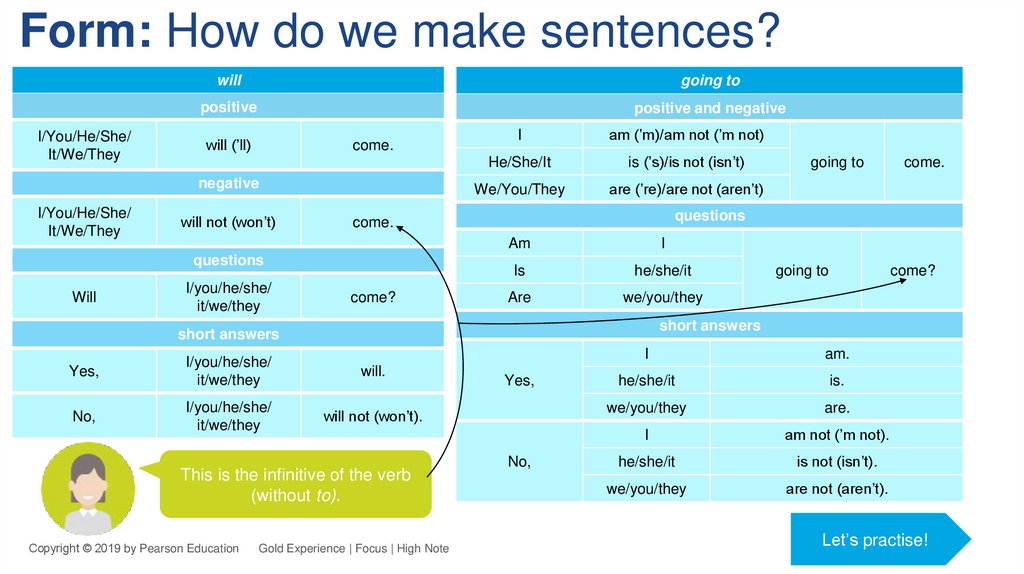
6. Form: How do we make sentences?
I/You/He/She/It/We/They
will
going to
positive
positive and negative
will (’ll)
come.
negative
I/You/He/She/
It/We/They
will not (won’t)
I/you/he/she/
it/we/they
am (’m)/am not (’m not)
He/She/It
is (’s)/is not (isn’t)
We/You/They
are (’re)/are not (aren’t)
come?
Am
I
Is
he/she/it
Are
we/you/they
come.
going to
come?
short answers
short answers
Yes,
I/you/he/she/
it/we/they
will.
No,
I/you/he/she/
it/we/they
will not (won’t).
This is the infinitive of the verb
(without to).
Copyright © 2019 by Pearson Education
going to
questions
come.
questions
Will
I
Gold Experience | Focus | High Note
Yes,
No,
I
am.
he/she/it
is.
we/you/they
are.
I
am not (’m not).
he/she/it
is not (isn’t).
we/you/they
are not (aren’t).
Let’s practise!
7.
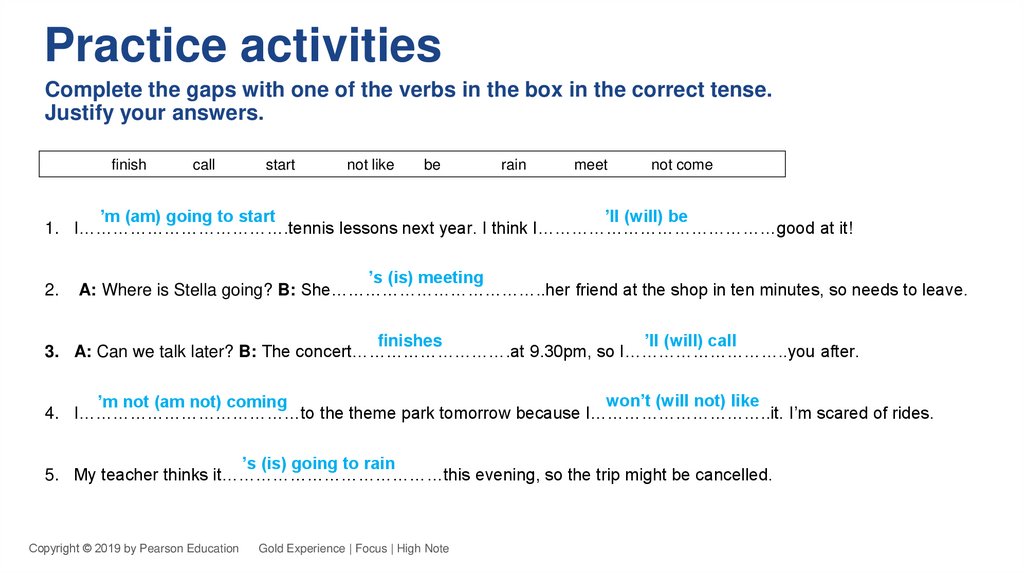
Practice activitiesComplete the gaps with one of the verbs in the box in the correct tense.
Justify your answers.
finish
call
start
not like
be
rain
meet
not come
’m (am) going to start
’ll (will) be
1. I……………………………….tennis lessons next year. I think I……………………………………good at it!
2.
’s (is) meeting
A: Where is Stella going? B: She………………………………..her friend at the shop in ten minutes, so needs to leave.
finishes
’ll (will) call
3. A: Can we talk later? B: The concert……………………….at 9.30pm, so I………………………..you after.
won’t (will not) like
’m not (am not) coming
4. I…………………………………to the theme park tomorrow because I…………………………..it. I’m scared of rides.
’s (is) going to rain
5. My teacher thinks it…………………………………this evening, so the trip might be cancelled.
Copyright © 2019 by Pearson Education
Gold Experience | Focus | High Note