

 electronics
Similar presentations:









High Voltage Ferrite Core Transformer
1. High Voltage Ferrite Core Transformer
2. Objective
Extraction of equivalent circuitparameters of the transformer
Inductive and resistive
parameters:
Primary coil magnetizing
inductance
Primary coil resistance
Primary coil leakage inductance
Primary coil leakage resistance
Capacitive parameters:
Primary coil self-capacitance
Secondary coil self-capacitance
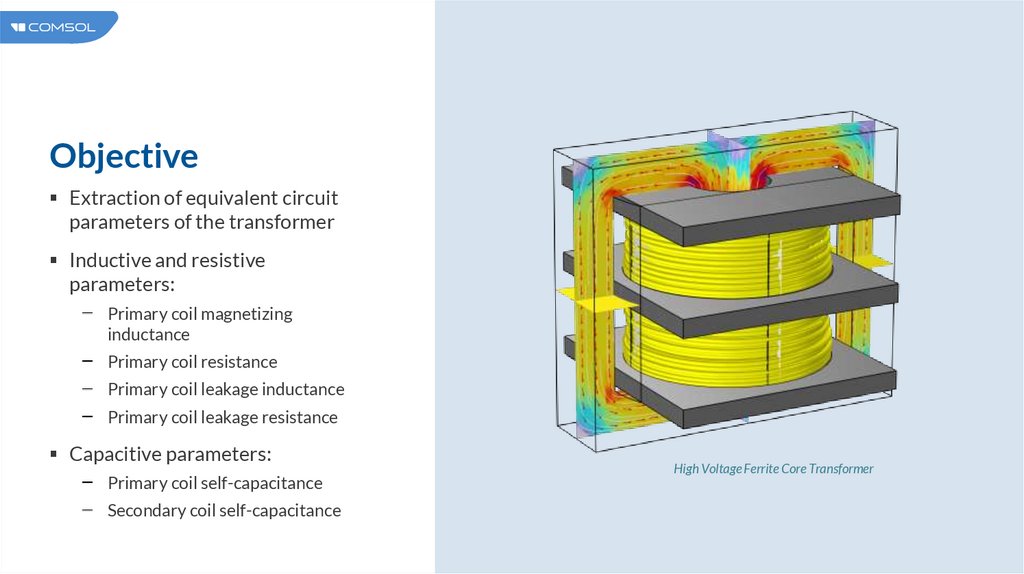
High Voltage Ferrite Core Transformer
3. Model Inputs
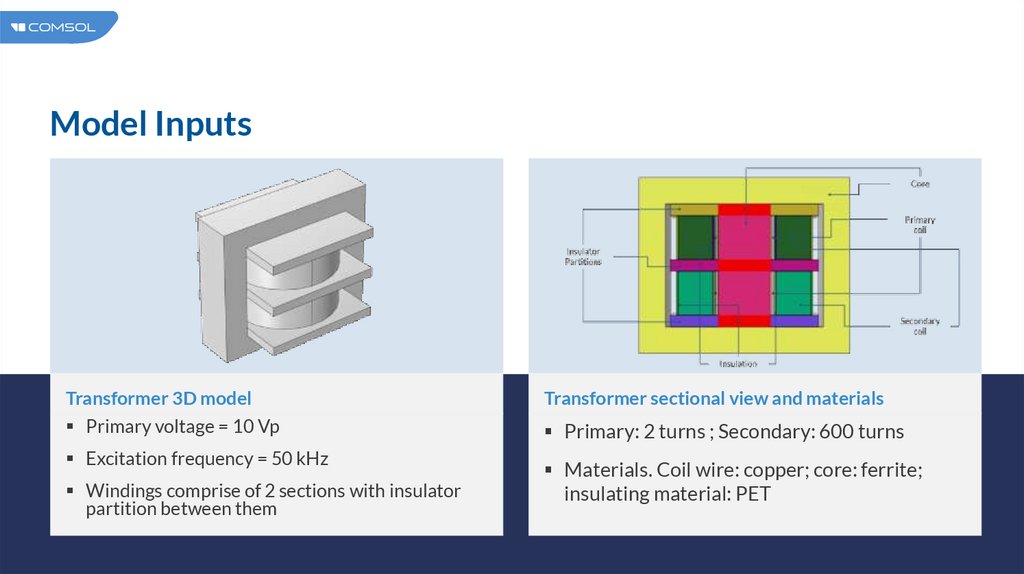
Transformer 3D modelTransformer sectional view and materials
Primary voltage = 10 Vp
Primary: 2 turns ; Secondary: 600 turns
Excitation frequency = 50 kHz
Windings comprise of 2 sections with insulator
partition between them
Materials. Coil wire: copper; core: ferrite;
insulating material: PET
4. Open-Circuit Test and Short-Circuit Test
Open Circuit Test (OCT)Primary coil voltage = 10 V
Secondary coil current = 0 A
Short Circuit Test (SCT)
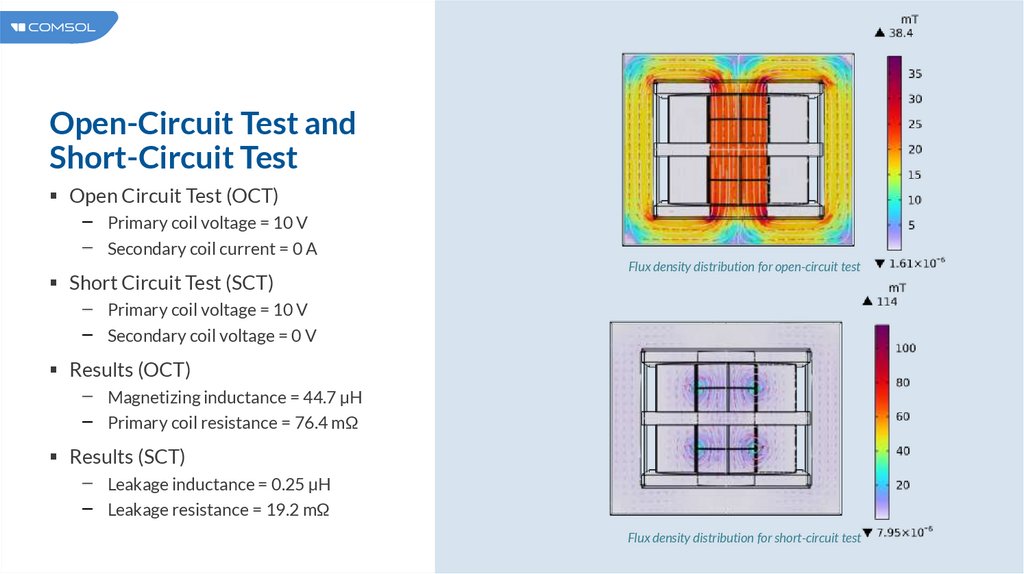
Flux density distribution for open-circuit test
Primary coil voltage = 10 V
Secondary coil voltage = 0 V
Results (OCT)
Magnetizing inductance = 44.7 µH
Primary coil resistance = 76.4 mΩ
Results (SCT)
Leakage inductance = 0.25 µH
Leakage resistance = 19.2 mΩ
Flux density distribution for short-circuit test
5. Extraction of Parasitic Capacitances
Primary self-capacitancePrimary coil turn 1 voltage = 5 V
Primary coil turn 2 voltage = 10 V
Secondary coil section 1 voltage = 0 V
Secondary coil section 2 voltage = 0 V
Core surface: Floating potential
Potential distribution for primary self-capacitance
Secondary self-capacitance
Primary coil turn 1 voltage = 0 V
Primary coil turn 2 voltage = 0 V
Secondary coil section 1 voltage = 1.5 kV
Secondary coil section 2 voltage = 3 kV
Core surface: Floating potential
Results
Primary self capacitance = 14 pF
Secondary self capacitance = 30.5 pF
Potential distribution for secondary self-capacitance
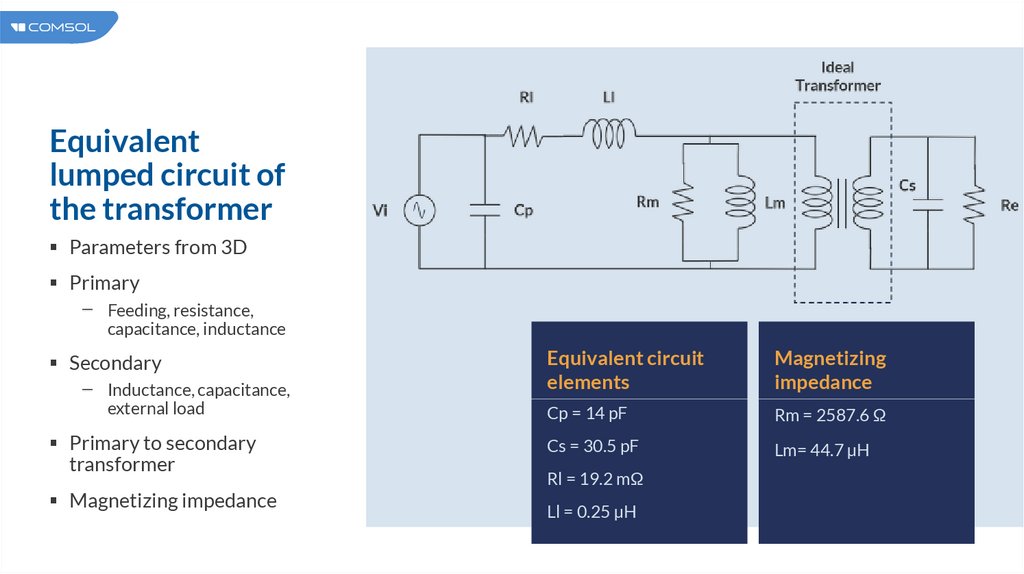
6. Equivalent lumped circuit of the transformer
Parameters from 3DPrimary
Feeding, resistance,
capacitance, inductance
Secondary
Inductance, capacitance,
external load
Primary to secondary
transformer
Magnetizing impedance
Equivalent circuit
elements
Magnetizing
impedance
Cp = 14 pF
Rm = 2587.6 Ω
Cs = 30.5 pF
Lm= 44.7 µH
Rl = 19.2 mΩ
Ll = 0.25 µH
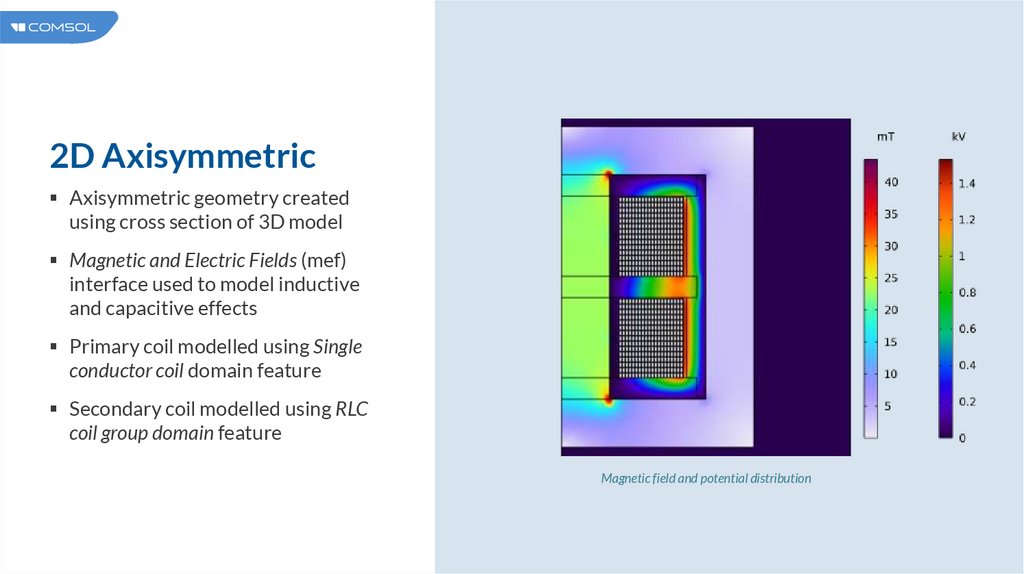
7. 2D Axisymmetric
Axisymmetric geometry createdusing cross section of 3D model
Magnetic and Electric Fields (mef)
interface used to model inductive
and capacitive effects
Primary coil modelled using Single
conductor coil domain feature
Secondary coil modelled using RLC
coil group domain feature
Magnetic field and potential distribution
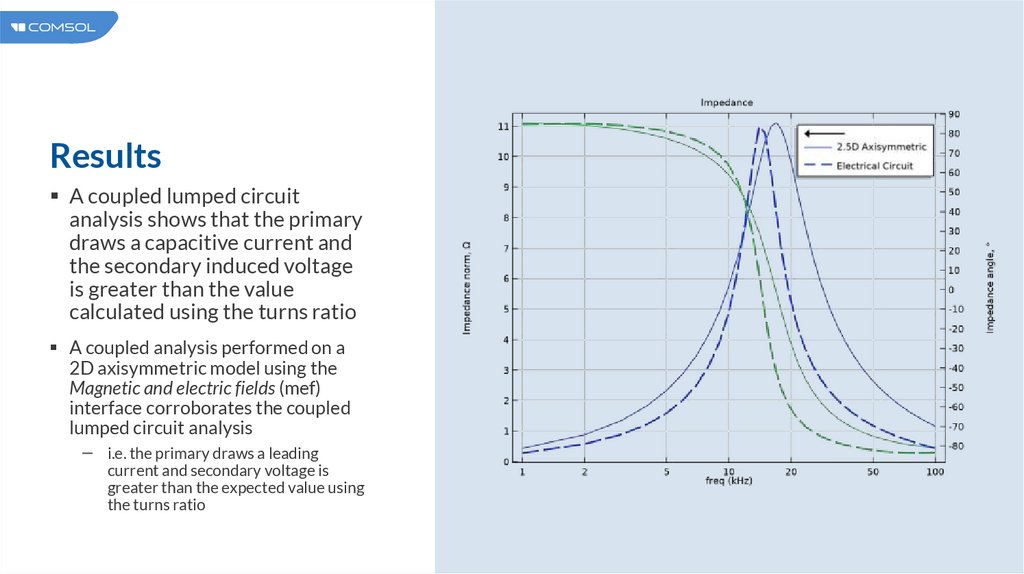
8. Results
A coupled lumped circuitanalysis shows that the primary
draws a capacitive current and
the secondary induced voltage
is greater than the value
calculated using the turns ratio
A coupled analysis performed on a
2D axisymmetric model using the
Magnetic and electric fields (mef)
interface corroborates the coupled
lumped circuit analysis
i.e. the primary draws a leading
current and secondary voltage is
greater than the expected value using
the turns ratio
9. Conclusions
A coupled analysis including both inductive and displacement currents should not be usedto extract the equivalent circuit parameters of a transformer since inductive and capacitive
effects are mutually opposite
It is recommended that
Magnetizing and leakage inductances should be extracted using mf interface
Parasitic capacitances should be extracted using es or Electrostatics (es) interface