







 history
Similar presentations:




European History The Road to World War II
1. European History The Road to World War II
Professor Vjosa MusliuVrije Universiteit Brussel
2024-2025
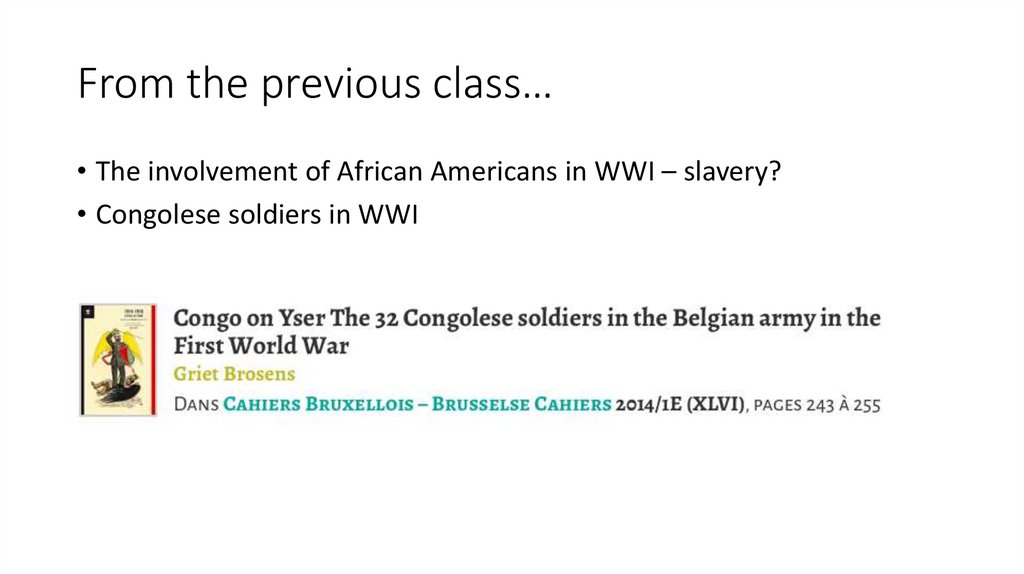
2. From the previous class…
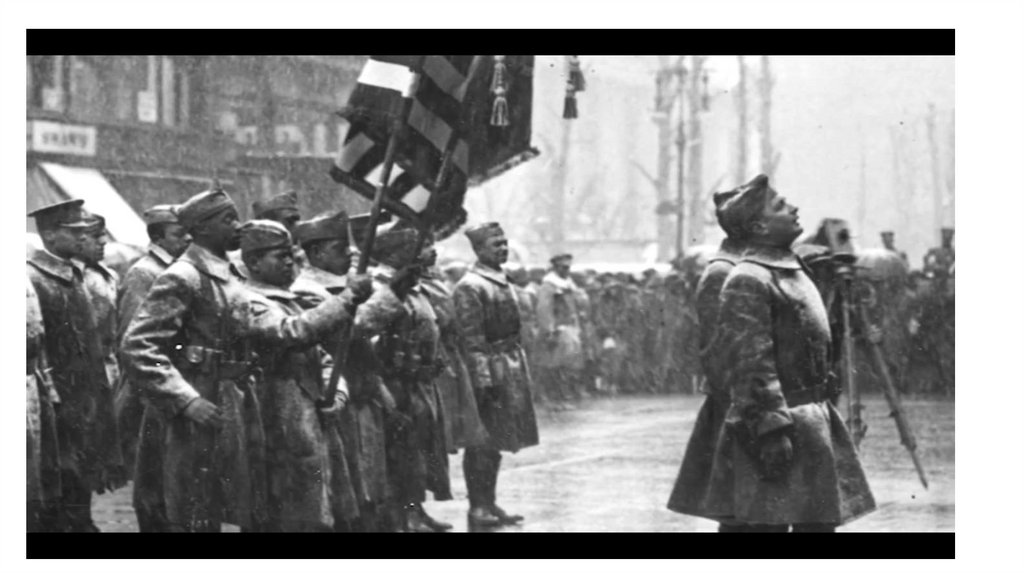
• The involvement of African Americans in WWI – slavery?• Congolese soldiers in WWI
3. The Road Second World War II: class overview
1. The Paris Peace Conference in 19192. Interbellum (interwar period)
• Economic crisis
• Class polarisation
• Appeasement politics
3. Implications for Palestine
4. The Road Second World War II: class overview
1. The Paris Peace Conference in 19192. Interbellum (interwar period)
• Economic crisis
• Class polarisation
• Appeasement politics
3. Implications for Palestine
5. 1. The Paris Peace Conference 1919
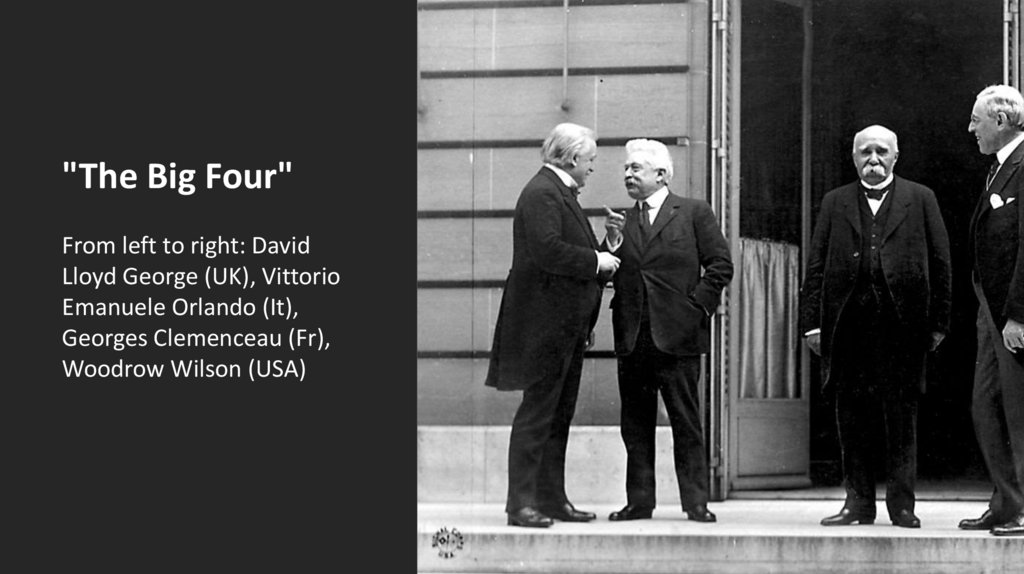
A meeting of “victors”• Delegates of 27 nations yet main decisions taken by the Council of Four (UK, USA, Fr, It)
• No delegation from Germany or Austria-Hungary
• Bolshevik Russia ostracized and not taking part
Context
By 1919, the late ally Russia was in the hands of the Bolsheviks and excluded
New republics already existed along the Baltic Coast, in Poland, the Danube basis but
without effective governments or acknowledged frontiers.
Central Europe in a state of chaos, with Russian-style revolution threatening to break out
Allied blockade of Germany continued, Western Europe devastated
Europeans looked with awe to USA president Wilson; American intervention had decided
the confict; Wilson enjoyed eminence for his views on international relations and peace
6.
"The Big Four"From left to right: David
Lloyd George (UK), Vittorio
Emanuele Orlando (It),
Georges Clemenceau (Fr),
Woodrow Wilson (USA)
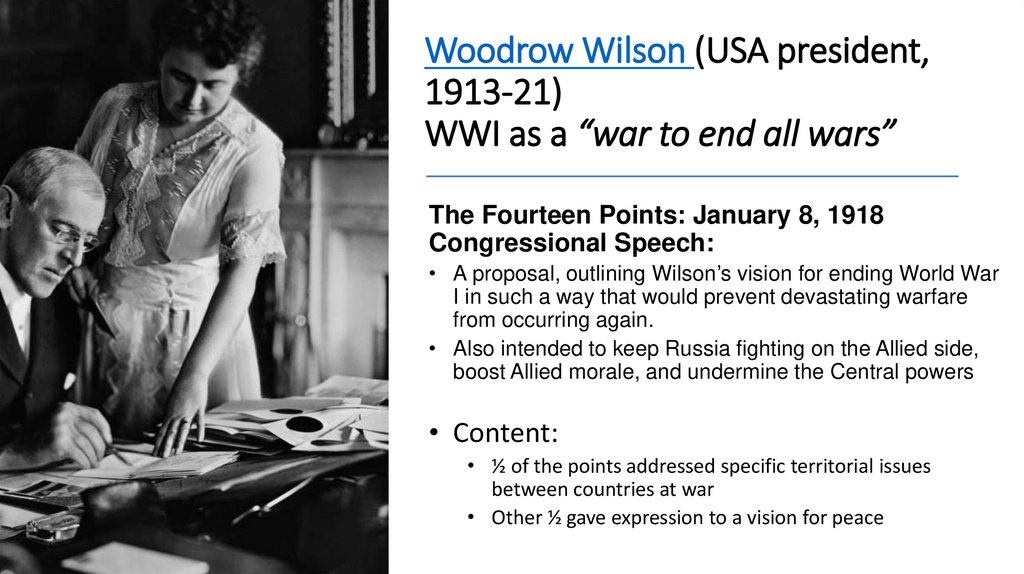
7. Woodrow Wilson (USA president, 1913-21) WWI as a “war to end all wars”
The Fourteen Points: January 8, 1918Congressional Speech:
• A proposal, outlining Wilson’s vision for ending World War
I in such a way that would prevent devastating warfare
from occurring again.
• Also intended to keep Russia fighting on the Allied side,
boost Allied morale, and undermine the Central powers
• Content:
• ½ of the points addressed specific territorial issues
between countries at war
• Other ½ gave expression to a vision for peace
8. 1. The Paris Peace Conference
• Wilson’s Fourteen points:1. Transparency in international relations
• “Open convenants openly arrived at”: a plea to end secret treaties and secret
diplomacy
2. A peace without victory:
• A peace proposal favouring stability and repair of diplomatic relations; as
opposed to punishment of central powers
• Analogy to Congress of Vienna, 1815
3. A liberal, free world
• Removal of barriers and inequalities in international trade
• Freedom of the seas ”alike in peace and in war”
• Reducation of armaments by all powers
9. 1. The Paris Peace Conference
• Wilson’s Fourteen points:4. National self-determination
• = the principle that groups bound by common language or lines of descent have a
right to territorial independence
• Evacuation of occupied territories, self-determination of nationalities, and a
redrawing of European boundaries along national lines
• Colonial adjustments: giving equal weight to peoples of colonized countries and
their colonisers
5. An international political organisation to prevent war
• A League of Nations (1920), “a general association of nations”, to guarantee the
independence and territorial integrity of member countries
• Multilateralism and conflict resolution: A permanent international body in which
nations, without sacrificing sovereign rights over their teritory, would meet to
discuss and settle conflicts
10.
11. 1. The Paris Peace Conference
“On the whole, Wilson stood for the fruition of the democratic, liberal,progressive, and nationalistic movements of the century past, for the ideals of
the Enlightenment, the French Revolution, and the revolutions of 1848. As
Wilson saw it, and as many believed, the World War should end in a new type of
treaty. There was thought to be something sinister about peace conferences of
the past, for example, the Congress of Vienna of 1815. The old diplomacy was
blamed for leading to war. Lenin in his own way and for his own purposes was
saying this in Russia too. It was felt that treaties had too long been wrongly
based on a politics of power or on unprincipled deals and bargains made
without regard to the people concerned. Democracy having defeated the
Great Powers, people hoped that a new settlement, made in a democratic age,
might be reached by general agreement in an atmosphere of mutual
confidence. There was a real sense that a new political era was dawning.”
- Palmer, Colton and Cramer (2014, p. 724)
12. 1. The Paris Peace Conference
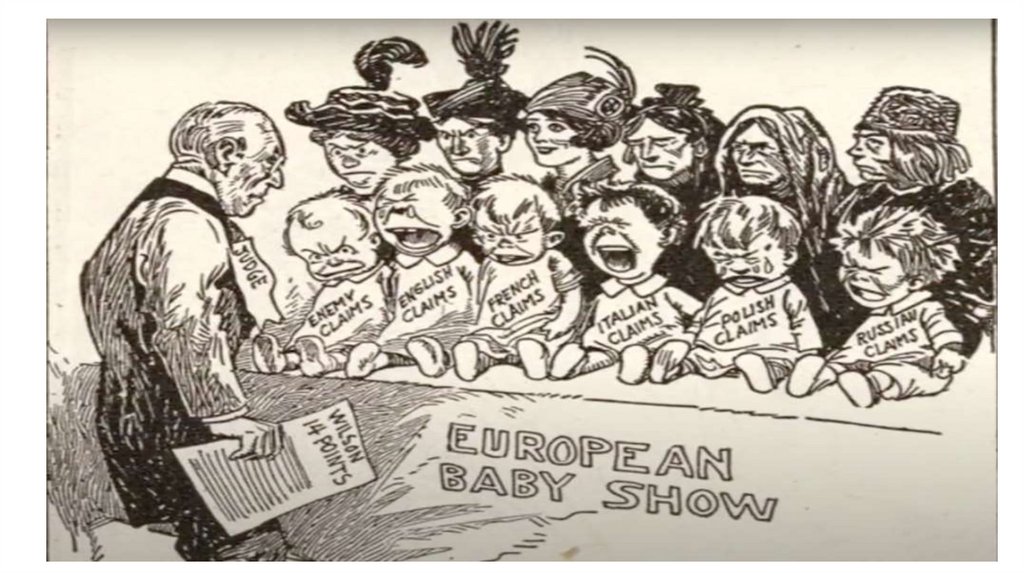
• Yet, the peace negotiations would not be characterized by a“peace without victory” mentality
• Great European Powers: diverging objectives
• France demanded guarantees against renewed German invasions;
asked that the part of Germany west of the Rhine be an independent
state under Allied control
• British vetoed the freedom of the seas; sought to preserve British
command of the sea
• Italy wanted to gain “Italian” territories in former Austria-Hungary,
Eastern-Europe; sought to manifest itself as one of the great European
powers
13.
14.
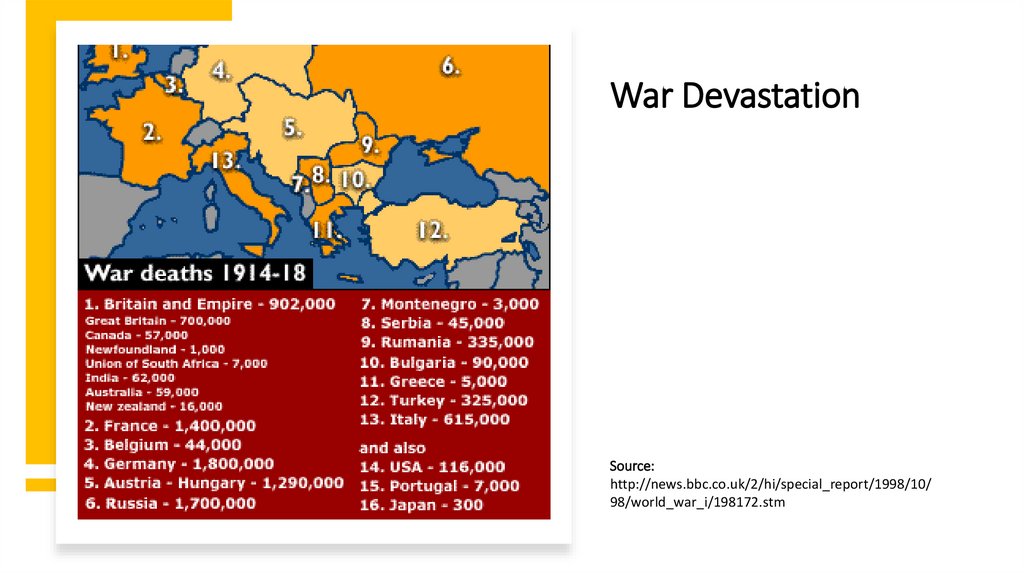
War DevastationSource:
http://news.bbc.co.uk/2/hi/special_report/1998/10/
98/world_war_i/198172.stm
15.
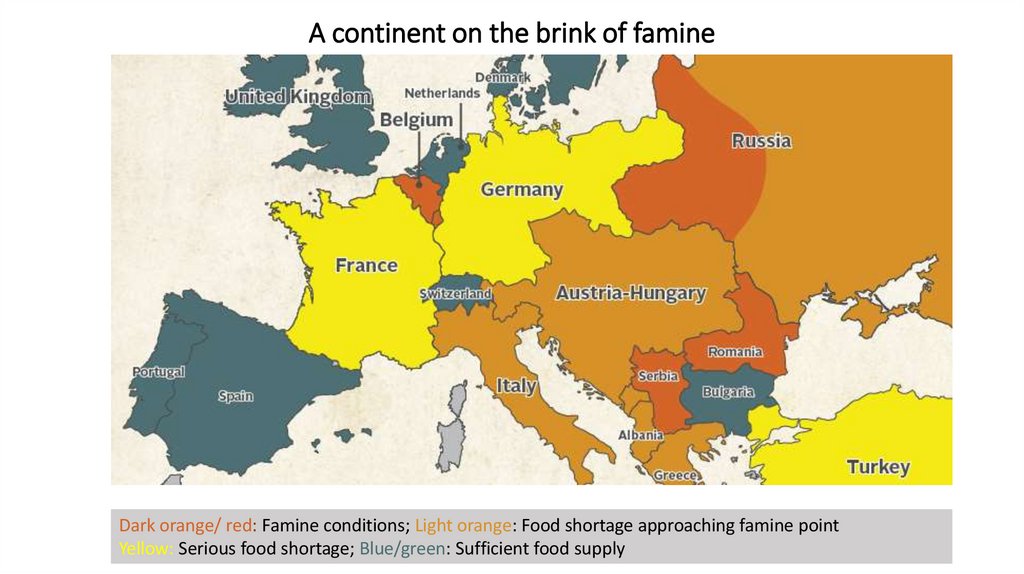
A continent on the brink of famineDark orange/ red: Famine conditions; Light orange: Food shortage approaching famine point
Yellow: Serious food shortage; Blue/green: Sufficient food supply
16.
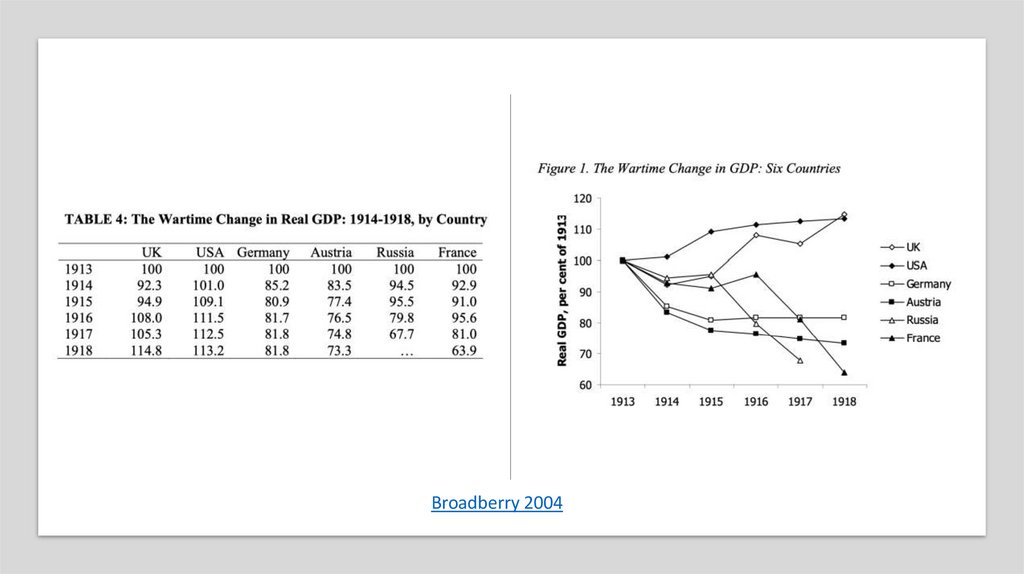
Broadberry 200417. 1. The Paris Peace Conference
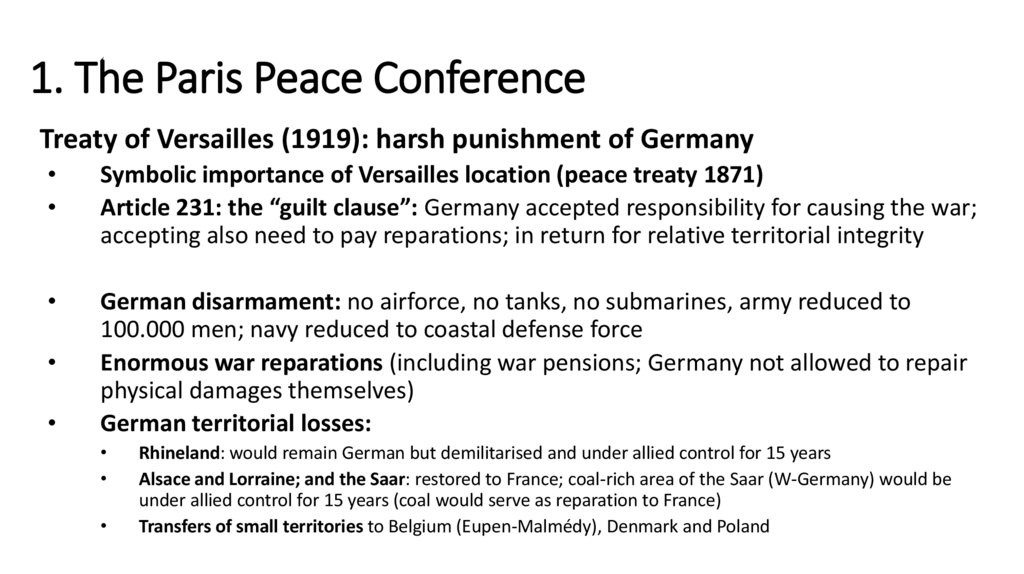
Treaty of Versailles (1919): harsh punishment of GermanySymbolic importance of Versailles location (peace treaty 1871)
Article 231: the “guilt clause”: Germany accepted responsibility for causing the war;
accepting also need to pay reparations; in return for relative territorial integrity
German disarmament: no airforce, no tanks, no submarines, army reduced to
100.000 men; navy reduced to coastal defense force
Enormous war reparations (including war pensions; Germany not allowed to repair
physical damages themselves)
German territorial losses:
Rhineland: would remain German but demilitarised and under allied control for 15 years
Alsace and Lorraine; and the Saar: restored to France; coal-rich area of the Saar (W-Germany) would be
under allied control for 15 years (coal would serve as reparation to France)
Transfers of small territories to Belgium (Eupen-Malmédy), Denmark and Poland
18.
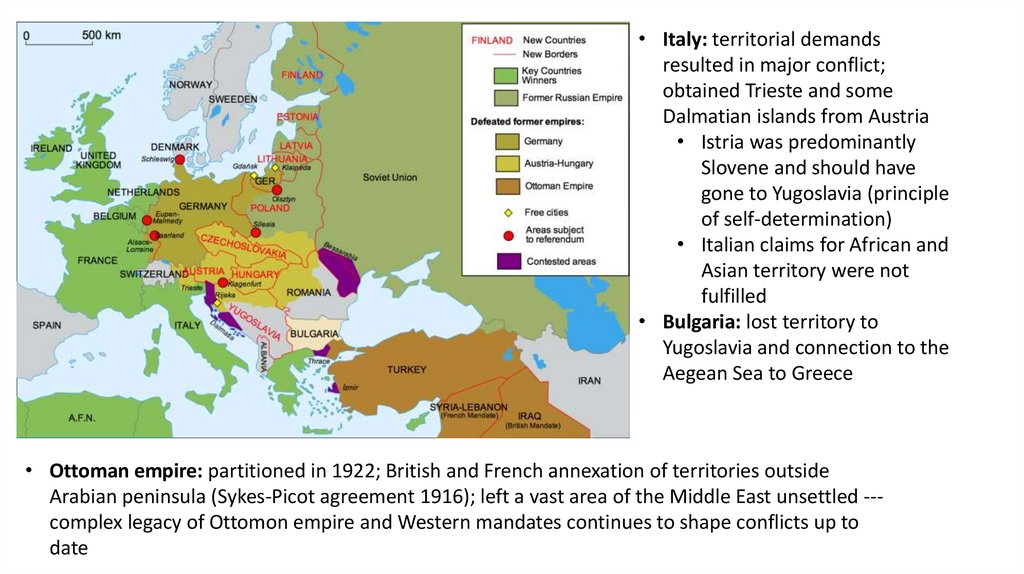
• The Austrian-Hungarian empirewas split into six new countries
(Austria, Hungary, Czechoslovakia,
Yugoslavia, Poland, Romania).
• One of these, Czechoslovakia,
would split into the Czech
Republic and Slovakia (1992).
• Former Serbia combined with
territories annexed from
Austria-Hungary formed
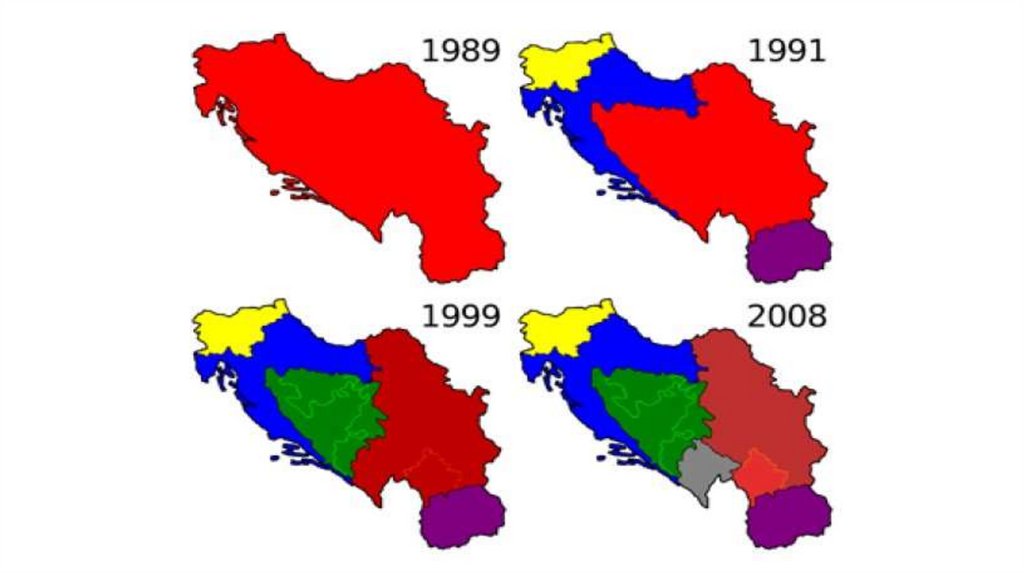
Yugoslavia, composed of
mainly South Slavic peoples. It
disintegrated in the early
1990s, producing several small
countries that exist in the
Balkans today.
• The Soviet Union (former empire
of Russia) lost territory to the new
Baltic states and to Poland.
• Poland got parts of Germany;
buffer against Bolshevik Russia.
19.
20.
• Italy: territorial demandsresulted in major conflict;
obtained Trieste and some
Dalmatian islands from Austria
• Istria was predominantly
Slovene and should have
gone to Yugoslavia (principle
of self-determination)
• Italian claims for African and
Asian territory were not
fulfilled
• Bulgaria: lost territory to
Yugoslavia and connection to the
Aegean Sea to Greece
• Ottoman empire: partitioned in 1922; British and French annexation of territories outside
Arabian peninsula (Sykes-Picot agreement 1916); left a vast area of the Middle East unsettled --complex legacy of Ottomon empire and Western mandates continues to shape conflicts up to
date
21. 1. The Paris Peace Conference
Treaty of Versailles (1919): harsh punishmentGermany lost all its colonies
Mandate system under League of Nations: Wilson – together with the South African General
Smuts – saw to it that the colonies of Germany were awarded to the League of Nations. The
League, then, under ”mandates”, assigned them to various powers for administration.
France and Great Britain divided up most of German colonies in Africa; Belgian Congo was
enlarged
Japan received a mandate for German Pacific Islands north of the Equator; claimed rights over
German concessions in China but only acquired about half of them.
Critique on violation of the principles of national self-determination was largely
ignored:
The Western European power continued to control their large Asian empires
The new mandate system even expanded their influence in Africa and the Middle East
22. 1. The Paris Peace Conference
Treaty of Versailles (1919): harsh punishmentCompleted in three months; in absence of German and Russian delegations
Germany first refused to sign ; threatened with a renewal of hostilities and blockade
“We know the full brunt of hate that confronts us here. You demand from us to confess we
were the only guilty party of war; such a confession in my mouth would be a lie.”
- Ulrich Graf van Brockdorff-Rantzau, foreign minister and head of German Delegation
“Which hand, trying to put us in chains like this, would not wither (lessen)? The Treaty is
unacceptable”
- Philipp Scheidemann, 1st democratically elected German Chancellor (Feb 1919)
Following a government crisis in Berlin (resignation Scheidemann), a new government
coalition consented to the burden, and agreed signing
23. 1. Significance of the Paris Peace Settlement
Triumph of (Western) nationalism• Yet, failure to fully solve all minority problems and irredentism (in particular, Eastern
Europe)
• Germans in Sudetenland of Czechoslovakia complained that they had been cut of from
Germany
• German punishment would bolster German nationalism
Failure of Treaty of Versailles (with Germany)
• Too severe to prevent German revanchism; too lenient to destroy German power;
remained an economically dominant pwoer
• Conflicts of interests between Great Powers remained
• Italy bitter over small territorial gains; China dissatisfied by Japanese gains, Russia objected
to cordon sanitaire and loss of territory; France felt duped over Rhineland and AngloAmerican guarantee of support against future German aggressions
• USA never ratified the Treaty nor entered the League of Nations (return to
isolationism)
24. 1. Significance of the Paris Peace Settlement
1920: Creation of the League of Nations• A Council (permanent members + elected members)
• An Assembly (representatives of member states)
• A Secretariat (Geneva) and Court of International Justice (The Hague)
Could not prevent WWII
• Lacked its own army; dependent on Allied Forces to enforce peace resolutions
• Weakened credibility:
• Its covenant was part of the Versailles treaty, and many saw in that treaty not a system for
international arbitration but a means for remaining the status quo in favor of Britain and
France
• USA: refused to sign; American Congress held sole constitutional power to declare war;
resisted mutual defense clause which would extend this power to the League
• 1935: Abysinnian crisis: Italy invades Ethiopia
• Soviet Union only joined late and briefly (expelled for invading Finland, 1939)
25. The Road Second World War II: class overview
1. The Paris Peace Conference in 19192. Interbellum (interwar period)
• Economic crisis
• Class polarisation
• Appeasement politics
3. Implications for Palestine
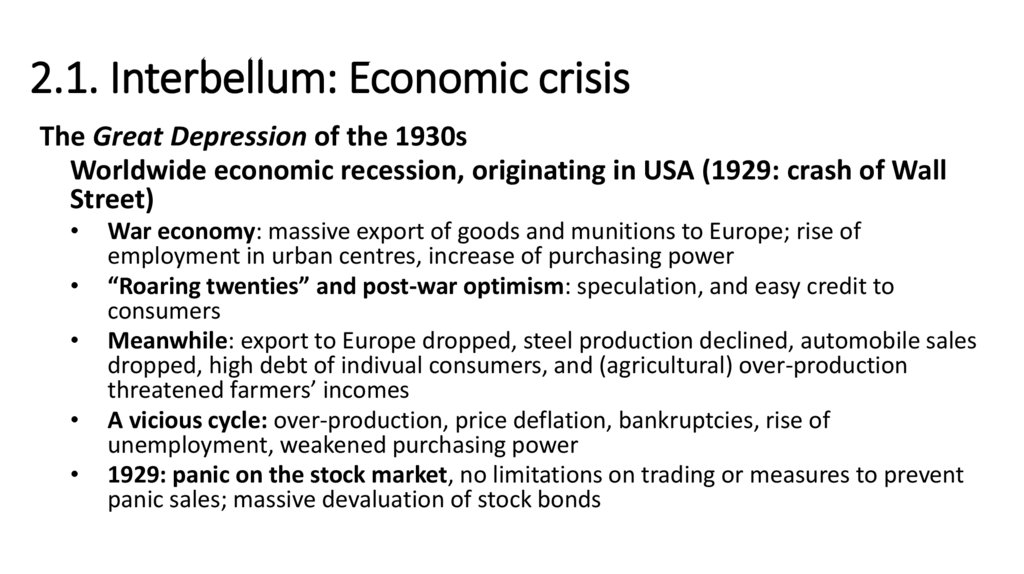
26. 2.1. Interbellum: Economic crisis
The Great Depression of the 1930sWorldwide economic recession, originating in USA (1929: crash of Wall
Street)
War economy: massive export of goods and munitions to Europe; rise of
employment in urban centres, increase of purchasing power
“Roaring twenties” and post-war optimism: speculation, and easy credit to
consumers
Meanwhile: export to Europe dropped, steel production declined, automobile sales
dropped, high debt of indivual consumers, and (agricultural) over-production
threatened farmers’ incomes
A vicious cycle: over-production, price deflation, bankruptcies, rise of
unemployment, weakened purchasing power
1929: panic on the stock market, no limitations on trading or measures to prevent
panic sales; massive devaluation of stock bonds
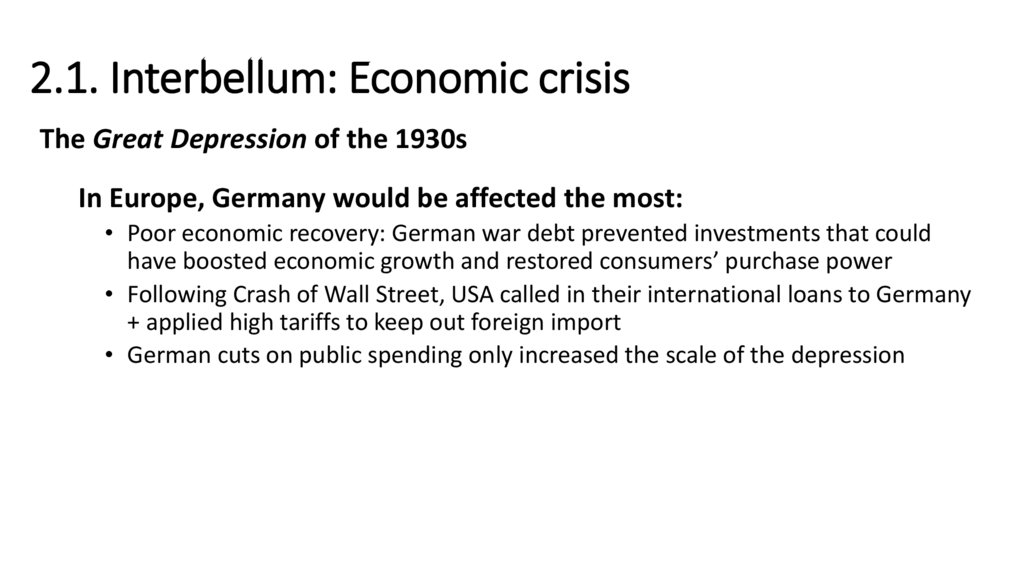
27. 2.1. Interbellum: Economic crisis
The Great Depression of the 1930sIn Europe, Germany would be affected the most:
• Poor economic recovery: German war debt prevented investments that could
have boosted economic growth and restored consumers’ purchase power
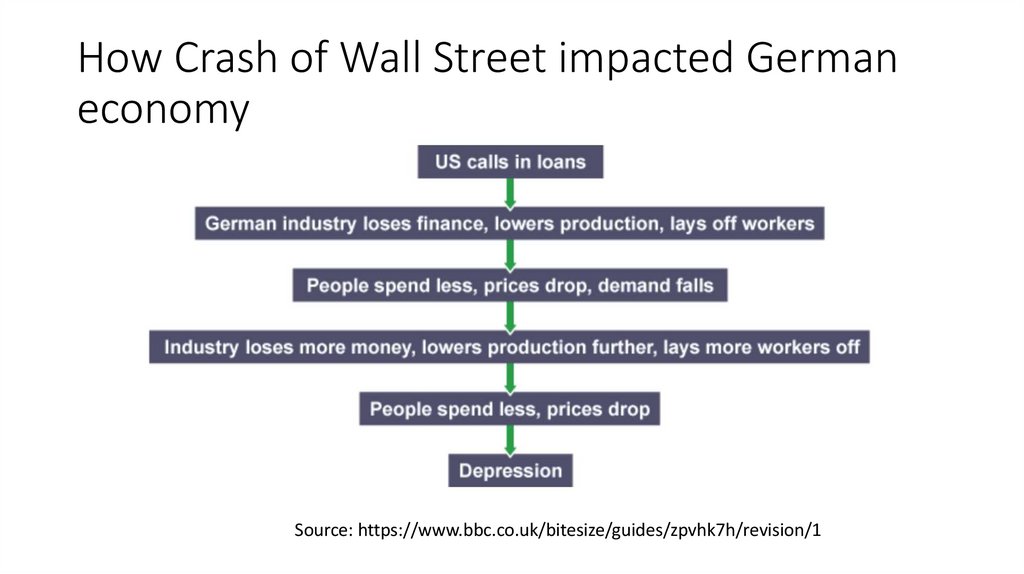
• Following Crash of Wall Street, USA called in their international loans to Germany
+ applied high tariffs to keep out foreign import
• German cuts on public spending only increased the scale of the depression
28. How Crash of Wall Street impacted German economy
Source: https://www.bbc.co.uk/bitesize/guides/zpvhk7h/revision/129. 2.2. Interbellum: Class polarisation (Left vs. Right)
WWI war effort had intensified the “social question”Vacuum of political power (= collapse of monarchies)
Heightened inequality: radicalisation and working-class militancy
Labour shortages enhanced the negotiation power of labour unions
• Yet, lack of a unified left (communists vs. social-democrats; participation in WWI or not)
• 1917 Russian revolution: public feared renewed destabilization; this fear provided
opportunities for ultra-right, nationalist groupings (fascism)
“From a European war, a revolution may spring up and the ruling classes would do well to
think of this. But it may also result, over a long period, in crises of counter-revolution, of
furious reaction, of exasperated nationalism, of stifling dictatorships, of monstrous
militarism, a long chain of retrograde violence.”
- Jean Jaurès (1859-1914) – anti-militarist statement in 1905
30.
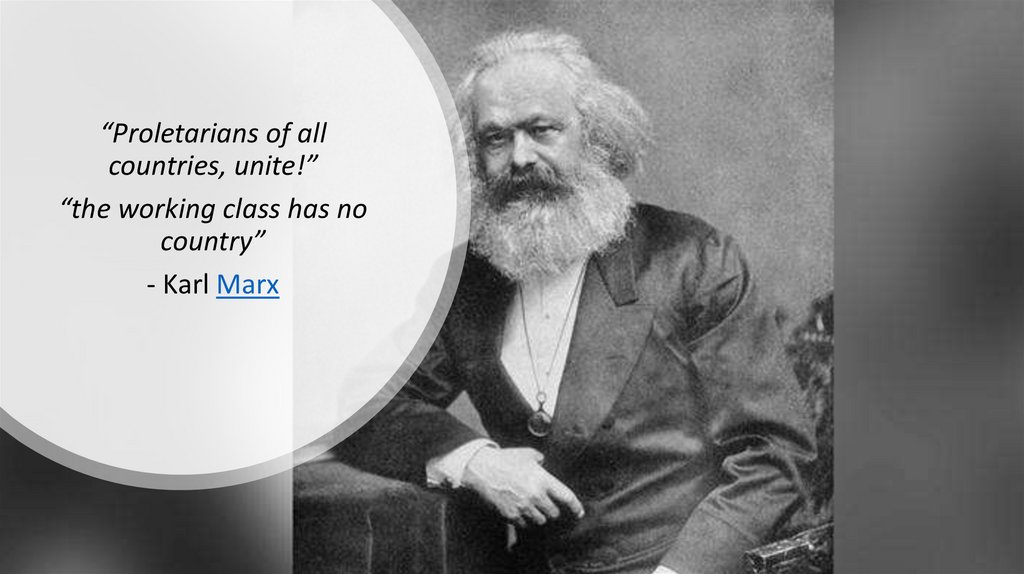
“Proletarians of allcountries, unite!”
“the working class has no
country”
- Karl Marx
31. 2.2. Interbellum: Class polarisation
“Bolshevik Russia became a beacon of hope (“baken van hoop”)for the left in Europe and a spectre of fear (“een angstbeeld”) for
the right.”
- Paul Preston (2005)
32. 2.2. Interbellum: Communist threat
• The Russian Revolution (1917)• Clip: Visual Academia
• Russian revolution of 1917 can be compared in its historical
magnitude with the French Revolution of 1789
• While the Fr. Revolution claimed to be a movement of liberation against
feudalism and despotism, the Russian Revolution claimed to be a liberation
against capitalism and imperialism
• Like with the Fr. Revolution relative unity of opinions at the level of
overthrowing the traditional (tsarist) regime, yet disunity and conflict over
the founding of the new regime
• Like with the Fr. Revolution, a minority of radicals organised and managed to
suppress all opposition in order to defend the revolutionary cause
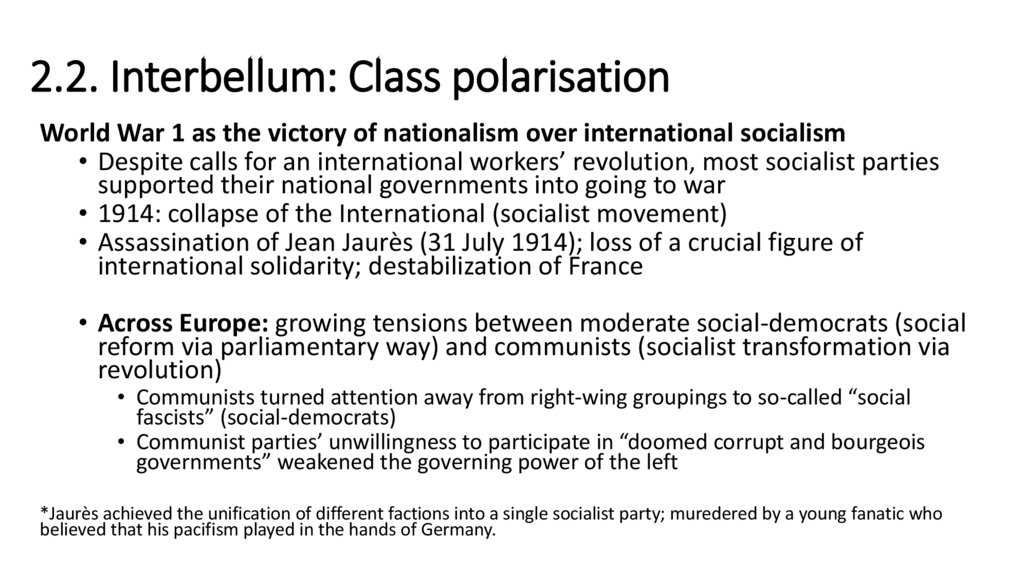
33. 2.2. Interbellum: Class polarisation
World War 1 as the victory of nationalism over international socialism• Despite calls for an international workers’ revolution, most socialist parties
supported their national governments into going to war
• 1914: collapse of the International (socialist movement)
• Assassination of Jean Jaurès (31 July 1914); loss of a crucial figure of
international solidarity; destabilization of France
• Across Europe: growing tensions between moderate social-democrats (social
reform via parliamentary way) and communists (socialist transformation via
revolution)
• Communists turned attention away from right-wing groupings to so-called “social
fascists” (social-democrats)
• Communist parties’ unwillingness to participate in “doomed corrupt and bourgeois
governments” weakened the governing power of the left
*Jaurès achieved the unification of different factions into a single socialist party; muredered by a young fanatic who
believed that his pacifism played in the hands of Germany.
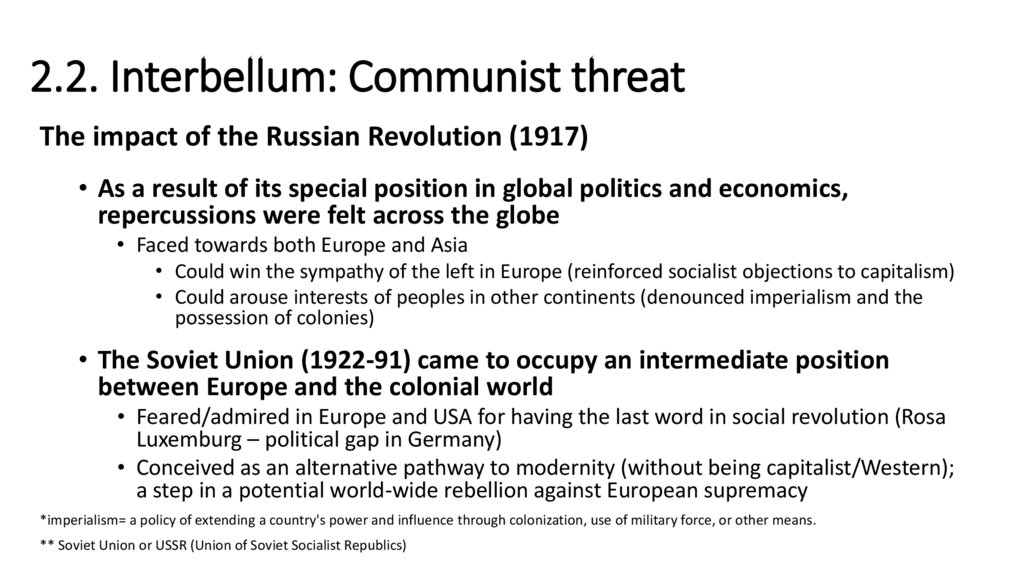
34. 2.2. Interbellum: Communist threat
The impact of the Russian Revolution (1917)• As a result of its special position in global politics and economics,
repercussions were felt across the globe
• Faced towards both Europe and Asia
• Could win the sympathy of the left in Europe (reinforced socialist objections to capitalism)
• Could arouse interests of peoples in other continents (denounced imperialism and the
possession of colonies)
• The Soviet Union (1922-91) came to occupy an intermediate position
between Europe and the colonial world
• Feared/admired in Europe and USA for having the last word in social revolution (Rosa
Luxemburg – political gap in Germany)
• Conceived as an alternative pathway to modernity (without being capitalist/Western);
a step in a potential world-wide rebellion against European supremacy
*imperialism= a policy of extending a country's power and influence through colonization, use of military force, or other means.
** Soviet Union or USSR (Union of Soviet Socialist Republics)
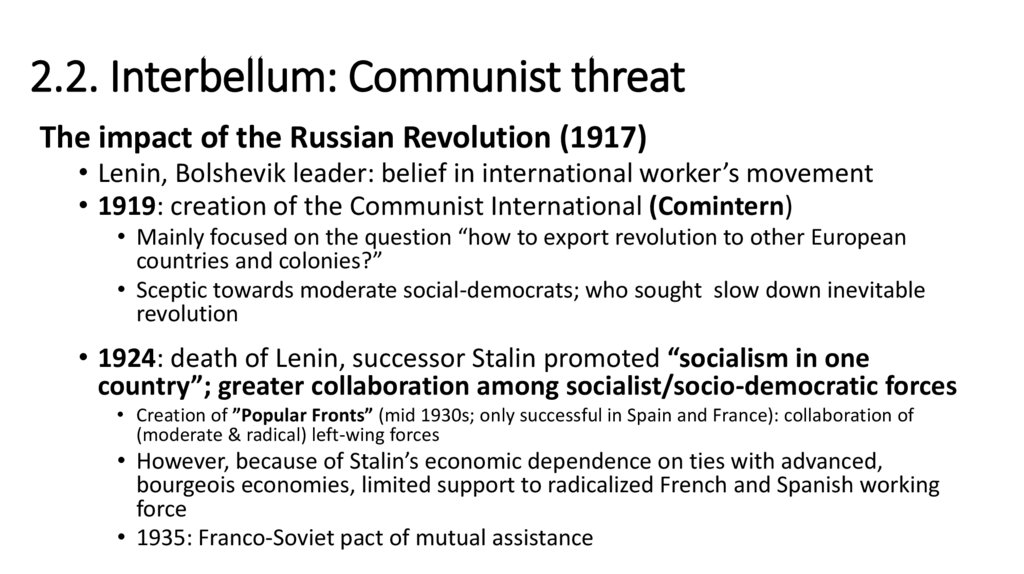
35. 2.2. Interbellum: Communist threat
The impact of the Russian Revolution (1917)• Lenin, Bolshevik leader: belief in international worker’s movement
• 1919: creation of the Communist International (Comintern)
• Mainly focused on the question “how to export revolution to other European
countries and colonies?”
• Sceptic towards moderate social-democrats; who sought slow down inevitable
revolution
• 1924: death of Lenin, successor Stalin promoted “socialism in one
country”; greater collaboration among socialist/socio-democratic forces
• Creation of ”Popular Fronts” (mid 1930s; only successful in Spain and France): collaboration of
(moderate & radical) left-wing forces
• However, because of Stalin’s economic dependence on ties with advanced,
bourgeois economies, limited support to radicalized French and Spanish working
force
• 1935: Franco-Soviet pact of mutual assistance
36. 2.2. Class polarisation --- Italy
• 1919: Partito Socialista Italiano (PSI)• Growing popularity in WWI; dominance in rural areas of the Po valley
(labour shortages as result of mass conscription during war); attempts to
dictate labour conditions and land use enraged land and factory-owners
• 1919: 156/508 parliamentary seats; biggest single party but no
participation in government
• Split between “minimalists” (social democrats) and “maximalists” (revolution)
• Because the largest party did not participate in government formation ----unstable
governmental coalitions + no access to key government positions (ministry of war
and interior) that could have stopped fascists
• 1920-1921: Fascists control Po valley
• 1922: Benito Mussolini --- “March on Rome”
• 30.000 participants fear for civil war King Victor Emmanuel III (King of Italy)
transfers power to Mussolini
37. A peaceful transfer of power – March on Rome (1922)
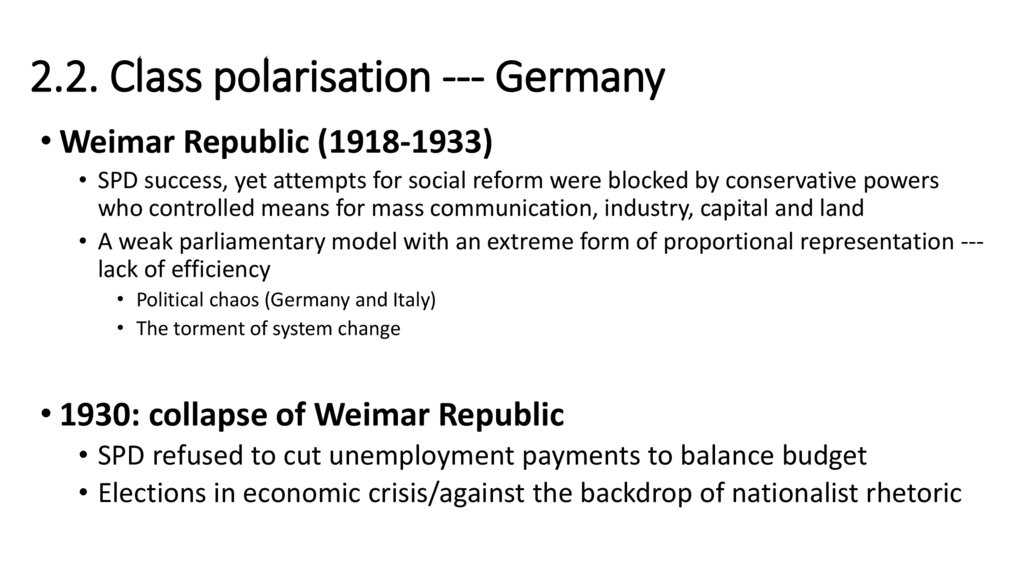
38. 2.2. Class polarisation --- Germany
• Weimar Republic (1918-1933)• SPD success, yet attempts for social reform were blocked by conservative powers
who controlled means for mass communication, industry, capital and land
• A weak parliamentary model with an extreme form of proportional representation --lack of efficiency
• Political chaos (Germany and Italy)
• The torment of system change
• 1930: collapse of Weimar Republic
• SPD refused to cut unemployment payments to balance budget
• Elections in economic crisis/against the backdrop of nationalist rhetoric
39. 2.2. Class polarisation --- Germany
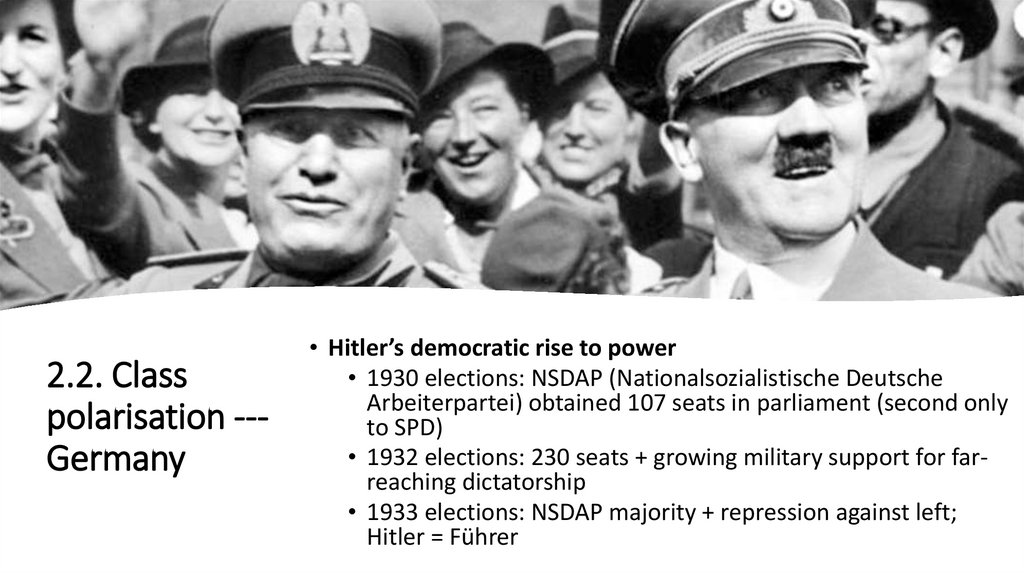
2.2. Classpolarisation --Germany
• Hitler’s democratic rise to power
• 1930 elections: NSDAP (Nationalsozialistische Deutsche
Arbeiterpartei) obtained 107 seats in parliament (second only
to SPD)
• 1932 elections: 230 seats + growing military support for farreaching dictatorship
• 1933 elections: NSDAP majority + repression against left;
Hitler = Führer
40.
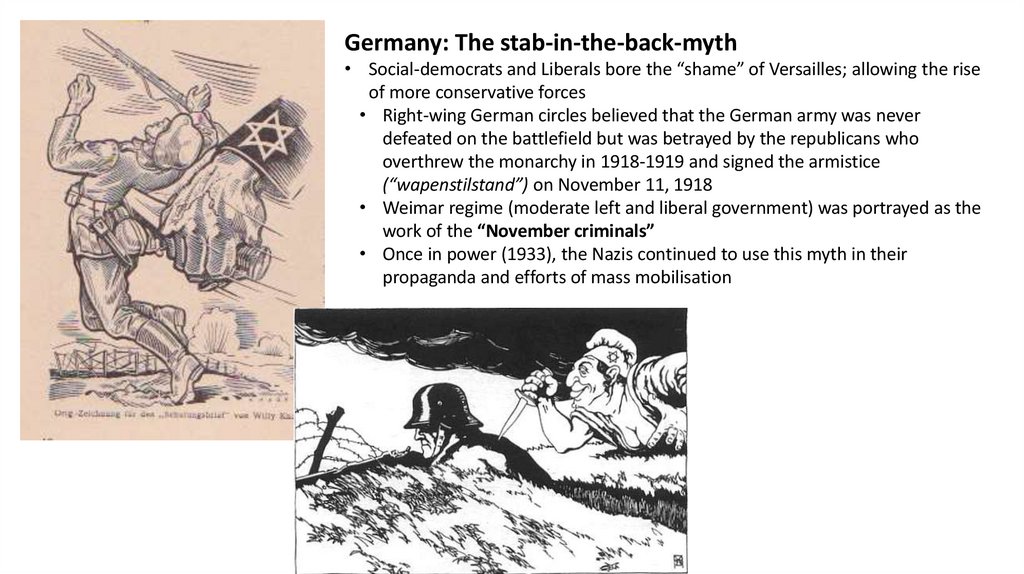
Germany: The stab-in-the-back-myth• Social-democrats and Liberals bore the “shame” of Versailles; allowing the rise
of more conservative forces
• Right-wing German circles believed that the German army was never
defeated on the battlefield but was betrayed by the republicans who
overthrew the monarchy in 1918-1919 and signed the armistice
(“wapenstilstand”) on November 11, 1918
• Weimar regime (moderate left and liberal government) was portrayed as the
work of the “November criminals”
• Once in power (1933), the Nazis continued to use this myth in their
propaganda and efforts of mass mobilisation
41.
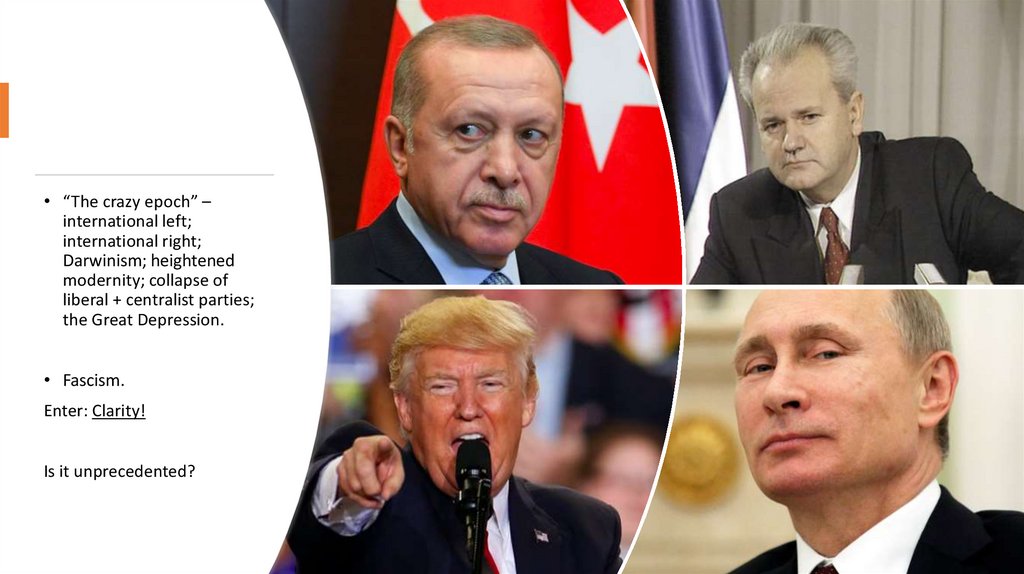
• “The crazy epoch” –international left;
international right;
Darwinism; heightened
modernity; collapse of
liberal + centralist parties;
the Great Depression.
• Fascism.
Enter: Clarity!
Is it unprecedented?
42. 2.2. Class polarisation --- Spanish civil war
• 1931-1933: coalition of middle-class liberal republicans & moderatesocialists (social reform program)
• 1933: socialist gamble: to stop growing popularity of right-wing parties,
socialists run for elections alone ---- right-wing victory (overturn social
reforms)
• 1934: uprising of socialists/anarchists/communists in mining districts in
Spain; harsh repression by military
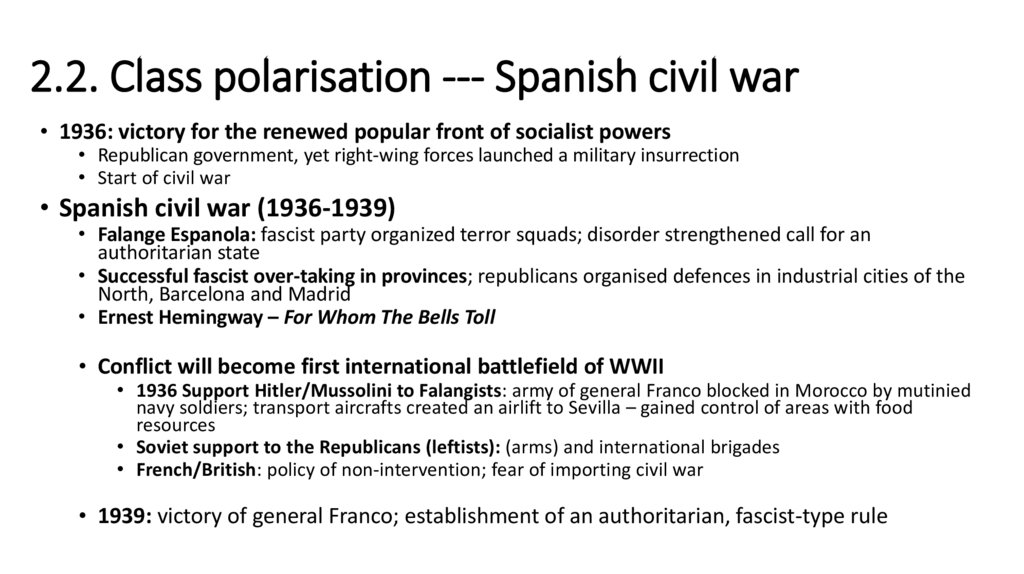
43. 2.2. Class polarisation --- Spanish civil war
• 1936: victory for the renewed popular front of socialist powers• Republican government, yet right-wing forces launched a military insurrection
• Start of civil war
• Spanish civil war (1936-1939)
• Falange Espanola: fascist party organized terror squads; disorder strengthened call for an
authoritarian state
• Successful fascist over-taking in provinces; republicans organised defences in industrial cities of the
North, Barcelona and Madrid
• Ernest Hemingway – For Whom The Bells Toll
• Conflict will become first international battlefield of WWII
• 1936 Support Hitler/Mussolini to Falangists: army of general Franco blocked in Morocco by mutinied
navy soldiers; transport aircrafts created an airlift to Sevilla – gained control of areas with food
resources
• Soviet support to the Republicans (leftists): (arms) and international brigades
• French/British: policy of non-intervention; fear of importing civil war
• 1939: victory of general Franco; establishment of an authoritarian, fascist-type rule
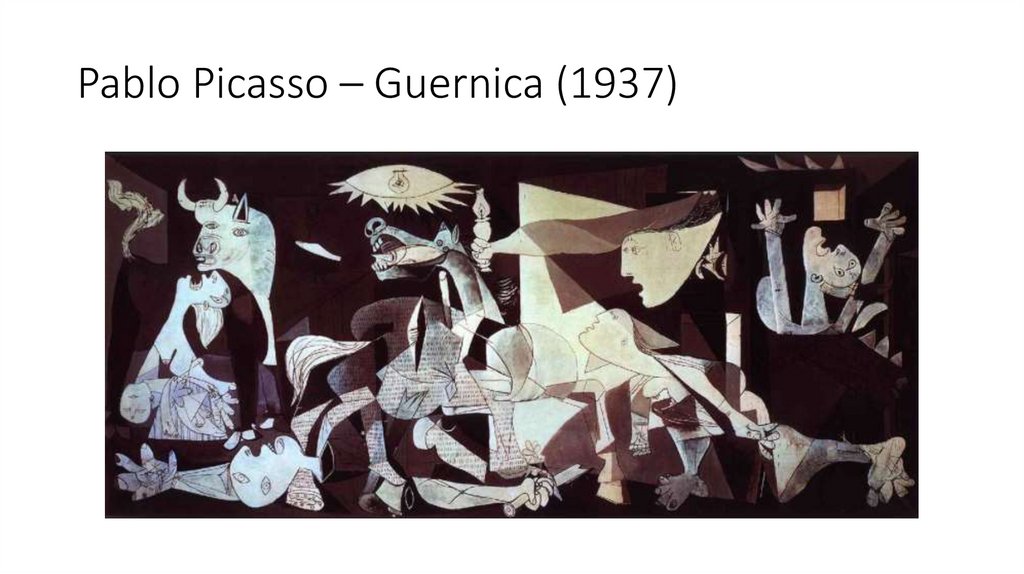
44. Pablo Picasso – Guernica (1937)
45.
“The Great Depression ushered in the nightmare of the 1930s. Everywherethe demand was for security. Each nation tried to live, insofar as possible,
within itself. (…) Within each country, the same search for security
encouraged the advancement of the welfare state and social democracy.
Where democratic institutions were strong and resilient, governments took
steps to protect individuals against the ravages of unemployment and
destitution and to help guard against future catastrophes. This political
response to the economic crisis shaped new democratic social reforms in
northwestern Europe and the United States. (…) On the other hand, where
democratic governments were not well established or taken for granted,
which was the case in many countries after the WWI, dictatorship spread
alarmingly in the 1930s with the coming of the Depression. Democracy was
said to be suited only to wealthy and prosperous countries. Unemployed
people generally cared far more for (promises of) economic help than for
any theory of how persons wielding public power should be selected. The
cry was for a leader, someone who would act, make decisions, get results,
inspire confidence, and restore national pride”
- Palmer, Colton and Kramer (2014, p. 811).
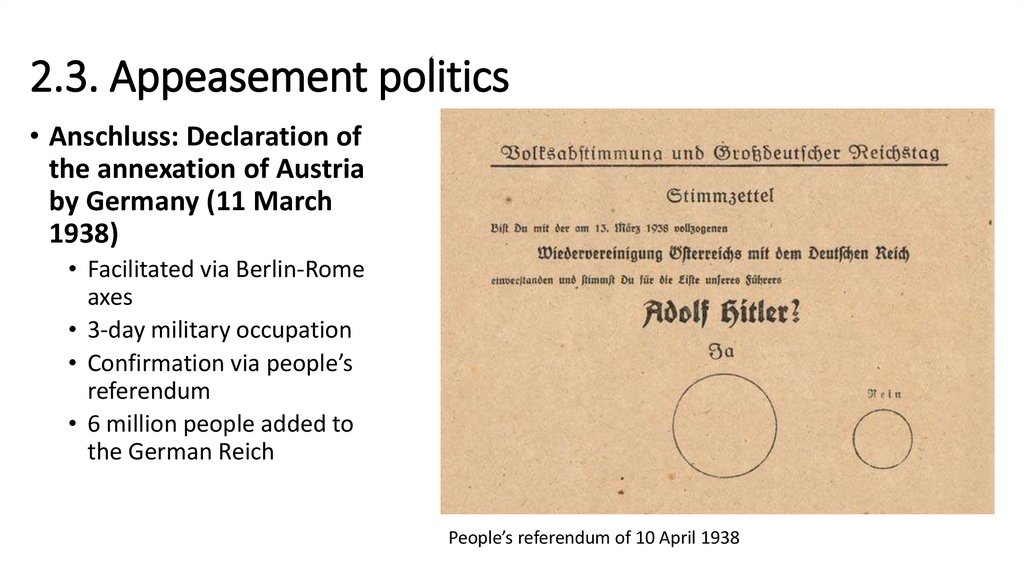
46. 2.3. Appeasement politics
• Anschluss: Declaration ofthe annexation of Austria
by Germany (11 March
1938)
• Facilitated via Berlin-Rome
axes
• 3-day military occupation
• Confirmation via people’s
referendum
• 6 million people added to
the German Reich
People’s referendum of 10 April 1938
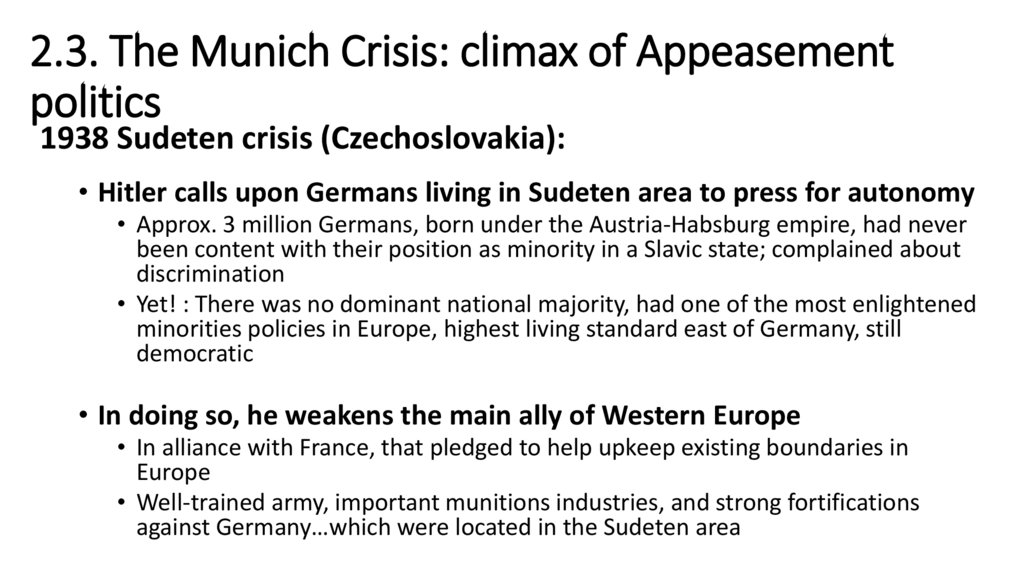
47. 2.3. The Munich Crisis: climax of Appeasement politics
1938 Sudeten crisis (Czechoslovakia):• Hitler calls upon Germans living in Sudeten area to press for autonomy
• Approx. 3 million Germans, born under the Austria-Habsburg empire, had never
been content with their position as minority in a Slavic state; complained about
discrimination
• Yet! : There was no dominant national majority, had one of the most enlightened
minorities policies in Europe, highest living standard east of Germany, still
democratic
• In doing so, he weakens the main ally of Western Europe
• In alliance with France, that pledged to help upkeep existing boundaries in
Europe
• Well-trained army, important munitions industries, and strong fortifications
against Germany…which were located in the Sudeten area
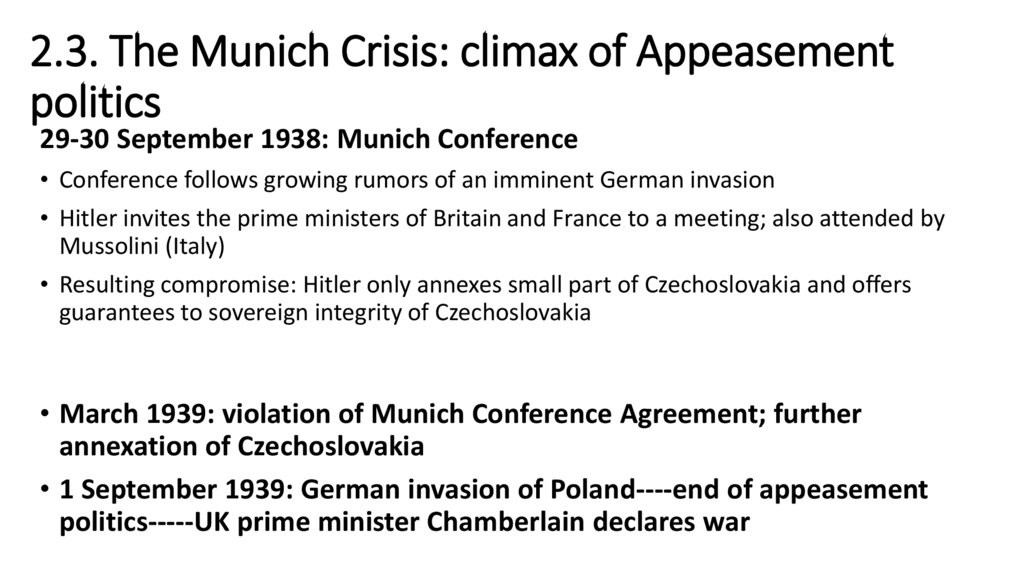
48. 2.3. The Munich Crisis: climax of Appeasement politics
29-30 September 1938: Munich Conference• Conference follows growing rumors of an imminent German invasion
• Hitler invites the prime ministers of Britain and France to a meeting; also attended by
Mussolini (Italy)
• Resulting compromise: Hitler only annexes small part of Czechoslovakia and offers
guarantees to sovereign integrity of Czechoslovakia
• March 1939: violation of Munich Conference Agreement; further
annexation of Czechoslovakia
• 1 September 1939: German invasion of Poland----end of appeasement
politics-----UK prime minister Chamberlain declares war
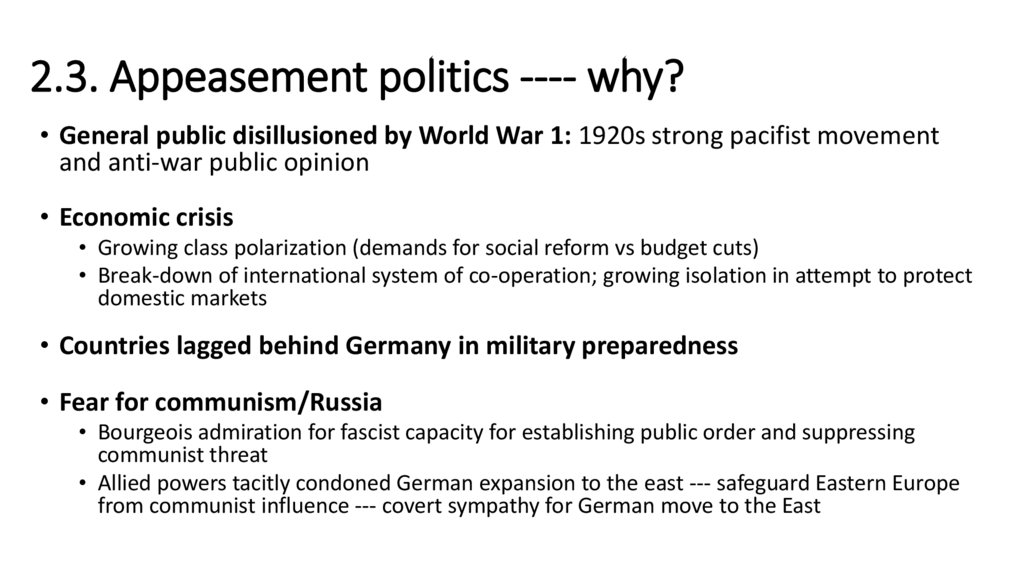
49. 2.3. Appeasement politics ---- why?
• General public disillusioned by World War 1: 1920s strong pacifist movementand anti-war public opinion
• Economic crisis
• Growing class polarization (demands for social reform vs budget cuts)
• Break-down of international system of co-operation; growing isolation in attempt to protect
domestic markets
• Countries lagged behind Germany in military preparedness
• Fear for communism/Russia
• Bourgeois admiration for fascist capacity for establishing public order and suppressing
communist threat
• Allied powers tacitly condoned German expansion to the east --- safeguard Eastern Europe
from communist influence --- covert sympathy for German move to the East
50. The Road Second World War II: class overview
1. The Paris Peace Conference in 19192. Interbellum (interwar period)
• Economic crisis
• Class polarisation
• Appeasement politics
3. Implications for Palestine
51.
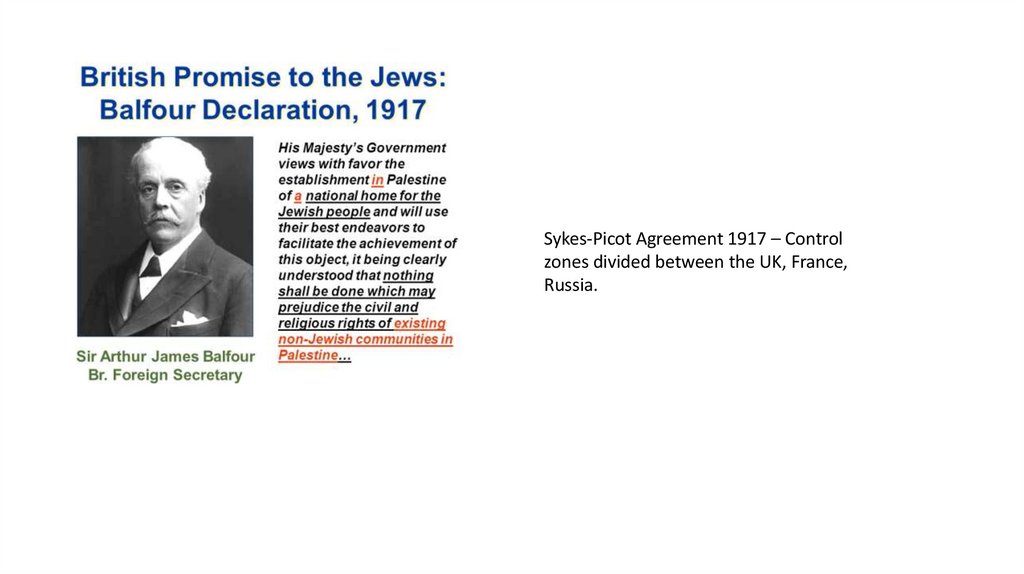
Sykes-Picot Agreement 1917 – Controlzones divided between the UK, France,
Russia.
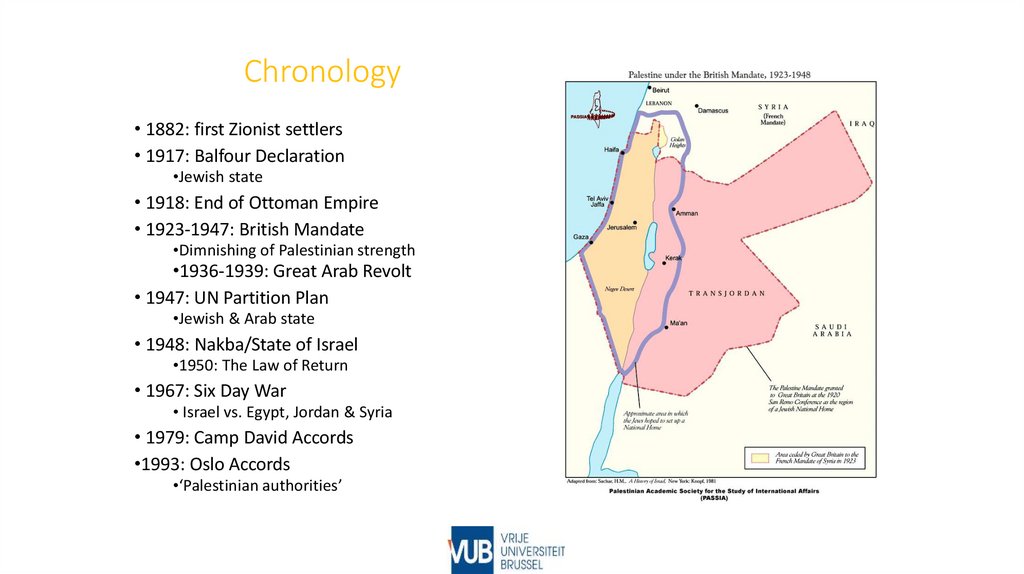
52. Chronology
• 1882: first Zionist settlers• 1917: Balfour Declaration
•Jewish state
• 1918: End of Ottoman Empire
• 1923-1947: British Mandate
•Dimnishing of Palestinian strength
•1936-1939: Great Arab Revolt
• 1947: UN Partition Plan
•Jewish & Arab state
• 1948: Nakba/State of Israel
•1950: The Law of Return
• 1967: Six Day War
• Israel vs. Egypt, Jordan & Syria
• 1979: Camp David Accords
•1993: Oslo Accords
•‘Palestinian authorities’
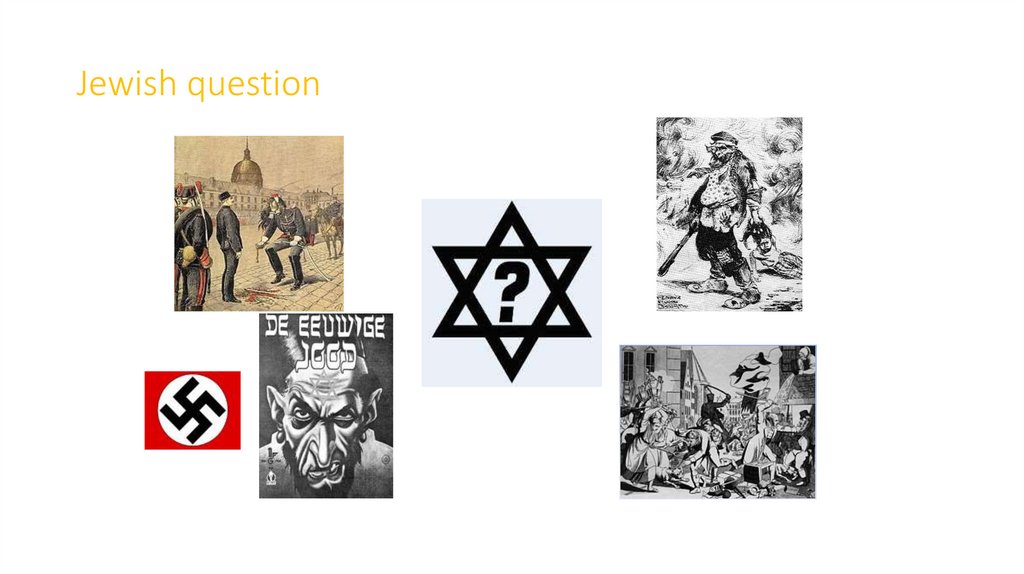
53. Jewish question
54.
55.
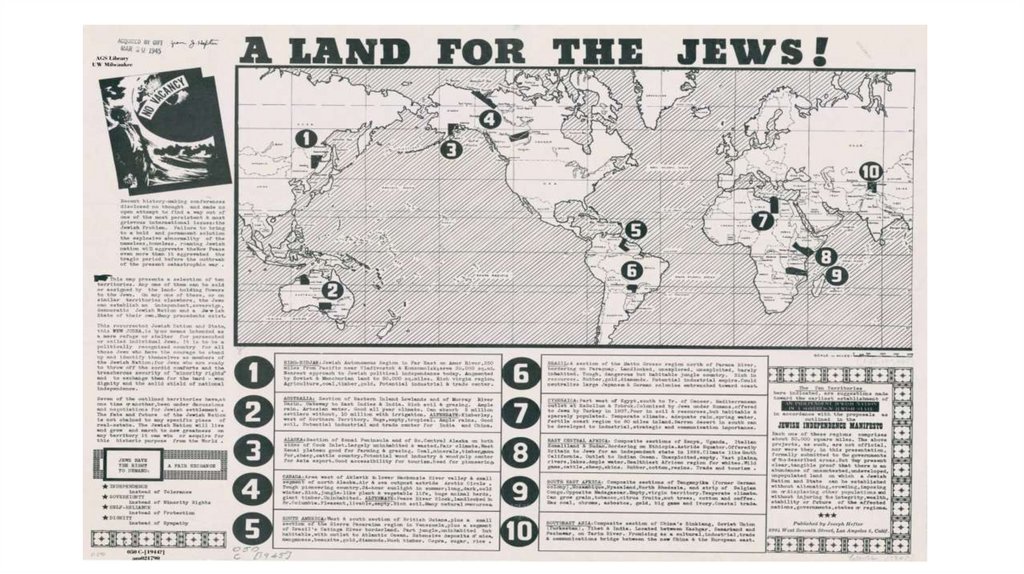
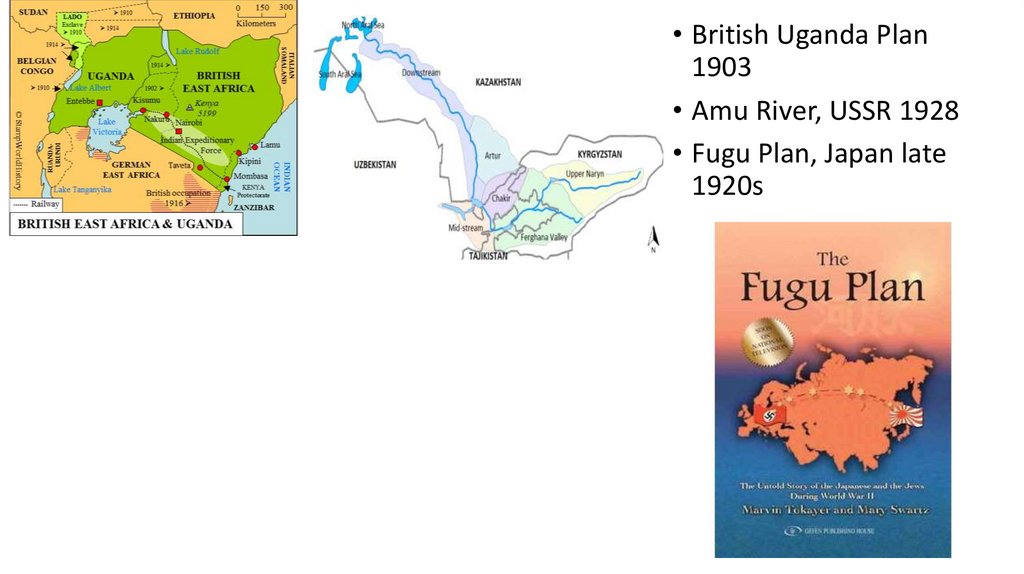
• British Uganda Plan1903
• Amu River, USSR 1928
• Fugu Plan, Japan late
1920s
56. Jewish solution: Land
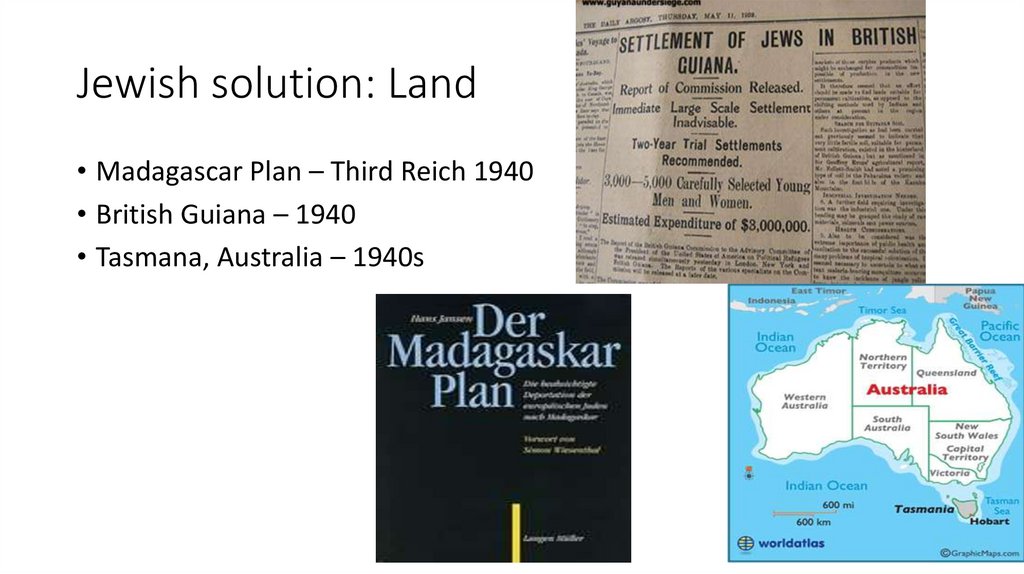
• Madagascar Plan – Third Reich 1940• British Guiana – 1940
• Tasmana, Australia – 1940s
57. Paradigms
Jewish nationalismRacism
Colonialism
Settler Colonialism
58. Paradigm of Jewish nationalism
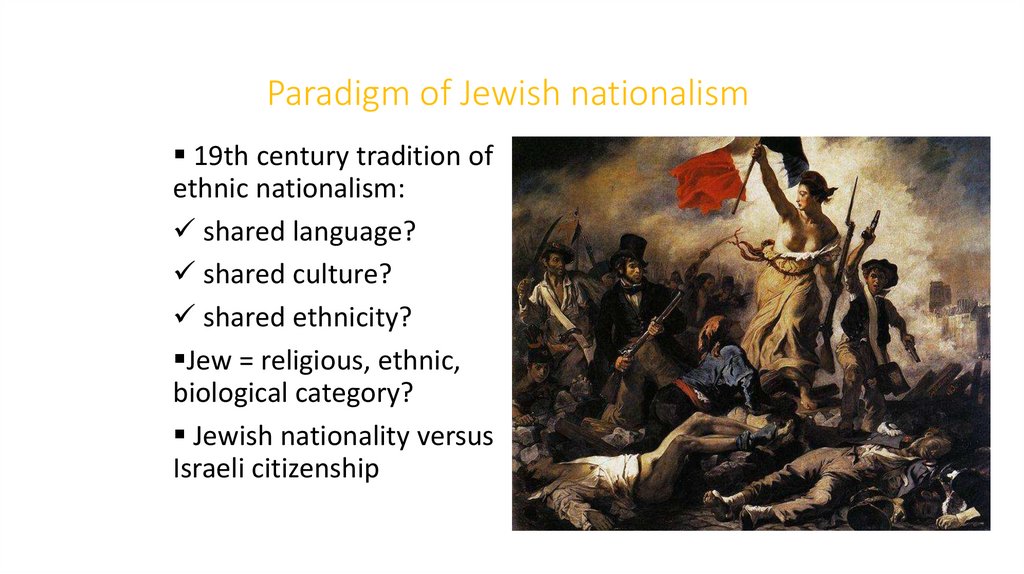
19th century tradition ofethnic nationalism:
shared language?
shared culture?
shared ethnicity?
Jew = religious, ethnic,
biological category?
Jewish nationality versus
Israeli citizenship
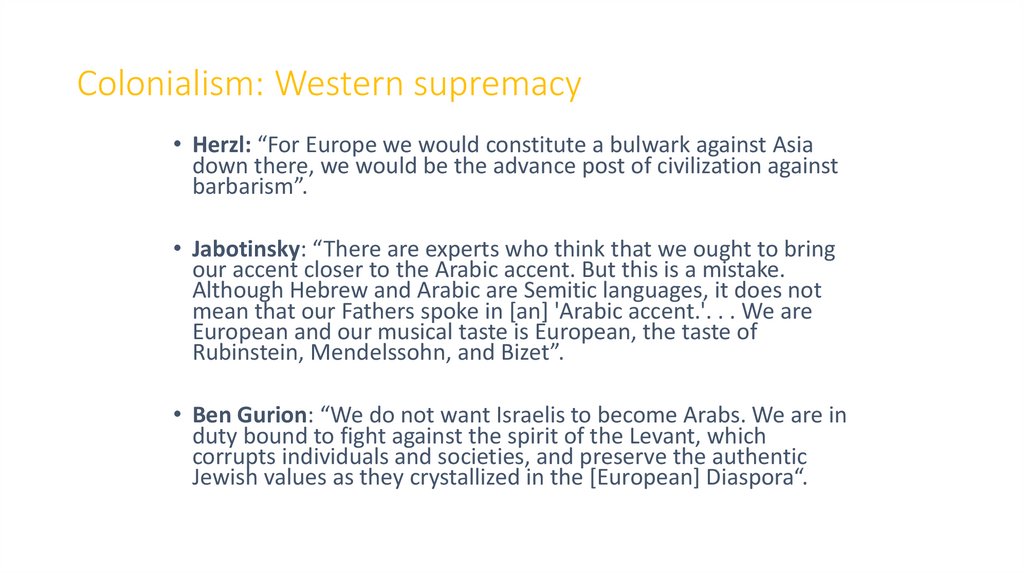
59. Colonialism: Western supremacy
• Herzl: “For Europe we would constitute a bulwark against Asiadown there, we would be the advance post of civilization against
barbarism”.
• Jabotinsky: “There are experts who think that we ought to bring
our accent closer to the Arabic accent. But this is a mistake.
Although Hebrew and Arabic are Semitic languages, it does not
mean that our Fathers spoke in [an] 'Arabic accent.'. . . We are
European and our musical taste is European, the taste of
Rubinstein, Mendelssohn, and Bizet”.
• Ben Gurion: “We do not want Israelis to become Arabs. We are in
duty bound to fight against the spirit of the Levant, which
corrupts individuals and societies, and preserve the authentic
Jewish values as they crystallized in the [European] Diaspora“.
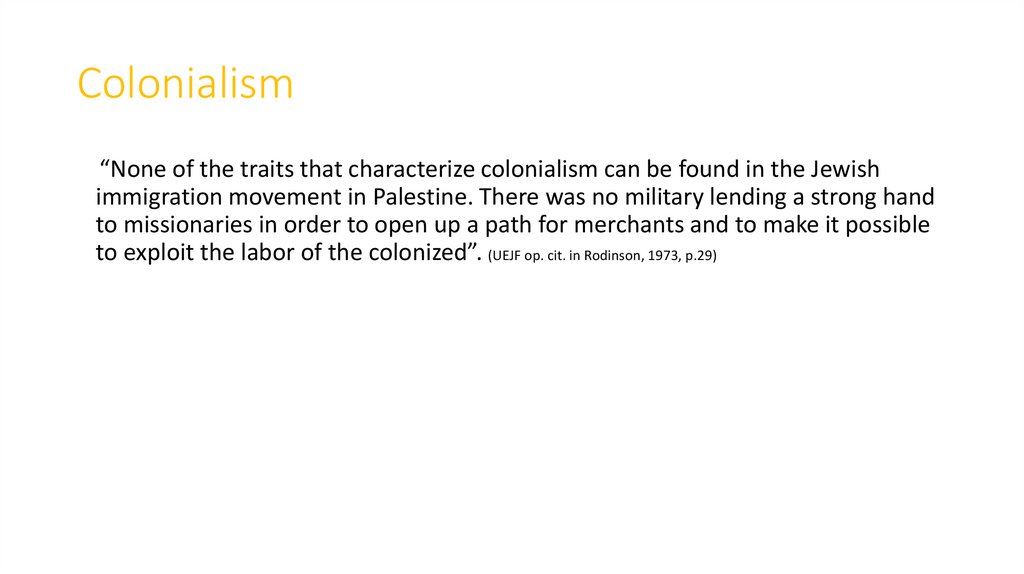
60. Colonialism
“None of the traits that characterize colonialism can be found in the Jewishimmigration movement in Palestine. There was no military lending a strong hand
to missionaries in order to open up a path for merchants and to make it possible
to exploit the labor of the colonized”. (UEJF op. cit. in Rodinson, 1973, p.29)
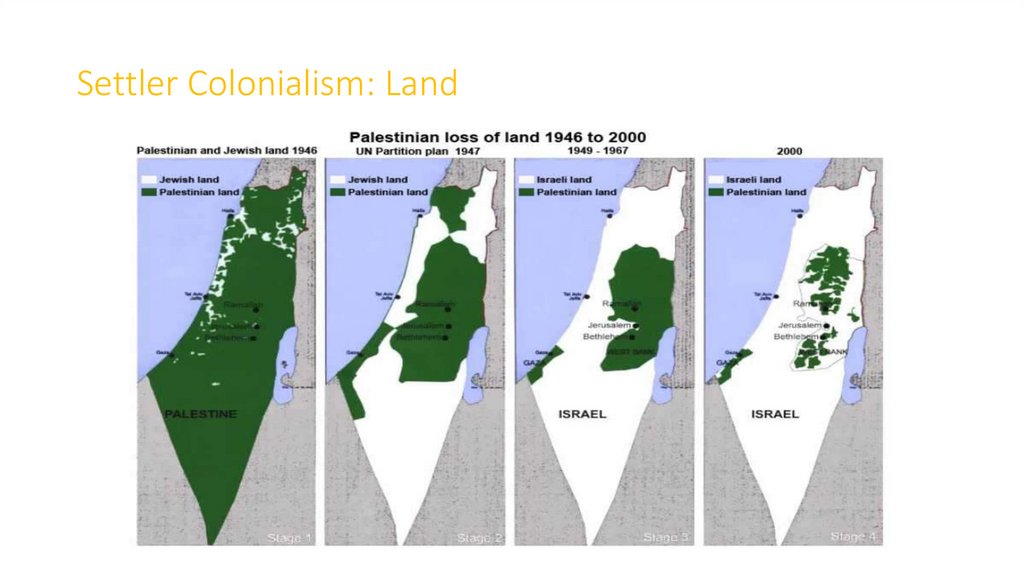
61. Settler Colonialism: Land
• Ruppin: "Land is the most necessary thing for establishing roots inPalestine. Since there are hardly any more arable unsettled lands. . . .
we are bound in each case. . . to remove the peasants who cultivate
the land.” (Ruppin, 1913)
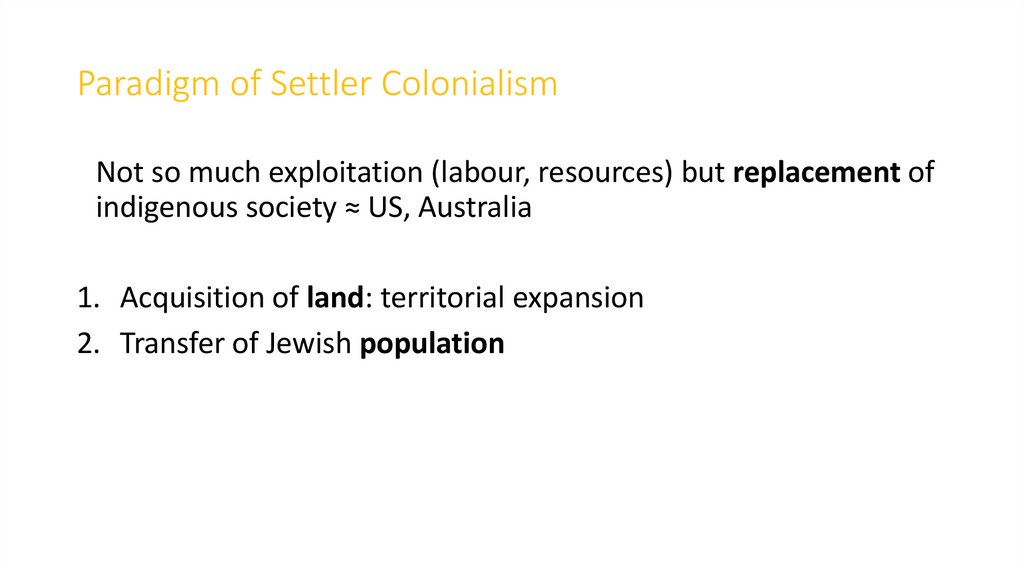
62. Paradigm of Settler Colonialism
Not so much exploitation (labour, resources) but replacement ofindigenous society ≈ US, Australia
1. Acquisition of land: territorial expansion
2. Transfer of Jewish population
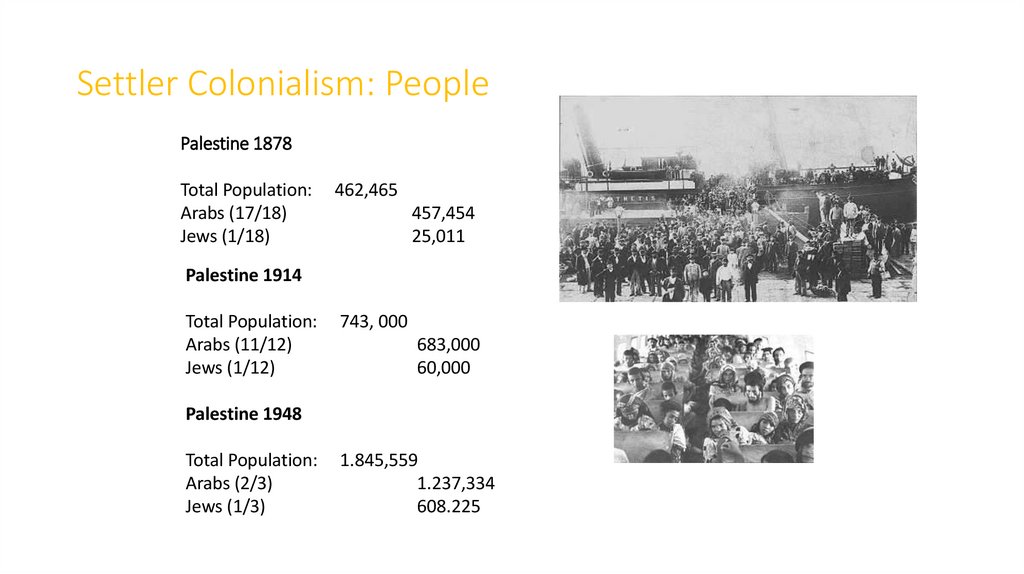
63. Settler Colonialism: People
Palestine 1878Total Population:
Arabs (17/18)
Jews (1/18)
462,465
457,454
25,011
Palestine 1914
Total Population:
Arabs (11/12)
Jews (1/12)
743, 000
683,000
60,000
Palestine 1948
Total Population:
Arabs (2/3)
Jews (1/3)
1.845,559
1.237,334
608.225
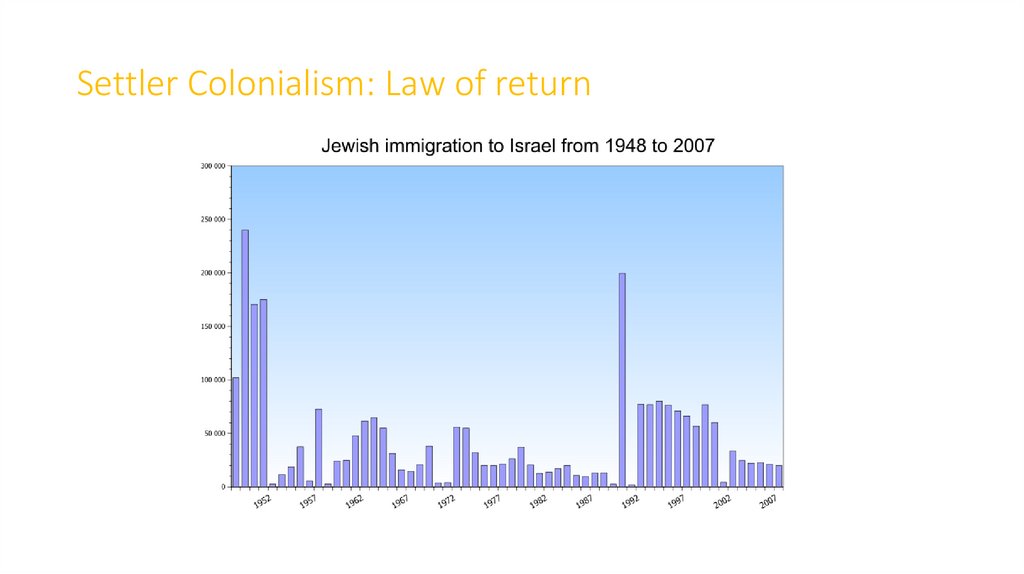
64. Settler Colonialism: Law of return
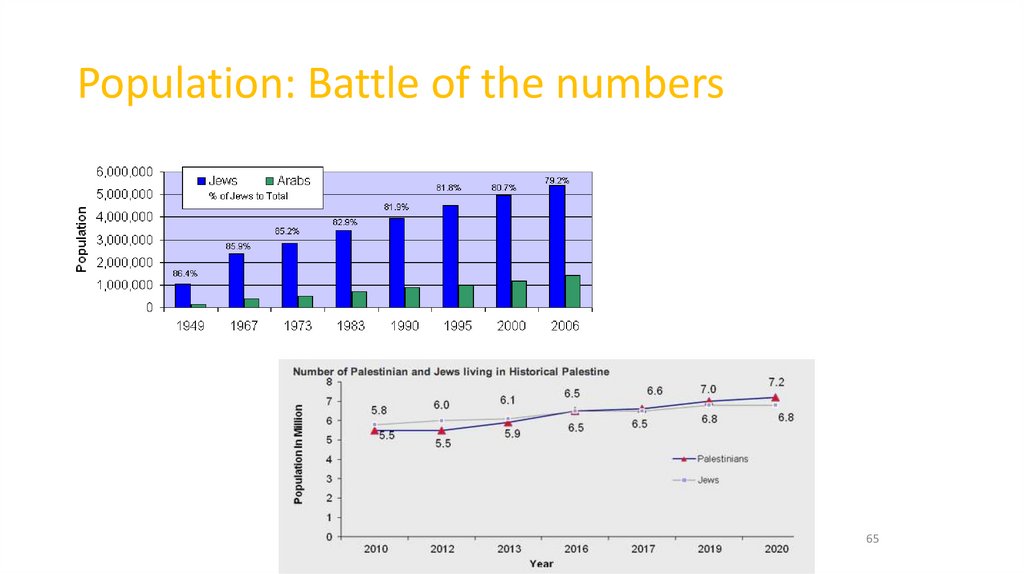
65. Population: Battle of the numbers
6566. Demographic politics: pronatalism
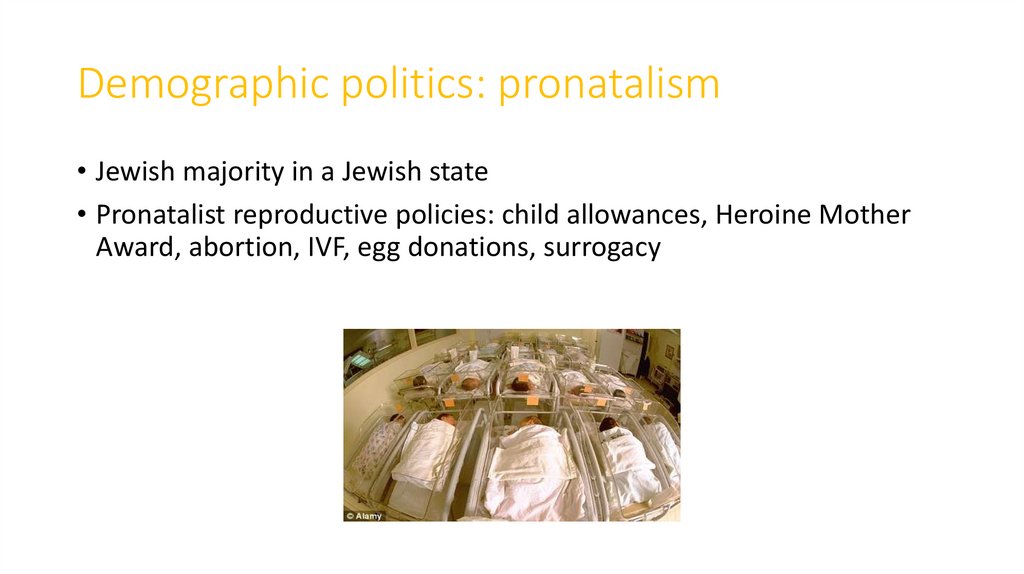
• Jewish majority in a Jewish state• Pronatalist reproductive policies: child allowances, Heroine Mother
Award, abortion, IVF, egg donations, surrogacy
67.
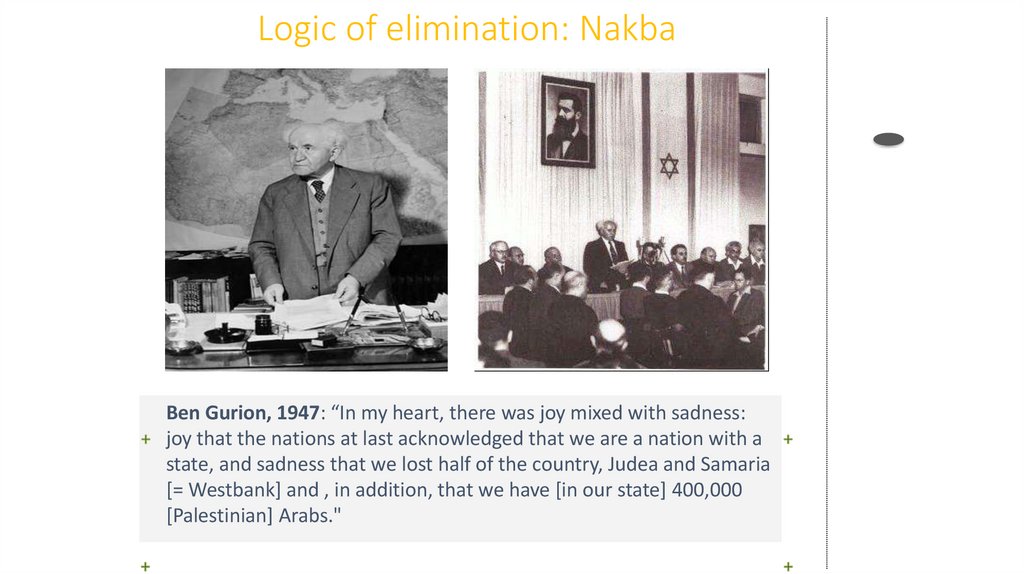
Logic of elimination: NakbaBen Gurion, 1947: “In my heart, there was joy mixed with sadness:
joy that the nations at last acknowledged that we are a nation with a
state, and sadness that we lost half of the country, Judea and Samaria
[= Westbank] and , in addition, that we have [in our state] 400,000
[Palestinian] Arabs."
68. Logic of elimination: Nakba
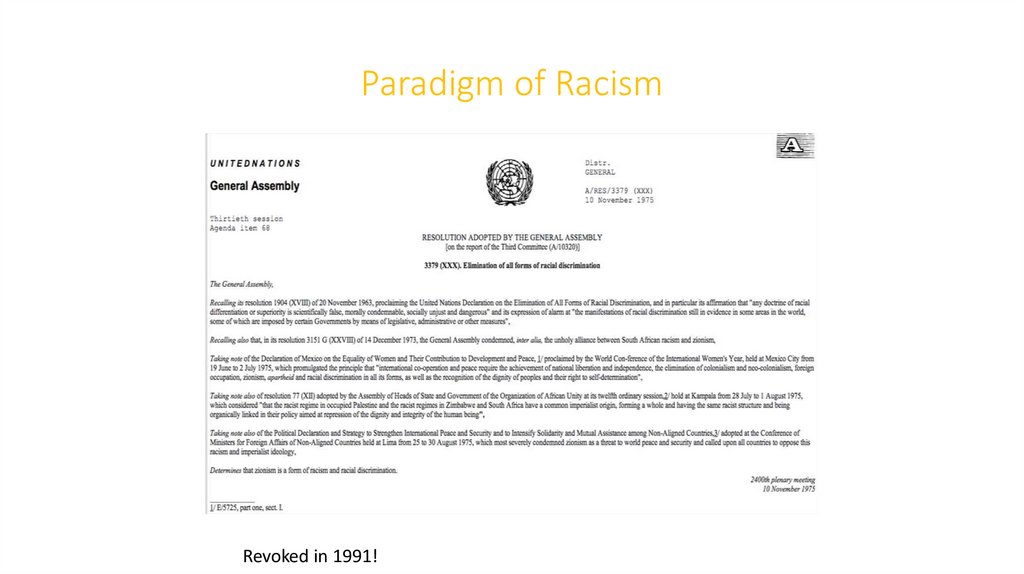
69. Paradigm of Racism
Revoked in 1991!70. Conclusion to Lecture on WWII
• The legacy of the 19th century would only come into full effect after WWII• Following WW II: welfare state + international cooperation
• Growing economic, financial and military cooperation
• Liberal internationalism: economic interdependence (open markets, free trade) and
international organizations as the road towards peace: states locked into a system of
mutual benefits and assurances
• Development of welfare state: post-war recovery schemes and public investments
(full employment) as means to prevent new economic crisis
• Democratization: extension of suffrage rights
• International conflict resolution (e.g., United Nations)
71. Questions to help you study
• Why is the Versailles Treaty (1919) conceived as an imperfect peace treaty?• How did the map of Europe change after WWI?
• How did class polarisation facilitate the rise of fascist forces in Europe? Include a European
example in your answer.
• What factors explain the appeasement politics towards Adolf Hitler?
• What is the stab-in-the-back myth about?
• How can we explain that both Hitler and Mussolini rose to power via democratic and
peaceful ways?
• Explain the propaganda on slide 35. What do you see? What is this about?
• ….
Reading suggestions
• Milward, A.S. (1980). War, Economy and Society, 1939-1945. Oakland: University
of California Press.
• Parker, R.A.C. (1989). Struggle for Survival: The History of the Second World War.
Oxford: Oxford University Press.