

 history
Similar presentations:





World War I
1.
WW1HISTORY CLASS
World War I
KEY FACTS OF WWI
BY SLIDECORE
2.
1914–18The Great War
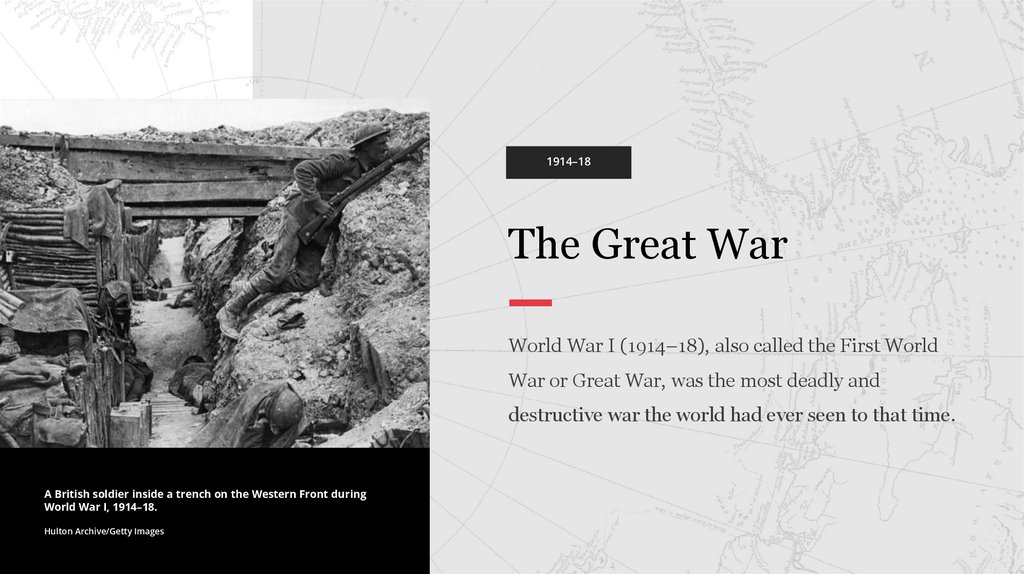
World War I (1914–18), also called the First World
War or Great War, was the most deadly and
destructive war the world had ever seen to that time.
A British soldier inside a trench on the Western Front during
World War I, 1914–18.
Hulton Archive/Getty Images
3.
Source article:britannica.com
JUNE 28, 1914
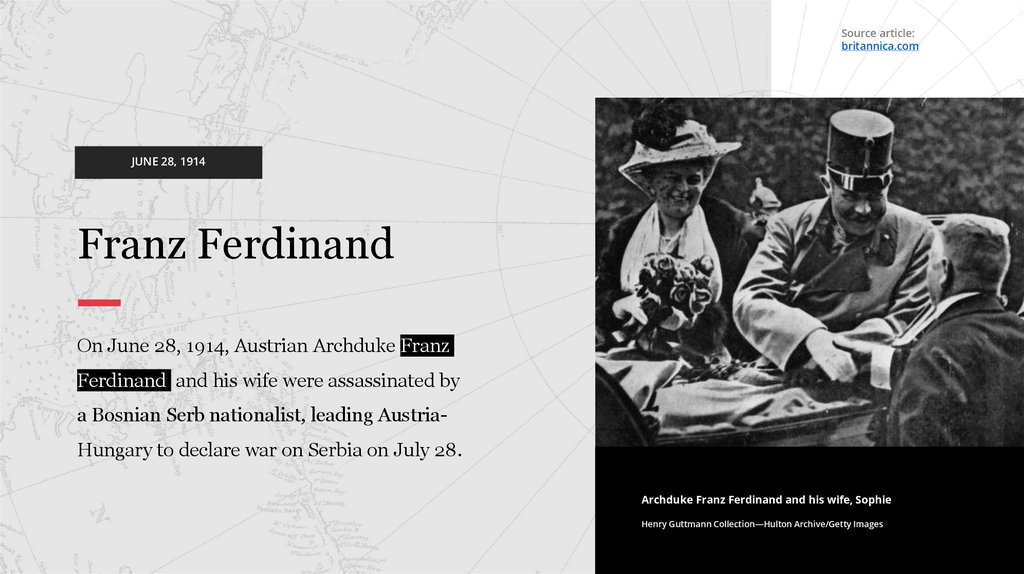
Franz Ferdinand
On June 28, 1914, Austrian Archduke Franz
Ferdinand and his wife were assassinated by
a Bosnian Serb nationalist, leading AustriaHungary to declare war on Serbia on July 28.
Archduke Franz Ferdinand and his wife, Sophie
Henry Guttmann Collection—Hulton Archive/Getty Images
4.
Triple AllianceFor many years rival groups of European
nations had been making treaties and
alliances. By 1914 Europe had been divided
into two camps. Germany, AustriaHungary, and Italy were members of
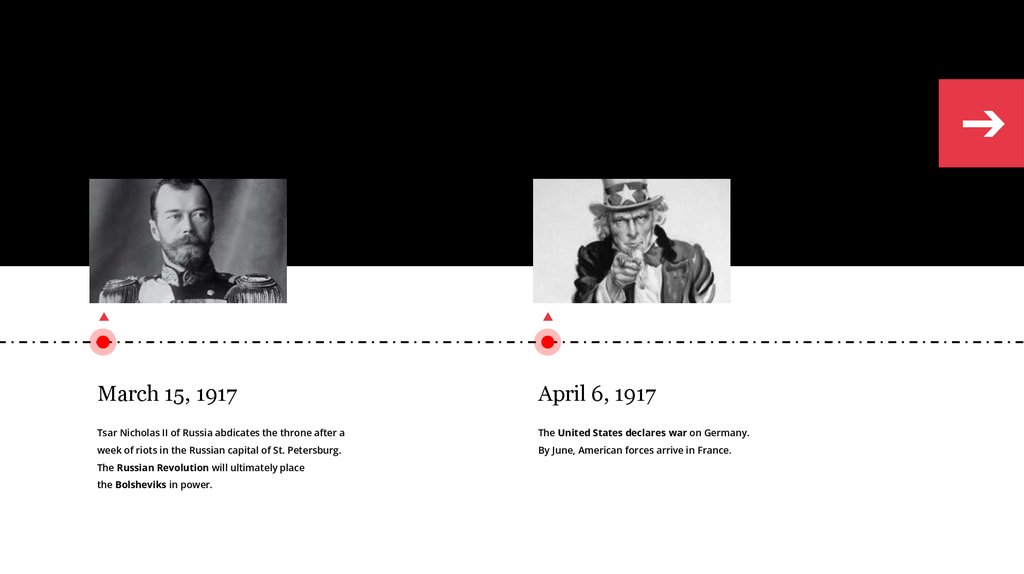
the Triple Alliance.
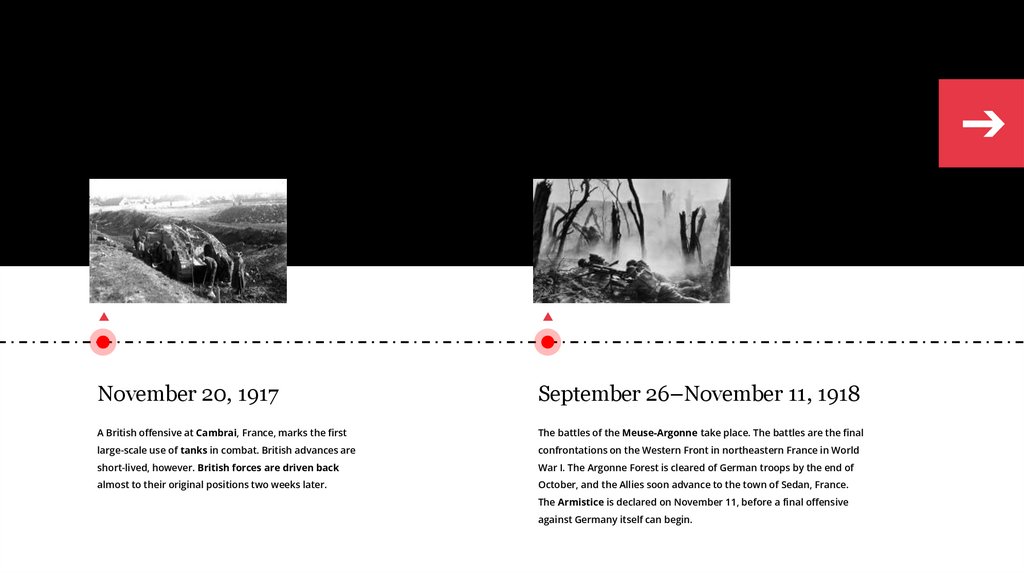
The Triple Alliance
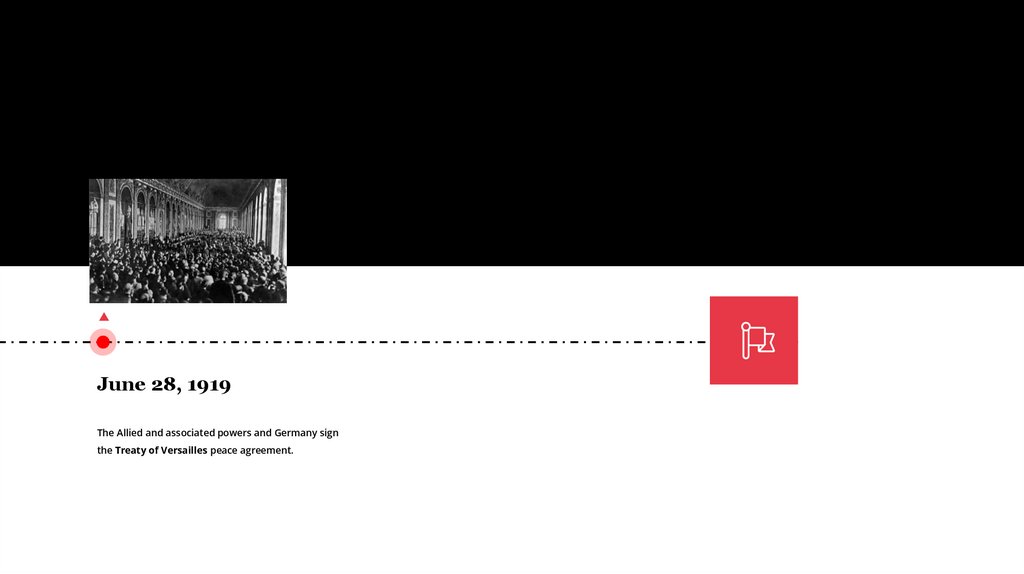
Source: Wikipedia
5.
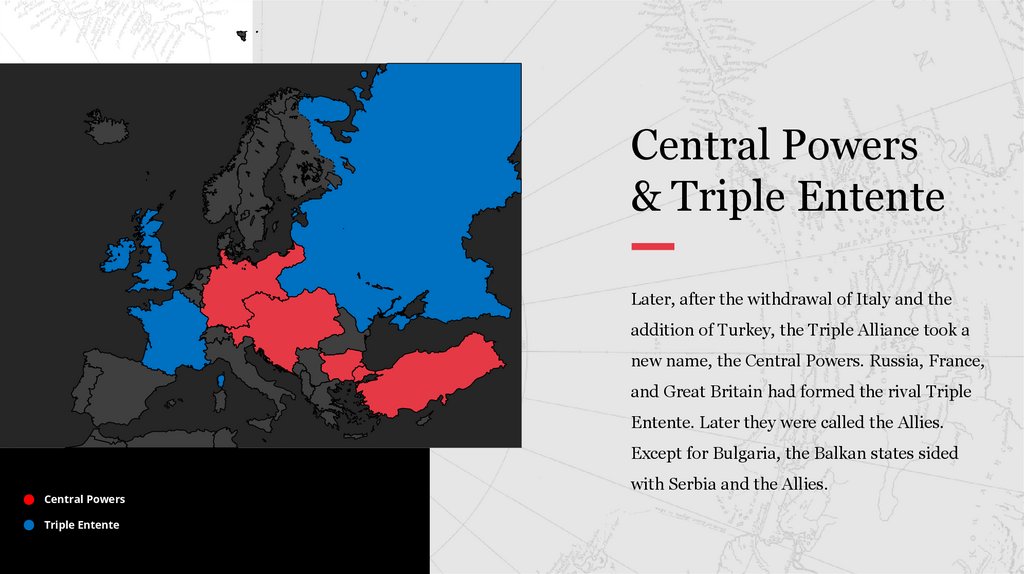
Central Powers& Triple Entente
Later, after the withdrawal of Italy and the
addition of Turkey, the Triple Alliance took a
new name, the Central Powers. Russia, France,
and Great Britain had formed the rival Triple
Entente. Later they were called the Allies.
Except for Bulgaria, the Balkan states sided
Central Powers
Triple Entente
with Serbia and the Allies.
6.
These alliances were brought into actionby Austria-Hungary’s declaration of war.
7.
Within a week most ofEurope was at war.
8.
Source article:britannica.com
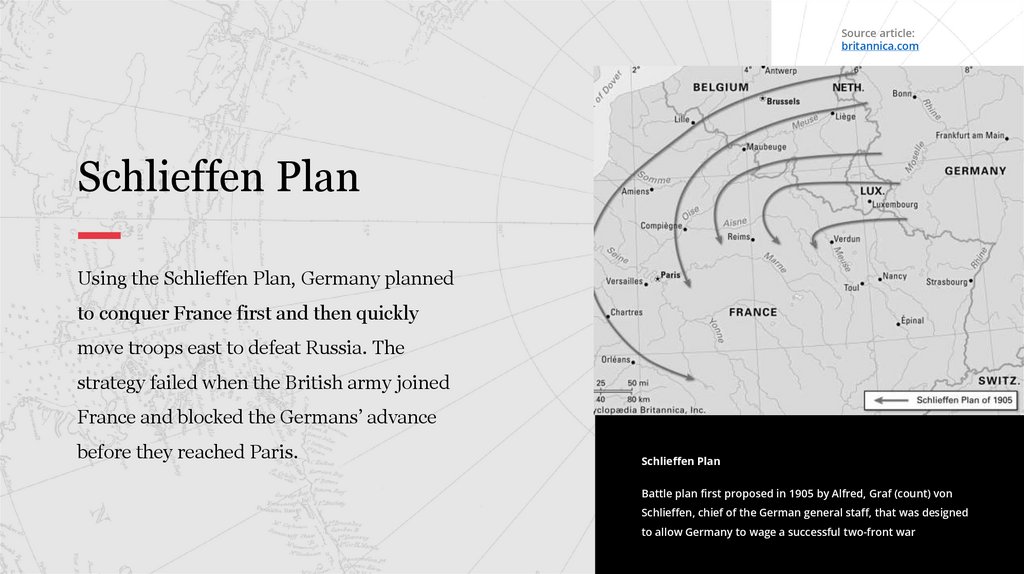
Schlieffen Plan
Using the Schlieffen Plan, Germany planned
to conquer France first and then quickly
move troops east to defeat Russia. The
strategy failed when the British army joined
France and blocked the Germans’ advance
before they reached Paris.
Schlieffen Plan
Battle plan first proposed in 1905 by Alfred, Graf (count) von
Schlieffen, chief of the German general staff, that was designed
to allow Germany to wage a successful two-front war
9.
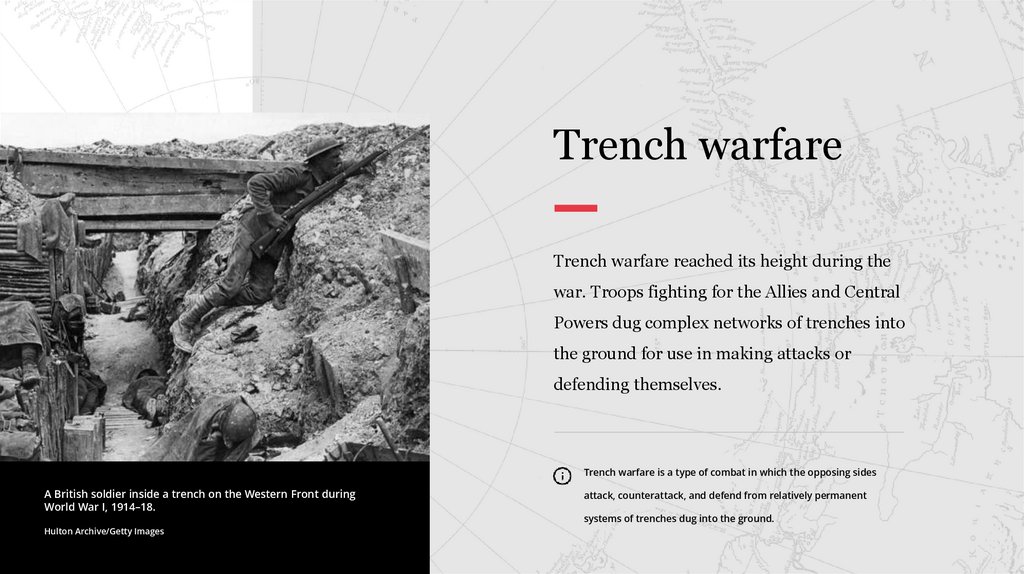
Trench warfareTrench warfare reached its height during the
war. Troops fighting for the Allies and Central
Powers dug complex networks of trenches into
the ground for use in making attacks or
defending themselves.
Trench warfare is a type of combat in which the opposing sides
A British soldier inside a trench on the Western Front during
World War I, 1914–18.
Hulton Archive/Getty Images
attack, counterattack, and defend from relatively permanent
systems of trenches dug into the ground.
10.
Source article:britannica.com
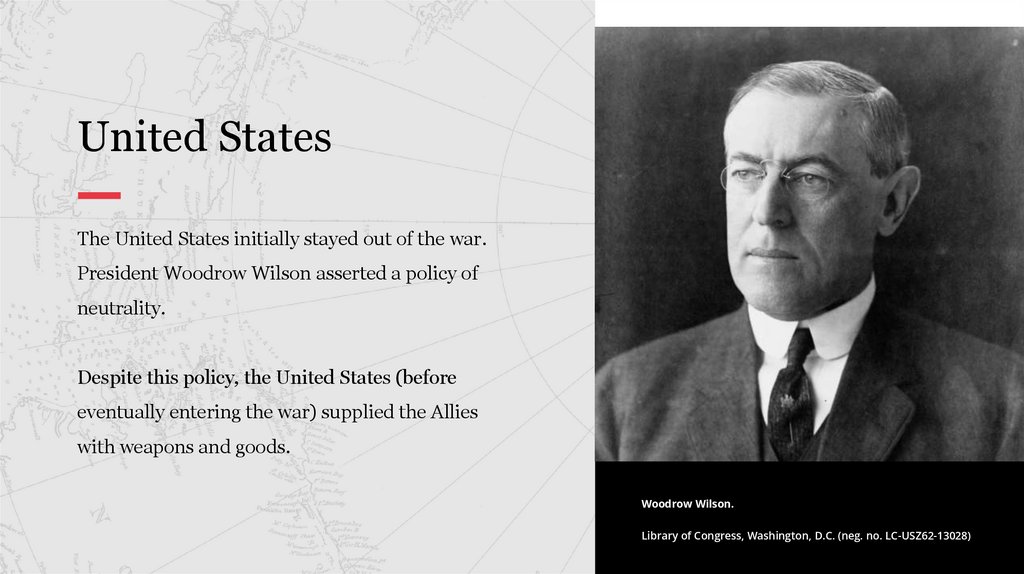
United States
The United States initially stayed out of the war.
President Woodrow Wilson asserted a policy of
neutrality.
Despite this policy, the United States (before
eventually entering the war) supplied the Allies
with weapons and goods.
Woodrow Wilson.
Library of Congress, Washington, D.C. (neg. no. LC-USZ62-13028)
11.
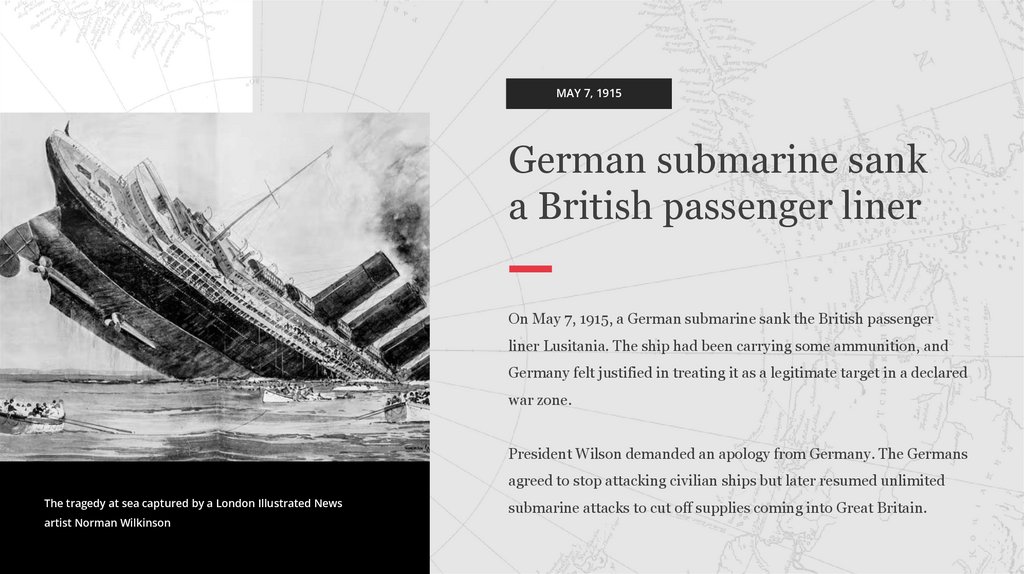
MAY 7, 1915German submarine sank
a British passenger liner
On May 7, 1915, a German submarine sank the British passenger
liner Lusitania. The ship had been carrying some ammunition, and
Germany felt justified in treating it as a legitimate target in a declared
war zone.
President Wilson demanded an apology from Germany. The Germans
agreed to stop attacking civilian ships but later resumed unlimited
The tragedy at sea captured by a London Illustrated News
artist Norman Wilkinson
submarine attacks to cut off supplies coming into Great Britain.
12.
Source article:britannica.com
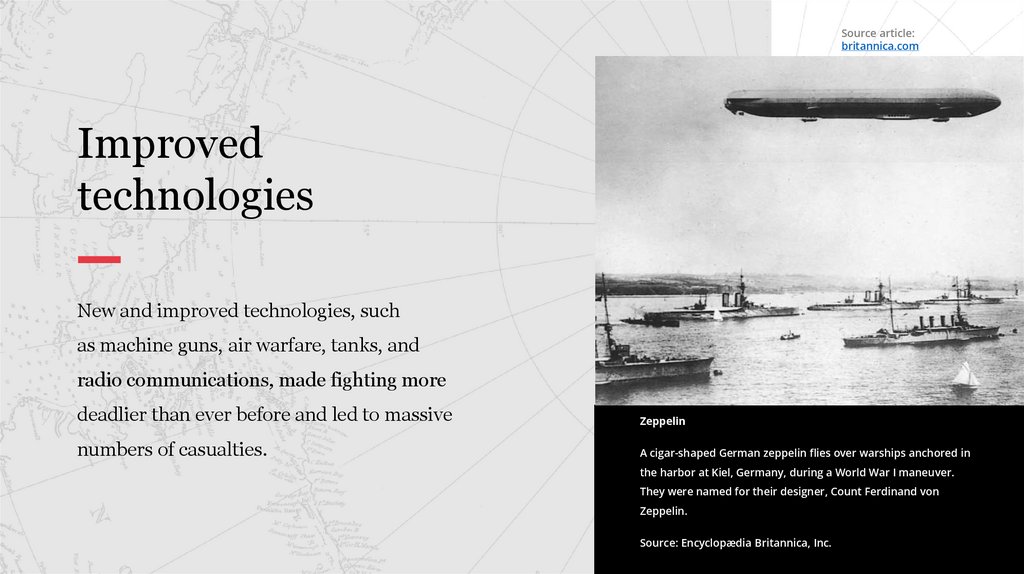
Improved
technologies
New and improved technologies, such
as machine guns, air warfare, tanks, and
radio communications, made fighting more
deadlier than ever before and led to massive
Zeppelin
numbers of casualties.
A cigar-shaped German zeppelin flies over warships anchored in
the harbor at Kiel, Germany, during a World War I maneuver.
They were named for their designer, Count Ferdinand von
Zeppelin.
Source: Encyclopædia Britannica, Inc.
13.
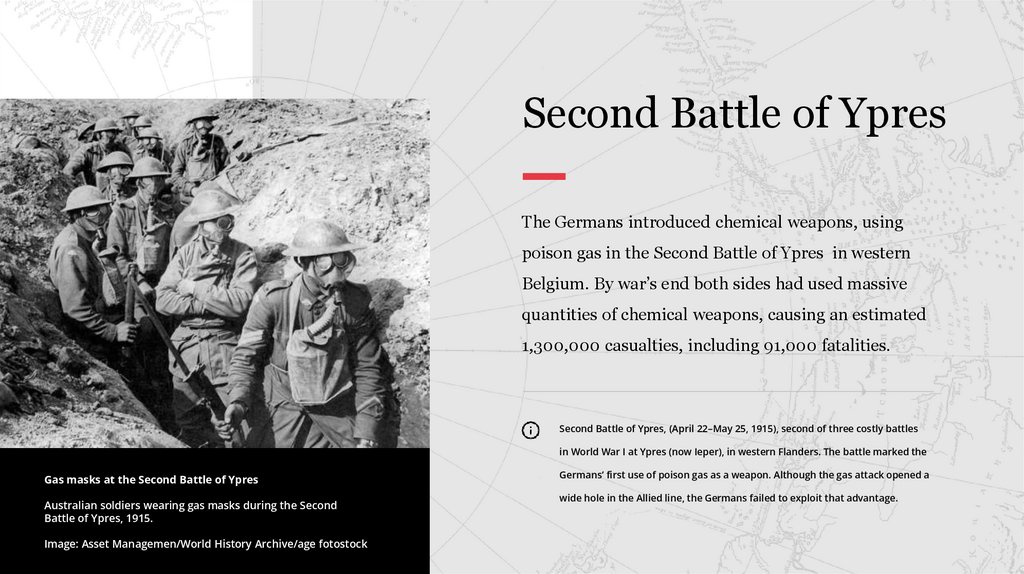
Second Battle of YpresThe Germans introduced chemical weapons, using
poison gas in the Second Battle of Ypres in western
Belgium. By war’s end both sides had used massive
quantities of chemical weapons, causing an estimated
1,300,000 casualties, including 91,000 fatalities.
Second Battle of Ypres, (April 22–May 25, 1915), second of three costly battles
in World War I at Ypres (now Ieper), in western Flanders. The battle marked the
Gas masks at the Second Battle of Ypres
Australian soldiers wearing gas masks during the Second
Battle of Ypres, 1915.
Image: Asset Managemen/World History Archive/age fotostock
Germans’ first use of poison gas as a weapon. Although the gas attack opened a
wide hole in the Allied line, the Germans failed to exploit that advantage.
14.
Source article:britannica.com
JAN 16, 1917
Arthur
Zimmermann
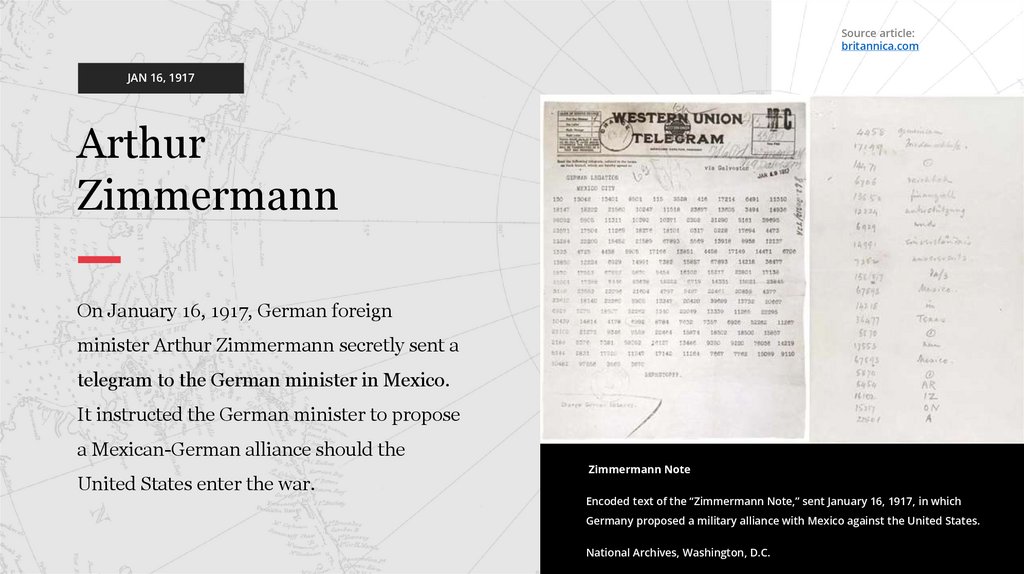
On January 16, 1917, German foreign
minister Arthur Zimmermann secretly sent a
telegram to the German minister in Mexico.
It instructed the German minister to propose
a Mexican-German alliance should the
United States enter the war.
Zimmermann Note
Encoded text of the “Zimmermann Note,” sent January 16, 1917, in which
Germany proposed a military alliance with Mexico against the United States.
National Archives, Washington, D.C.
15.
APRIL 6, 1917United States enters
the war
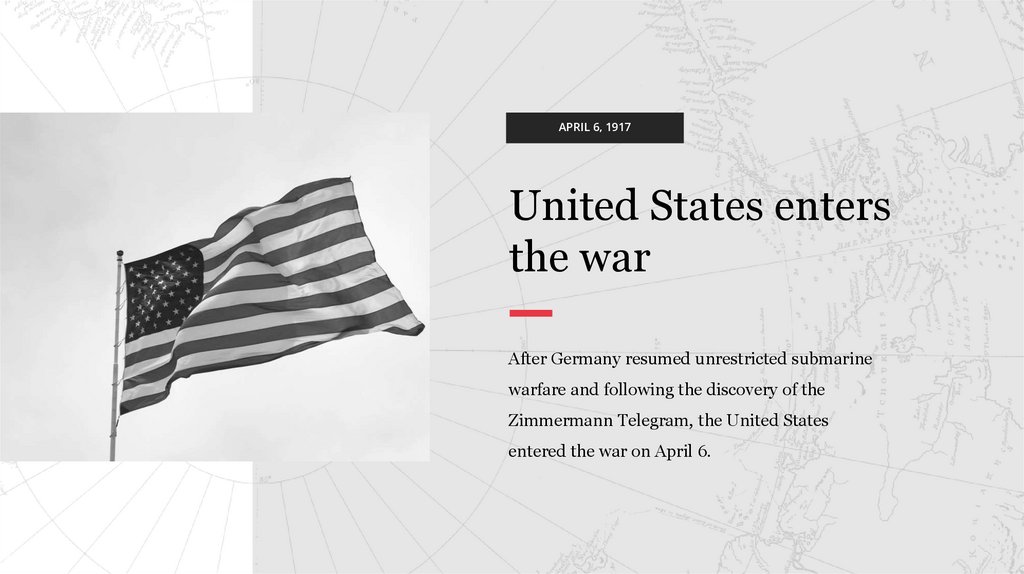
After Germany resumed unrestricted submarine
warfare and following the discovery of the
Zimmermann Telegram, the United States
entered the war on April 6.
16.
Source article:britannica.com
AEF
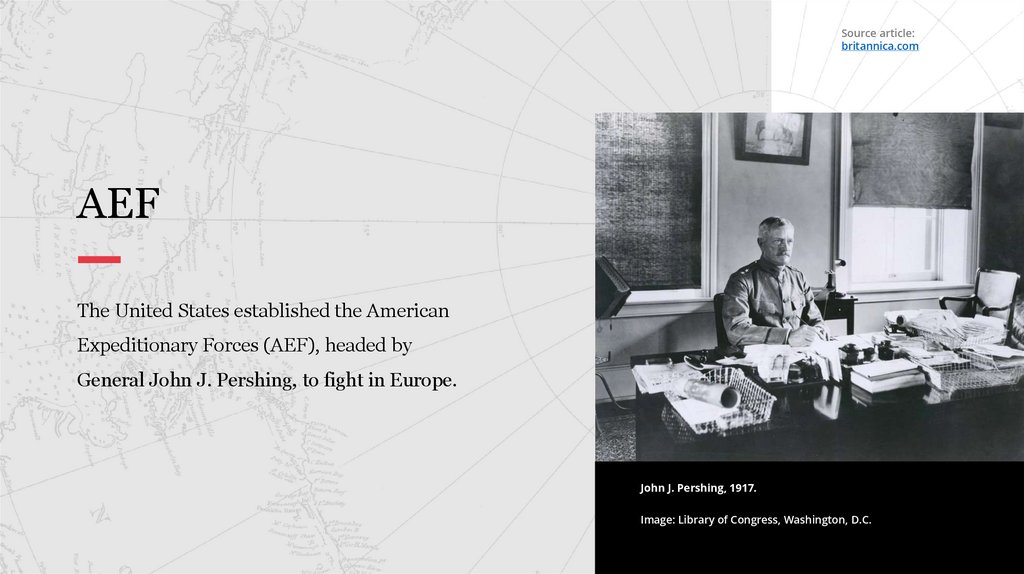
The United States established the American
Expeditionary Forces (AEF), headed by
General John J. Pershing, to fight in Europe.
John J. Pershing, 1917.
Image: Library of Congress, Washington, D.C.
17.
JANUARY 8,1918Fourteen
Points for peace
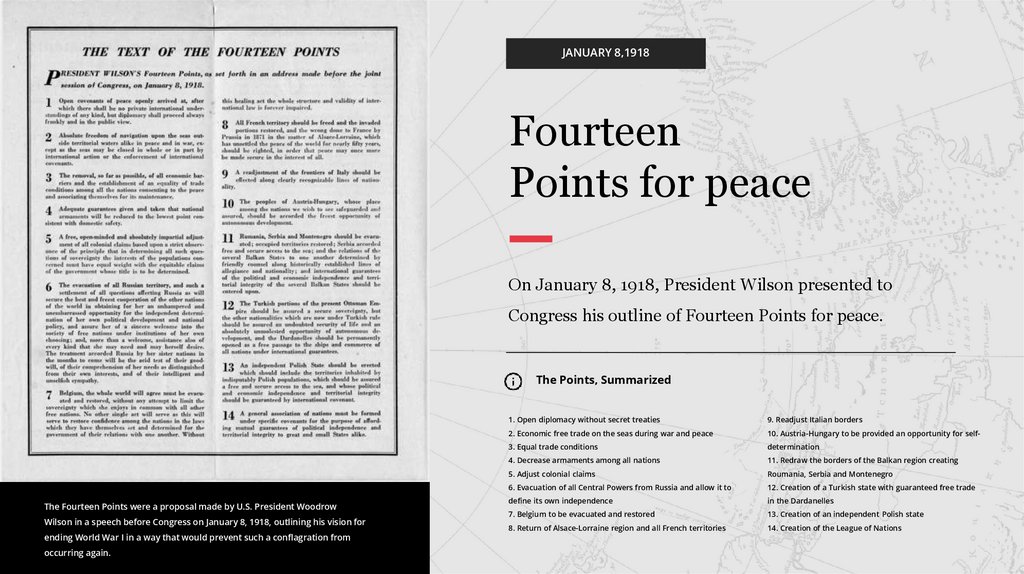
On January 8, 1918, President Wilson presented to
Congress his outline of Fourteen Points for peace.
The Points, Summarized
The Fourteen Points were a proposal made by U.S. President Woodrow
Wilson in a speech before Congress on January 8, 1918, outlining his vision for
ending World War I in a way that would prevent such a conflagration from
occurring again.
1. Open diplomacy without secret treaties
9. Readjust Italian borders
2. Economic free trade on the seas during war and peace
10. Austria-Hungary to be provided an opportunity for self-
3. Equal trade conditions
determination
4. Decrease armaments among all nations
11. Redraw the borders of the Balkan region creating
5. Adjust colonial claims
Roumania, Serbia and Montenegro
6. Evacuation of all Central Powers from Russia and allow it to
12. Creation of a Turkish state with guaranteed free trade
define its own independence
in the Dardanelles
7. Belgium to be evacuated and restored
13. Creation of an independent Polish state
8. Return of Alsace-Lorraine region and all French territories
14. Creation of the League of Nations
18.
Source article:britannica.com
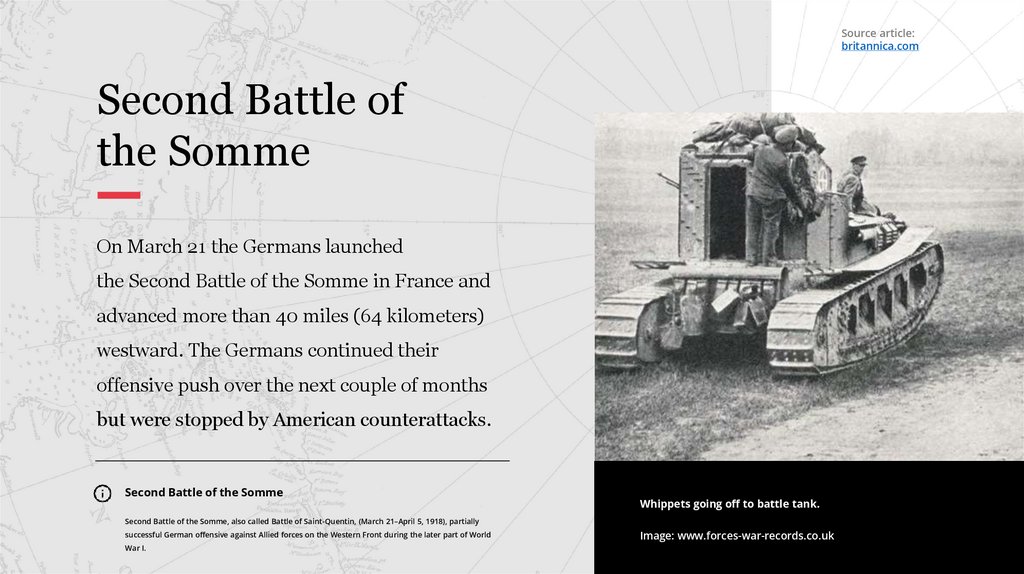
Second Battle of
the Somme
On March 21 the Germans launched
the Second Battle of the Somme in France and
advanced more than 40 miles (64 kilometers)
westward. The Germans continued their
offensive push over the next couple of months
but were stopped by American counterattacks.
Second Battle of the Somme
Whippets going off to battle tank.
Second Battle of the Somme, also called Battle of Saint-Quentin, (March 21–April 5, 1918), partially
successful German offensive against Allied forces on the Western Front during the later part of World
War I.
Image: www.forces-war-records.co.uk
19.
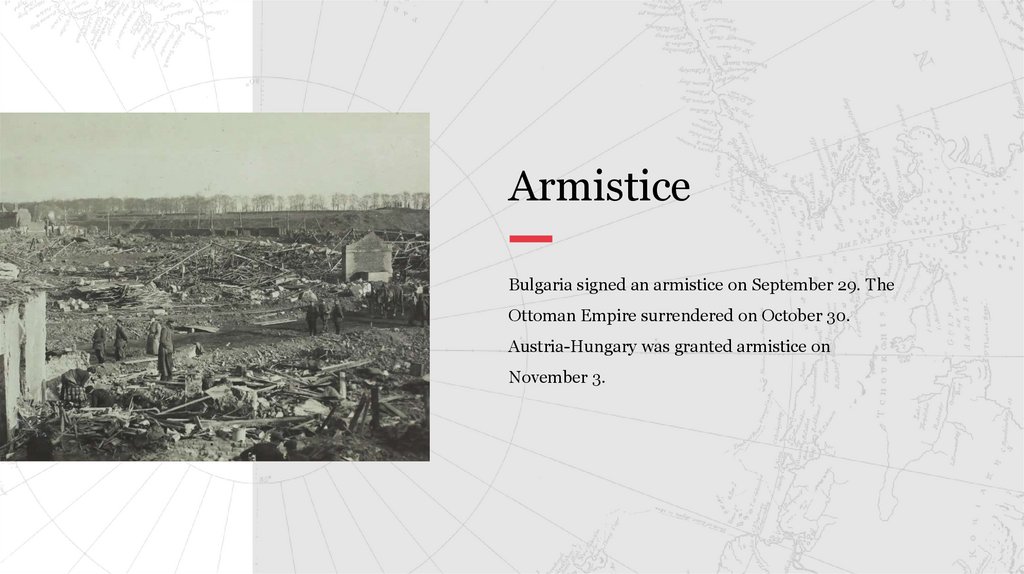
ArmisticeBulgaria signed an armistice on September 29. The
Ottoman Empire surrendered on October 30.
Austria-Hungary was granted armistice on
November 3.
20.
Source article:britannica.com
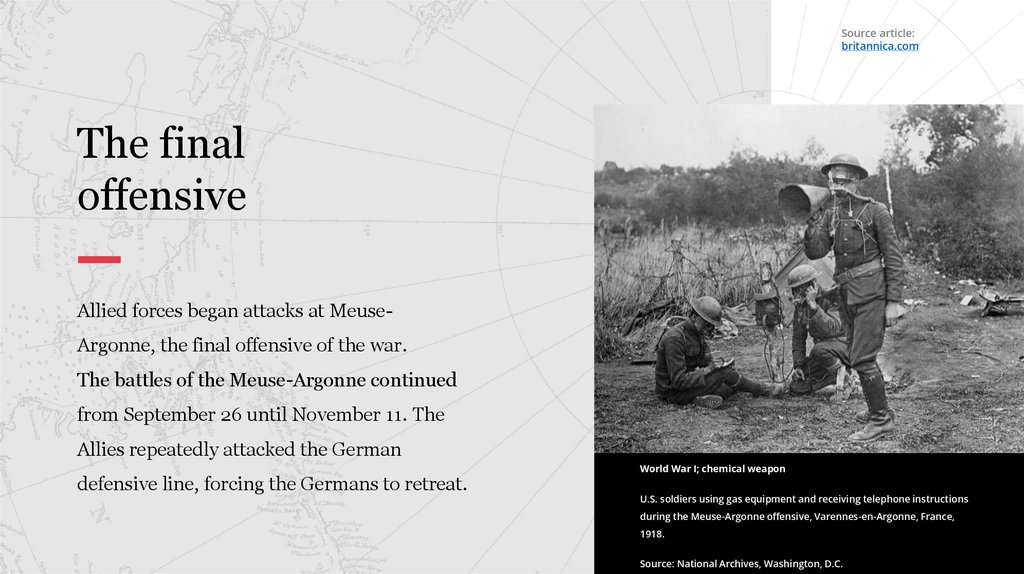
The final
offensive
Allied forces began attacks at MeuseArgonne, the final offensive of the war.
The battles of the Meuse-Argonne continued
from September 26 until November 11. The
Allies repeatedly attacked the German
defensive line, forcing the Germans to retreat.
World War I; chemical weapon
U.S. soldiers using gas equipment and receiving telephone instructions
during the Meuse-Argonne offensive, Varennes-en-Argonne, France,
1918.
Source: National Archives, Washington, D.C.
21.
Negotiationsfor peace
The November 11 Armistice between Germany and
the Allies ended the fighting, and negotiations for
peace began.
22.
Source article:britannica.com
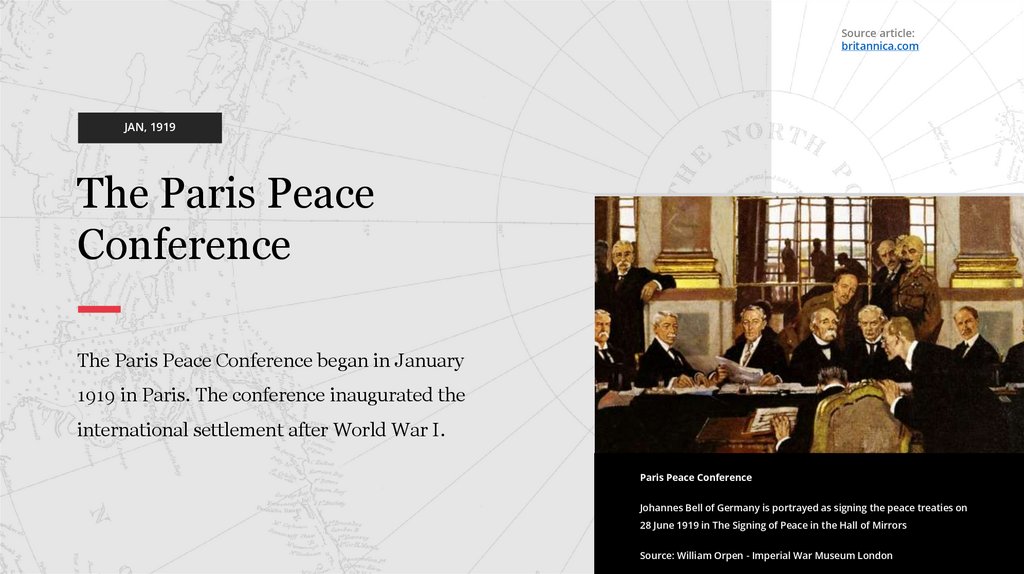
JAN, 1919
The Paris Peace
Conference
The Paris Peace Conference began in January
1919 in Paris. The conference inaugurated the
international settlement after World War I.
Paris Peace Conference
Johannes Bell of Germany is portrayed as signing the peace treaties on
28 June 1919 in The Signing of Peace in the Hall of Mirrors
Source: William Orpen - Imperial War Museum London
23.
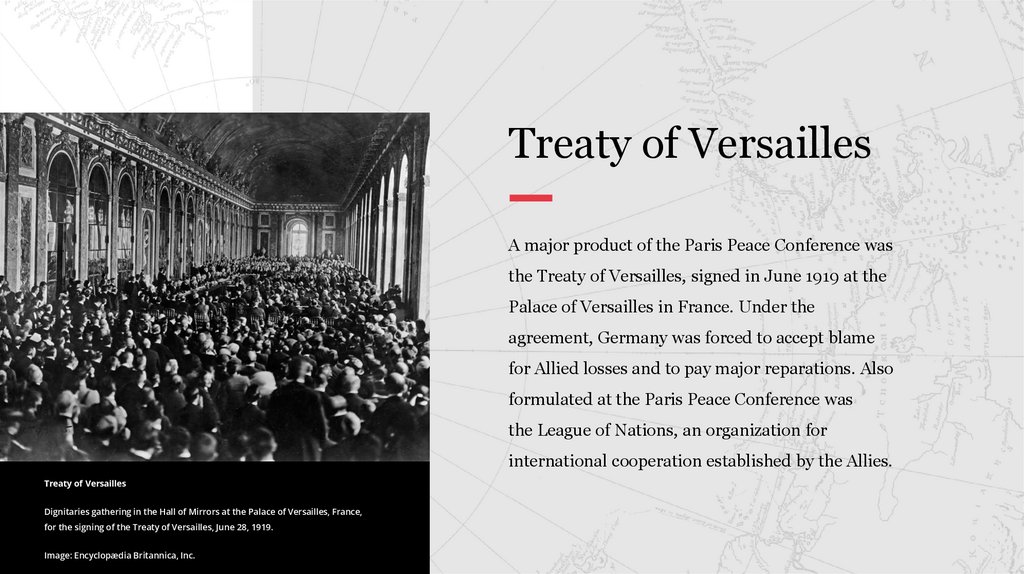
Treaty of VersaillesA major product of the Paris Peace Conference was
the Treaty of Versailles, signed in June 1919 at the
Palace of Versailles in France. Under the
agreement, Germany was forced to accept blame
for Allied losses and to pay major reparations. Also
formulated at the Paris Peace Conference was
the League of Nations, an organization for
international cooperation established by the Allies.
Treaty of Versailles
Dignitaries gathering in the Hall of Mirrors at the Palace of Versailles, France,
for the signing of the Treaty of Versailles, June 28, 1919.
Image: Encyclopædia Britannica, Inc.
24.
WW1World War I Timeline
They key facts of WW1 in timeline mode
-24
25.
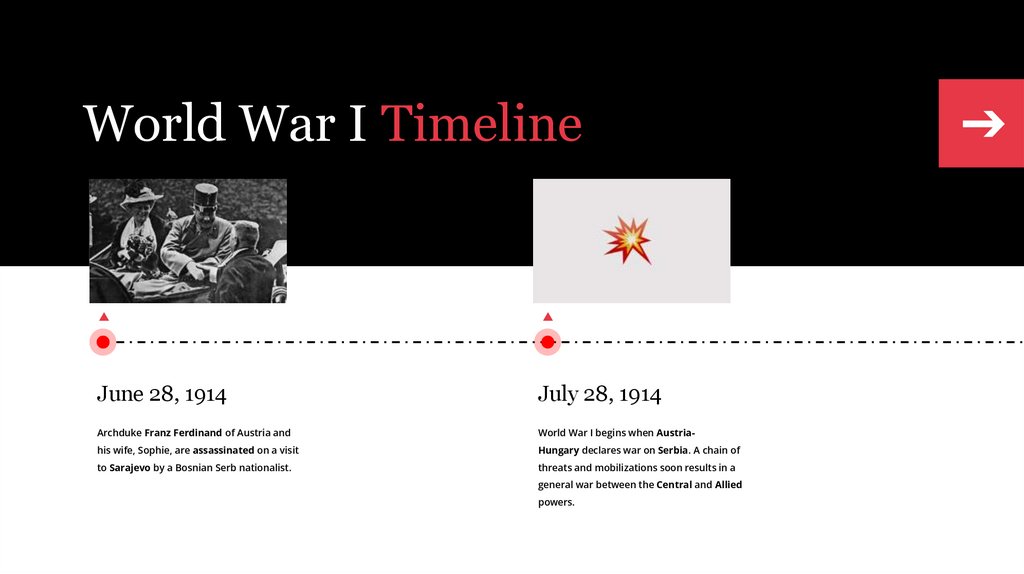
World War I TimelineJune 28, 1914
July 28, 1914
Archduke Franz Ferdinand of Austria and
World War I begins when Austria-
his wife, Sophie, are assassinated on a visit
Hungary declares war on Serbia. A chain of
to Sarajevo by a Bosnian Serb nationalist.
threats and mobilizations soon results in a
general war between the Central and Allied
powers.
➔
26.
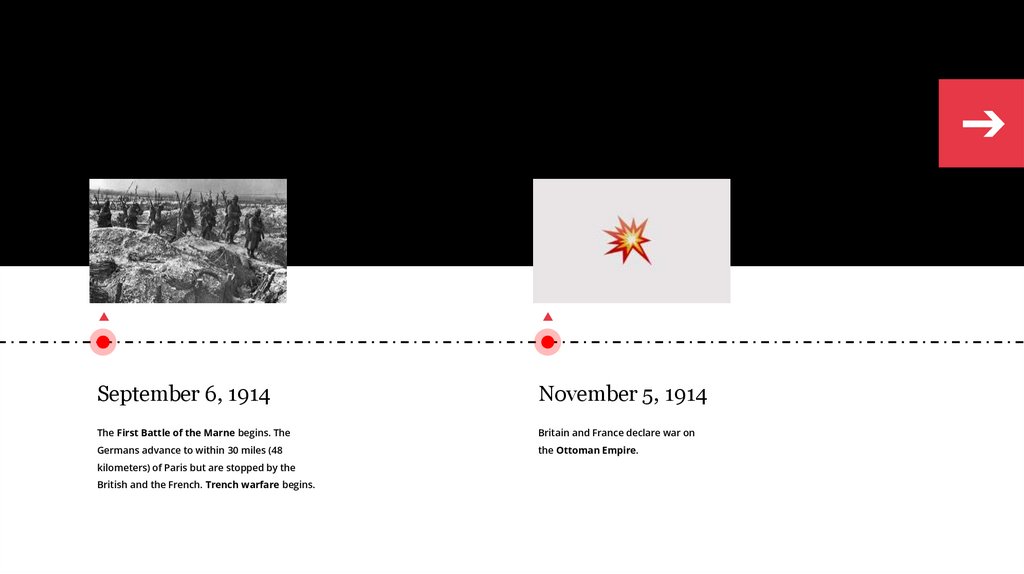
➔September 6, 1914
November 5, 1914
The First Battle of the Marne begins. The
Britain and France declare war on
Germans advance to within 30 miles (48
the Ottoman Empire.
kilometers) of Paris but are stopped by the
British and the French. Trench warfare begins.
27.
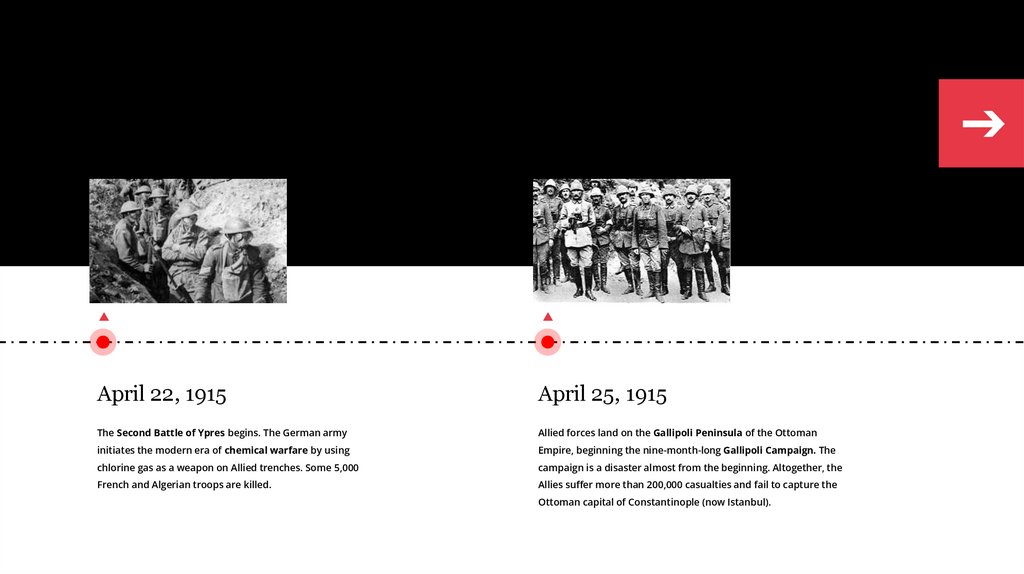
➔April 22, 1915
April 25, 1915
The Second Battle of Ypres begins. The German army
Allied forces land on the Gallipoli Peninsula of the Ottoman
initiates the modern era of chemical warfare by using
Empire, beginning the nine-month-long Gallipoli Campaign. The
chlorine gas as a weapon on Allied trenches. Some 5,000
campaign is a disaster almost from the beginning. Altogether, the
French and Algerian troops are killed.
Allies suffer more than 200,000 casualties and fail to capture the
Ottoman capital of Constantinople (now Istanbul).
28.
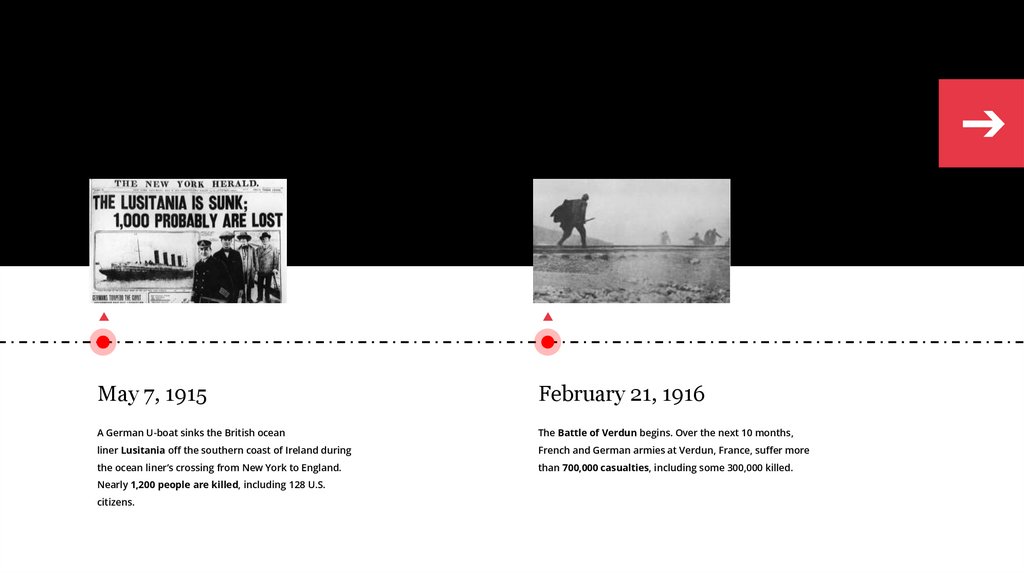
➔May 7, 1915
February 21, 1916
A German U-boat sinks the British ocean
The Battle of Verdun begins. Over the next 10 months,
liner Lusitania off the southern coast of Ireland during
French and German armies at Verdun, France, suffer more
the ocean liner’s crossing from New York to England.
than 700,000 casualties, including some 300,000 killed.
Nearly 1,200 people are killed, including 128 U.S.
citizens.
29.
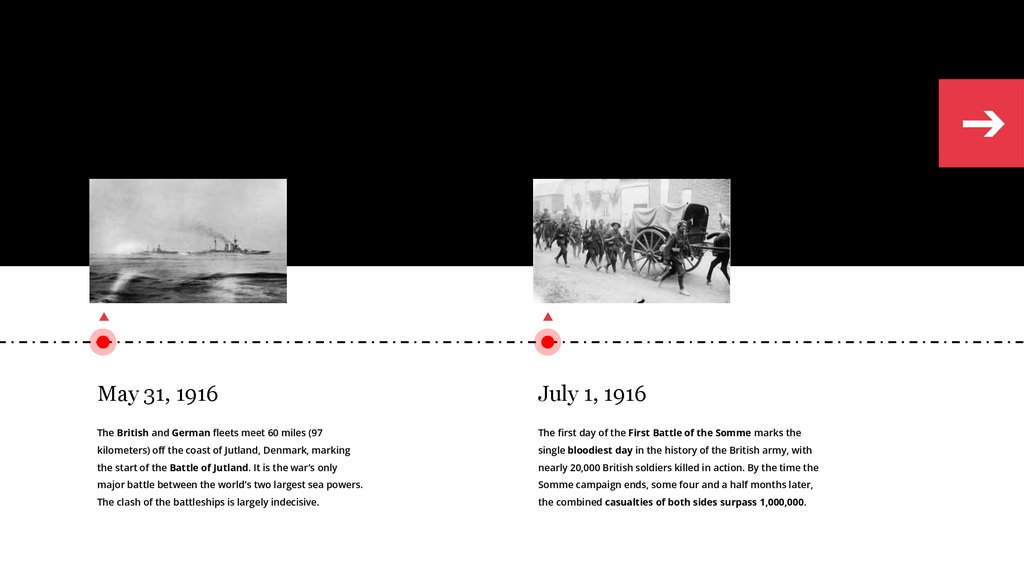
➔May 31, 1916
July 1, 1916
The British and German fleets meet 60 miles (97
The first day of the First Battle of the Somme marks the
kilometers) off the coast of Jutland, Denmark, marking
single bloodiest day in the history of the British army, with
the start of the Battle of Jutland. It is the war’s only
nearly 20,000 British soldiers killed in action. By the time the
major battle between the world’s two largest sea powers.
Somme campaign ends, some four and a half months later,
The clash of the battleships is largely indecisive.
the combined casualties of both sides surpass 1,000,000.
30.
➔March 15, 1917
April 6, 1917
Tsar Nicholas II of Russia abdicates the throne after a
The United States declares war on Germany.
week of riots in the Russian capital of St. Petersburg.
By June, American forces arrive in France.
The Russian Revolution will ultimately place
the Bolsheviks in power.
31.
➔November 20, 1917
September 26–November 11, 1918
A British offensive at Cambrai, France, marks the first
The battles of the Meuse-Argonne take place. The battles are the final
large-scale use of tanks in combat. British advances are
confrontations on the Western Front in northeastern France in World
short-lived, however. British forces are driven back
War I. The Argonne Forest is cleared of German troops by the end of
almost to their original positions two weeks later.
October, and the Allies soon advance to the town of Sedan, France.
The Armistice is declared on November 11, before a final offensive
against Germany itself can begin.
32.
June 28, 1919The Allied and associated powers and Germany sign
the Treaty of Versailles peace agreement.
33.
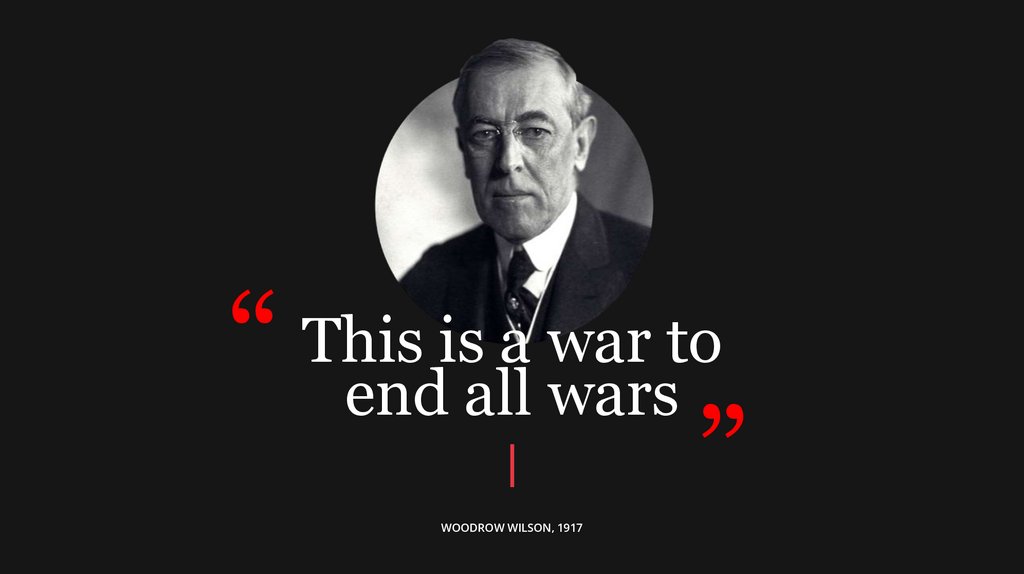
“This is a war to
end all wars
WOODROW WILSON, 1917
”
-33
34.
WW1Transition slide
A beautiful and artsy template to inspire
yourself and others
NEXT CHAPTER
-34
35.
Chronology editbale template (excel)Suspendisse quis facilisis tempus massa. In eleifend
volutpat porttito scelerisque, ipsum ac pretium pretium.
1918
1914
Important event
Important event
Data name one
Data name two
-35
36.
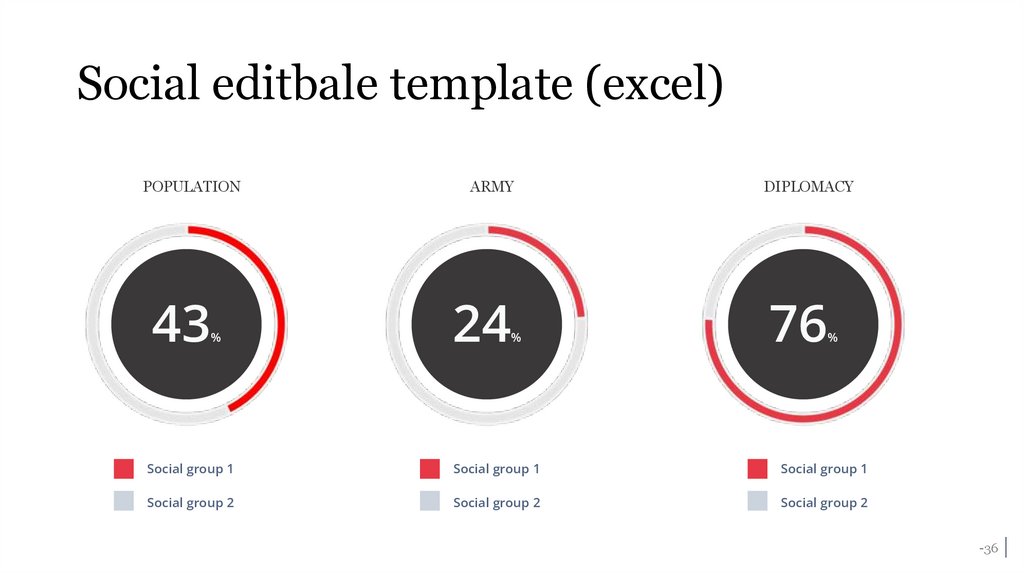
Social editbale template (excel)POPULATION
43
%
ARMY
24
%
DIPLOMACY
76
%
Social group 1
Social group 1
Social group 1
Social group 2
Social group 2
Social group 2
-36
37.
WW1Clean Slide
Suspendisse quis facilisis tempus massa.
In eleifend volutpat porttito scelerisque.
-37
38.
Editable Icon SetThings you can
do:
Resize the icon
Change fill color and opacity
Add stroke
Add dash lines
39.
This template was madespecially for you by
Big shout-out to the great
people that provided us with
the free resources of this
presentation:
STOCK IMAGES
unsplash.com
pixabay.com
ICONS
Thick Icons
Nice and Serious
Visit slidecoretemplates.com to get more editable premium
presentations for free
SOURCE
Brittanica.com
https://www.britannica.com/summary/Key-Facts-of-World-War-I