

 biology
Similar presentations:



Synthetic biology and DNA assembly
1.
DATE 03-06-2025synthetic biology
and DNA assembly
By Ana and Maki
2.
SYNTHETIC BIOLOGY• What is it? Engineering biological systems for new functions and
applications.
• Key Uses: Medicine (gene therapy, synthetic vaccines), agriculture,
biofuels, and environmental solutions.
• Future Potential: Synthetic
sustainable materials.
organisms,
bio-computing,
and
3.
DNA ASSEMBLY• Purpose: Constructing custom DNA
engineering and synthetic biology.
sequences
for
genetic
• Methods: Golden Gate Assembly, Gibson Assembly, and Bio-bricks.
• Advancements: Automation, AI-driven design, and improved
accuracy.
4.
CostsCOSTS & ACCESSIBILITY
INNOVATIONS
• DNA synthesis costs dropping,
enabling whole genome
projects.
• Advances in automation & AI
lower labor expenses.
• Gene synthesis optimized via
polymerase cycling &
microarray techniques.
Easier Access Innovations
• In vivo assembly in yeast & bacteria for
large-scale DNA construction.
• Combinatorial techniques (Golden
Gate, Gibson, SLIC) streamline parallel
DNA assembly.
• Standardized DNA parts (BioBrick™,
BglBrick) enable modular plug-andplay engineering.
5.
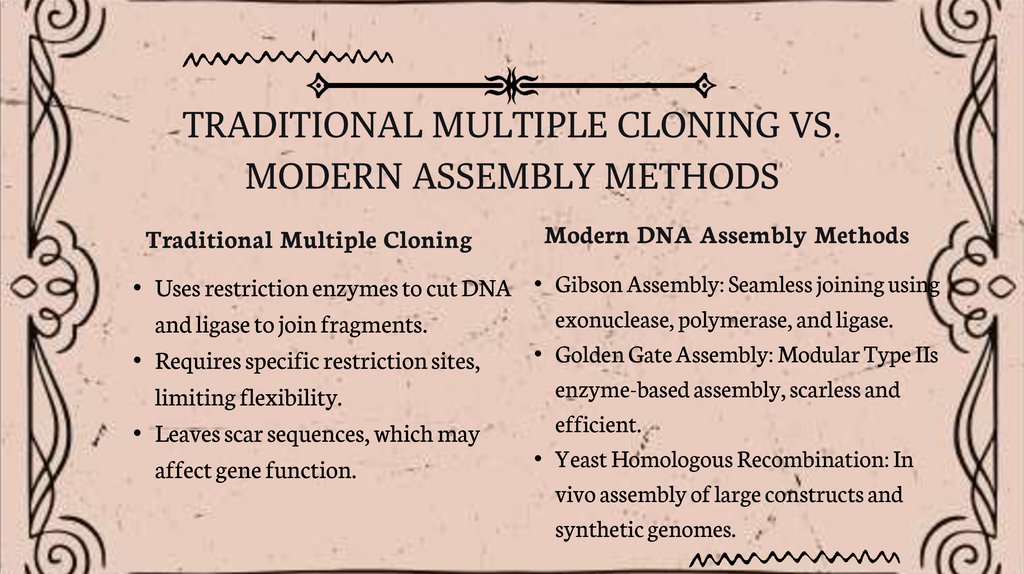
TRADITIONAL MULTIPLE CLONING VS.MODERN ASSEMBLY METHODS
Traditional Multiple Cloning
Modern DNA Assembly Methods
• Uses restriction enzymes to cut DNA • Gibson Assembly: Seamless joining using
exonuclease, polymerase, and ligase.
and ligase to join fragments.
• Golden Gate Assembly: Modular Type IIs
• Requires specific restriction sites,
enzyme-based assembly, scarless and
limiting flexibility.
efficient.
• Leaves scar sequences, which may
Yeast
Homologous
Recombination:
In
affect gene function.
vivo assembly of large constructs and
synthetic genomes.
6.
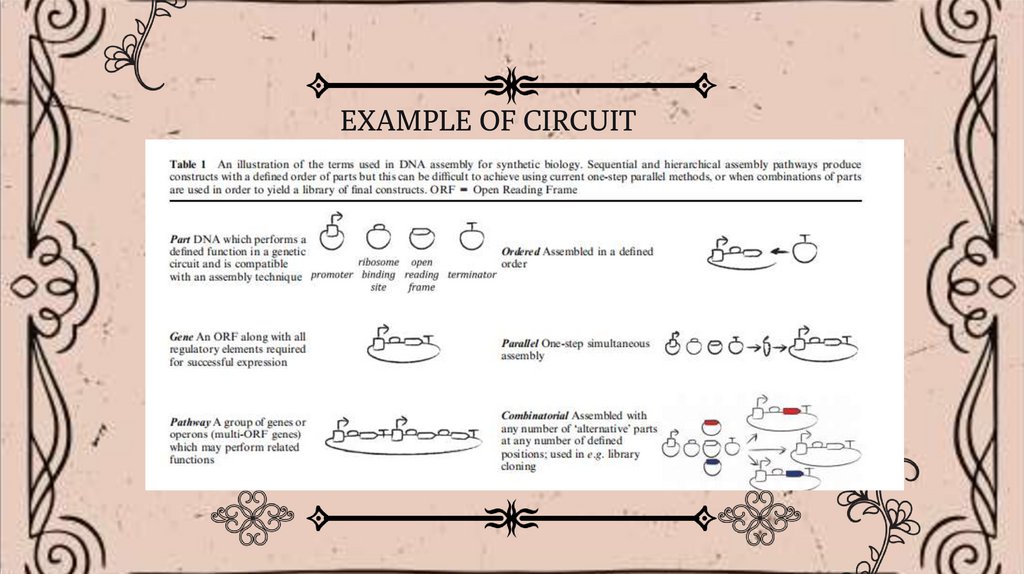
EXAMPLE OF CIRCUIT7.
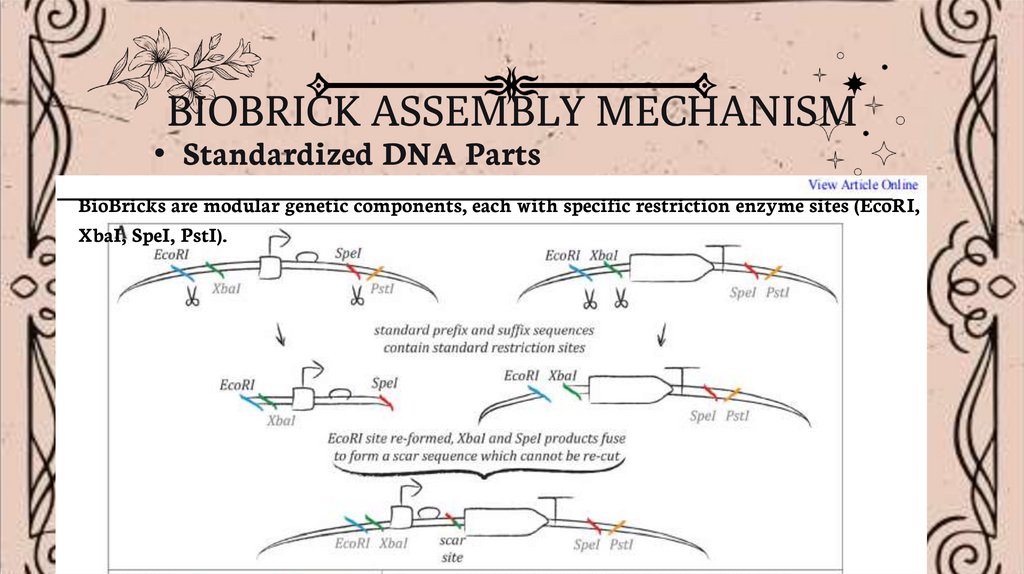
BIOBRICK ASSEMBLY MECHANISM• Standardized DNA Parts
BioBricks are modular genetic components, each with specific restriction enzyme sites (EcoRI,
XbaI, SpeI, PstI).
8.
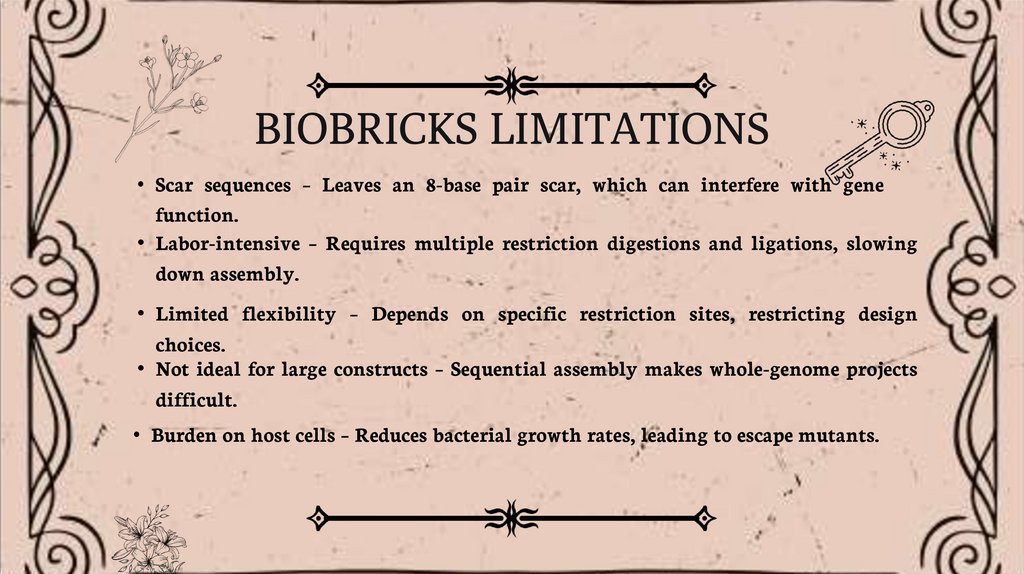
BIOBRICKS LIMITATIONS• Scar sequences – Leaves an 8-base pair scar, which can interfere with gene
function.
• Labor-intensive – Requires multiple restriction digestions and ligations, slowing
down assembly.
• Limited flexibility – Depends on specific restriction sites, restricting design
choices.
• Not ideal for large constructs – Sequential assembly makes whole-genome projects
difficult.
• Burden on host cells – Reduces bacterial growth rates, leading to escape mutants.
9.
GIBSON ASSEMBLY• Gibson Assembly enables seamless DNA assembly by using
exonuclease, polymerase, and ligase in a single reaction.
10.
GIBSON ASSEMBLY LIMITATION• Fragment Number Limit – Efficiency decreases when assembling more than
~8 fragments due to complexity.
• Sequence Constraints – Requires precise overlapping sequences, limiting
flexibility
• Error Risk – Can introduce mutations at fragment junctions, affecting accuracy.
• Not Ideal for Short Fragments – Standard Gibson Assembly struggles with
single-stranded or very short DNA inserts.
• Optimization Challenges – Requires careful primer design and reaction
conditions for high efficiency.
11.
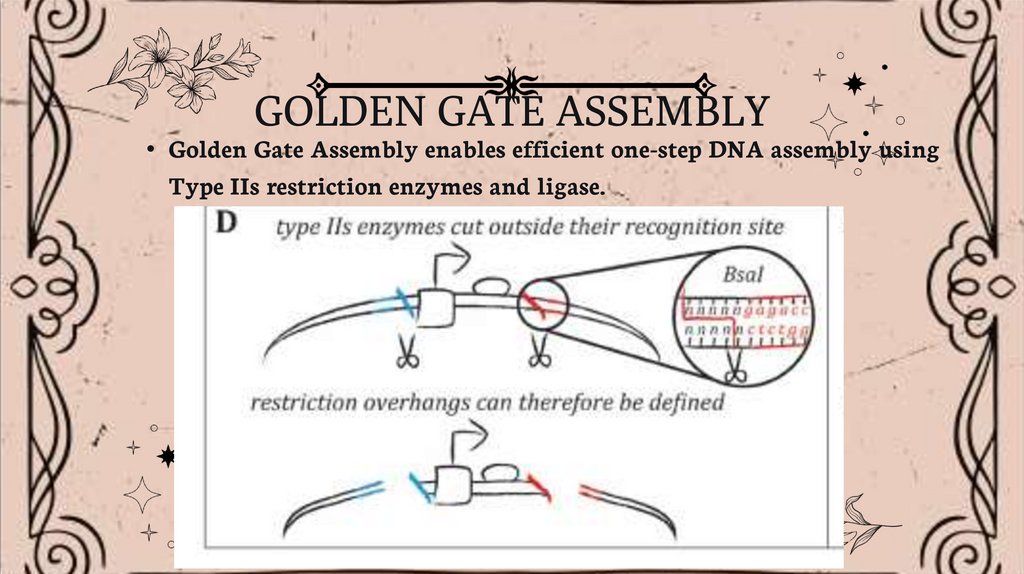
GOLDEN GATE ASSEMBLY• Golden Gate Assembly enables efficient one-step DNA assembly using
Type IIs restriction enzymes and ligase.
12.
GOLDEN GATE ASSEMBLY• Sequence Constraints – Requires specific restriction sites, limiting flexibility
• Efficiency Issues – Assembly success decreases with increasing fragment
number, especially beyond 10 fragments.
• Scarless but Error-Prone – While it avoids unwanted sequences, ligation errors
can occur at junctions.
• Optimization Challenges – Requires careful design of overhangs to ensure
correct assembly.
• Not Ideal for Large Constructs – Works best for modular cloning, but
struggles with whole-genome assembly.
13.
IMPORTANCE• Enables precise DNA editing and manipulation.
• Facilitates modular cloning, allowing scalable genetic
engineering.
• Supports synthetic biology, advancing medicine, biotechnology,
and bioengineering.
• Improves efficiency in assembling complex genetic constructs for
research and applications.
14.
AREAS OF USE• Biomedical Research – Gene therapy, vaccine development, and
synthetic genome projects.
• Industrial Biotechnology – Engineering microorganisms for
biofuel production and pharmaceutical synthesis.
• Agriculture – Developing genetically modified crops with
enhanced traits.
• Environmental Science – Bioremediation using engineered
microbes to clean pollutants.
15.
FUTURE IMPLICATIONS• Scalable genome assembly – Enabling synthetic organisms for
tailored medical and industrial applications.
• Automated DNA design – AI-assisted genetic engineering for
faster and more precise DNA synthesis.
• Advanced gene therapies – Personalized medicine using
engineered gene circuits for targeted disease treatment.
• Synthetic biosensors – Using engineered DNA constructs for realtime monitoring of environmental and biological conditions