
 law
lawSimilar presentations:






Court Operations Overview
1.
Court OperationsOverview
Exploring the unique functions of the court system, including its role
in justice, dispute resolution, and upholding the law.
2.
Understanding Court Roles andFunctions
Courts are essential in
interpreting laws, ensuring
justice, and resolving disputes
within a legal framework.
They uphold the rule of law by
providing a structured process
for legal proceedings and
enforcing legal rights.
3.
Judicial System Structure Overview1
2
Supreme Court
Appellate Courts
The highest authority,
overseeing the entire
judicial system.
Handle appeals and
review decisions from
lower courts.
3
Trial Courts
Initial level for legal
disputes, handle cases
firsthand.
4.
Understanding Court Types andJurisdictions
1
2
Federal Courts
State Courts
Handle cases involving
federal laws and
constitutional issues.
Deal with state laws
including civil and
criminal cases.
3
Specialized Courts
Focus on specific areas
like family, tax, or
bankruptcy law.
5.
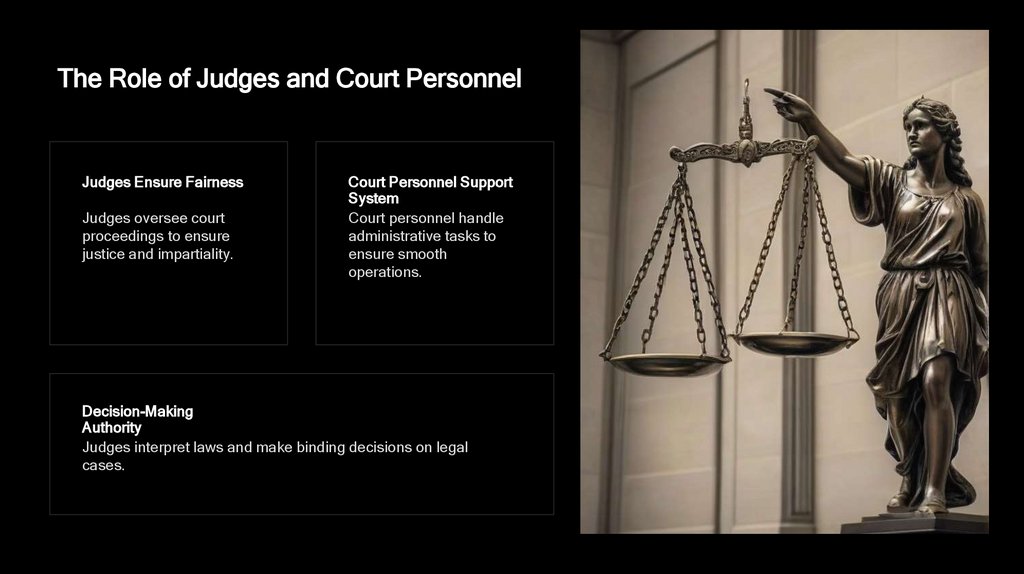
The Role of Judges and Court PersonnelJudges Ensure Fairness
Judges oversee court
proceedings to ensure
justice and impartiality.
Court Personnel Support
System
Court personnel handle
administrative tasks to
ensure smooth
operations.
Decision-Making
Authority
Judges interpret laws and make binding decisions on legal
cases.
6.
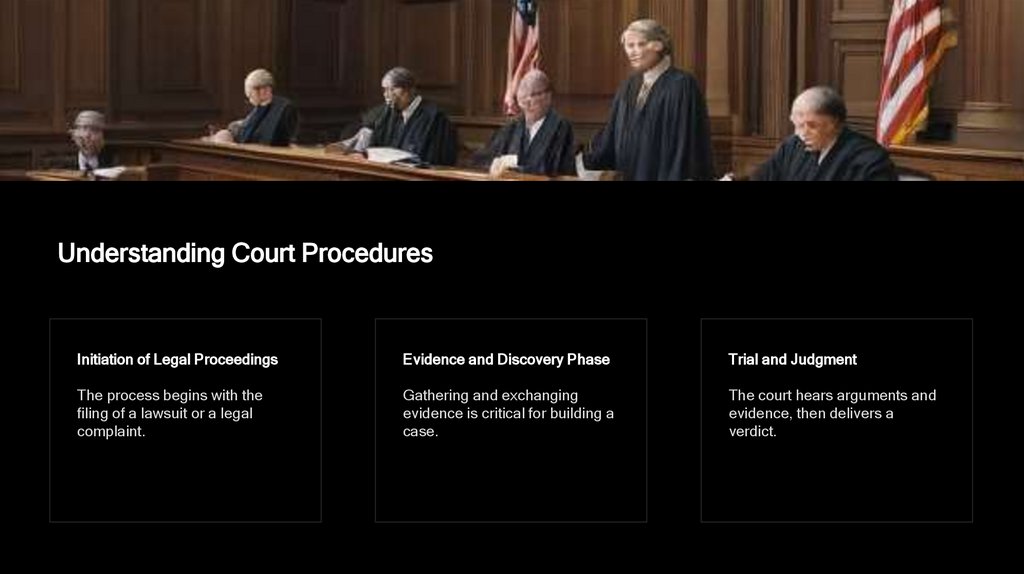
Understanding Court ProceduresInitiation of Legal Proceedings
Evidence and Discovery Phase
Trial and Judgment
The process begins with the
filing of a lawsuit or a legal
complaint.
Gathering and exchanging
evidence is critical for building a
case.
The court hears arguments and
evidence, then delivers a
verdict.
7.
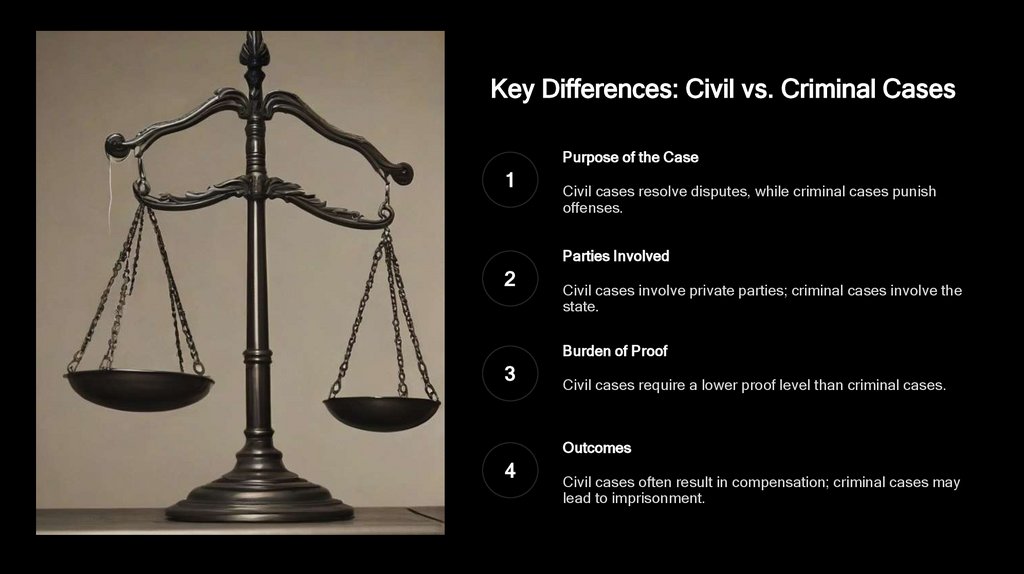
Key Differences: Civil vs. Criminal CasesPurpose of the Case
1
Civil cases resolve disputes, while criminal cases punish
offenses.
Parties Involved
2
Civil cases involve private parties; criminal cases involve the
state.
Burden of Proof
3
Civil cases require a lower proof level than criminal cases.
Outcomes
4
Civil cases often result in compensation; criminal cases may
lead to imprisonment.
8.
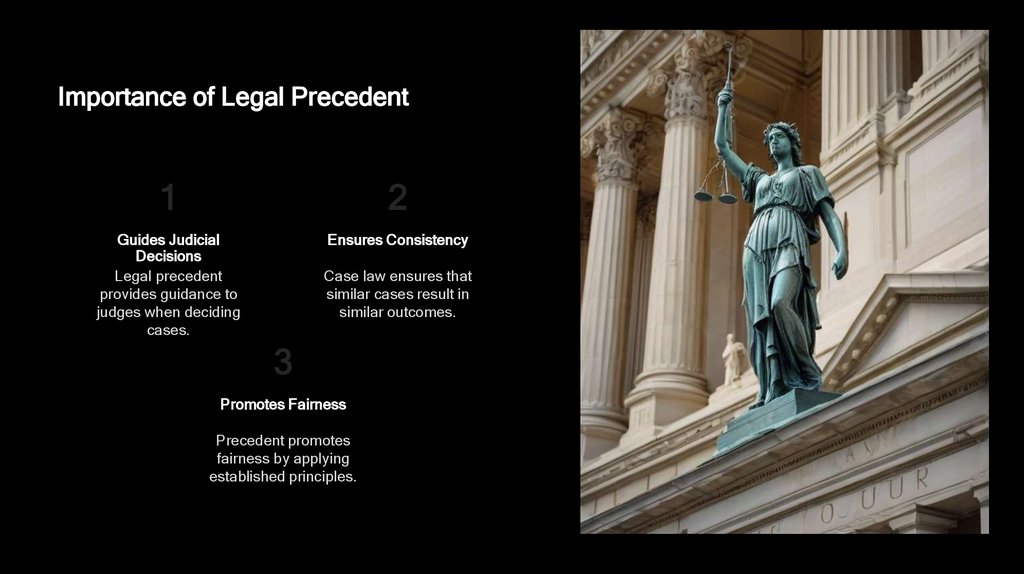
Importance of Legal Precedent1
2
Guides Judicial
Decisions
Legal precedent
provides guidance to
judges when deciding
cases.
Ensures Consistency
Case law ensures that
similar cases result in
similar outcomes.
3
Promotes Fairness
Precedent promotes
fairness by applying
established principles.
9.
Technology's Impact on Court OperationsIncreased Efficiency
Enhanced Accessibility
Technology streamlines
court processes,
reducing case backlog.
Digital platforms enable
remote access to legal
resources and services.
Improved Data
Management
Automation facilitates accurate and secure handling of court
records.
10.
Current Challenges in Judicial SystemCase Backlog
Technological Inefficiencies
Need for Judicial Reform
Excessive case load leads to
delays in the judicial process.
Lack of modern tech hinders
efficiency and accessibility in
courts.
Outdated laws and processes
require ongoing reform and
adaptation.
11.
The Evolving Role of the JudiciaryJudiciary and Social Change
Courts adapt to social transformations.
Technological Impact
Technology reshapes judicial processes.
Global Influence
Judicial decisions affect global standards.