




 english
Similar presentations:



Based on the work "Pride and Prejudice" by Jane Austen
1. PROJECT Based on the work "Pride and Prejudice" by Jane Austen
PROJECTBased on the work "Pride and Prejudice" by
Jane Austen
Completed by Sevil Suleymanova 222 (A)
2.
IndefiniteInfinitive
Active
Passive
Not handsome enough to dance with. I wish
you had been there,
my dear, to have given him one of your setdowns. [p. 16]
but as he was now provided with a good
house and the liberty of a manor, it was
doubtful to many of those who best knew
the easiness of his temper, whether he might
not spend the remainder of his days at
Netherfield, and leave the next generation to
purchase [p. 19]
Miss Bingley was by no means unwilling to
preside at his table[p. 19]
‘That is very true,’ replied Elizabeth, ‘
and I could easily forgive his pride, if he had
not mortified mine[p. 23]
"I beg you would not put it into Lizzy's head to be
vexed by his ill-treatment [p. 22]
or he is such a disagreeable man, that it would be
quite a misfortune to be liked by him [p. 22]
but she considered with pleasure that it was not
likely to be discovered by the world in general [p.
25]
3.
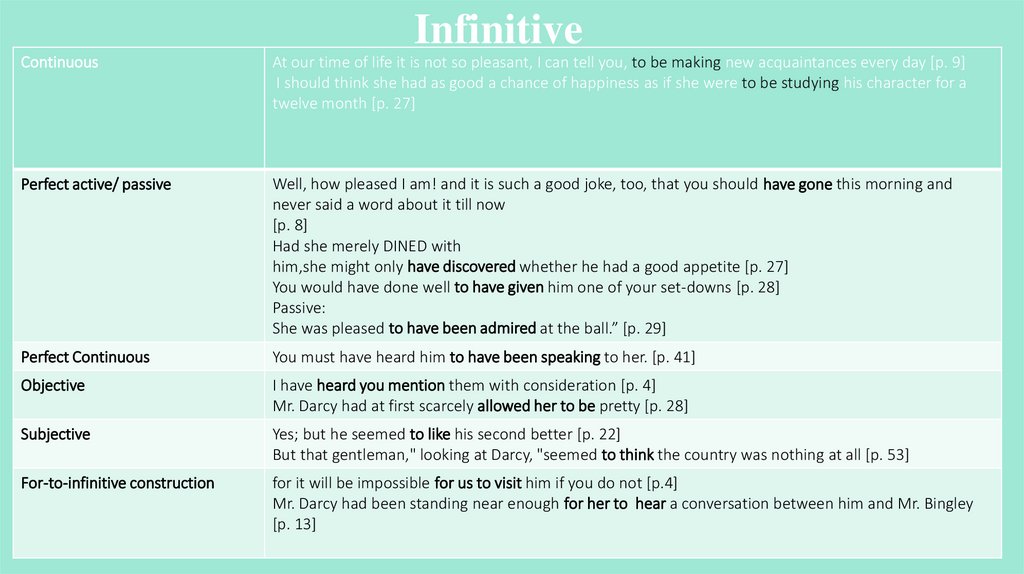
InfinitiveContinuous
At our time of life it is not so pleasant, I can tell you, to be making new acquaintances every day [p. 9]
I should think she had as good a chance of happiness as if she were to be studying his character for a
twelve month [p. 27]
Perfect active/ passive
Well, how pleased I am! and it is such a good joke, too, that you should have gone this morning and
never said a word about it till now
[p. 8]
Had she merely DINED with
him,she might only have discovered whether he had a good appetite [p. 27]
You would have done well to have given him one of your set-downs [p. 28]
Passive:
She was pleased to have been admired at the ball.” [p. 29]
Perfect Continuous
You must have heard him to have been speaking to her. [p. 41]
Objective
I have heard you mention them with consideration [p. 4]
Mr. Darcy had at first scarcely allowed her to be pretty [p. 28]
Subjective
Yes; but he seemed to like his second better [p. 22]
But that gentleman," looking at Darcy, "seemed to think the country was nothing at all [p. 53]
For-to-infinitive construction
for it will be impossible for us to visit him if you do not [p.4]
Mr. Darcy had been standing near enough for her to hear a conversation between him and Mr. Bingley
[p. 13]
4.
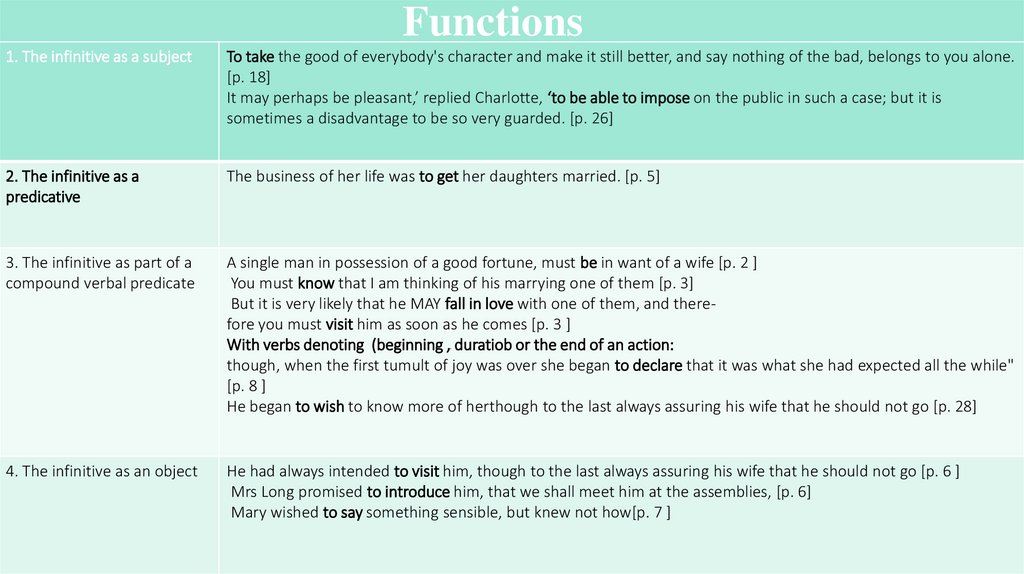
Functions1. The infinitive as a subject
To take the good of everybody's character and make it still better, and say nothing of the bad, belongs to you alone.
[p. 18]
It may perhaps be pleasant,’ replied Charlotte, ‘to be able to impose on the public in such a case; but it is
sometimes a disadvantage to be so very guarded. [p. 26]
2. The infinitive as a
predicative
The business of her life was to get her daughters married. [p. 5]
3. The infinitive as part of a
compound verbal predicate
A single man in possession of a good fortune, must be in want of a wife [p. 2 ]
You must know that I am thinking of his marrying one of them [p. 3]
But it is very likely that he MAY fall in love with one of them, and therefore you must visit him as soon as he comes [p. 3 ]
With verbs denoting (beginning , duratiob or the end of an action:
though, when the first tumult of joy was over she began to declare that it was what she had expected all the while"
[p. 8 ]
He began to wish to know more of herthough to the last always assuring his wife that he should not go [p. 28]
4. The infinitive as an object
He had always intended to visit him, though to the last always assuring his wife that he should not go [p. 6 ]
Mrs Long promised to introduce him, that we shall meet him at the assemblies, [p. 6]
Mary wished to say something sensible, but knew not how[p. 7 ]
5.
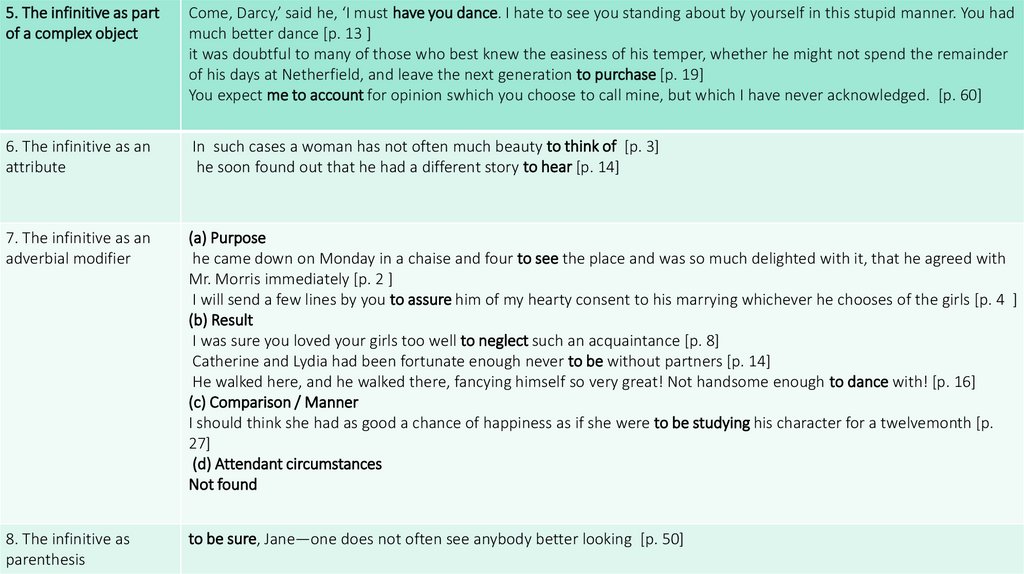
5. The infinitive as partof a complex object
Come, Darcy,’ said he, ‘I must have you dance. I hate to see you standing about by yourself in this stupid manner. You had
much better dance [p. 13 ]
it was doubtful to many of those who best knew the easiness of his temper, whether he might not spend the remainder
of his days at Netherfield, and leave the next generation to purchase [p. 19]
You expect me to account for opinion swhich you choose to call mine, but which I have never acknowledged. [p. 60]
6. The infinitive as an
attribute
In such cases a woman has not often much beauty to think of [p. 3]
he soon found out that he had a different story to hear [p. 14]
7. The infinitive as an
adverbial modifier
(a) Purpose
he came down on Monday in a chaise and four to see the place and was so much delighted with it, that he agreed with
Mr. Morris immediately [p. 2 ]
I will send a few lines by you to assure him of my hearty consent to his marrying whichever he chooses of the girls [p. 4 ]
(b) Result
I was sure you loved your girls too well to neglect such an acquaintance [p. 8]
Catherine and Lydia had been fortunate enough never to be without partners [p. 14]
He walked here, and he walked there, fancying himself so very great! Not handsome enough to dance with! [p. 16]
(c) Comparison / Manner
I should think she had as good a chance of happiness as if she were to be studying his character for a twelvemonth [p.
27]
(d) Attendant circumstances
Not found
8. The infinitive as
parenthesis
to be sure, Jane—one does not often see anybody better looking [p. 50]
6.
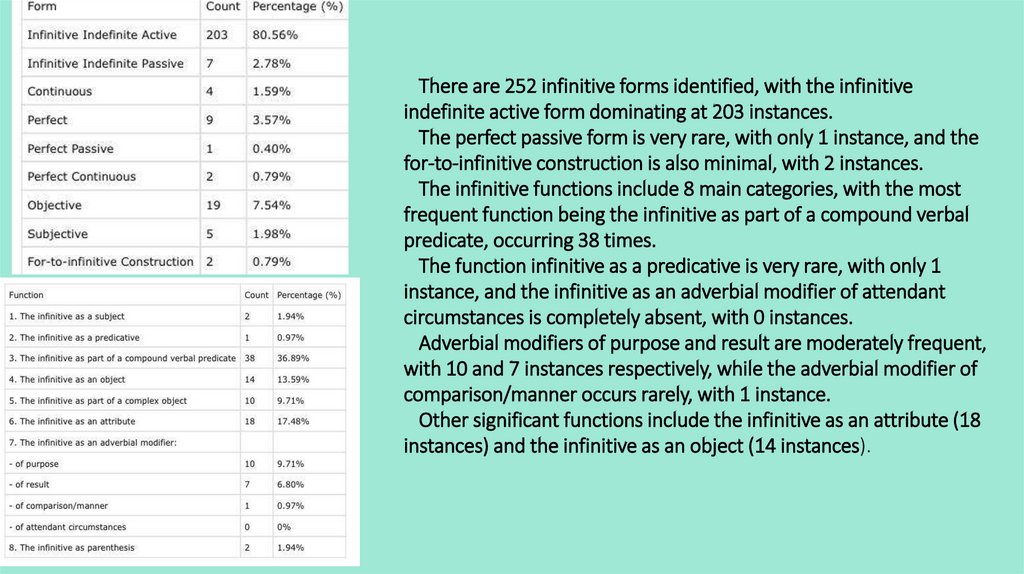
There are 252 infinitive forms identified, with the infinitiveindefinite active form dominating at 203 instances.
The perfect passive form is very rare, with only 1 instance, and the
for-to-infinitive construction is also minimal, with 2 instances.
The infinitive functions include 8 main categories, with the most
frequent function being the infinitive as part of a compound verbal
predicate, occurring 38 times.
The function infinitive as a predicative is very rare, with only 1
instance, and the infinitive as an adverbial modifier of attendant
circumstances is completely absent, with 0 instances.
Adverbial modifiers of purpose and result are moderately frequent,
with 10 and 7 instances respectively, while the adverbial modifier of
comparison/manner occurs rarely, with 1 instance.
Other significant functions include the infinitive as an attribute (18
instances) and the infinitive as an object (14 instances).
7. Gerund
ActivePassive
Indefinite
The rest of the evening was spent in
conjecturing how soon he would return [p. 8]
I was very much flattered by his asking me to
dance a second time [ p. 17]
To be fond of dancing was a certain step
towards falling in love [p. 10]
He had entertained hopes of being admitted to a
sight of the young ladies [p. 10]
Bingley was sure of being liked wherever he
appeared [ p. 20]
Mr. Darcy danced only once with Mrs. Hurst and
once with Miss Bingley, declined being introduced
to any other lady
Perfect
Amongst the most violent against him was
Mrs. Bennet, whose dislike of his general
behaviour was sharpened
into particular resentmentby his having
slighted one of her daughters [p. 12]
Not found
8. Functions
The gerund as asubject
Elizabeth, feeling really anxious, was determined to go to her, though the carriage was not to be had; and as she was no
horsewoman, walking was her only alternative.[p. 39]
The gerund as a
predicative
Not found
The gerund as part (a) With modal verbs, expressions
of a compound
He could not help seeing that you were about five times as pretty as every other woman in the room [p. 17 ]
verbal predicate
(b) With beginning/duration/end
When dinner was over, she returned directly to Jane, and Miss Bingley began abusing her as soon as she was out of
the room. [ p. 43]
and after a short silence Mrs. Bennet began repeating her thanks to Mr. Bingley for his kindness
to Jane [p. 55]
The gerund as an
object
Mrs. Bennet was prevented replying by the entrance of the footman with a note for Miss Bennet; it came from Netherfield [p.
36 ]
Oh! I am not afraid of her dying [p. 38 ]
I shall insist on their giving one also [p. 56 ]
The gerund as an
attribute
Mr. Bennet: «Is that his design in settling here? [p. 3]
said Mrs. Bennet more than once, as if the credit of making it rain were all her own [p. 38 ]
9.
The gerund as anadverbial
modifier
a) Time
The sisters, on hearing this, repeated three or four times [p. 42]
With a renewal of tenderness, however, they returned to her room on leaving the dining-parlour, and sat with
her till summoned to coffee [p. 44 ]
b) Manner
Mr. Darcy danced only once with Mrs. Hurst and once with Miss Bingley, declined being introduced to any
other lady, and spent the rest of the evening in walking about the room, speaking occasionally to one of his
own party [p. 12 ]
She is one of those young ladies who seek to recommend themselves to the other sex by undervaluing their
own [p. 48]
c) Attendant circumstances
he sat close to her for half-an-hour without once opening his lips [ p. 22]
A person may be proud without being vain [p. 24]
d) Purpose
When she is secure of him, there will be more leisure for falling in love as much as she chooses [p. 26]
e) Condition
and I am sure I never heard a young lady spoken of for the first time, without being informed that she was
very accomplished [p. 47]
f) Cause
Elizabeth, for the sake of saying something that might turn her mother’s thoughts, now asked her if Charlotte
Lucas had been at Longbourn since HER coming away [p. 53]
g) Concession
he was forced to acknowledge her figure to be light and pleasing; and in spite of his asserting that her manners
were not those of the fashionable world, he was caught by their easy playfulness [ p. 28]
10.
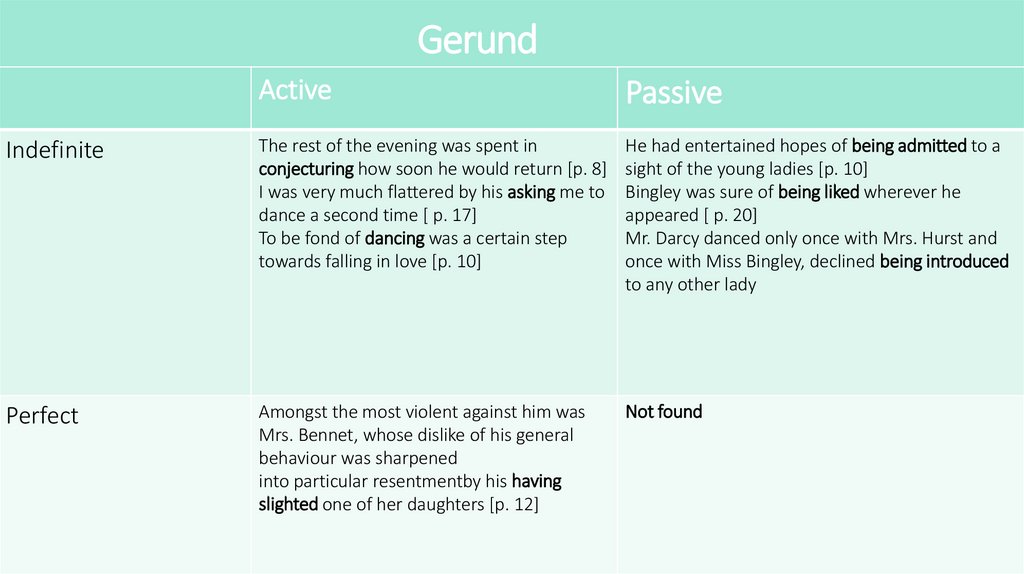
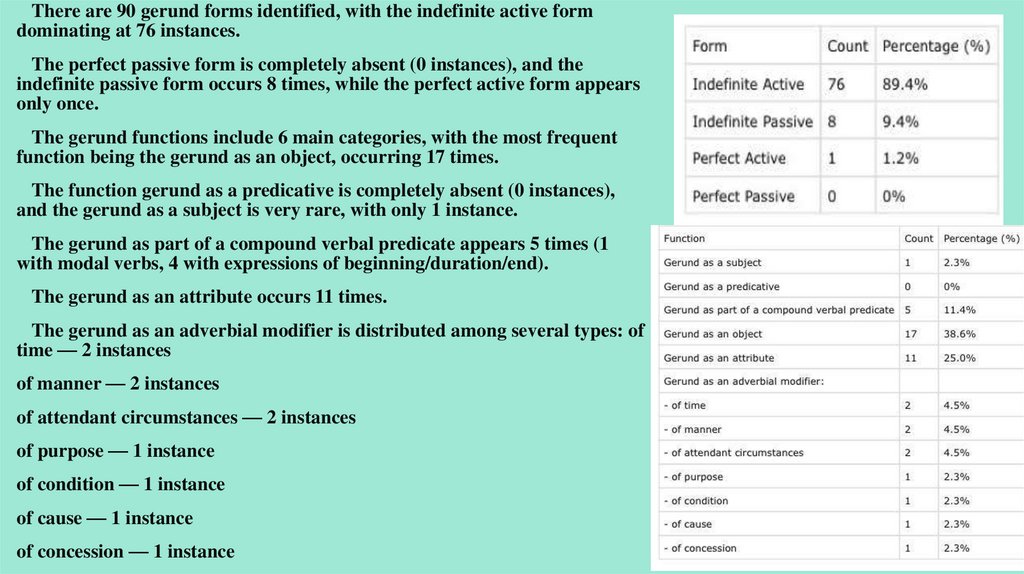
There are 90 gerund forms identified, with the indefinite active formdominating at 76 instances.
The perfect passive form is completely absent (0 instances), and the
indefinite passive form occurs 8 times, while the perfect active form appears
only once.
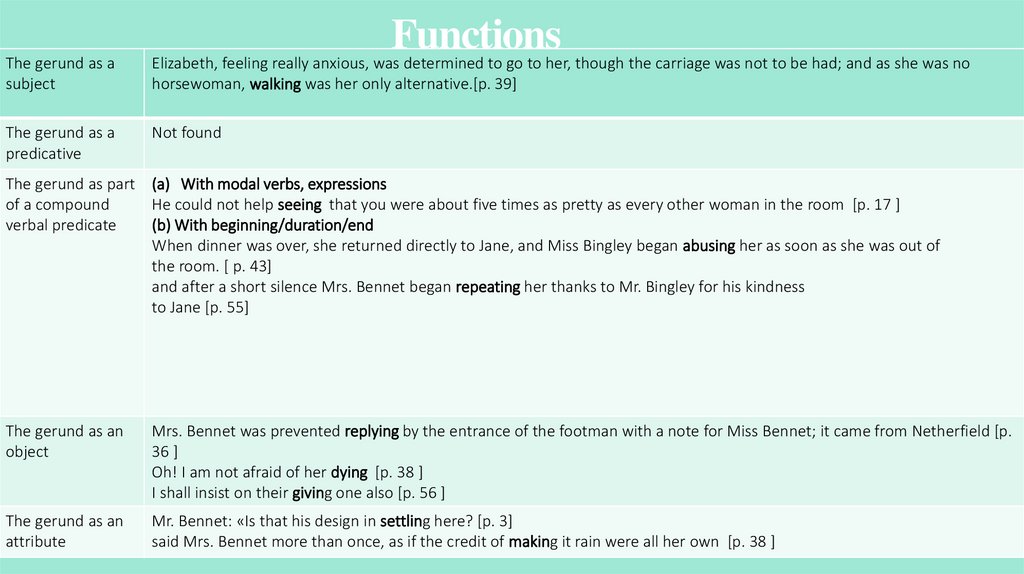
The gerund functions include 6 main categories, with the most frequent
function being the gerund as an object, occurring 17 times.
The function gerund as a predicative is completely absent (0 instances),
and the gerund as a subject is very rare, with only 1 instance.
The gerund as part of a compound verbal predicate appears 5 times (1
with modal verbs, 4 with expressions of beginning/duration/end).
The gerund as an attribute occurs 11 times.
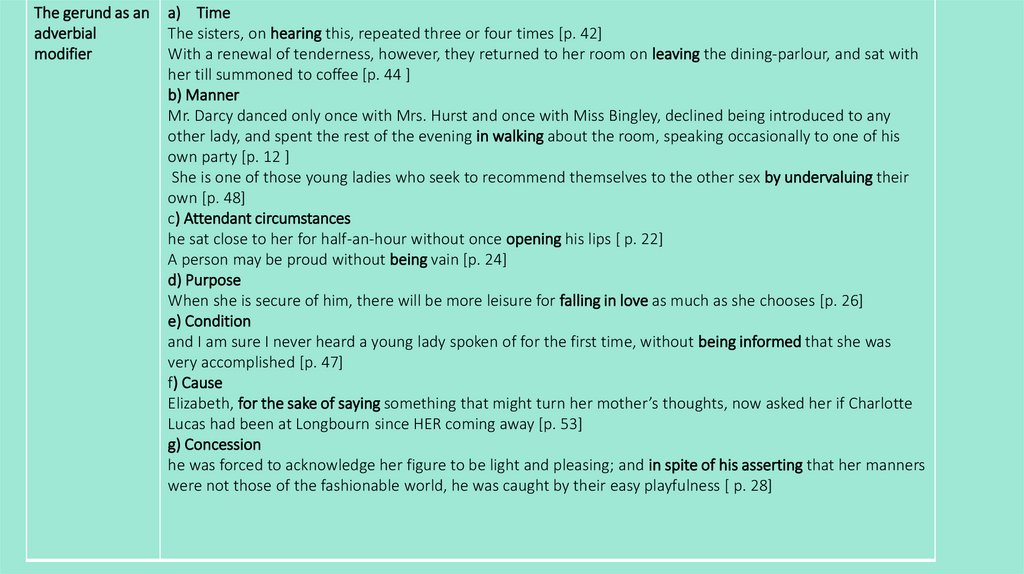
The gerund as an adverbial modifier is distributed among several types: of
time — 2 instances
of manner — 2 instances
of attendant circumstances — 2 instances
of purpose — 1 instance
of condition — 1 instance
of cause — 1 instance
of concession — 1 instance
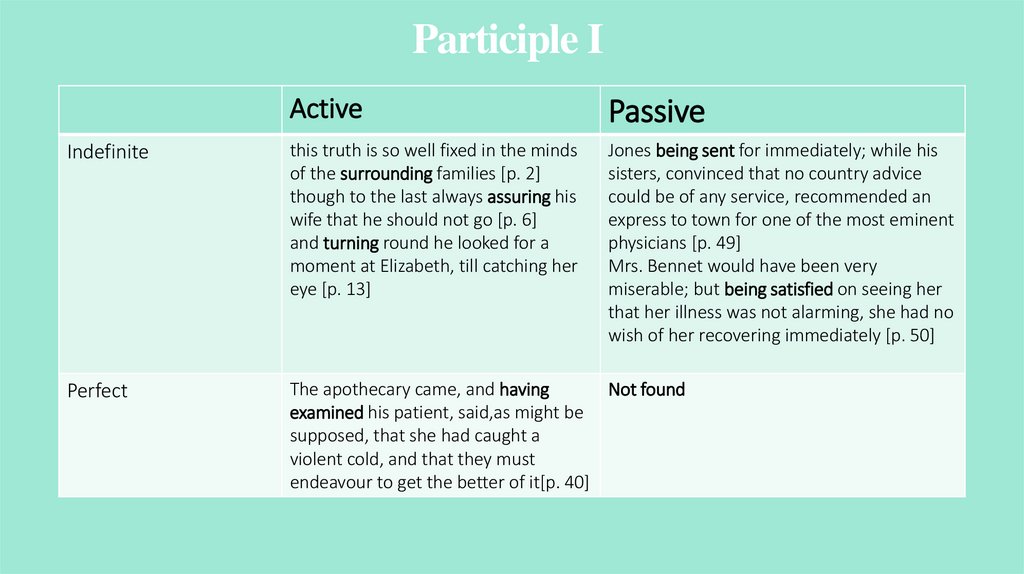
11. Participle I
ActivePassive
Indefinite
this truth is so well fixed in the minds
of the surrounding families [p. 2]
though to the last always assuring his
wife that he should not go [p. 6]
and turning round he looked for a
moment at Elizabeth, till catching her
eye [p. 13]
Jones being sent for immediately; while his
sisters, convinced that no country advice
could be of any service, recommended an
express to town for one of the most eminent
physicians [p. 49]
Mrs. Bennet would have been very
miserable; but being satisfied on seeing her
that her illness was not alarming, she had no
wish of her recovering immediately [p. 50]
Perfect
The apothecary came, and having
Not found
examined his patient, said,as might be
supposed, that she had caught a
violent cold, and that they must
endeavour to get the better of it[p. 40]
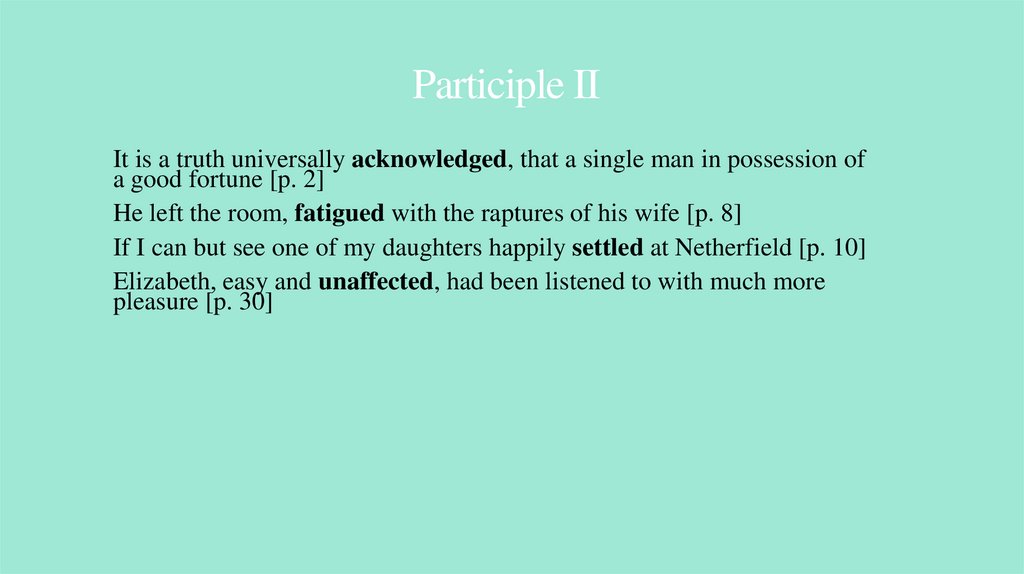
12. Participle II
It is a truth universally acknowledged, that a single man in possession ofa good fortune [p. 2]
He left the room, fatigued with the raptures of his wife [p. 8]
If I can but see one of my daughters happily settled at Netherfield [p. 10]
Elizabeth, easy and unaffected, had been listened to with much more
pleasure [p. 30]
13.
Subjective Participial ConstructionBut, however, he did not admire her at all; indeed, nobody can, you know;
and he seemed quite struck with Jane as she was going down the dance.
Prepositional Absolute Participial
Construction
Not found
Nominative Absolute Participial Construction
Not found
Objective Participial Construction
I hate to see you standing about by yourself in this stupid manner [p. 13]
Mary had heard herself mentioned to Miss Bingley as the most accomplished
girl [p. 14]
14.
FunctionsParticiple I
Participle II
1. Participle I as an Attribute
Miss Bennet's pleasing manners grew on the goodwill of Mrs. Hurst and
Miss Bingley [p. 25]
this truth is so well fixed in the minds of the surrounding families [p. 2]
1. Participle II as an Attribute
It is a truth universally acknowledged, that a single man in
possession of a good fortune [p. 2]
If I can but see one of my daughters happily settled at Netherfield
[p. 10]
2. Participle I as an Adverbial Modifier
(a) of Time
Observing his second daughter employed in trimming a hat, he suddenly
addressed her [p. 6]
The apothecary came, and having examined his patient, said,as might be
supposed, that she had caught a violent cold, and that they must
endeavour to get the better of it[p. 40]
(b) of Cause
He walked here, and he walked there, fancying himself so very great! Not
handsome enough to dance with! [15]
she requested to have a note sent to Longbourn, desiring her mother to
visit Jane [p. 50]
(c) of Manner and Attendant Circumstances
Mr. Darcy is all politeness," said Elizabeth, smiling [p. 32]
And, taking her hand, he would have given it to Mr.Darcy who, though
extremely surprised [p. 31]
(d) of Comparison
Constructions not found
2. Participle II as a Predicative
He did look at it, and into it for half-an-hour—was pleased with the
situation and the principal rooms, satisfied with what the owner
said in its praise, and took it immediately [p. 19]
From expressing in her note how much she longed for such a visit,
was delighted at her entrance [p. 40]
15.
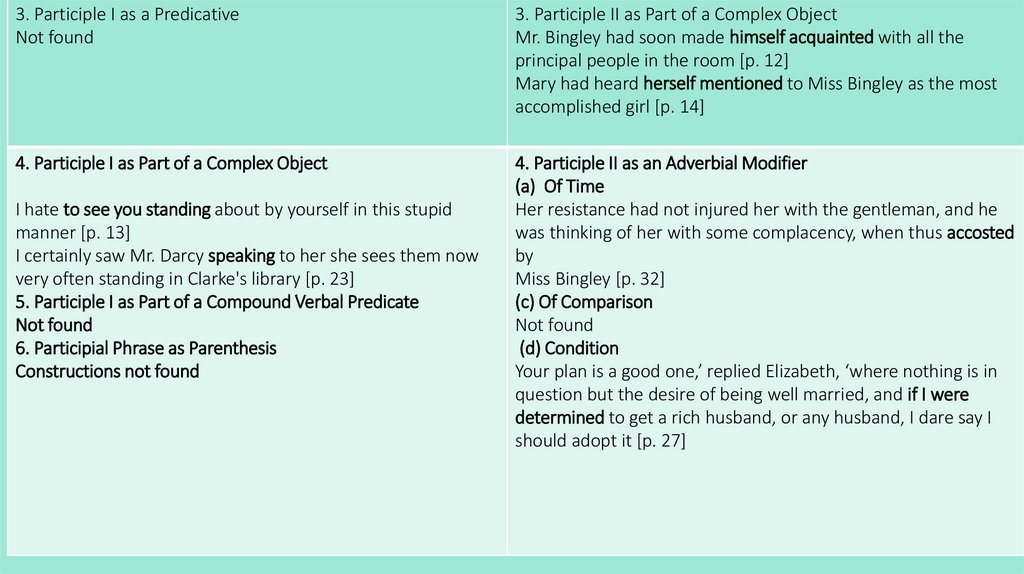
3. Participle I as a PredicativeNot found
3. Participle II as Part of a Complex Object
Mr. Bingley had soon made himself acquainted with all the
principal people in the room [p. 12]
Mary had heard herself mentioned to Miss Bingley as the most
accomplished girl [p. 14]
4. Participle I as Part of a Complex Object
4. Participle II as an Adverbial Modifier
(a) Of Time
Her resistance had not injured her with the gentleman, and he
was thinking of her with some complacency, when thus accosted
by
Miss Bingley [p. 32]
(c) Of Comparison
Not found
(d) Condition
Your plan is a good one,’ replied Elizabeth, ‘where nothing is in
question but the desire of being well married, and if I were
determined to get a rich husband, or any husband, I dare say I
should adopt it [p. 27]
I hate to see you standing about by yourself in this stupid
manner [p. 13]
I certainly saw Mr. Darcy speaking to her she sees them now
very often standing in Clarke's library [p. 23]
5. Participle I as Part of a Compound Verbal Predicate
Not found
6. Participial Phrase as Parenthesis
Constructions not found
16.
17.
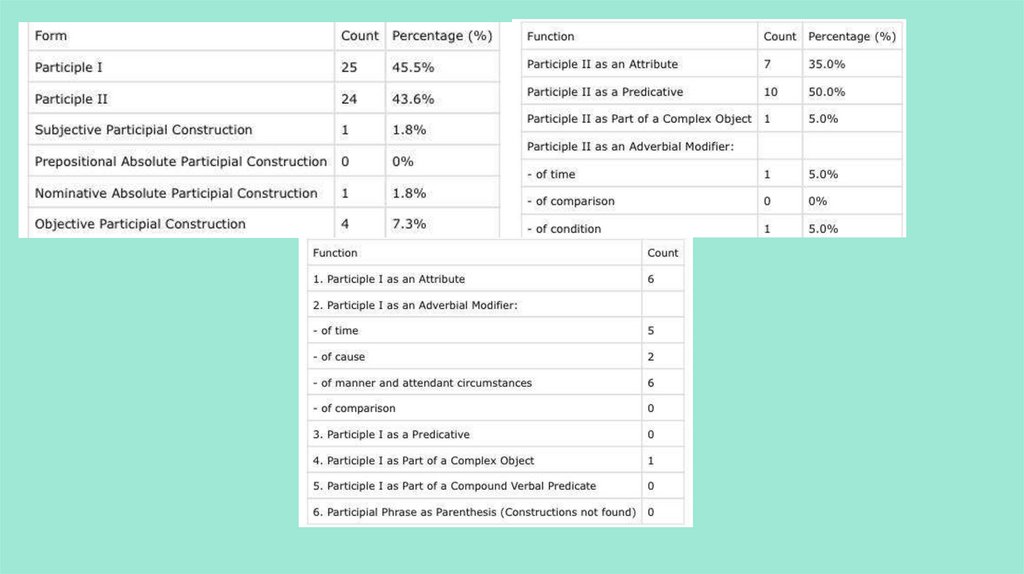
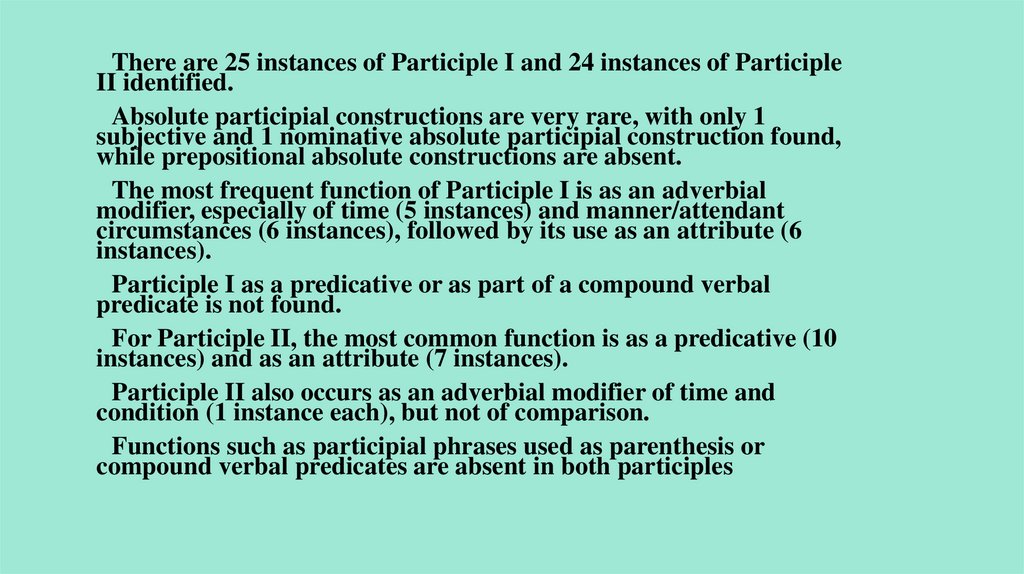
There are 25 instances of Participle I and 24 instances of ParticipleII identified.
Absolute participial constructions are very rare, with only 1
subjective and 1 nominative absolute participial construction found,
while prepositional absolute constructions are absent.
The most frequent function of Participle I is as an adverbial
modifier, especially of time (5 instances) and manner/attendant
circumstances (6 instances), followed by its use as an attribute (6
instances).
Participle I as a predicative or as part of a compound verbal
predicate is not found.
For Participle II, the most common function is as a predicative (10
instances) and as an attribute (7 instances).
Participle II also occurs as an adverbial modifier of time and
condition (1 instance each), but not of comparison.
Functions such as participial phrases used as parenthesis or
compound verbal predicates are absent in both participles
18. Conclusion
InfinitivesInfinitives are used most often, especially the basic
active form (203 times). Other forms like passive,
perfect, or continuous are much less common.
Infinitives mainly appear as parts of compound
verbs (38 times), as attributes (18), and as objects
(14). They also express purpose or result in some
cases.
Less often, infinitives act as subjects, predicatives,
or parenthetical phrases.
This shows that infinitives are important for
expressing intentions, plans, and complex actions
in the story.
Gerunds
Gerunds are less frequent than infinitives, with 80
active forms and a few passive and perfect forms;
perfect passive gerunds don’t appear.
The gerund mostly functions as an object (17
times) or an attribute (11), and sometimes as part
of compound verbs (5).
Gerunds also describe time, manner, cause,
condition, and purpose, but these uses are rare.
Gerunds rarely serve as subjects or predicatives.
This suggests gerunds are mainly used to describe ongoing or
repeated actions and states.
Participles
Participle I and II appear almost equally (25 and 24 times).
Absolute participial constructions are very rare.
Participle I is mostly used as an adverbial modifier (time, cause,
manner) and as an attribute. It does not appear as a predicative
or in compound predicates.
Participle II is often a predicative (10 times) or an attribute (7
times), with some use as an adverbial modifier.
Participial phrases as parenthesis or compound predicates are
absent.
Participles mainly add descriptive details and explain timing,
cause, or qualities.
Overall
Infinitives dominate the use of non-finite verbs, showing their key
role in expressing purpose and complex actions.
Gerunds support by describing ongoing or habitual actions,
mostly in object or attribute roles.
Participles add description and clarify timing or cause, enriching
the narrative detail.