 pedagogy
Similar presentations:









Use Scales
1.
2.
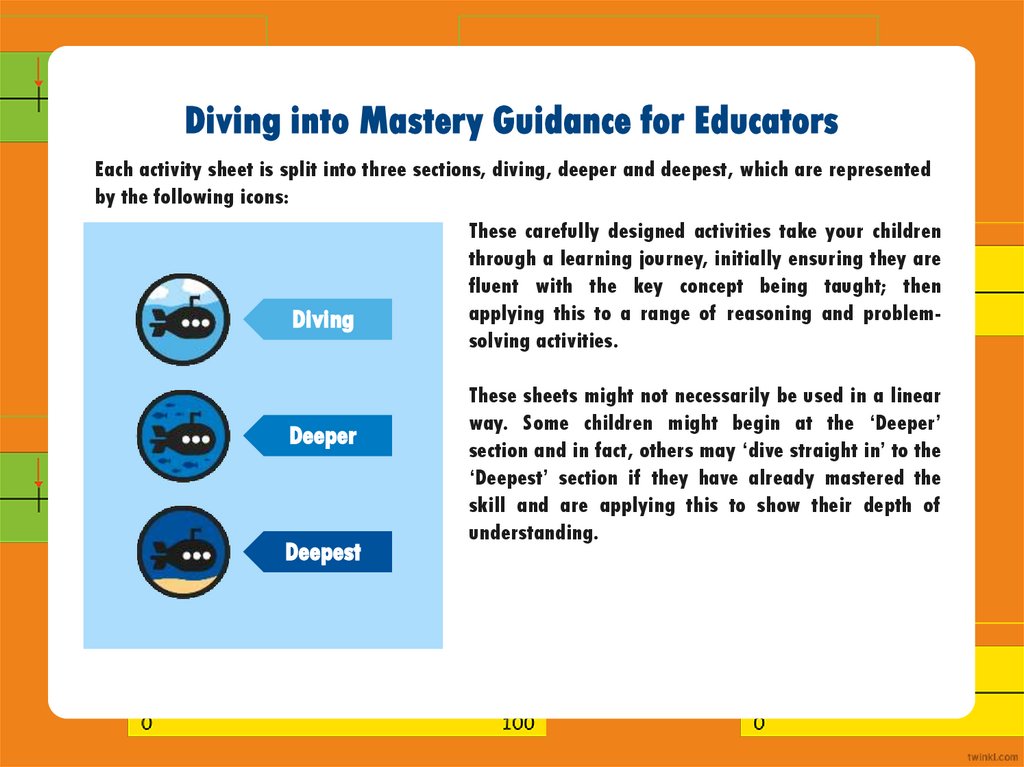
Diving into Mastery Guidance for EducatorsEach activity sheet is split into three sections, diving, deeper and deepest, which are represented
by the following icons:
Diving
Deeper
Deepest
These carefully designed activities take your children
through a learning journey, initially ensuring they are
fluent with the key concept being taught; then
applying this to a range of reasoning and problemsolving activities.
These sheets might not necessarily be used in a linear
way. Some children might begin at the ‘Deeper’
section and in fact, others may ‘dive straight in’ to the
‘Deepest’ section if they have already mastered the
skill and are applying this to show their depth of
understanding.
3.
National Curriculum Aim• Measure compare, add and subtract: lengths
(m/cm/mm); mass(kg/g): volume/capacity (l/ml)
4.
Use ScalesDivin
g
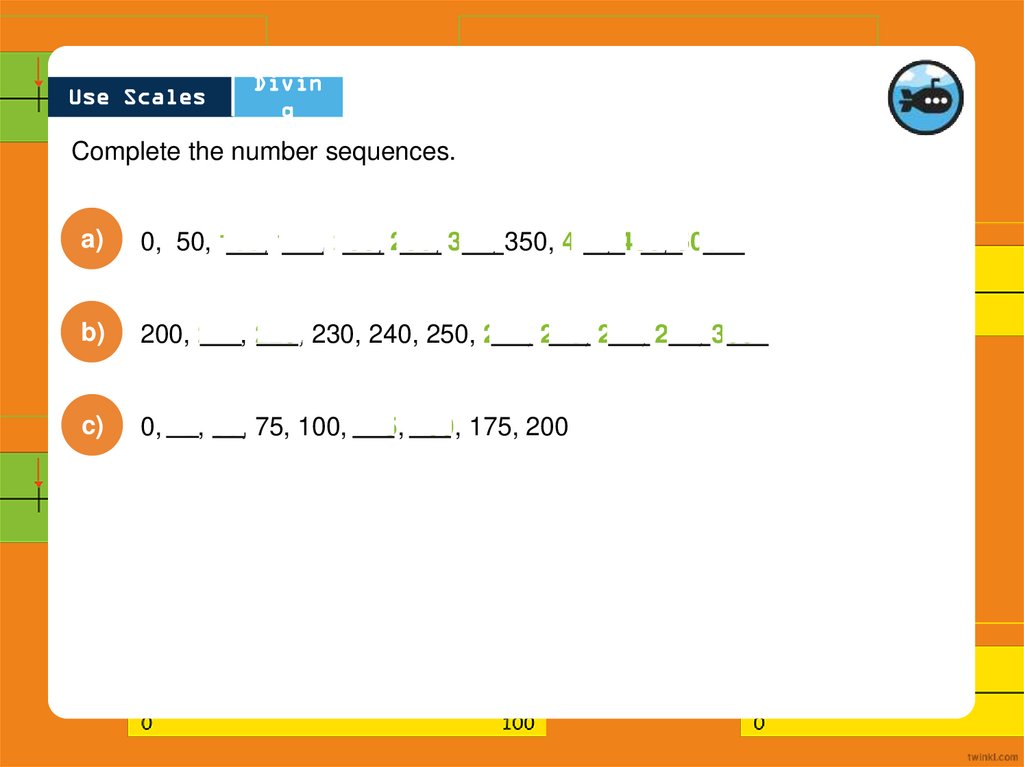
Complete the number sequences.
a)
0, 50, 100, 150, 200, 250, 300, 350, 400, 450, 500
b)
200, 210, 220, 230, 240, 250, 260, 270, 280, 290, 300
c)
0, 25, 50, 75, 100, 125, 150, 175, 200
5.
UseScales
Divin
g
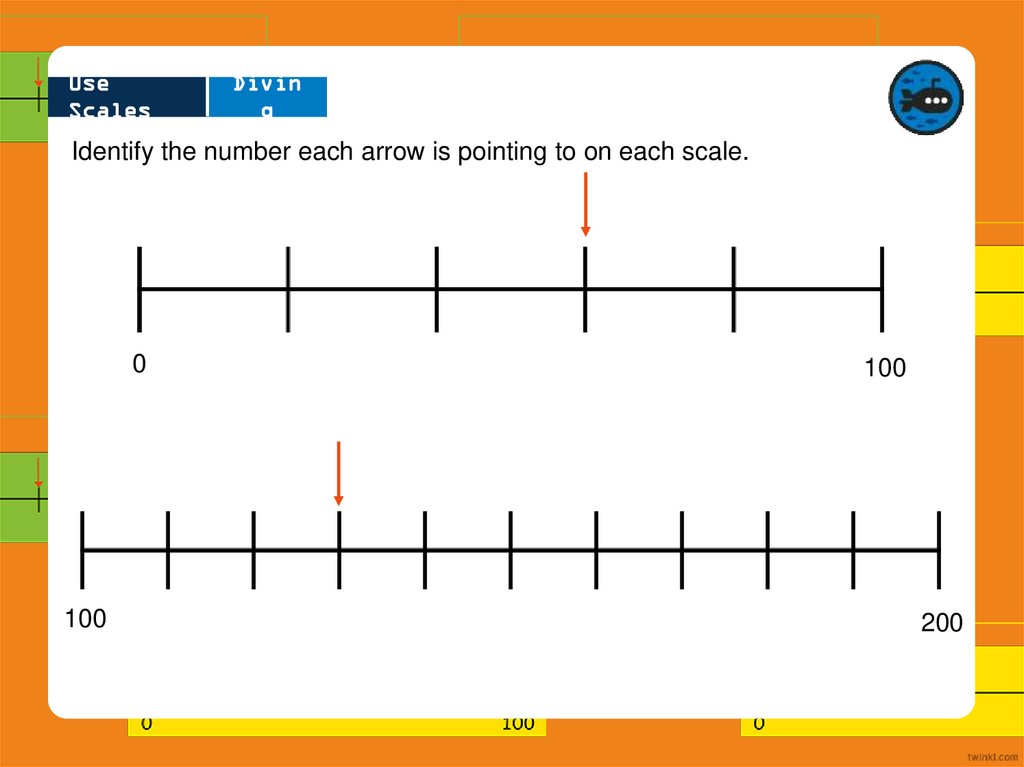
Identify the number each arrow is pointing to on each scale.
0
100
20
11
0
120
40
13
0
140
60
150
160
80
170
100
180
190
200
6.
Use ScalesDeeper
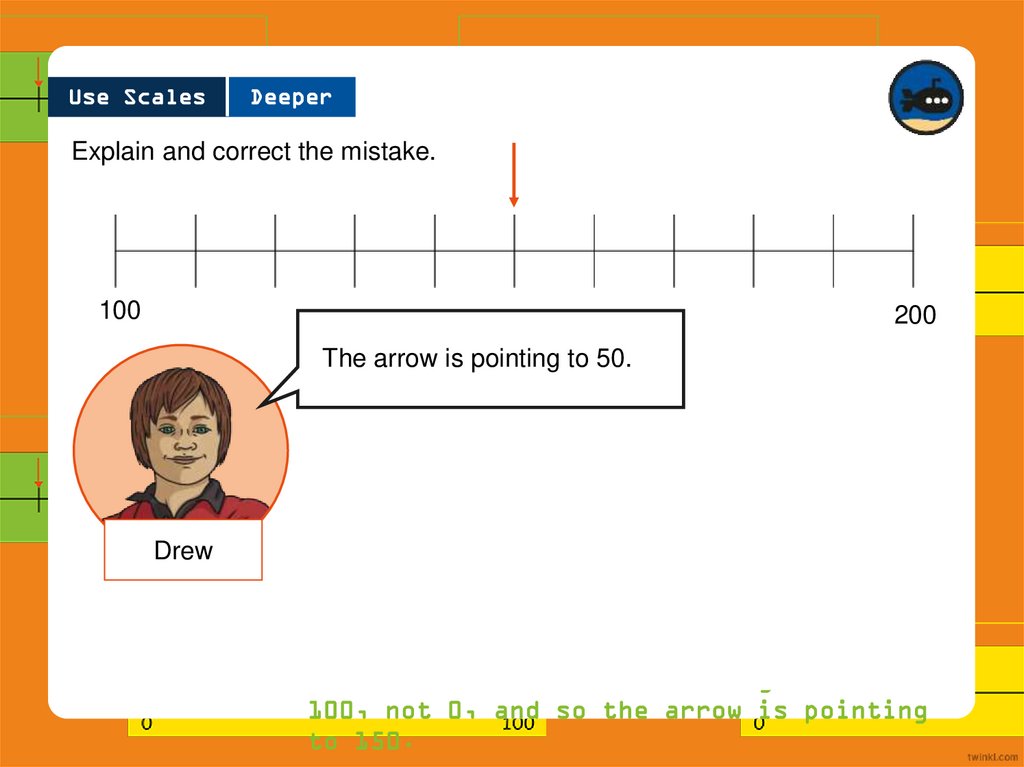
Explain and correct the mistake.
100
200
The arrow is pointing to 50.
Drew
Drew has counted that the scale has been
split into 10 equal parts and that the
difference between the start and end
number is 100. So they believe that the
arrow is pointing to 50 because 50 is
half of 100. They have not looked
carefully at the start and end numbers
and realised that the starting number is
100, not 0, and so the arrow is pointing
to 150.
7.
Use ScalesDeeper
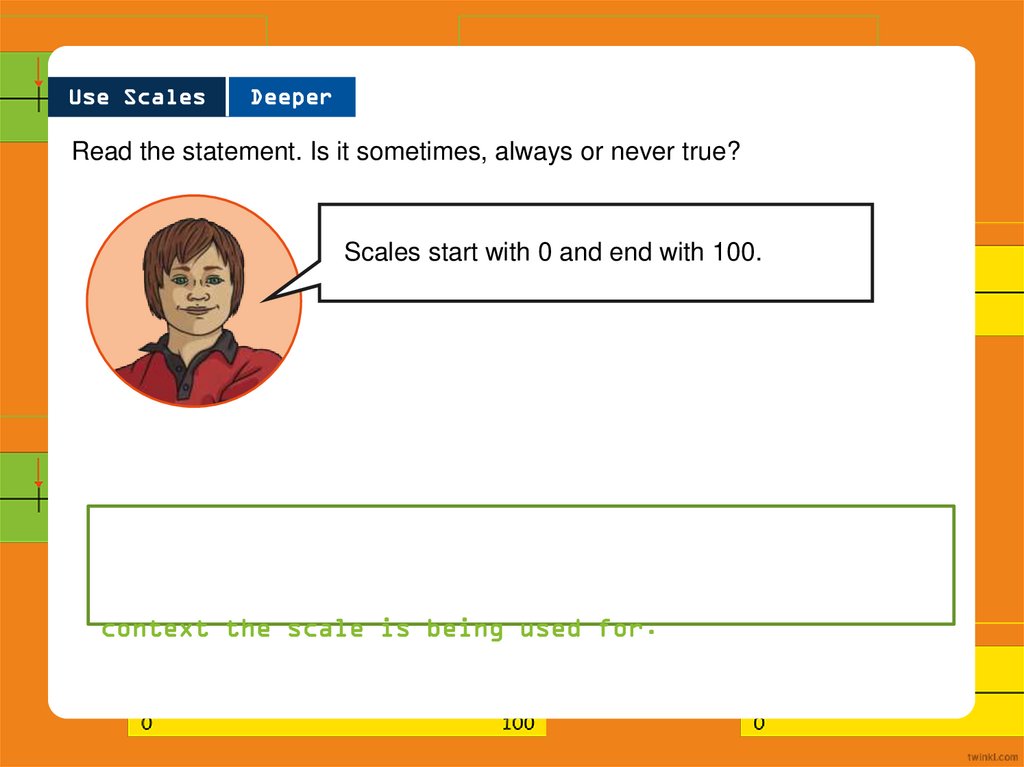
Read the statement. Is it sometimes, always or never true?
Scales start with 0 and end with 100.
Sometimes true. Scales can vary. Sometimes they start
with 0 and end with 100 and sometimes they can start
and end with different numbers. It depends on the
context the scale is being used for.
8.
Use ScalesDeeper
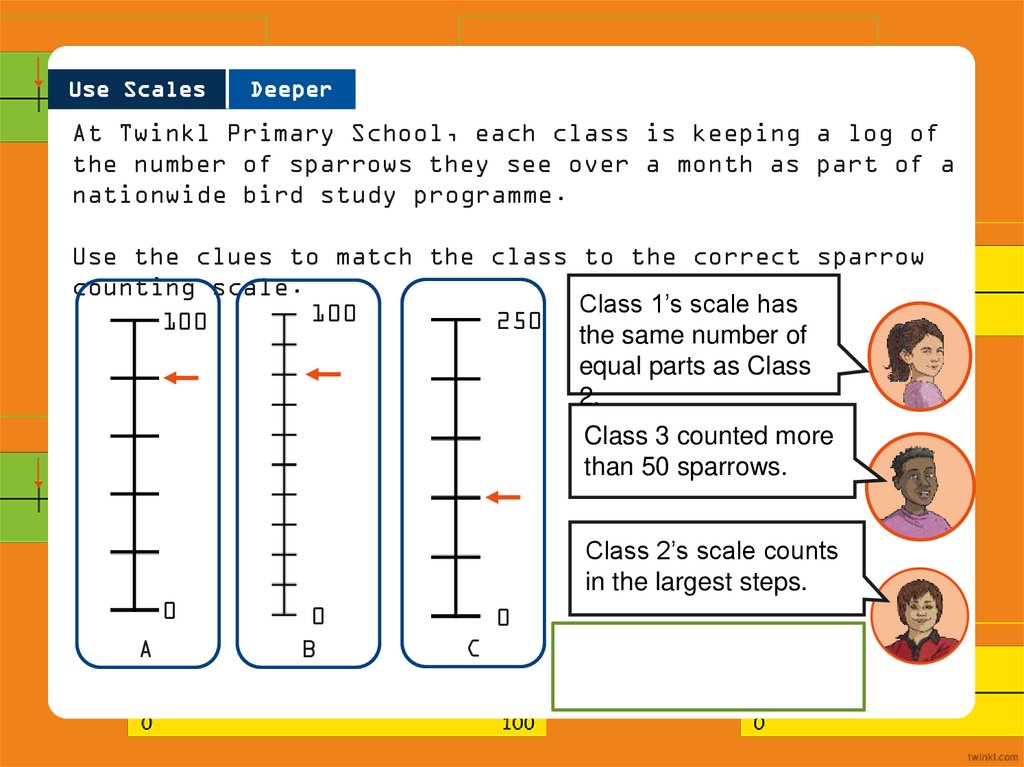
At Twinkl Primary School, each class is keeping a log of
the number of sparrows they see over a month as part of a
nationwide bird study programme.
Use the clues to match the class to the correct sparrow
counting scale.
Class 1’s scale has
100
250
100
the same number of
equal parts as Class
2.
Class 3 counted more
than 50 sparrows.
Class 2’s scale counts
in the largest steps.
0
A
0
B
0
C
Class 1 – A, Class
2 – C, Class 3 – B
9.
UseScales
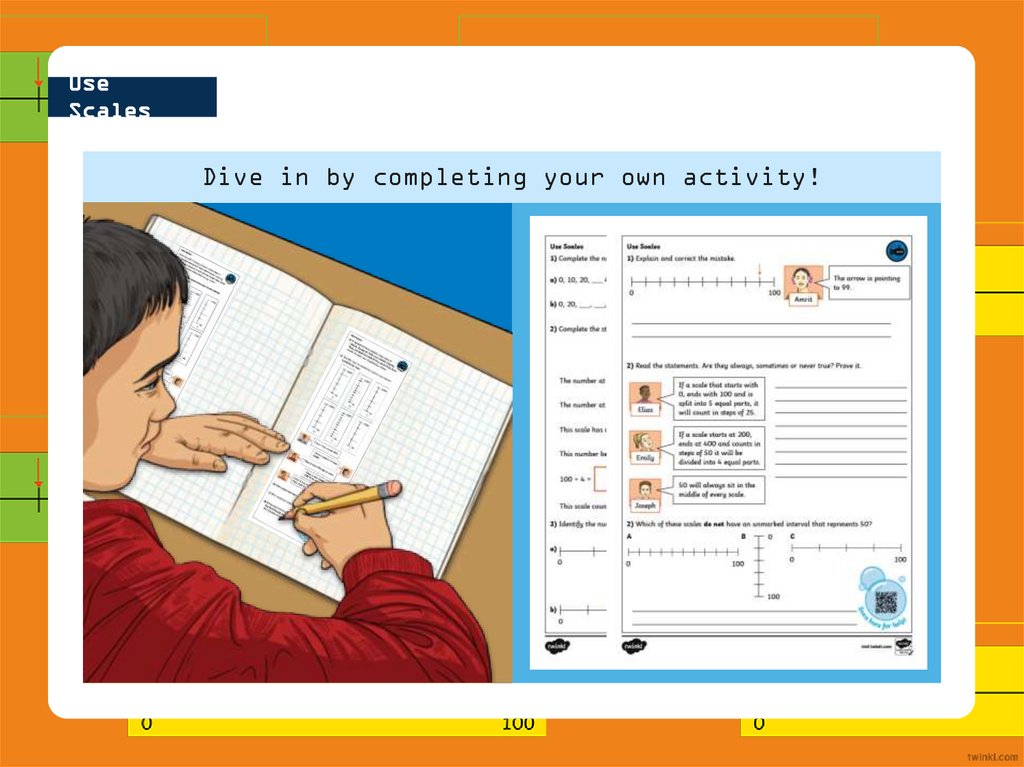
Dive in by completing your own activity!
10.
Need Planning to Complement this Resource?National Curriculum Aim
Measure compare, add and subtract: lengths (m/cm/mm); mass(kg/g):
volume/capacity (l/ml)
For more planning resources to support this aim, click here.
Twinkl PlanIt is our award-winning scheme of work
with over 4000 resources.