
 programming
Similar presentations:



Algorithms and Data structure Lecture 5 – Hash Tabel and BST (Part i)
1. Algorithms and Data structure Lecture 5 – Hash Tabel and BST (Part i)
ALGORITHMS AND DATA STRUCTURELECTURE 5 – HASH TABEL AND BST (PART I)
Aigerim Aibatbek, Eldiyar Zhantileuov
aigerim.aibatbek@astanait.edu.kz, zhantileuov.eldiyar@astanait.edu.kz
2. content
CONTENT1.
Hashing
2.
Hash Table
3.
Binary Search Tree
4.
BST: Inorder Traversal
2
3. Hashing
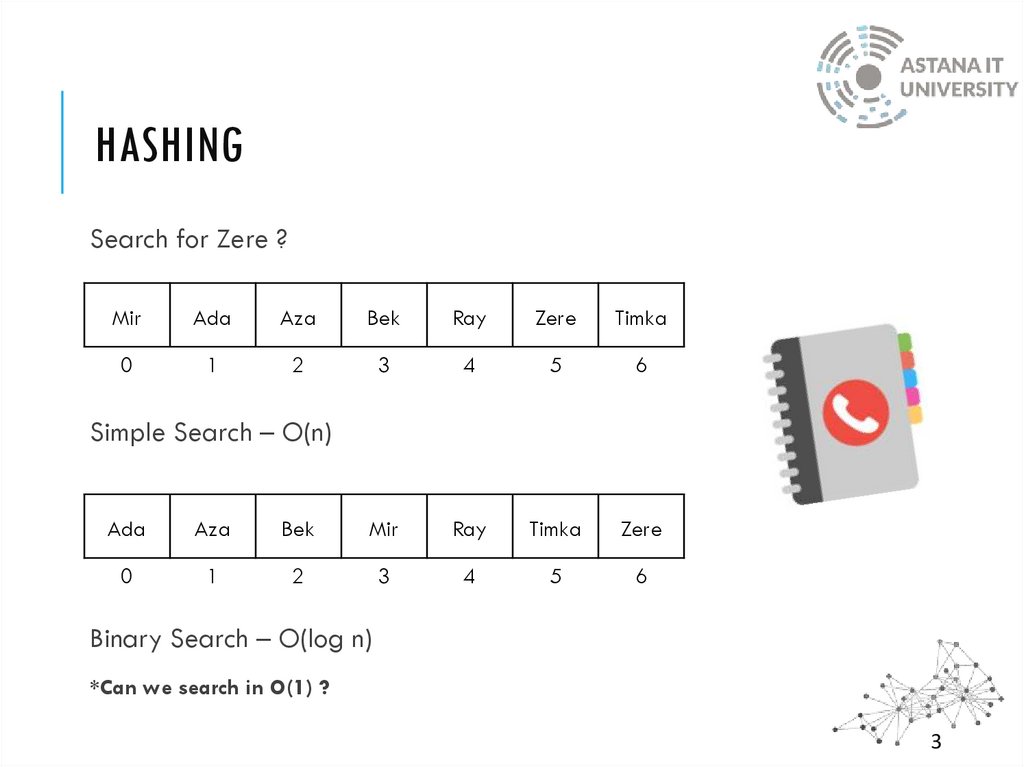
HASHINGSearch for Zere ?
Mir
Ada
Aza
Bek
Ray
Zere
Timka
0
1
2
3
4
5
6
Simple Search – O(n)
Ada
Aza
Bek
Mir
Ray
Timka
Zere
0
1
2
3
4
5
6
Binary Search – O(log n)
*Can we search in O(1) ?
3
4. Hashing
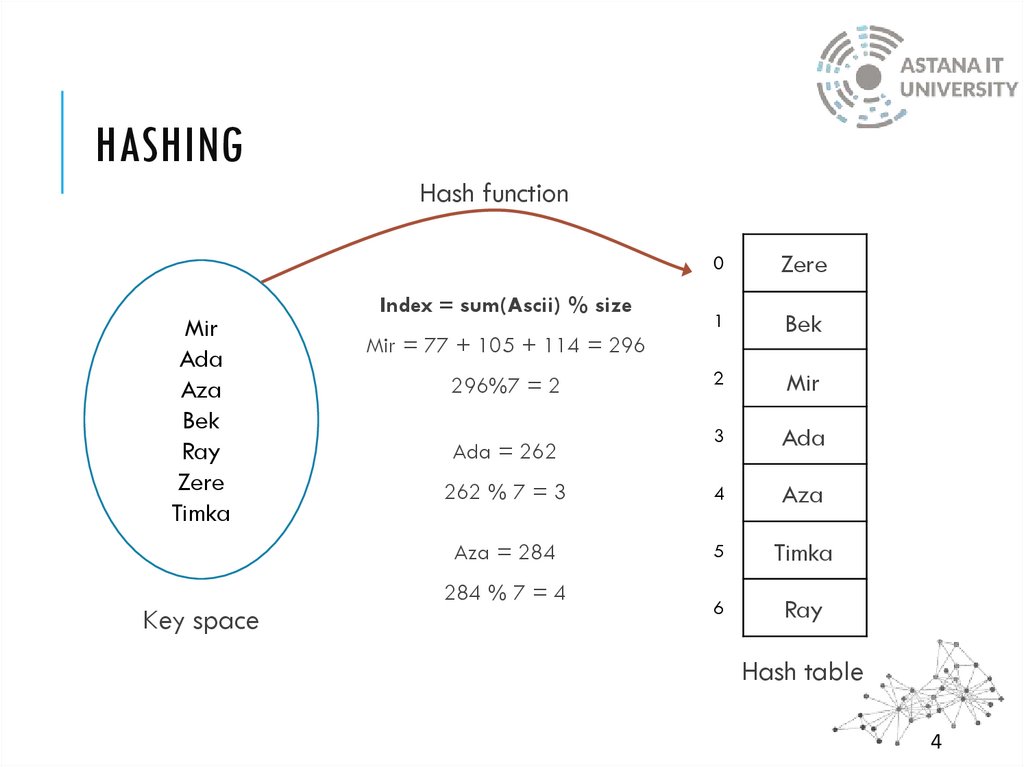
HASHINGHash function
Mir
Ada
Aza
Bek
Ray
Zere
Timka
0
Zere
1
Bek
2
Mir
3
Ada
262 % 7 = 3
4
Aza
Aza = 284
5
Timka
6
Ray
Index = sum(Ascii) % size
Mir = 77 + 105 + 114 = 296
296%7 = 2
Ada = 262
284 % 7 = 4
Key space
Hash table
4
5. Hashing
HASHING0
Zere
Search for Zere ?
1
Bek
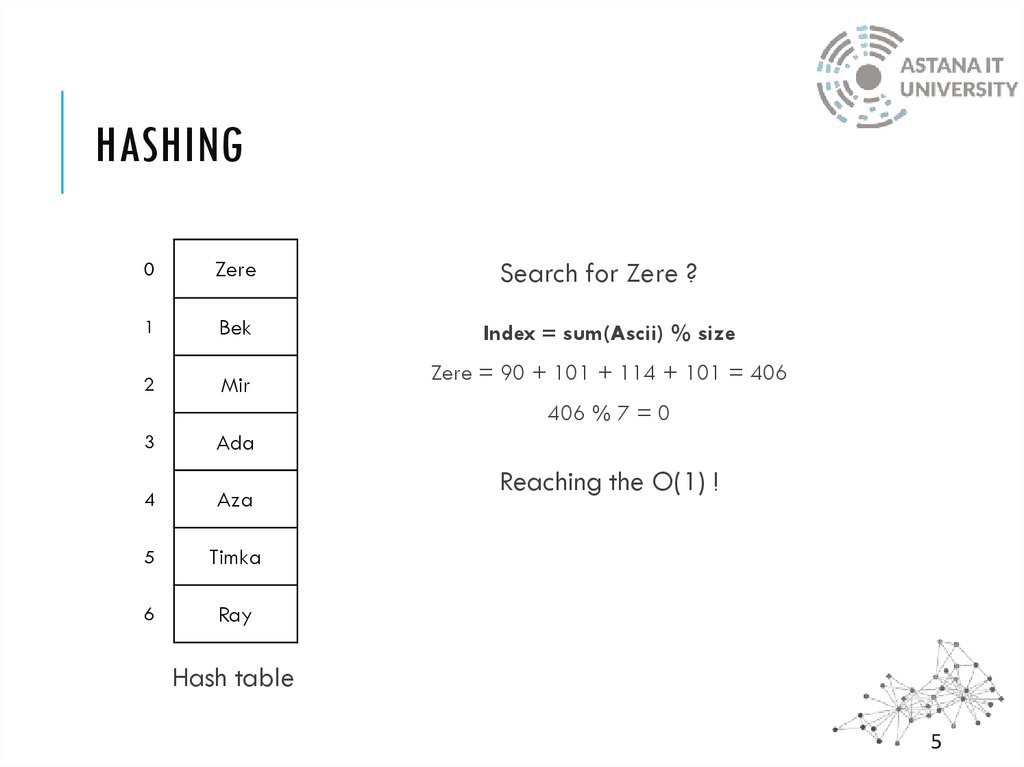
Index = sum(Ascii) % size
2
Mir
Zere = 90 + 101 + 114 + 101 = 406
406 % 7 = 0
3
Ada
4
Aza
5
Timka
6
Ray
Reaching the O(1) !
Hash table
5
6. Hashing
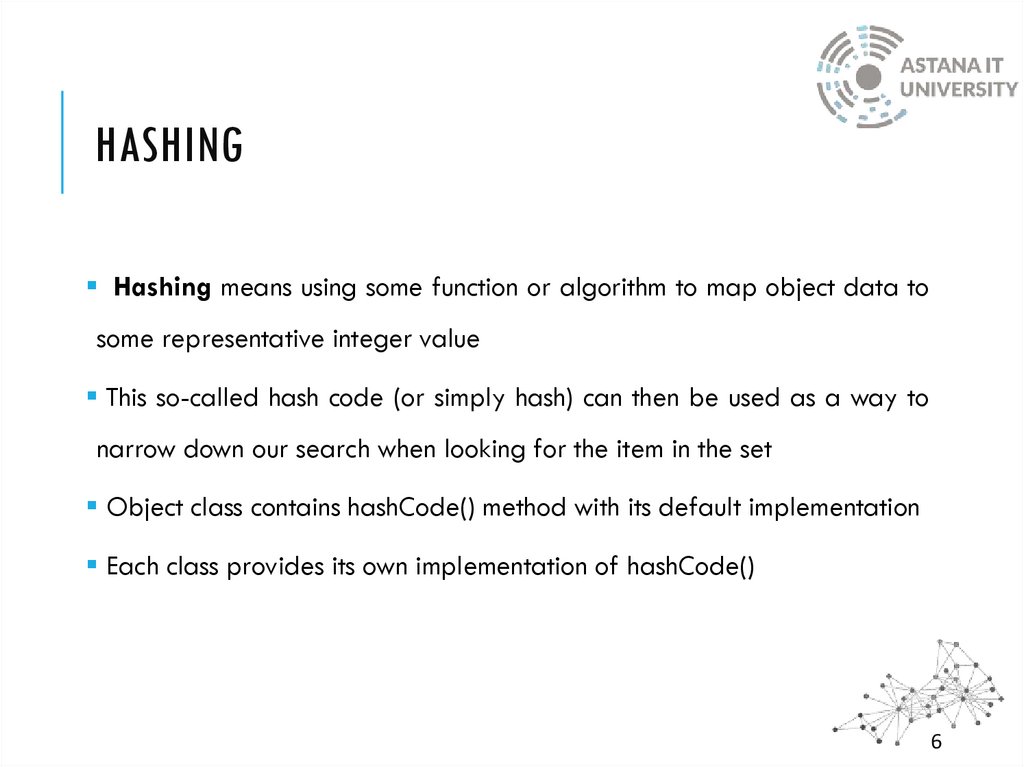
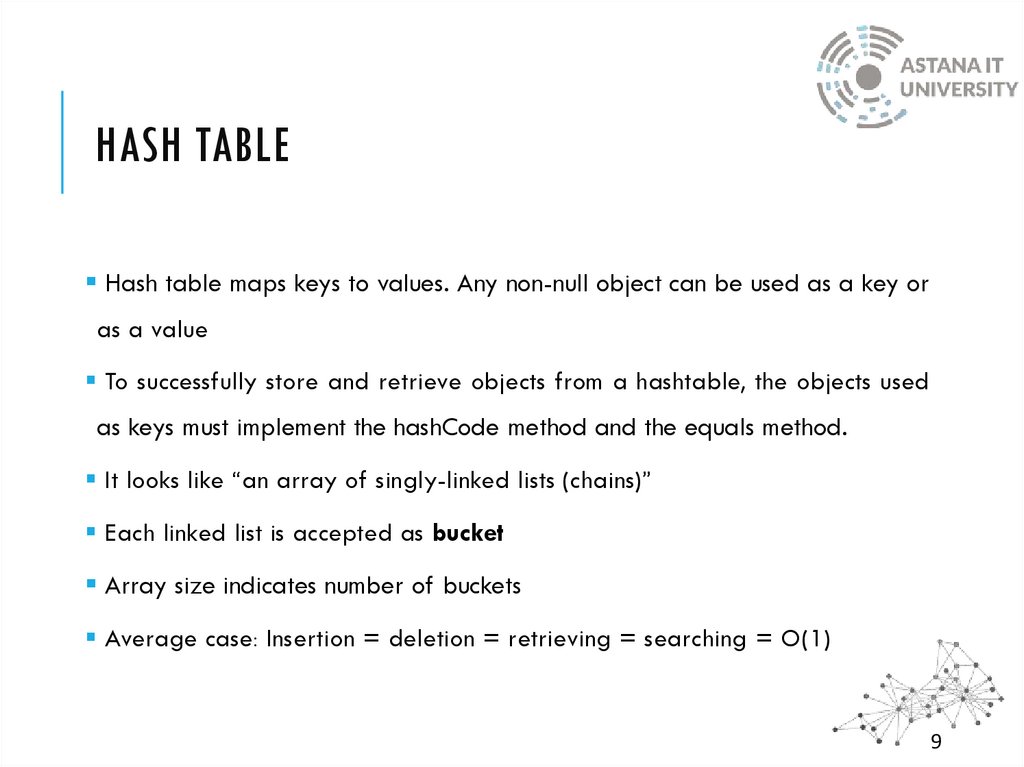
HASHINGHashing means using some function or algorithm to map object data to
some representative integer value
This so-called hash code (or simply hash) can then be used as a way to
narrow down our search when looking for the item in the set
Object class contains hashCode() method with its default implementation
Each class provides its own implementation of hashCode()
6
7. Implementing HashCode(): STRING EXAMPLE
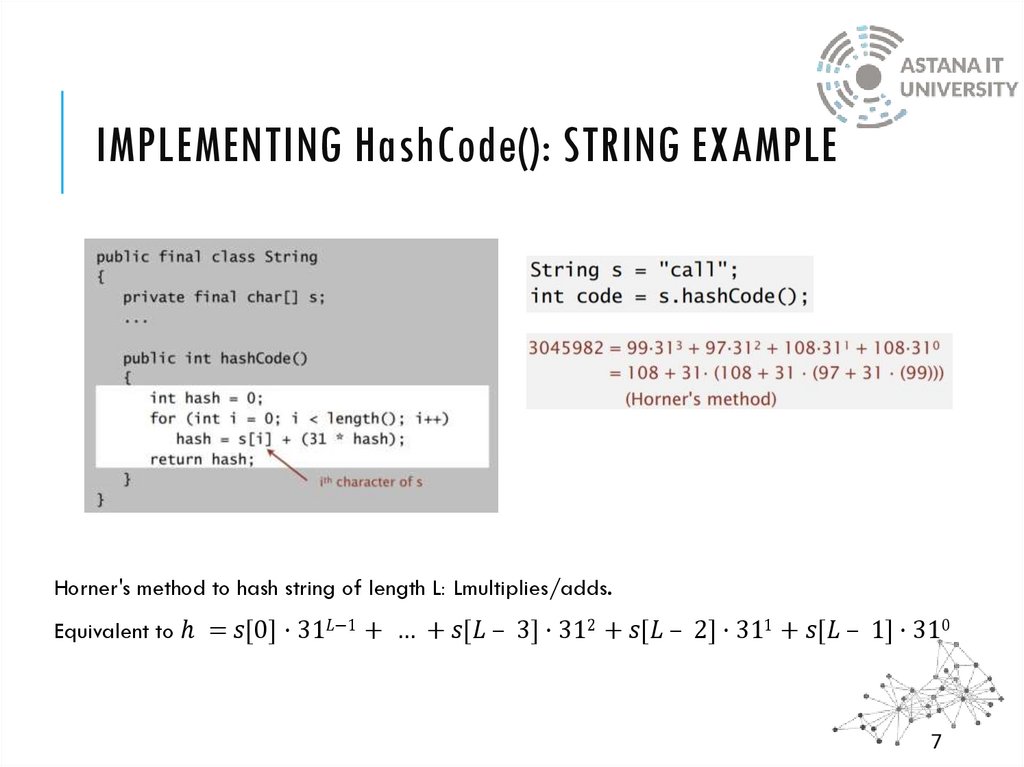
IMPLEMENTING HashCode(): STRING EXAMPLEHorner's method to hash string of length L: Lmultiplies/adds.
Equivalent to ℎ =