


 management
Similar presentations:








Housekeeping operations TRHM 104
1. HOUSEKEEPING OPERATIONS TRHM 104 Asst. Prof. Dr. Marjan Kamyabi
HOUSEKEEPING OPERATIONSTRHM 104
ASST. PROF. DR. MARJAN KAMYABI
2. HOUSEKEEPING MANPOWER PLANNING
Housekeeping manpower planning is the process of determining the optimal number of staff required toefficiently manage the housekeeping operations in a hotel or similar establishment. It involves assessing
factors like the size of the property, the number of rooms, occupancy rates, and the specific tasks that
need to be performed, such as cleaning, maintenance, and guest services.
3. HOUSEKEEPING MANPOWER PLANNING
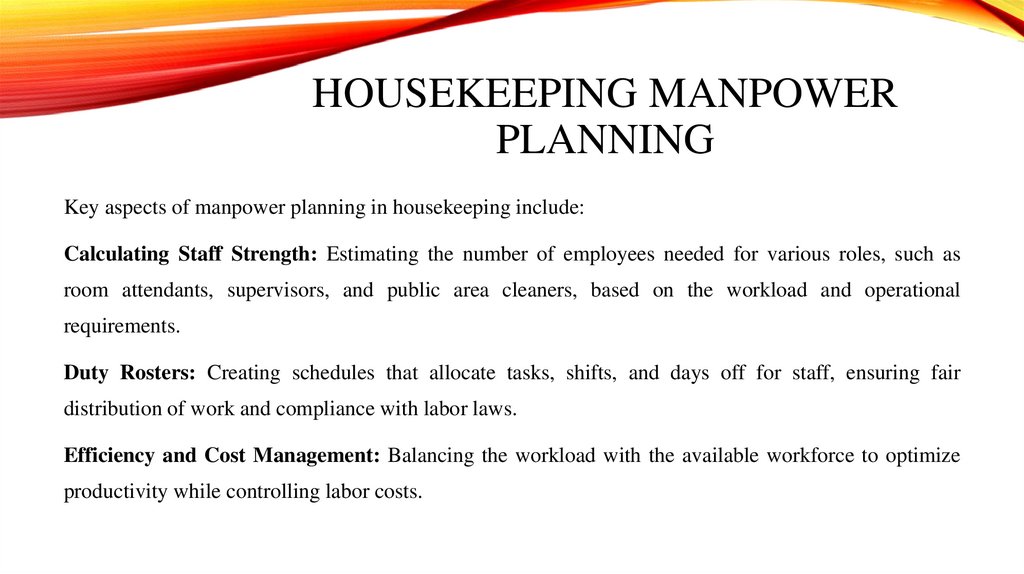
Key aspects of manpower planning in housekeeping include:Calculating Staff Strength: Estimating the number of employees needed for various roles, such as
room attendants, supervisors, and public area cleaners, based on the workload and operational
requirements.
Duty Rosters: Creating schedules that allocate tasks, shifts, and days off for staff, ensuring fair
distribution of work and compliance with labor laws.
Efficiency and Cost Management: Balancing the workload with the available workforce to optimize
productivity while controlling labor costs.
4.
5.
6.
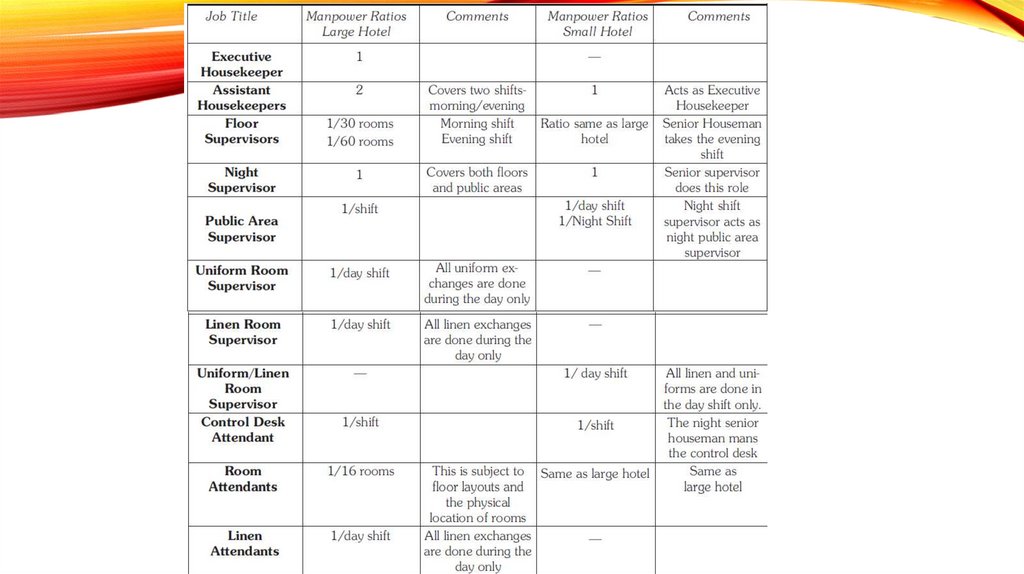
The key strategy for the Housekeeper is to multi-task resources. Supervisors must be rotated amongpublic areas, control desk and night duties; housemen must be rotated between floors and public areas;
all press operators in the laundry must be rotated to all the types of presses and preferably, to the tasks
of the washer man and dry cleaners as well; Linen and uniform room supervisors must interchange with
each other.
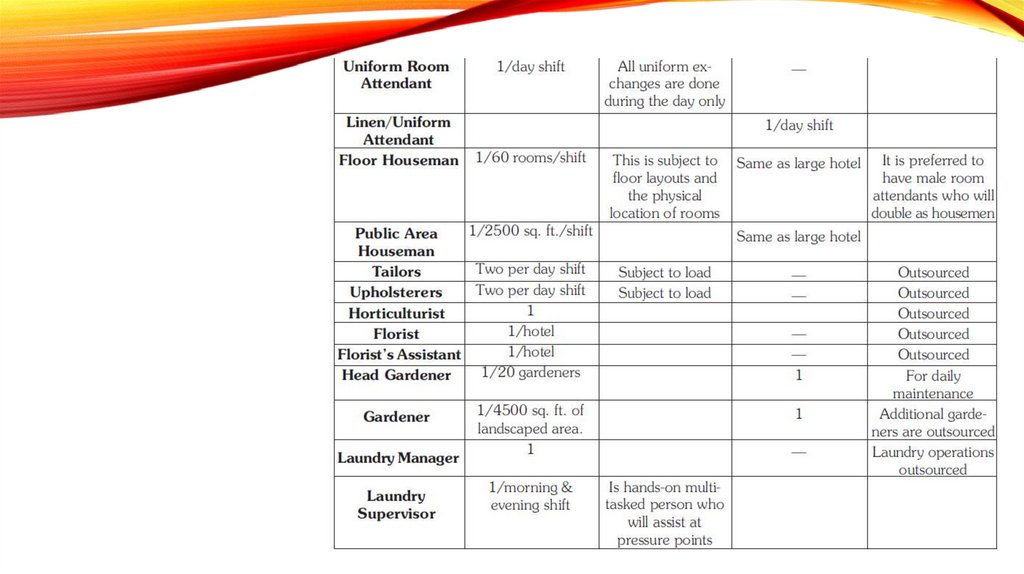
Some roles are strictly specialist like that of the horticulturist, florist and the Laundry Manager. Such
positions have capable deputies in supervisory positions to fill in the absences of the positions.
7. ADMINISTRATIVE DUTIES
1- Taking AttendanceThe Executive Housekeeper must maintain three attendance registers:
(a) One which has all the names of housekeeping personnel listed on a page to mark their presence or absence.
(b) One which devotes a page to each housekeeping member that records the number of hours each has worked,
along with their days off, overtime statistics and special duties.
(c) One register that records the hours put in by daily wagers or employees working on an hourly basis.
8.
2- BriefingBriefing is that process at the beginning of a work shift which is provided by the management to facilitate a twoway communication between management and staff. It is the one time during a shift that all housekeeping staff are
together to share information and feelings before they disperse to their work areas. Briefing is normally undertaken
when all the housekeeping personnel report on duty at the beginning of the shift to receive their work allotments for
the day. This is after the employees have formally clocked into the hotel at the office time and have collected their
fresh uniforms which they change in the locker rooms, provided separately for men and women. All employees are
required to report for briefing, properly attired and at the scheduled commencement of the shift or preferably
earlier.
Following are the issues covered in a briefing that takes about fifteen minutes:
9.
Dress TurnoutHousekeeping staff are mostly in the public eye. It is, therefore, important that they are well
roomed and
hygienically clean. While grooming projects the image and quality of the hotel, a guest also likes to feel that the
people who clean their rooms are themselves very hygienic.
Allotment of Duties
At a briefing, the duties of each staff member and the areas of accountability are explained. Some hotels believe in
a rotational policy of assigning rooms to make room attendants and housemen familiar with all the floors and rooms
of the hotel. Others may assign dedicated floors and room numbers on the belief that this brings about ownership to
those set of rooms and the staff are fiercely proud about the standards maintained in their charge. The public area
supervisor too receives her special instructions about public areas that will need more attention in a given day.
10.
Policies and ProceduresThe briefing is an opportunity for re-emphasizing existing policies and procedures of the property especially those
that impact housekeeping staff. It is the time to introduce new policies and receive queries and clarifications about
them.
VIPs in the House
The housekeeper must give the names and room numbers of VIPs in the house. Each room attendant will check
those numbers against the rooms allotted to her in the shift. VIP rooms will receive special attention in their
preparation. The VIP list is further displayed on the communications notice board of the desk control room.
Feedback from Staff
Briefing time is the best opportunity to receive professional grievances that impact on the productivity of the staff.
(Personal grievances are handled in privacy on a one-to-one basis and not in a public forum like a briefing). It is
beneficial to productivity and morale if grievances are resolved immediately and not allowed to fester.
11.
3- TrainingBriefing is the time to coach staff in minor tasks. Larger tasks will need more time and attention. One of the
reminders in training is the standards of performance. Standards such as the number of rooms to be completed in a
shift; cleaning standards; etc. are reemphasized daily. The Housekeeper gives feedback of supervisor reports on
standards and ascertains those that need training and those that need disciplinary action.
12.
4- Guest ComplaintsIn spite of the best intentions of the hotel, guest complaints continue to come as each guest perceives service in his
own special way. Such complaints can be logged by the guest to the (a) Control Desk Supervisor, (b) Guest
Relations Executive, (c) Lobby Manager, (d) Guest Comment Forms, (e) General Manager, (f) Floor Supervisor and
(g) Room Attendant.
Such complaints must be looked upon as a gift by the guest to improve services. A guest who does not voice his or
her complaint is dangerous because s/he would not come again and definitely speak about the bad experience to
others.
13. Cost Control
COST CONTROLA measure of increasing the profits of a housekeeping operation is by reducing costs. While this is the responsibility
of the entire brigade, the accountability for cost control lies with the Executive Housekeeper. Here are some tips to
reduce costs:
1. Check that quantity standards are strictly maintained. The amount of detergents used must be in the correct
quantities.
2. Staff must be trained to handle equipment correctly.
3. Linen is expensive and constitutes a major investment by the owner. It should not be used for wiping tables or
floors.
4. Inspections are important to ensure that correct procedures are followed.
14. Employee Scheduling
EMPLOYEE SCHEDULINGThe scheduling of employees of a housekeeping department is very demanding and critical as it has a large
workforce and the greatest proportion of employee hours to cover. Moreover unlike the restaurant and bar, which
generate revenues that cover employee costs, housekeeping is a cost centre. Revenue centres can afford to add
employees as the potential for revenue increases. Housekeeping does not have this flexibility. Each employee added
has to meticulously justify the cost of such addition. The employee hours depend on the hotel and type of
customer, business people require different time schedules than people on holiday with children. The employee
needs to be scheduled accordingly and in a ratio to the number of guests staying in the hotel.
15.
The schedule must show a human face in taking into account each employees special requests for leave as far aspossible without affecting service. Employees must be rotated equitably through shifts and holidays. Hotel business
is a 7-day business and not all employees can get leave on the same day. Guests stay in the hotel even on weekends
and national holidays. Housekeeping employees have to be on duty to give the guests their service. The off-days
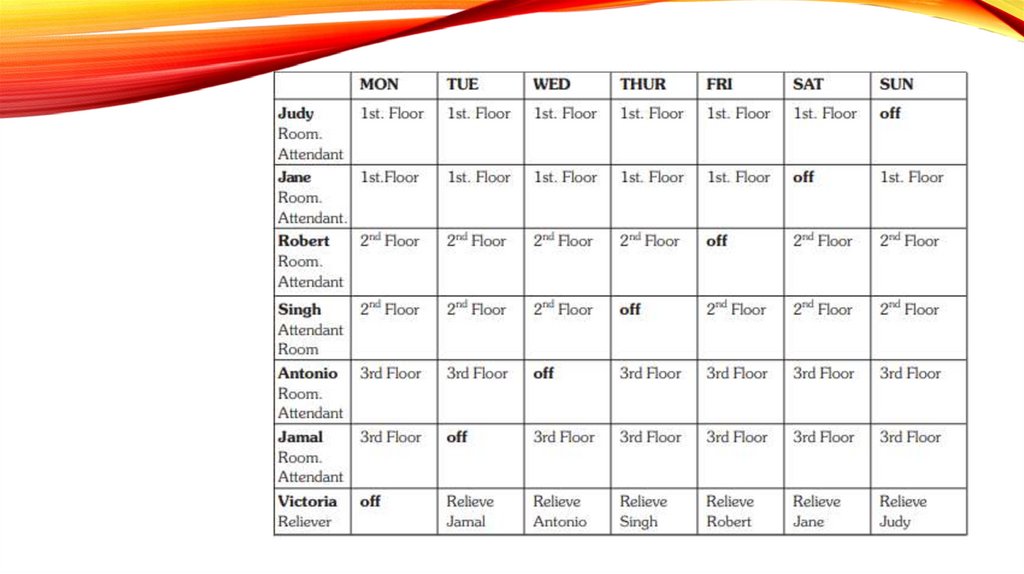
have to be distributed fairly on a round-robin basis as given in the schedule in following table. The schedule must
be made at least three or four days before it becomes effective to enable employees to plan their personal
commitments to meet their duty hours. Every schedule is authorized by the Executive Housekeeper who is
responsible for the human resources and their deployment.
16.
17. Considerations while Scheduling
CONSIDERATIONS WHILE SCHEDULINGThe challenge that Executive Housekeeper is faced such as the ready availability of part-timers when needed; the
standards of productivity and quality provided by part-timers; the higher costs of wages in season; the time required
to train them before they are made operational; whether part-timers can be relied upon or not to reveal confidential
information to competitors; and whether they can readily become part of the housekeeping team.
A lot also depends on where the hotel is at the moment. Scheduling for an existing hotel is different to a new hotel.
While existing hotels have past records to rely on, new hotels will have to depend on data such as average
occupancy expected, mix of guests, e.g. individuals or families etc. from competing hotels or published materials.
18.
Innovative software is available in the market like Visual Rota which can plan the entire complexities involved in amoment. However, such software does require realistic input. Software for new hotels will start with the daily hour
totals to tell how many employees are needed each day. If this is fed into the software, it will calculate a schedule
for a 13-14 week period. It will allocate shifts according to the expected occupancy anticipated. One can factor in
full-time or part-time employees, working full shifts, half shifts, and split shifts. It calculates the employee days
off, usually in the ratio of 1 day for every 6 days.
19.
At some stage the Executive Housekeeper will need to deal with holidays and employee turnover. All employeestake annual holidays but it is difficult to know in advance when this is going to be. Therefore, the Executive
Housekeeper must take out an Annual Leave Plan at the beginning of the year and fill in employee requests for
leave. Employees, in other words, have to plan in advance their leave in conjunction with work requirements.
Employees are required to give their first and second choices of leave dates. The housekeeper normally will grant
first choice of annual leave dates. However, if there is a clash of dates with others, she will opt for the second
choice. Busy hotels may require a third choice as well. The advantage of advance planning is that both the
Executive Housekeeper and the employee are synchronized in leave dates. The housekeeper also knows the dates
when to make alternative arrangements.