






 biology
 pedagogy
Similar presentations:









Profession - veterinarian
1.
VeterinarianОбразец подзаголовка
Prepared by a student of group 1b Right now Violetta
Vitalievna
2.
Who is a veterinarian?1.
2.
A veterinarian (veterinarian, paramedic) is a specialist with
higher or secondary specialized education engaged in
animal treatment (veterinary medicine) and related duties.
The list of animals required to study their anatomy,
physiology, pathophysiology, microbiology, etc. includes:
horse, cattle, pig, dog, cat, rabbit, mouse, poultry, camel, etc.
In addition to general disciplines, the veterinarian also
knows private ones - private physiology (for example, dogs),
diseases of bees and fish, as well as veterinary and
sanitary examination of animal raw materials .
3.
The history of theprofession
The word veterinarian from Latin means treating cattle.
Veterinarian is one of the most ancient professions on
Earth. Humans have been treating animals since their
domestication.
The first veterinarians appeared in pastoral tribes several
thousand years ago. Already at that time, some herbs, such
as wormwood, were used to treat animals.
In ancient countries, they understood how the profession
of a veterinarian was needed, and they greatly appreciated
such people.
4.
The history of theprofession
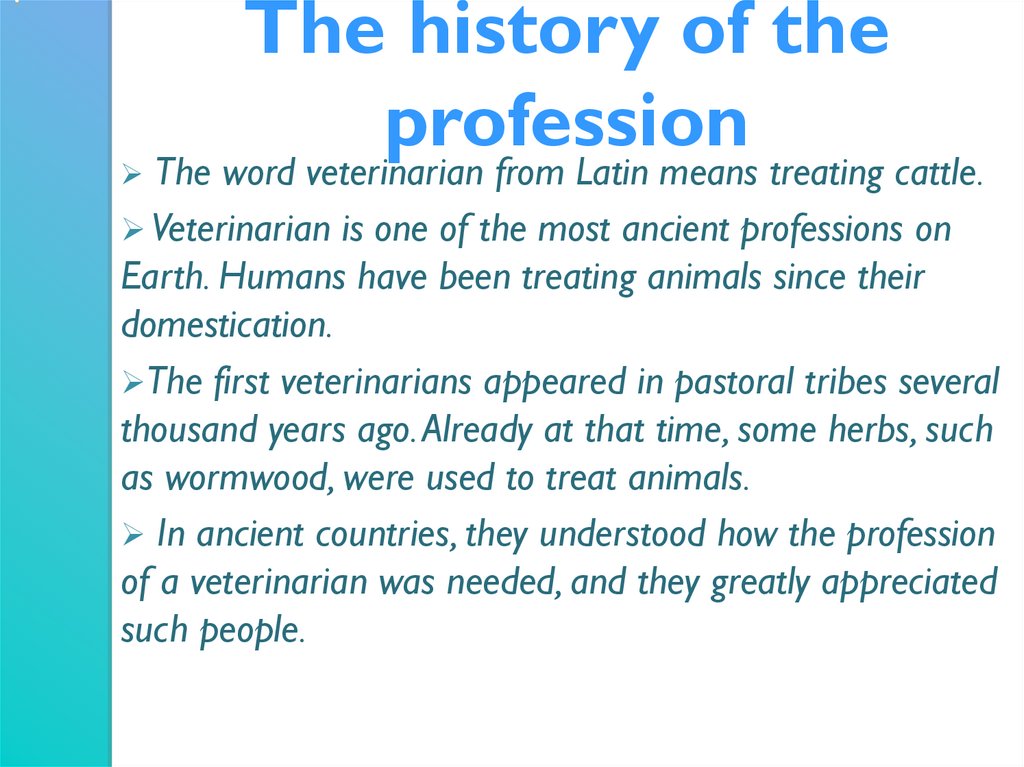
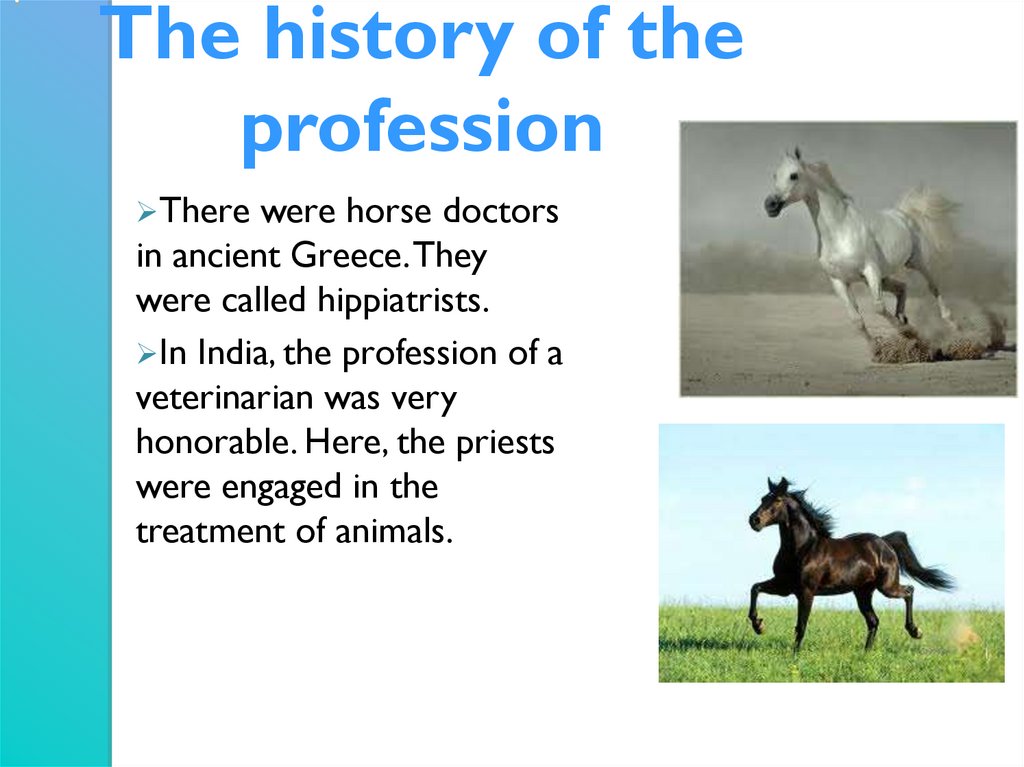
There were horse doctors
in ancient Greece. They
were called hippiatrists.
In India, the profession of a
veterinarian was very
honorable. Here, the priests
were engaged in the
treatment of animals.
5.
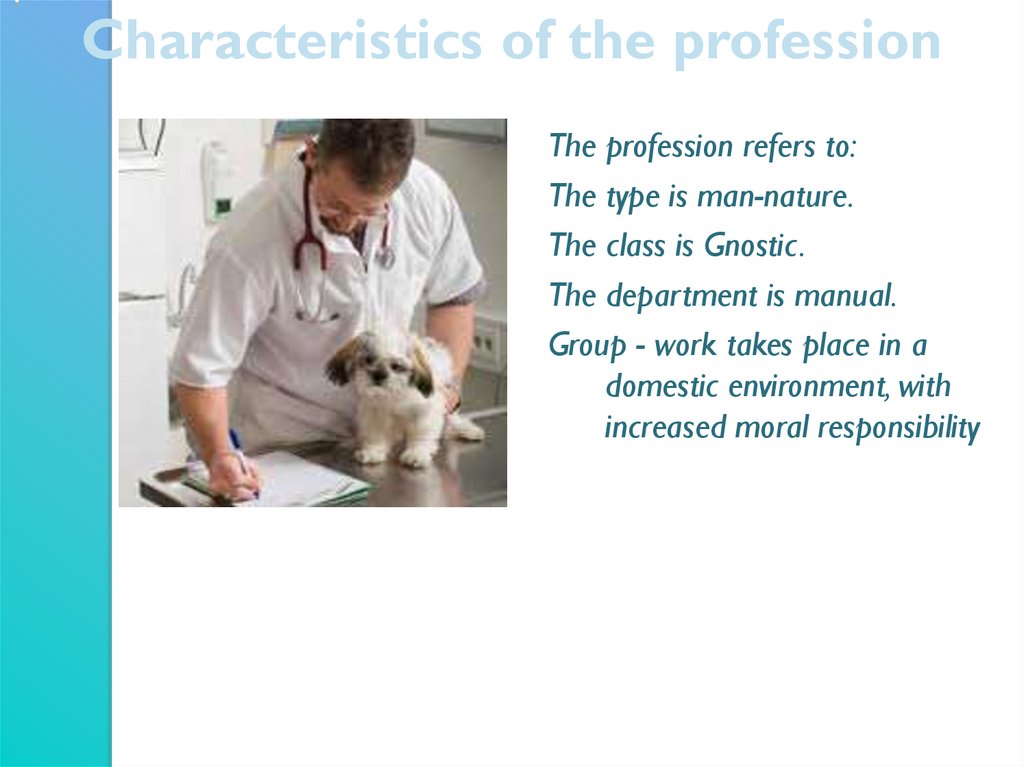
Characteristics of the professionThe profession refers to:
The type is man-nature.
The class is Gnostic.
The department is manual.
Group - work takes place in a
domestic environment, with
increased moral responsibility
6.
Professional suitabilityThis is a profession with
relative professional
aptitude.
In order to become a
veterinarian, you need to
undergo special training.
7.
Qualities important for aveterinarian
Love for animals
Four-legged patients feel
this love perfectly, so they
agree to endure the most
painful procedure from one
doctor, and they will not even
let another examine
themselves.
8.
Qualities important for aveterinarian
Patience
Industriousness
Determination
Resourcefulness
Sense of duty
Discipline
Assiduity
Responsibility
Physical strength
Endurance
Courage
Long-term memory
Logical thinking
Stress resistance
9.
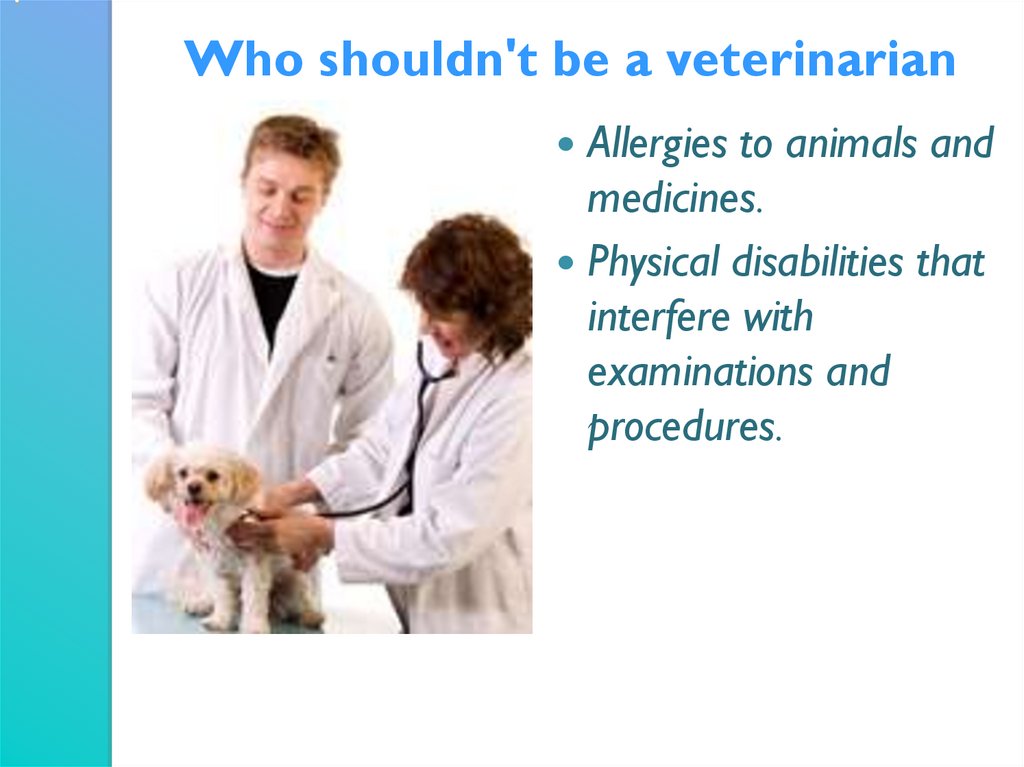
Who shouldn't be a veterinarianAllergies to animals and
medicines.
Physical disabilities that
interfere with
examinations and
procedures.
10.
Where can I get a profession?The profession of a
veterinarian can be
obtained at
universities:
the Moscow State
Academy of Veterinary
Medicine named after
K. I. Scriabin.
11.
What does it take to become agood specialist?
Knowledgeable people advise you
to assist, gain experience and
establish contacts with specialists
in veterinary clinics as early as
possible.
At first, it is hardly worth counting
on a good salary (up to 2
thousand rubles), but after
graduation, having practical
experience is crucial for getting a
well-paid job.
12.
The cost of trainingThe price of paid tuition varies.
For example, at the Moscow
State Academy of Veterinary
Medicine and Biotechnology
named after K. I. Scriabin, full—
time education costs about
1,700 USD, and part-time
education is two times cheaper.
13.
How much does the vet get?The official income of
employees of veterinary
control services is on
average from $350-800.
The standard salary of a
veterinarian at a nongovernmental clinic is
$650-800.
14.
Thanks for yourattention!