 mathematics
Similar presentations:




Discrete Mathematics. Lecture 1. Basic Structures: Sets, Functions, Sequences, and Sums
1. Discrete Mathematics
Basic Structures : Sets, Functions,Sequences, and Sums
Lecturer: Shayakhmetov D.B.
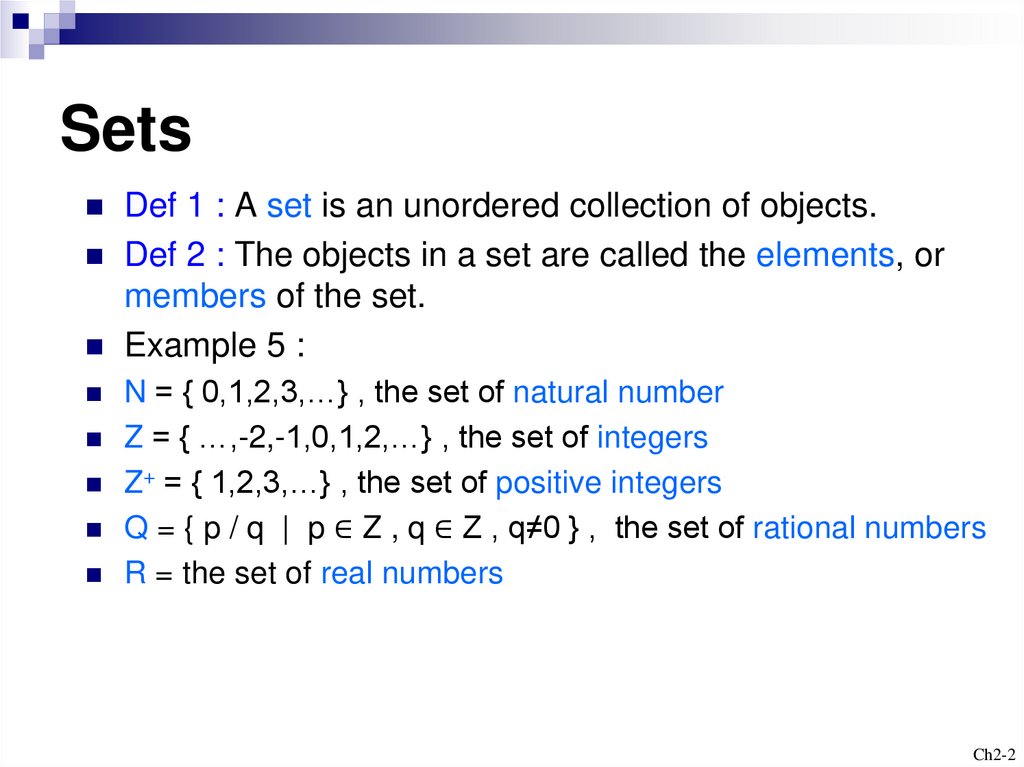
2. Sets
Def 1 : A set is an unordered collection of objects.Def 2 : The objects in a set are called the elements, or
members of the set.
Example 5 :
N = { 0,1,2,3,…} , the set of natural number
Z = { …,-2,-1,0,1,2,…} , the set of integers
Z+ = { 1,2,3,…} , the set of positive integers
Q = { p / q | p ∈ Z , q ∈ Z , q≠0 } , the set of rational numbers
R = the set of real numbers
Ch2-2
3.
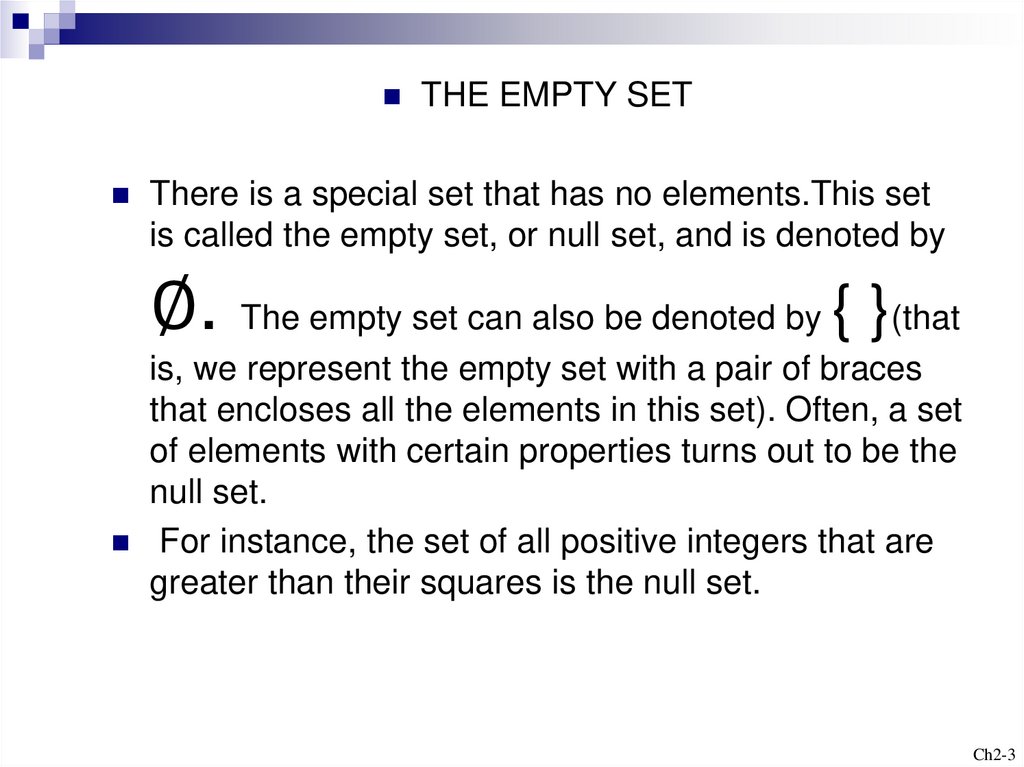
THE EMPTY SETThere is a special set that has no elements.This set
is called the empty set, or null set, and is denoted by
∅. The empty set can also be denoted by { }(that
is, we represent the empty set with a pair of braces
that encloses all the elements in this set). Often, a set
of elements with certain properties turns out to be the
null set.
For instance, the set of all positive integers that are
greater than their squares is the null set.
Ch2-3
4. Venn diagrams
Sets can be represented graphically usingVenn diagrams, named after the English
mathemati cian JohnVenn, who introduced
their use in 1881. InVenn diagrams the
universal set U, which contains all the
objects under consideration, is
represented by a rectangle.
Ch2-4
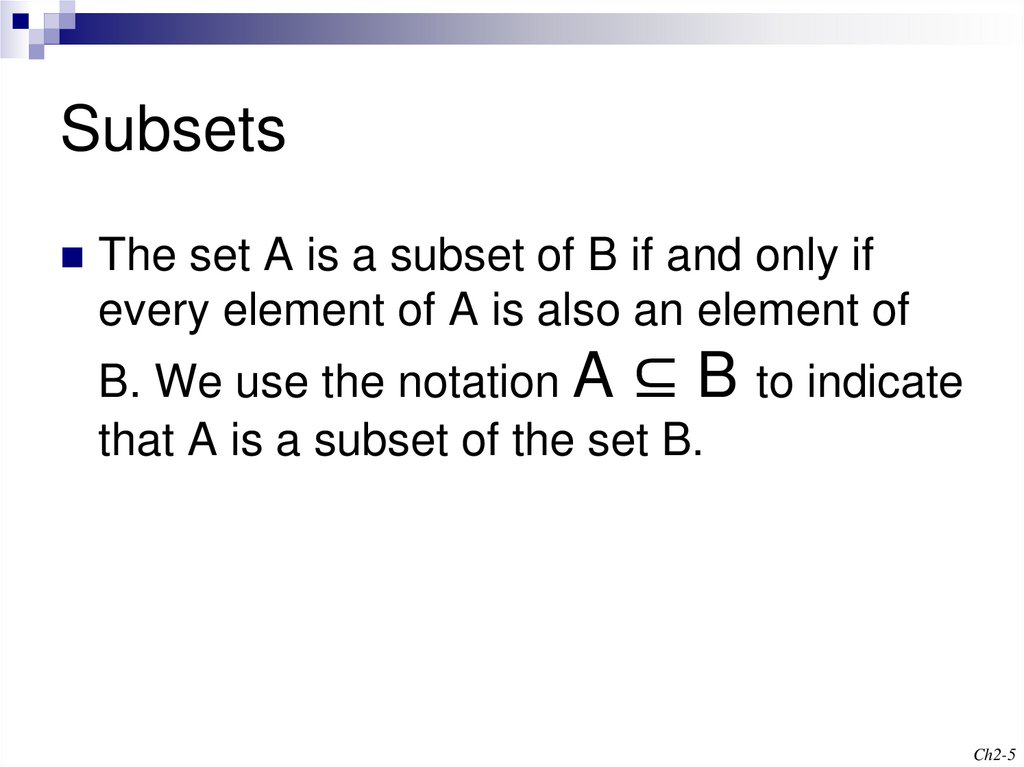
5. Subsets
The set A is a subset of B if and only ifevery element of A is also an element of
B. We use the notation A ⊆ B to indicate
that A is a subset of the set B.
Ch2-5
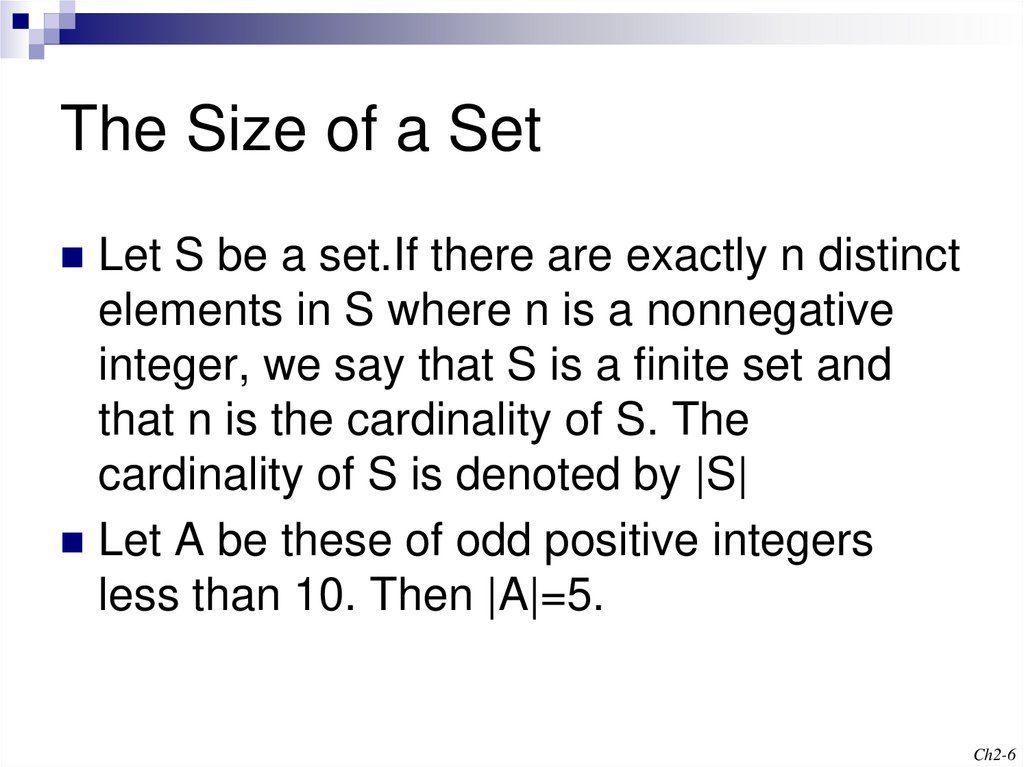
6. The Size of a Set
Let S be a set.If there are exactly n distinctelements in S where n is a nonnegative
integer, we say that S is a finite set and
that n is the cardinality of S. The
cardinality of S is denoted by |S|
Let A be these of odd positive integers
less than 10. Then |A|=5.
Ch2-6
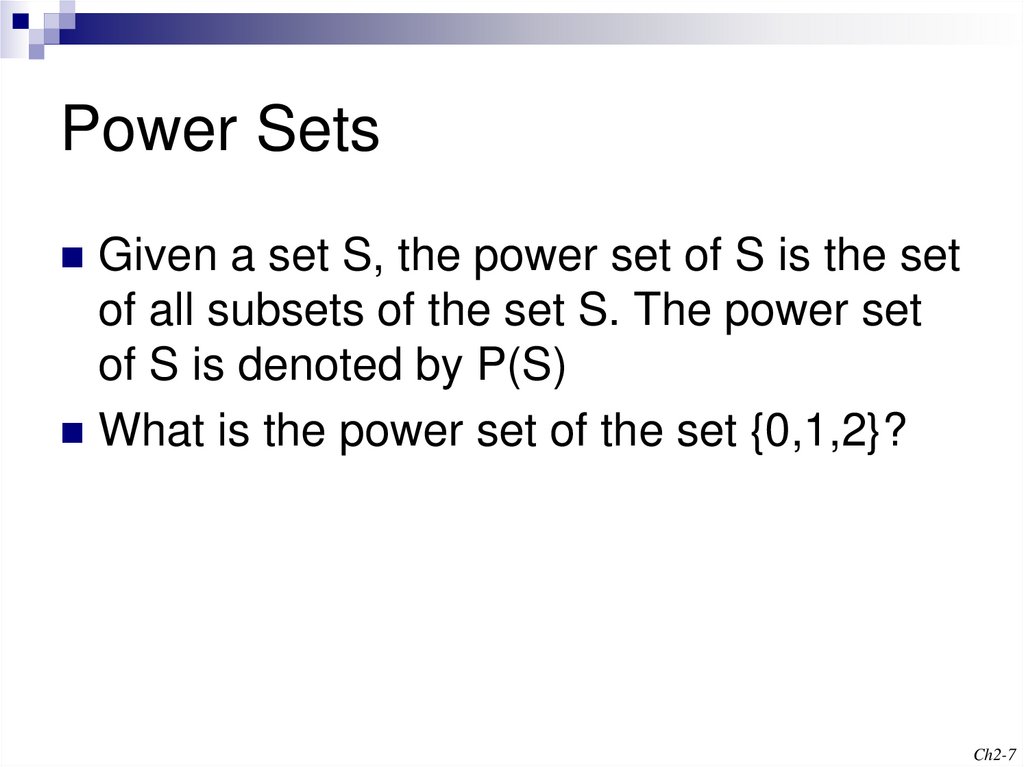
7. Power Sets
Given a set S, the power set of S is the setof all subsets of the set S. The power set
of S is denoted by P(S)
What is the power set of the set {0,1,2}?
Ch2-7
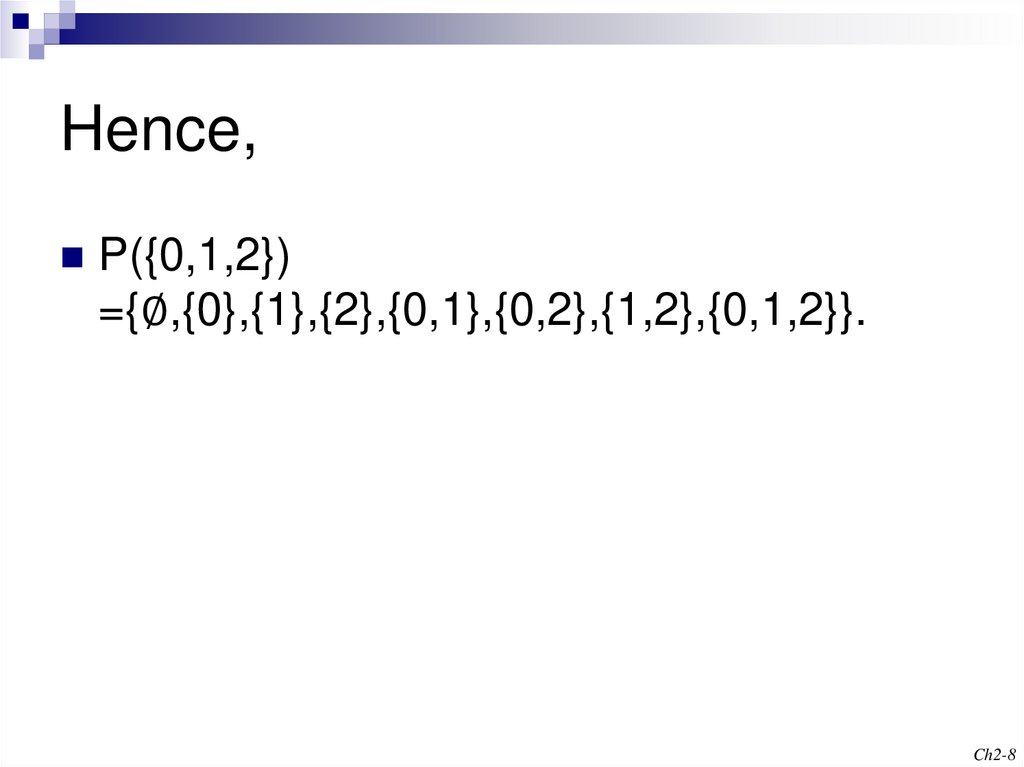
8. Hence,
P({0,1,2})={∅,{0},{1},{2},{0,1},{0,2},{1,2},{0,1,2}}.
Ch2-8
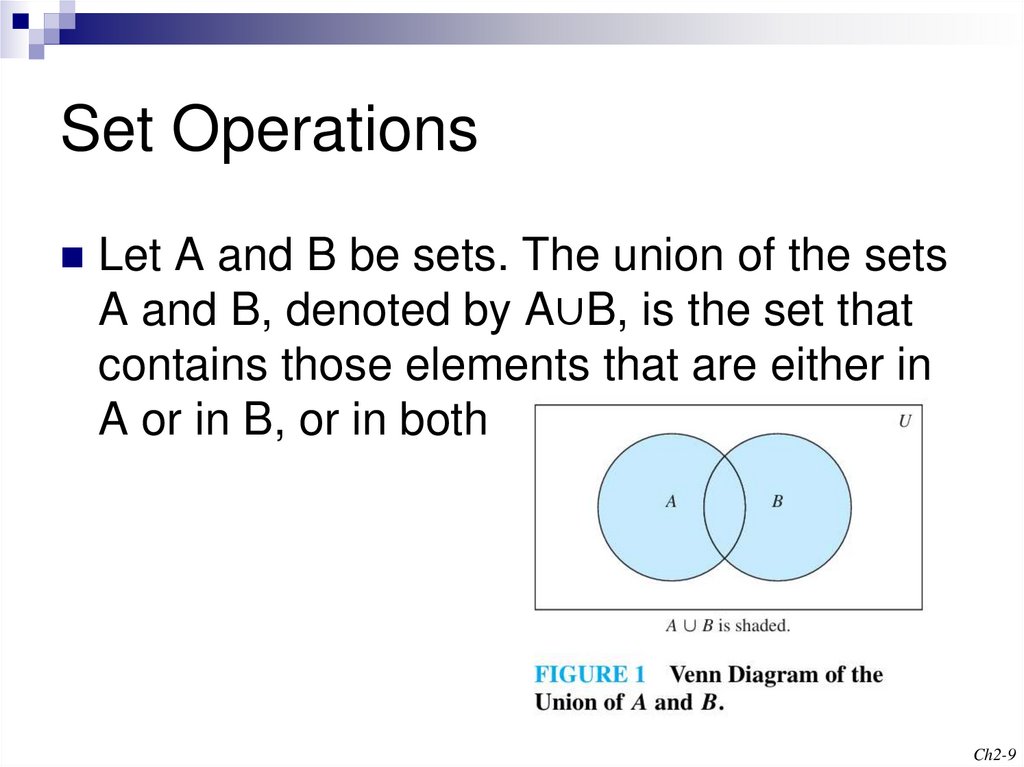
9. Set Operations
Let A and B be sets. The union of the setsA and B, denoted by A∪B, is the set that
contains those elements that are either in
A or in B, or in both
Ch2-9
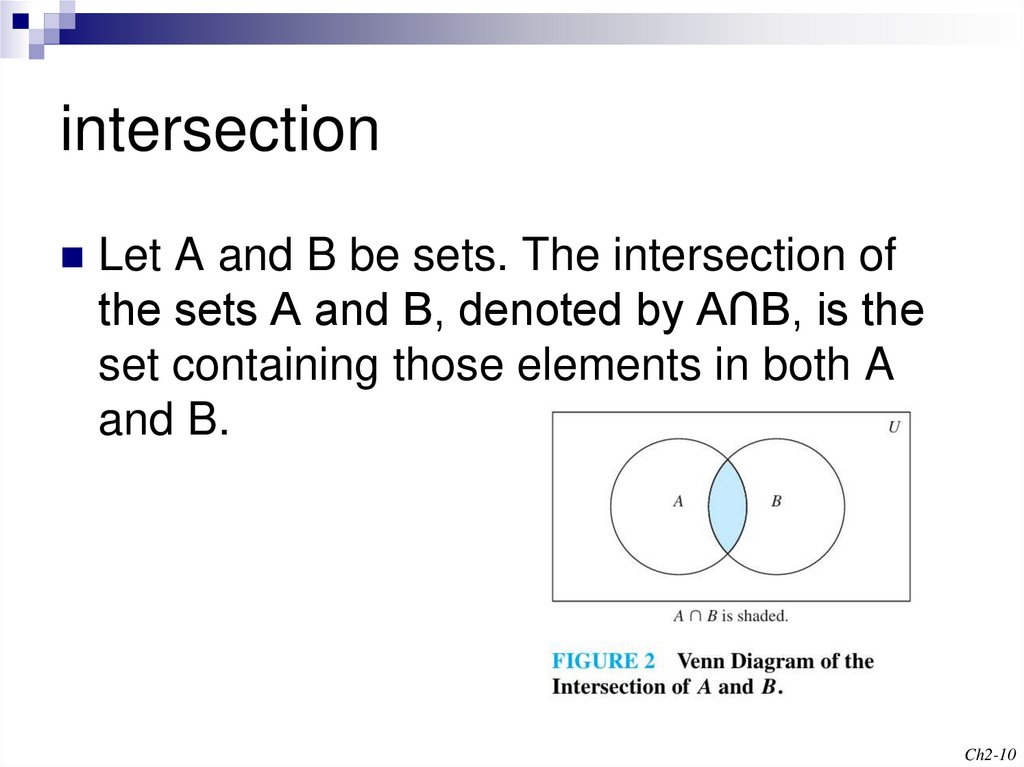
10. intersection
Let A and B be sets. The intersection ofthe sets A and B, denoted by A∩B, is the
set containing those elements in both A
and B.
Ch2-10
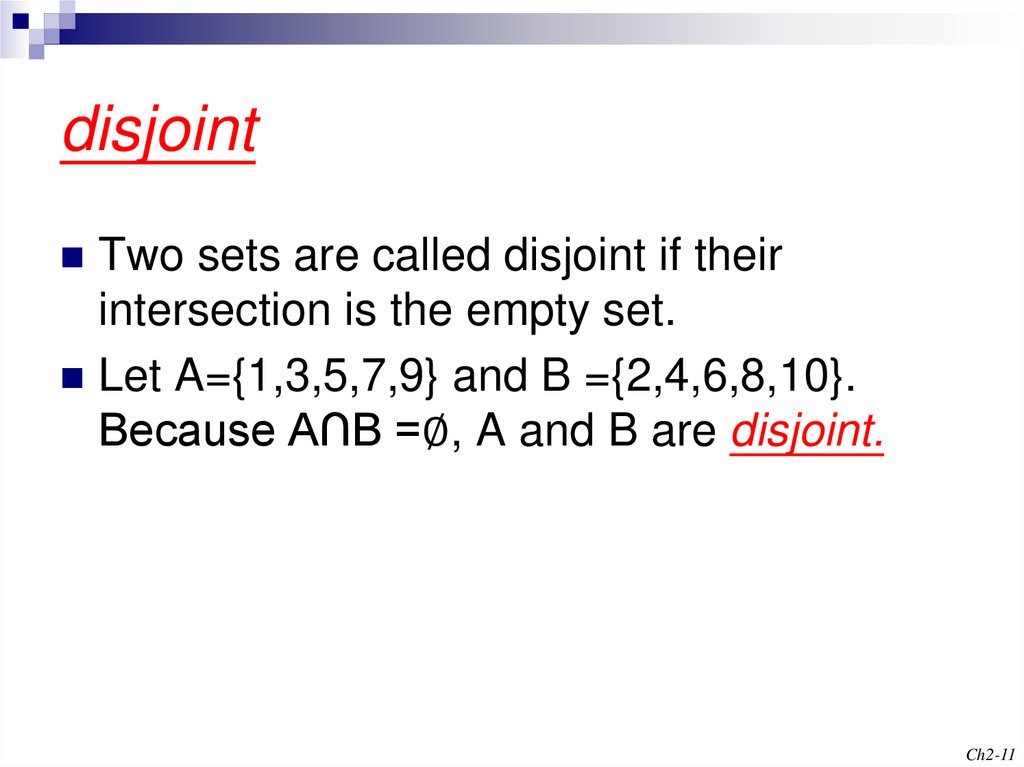
11. disjoint
Two sets are called disjoint if theirintersection is the empty set.
Let A={1,3,5,7,9} and B ={2,4,6,8,10}.
Because A∩B =∅, A and B are disjoint.
Ch2-11
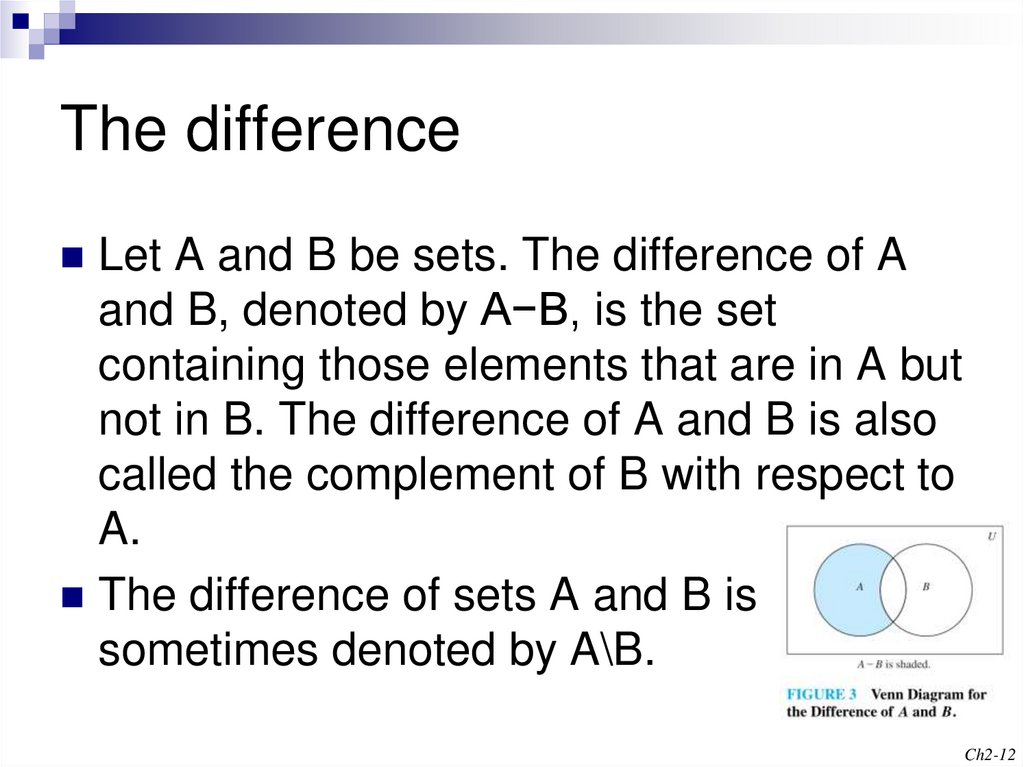
12. The difference
Let A and B be sets. The difference of Aand B, denoted by A−B, is the set
containing those elements that are in A but
not in B. The difference of A and B is also
called the complement of B with respect to
A.
The difference of sets A and B is
sometimes denoted by A\B.
Ch2-12
13. complement
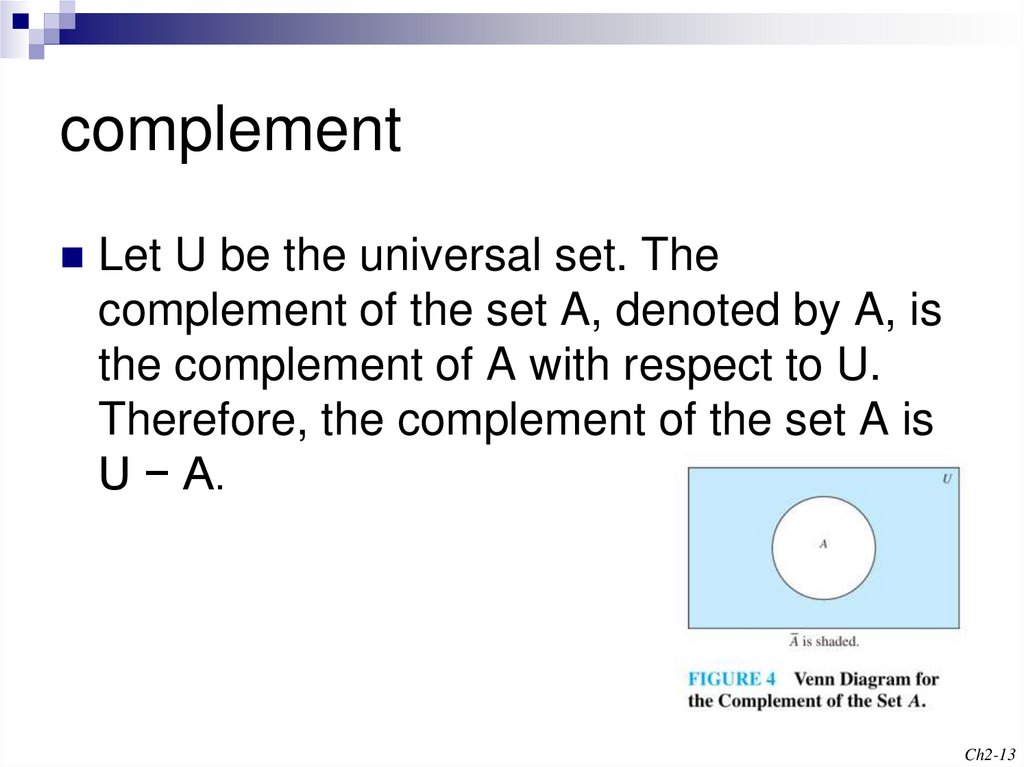
Let U be the universal set. Thecomplement of the set A, denoted by A, is
the complement of A with respect to U.
Therefore, the complement of the set A is
U − A.
Ch2-13
14. symmetric difference
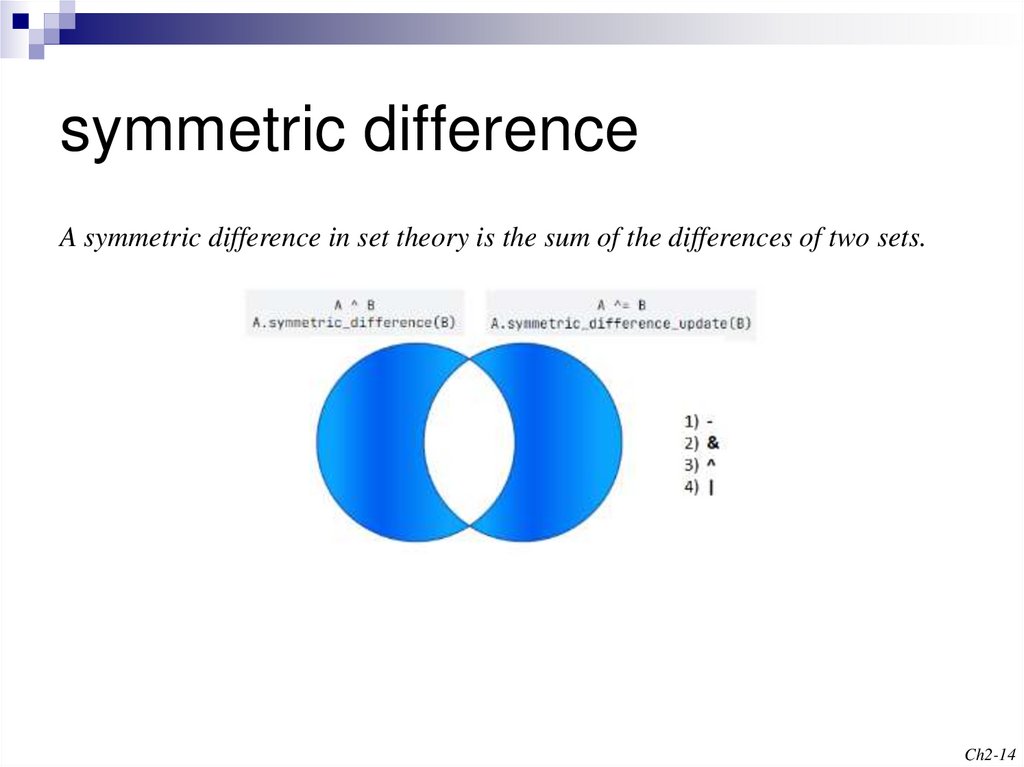
A symmetric difference in set theory is the sum of the differences of two sets.Ch2-14
15. Cartesian Products
Let A and B be sets.The Cartesian productof A and B, denoted by A×B, is the set of
all ordered pairs (a,b), where a ∈ A and b
∈ B.
Hence,
A×B={(a,b) | a ∈ A∧b ∈B}
Ch2-15
16.
Exercise :1-47 page 125-126
1-59 page 136-137
Ch2-16