



 medicine
Similar presentations:


Motivation, Recruitment, and Retention of Blood Donors & Understanding Donors Perception of the Blood Donation Process
1. Motivation, Recruitment and Retention of Blood Donors & UNDERSTANDING THE DONORS PERCEPTION OF BLOOD DONATION PROCESS
Motivation, Recruitment and Retentionof Blood Donors
&
DR RAJESH SAWANT MD, PDCR
Consultant- Transfusion Medicine, Histocompatibility & Immunogenetics
Kokilaben Dhirubhai Ambani Hospital
Mumbai, India
2. Outline
• Few Relevant facts• Donor Motivation and its strategies
• Donor Recruitment and its strategies
• Donor Retention and its strategies
• Sharing actual data for better plicy/decision
• Pilot study details
• Concluding remarks
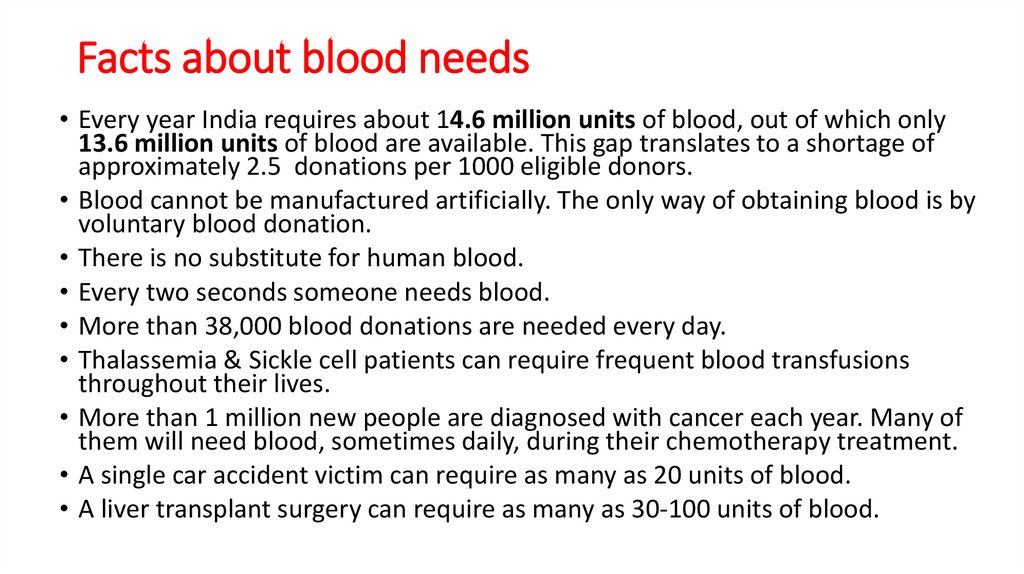
3. Facts about blood needs
• Every year India requires about 14.6 million units of blood, out of which only13.6 million units of blood are available. This gap translates to a shortage of
approximately 2.5 donations per 1000 eligible donors.
• Blood cannot be manufactured artificially. The only way of obtaining blood is by
voluntary blood donation.
• There is no substitute for human blood.
• Every two seconds someone needs blood.
• More than 38,000 blood donations are needed every day.
• Thalassemia & Sickle cell patients can require frequent blood transfusions
throughout their lives.
• More than 1 million new people are diagnosed with cancer each year. Many of
them will need blood, sometimes daily, during their chemotherapy treatment.
• A single car accident victim can require as many as 20 units of blood.
• A liver transplant surgery can require as many as 30-100 units of blood.
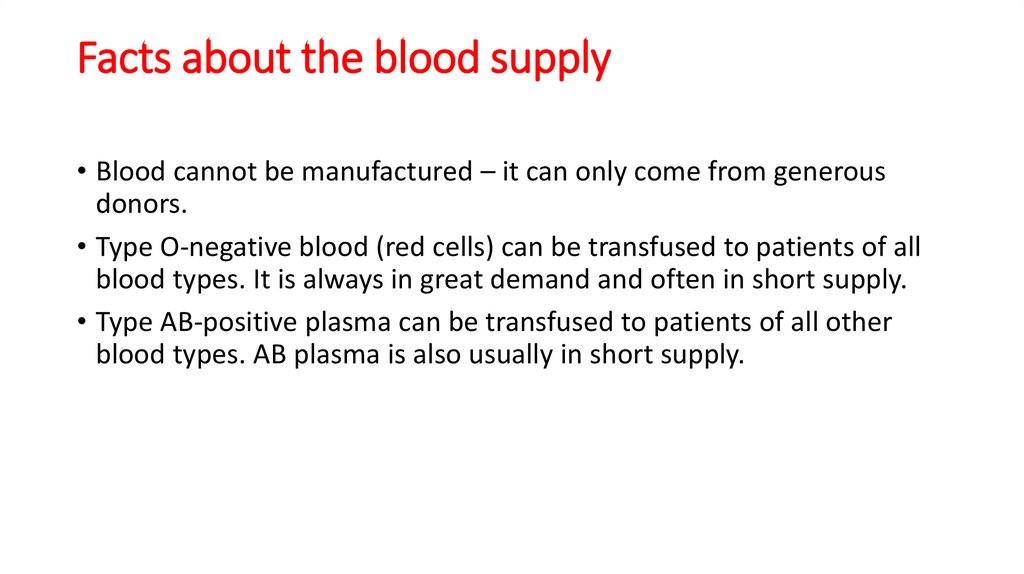
4. Facts about the blood supply
• Blood cannot be manufactured – it can only come from generousdonors.
• Type O-negative blood (red cells) can be transfused to patients of all
blood types. It is always in great demand and often in short supply.
• Type AB-positive plasma can be transfused to patients of all other
blood types. AB plasma is also usually in short supply.
5. Facts about the blood donation process
• Donating blood is a safe process. A sterile needle (part of the Bag used forblood collection) is used only once for each donor and then discarded.
• Blood donation is a simple four-step process: registration, medical
history and mini-physical examination, donation and refreshments.
• Every blood donor is given a mini-physical, checking the donor's
temperature, blood pressure, pulse and hemoglobin to ensure it is safe for
the donor to give blood.
• The actual blood donation typically takes less than 10 minutes. The entire
process, from the time you arrive to the time you leave, takes about an
hour and 15 min.
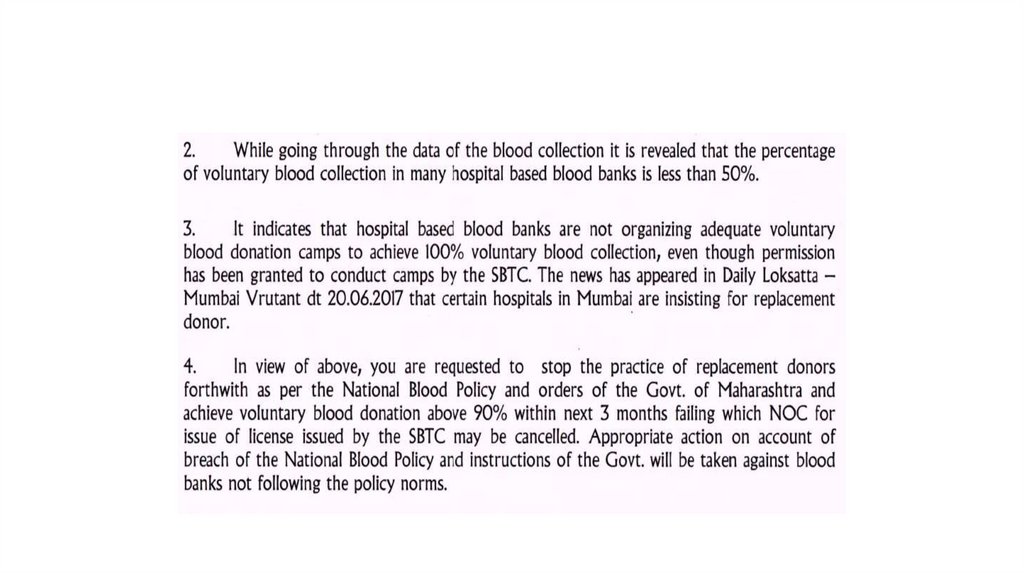
• The average adult has about 10 units of blood in his body. Roughly 1 unit is
given during a donation.
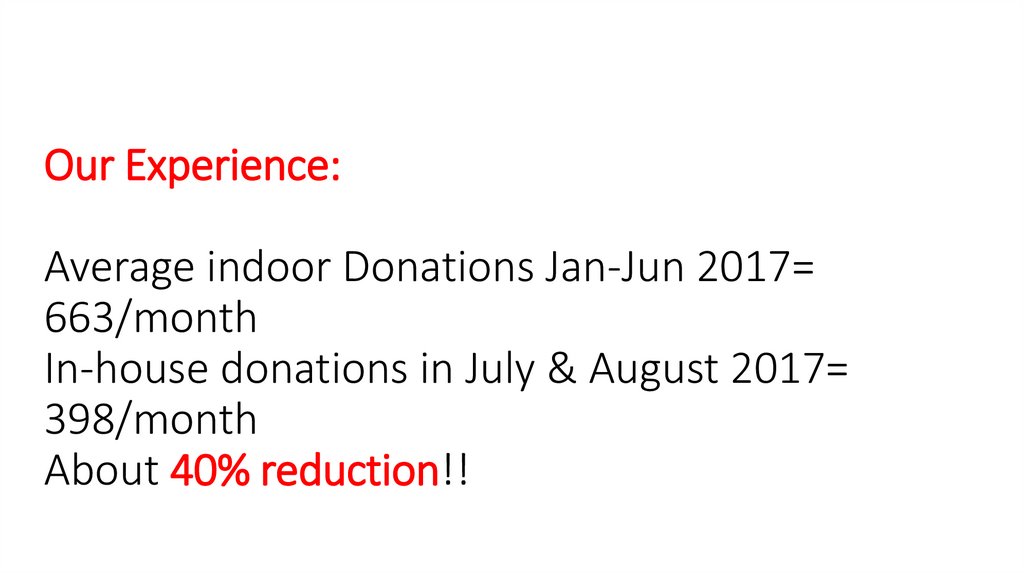
• A healthy donor may donate blood every 90 days.
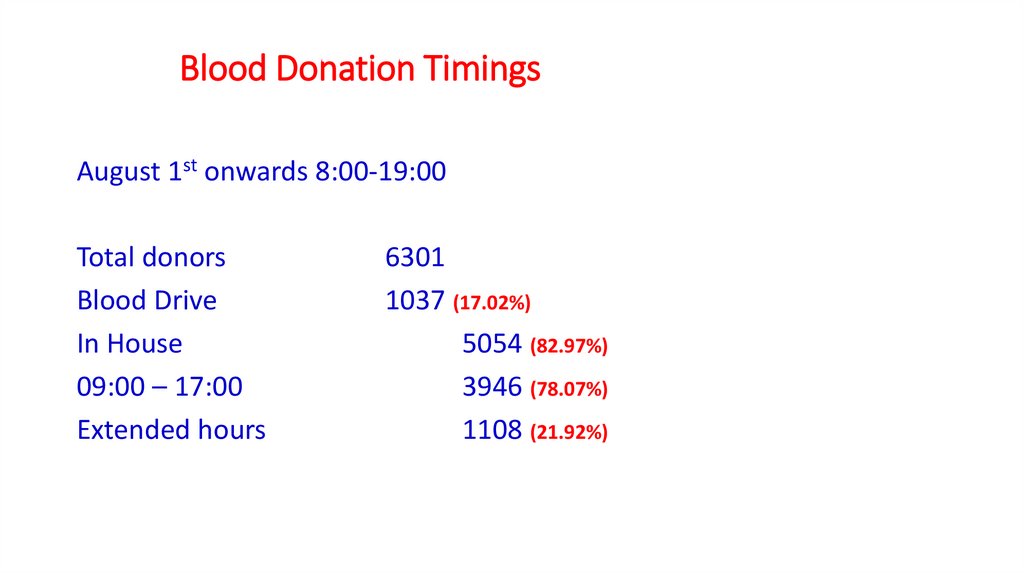
• A healthy donor may donate platelets as few as 7 days apart, but a
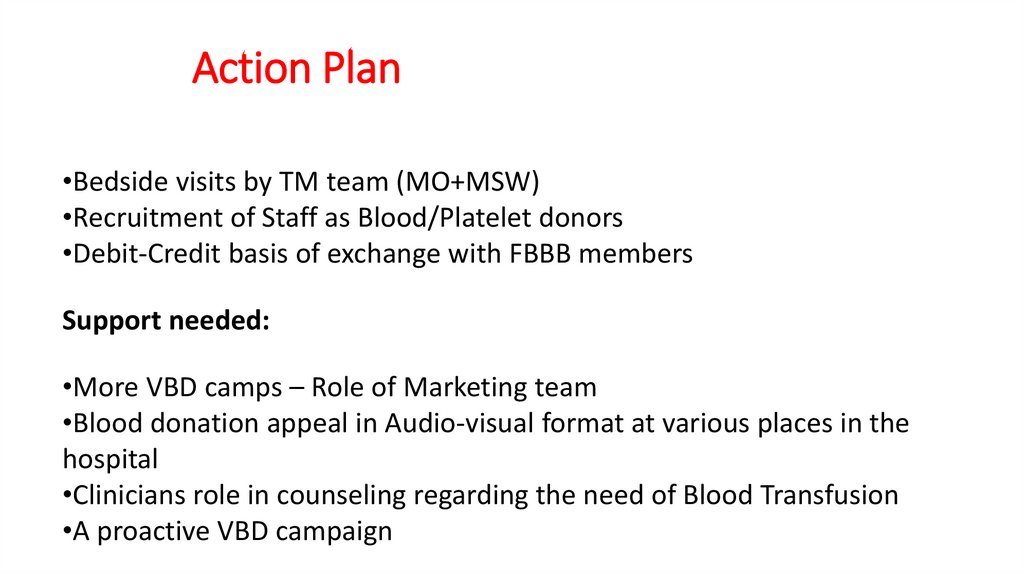
maximum of 24 times a year.
• All donated blood is tested for HIV, hepatitis B and C, syphilis and Malarial
parasite before it can be transfused to patients.
6. Facts about blood and its components
• Blood makes up about 7 percent of your body's weight.• There are four types of transfusable products that can be derived from
blood: red cells, platelets, plasma and cryoprecipitate. Typically, two or three
of these are produced from a unit of donated whole blood – hence each
donation can help save up to three lives.
• Donors can give either whole blood or specific blood components only. The
process of donating specific blood components – red cells, plasma or
platelets – is called apheresis.
• One transfusion dose of platelets can be obtained through one apheresis
donation of platelets or by combining the platelets derived from five whole
blood donations.
• Donated platelets must be used within five days of collection.
• Healthy bone marrow makes a constant supply of red cells, plasma and
platelets. The body will replenish the elements given during a blood donation
– some in a matter of hours and others in a matter of weeks.
7. Facts about donors
• The number one reason donors say they give blood is because they "want to helpothers."
• Two most common reasons cited by people who don't give blood are: "Never thought
about it" and "I don't like needles."
• One donation can help save the lives of up to three people.
• If you began donating blood at age 18 and donated every 90 days until you reached
60, you would have donated 30 gallons of blood, potentially helping save more than
500 lives!
• Only 7 percent of people in India have O-negative blood type. O-negative blood type
donors are universal donors as their blood can be given to people of all blood types.
• Type O-negative blood is needed in emergencies before the patient's blood type is
known and with newborns who need blood.
• Thirty-five percent of people have Type O (positive or negative) blood.
• 0.4 percent of people have AB-blood type. AB-type blood donors are universal
donors of plasma, which is often used in emergencies, for newborns and for patients
requiring massive transfusions.
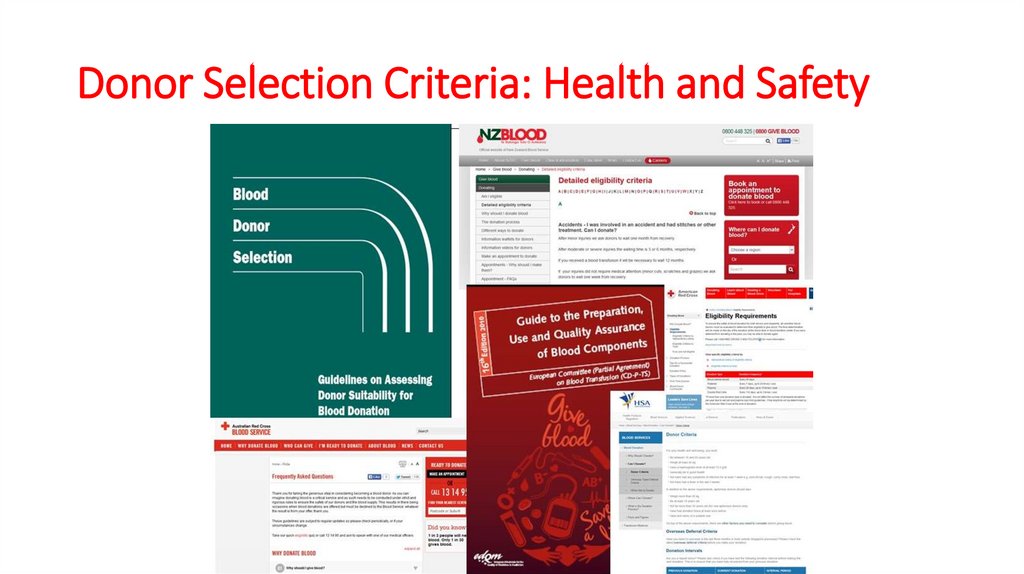
8. Donor Selection Criteria: Health and Safety
9.
Landmark Judgements:Voluntary non-remunerated Blood Donation
• Jan 1998-the Drugs Controller General issued a notification that
permanently defer paid professional blood donors.
• 1989-Drugs & cosmetics Act & Rules-made HIV test mandatory
• 2001 -Drugs &cosmetics Act & Rules-made HCV test mandatory
10. Donor Motivation is a process
Motivation is no more a casual work or a leisure time activityDonor Motivation is a process
“
To change the attitude of a person by disseminating
information and help him by imparting education to decide
to donate blood voluntarily ”
Motivation methodology has its objectives
1.
2.
3.
Identify the pattern of donors
Assess different motivational approach
Know major considerations for donating blood
11. Blood Donor Motivation
Blood donor is the foundation of any Blood Transfusion System.Blood donor motivation is an art based on science and should
be practiced with conviction & dedication either from within
the transfusion service or from outside.
……..Nobody is born as a blood donor…..…
Awareness has to be generated for regular voluntary blood
donation in the community. Misconceptions, fear complex and
prejudices have to be removed scientifically by rationally
emphasizing that blood donation is harmless to the donor.
So little to give……… so precious to save
12. Important points to consider:
Motivation, Recruitment and RetentionMotivating and Educating Donors
Assessing Needs and Setting Recruitment Goals
Recruitment of Donors
Selecting Safe Donors
Counselling and Testing
Retaining Donors
Record Maintenance
Monitoring and Evaluation
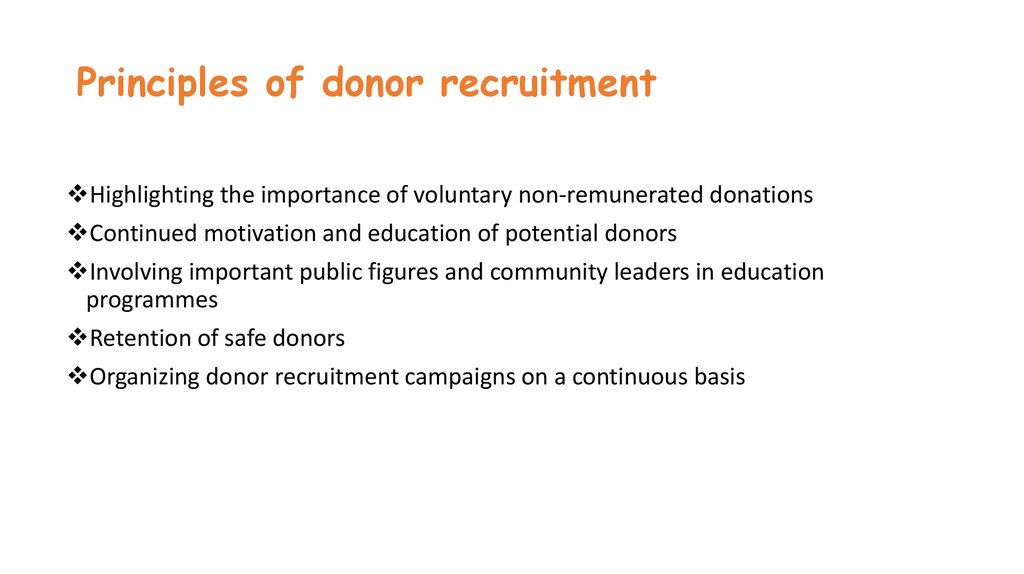
13. Principles of donor recruitment
Highlighting the importance of voluntary non-remunerateddonations
Continued motivation and education of potential donors
Involving important public figures and community leaders in
education programmes
Retention of safe donors
Organizing donor recruitment campaigns on a continuous
basis
14. Strategy to ensure a safe and adequate supply of blood
• Motivation• Recruitment
• Selection and
• Retention of
• Voluntary non-remunerated blood donors.
A regular donor is one who donates blood two to three times a year and
continues to donate at least once a year.
15. Activities to ensure safe and regular blood donation
Identify low-risk donors and encourage self- exclusionby donors with risk behaviour
Estimate blood requirements
Develop effective education and motivation campaign to
recruit voluntary donors
Develop and maintain effective donor selection
procedure
Provide high standard of comprehensive donor care
Maintain efficient donor records
Develop system to retain voluntary and non-remunerated
donors
16. Motivating and Educating Donors
Most important aspects of a national blood transfusion programme.A major challenge
The following should be kept in mind:
People do not donate blood unless they are asked to
There are sufficient potential donors available
There are several myths and misconceptions about blood donation in public
17. Donor education
Education is an important bridge between awareness andrecruitment.
Essential to ensure recruitment of safe donors
Donor education and information materials, donor
questionnaires and consent forms should be prepared in
simple language and translated for use according to regional
variations.
Picture presentations or flip charts can be used to educate
donors who cannot read printed educational material.
18.
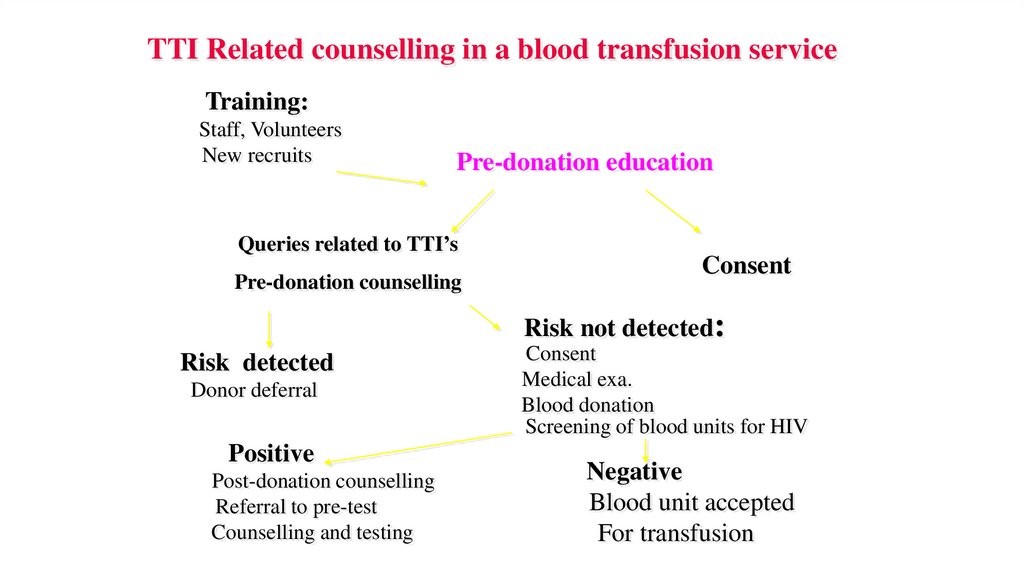
TTI Related counselling in a blood transfusion serviceTraining:
Staff, Volunteers
New recruits
Pre-donation education
Queries related to TTI’s
Pre-donation counselling
Consent
Risk not detected:
Risk detected
Donor deferral
Positive
Post-donation counselling
Referral to pre-test
Counselling and testing
Consent
Medical exa.
Blood donation
Screening of blood units for HIV
Negative
Blood unit accepted
For transfusion
19.
20. Benefits of BTS Counselling
21. Assessing Needs and Setting Recruitment Goals
• The requirement of blood and blood products in a country dependson :
-The population
-Health care structure
-Prevalence of conditions requiring
regular transfusions, such as haemophilia and thalassaemia
-Availability of surgical centres using modern sophisticated techniques and
-Awareness amongst clinicians regarding judicious use of blood.
22. The requirement of blood is assessed in relation to:
Total populationAcute hospital beds
Medical facilities available in the area
Annual blood usage (past, present and future)
If 2% of the population donates blood, it will be sufficient to meet
the need of the developing countries.
The need for blood varies from 7-15 units per acute patient bed per year
23. Recruitment of Donors
Identification, education and motivation of potential donorsTraining and motivation of blood donor organizers and
recruiters
Donor record maintenance and confidentiality.
24. For satisfactory donor recruitment
• Initiate Knowledge, Attitude and Practice (KAP) studies-Helpful in developing appropriate messages to be used during recruitment campaigns
-Creating and strengthening positive attitudes towards blood donation
-Developing and implementing focused awareness programmes for target populations
25. Principles of donor recruitment
Highlighting the importance of voluntary non-remunerated donationsContinued motivation and education of potential donors
Involving important public figures and community leaders in education
programmes
Retention of safe donors
Organizing donor recruitment campaigns on a continuous basis
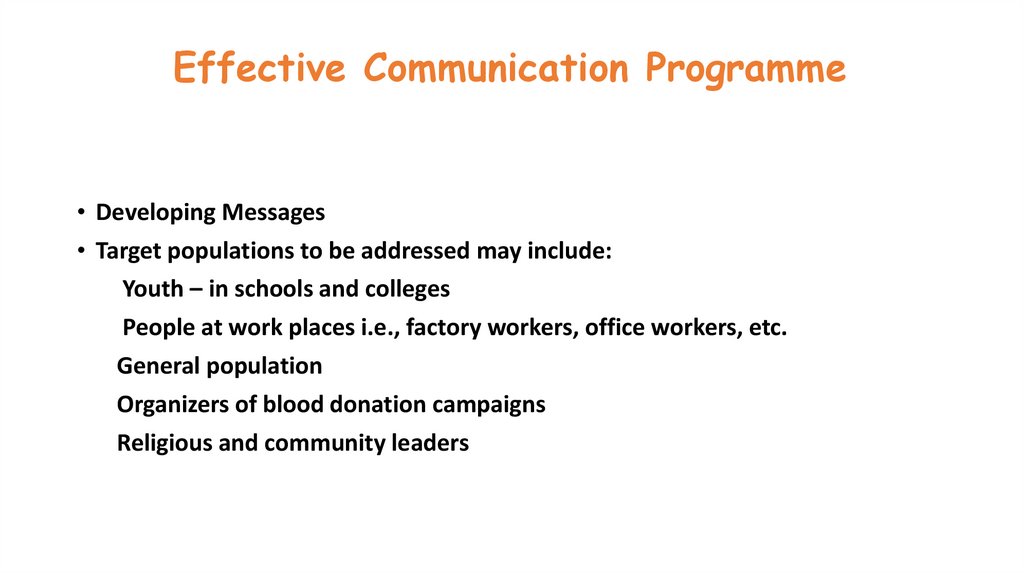
26. Effective Communication Programme
• Developing Messages• Target populations to be addressed may include:
Youth – in schools and colleges
People at work places i.e., factory workers, office workers, etc.
General population
Organizers of blood donation campaigns
Religious and community leaders
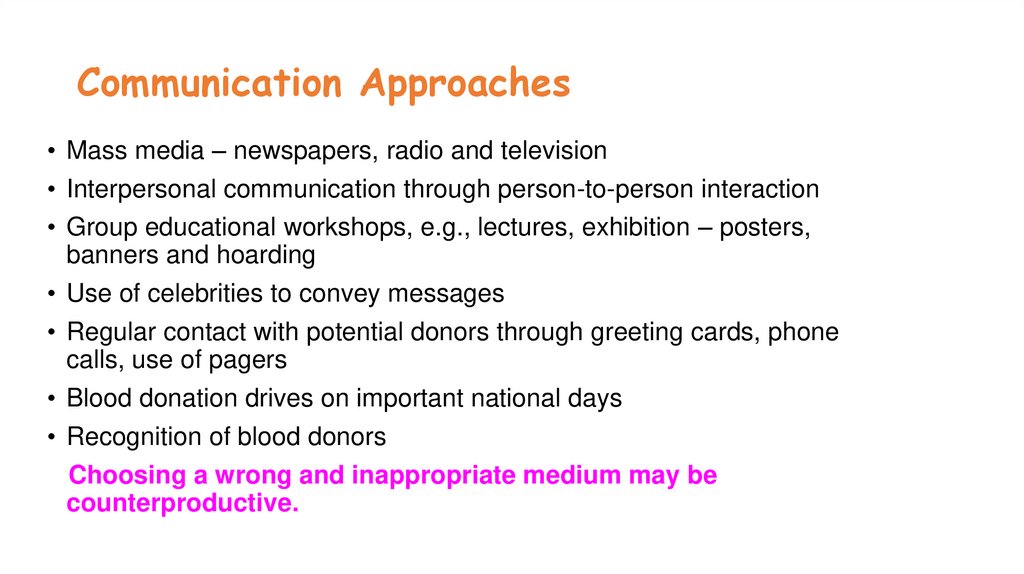
27. Communication Approaches
• Mass media – newspapers, radio and television• Interpersonal communication through person-to-person interaction
• Group educational workshops, e.g., lectures, exhibition – posters,
banners and hoarding
• Use of celebrities to convey messages
• Regular contact with potential donors through greeting cards, phone
calls, use of pagers
• Blood donation drives on important national days
• Recognition of blood donors
Choosing a wrong and inappropriate medium may be
counterproductive.
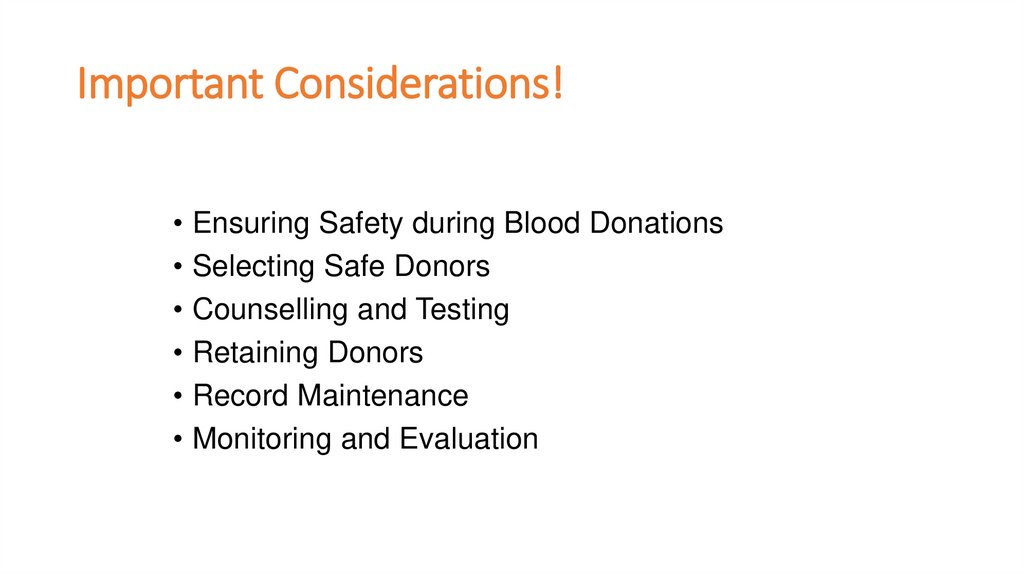
28. Important Considerations!
• Ensuring Safety during Blood Donations• Selecting Safe Donors
• Counselling and Testing
• Retaining Donors
• Record Maintenance
• Monitoring and Evaluation
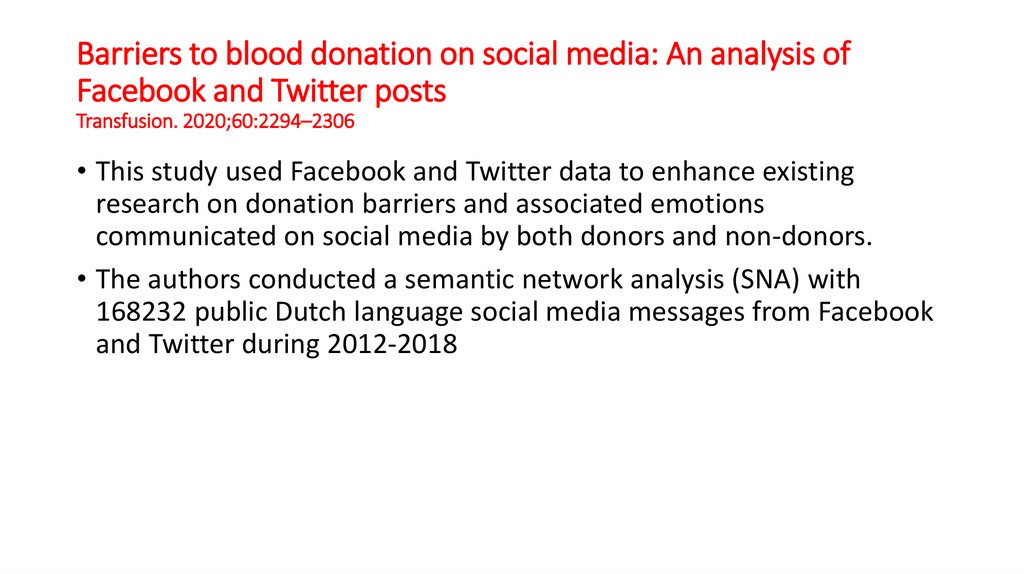
29. Barriers to blood donation on social media: An analysis of Facebook and Twitter posts Transfusion. 2020;60:2294–2306
• This study used Facebook and Twitter data to enhance existingresearch on donation barriers and associated emotions
communicated on social media by both donors and non-donors.
• The authors conducted a semantic network analysis (SNA) with
168232 public Dutch language social media messages from Facebook
and Twitter during 2012-2018
30.
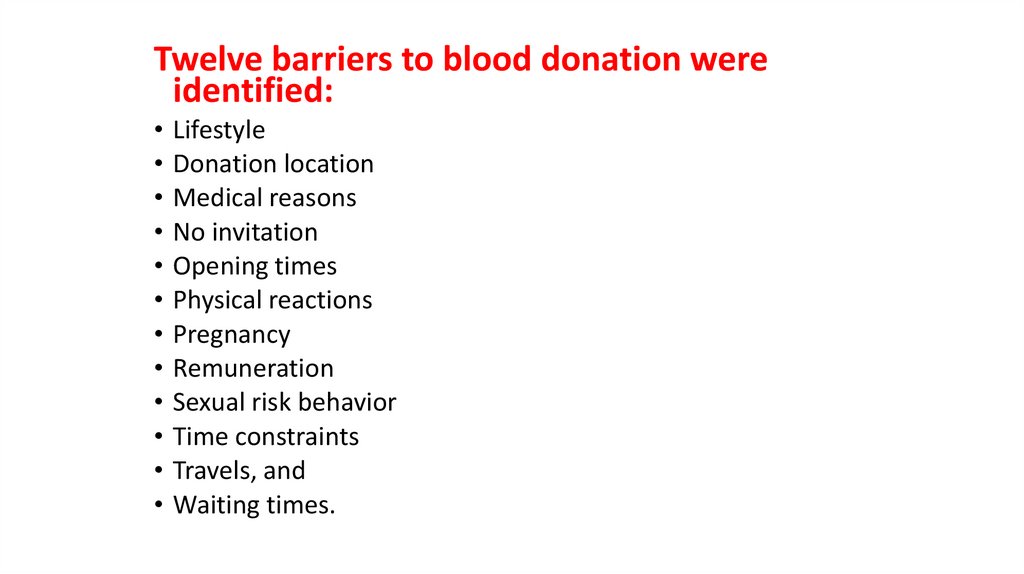
Twelve barriers to blood donation wereidentified:
• Lifestyle
• Donation location
• Medical reasons
• No invitation
• Opening times
• Physical reactions
• Pregnancy
• Remuneration
• Sexual risk behavior
• Time constraints
• Travels, and
• Waiting times.
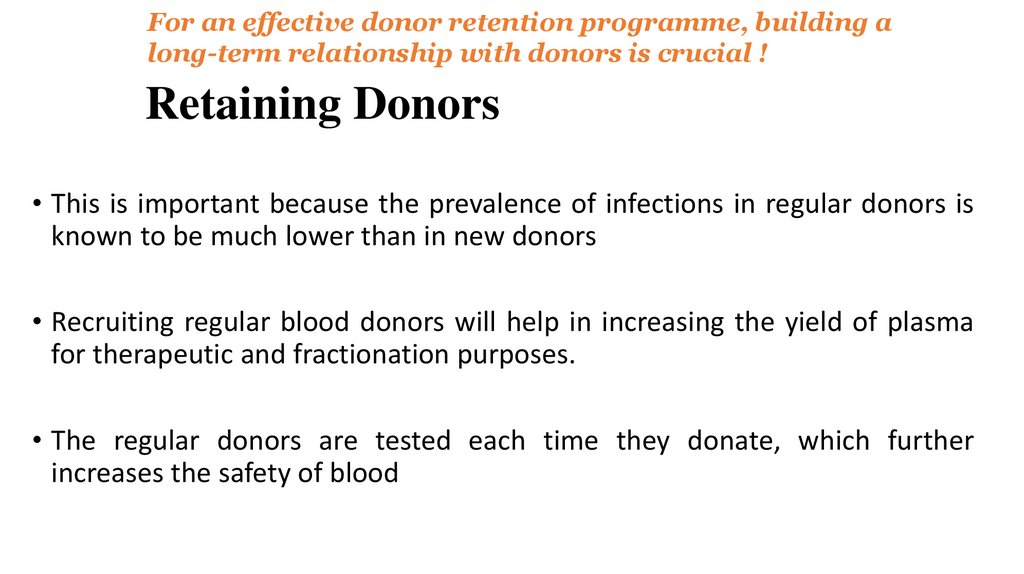
31. Retaining Donors
For an effective donor retention programme, building along-term relationship with donors is crucial !
Retaining Donors
• This is important because the prevalence of infections in regular donors is
known to be much lower than in new donors
• Recruiting regular blood donors will help in increasing the yield of plasma
for therapeutic and fractionation purposes.
• The regular donors are tested each time they donate, which further
increases the safety of blood
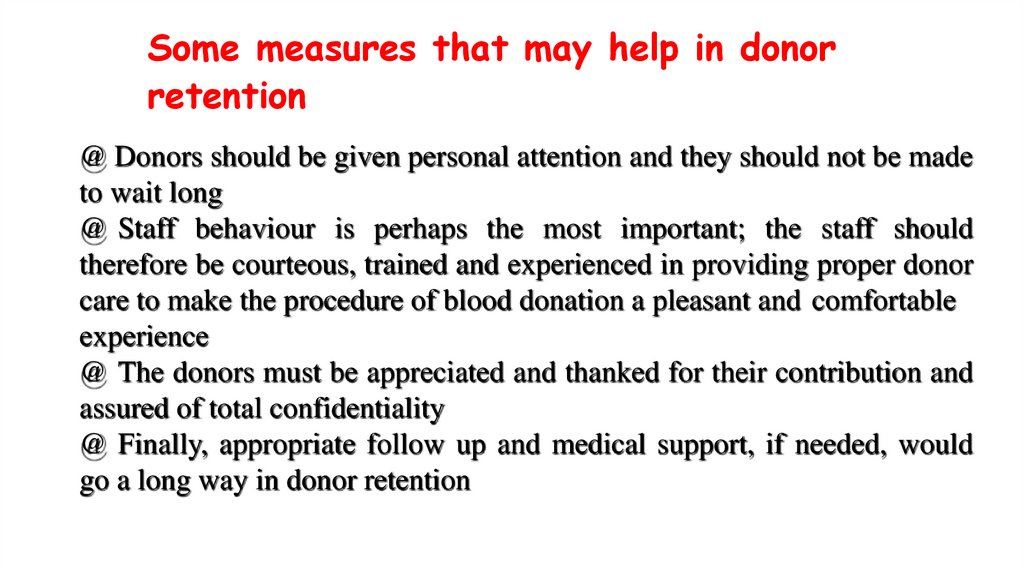
32. Some measures that may help in donor retention
@ Donors should be given personal attention and they should not be madeto wait long
@ Staff behaviour is perhaps the most important; the staff should
therefore be courteous, trained and experienced in providing proper donor
care to make the procedure of blood donation a pleasant and comfortable
experience
@ The donors must be appreciated and thanked for their contribution and
assured of total confidentiality
@ Finally, appropriate follow up and medical support, if needed, would
go a long way in donor retention
33. Activities to ensure safe and regular blood donation
Blood donation is a continuous programme and there is a needfor recruitment of donors all the time
Activities to ensure safe and
regular blood donation
• Identify low risk donors and encourage self exclusion by donors with
risk behavior
• Develop effective education & motivation campaign to recruit
voluntary donors
• Provide high standard comprehensive donor care
• Maintain efficient record
• Develop system to retain voluntary and non-remunerated donors
34. Indicators of effectiveness
• Increase in the total number of voluntary non-paid donors• Decrease in the number of permanently excluded donors
• Increase in the number of regular donors
• Increase in the number of organizations and/or communities
involved in motivating voluntary blood donation
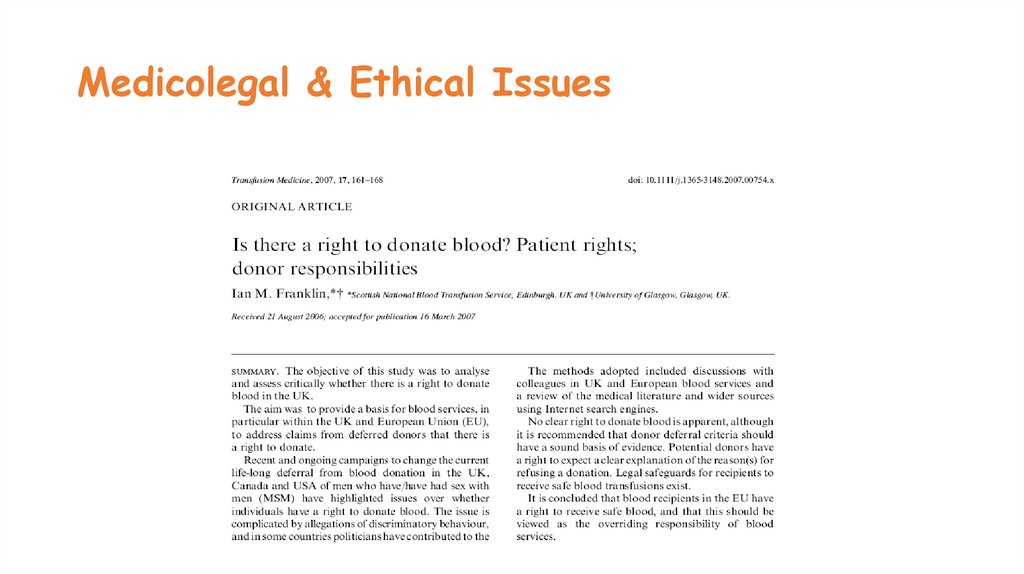
35. Medicolegal & Ethical Issues
Medicolegal & Ethical Issues36.
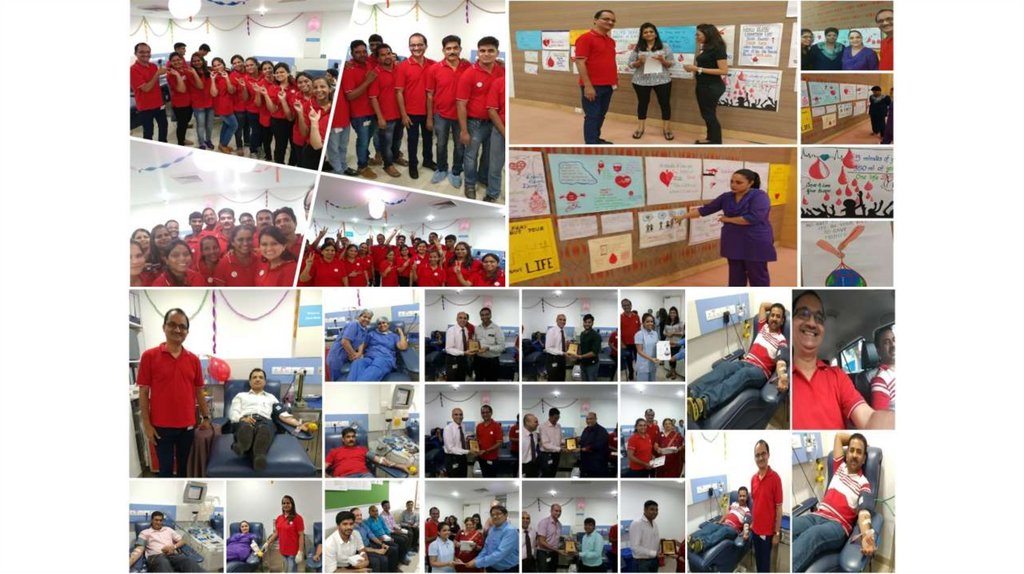
June 14th the birthday of Karl Landsteiner ,the Nobel prize winner who discovered ABO
blood group system, but It also has been
designated as World Blood Donors Day .
World Blood Donors Day “ provides a unique
opportunity to give thanks to those very
special people who provide the foundation of
a safe blood, available to all patients
requiring transfusion.
37. World Blood Donor Day events should:
Raise awareness of the importance of regular, voluntary, unpaidblood donation and a strong national blood donor programme in
ensuring that safe blood is available to every patient who needs it
Thank existing voluntary unpaid blood donors and encourage them
to donate regularly
Recruit new, safe, voluntary blood donors
Encourage healthy donors who have given blood when required by a
family or community member to become regular voluntary unpaid
donors
Promote healthy lifestyles among blood donors to protect both their
own health and that of the patients who receive their blood
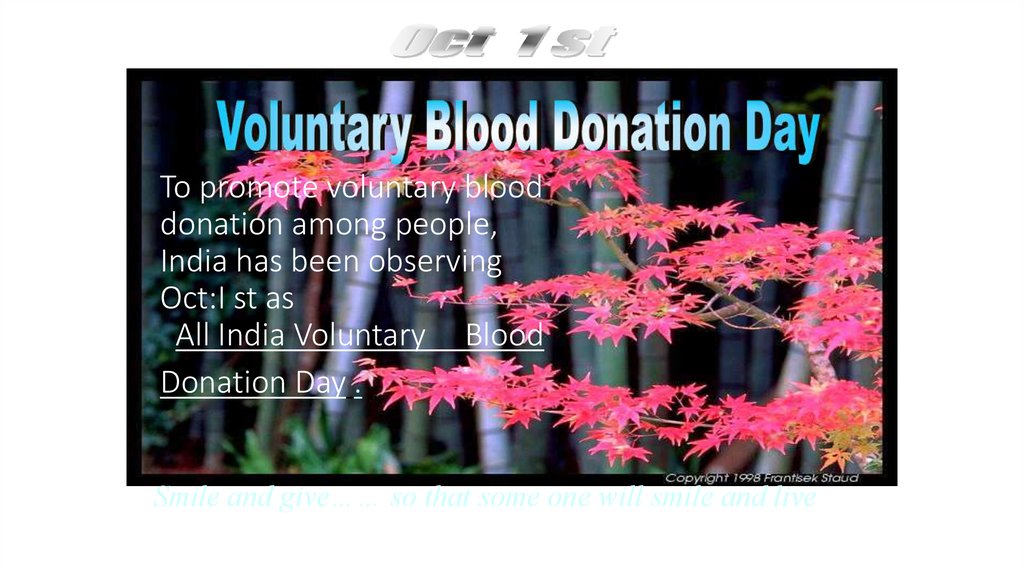
38. To promote voluntary blood donation among people, India has been observing Oct:I st as All India Voluntary Blood Donation Day .
Smile and give…… so that some one will smile and live…39.
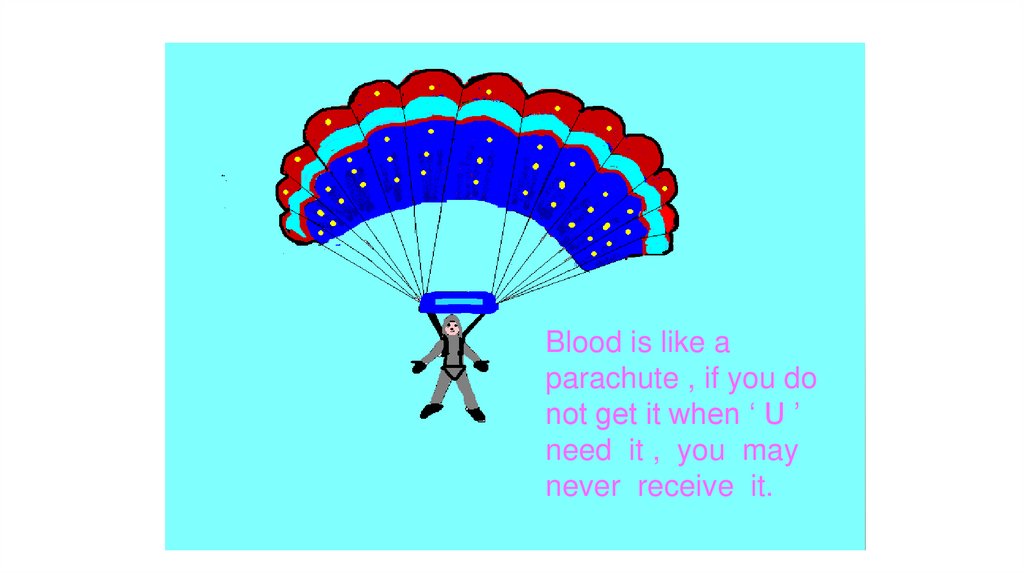
Blood is like aparachute , if you do
not get it when ‘ U ’
need it , you may
never receive it.
40.
“We” can dare to declareFreedom from “BLOOD SHORTAGES”
If only “YOU”
Would care to become a
“REGULAR DONOR”
41.
U CAN DONATE WITH REASONWITHOUT REASON
42.
On Your wedding anniversary43.
On Your Birthday44.
45.
46.
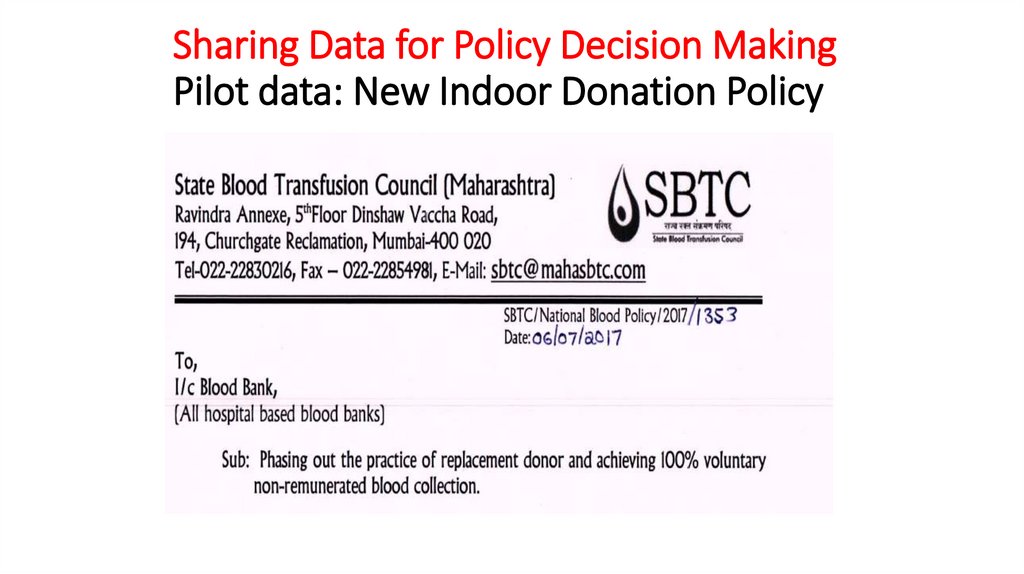
CELEBRATE IT WITH DONATING BLOOD47. Sharing Data for Policy Decision Making Pilot data: New Indoor Donation Policy
48.
49. Our Experience: Average indoor Donations Jan-Jun 2017= 663/month In-house donations in July & August 2017= 398/month About 40%
Our Experience:Average indoor Donations Jan-Jun 2017=
663/month
In-house donations in July & August 2017=
398/month
About 40% reduction!!
50. Blood Donation Timings
August 1st onwards 8:00-19:00Total donors
Blood Drive
In House
09:00 – 17:00
Extended hours
6301
1037 (17.02%)
5054 (82.97%)
3946 (78.07%)
1108 (21.92%)
51. Action Plan
•Bedside visits by TM team (MO+MSW)•Recruitment of Staff as Blood/Platelet donors
•Debit-Credit basis of exchange with FBBB members
Support needed:
•More VBD camps – Role of Marketing team
•Blood donation appeal in Audio-visual format at various places in the
hospital
•Clinicians role in counseling regarding the need of Blood Transfusion
•A proactive VBD campaign
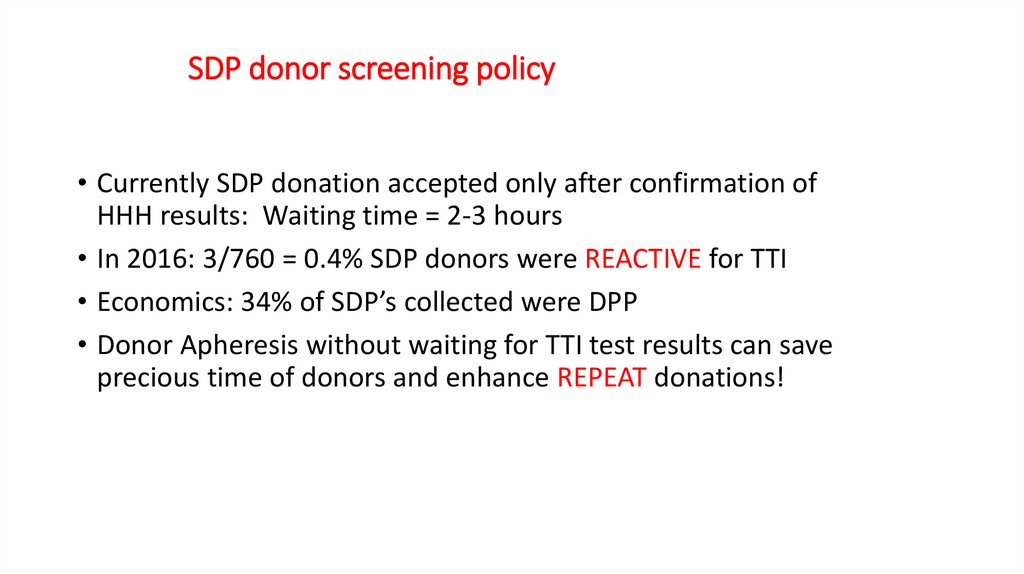
52. SDP donor screening policy
• Currently SDP donation accepted only after confirmation ofHHH results: Waiting time = 2-3 hours
• In 2016: 3/760 = 0.4% SDP donors were REACTIVE for TTI
• Economics: 34% of SDP’s collected were DPP
• Donor Apheresis without waiting for TTI test results can save
precious time of donors and enhance REPEAT donations!
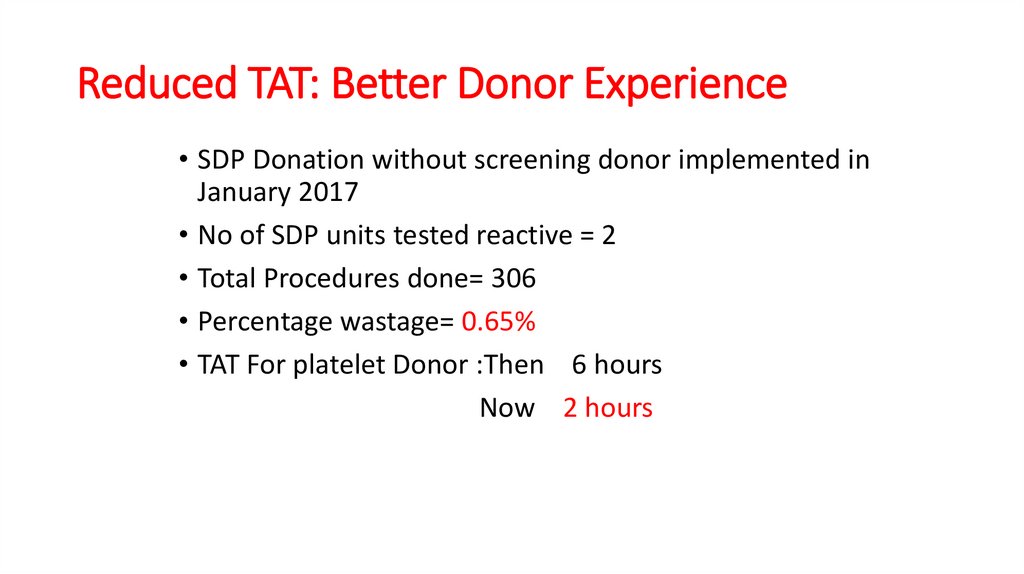
53. Reduced TAT: Better Donor Experience
• SDP Donation without screening donor implemented inJanuary 2017
• No of SDP units tested reactive = 2
• Total Procedures done= 306
• Percentage wastage= 0.65%
• TAT For platelet Donor :Then 6 hours
Now 2 hours
54. UNDERSTANDING THE DONORS PERCEPTION OF BLOOD DONATION PROCESS
Prateik Jondhale, Rajesh Sawant, Anand DeshpandeP. D. Hinduja National Hospital & MRC,
Mumbai, Maharashtra, India.
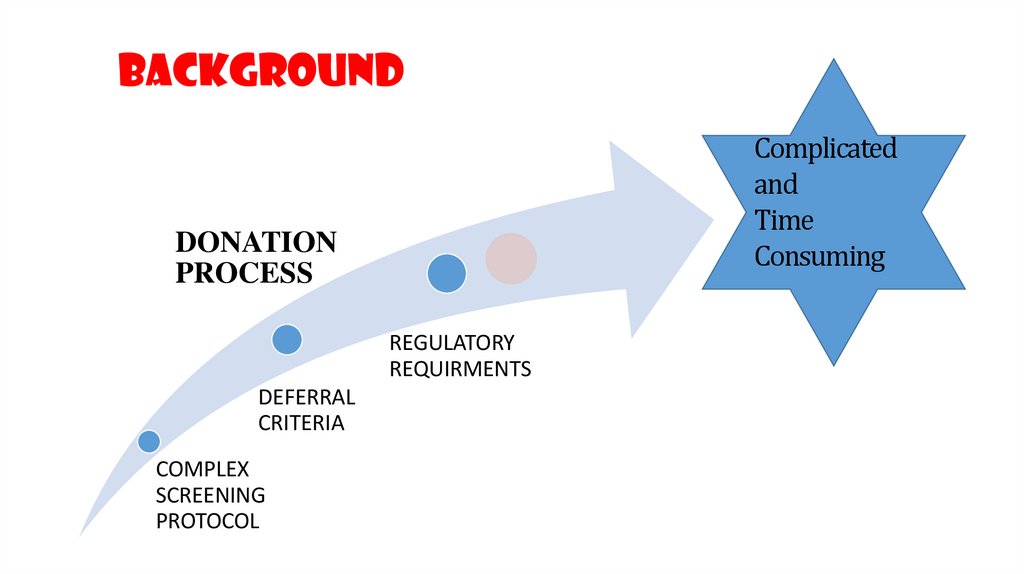
55.
BACKGROUNDComplicated
and
Time
Consuming
DONATION
PROCESS
REGULATORY
REQUIRMENTS
DEFERRAL
CRITERIA
COMPLEX
SCREENING
PROTOCOL
56.
ImportantFactor For
Donor
Recruitment
And
Retention
Program
DONORS’
SATISFACTIO
N
57. Aim
To Have A Better Understanding Of HowDonors Perceive Satisfaction With Their
Blood Donation Experience And Increase
Understanding Of Donor Motivational
Factors.
58. MATERIAL & METHODS
MATERIAL&
METHODS
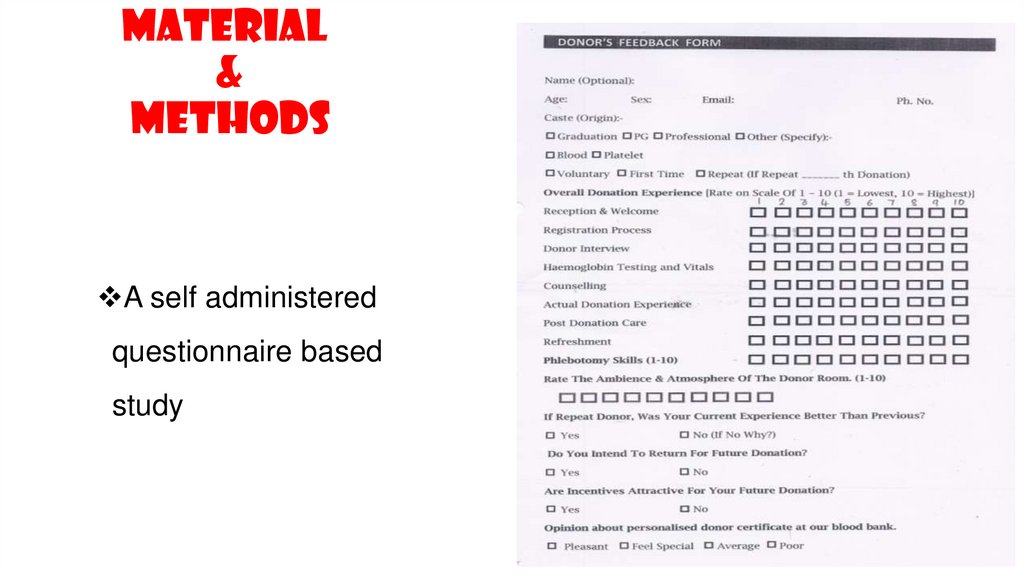
A self administered
questionnaire based
study
59.
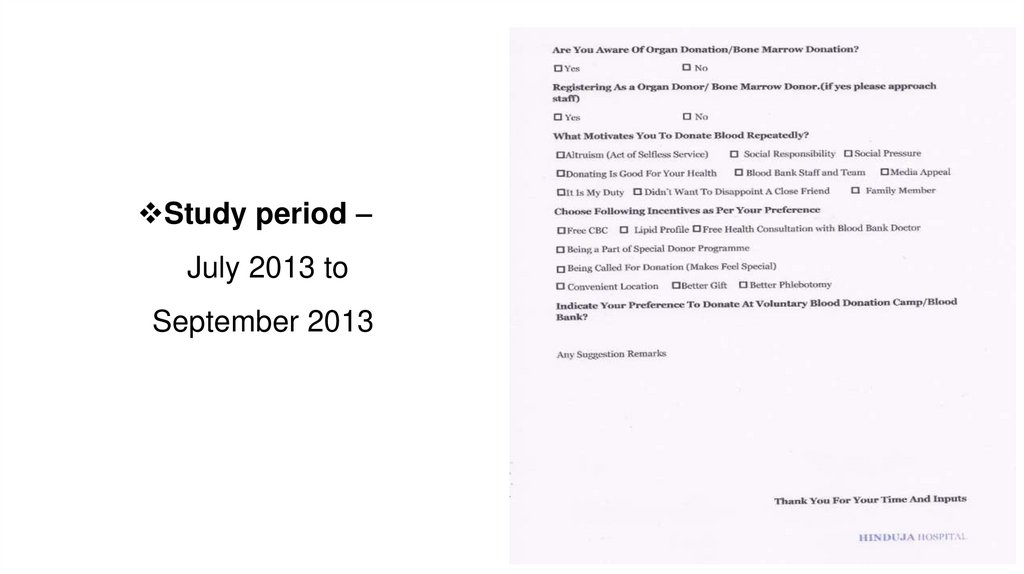
Study period –July 2013 to
September 2013
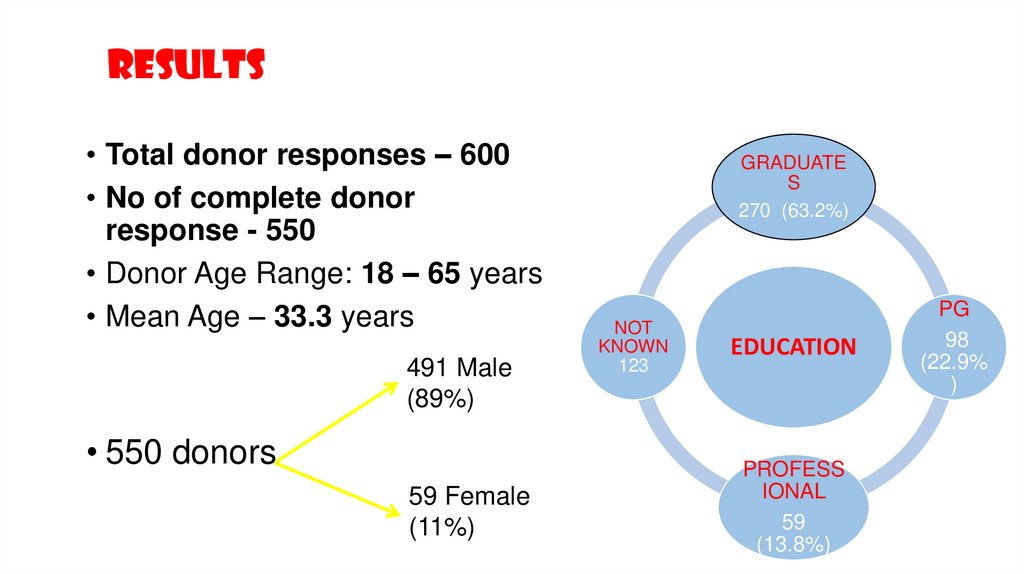
60. RESULTS
• Total donor responses – 600• No of complete donor
response - 550
• Donor Age Range: 18 – 65 years
• Mean Age – 33.3 years
491 Male
(89%)
• 550 donors
59 Female
(11%)
GRADUATE
S
270 (63.2%)
NOT
KNOWN
123
EDUCATION
PROFESS
IONAL
59
(13.8%)
PG
98
(22.9%
)
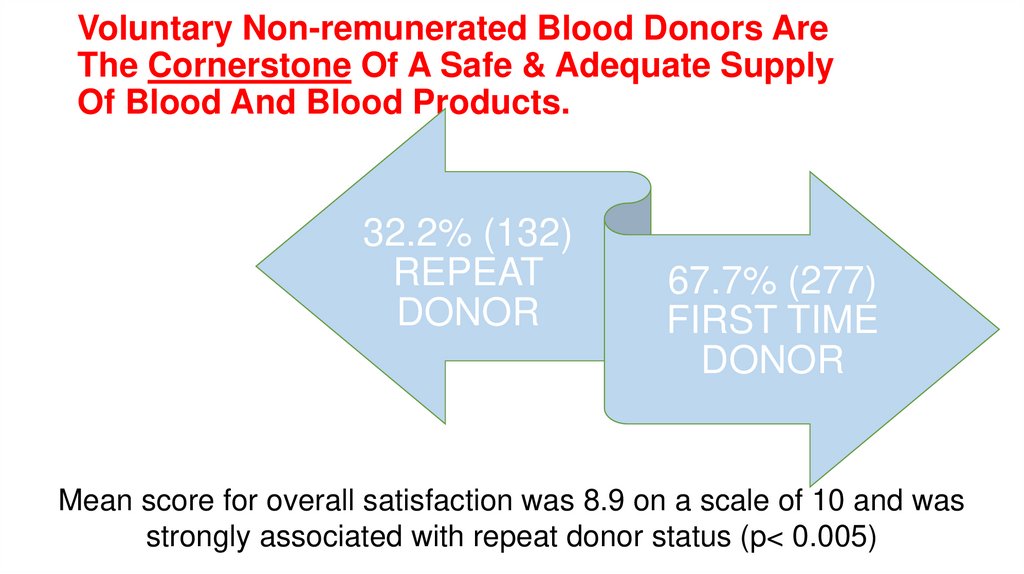
61. Voluntary Non-remunerated Blood Donors Are The Cornerstone Of A Safe & Adequate Supply Of Blood And Blood Products.
Voluntary Non-remunerated Blood Donors AreThe Cornerstone Of A Safe & Adequate Supply
Of Blood And Blood Products.
32.2% (132)
REPEAT
DONOR
67.7% (277)
FIRST TIME
DONOR
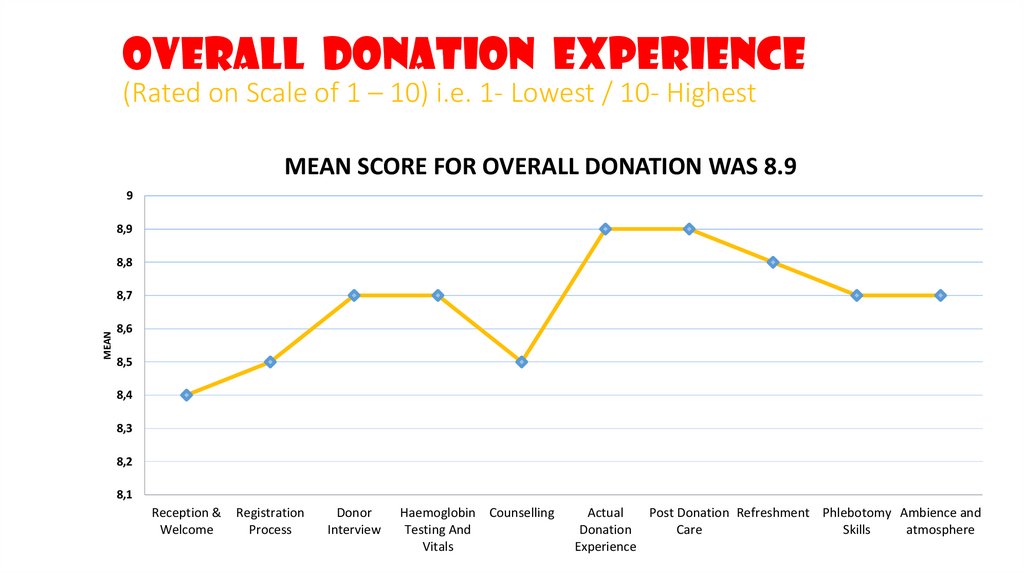
Mean score for overall satisfaction was 8.9 on a scale of 10 and was
strongly associated with repeat donor status (p< 0.005)
62. Overall Donation Experience (Rated on Scale of 1 – 10) i.e. 1- Lowest / 10- Highest
MEAN SCORE FOR OVERALL DONATION WAS 8.99
8,9
8,8
MEAN
8,7
8,6
8,5
8,4
8,3
8,2
8,1
Reception &
Welcome
Registration
Process
Donor
Interview
Haemoglobin Counselling
Testing And
Vitals
Actual
Post Donation Refreshment Phlebotomy Ambience and
Donation
Care
Skills
atmosphere
Experience
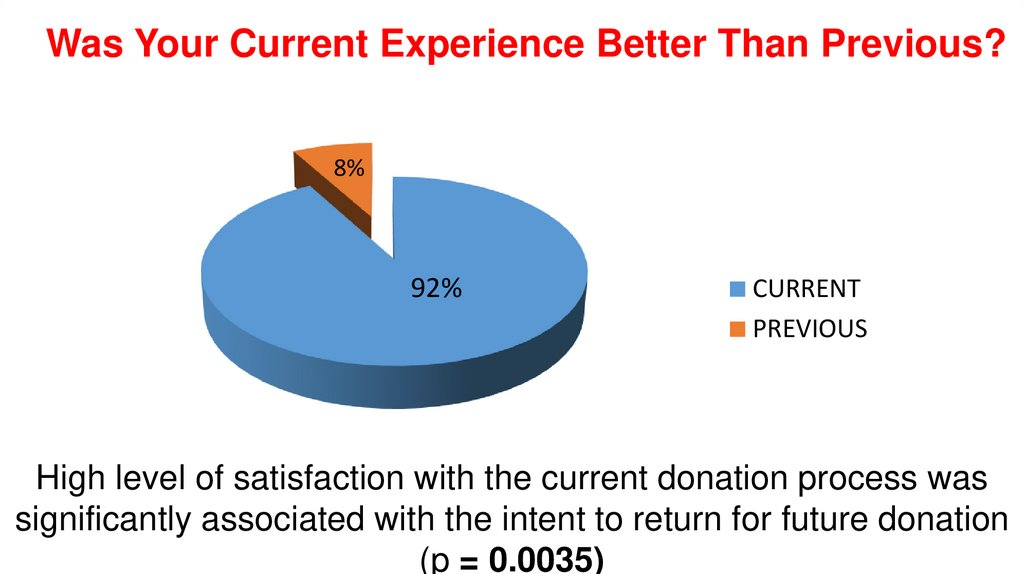
63. Was Your Current Experience Better Than Previous?
8%92%
CURRENT
PREVIOUS
High level of satisfaction with the current donation process was
significantly associated with the intent to return for future donation
(p = 0.0035)
64.
13.18% DONORS DID NOT INTEND TORETURN BACK IN FUTURE
Phlebotomy skills
Increased Turn around
Time
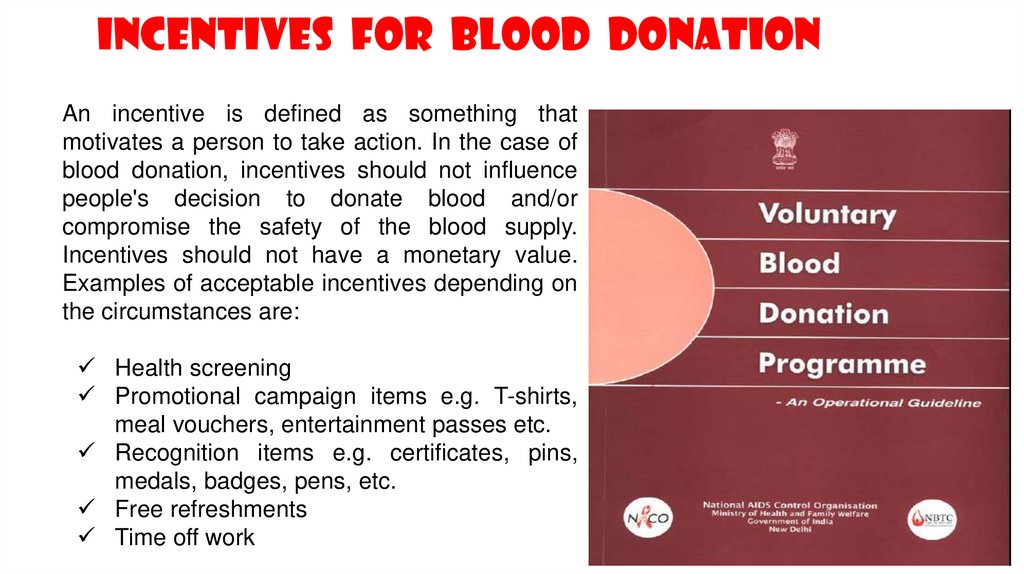
65. INCENTIVES FOR BLOOD DONATION
An incentive is defined as something thatmotivates a person to take action. In the case of
blood donation, incentives should not influence
people's decision to donate blood and/or
compromise the safety of the blood supply.
Incentives should not have a monetary value.
Examples of acceptable incentives depending on
the circumstances are:
Health screening
Promotional campaign items e.g. T-shirts,
meal vouchers, entertainment passes etc.
Recognition items e.g. certificates, pins,
medals, badges, pens, etc.
Free refreshments
Time off work
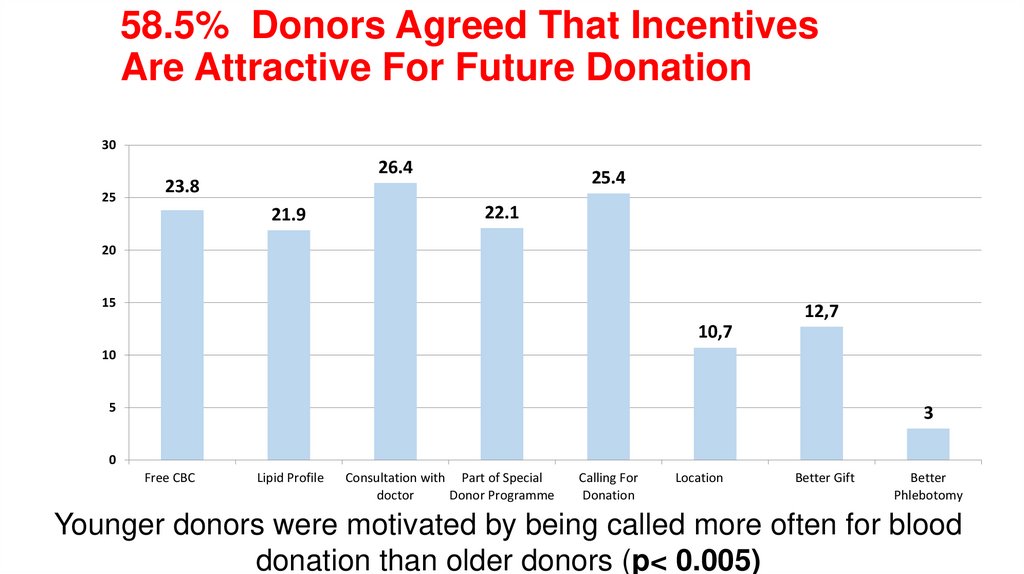
66. 58.5% Donors Agreed That Incentives Are Attractive For Future Donation
3026.4
25
25.4
23.8
21.9
22.1
20
15
12,7
10,7
10
5
3
0
Free CBC
Lipid Profile
Consultation with Part of Special
doctor
Donor Programme
Calling For
Donation
Location
Better Gift
Better
Phlebotomy
Younger donors were motivated by being called more often for blood
donation than older donors (p< 0.005)
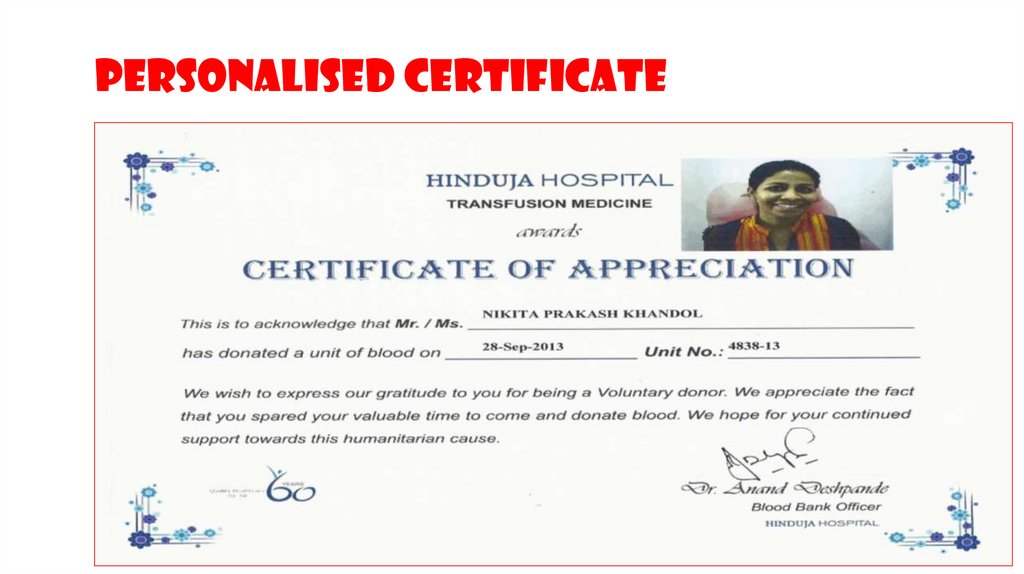
67. PERSONALISED CERTIFICATE
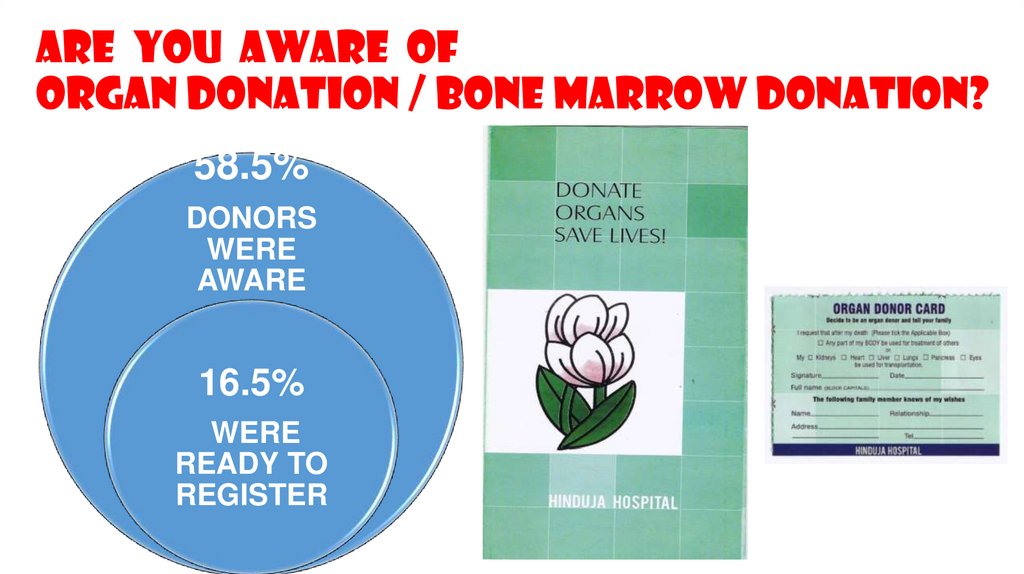
68. Are you Aware of Organ donation / Bone Marrow donation?
58.5%DONORS
WERE
AWARE
16.5%
WERE
READY TO
REGISTER
69.
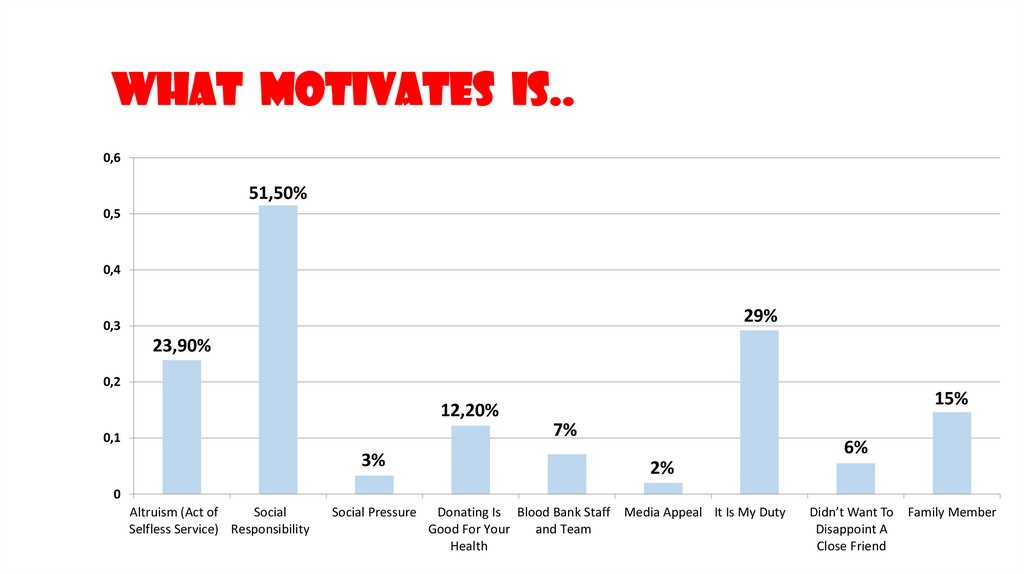
WHAT MOTIVATES IS..0,6
51,50%
0,5
0,4
29%
0,3
23,90%
0,2
15%
12,20%
7%
0,1
3%
6%
2%
0
Altruism (Act of
Social
Selfless Service) Responsibility
Social Pressure
Donating Is Blood Bank Staff Media Appeal It Is My Duty
Good For Your
and Team
Health
Didn’t Want To
Disappoint A
Close Friend
Family Member
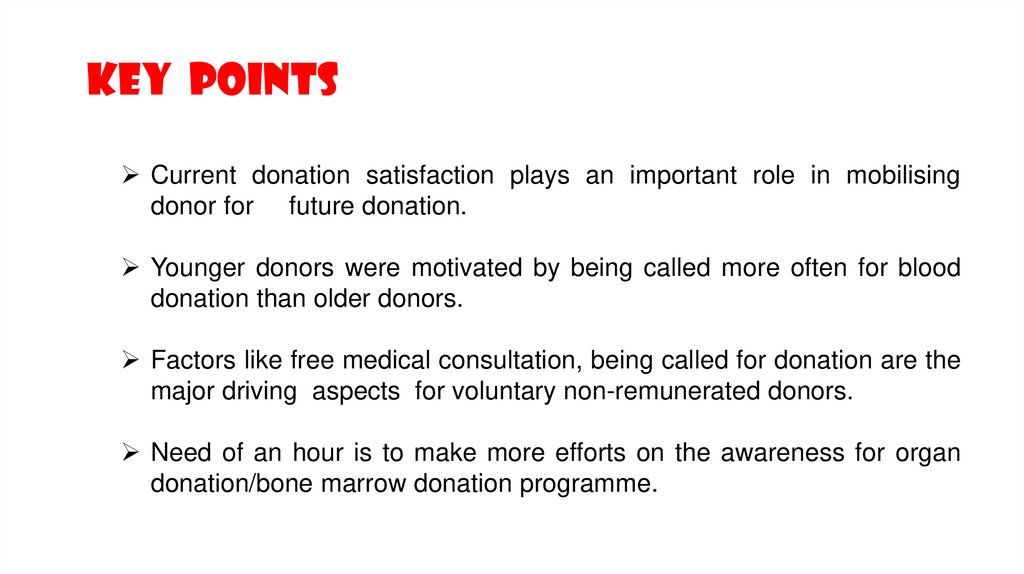
70. key points
Current donation satisfaction plays an important role in mobilisingdonor for future donation.
Younger donors were motivated by being called more often for blood
donation than older donors.
Factors like free medical consultation, being called for donation are the
major driving aspects for voluntary non-remunerated donors.
Need of an hour is to make more efforts on the awareness for organ
donation/bone marrow donation programme.
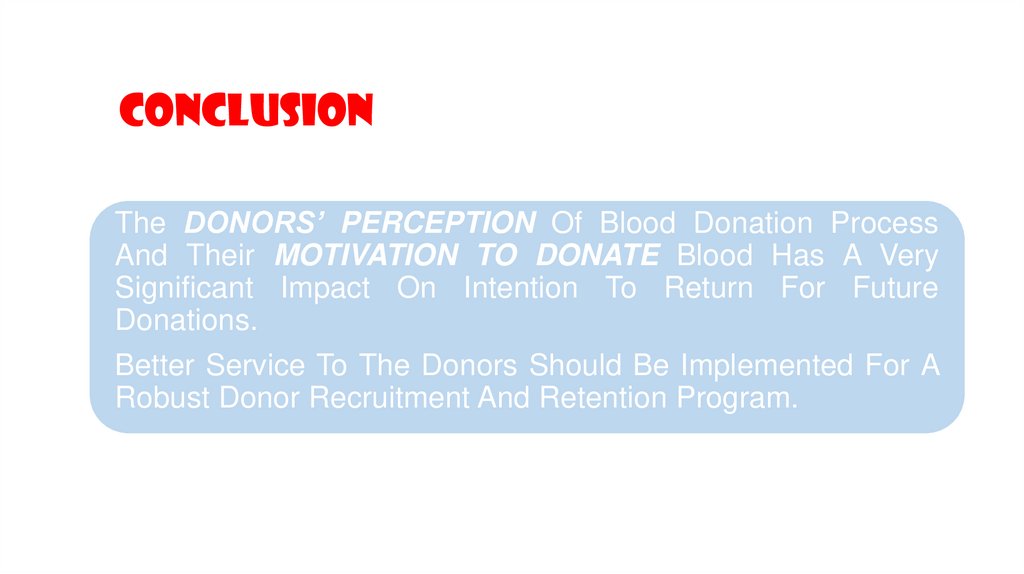
71.
CONCLUSIONThe DONORS’ PERCEPTION Of Blood Donation Process
And Their MOTIVATION TO DONATE Blood Has A Very
Significant Impact On Intention To Return For Future
Donations.
Better Service To The Donors Should Be Implemented For A
Robust Donor Recruitment And Retention Program.
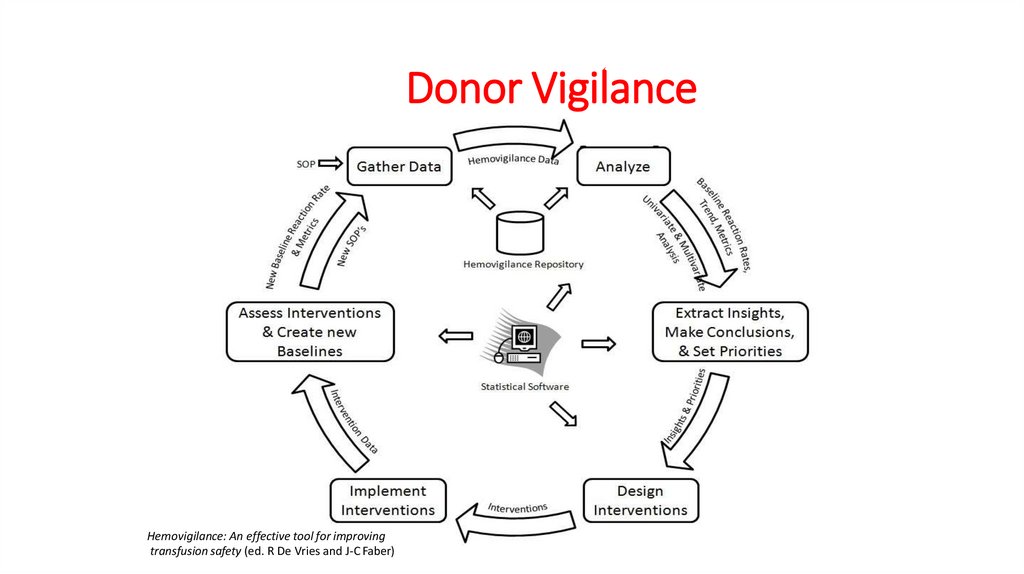
72. Donor Vigilance
Hemovigilance: An effective tool for improvingtransfusion safety (ed. R De Vries and J-C Faber)
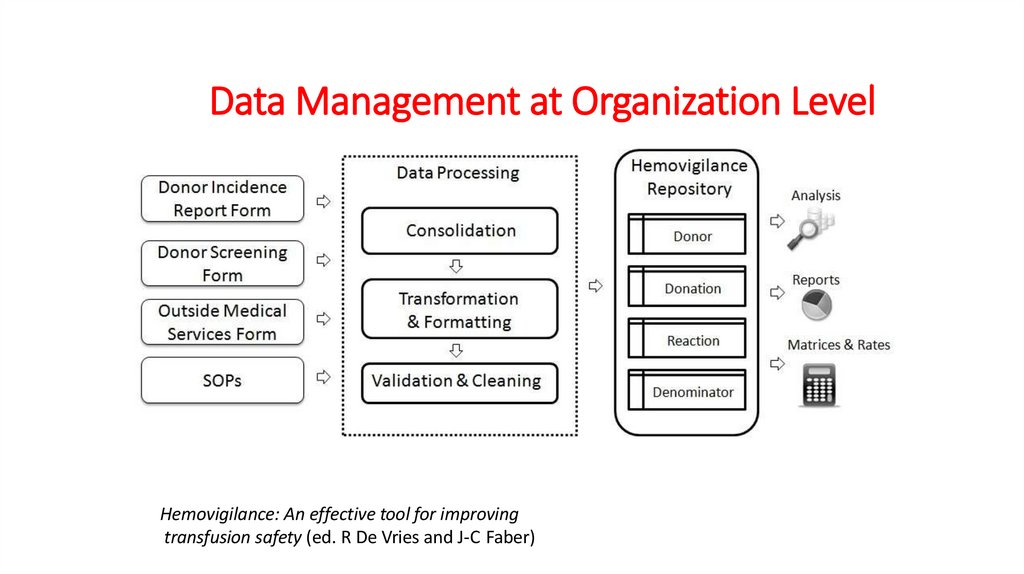
73. Data Management at Organization Level
Hemovigilance: An effective tool for improvingtransfusion safety (ed. R De Vries and J-C Faber)
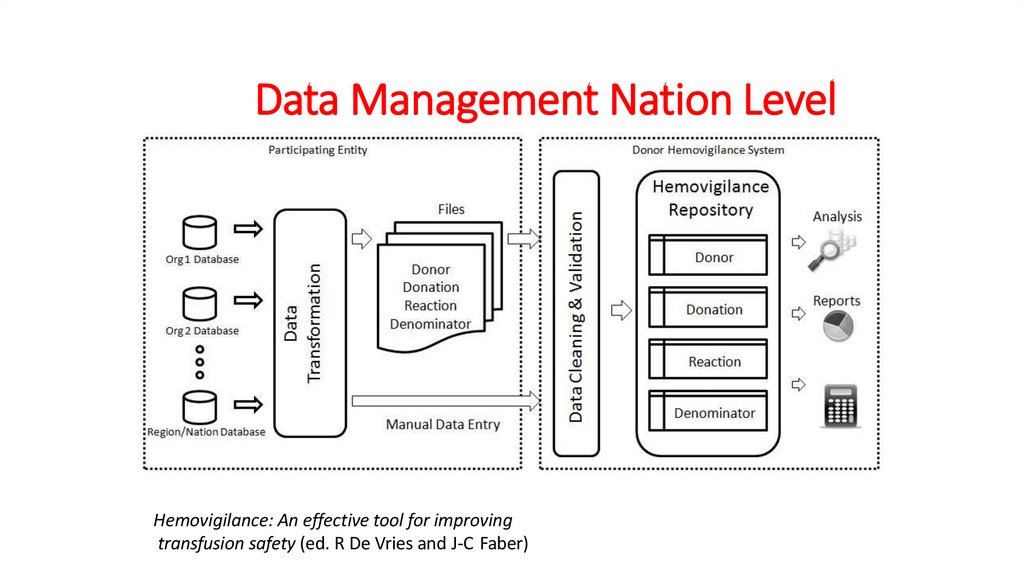
74. Data Management Nation Level
Hemovigilance: An effective tool for improvingtransfusion safety (ed. R De Vries and J-C Faber)
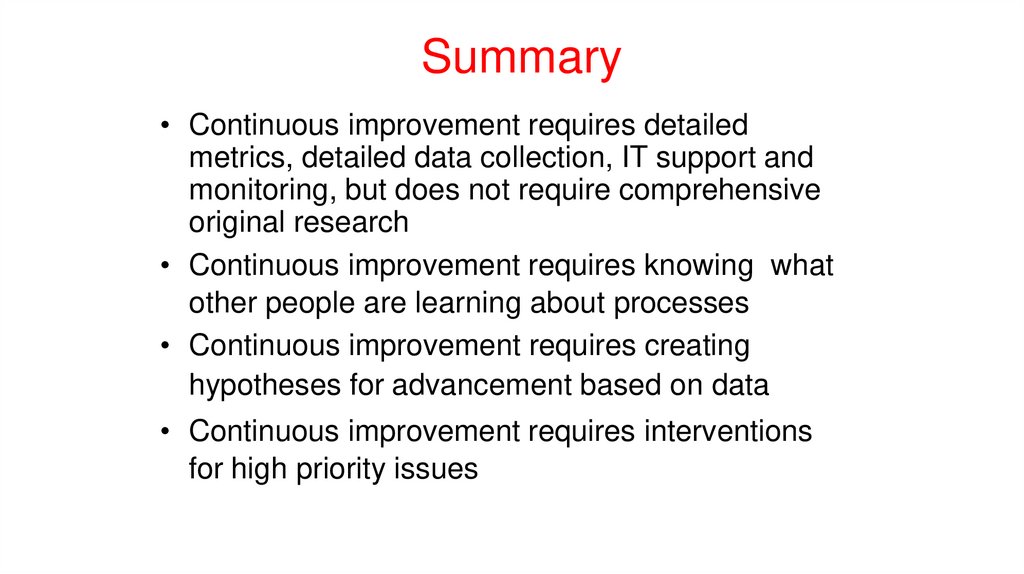
75. Summary
• Continuous improvement requires detailedmetrics, detailed data collection, IT support and
monitoring, but does not require comprehensive
original research
• Continuous improvement requires knowing what
other people are learning about processes
• Continuous improvement requires creating
hypotheses for advancement based on data
• Continuous improvement requires interventions
for high priority issues
76.
acknowledgementsTo all our donors who donated blood and participated in our study
Institutional Review Board (IRB)
Blood Centre staff
"Compassion is a foundation for sharing our
aliveness and building a more humane world."
Martin Lowenthal
77.
78. Do Something Amazing... 99% of us rely on the remaining 1% to give blood. Please don’t leave it to someone else!
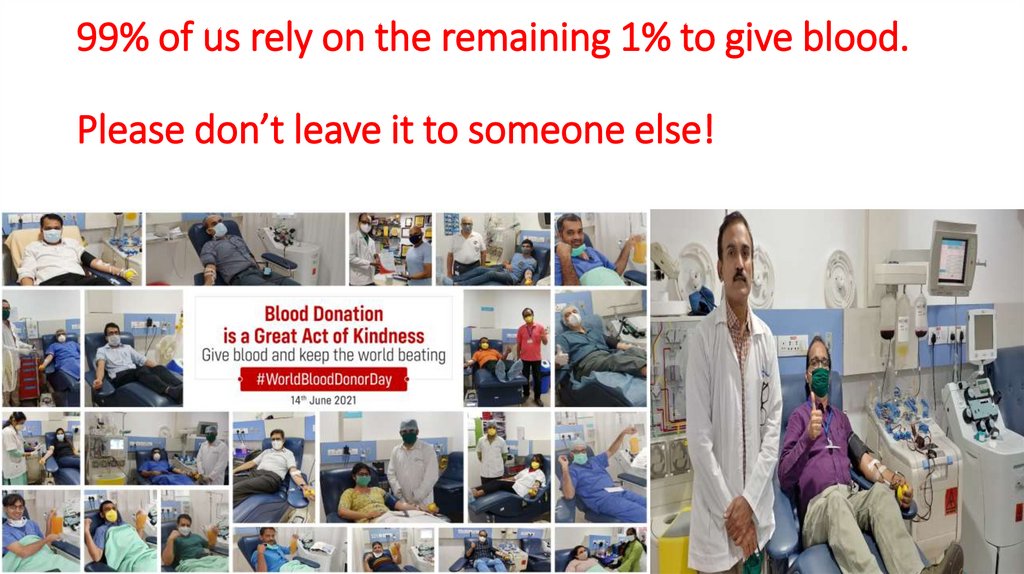
99% of us rely on the remaining 1% to give blood.Please don’t leave it to someone else!