 english
Similar presentations:



Syllabic Structure of English Words
1. SYLLABIC STRUCTURE OF ENGLISH WORDS
2. Theories on syllable formation and division
• minimal pronounceable units presenting a cluster orgroup of sounds;
• form language units of greater magnitude:
morphemes, words and phrases, each characterized
by a certain syllabic structure;
• any meaningful language unit may be considered
from the point of view of two aspects: syllable
formation and syllable division, which form a
dialectal unity.
3. Theories on syllable formation and division
• is a complicated phenomenon;• can be studied on four levels: articulatory, acoustic,
auditory and functional;
• complex character →to many theories in foreign and
home linguistics: the expiratory theory, the sonority
theory, the theory of muscular tension, the loudness
theory.
4. Syllable Definition
• the attempts to define the concept of the syllable →different approaches;
• a purely articulatory unit universal for all
languages, which lacks any functional value,
because its boundaries do not always coincide with
those of morphemes;
• the smallest pronounceable unit with a certain
linguistic function which refers to the structure of a
particular language
5. Features of the Syllable
— is a chain of phonemes of varying length;—is constructed on the basis of the contrast of its
constituents, usually of vowel-consonant (VC) type;
— the nucleus is a vowel (in some lges this function
is performed by a consonant);
— the presence of consonants in a syllable is
optional;
— the distribution of phonemes in the syllable
follows the rules of a particular language.
6. Syllable Formation in English
• is generally based on the phonological opposition‘vowel vs. consonant’;
• vowels – syllabic while consonants – not, with the
exceptions of [l, m, n];
• English possesses a great variety of syllables types.
7. V.A. Vassilyev’s Classification of Syllable Formation
• on the basis of the type of phoneme the syllable endsin → 2 types of syllables:
(1) open syllables ending in a vowel phoneme;
(2) closed syllables ending in a consonant phoneme.
• these are phonetic syllables which distinguish the
actual pronunciation of a word
8. Classification of Syllable Formation by M.A. Sokolova, V.D. Arakin and others
• on the basis of the number and arrangement ofconsonants with a vowel:
(1) fully open syllables, which consist of a vowel sound
only (V type);
(2) fully closed syllables, in which a vowel is between
consonants (C)CVC(C) type);
(3) syllables covered at the beginning, in which a
consonant or a sequence of consonants precede a vowel
(CC)CV type);
(4) syllables covered at the end, in which a consonant or a
sequence of consonants follow a vowel (VC(CC) type).
9. Other Approaches to Classification of Syllable Formation
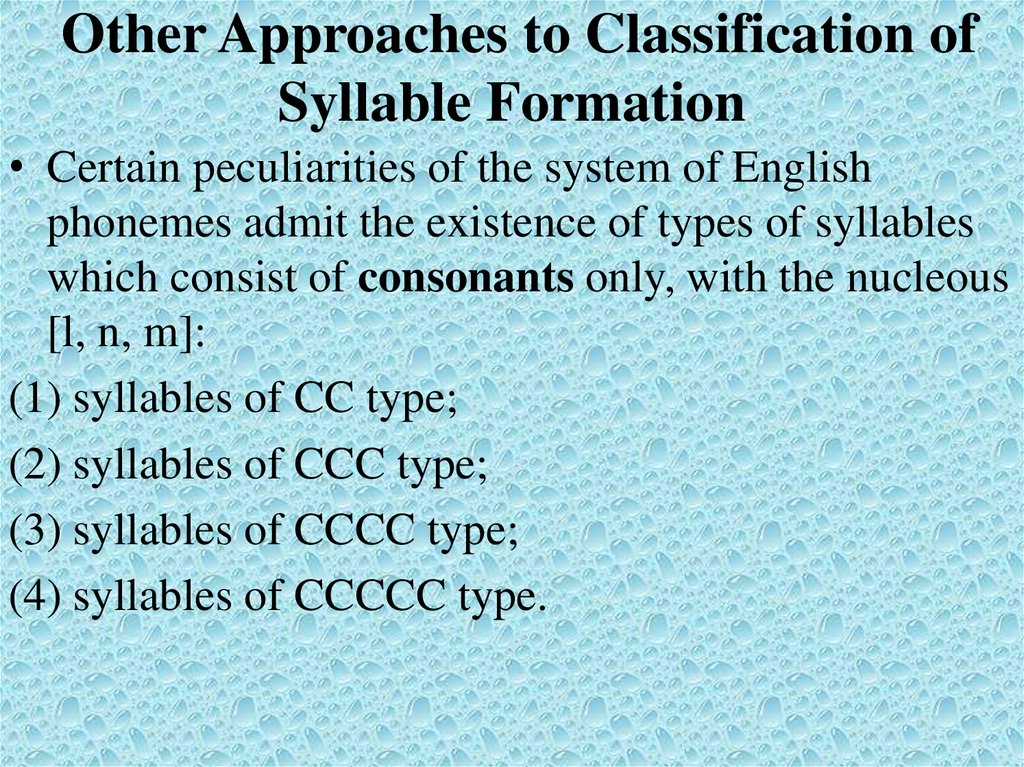
• Certain peculiarities of the system of Englishphonemes admit the existence of types of syllables
which consist of consonants only, with the nucleous
[l, n, m]:
(1) syllables of CC type;
(2) syllables of CCC type;
(3) syllables of CCCC type;
(4) syllables of CCCCC type.
10. Distribution of Consonants in the Structure of Syllables
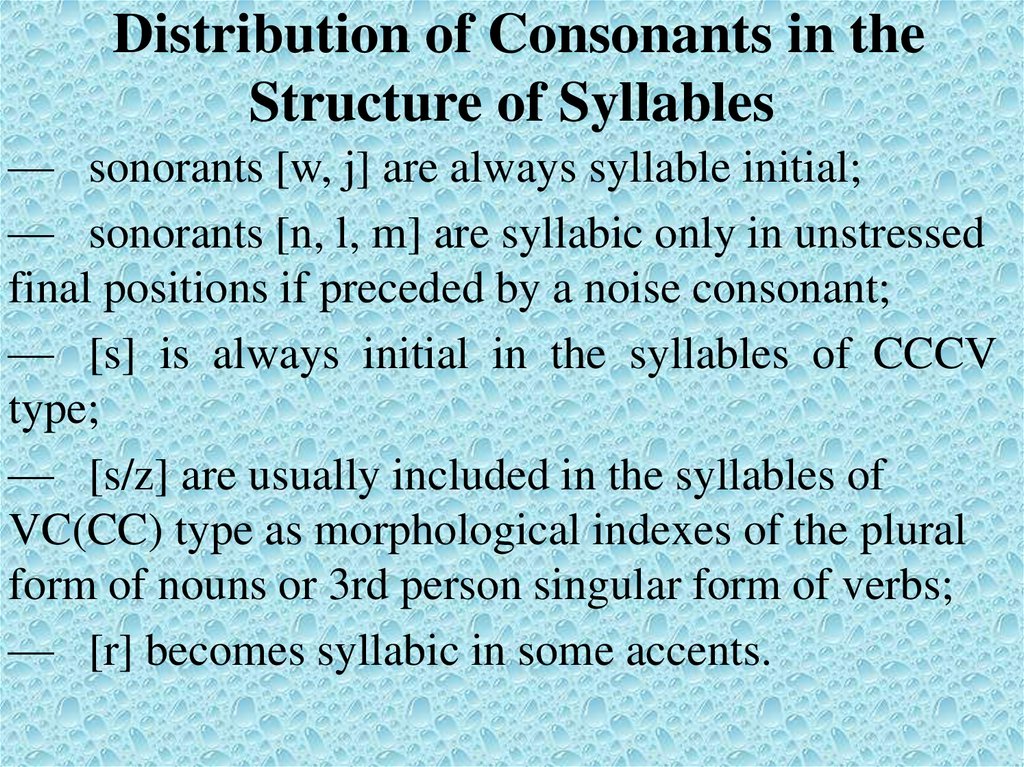
— sonorants [w, j] are always syllable initial;— sonorants [n, l, m] are syllabic only in unstressed
final positions if preceded by a noise consonant;
— [s] is always initial in the syllables of CCCV
type;
— [s/z] are usually included in the syllables of
VC(CC) type as morphological indexes of the plural
form of nouns or 3rd person singular form of verbs;
— [r] becomes syllabic in some accents.
11. The Structure of Syllables in English
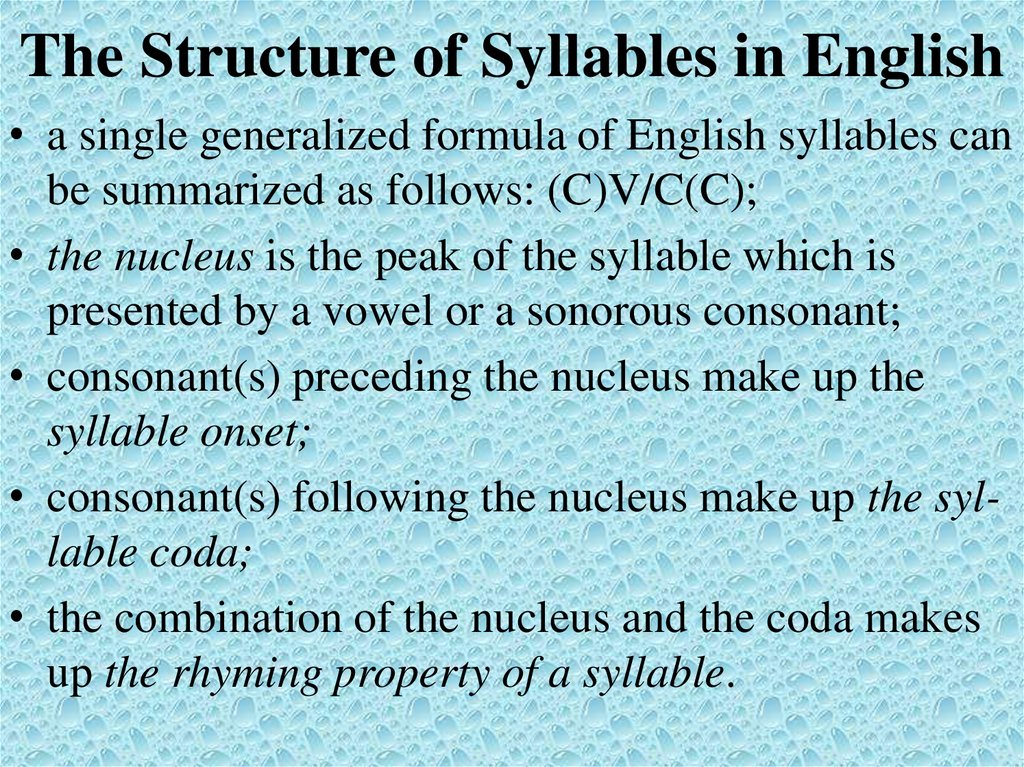
• a single generalized formula of English syllables canbe summarized as follows: (C)V/C(C);
• the nucleus is the peak of the syllable which is
presented by a vowel or a sonorous consonant;
• consonant(s) preceding the nucleus make up the
syllable onset;
• consonant(s) following the nucleus make up the syllable coda;
• the combination of the nucleus and the coda makes
up the rhyming property of a syllable.
12. The Structure of Syllables in English
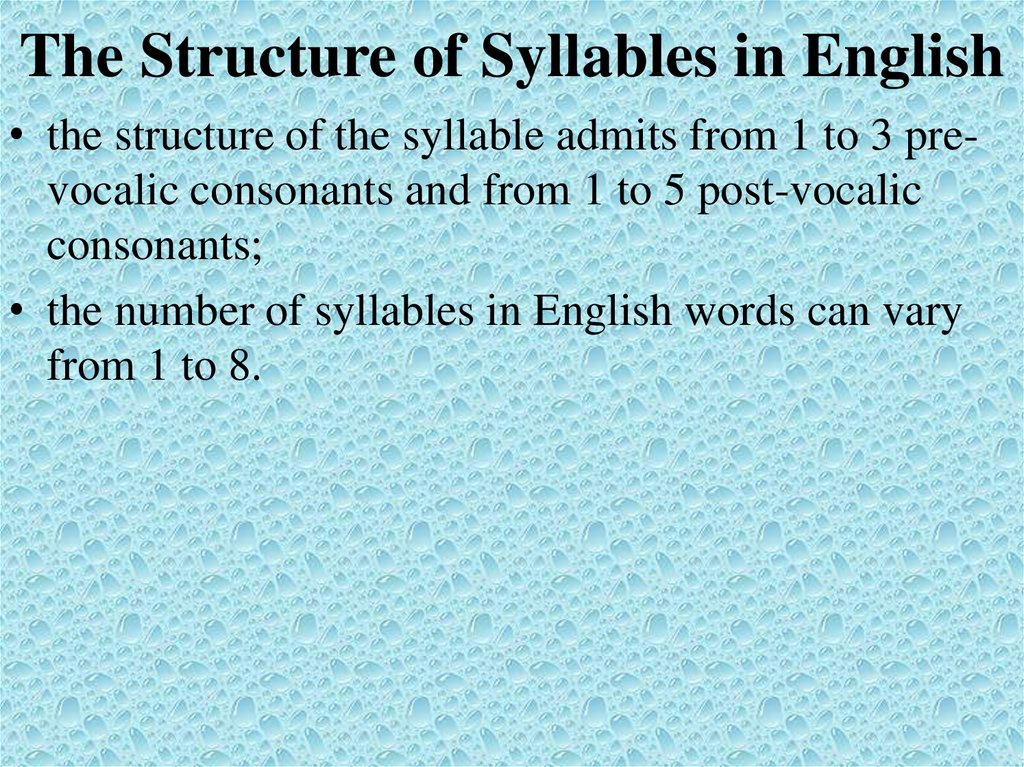
• the structure of the syllable admits from 1 to 3 prevocalic consonants and from 1 to 5 post-vocalicconsonants;
• the number of syllables in English words can vary
from 1 to 8.
13. Syllable Division in English
• helps to establish the structure of meaningfullanguage units (morphemes and words) and
determines the syllabic characteristics of the
language;
• the rules of syllable division are studied by
phonotactics which determines the patterns according to which phonemes are grouped into syllables;
• 4 rules for syllable division.
14. Rules of Syllable Division in English
I. Syllable division concerning stressed longmonophthongs, diphthongs and diphthongoids
(doesn’t present any difficulty)
free vowels occur in a phonetically open syllable and
the point of syllable division is right after them
15. Rules of Syllable Division in English
II. Syllable division in case of short vowels(manifests their checked character under stress)
a short stressed vowel separated from the next vowel
by a consonant or a consonant cluster always occurs in
a closed syllable in order to retain its checked
character (the difficulty is to find the point of syllable
division)
16. Rules of Syllable Division in English
II. Syllable division in case of short vowels(1)when a short stressed vowel is followed by one
consonant, there are two possibilities to determine
the point of syllable division;
(2)when a short stressed vowel is followed by a
consonant cluster, the rule for syllable division is
different.
17. Rules of Syllable Division in English
III. Syllable division concerning English pre-tonicunstressed vowels
(depends on the number of consonants separating them
from the next stressed vowel)
(1) when an unstressed short vowel is separated from a
succeeding stressed one by a single consonant, the
syllable it belongs to is always open;
(2) the case when vowels are separated by a cluster of
two consonants is more difficult (the point of syllable
division is determined by phoneme distribution).
18. Rules of Syllable Division in English
IV. Syllable division of post tonic vowels separatedfrom the following vowel by a consonant
(is a matter of no practical importance for language
learners)
19. Functional Characteristics of the Syllable
• The constitutive function of the syllable lies in itsability to be a word or a part of it;
• The distinctive function of the syllable lies in its
ability to differentiate words and word-forms taken
separately or in combinations.
• The identificatory function of the syllable is
conditioned by the pronunciation of the speaker.
20. Functional Characteristics of the Syllable
• The realization of the distinctive and identificatoryfunctions of the syllable is closely connected with
the notion of juncture, kept by the speaker and taken
in by the listener.
• Close juncture (conjuncture) occurs between the
sounds of the same syllable.
• Open juncture (disjuncture) occurs between the
sounds of two different syllables.