 psychology
Similar presentations:






Diversity and Inclusion
1. Week 6: Diversity and Inclusion
WEEK 6: DIVERSITY AND INCLUSIONINTRODUCTION TO LEADERSHIP
Assistant Professor M.M. Dyussenov (PhD NUS’19)
2. Introduction (Diversity)
■ Leadership requires that leaders understand diversity and inclusion, and the role these play inorganizational outcomes. First, let’s define diversity and inclusion and discuss common usages for
these terms. Diversity and inclusion are general terms that represent complex processes.
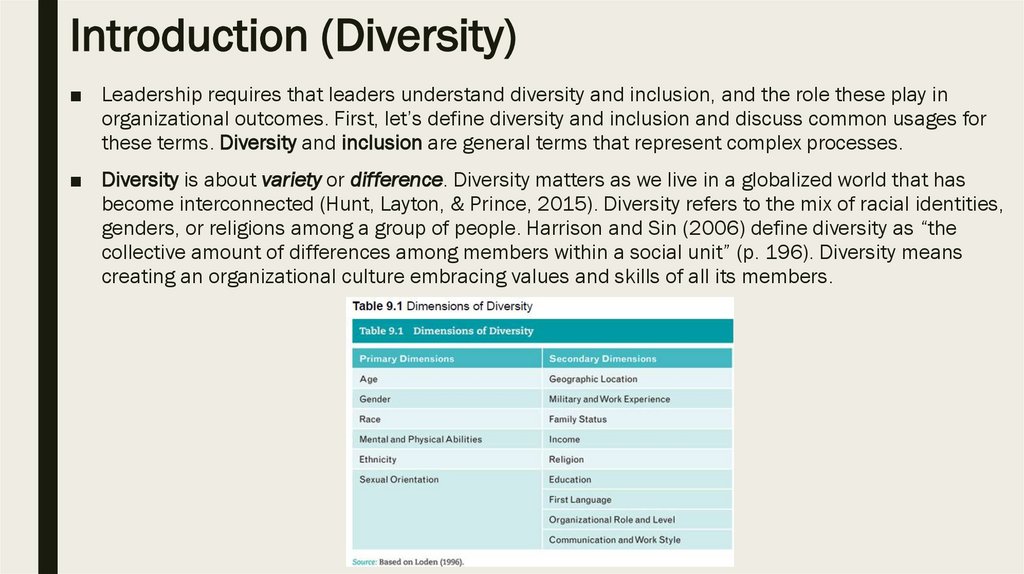
■ Diversity is about variety or difference. Diversity matters as we live in a globalized world that has
become interconnected (Hunt, Layton, & Prince, 2015). Diversity refers to the mix of racial identities,
genders, or religions among a group of people. Harrison and Sin (2006) define diversity as “the
collective amount of differences among members within a social unit” (p. 196). Diversity means
creating an organizational culture embracing values and skills of all its members.
3. Inclusion and Equity
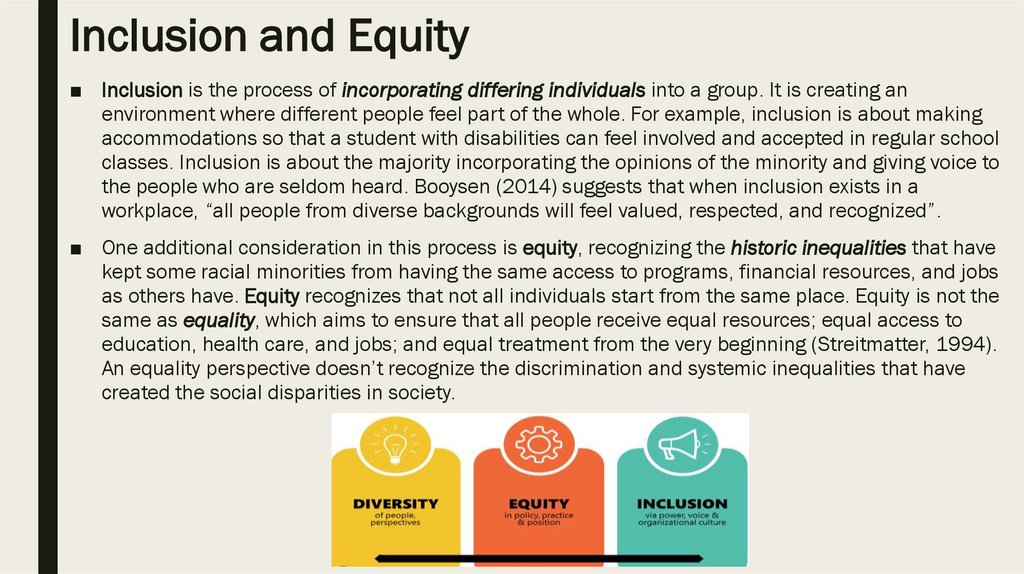
■ Inclusion is the process of incorporating differing individuals into a group. It is creating anenvironment where different people feel part of the whole. For example, inclusion is about making
accommodations so that a student with disabilities can feel involved and accepted in regular school
classes. Inclusion is about the majority incorporating the opinions of the minority and giving voice to
the people who are seldom heard. Booysen (2014) suggests that when inclusion exists in a
workplace, “all people from diverse backgrounds will feel valued, respected, and recognized”.
■ One additional consideration in this process is equity, recognizing the historic inequalities that have
kept some racial minorities from having the same access to programs, financial resources, and jobs
as others have. Equity recognizes that not all individuals start from the same place. Equity is not the
same as equality, which aims to ensure that all people receive equal resources; equal access to
education, health care, and jobs; and equal treatment from the very beginning (Streitmatter, 1994).
An equality perspective doesn’t recognize the discrimination and systemic inequalities that have
created the social disparities in society.
4. Approaches to Diversity
■ In the US, diversity was the basis of its democratic system. The country was originally formed bypeople seeking to escape persecution elsewhere. This ideal of seeking freedom drove to the country
many groups of immigrants, all of whom had different values, traditions, and religions. As the country
evolved, diversity also came to mean addressing the needs of people marginalized in the United
States, including African Americans whose ancestors originally came to the country as slaves as well
as Native Americans who were already living there.
5. Examples
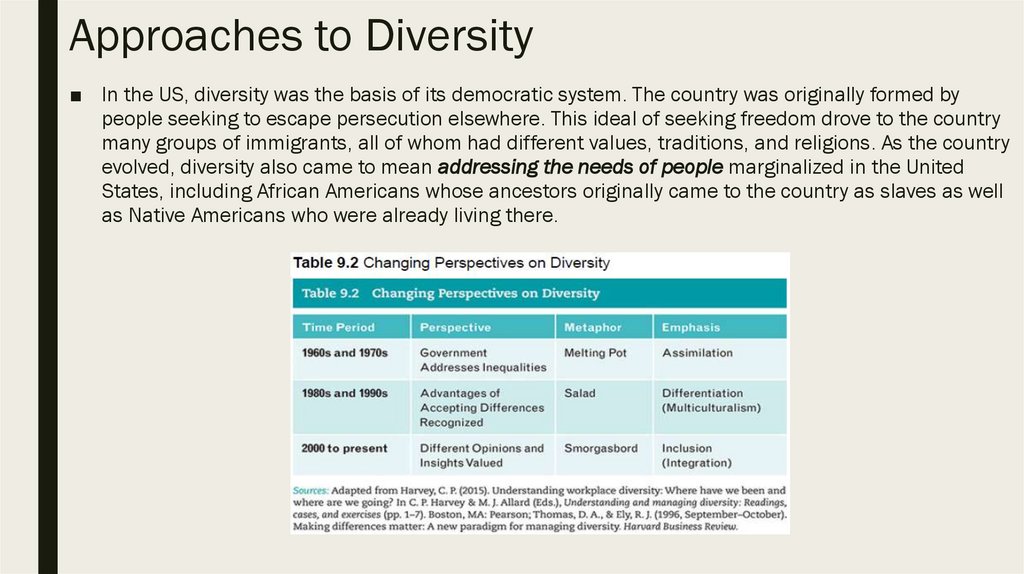
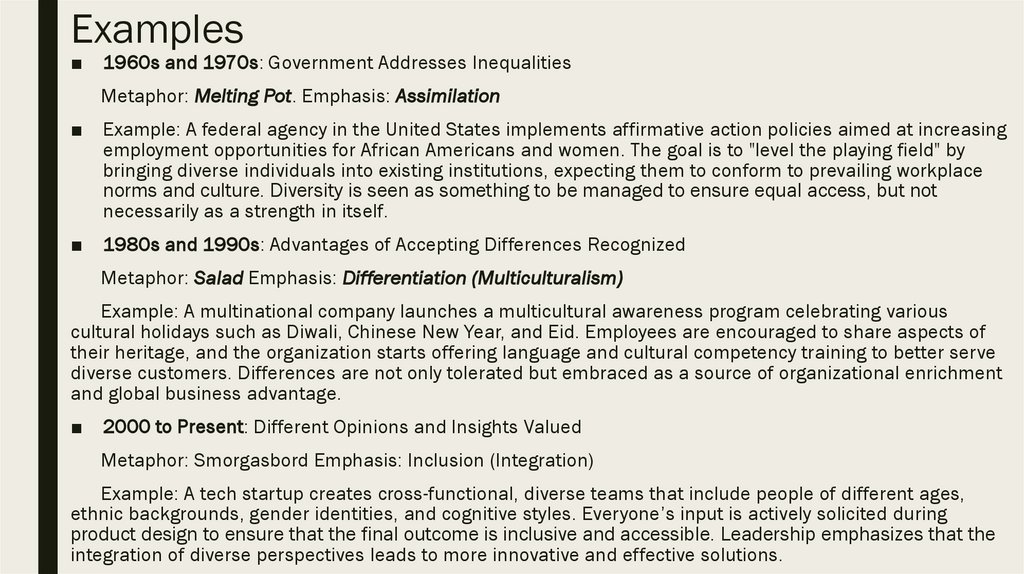
■ 1960s and 1970s: Government Addresses InequalitiesMetaphor: Melting Pot. Emphasis: Assimilation
■ Example: A federal agency in the United States implements affirmative action policies aimed at increasing
employment opportunities for African Americans and women. The goal is to "level the playing field" by
bringing diverse individuals into existing institutions, expecting them to conform to prevailing workplace
norms and culture. Diversity is seen as something to be managed to ensure equal access, but not
necessarily as a strength in itself.
■ 1980s and 1990s: Advantages of Accepting Differences Recognized
Metaphor: Salad Emphasis: Differentiation (Multiculturalism)
Example: A multinational company launches a multicultural awareness program celebrating various
cultural holidays such as Diwali, Chinese New Year, and Eid. Employees are encouraged to share aspects of
their heritage, and the organization starts offering language and cultural competency training to better serve
diverse customers. Differences are not only tolerated but embraced as a source of organizational enrichment
and global business advantage.
■ 2000 to Present: Different Opinions and Insights Valued
Metaphor: Smorgasbord Emphasis: Inclusion (Integration)
Example: A tech startup creates cross-functional, diverse teams that include people of different ages,
ethnic backgrounds, gender identities, and cognitive styles. Everyone’s input is actively solicited during
product design to ensure that the final outcome is inclusive and accessible. Leadership emphasizes that the
integration of diverse perspectives leads to more innovative and effective solutions.
6. INCLUSION FRAMEWORK
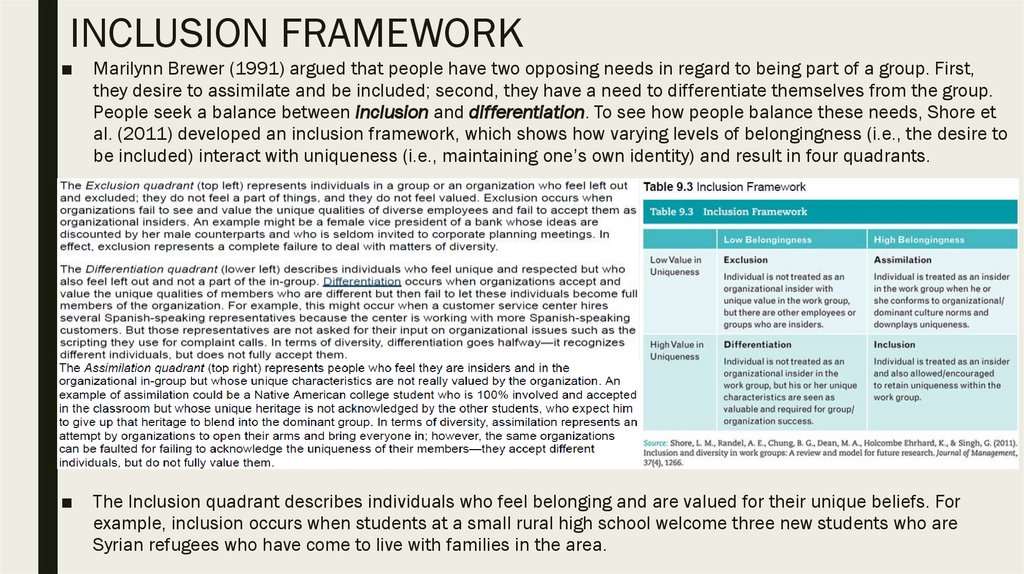
■Marilynn Brewer (1991) argued that people have two opposing needs in regard to being part of a group. First,
they desire to assimilate and be included; second, they have a need to differentiate themselves from the group.
People seek a balance between inclusion and differentiation. To see how people balance these needs, Shore et
al. (2011) developed an inclusion framework, which shows how varying levels of belongingness (i.e., the desire to
be included) interact with uniqueness (i.e., maintaining one’s own identity) and result in four quadrants.
■
The Inclusion quadrant describes individuals who feel belonging and are valued for their unique beliefs. For
example, inclusion occurs when students at a small rural high school welcome three new students who are
Syrian refugees who have come to live with families in the area.
7. The Model of Inclusive Practices
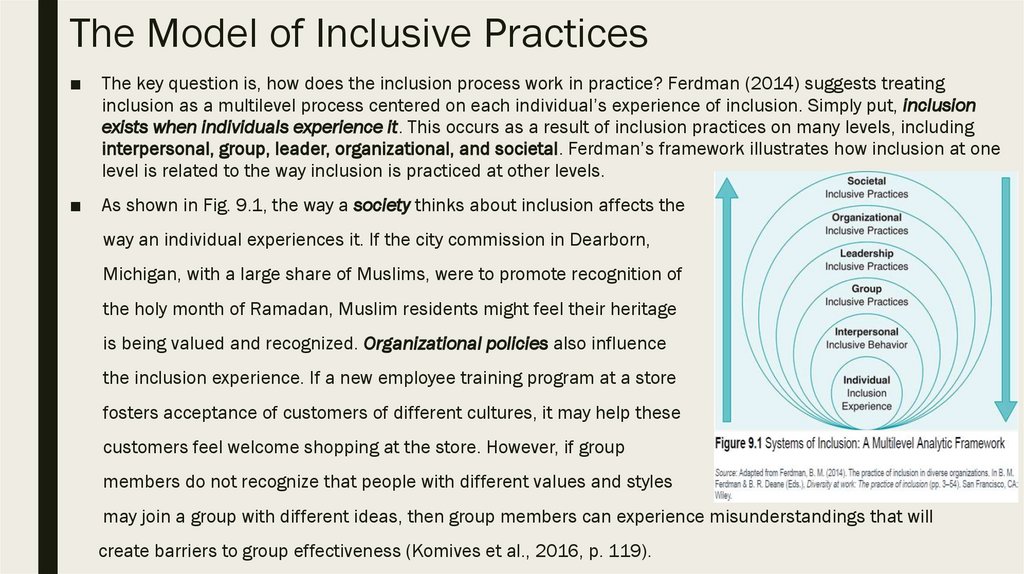
■The key question is, how does the inclusion process work in practice? Ferdman (2014) suggests treating
inclusion as a multilevel process centered on each individual’s experience of inclusion. Simply put, inclusion
exists when individuals experience it. This occurs as a result of inclusion practices on many levels, including
interpersonal, group, leader, organizational, and societal. Ferdman’s framework illustrates how inclusion at one
level is related to the way inclusion is practiced at other levels.
■
As shown in Fig. 9.1, the way a society thinks about inclusion affects the
way an individual experiences it. If the city commission in Dearborn,
Michigan, with a large share of Muslims, were to promote recognition of
the holy month of Ramadan, Muslim residents might feel their heritage
is being valued and recognized. Organizational policies also influence
the inclusion experience. If a new employee training program at a store
fosters acceptance of customers of different cultures, it may help these
customers feel welcome shopping at the store. However, if group
members do not recognize that people with different values and styles
may join a group with different ideas, then group members can experience misunderstandings that will
create barriers to group effectiveness (Komives et al., 2016, p. 119).
8. Barriers to Embracing Diversity and Inclusion
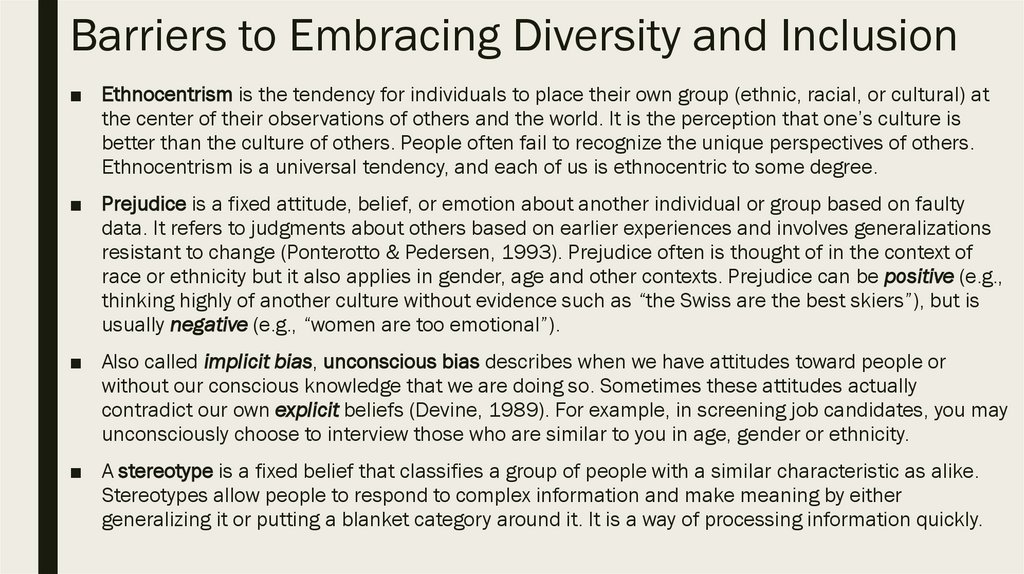
■ Ethnocentrism is the tendency for individuals to place their own group (ethnic, racial, or cultural) atthe center of their observations of others and the world. It is the perception that one’s culture is
better than the culture of others. People often fail to recognize the unique perspectives of others.
Ethnocentrism is a universal tendency, and each of us is ethnocentric to some degree.
■ Prejudice is a fixed attitude, belief, or emotion about another individual or group based on faulty
data. It refers to judgments about others based on earlier experiences and involves generalizations
resistant to change (Ponterotto & Pedersen, 1993). Prejudice often is thought of in the context of
race or ethnicity but it also applies in gender, age and other contexts. Prejudice can be positive (e.g.,
thinking highly of another culture without evidence such as “the Swiss are the best skiers”), but is
usually negative (e.g., “women are too emotional”).
■ Also called implicit bias, unconscious bias describes when we have attitudes toward people or
without our conscious knowledge that we are doing so. Sometimes these attitudes actually
contradict our own explicit beliefs (Devine, 1989). For example, in screening job candidates, you may
unconsciously choose to interview those who are similar to you in age, gender or ethnicity.
■ A stereotype is a fixed belief that classifies a group of people with a similar characteristic as alike.
Stereotypes allow people to respond to complex information and make meaning by either
generalizing it or putting a blanket category around it. It is a way of processing information quickly.