

 english
Similar presentations:








Reported Speech: affirmative sentences, general and wh-questions, imperative mood
1. Reported Speech: affirmative sentences, general and wh-questions, imperative mood
2. Reported Speech
• Direct speech (прямаяречь)
• She says: “I phone my
friends every day”
• Если глагол, который
вводит прямую речь
стоит в настоящем
времени, то в
косвенной речи время
глагола не будет
меняться
• Reported Speech
(Косвенная речь)
• She says (that) she
phones her friends
every day
3. Study the examples:
John said: “I live in New York” → John said (that) helived in New York.
Bob said: “I am learning French” → Bob said he was
learning French.
Ann said: “Jack came home” → Ann said Jack had come
home.
Fred said: “I have done it.” → Fred said he had done it.
Bob said: “I will drive a car.” → Bob said he would drive
a car .
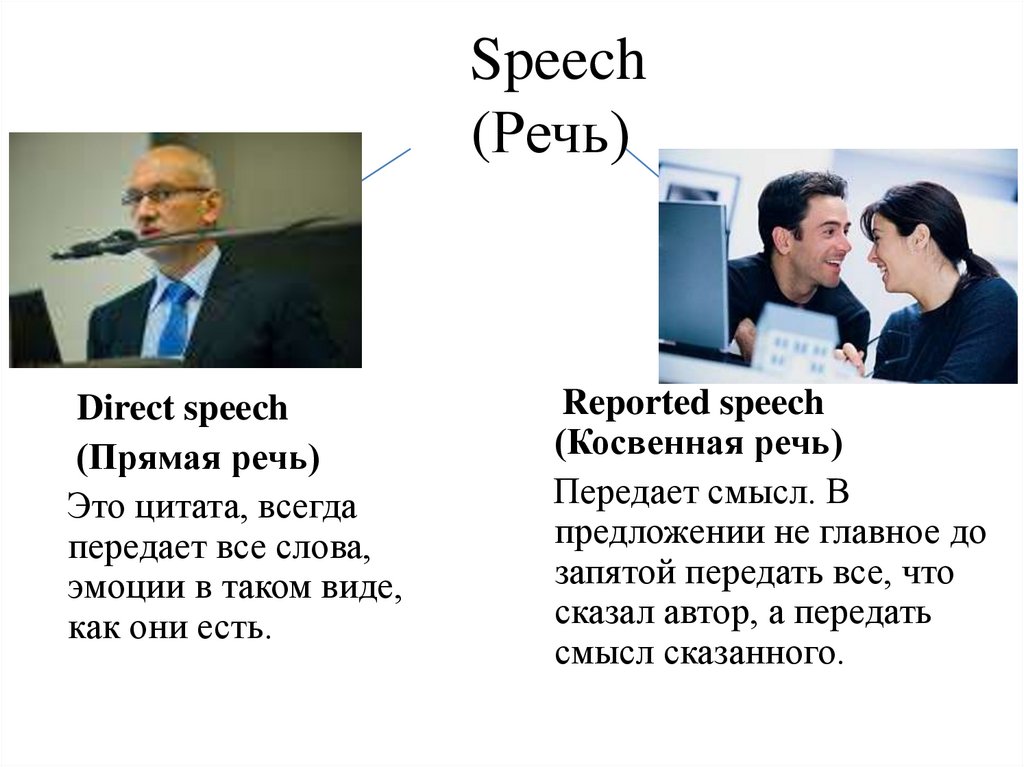
4. Speech (Речь)
Direct speech(Прямая речь)
Это цитата, всегда
передает все слова,
эмоции в таком виде,
как они есть.
Reported speech
(Косвенная речь)
Передает смысл. В
предложении не главное до
запятой передать все, что
сказал автор, а передать
смысл сказанного.
5. Reported Speech
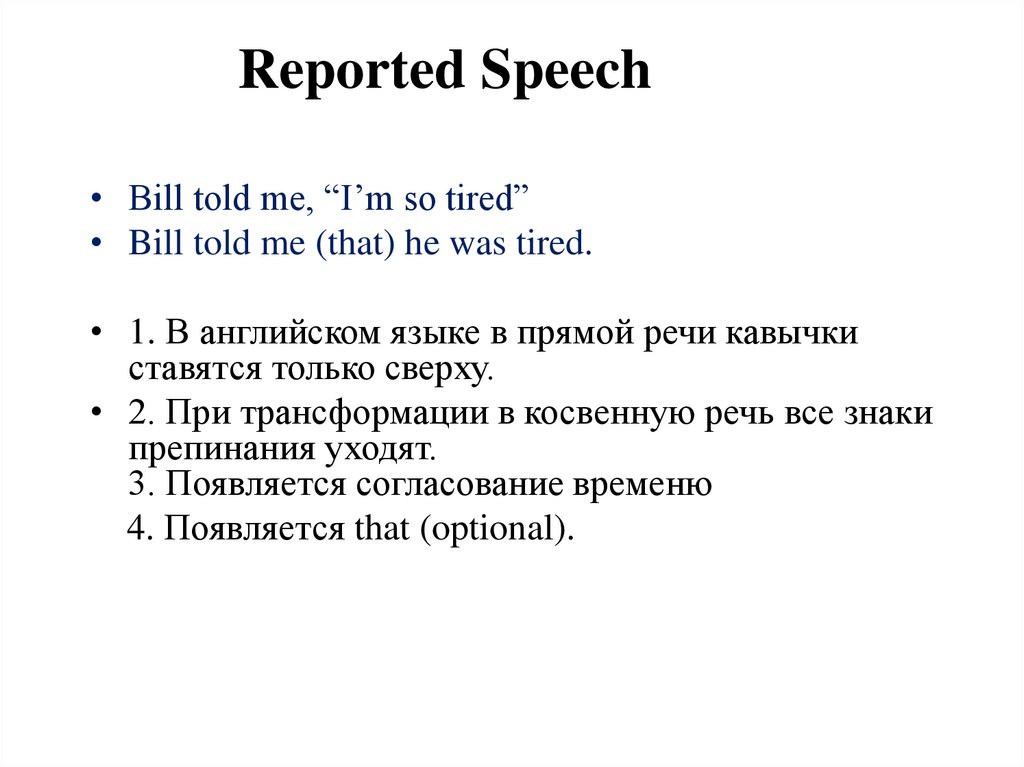
• Bill told me, “I’m so tired”• Bill told me (that) he was tired.
• 1. В английском языке в прямой речи кавычки
ставятся только сверху.
• 2. При трансформации в косвенную речь все знаки
препинания уходят.
3. Появляется согласование временю
4. Появляется that (optional).
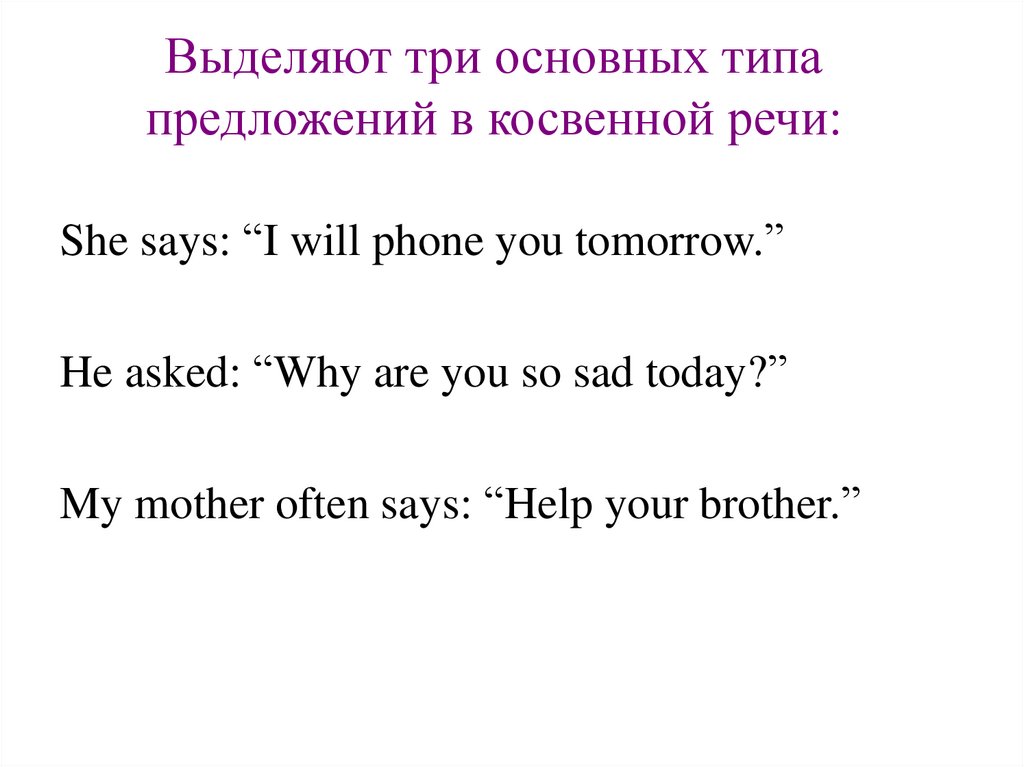
6. Выделяют три основных типа предложений в косвенной речи:
She says: “I will phone you tomorrow.”He asked: “Why are you so sad today?”
My mother often says: “Help your brother.”
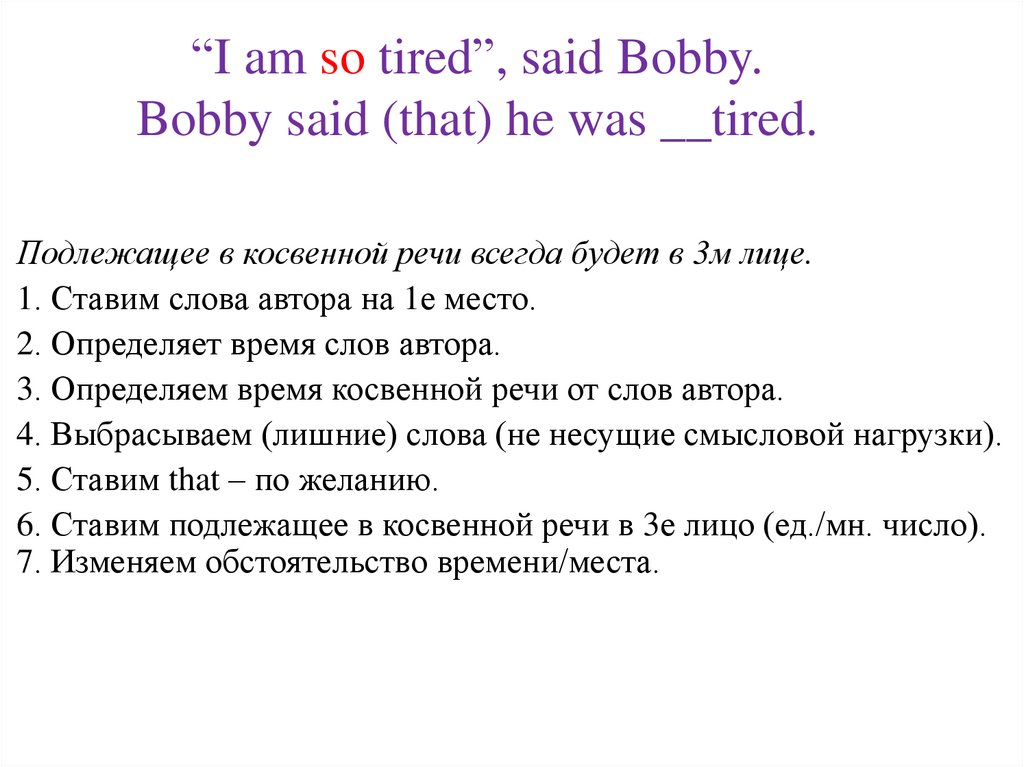
7. “I am so tired”, said Bobby. Bobby said (that) he was __tired.
Подлежащее в косвенной речи всегда будет в 3м лице.1. Ставим слова автора на 1е место.
2. Определяет время слов автора.
3. Определяем время косвенной речи от слов автора.
4. Выбрасываем (лишние) слова (не несущие смысловой нагрузки).
5. Ставим that – по желанию.
6. Ставим подлежащее в косвенной речи в 3е лицо (ед./мн. число).
7. Изменяем обстоятельство времени/места.
8.
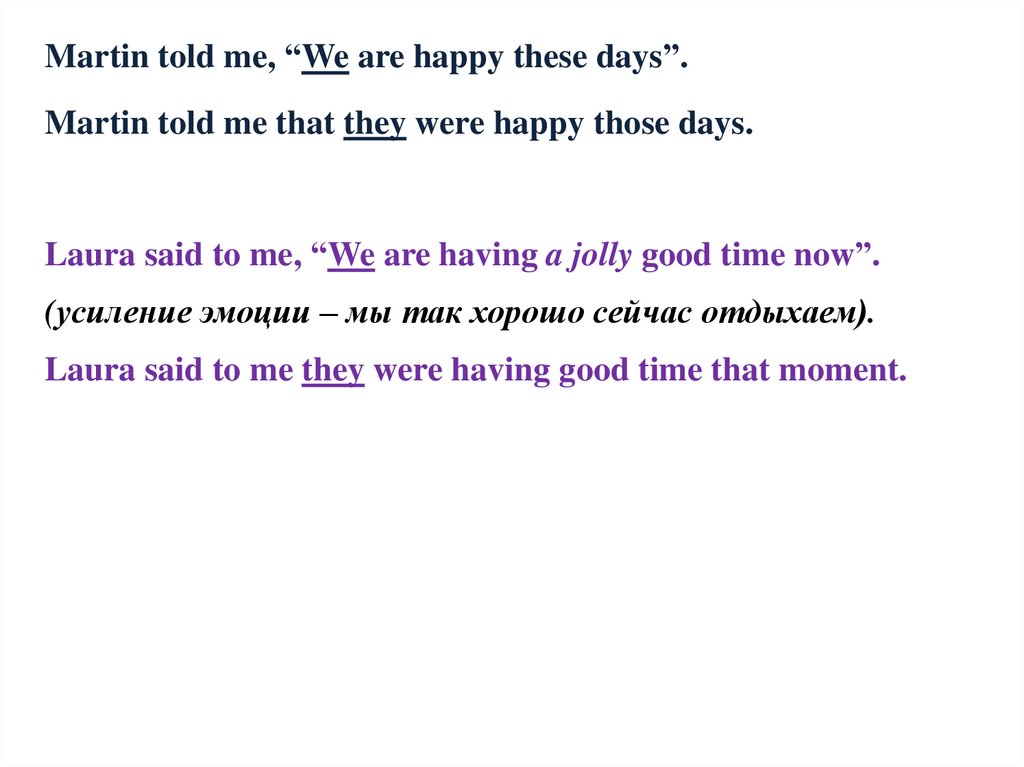
Martin told me, “We are happy these days”.Martin told me that they were happy those days.
Laura said to me, “We are having a jolly good time now”.
(усиление эмоции – мы так хорошо сейчас отдыхаем).
Laura said to me they were having good time that moment.
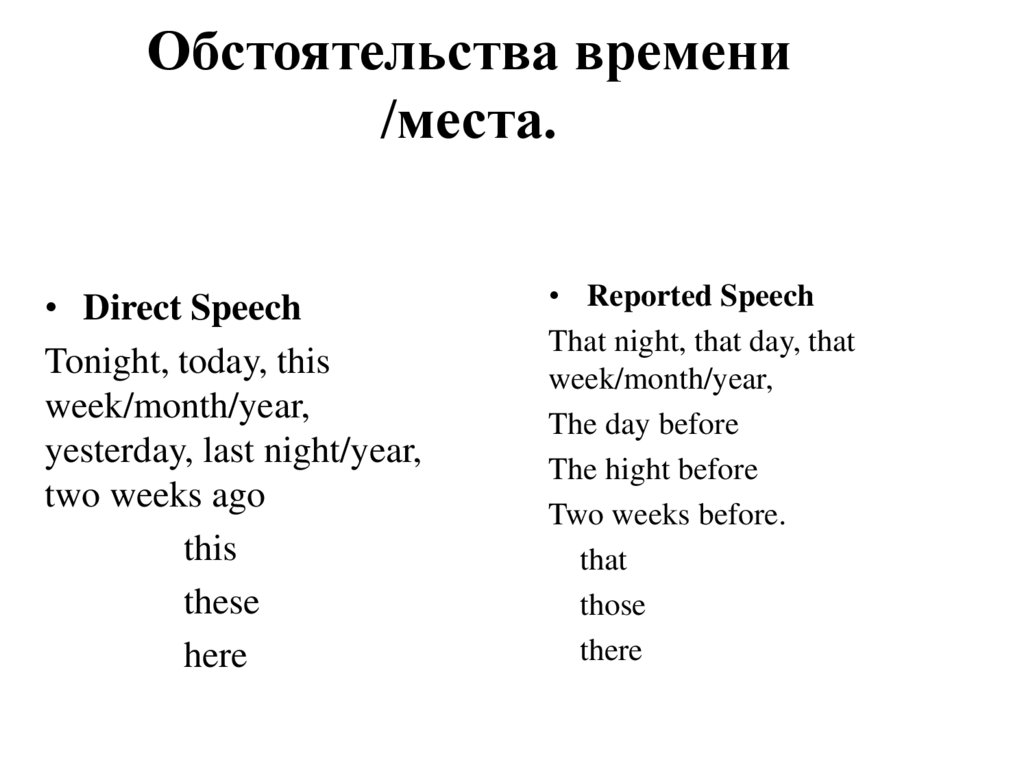
9. Обстоятельства времени /места.
• Direct SpeechTonight, today, this
week/month/year,
yesterday, last night/year,
two weeks ago
this
these
here
• Reported Speech
That night, that day, that
week/month/year,
The day before
The hight before
Two weeks before.
that
those
there
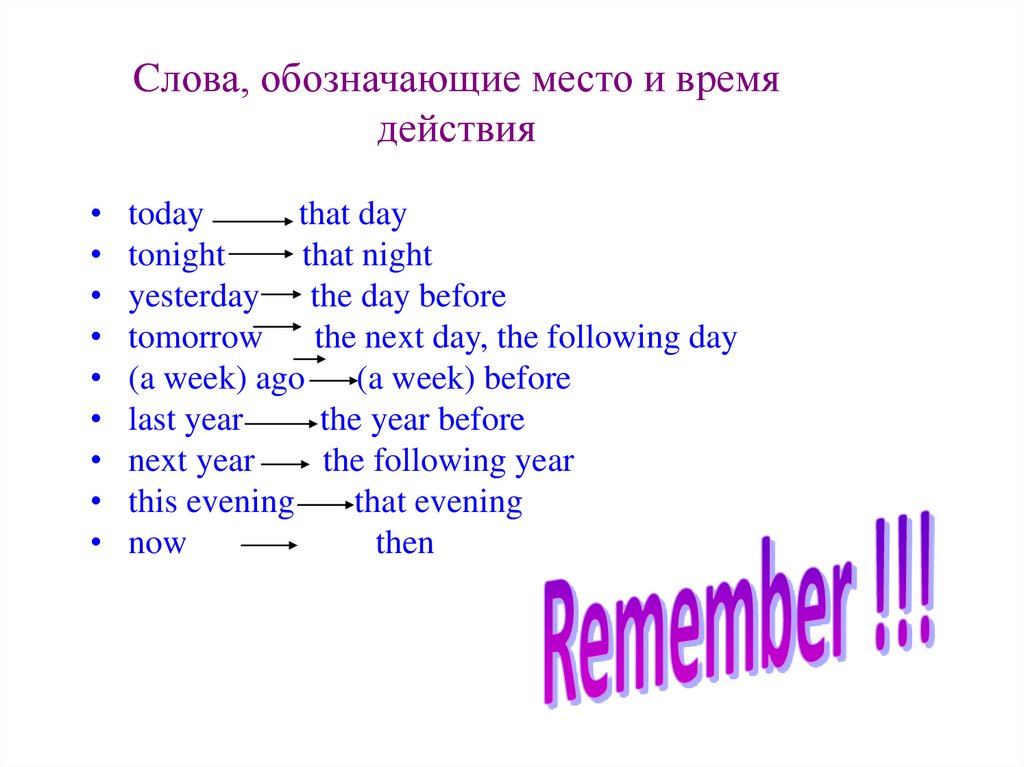
10. Cлова, обозначающие место и время действия
today
that day
tonight
that night
yesterday the day before
tomorrow
the next day, the following day
(a week) ago (a week) before
last year
the year before
next year
the following year
this evening
that evening
now
then
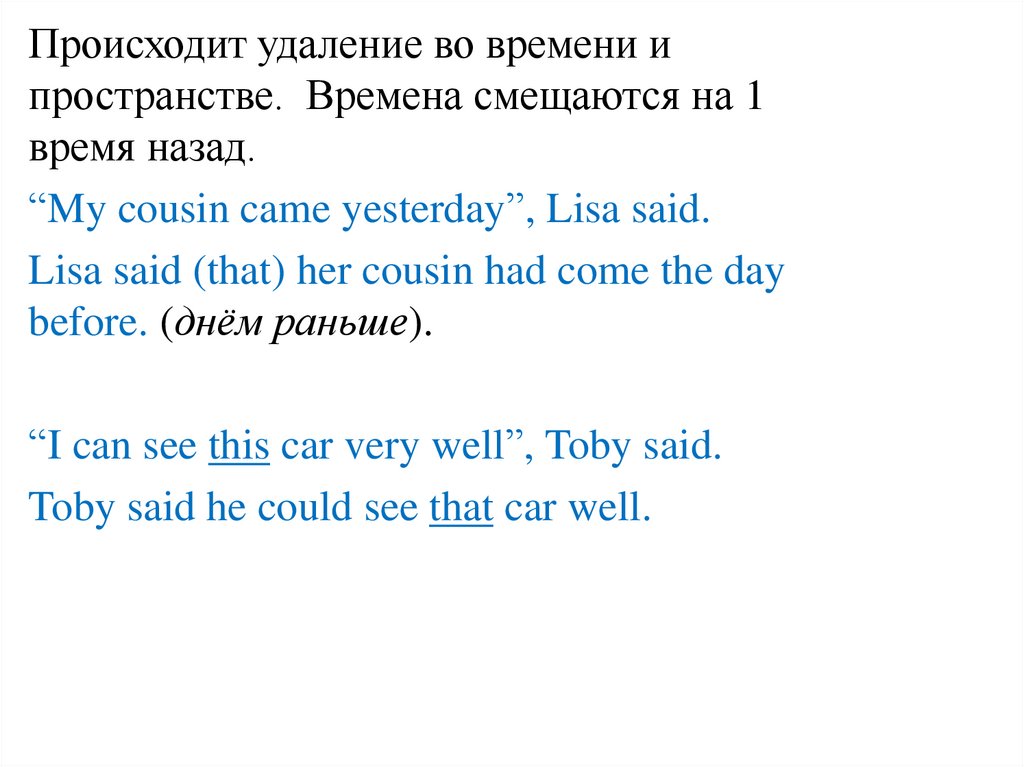
11.
Происходит удаление во времени ипространстве. Времена смещаются на 1
время назад.
“My cousin came yesterday”, Lisa said.
Lisa said (that) her cousin had come the day
before. (днём раньше).
“I can see this car very well”, Toby said.
Toby said he could see that car well.
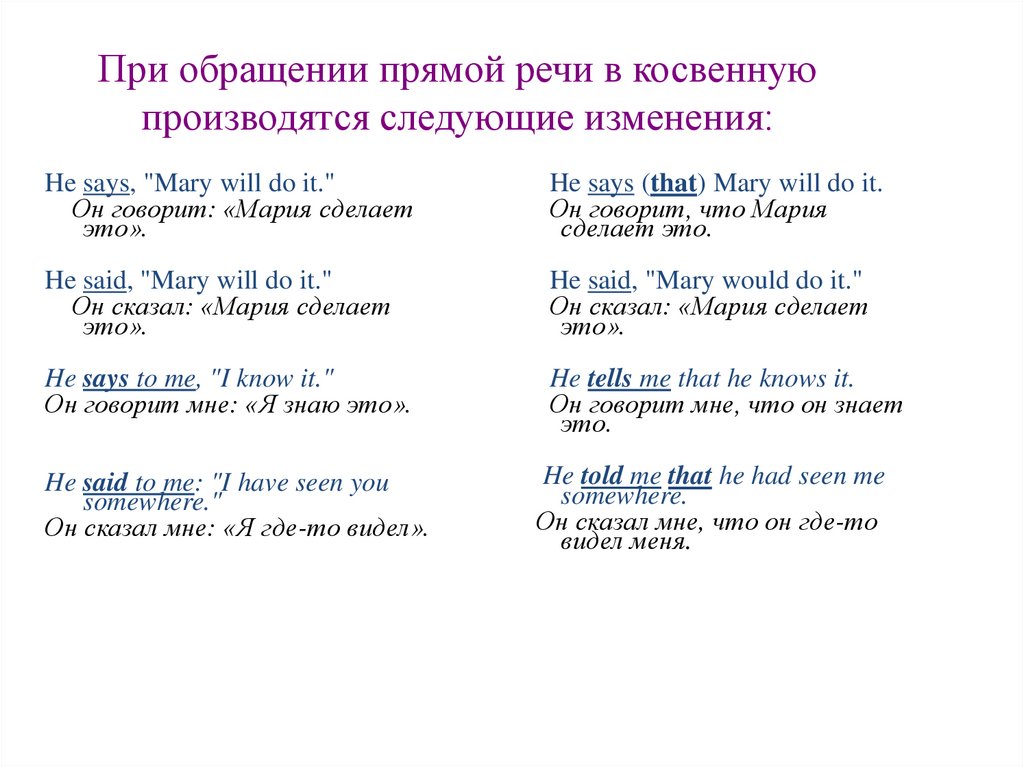
12. При обращении прямой речи в косвенную производятся следующие изменения:
He says, "Mary will do it."Он говорит: «Мария сделает
это».
He says (that) Mary will do it.
Он говорит, что Мария
сделает это.
He said, "Mary will do it."
Он сказал: «Мария сделает
это».
He said, "Mary would do it."
Он сказал: «Мария сделает
это».
He says to me, "I know it."
Он говорит мне: «Я знаю это».
He tells me that he knows it.
Он говорит мне, что он знает
это.
He said to me: "I have seen you
somewhere."
Он сказал мне: «Я где-то видел».
He told me that he had seen me
somewhere.
Он сказал мне, что он где-то
видел меня.
13.
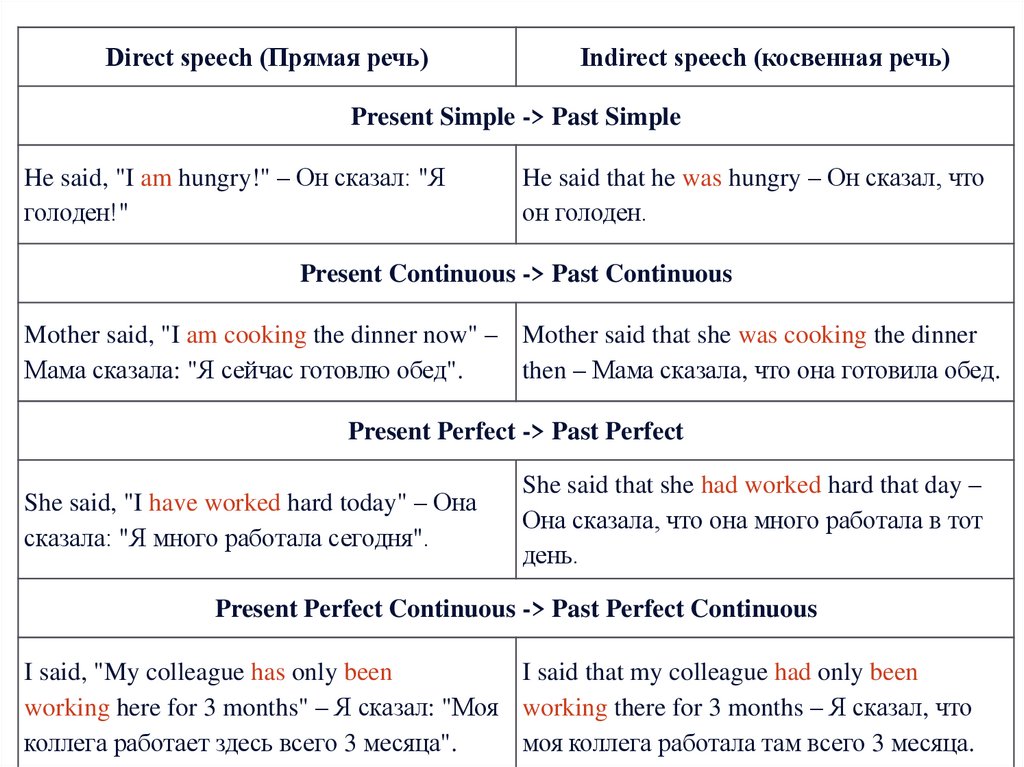
Direct speech (Прямая речь)Indirect speech (косвенная речь)
Present Simple -> Past Simple
He said, "I am hungry!" – Он сказал: "Я
голоден!"
He said that he was hungry – Он сказал, что
он голоден.
Present Continuous -> Past Continuous
Mother said, "I am cooking the dinner now" – Mother said that she was cooking the dinner
Мама сказала: "Я сейчас готовлю обед".
then – Мама сказала, что она готовила обед.
Present Perfect -> Past Perfect
She said, "I have worked hard today" – Она
сказала: "Я много работала сегодня".
She said that she had worked hard that day –
Она сказала, что она много работала в тот
день.
Present Perfect Continuous -> Past Perfect Continuous
I said, "My colleague has only been
I said that my colleague had only been
working here for 3 months" – Я сказал: "Моя working there for 3 months – Я сказал, что
коллега работает здесь всего 3 месяца".
моя коллега работала там всего 3 месяца.
14.
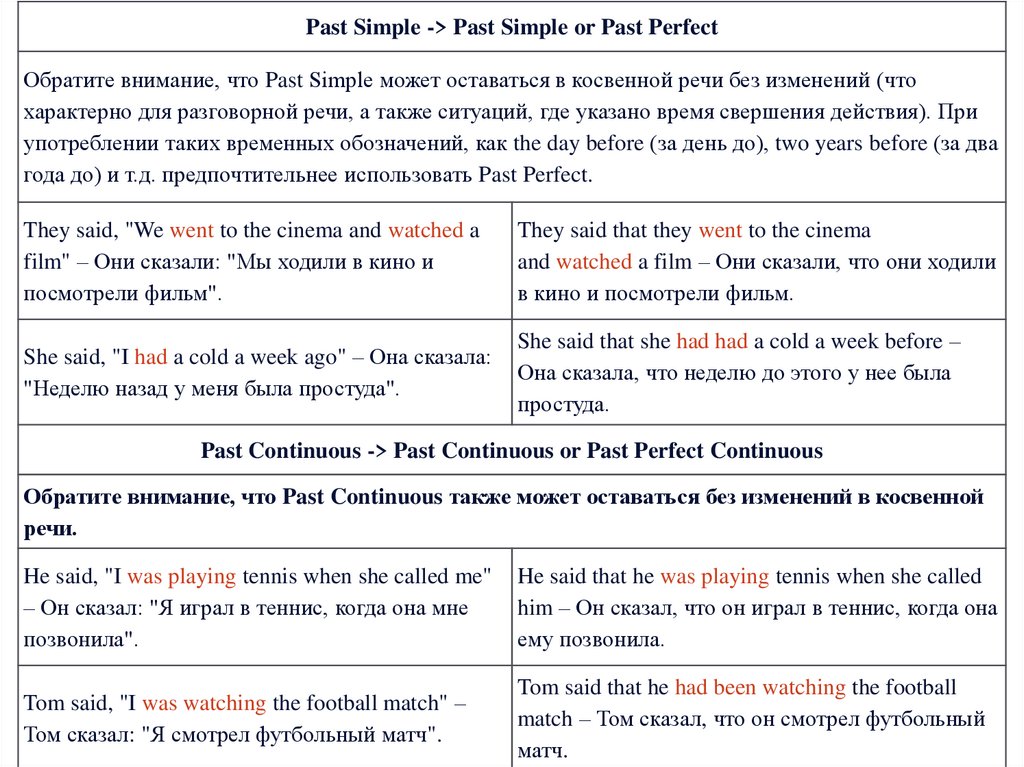
Past Simple -> Past Simple or Past PerfectОбратите внимание, что Past Simple может оставаться в косвенной речи без изменений (что
характерно для разговорной речи, а также ситуаций, где указано время свершения действия). При
употреблении таких временных обозначений, как the day before (за день до), two years before (за два
года до) и т.д. предпочтительнее использовать Past Perfect.
They said, "We went to the cinema and watched a
film" – Они сказали: "Мы ходили в кино и
посмотрели фильм".
They said that they went to the cinema
and watched a film – Они сказали, что они ходили
в кино и посмотрели фильм.
She said, "I had a cold a week ago" – Она сказала:
"Неделю назад у меня была простуда".
She said that she had had a cold a week before –
Она сказала, что неделю до этого у нее была
простуда.
Past Continuous -> Past Continuous or Past Perfect Continuous
Обратите внимание, что Past Continuous также может оставаться без изменений в косвенной
речи.
He said, "I was playing tennis when she called me"
– Он сказал: "Я играл в теннис, когда она мне
позвонила".
He said that he was playing tennis when she called
him – Он сказал, что он играл в теннис, когда она
ему позвонила.
Tom said, "I was watching the football match" –
Том сказал: "Я смотрел футбольный матч".
Tom said that he had been watching the football
match – Том сказал, что он смотрел футбольный
матч.
15.
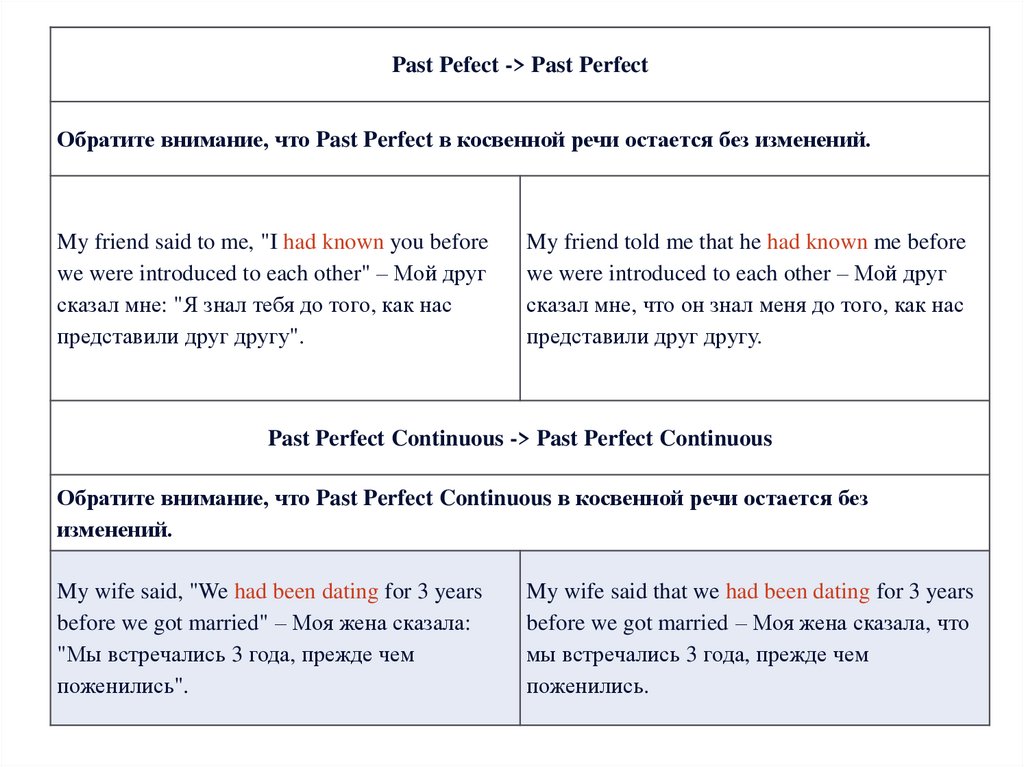
Past Pefect -> Past PerfectОбратите внимание, что Past Perfect в косвенной речи остается без изменений.
My friend said to me, "I had known you before
we were introduced to each other" – Мой друг
сказал мне: "Я знал тебя до того, как нас
представили друг другу".
My friend told me that he had known me before
we were introduced to each other – Мой друг
сказал мне, что он знал меня до того, как нас
представили друг другу.
Past Perfect Continuous -> Past Perfect Continuous
Обратите внимание, что Past Perfect Continuous в косвенной речи остается без
изменений.
My wife said, "We had been dating for 3 years
before we got married" – Моя жена сказала:
"Мы встречались 3 года, прежде чем
поженились".
My wife said that we had been dating for 3 years
before we got married – Моя жена сказала, что
мы встречались 3 года, прежде чем
поженились.
16.
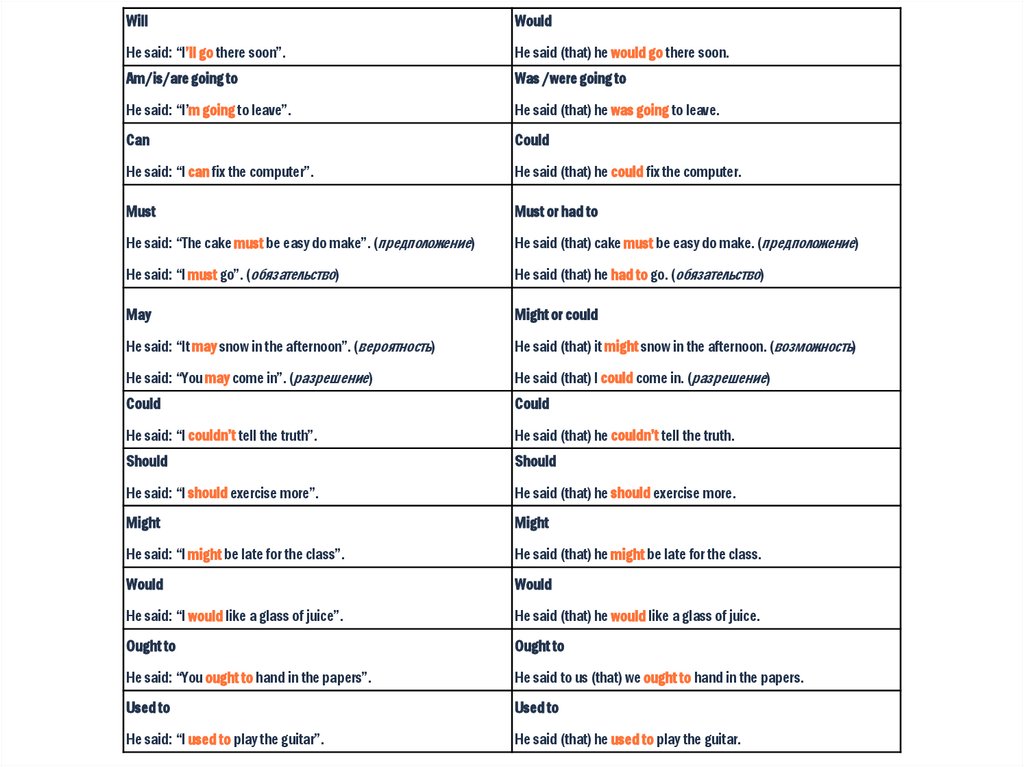
WillWould
He said: “I’ll go there soon”.
He said (that) he would go there soon.
Am/is/are going to
Was /were going to
He said: “I’m going to leave”.
He said (that) he was going to leave.
Can
Could
He said: “I can fix the computer”.
He said (that) he could fix the computer.
Must
Must or had to
He said: “The cake must be easy do make”. (предположение)
He said (that) cake must be easy do make. (предположение)
He said: “I must go”. (обязательство)
He said (that) he had to go. (обязательство)
May
Might or could
He said: “It may snow in the afternoon”. (вероятность)
He said (that) it might snow in the afternoon. (возможность)
He said: “You may come in”. (разрешение)
He said (that) I could come in. (разрешение)
Could
Could
He said: “I couldn’t tell the truth”.
He said (that) he couldn’t tell the truth.
Should
Should
He said: “I should exercise more”.
He said (that) he should exercise more.
Might
Might
He said: “I might be late for the class”.
He said (that) he might be late for the class.
Would
Would
He said: “I would like a glass of juice”.
He said (that) he would like a glass of juice.
Ought to
Ought to
He said: “You ought to hand in the papers”.
He said to us (that) we ought to hand in the papers.
Used to
Used to
He said: “I used to play the guitar”.
He said (that) he used to play the guitar.
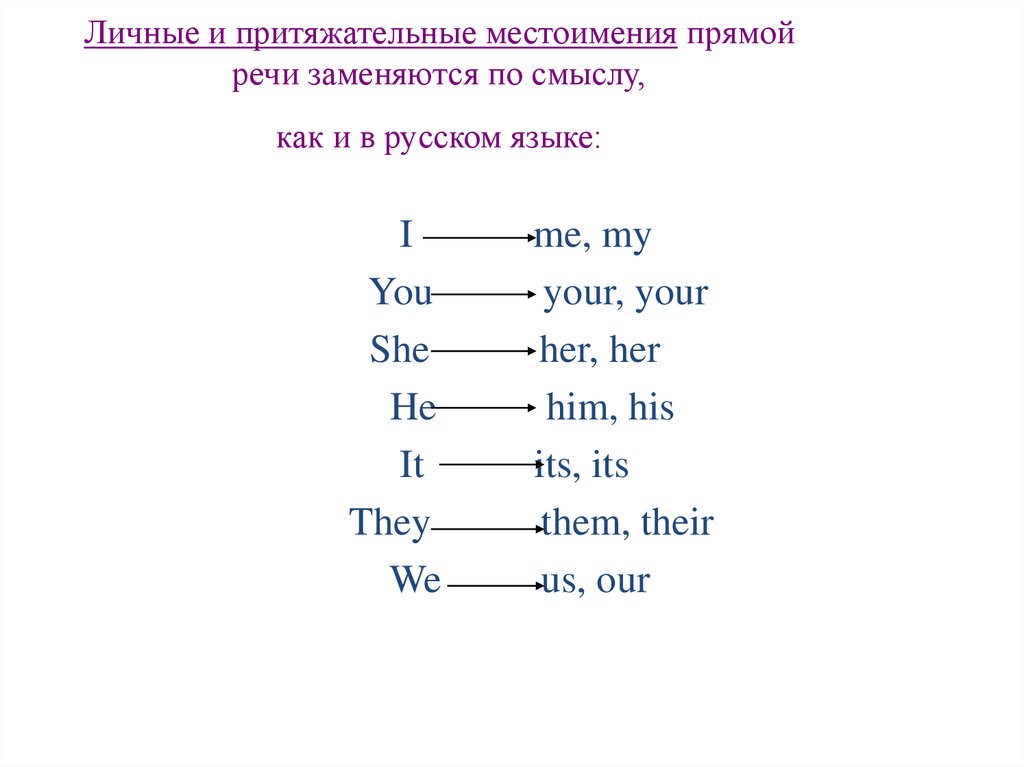
17. Личные и притяжательные местоимения прямой речи заменяются по смыслу, как и в русском языке:
IYou
She
He
It
They
We
me, my
your, your
her, her
him, his
its, its
them, their
us, our
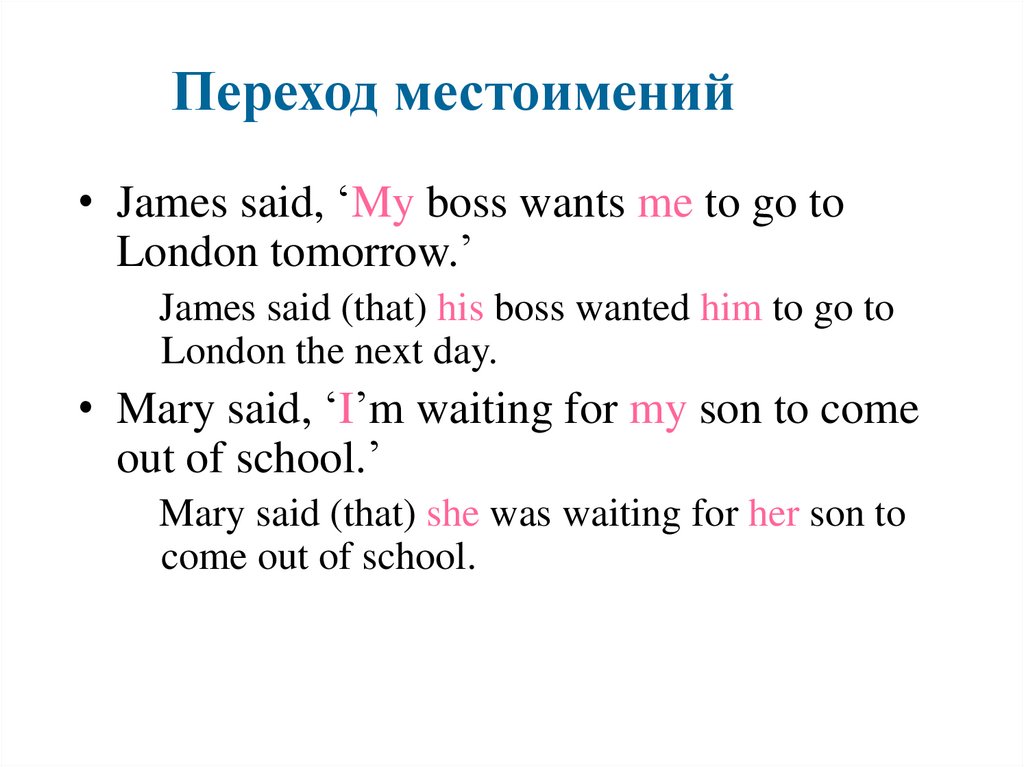
18. Переход местоимений
• James said, ‘My boss wants me to go toLondon tomorrow.’
James said (that) his boss wanted him to go to
London the next day.
• Mary said, ‘I’m waiting for my son to come
out of school.’
Mary said (that) she was waiting for her son to
come out of school.
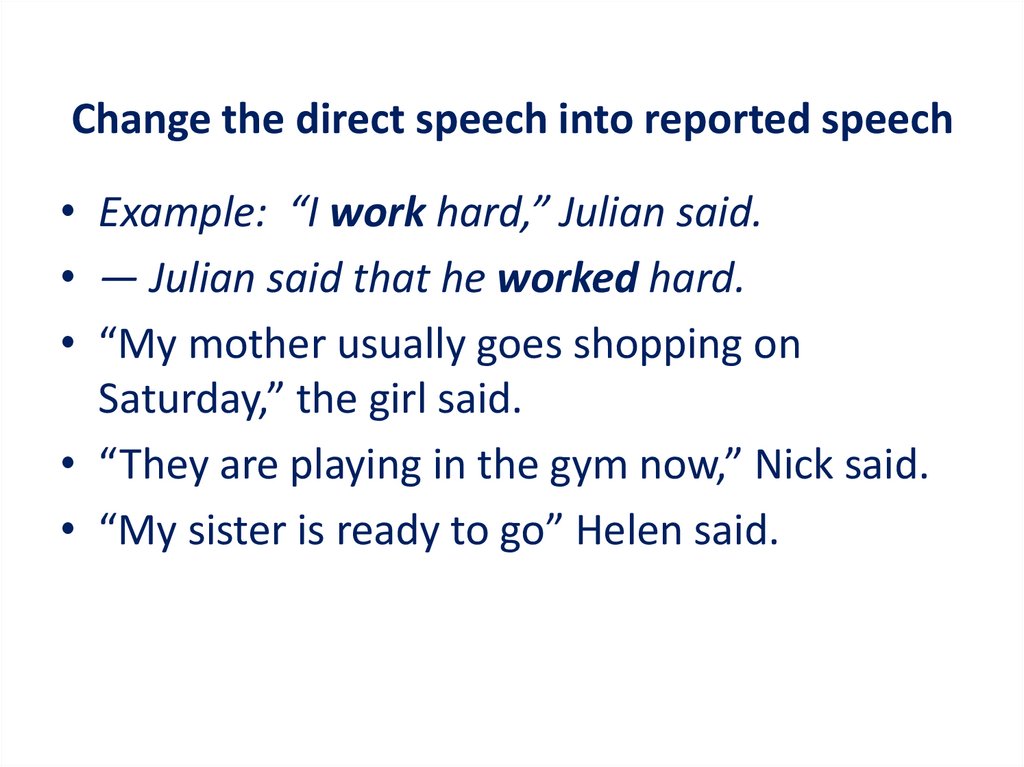
19. Change the direct speech into reported speech
• Example: “I work hard,” Julian said.• — Julian said that he worked hard.
• “My mother usually goes shopping on
Saturday,” the girl said.
• “They are playing in the gym now,” Nick said.
• “My sister is ready to go” Helen said.
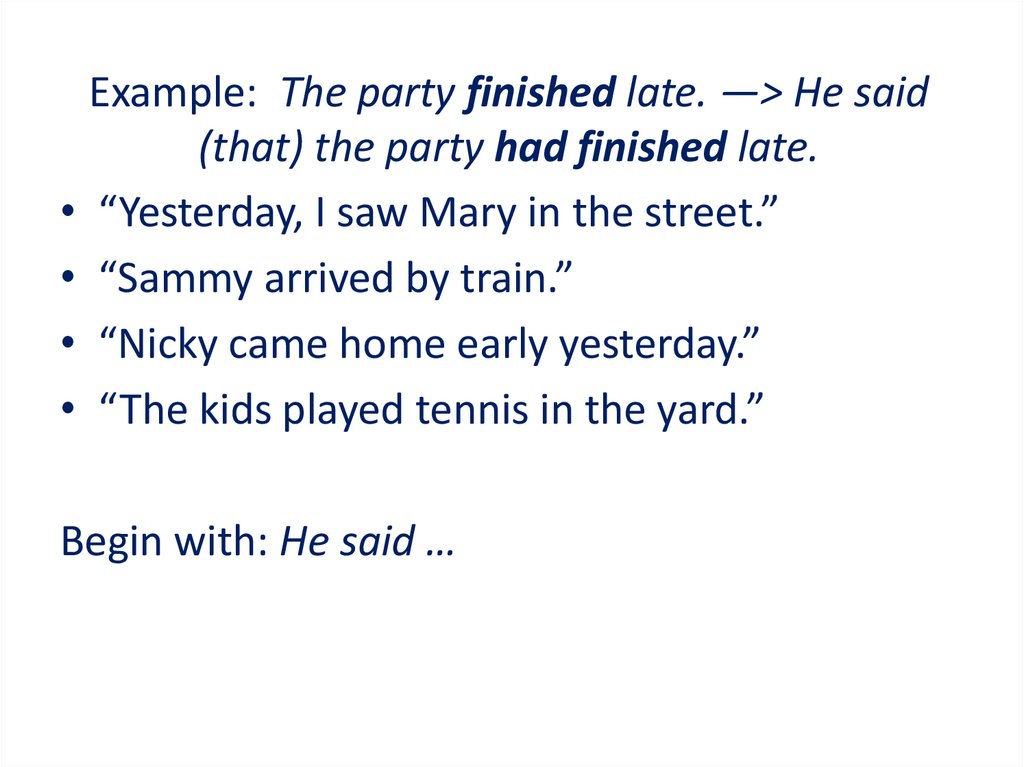
20. Example: The party finished late. —> He said (that) the party had finished late.
Example: The party finished late. —> He said(that) the party had finished late.
• “Yesterday, I saw Mary in the street.”
• “Sammy arrived by train.”
• “Nicky came home early yesterday.”
• “The kids played tennis in the yard.”
Begin with: He said …
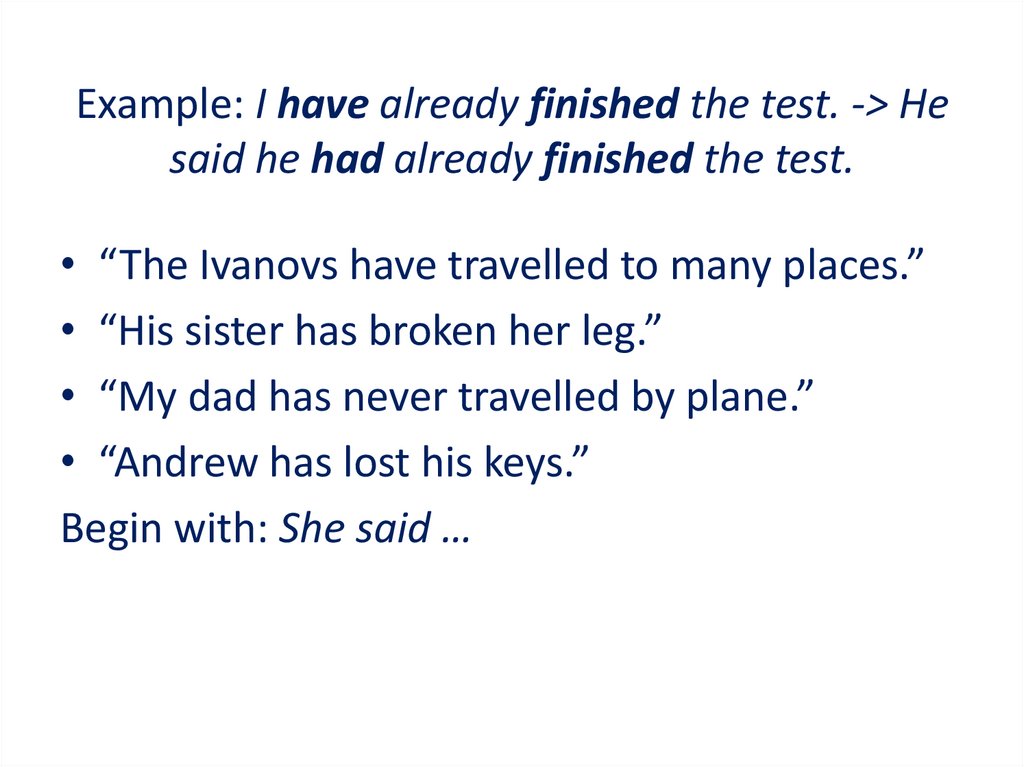
21. Example: I have already finished the test. -> He said he had already finished the test.
Example: I have already finished the test. -> Hesaid he had already finished the test.
• “The Ivanovs have travelled to many places.”
• “His sister has broken her leg.”
• “My dad has never travelled by plane.”
• “Andrew has lost his keys.”
Begin with: She said …
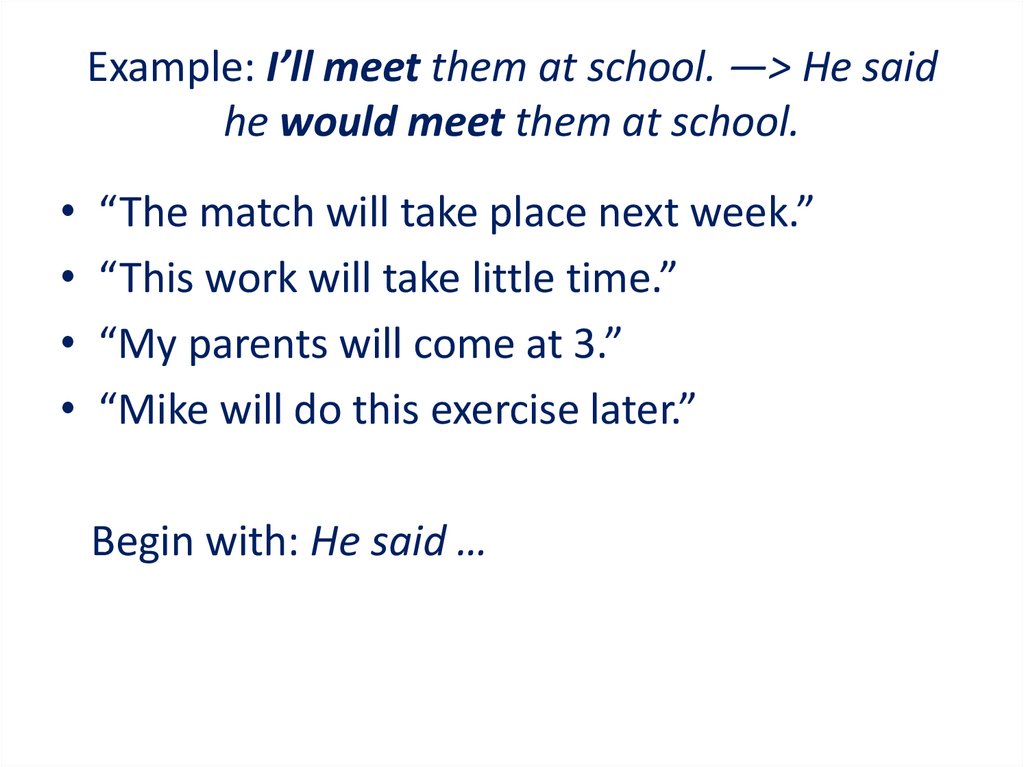
22. Example: I’ll meet them at school. —> He said he would meet them at school.
Example: I’ll meet them at school. —> He saidhe would meet them at school.
• “The match will take place next week.”
• “This work will take little time.”
• “My parents will come at 3.”
• “Mike will do this exercise later.”
Begin with: He said …
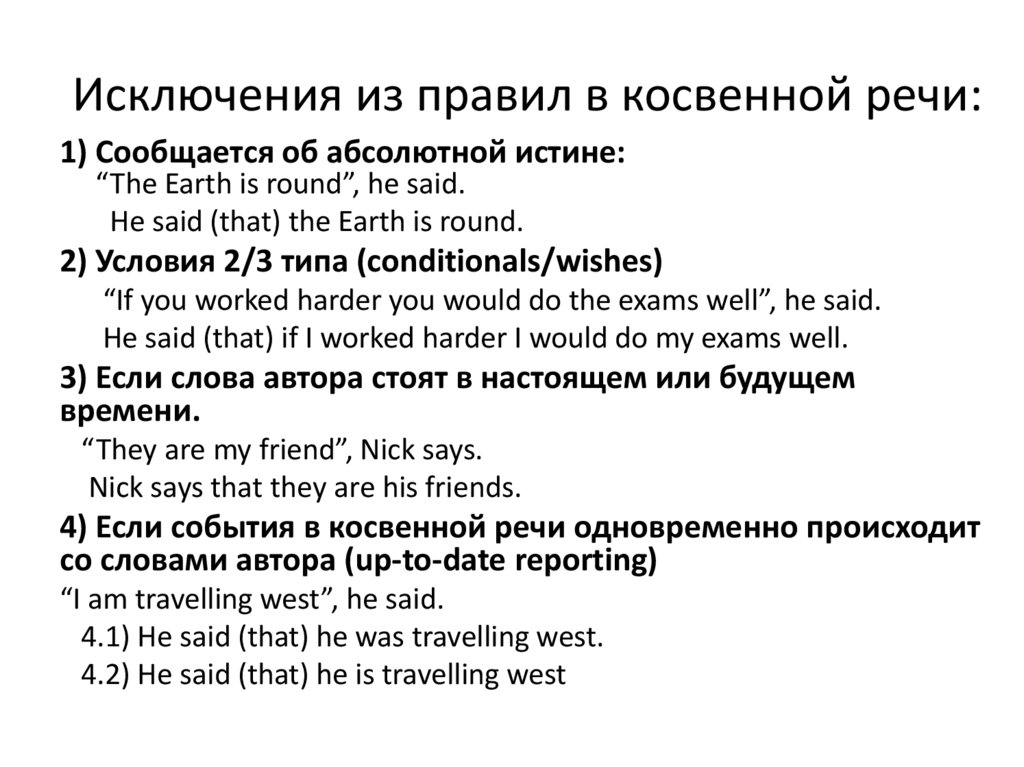
23. Исключения из правил в косвенной речи:
1) Сообщается об абсолютной истине:“The Earth is round”, he said.
He said (that) the Earth is round.
2) Условия 2/3 типа (conditionals/wishes)
“If you worked harder you would do the exams well”, he said.
He said (that) if I worked harder I would do my exams well.
3) Если слова автора стоят в настоящем или будущем
времени.
“They are my friend”, Nick says.
Nick says that they are his friends.
4) Если события в косвенной речи одновременно происходит
со словами автора (up-to-date reporting)
“I am travelling west”, he said.
4.1) He said (that) he was travelling west.
4.2) He said (that) he is travelling west
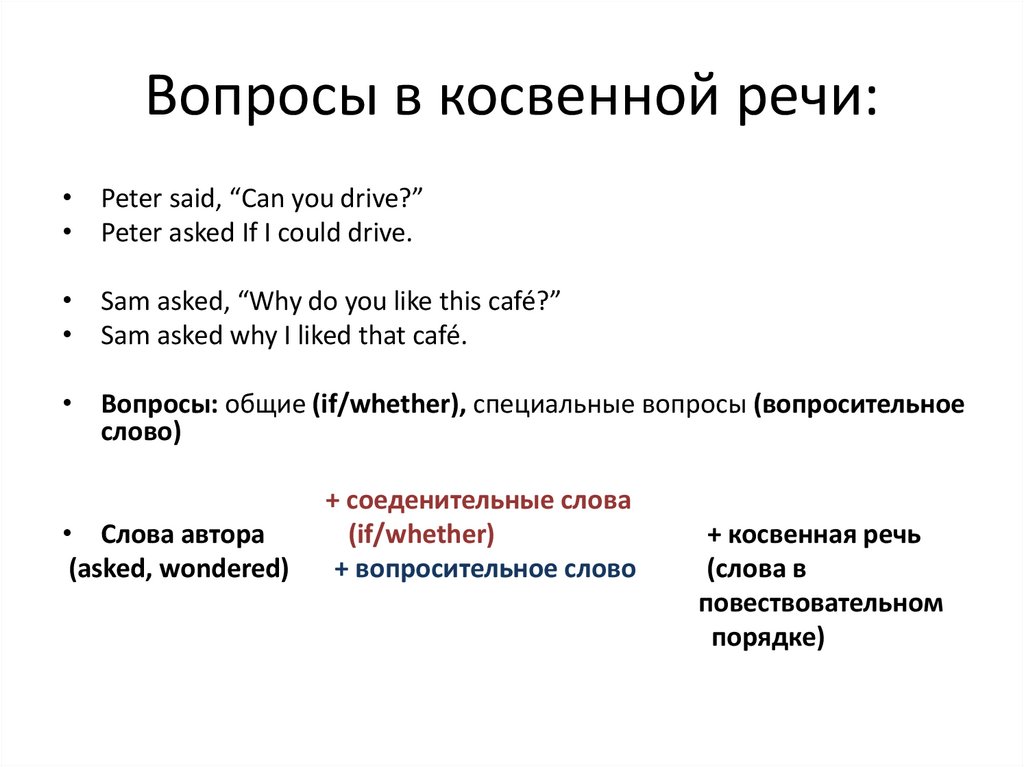
24. Вопросы в косвенной речи:
• Peter said, “Can you drive?”• Peter asked If I could drive.
• Sam asked, “Why do you like this café?”
• Sam asked why I liked that café.
• Вопросы: общие (if/whether), специальные вопросы (вопросительное
слово)
• Слова автора
(asked, wondered)
+ соеденительные слова
(if/whether)
+ вопросительное слово
+ косвенная речь
(слова в
повествовательном
порядке)
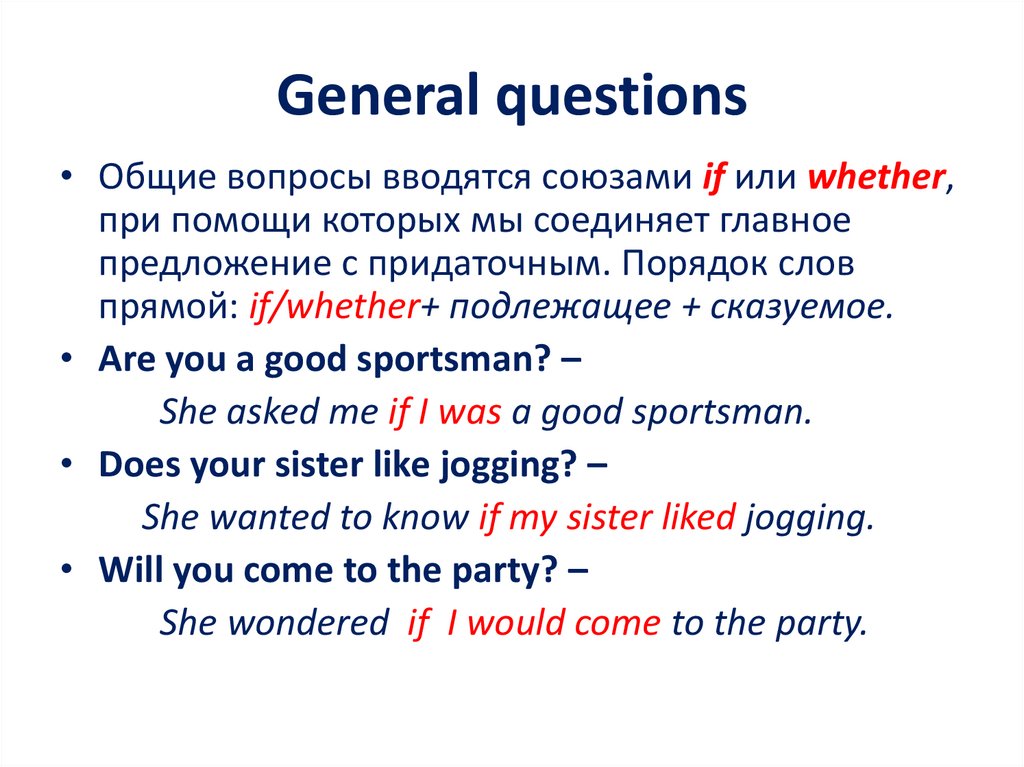
25. General questions
• Общие вопросы вводятся союзами if или whether,при помощи которых мы соединяет главное
предложение с придаточным. Порядок слов
прямой: if/whether+ подлежащее + сказуемое.
• Are you a good sportsman? –
She asked me if I was a good sportsman.
• Does your sister like jogging? –
She wanted to know if my sister liked jogging.
• Will you come to the party? –
She wondered if I would come to the party.
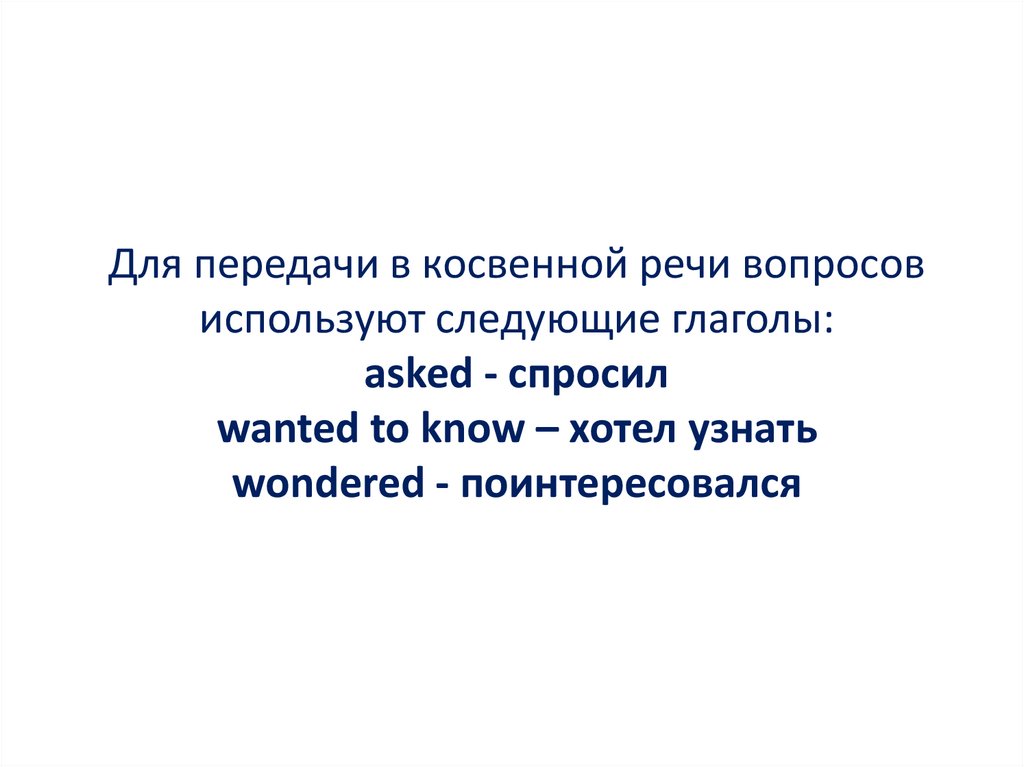
26. Для передачи в косвенной речи вопросов используют следующие глаголы: asked - спросил wanted to know – хотел узнать wondered -
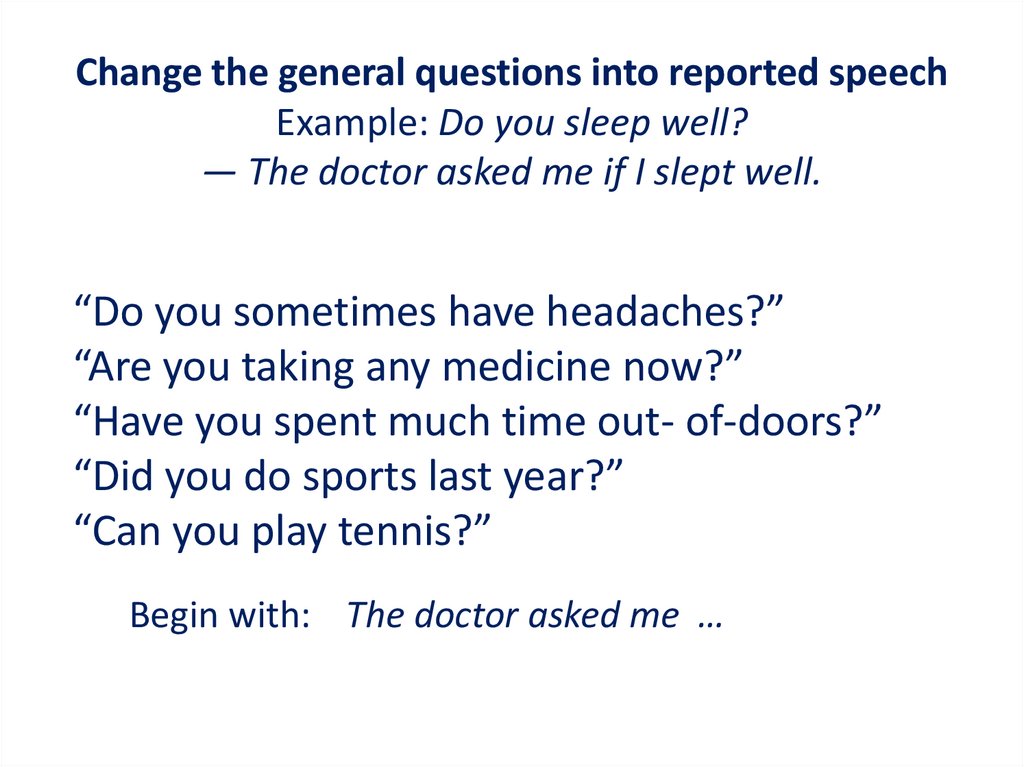
поинтересовался27. Change the general questions into reported speech Example: Do you sleep well? — The doctor asked me if I slept well.
“Do you sometimes have headaches?”“Are you taking any medicine now?”
“Have you spent much time out- of-doors?”
“Did you do sports last year?”
“Can you play tennis?”
Begin with: The doctor asked me …
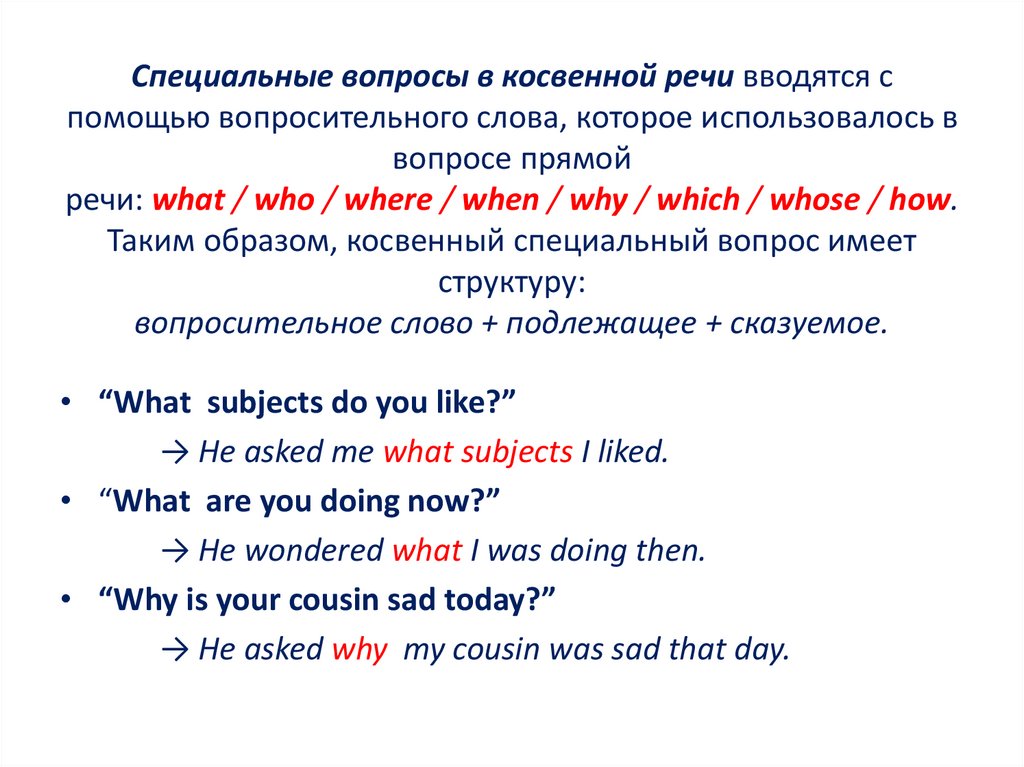
28. Специальные вопросы в косвенной речи вводятся с помощью вопросительного слова, которое использовалось в вопросе прямой
речи: what / who / where / when / why / which / whose / how.Таким образом, косвенный специальный вопрос имеет
структуру:
вопросительное слово + подлежащее + сказуемое.
• “What subjects do you like?”
→ He asked me what subjects I liked.
• “What are you doing now?”
→ He wondered what I was doing then.
• “Why is your cousin sad today?”
→ He asked why my cousin was sad that day.
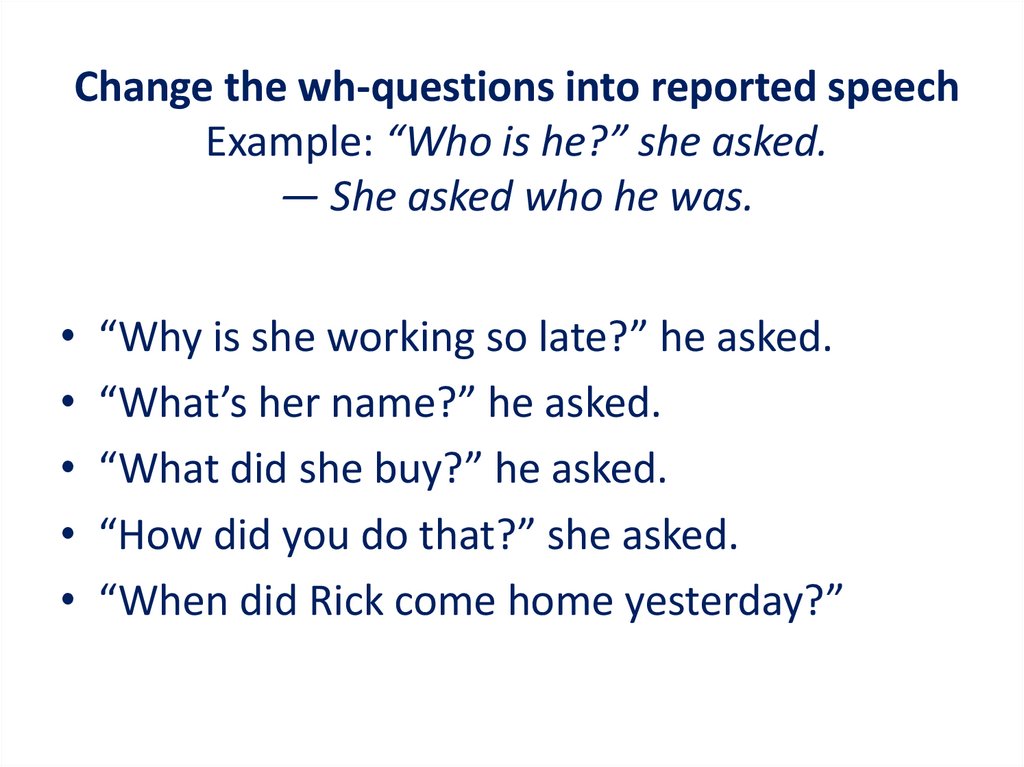
29. Change the wh-questions into reported speech Example: “Who is he?” she asked. — She asked who he was.
• “Why is she working so late?” he asked.• “What’s her name?” he asked.
• “What did she buy?” he asked.
• “How did you do that?” she asked.
• “When did Rick come home yesterday?”
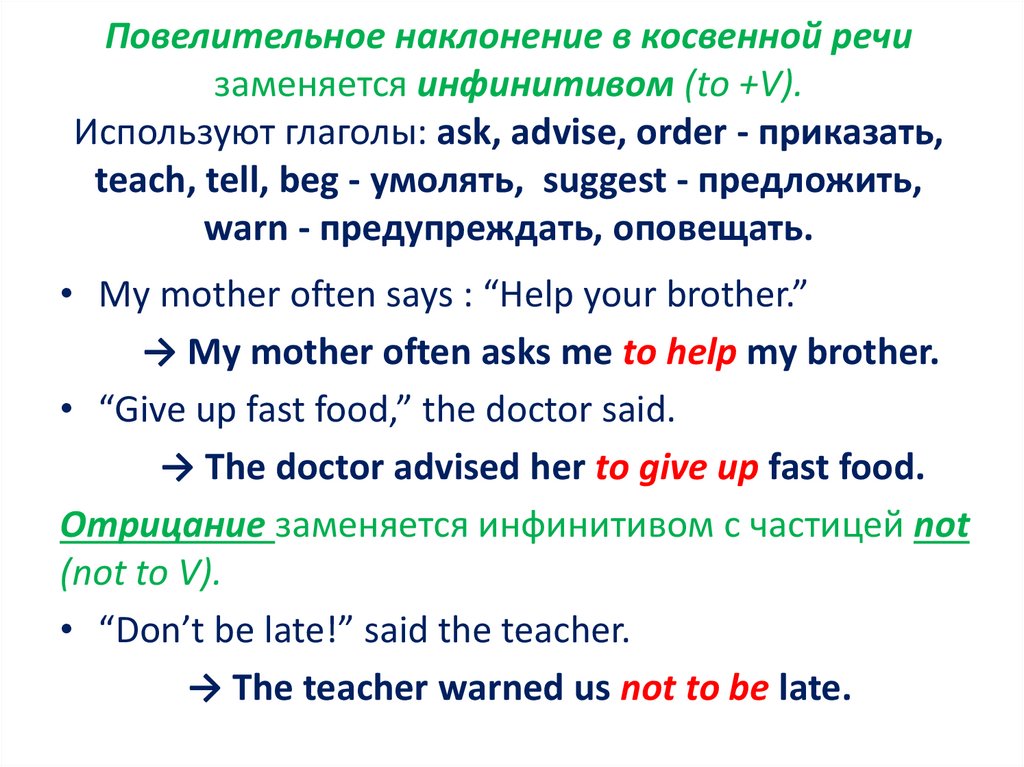
30. Повелительное наклонение в косвенной речи заменяется инфинитивом (to +V). Используют глаголы: ask, advise, order - приказать,
Повелительное наклонение в косвенной речизаменяется инфинитивом (to +V).
Используют глаголы: ask, advise, order - приказать,
teach, tell, beg - умолять, suggest - предложить,
warn - предупреждать, оповещать.
• My mother often says : “Help your brother.”
→ My mother often asks me to help my brother.
• “Give up fast food,” the doctor said.
→ The doctor advised her to give up fast food.
Отрицание заменяется инфинитивом с частицей not
(not to V).
• “Don’t be late!” said the teacher.
→ The teacher warned us not to be late.
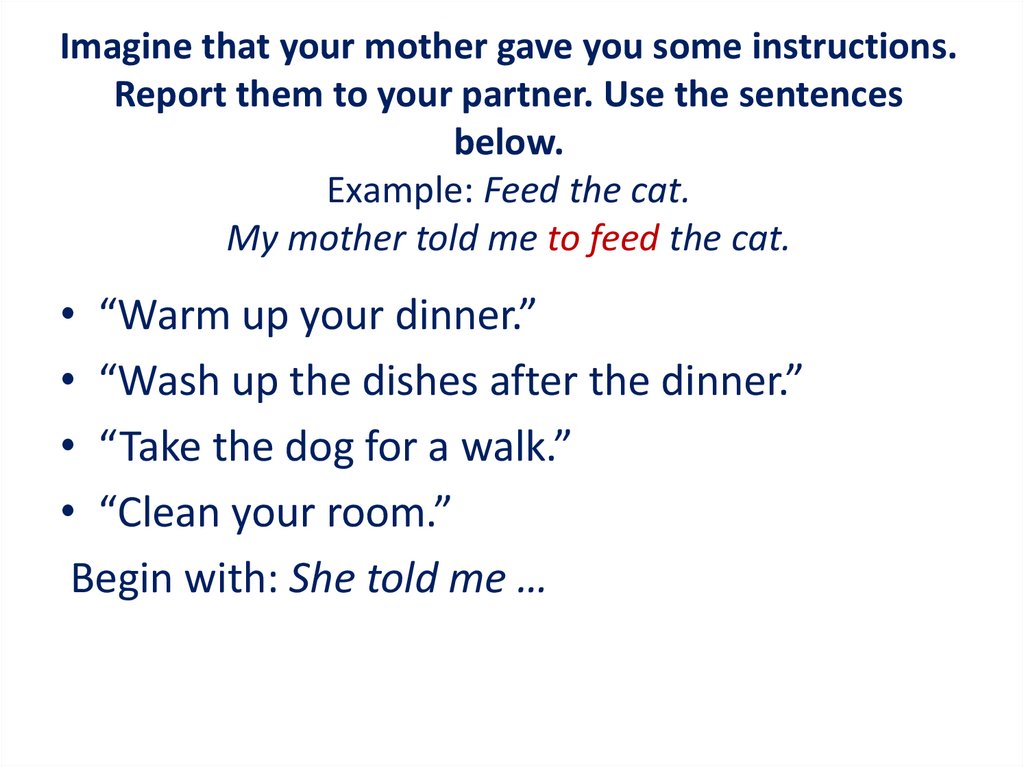
31. Imagine that your mother gave you some instructions. Report them to your partner. Use the sentences below. Example: Feed the
cat.My mother told me to feed the cat.
• “Warm up your dinner.”
• “Wash up the dishes after the dinner.”
• “Take the dog for a walk.”
• “Clean your room.”
Begin with: She told me …
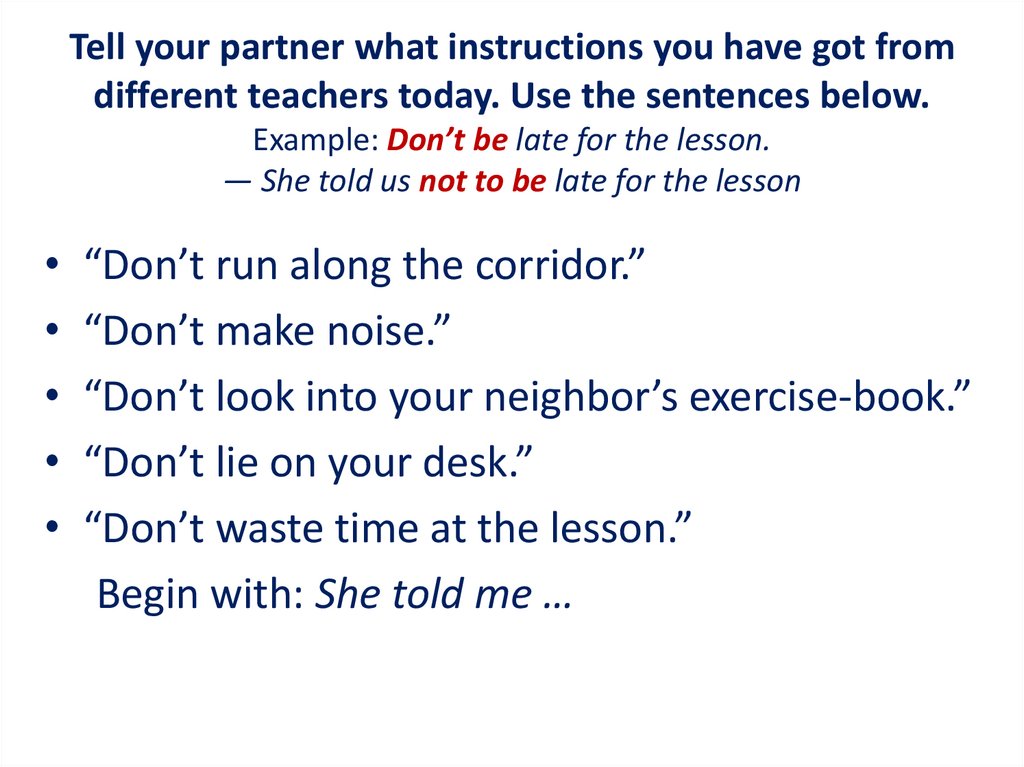
32. Tell your partner what instructions you have got from different teachers today. Use the sentences below. Example: Don’t be late
for the lesson.— She told us not to be late for the lesson
• “Don’t run along the corridor.”
• “Don’t make noise.”
• “Don’t look into your neighbor’s exercise-book.”
• “Don’t lie on your desk.”
• “Don’t waste time at the lesson.”
Begin with: She told me …
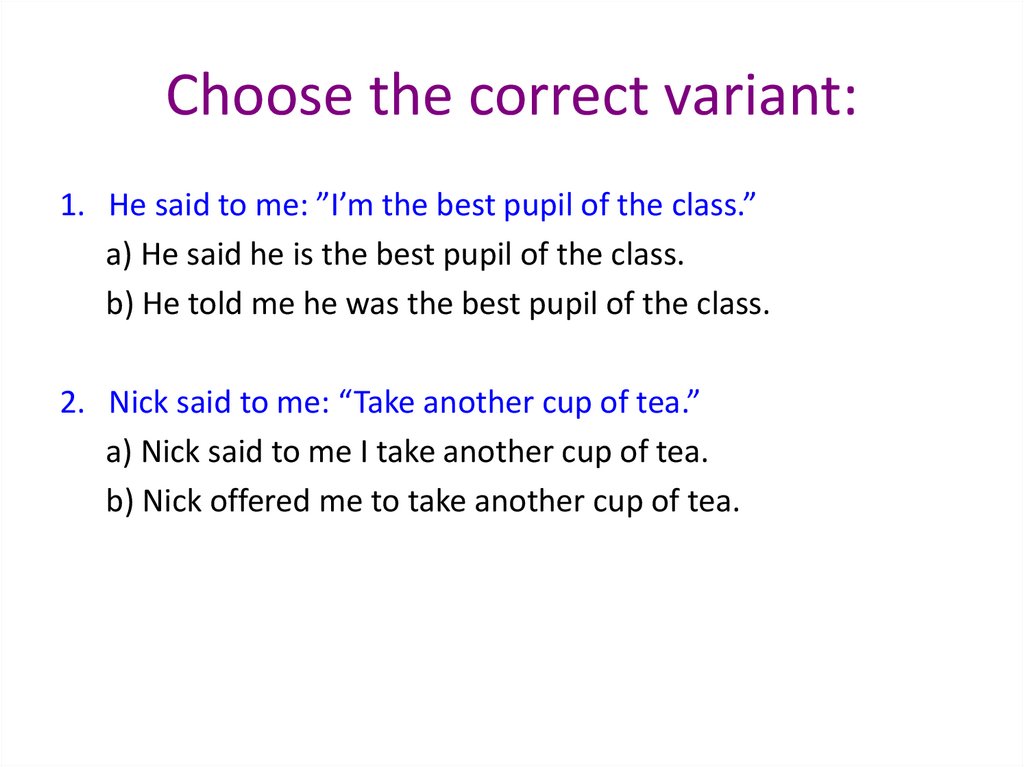
33. Choose the correct variant:
1. He said to me: ”I’m the best pupil of the class.”a) He said he is the best pupil of the class.
b) He told me he was the best pupil of the class.
2. Nick said to me: “Take another cup of tea.”
a) Nick said to me I take another cup of tea.
b) Nick offered me to take another cup of tea.
34.
3. Mother asked: “Did you finish writing thecomposition?”
a) Mother asked if I had finished writing the
composition.
b) Mother asked did I finish writing the composition.
4. Bob said: “Don’t tell him the secret, John.”
a) Bob said not to tell him the secret.
b) Bob asked John not to tell him the secret.
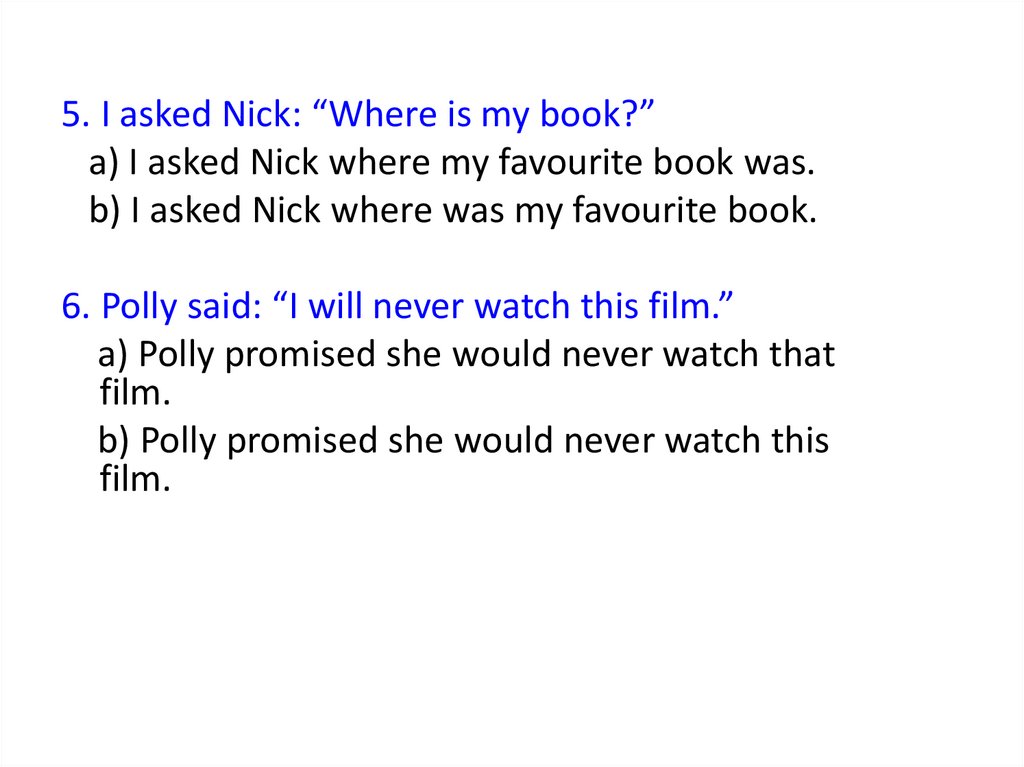
35.
5. I asked Nick: “Where is my book?”a) I asked Nick where my favourite book was.
b) I asked Nick where was my favourite book.
6. Polly said: “I will never watch this film.”
a) Polly promised she would never watch that
film.
b) Polly promised she would never watch this
film.
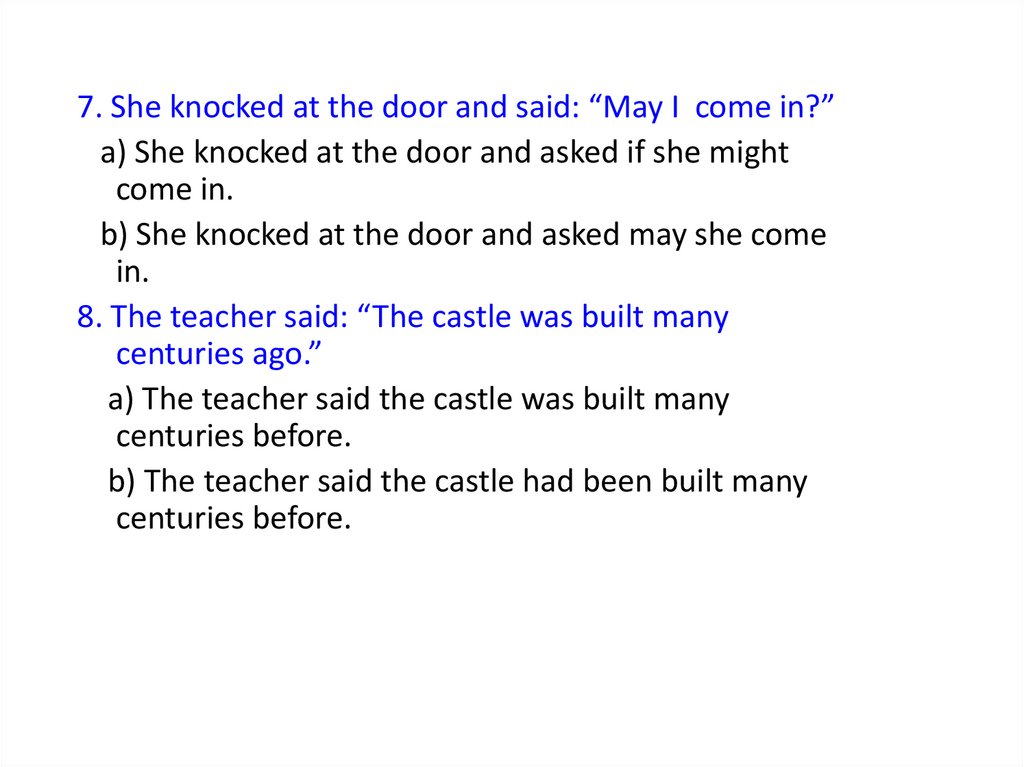
36.
7. She knocked at the door and said: “May I come in?”a) She knocked at the door and asked if she might
come in.
b) She knocked at the door and asked may she come
in.
8. The teacher said: “The castle was built many
centuries ago.”
a) The teacher said the castle was built many
centuries before.
b) The teacher said the castle had been built many
centuries before.
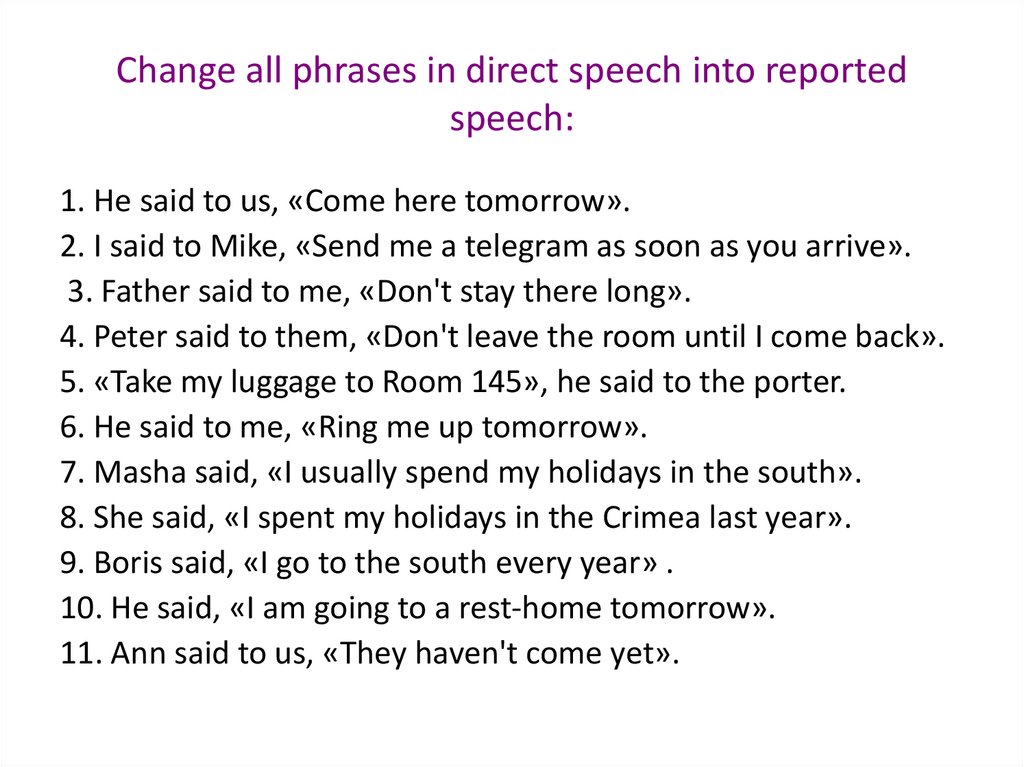
37. Change all phrases in direct speech into reported speech:
1. Не said to us, «Come here tomorrow».2. I said to Mike, «Send me a telegram as soon as you arrive».
3. Father said to me, «Don't stay there long».
4. Peter said to them, «Don't leave the room until I come back».
5. «Take my luggage to Room 145», he said to the porter.
6. He said to me, «Ring me up tomorrow».
7. Masha said, «I usually spend my holidays in the south».
8. She said, «I spent my holidays in the Crimea last year».
9. Boris said, «I go to the south every year» .
10. He said, «I am going to a rest-home tomorrow».
11. Ann said to us, «They haven't come yet».