
 finance
Similar presentations:






Lecture 2. Point estimation
1. Lecture 2
LECTURE 2POINT ESTIMATION
2. Point Estimation
POINT ESTIMATION• An estimator of a population parameter is a random variable that depends
on the sample information and whose realizations provide approximations
to this unknown parameter. A specific realization of that random variable is
called an estimate.
3. Point Estimation
POINT ESTIMATION• To clarify the distinction between the terms estimator and estimate, consider
the estimation of the mean income of all families in a neighbourhood, based on
a random sample of twenty families. It seems reasonable to base our
conclusions on the sample mean income, so we say that the estimator of the
population mean is the sample mean. Suppose that, having obtained the
sample, we find that the average income of the families in the sample is
$49.356. Then the estimate of the population mean is $49.356.
4. Poınt Estımator
POINT ESTIMATOR• A point estimator of a population parameter is a function of the sample
information that yields a single number. The corresponding realization is
called the point estimate of the parameter.
5.
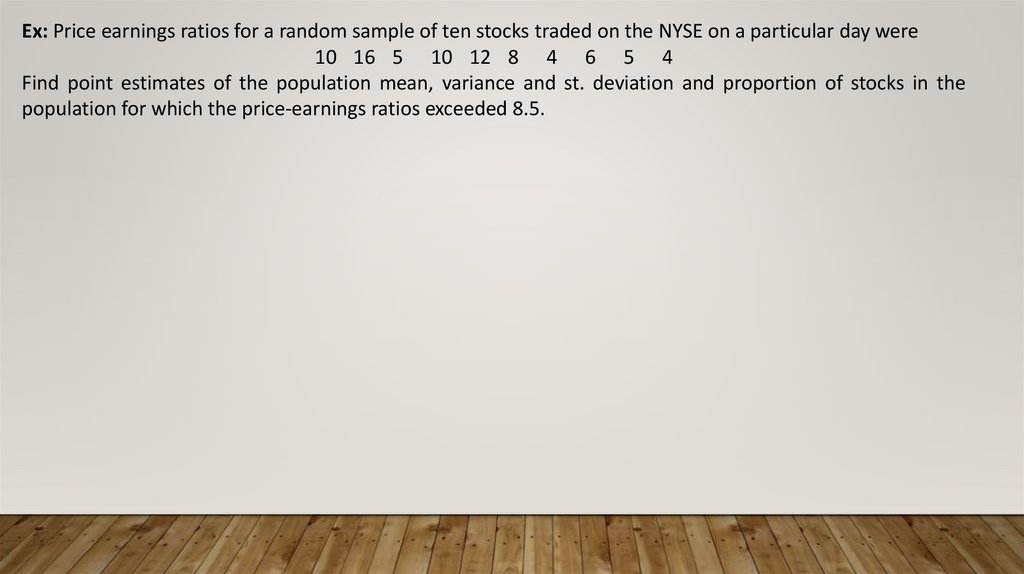
Ex: Price earnings ratios for a random sample of ten stocks traded on the NYSE on a particular day were10 16 5 10 12 8 4 6 5 4
Find point estimates of the population mean, variance and st. deviation and proportion of stocks in the
population for which the price-earnings ratios exceeded 8.5.
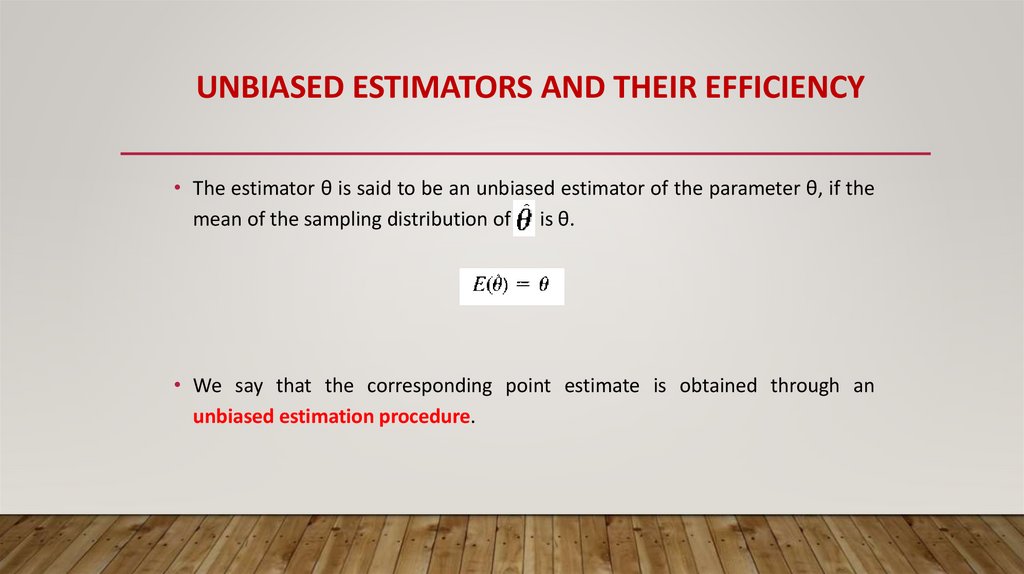
6. Unbıased estImators and theır effıcıency
UNBIASED ESTIMATORS AND THEIR EFFICIENCY• The estimator θ is said to be an unbiased estimator of the parameter θ, if the
mean of the sampling distribution of is θ.
• We say that the corresponding point estimate is obtained through an
unbiased estimation procedure.
7. Unbiasedness of some estimators
UNBIASEDNESS OF SOME ESTIMATORS• The sample mean, variance and proportion are unbiased estimators of the
corresponding population quantities.
• In general, the sample standard deviation is not an unbiased estimator of
the population standard deviation.
8.
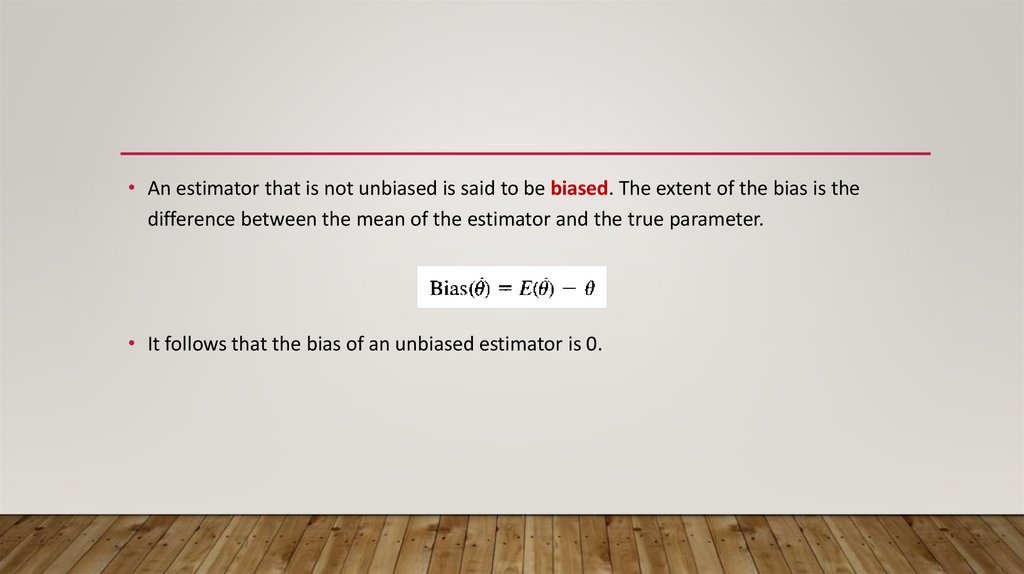
• An estimator that is not unbiased is said to be biased. The extent of the bias is thedifference between the mean of the estimator and the true parameter.
• It follows that the bias of an unbiased estimator is 0.