 literature
Similar presentations:




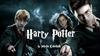

Harry Рotter and the philosopher's stone
1.
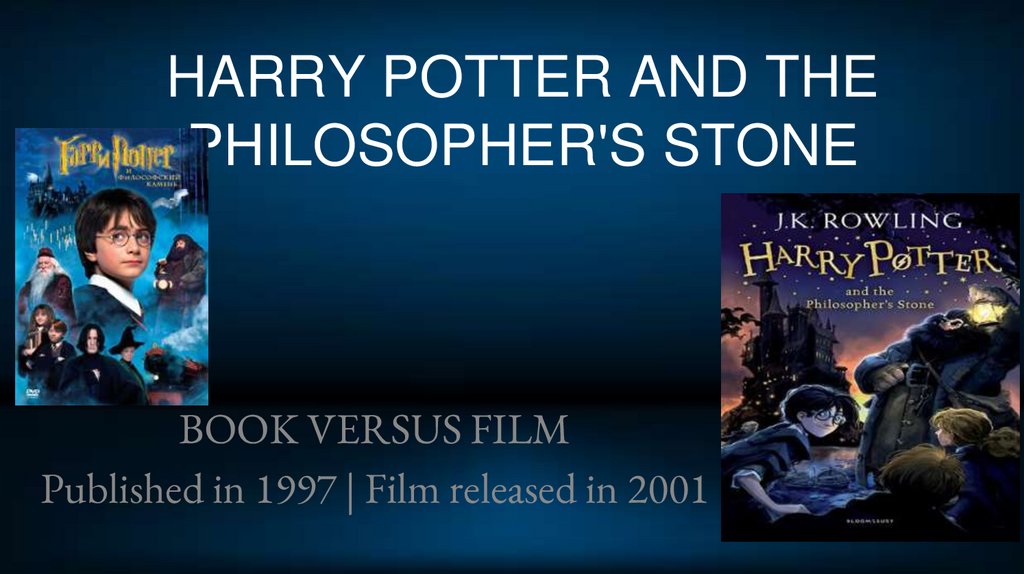
HARRY POTTER AND THEPHILOSOPHER'S STONE
BOOK VERSUS FILM
Published in 1997 | Film released in 2001
2.
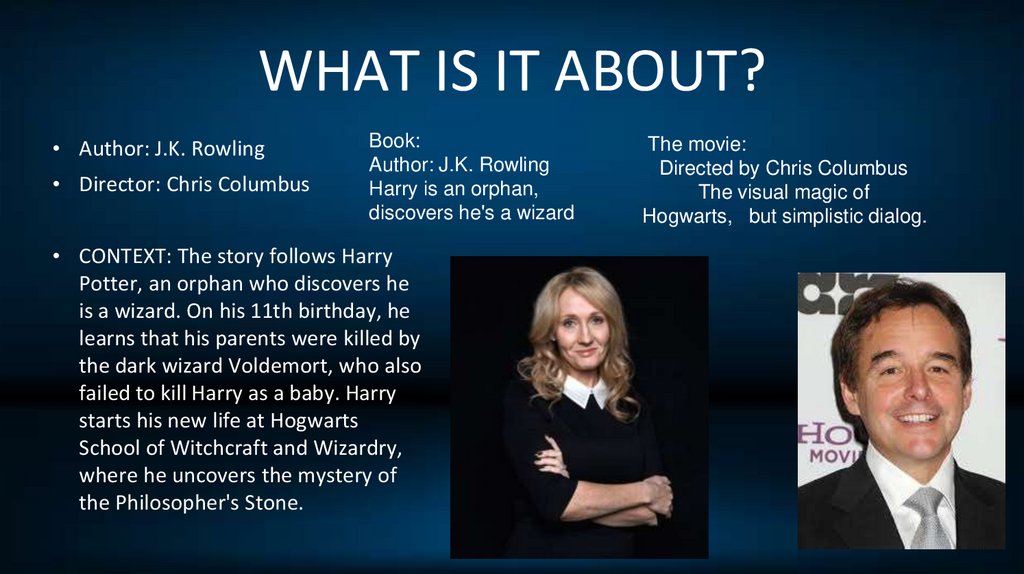
WHAT IS IT ABOUT?• Author: J.K. Rowling
• Director: Chris Columbus
Book:
Author: J.K. Rowling
Harry is an orphan,
discovers he's a wizard
• CONTEXT: The story follows Harry
Potter, an orphan who discovers he
is a wizard. On his 11th birthday, he
learns that his parents were killed by
the dark wizard Voldemort, who also
failed to kill Harry as a baby. Harry
starts his new life at Hogwarts
School of Witchcraft and Wizardry,
where he uncovers the mystery of
the Philosopher's Stone.
The movie:
Directed by Chris Columbus
The visual magic of
Hogwarts, but simplistic dialog.
3.
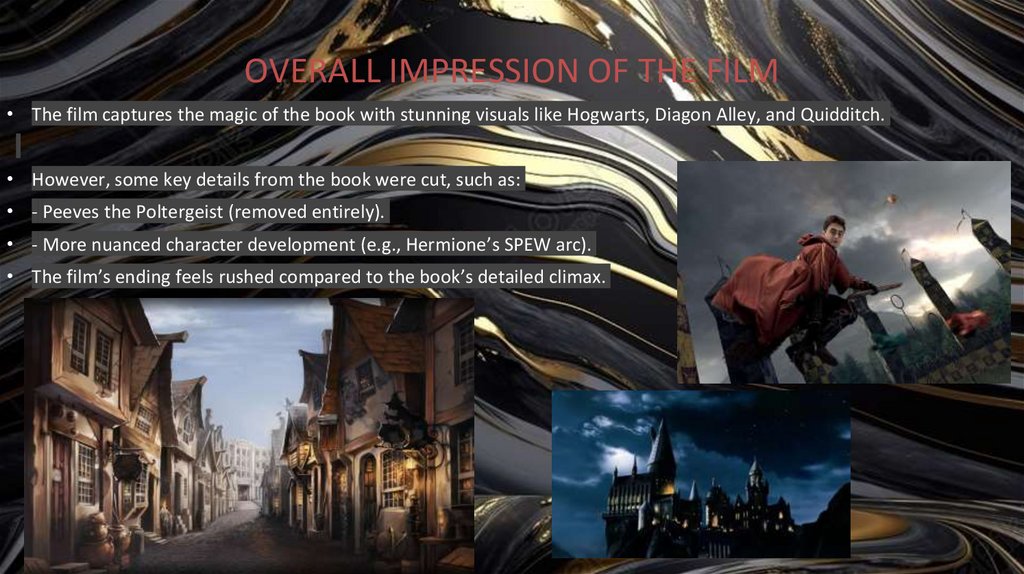
OVERALL IMPRESSION OF THE FILM• The film captures the magic of the book with stunning visuals like Hogwarts, Diagon Alley, and Quidditch.
• However, some key details from the book were cut, such as:
• - Peeves the Poltergeist (removed entirely).
• - More nuanced character development (e.g., Hermione’s SPEW arc).
• The film’s ending feels rushed compared to the book’s detailed climax.
4.
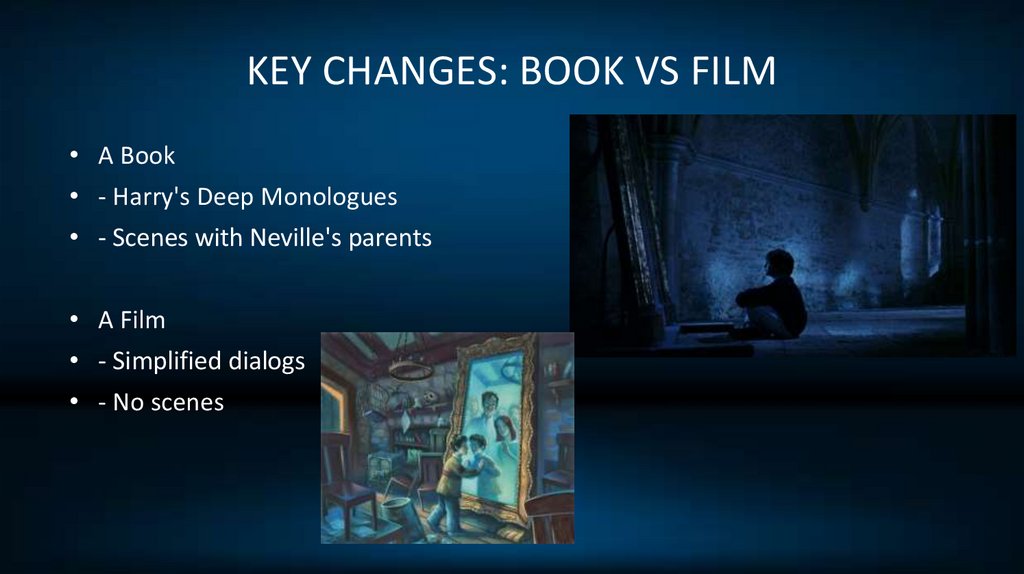
KEY CHANGES: BOOK VS FILM• A Book
• - Harry's Deep Monologues
• - Scenes with Neville's parents
• A Film
• - Simplified dialogs
• - No scenes
5.
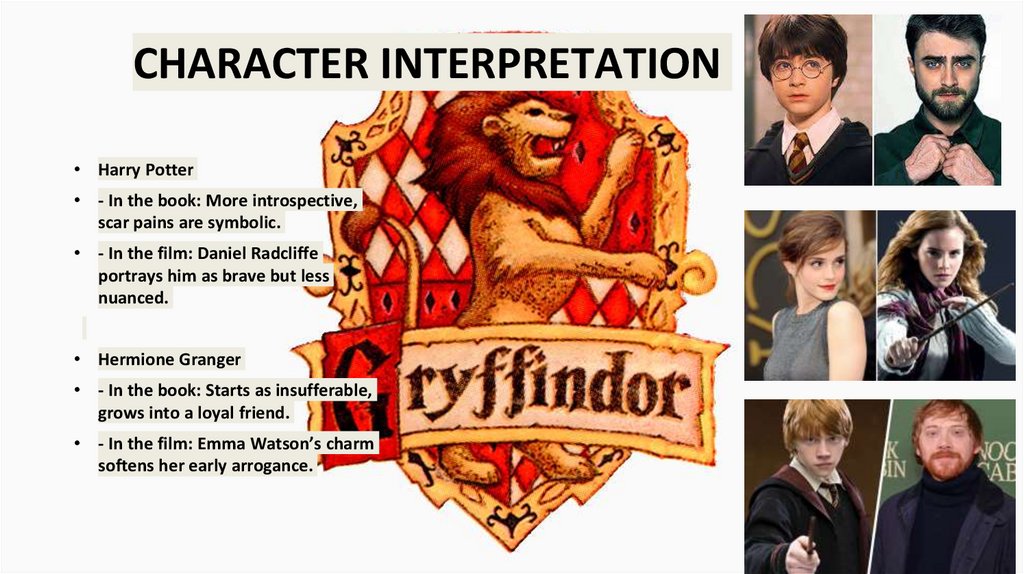
CHARACTER INTERPRETATIONHarry Potter
- In the book: More introspective,
scar pains are symbolic.
- In the film: Daniel Radcliffe
portrays him as brave but less
nuanced.
Hermione Granger
- In the book: Starts as insufferable,
grows into a loyal friend.
- In the film: Emma Watson’s charm
softens her early arrogance.
6.
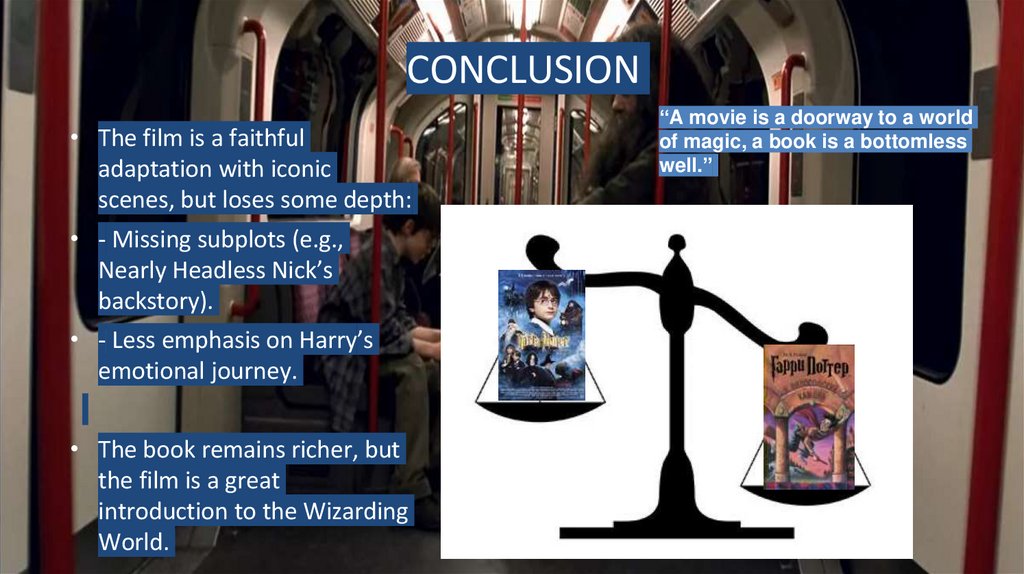
CONCLUSION• The film is a faithful
adaptation with iconic
scenes, but loses some depth:
• - Missing subplots (e.g.,
Nearly Headless Nick’s
backstory).
• - Less emphasis on Harry’s
emotional journey.
• The book remains richer, but
the film is a great
introduction to the Wizarding
World.
“A movie is a doorway to a world
of magic, a book is a bottomless
well.”