
 philosophy
Similar presentations:




Virtue ethics – Aristotle and the stoics
1.
2.
PHIL210 ETHICSVIRTUE ETHICS – ARISTOTLE AND THE STOICS
Dr Anthi Chrysanthou PhD
Week 10/Teaching Session 20 – November 9th, 2023
ac00@aubmed.ac.cy | American University of Beirut
3.
4.
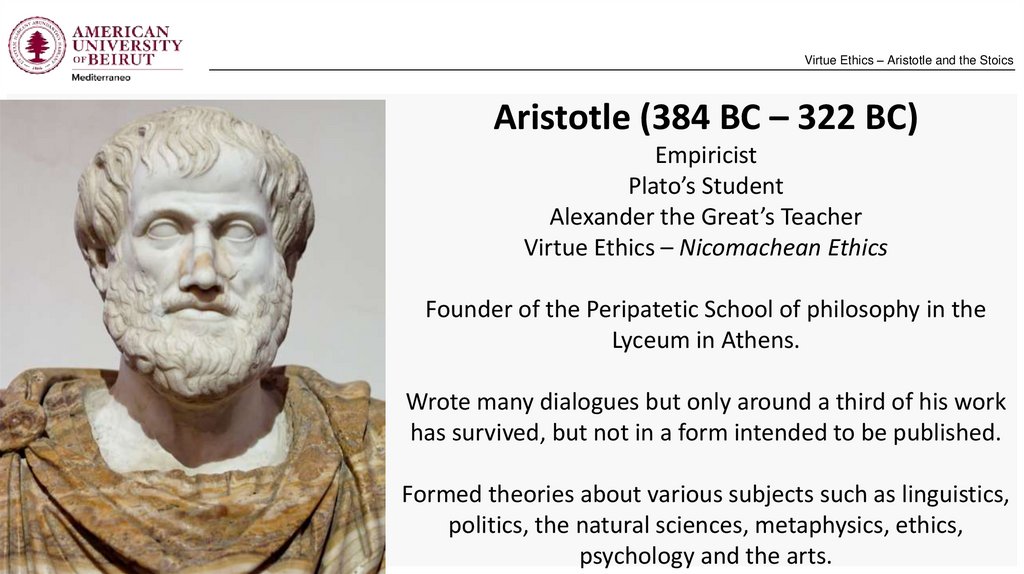
Virtue Ethics – Aristotle and the StoicsAristotle (384 BC – 322 BC)
Empiricist
Plato’s Student
Alexander the Great’s Teacher
Virtue Ethics – Nicomachean Ethics
Founder of the Peripatetic School of philosophy in the
Lyceum in Athens.
Wrote many dialogues but only around a third of his work
has survived, but not in a form intended to be published.
Formed theories about various subjects such as linguistics,
politics, the natural sciences, metaphysics, ethics,
psychology and the arts.
5.
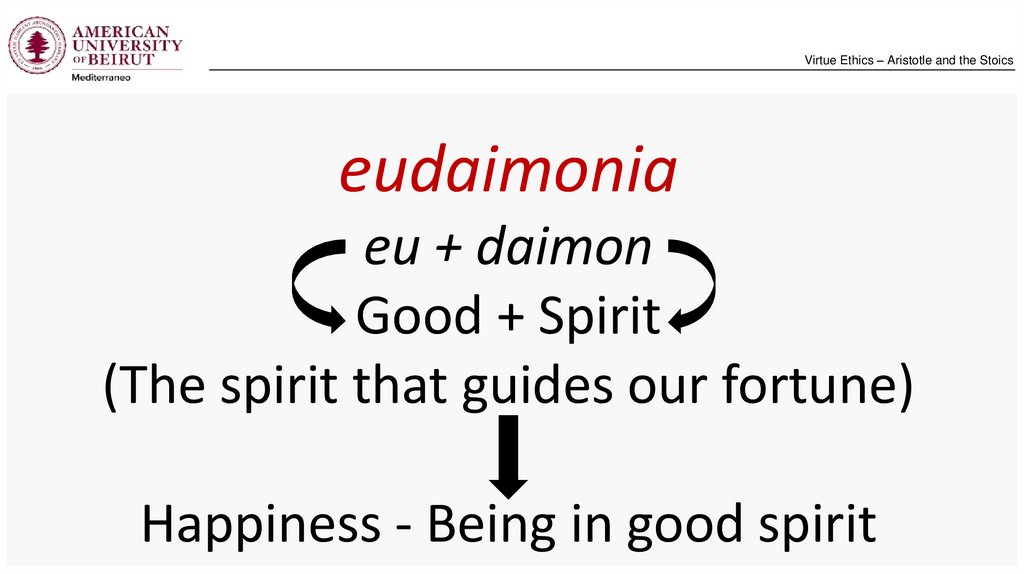
Virtue Ethics – Aristotle and the Stoicseudaimonia
eu + daimon
Good + Spirit
(The spirit that guides our fortune)
Happiness - Being in good spirit
6.
Virtue Ethics – Aristotle and the StoicsNE, Book 1. Ch.4: “Let us resume our inquiry and state, in view of the fact that
all knowledge and every pursuit aims at some good, what it is that we say
political science aims at and what is the highest of all goods achievable by
action. Verbally there is very general agreement; for both the general run of
men and people of superior refinement say that it is happiness, and
identify living well and doing well with being happy; but with regard to what
happiness is they differ, and the many do not give the same account as the
wise. For the former think it is some plain and obvious thing, like
pleasure, wealth, or honour; they differ, however, from one another- and often
even the same man identifies it with different things, with health when he is ill,
with wealth when he is poor; but, conscious of their ignorance, they admire
those who proclaim some great ideal that is above their comprehension.”
7.
8.
Virtue Ethics – Aristotle and the Stoics9.
Virtue Ethics – Aristotle and the StoicsNE, Book I.7: “There remains, then, an active life of the element that has a rational
principle; of this, one part has such a principle in the sense of being obedient to one,
the other in the sense of possessing one and exercising thought. And, as 'life of the
rational element' also has two meanings, we must state that life in the sense of activity
is what we mean; for this seems to be the more proper sense of the term. Now if the
function of man is an activity of soul which follows or implies a rational principle,
and if we say 'so-and-so-and 'a good so-and-so' have a function which is the same in
kind, e.g. a lyre, and a good lyre-player […] if this is the case, and we state the function
of man to be a certain kind of life, and this to be an activity or actions of the soul
implying a rational principle, and the function of a good man to be the good and noble
performance of these, and if any action is well performed when it is performed in
accordance with the appropriate excellence: if this is the case, human good turns out
to be activity of soul in accordance with virtue, and if there are more than one
virtue, in accordance with the best and most complete.”
10.
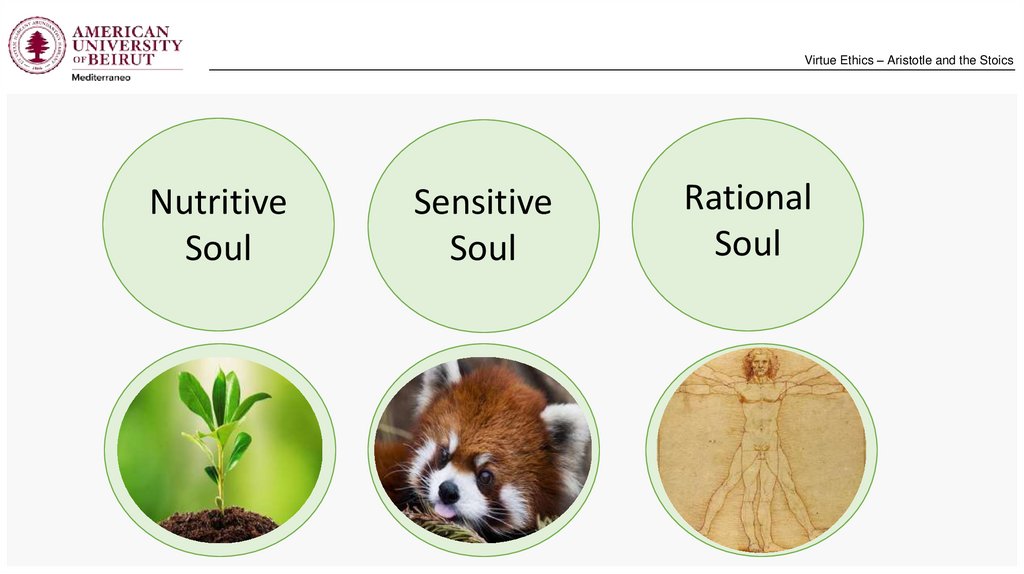
Virtue Ethics – Aristotle and the StoicsNutritive
Soul
Sensitive
Soul
Rational
Soul
11.
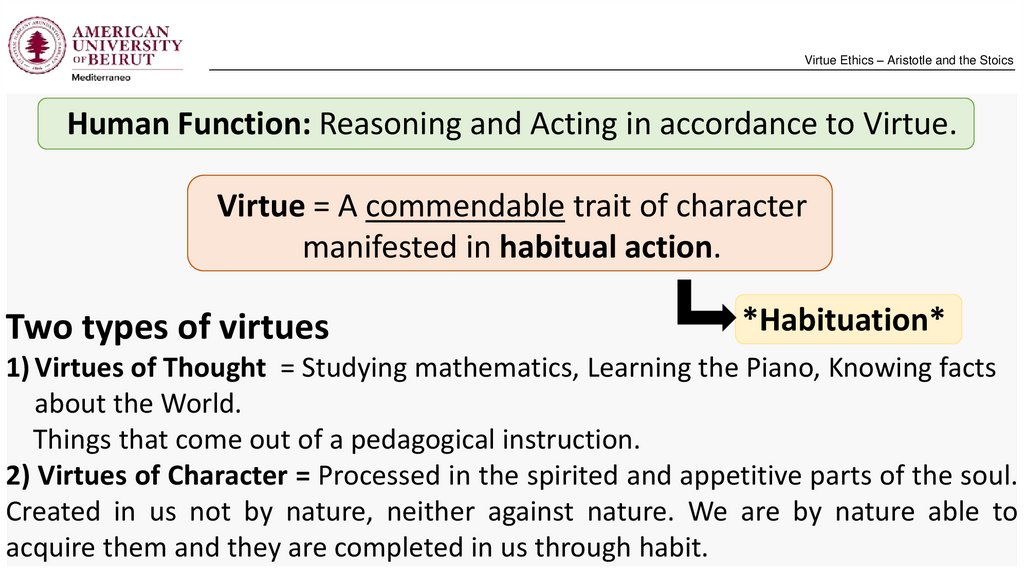
Virtue Ethics – Aristotle and the StoicsHuman Function: Reasoning and Acting in accordance to Virtue.
Virtue = A commendable trait of character
manifested in habitual action.
Two types of virtues
*Habituation*
1) Virtues of Thought = Studying mathematics, Learning the Piano, Knowing facts
about the World.
Things that come out of a pedagogical instruction.
2) Virtues of Character = Processed in the spirited and appetitive parts of the soul.
Created in us not by nature, neither against nature. We are by nature able to
acquire them and they are completed in us through habit.
12.
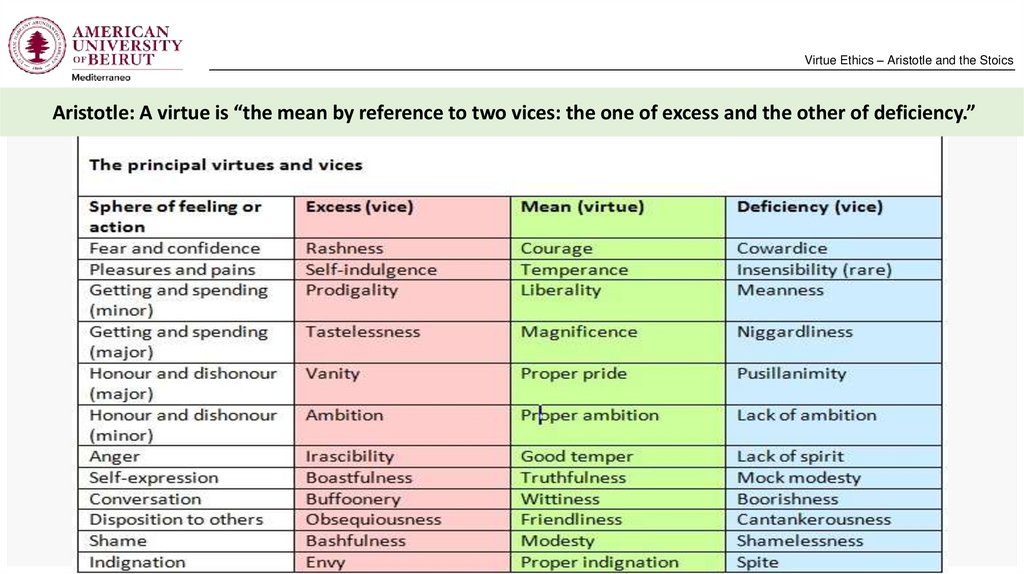
Virtue Ethics – Aristotle and the StoicsAristotle: A virtue is “the mean by reference to two vices: the one of excess and the other of deficiency.”
13.
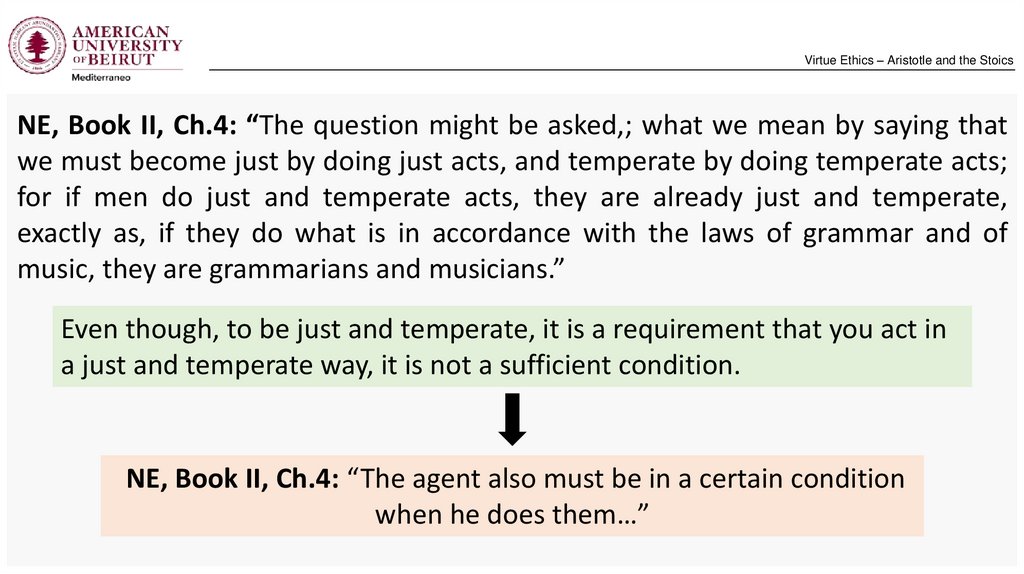
Virtue Ethics – Aristotle and the StoicsNE, Book II, Ch.4: “The question might be asked,; what we mean by saying that
we must become just by doing just acts, and temperate by doing temperate acts;
for if men do just and temperate acts, they are already just and temperate,
exactly as, if they do what is in accordance with the laws of grammar and of
music, they are grammarians and musicians.”
Even though, to be just and temperate, it is a requirement that you act in
a just and temperate way, it is not a sufficient condition.
NE, Book II, Ch.4: “The agent also must be in a certain condition
when he does them…”
14.
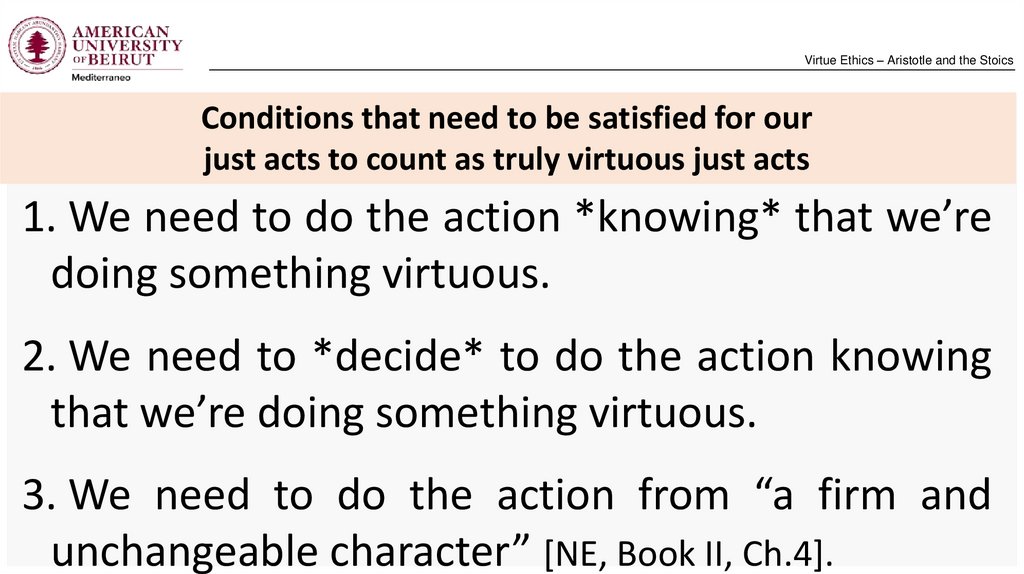
Virtue Ethics – Aristotle and the StoicsConditions that need to be satisfied for our
just acts to count as truly virtuous just acts
1. We need to do the action *knowing* that we’re
doing something virtuous.
2. We need to *decide* to do the action knowing
that we’re doing something virtuous.
3. We need to do the action from “a firm and
unchangeable character” [NE, Book II, Ch.4].