




 medicine
Similar presentations:







Whooping cough
1.
Whooping cough.2.
Whooping cough.Whooping cough is an acute infectious disease of a bacterial nature, manifested
in the form of seizures of spasmodic cough accompanying catarrhal symptoms.
Infection with whooping cough occurs by aerosol in close contact with a sick
person. The incubation period is from three to fourteen days. The catarrhal
period of whooping cough resembles the symptoms of acute pharyngitis,
followed by characteristic bouts of spasmodic coughing. Those who are
vaccinated are more likely to have an erased clinical picture of whooping cough.
Diagnosis is based on the detection of pertussis bacillus in pharyngeal and
sputum swabs. Antibacterial therapy (aminoglycosides, macrolides),
antihistamines with sedative effect, and inhalation are effective against
whooping cough.
Whooping cough is an acute infectious disease of a bacterial nature, manifested
3.
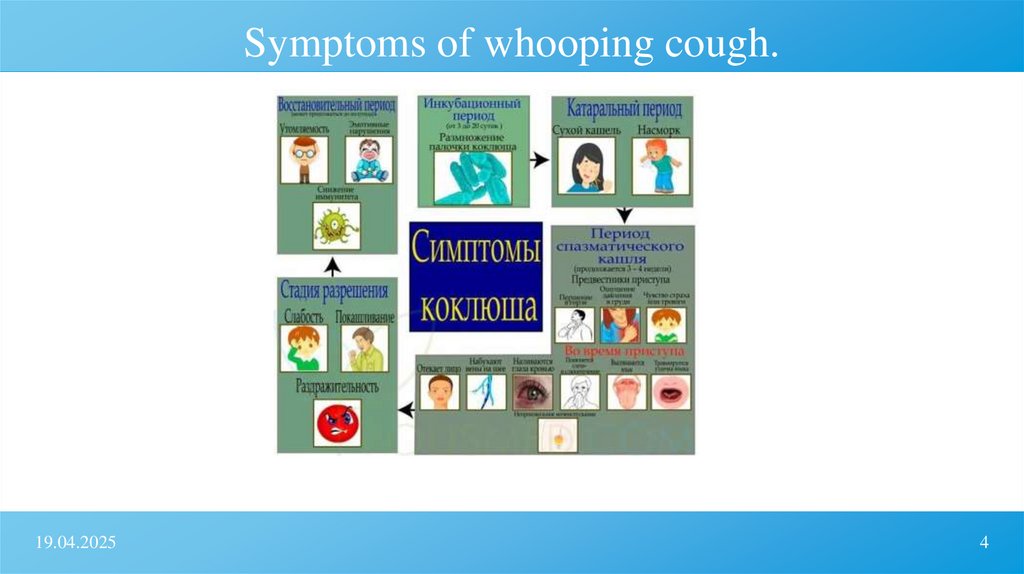
Symptoms of whooping cough.The incubation period of whooping cough can last from 3 days to two
weeks. The disease proceeds with a sequential succession of the following
periods: catarrhal, spasmodic cough and resolution. The catarrhal period
begins gradually, with a moderate dry cough and runny nose (rhinorrhea can
be quite pronounced in children).
Gradually, the catarrhal period turns into a period of spasmodic cough
(otherwise convulsive). Coughing attacks become more frequent, become
more intense, and the cough becomes convulsive and spastic.
19.04.2025
3
4.
Symptoms of whooping cough.19.04.2025
4
5.
Symptoms of whooping cough.The period of spasmodic cough lasts from three weeks to a month, after
which the disease enters the recovery phase (resolution): when coughing,
mucous sputum begins to expectorate, seizures become less frequent, lose
their spasmodic character and gradually stop. The duration of the resolution
period can take from several days to several months (despite the subsiding
of the main symptoms, nervous excitability, coughing and general asthenia
can occur in patients for a long time).
19.04.2025
5
6.
Symptoms of whooping cough.The erased form of whooping cough is sometimes noted in vaccinated
individuals. At the same time, spasmodic seizures are less pronounced, but
the cough may be more prolonged and difficult to treat. There are no
reprises, vomiting, or vascular spasms. The subclinical form is sometimes
found in the focus of pertussis infection during the examination of contact
persons. Subjectively, patients do not notice any pathological symptoms,
however, periodic coughing can often be noted. The abortive form is
characterized by the cessation of the disease at the stage of catarrhal
symptoms or in the first days of the convulsive period and rapid regression
of the clinic.
19.04.2025
6
7.
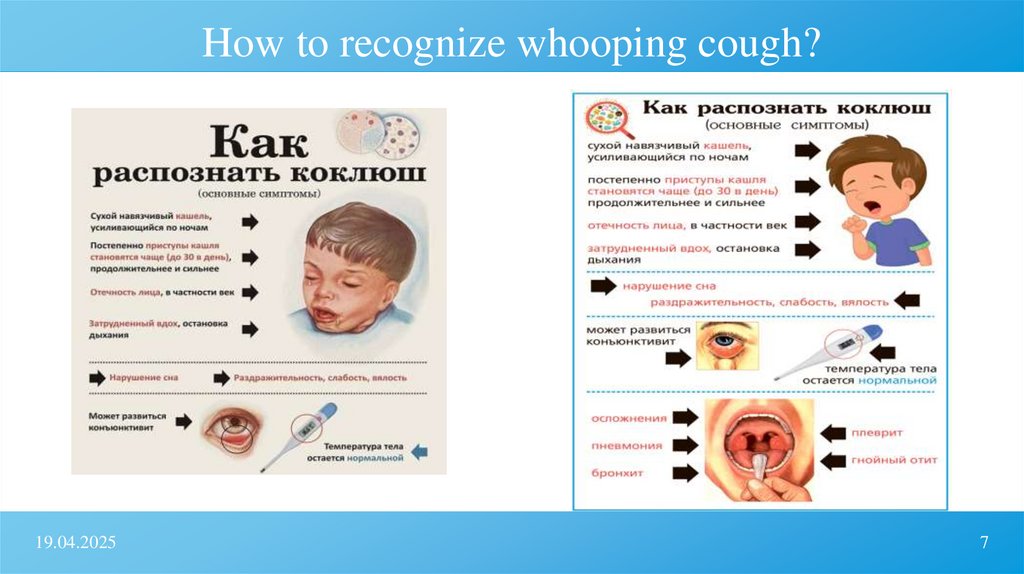
How to recognize whooping cough?19.04.2025
7
8.
Complications of whooping cough.Whooping cough most often causes complications
associated with the addition of a secondary infection,
especially common diseases of the respiratory system:
bronchitis, pneumonia, pleurisy. As a result of the
destructive activity of pertussis bacteria, emphysema
may develop. Severe course in rare cases leads to lung
atelectasis, pneumothorax. In addition, whooping
cough can contribute to the development of purulent
otitis media. There is a possibility (with frequent
intense attacks) of stroke, rupture of the abdominal wall
muscles, eardrums, rectal prolapse, hemorrhoids. In
young children, whooping cough can contribute to the
development of bronchiectasis.
19.04.2025
8
9.
Treatment of whooping cough.Whooping cough is treated on an outpatient basis, and it is advisable for patients to breathe moistened, oxygenrich air at room temperature. Full-fledged, fractional meals are recommended (often in small portions). It is
recommended to limit exposure to the nervous system (intense visual and auditory impressions). If the
temperature remains within the normal range, it is advisable to walk more outdoors (however, at an air
temperature of at least -10 ° C).
In the catarrhal period, it is effective to prescribe antibiotics (macrolides, aminoglycosides, ampicillin or
levomycetin) in medium therapeutic dosages for courses of 6-7 days. In combination with antibiotics, the
administration of a specific anti-pertussis gammaglobulin is often prescribed in the early days. Antihistamines
with sedative effect (promethazine, mebhydroline) are prescribed to patients as a pathogenetic agent. During the
convulsive period, antispasmodics can be prescribed to relieve seizures, and in severe cases, antipsychotics.
Antitussive, expectorant agents and mucolytics for whooping cough are ineffective, antitussive agents with a
central mechanism of action are contraindicated. Oxygen therapy is recommended for patients, and a good effect
is observed with oxygen barotherapy. Physiotherapy techniques and inhalation of proteolytic enzymes are
successfully used.
19.04.2025
9
10.
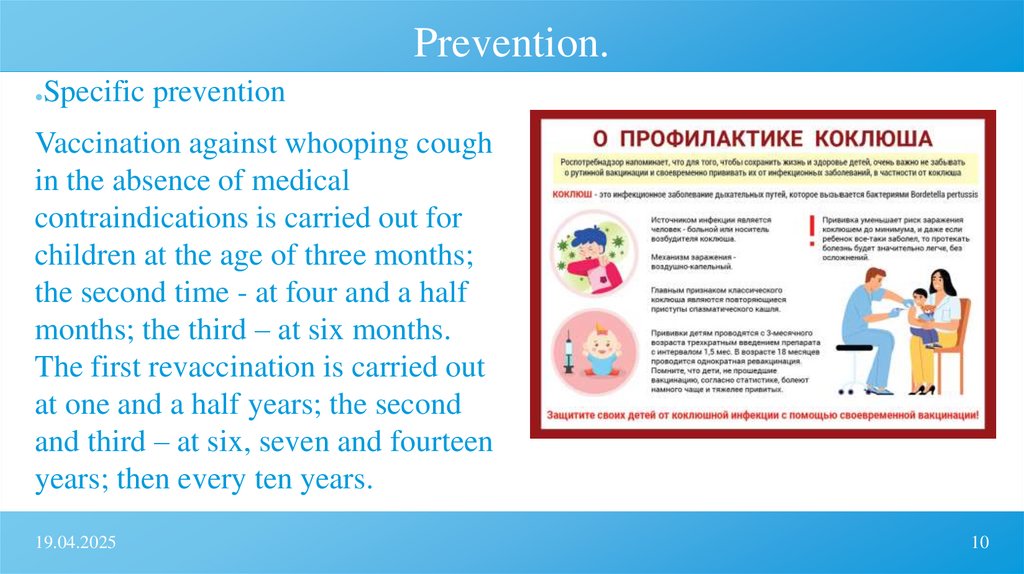
Prevention.Specific prevention
Vaccination against whooping cough
in the absence of medical
contraindications is carried out for
children at the age of three months;
the second time - at four and a half
months; the third – at six months.
The first revaccination is carried out
at one and a half years; the second
and third – at six, seven and fourteen
years; then every ten years.
19.04.2025
10
11.
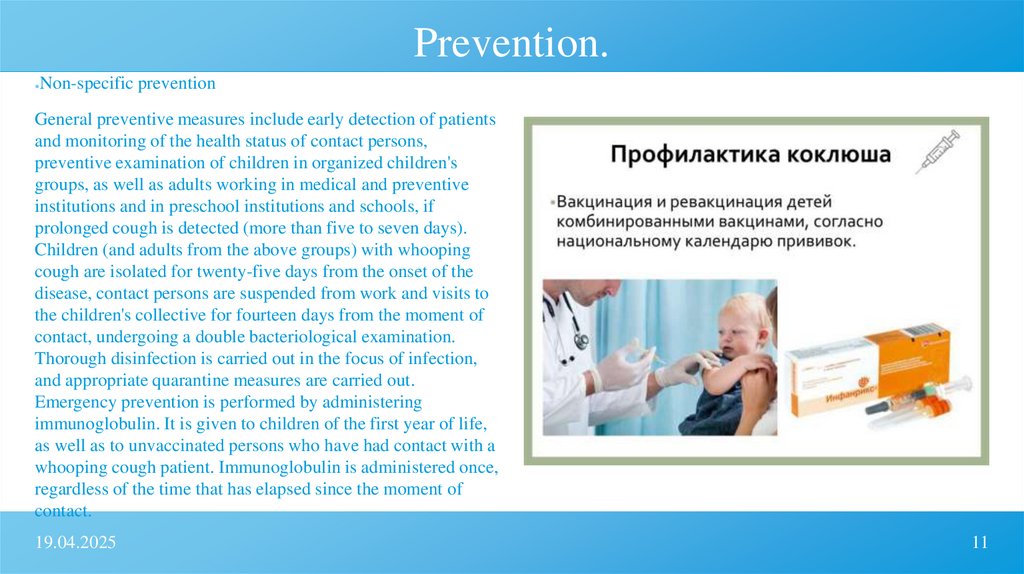
Prevention.Non-specific prevention
General preventive measures include early detection of patients
and monitoring of the health status of contact persons,
preventive examination of children in organized children's
groups, as well as adults working in medical and preventive
institutions and in preschool institutions and schools, if
prolonged cough is detected (more than five to seven days).
Children (and adults from the above groups) with whooping
cough are isolated for twenty-five days from the onset of the
disease, contact persons are suspended from work and visits to
the children's collective for fourteen days from the moment of
contact, undergoing a double bacteriological examination.
Thorough disinfection is carried out in the focus of infection,
and appropriate quarantine measures are carried out.
Emergency prevention is performed by administering
immunoglobulin. It is given to children of the first year of life,
as well as to unvaccinated persons who have had contact with a
whooping cough patient. Immunoglobulin is administered once,
regardless of the time that has elapsed since the moment of
contact.
19.04.2025
11
12.
Ребус19.04.2025
12
13.
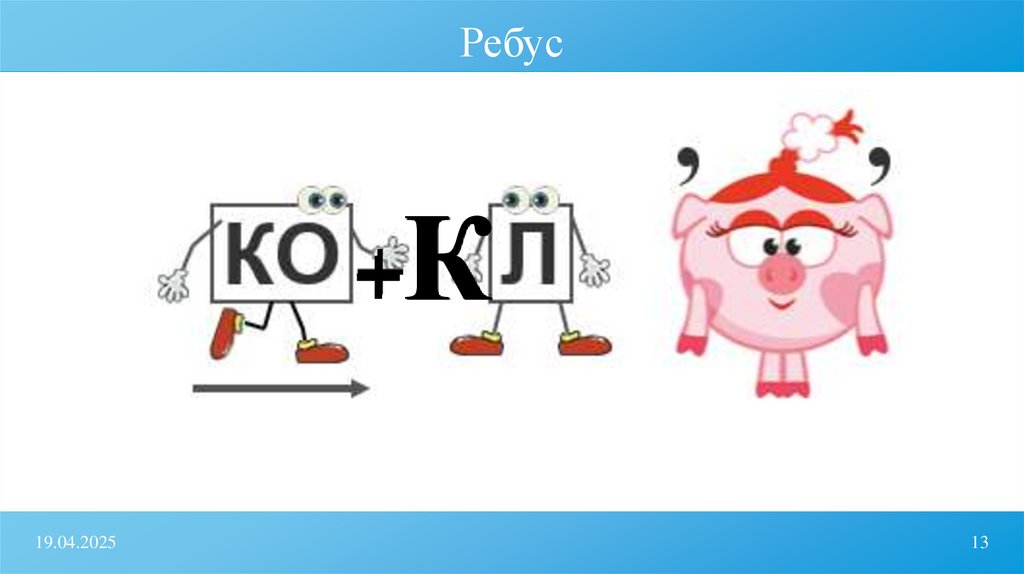
Ребус+К
19.04.2025
13
14.
Thanks for your attention!!Спасибо за внимание!!
19.04.2025
14