


 philosophy
Similar presentations:









Utilitarianism – Bentham and Mill
1.
2.
PHIL130 ETHICSUTILITARIANISM – BENTHAM AND MILL
Dr Anthi Chrysanthou PhD
Week 8/Teaching Session 16 – March 11, 2025
ac00@aubmed.ac.cy | American University of Beirut
3.
Utilitarianism – Bentham and MillJeremy Bentham (1748 -1832)
British philosopher.
Hedonist.
Leader of “Radical Philosophers”.
Founder of modern Utilitarianism.
Wrote a lot but also left behind massive amount of
unpublished work.
Wished to reform laws and institutions through
progressive theories.
“It is the greatest happiness of the greatest number that
is the measure of right and wrong.“
4.
Utilitarianism – Bentham and MillFelicific Calculus
The Felicific Calculus measures an action based on its tendency to produce pleasure or pain on seven
circumstances. The following are the circumstances to be consulted:
Intensity — what is the strength of the feeling of pleasure or pain that would result from the action?
Duration — how long would the pleasure or pain last after the action?
Certainty/Uncertainty — how sure can we be that the action will result in pleasure or pain?
Propinquity/Remoteness — is the pleasure or pain immediate, or will it be delayed to another future
time?
Fecundity — does the action have the ability to reproduce the same sort of feelings?
Purity — is there a chance that the pleasure of an action will lead to further pain and vice versa?
Extent — how far-reaching is the action regarding people impacted as a result?
Calculate:
1.Winning the lottery.
2.Curing cancer.
5.
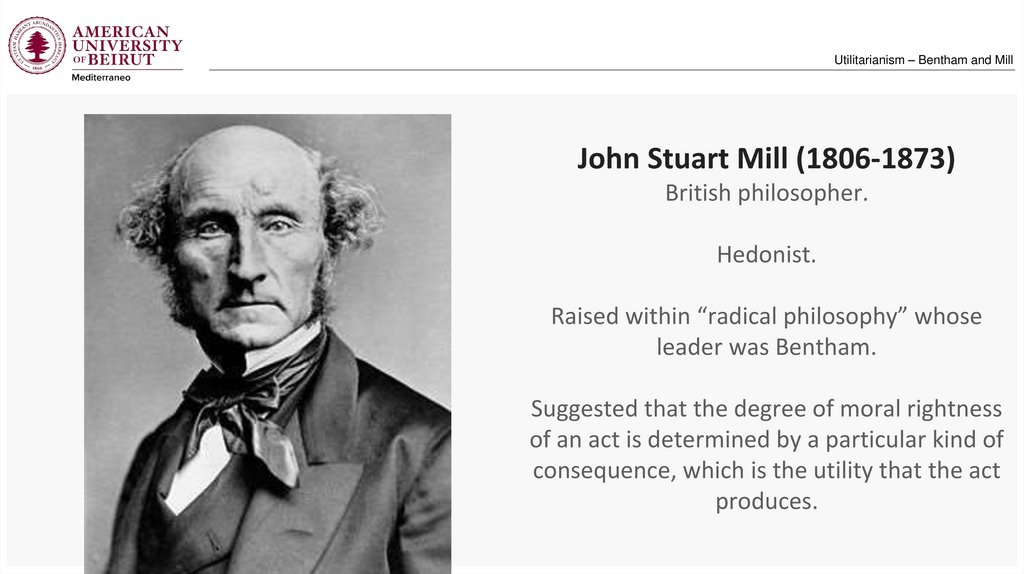
Utilitarianism – Bentham and MillJohn Stuart Mill (1806-1873)
British philosopher.
Hedonist.
Raised within “radical philosophy” whose
leader was Bentham.
Suggested that the degree of moral rightness
of an act is determined by a particular kind of
consequence, which is the utility that the act
produces.
6.
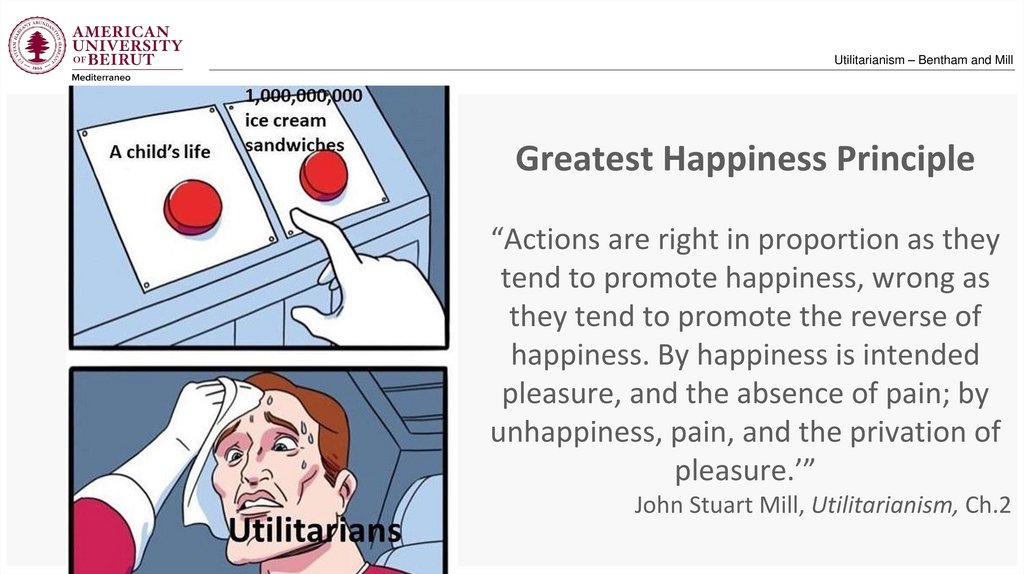
Utilitarianism – Bentham and MillGreatest Happiness Principle
“Actions are right in proportion as they
tend to promote happiness, wrong as
they tend to promote the reverse of
happiness. By happiness is intended
pleasure, and the absence of pain; by
unhappiness, pain, and the privation of
pleasure.’”
John Stuart Mill, Utilitarianism, Ch.2
7.
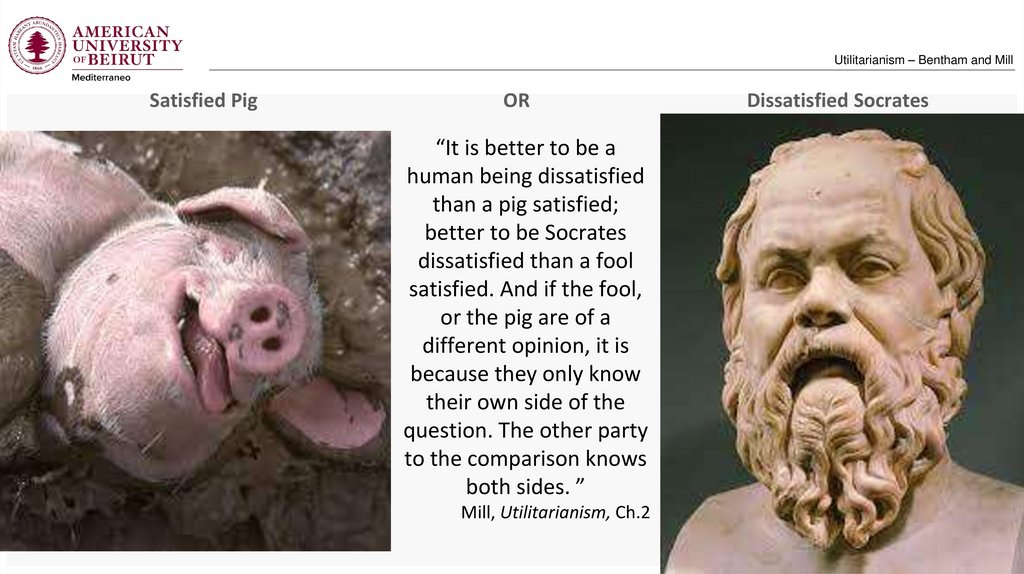
Utilitarianism – Bentham and MillSatisfied Pig
OR
“It is better to be a
human being dissatisfied
than a pig satisfied;
better to be Socrates
dissatisfied than a fool
satisfied. And if the fool,
or the pig are of a
different opinion, it is
because they only know
their own side of the
question. The other party
to the comparison knows
both sides. ”
Mill, Utilitarianism, Ch.2
Dissatisfied Socrates
8.
Utilitarianism – Bentham and MillHigher and Lower Pleasures
We should consider quality as well as quantity of pleasure.
“It is quite compatible with the principle of utility to recognize the fact that some kinds of
pleasure are more desirable and more valuable than others. It would be absurd that, while in
estimating all other things quality is considered as well as quantity, the estimation of pleasure
should be supposed to depend on quantity alone.”
Mill, Utilitarianism, Ch.2
“If I am asked what I mean by difference of quality in pleasures...except [one’s] being greater in
amount, there is but one possible answer. Of two pleasures, if there be one to which all or
almost all who have experience of both give a decided preference, irrespective of any feeling of
moral obligation to prefer it, that is the more desirable pleasure.”
Mill, Utilitarianism, Ch.2
9.
Utilitarianism – Bentham and MillMotivation is Irrelevant to the Action
The motive has nothing to do with the morality of the action:
“He who saves another creature from drowning does what is morally right
whether his motive be duty or the hope of being paid for his trouble”.
Intrinsic or instrumental value of goodness.
Motivation is Relevant to the Agent
Mill acknowledges that there is a difference between someone that is motivated
by true good intentions and someone that will get something in return.
10.
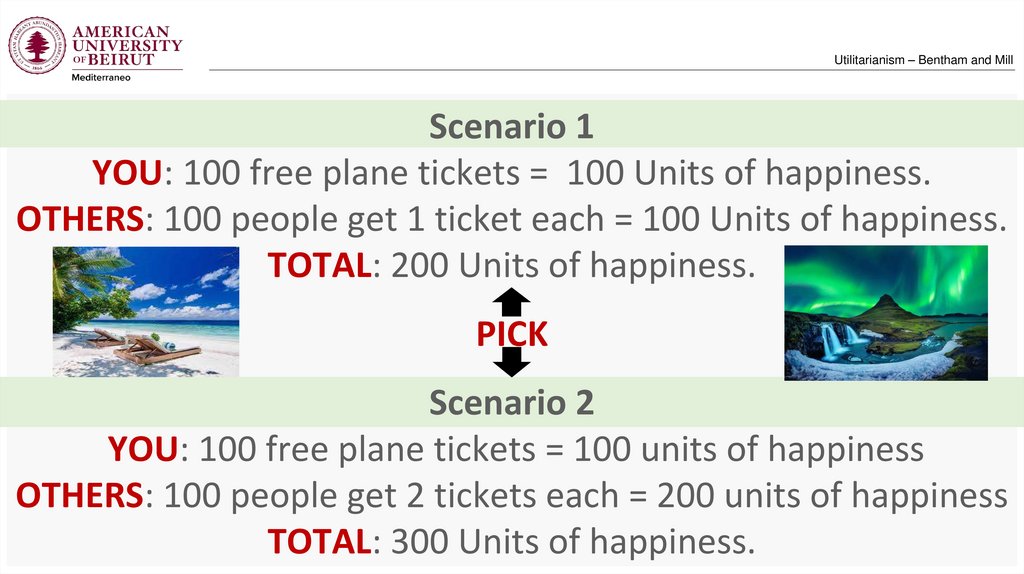
Utilitarianism – Bentham and MillScenario 1
YOU: 100 free plane tickets = 100 Units of happiness.
OTHERS: 100 people get 1 ticket each = 100 Units of happiness.
TOTAL: 200 Units of happiness.
PICK
Scenario 2
YOU: 100 free plane tickets = 100 units of happiness
OTHERS: 100 people get 2 tickets each = 200 units of happiness
TOTAL: 300 Units of happiness.
11.
Utilitarianism – Bentham and MillScenario 1
YOU: 100 free plane tickets = 100 Units of happiness.
OTHERS: 100 people get 1 ticket each = 100 Units of happiness.
TOTAL: 200 Units of happiness.
PICK
Scenario 2
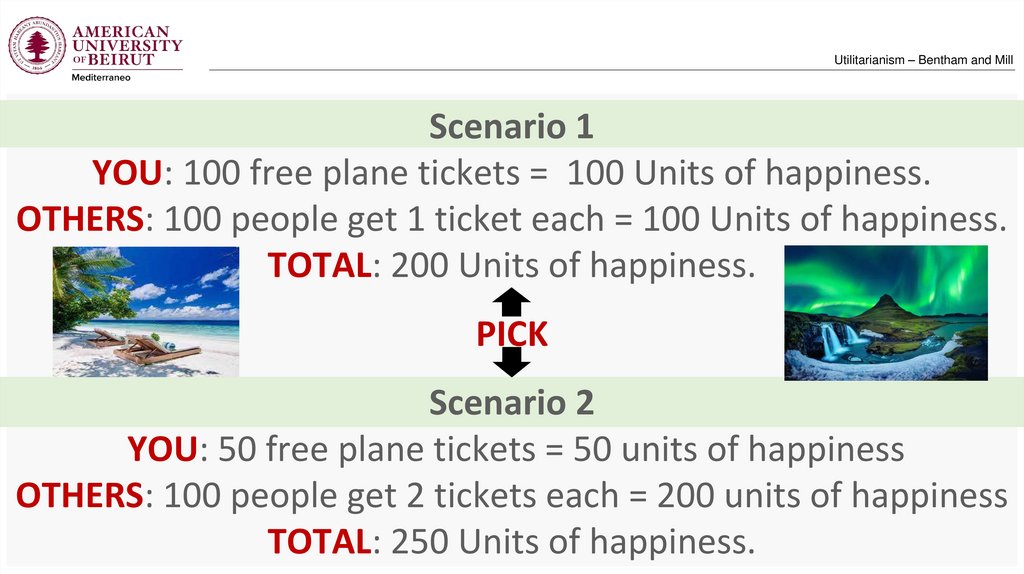
YOU: 50 free plane tickets = 50 units of happiness
OTHERS: 100 people get 2 tickets each = 200 units of happiness
TOTAL: 250 Units of happiness.
12.
Utilitarianism – Bentham and MillScenario 1
YOU: 100 free plane tickets = 100 Units of happiness.
OTHERS: 100 people get 1 ticket each = 100 Units of happiness.
TOTAL: 200 Units of happiness.
PICK
Scenario 2
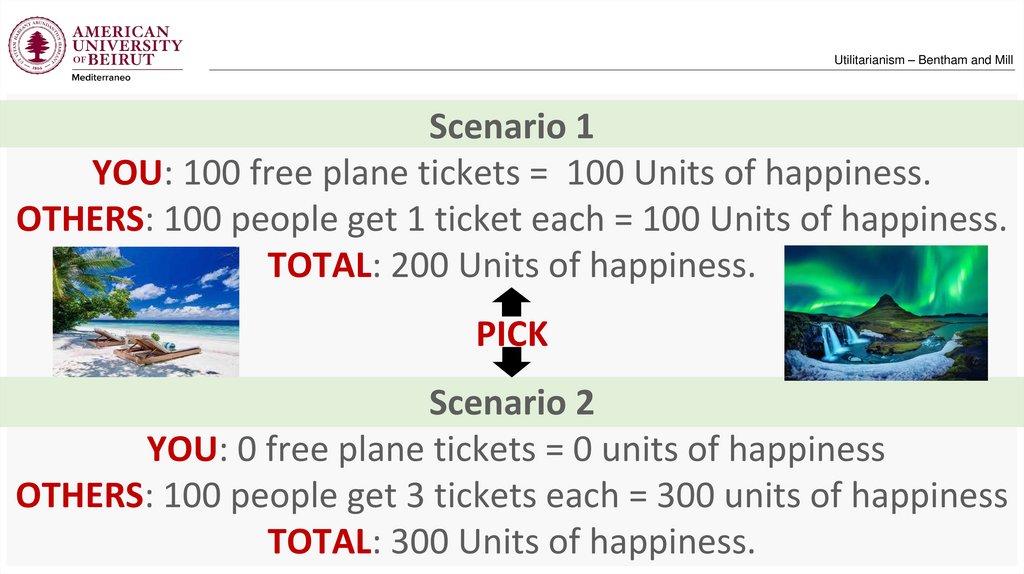
YOU: 0 free plane tickets = 0 units of happiness
OTHERS: 100 people get 3 tickets each = 300 units of happiness
TOTAL: 300 Units of happiness.
13.
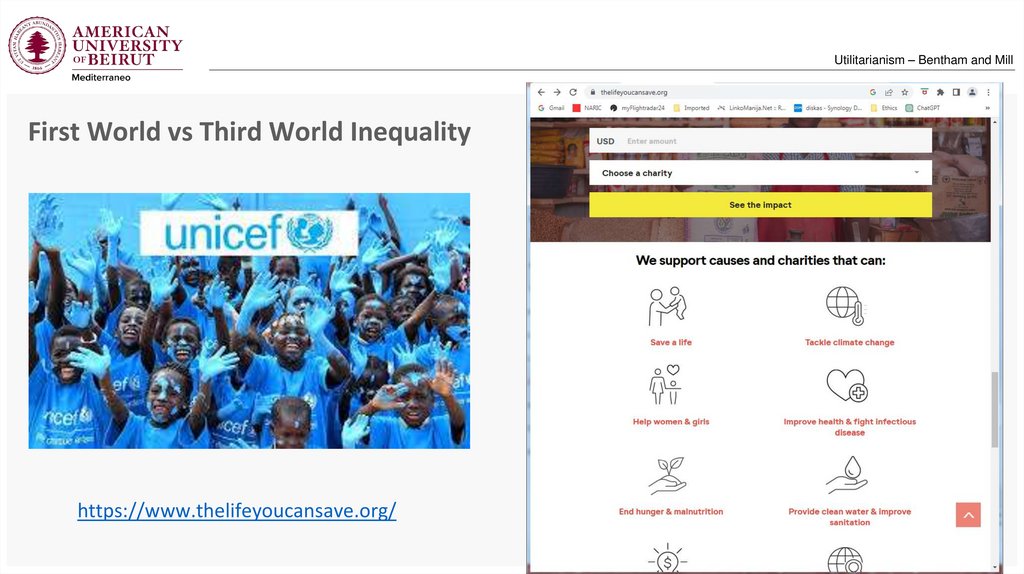
Utilitarianism – Bentham and MillFirst World vs Third World Inequality
https://www.thelifeyoucansave.org/
14.
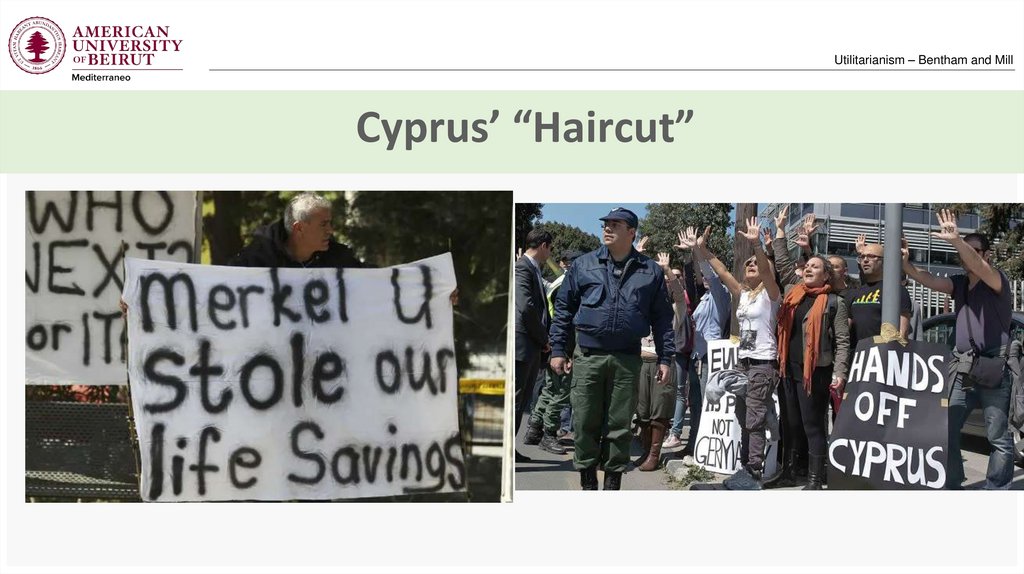
Utilitarianism – Bentham and MillCyprus’ “Haircut”