



 philosophy
Similar presentations:



Hegel – The Ethical Life
1.
2.
PHIL130 ETHICSHEGEL – THE ETHICAL LIFE
Dr Anthi Chrysanthou PhD
Week 7/Teaching Session 13 – February 27 2025
ac00@aubmed.ac.cy | American University of Beirut
3.
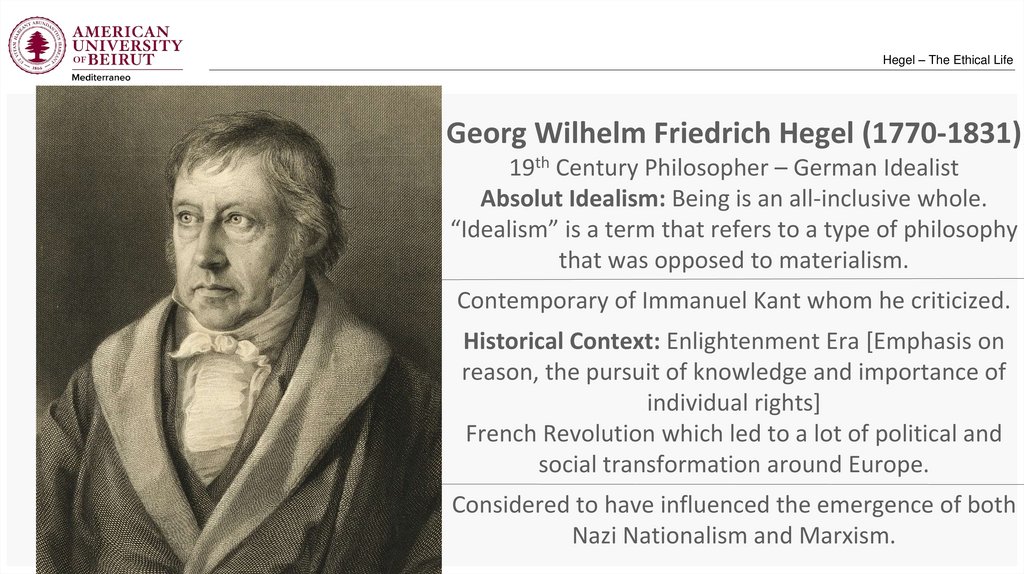
Hegel – The Ethical LifeGeorg Wilhelm Friedrich Hegel (1770-1831)
19th Century Philosopher – German Idealist
Absolut Idealism: Being is an all-inclusive whole.
“Idealism” is a term that refers to a type of philosophy
that was opposed to materialism.
Contemporary of Immanuel Kant whom he criticized.
Historical Context: Enlightenment Era [Emphasis on
reason, the pursuit of knowledge and importance of
individual rights]
French Revolution which led to a lot of political and
social transformation around Europe.
Considered to have influenced the emergence of both
Nazi Nationalism and Marxism.
4.
Hegel – The Ethical LifeKey Works
The Phenomenology of Spirit - 1807
Science of Logic - 1811
Encyclopedia of the Philosophical
Sciences - 1816
The Philosophy of Right - 1821
5.
Hegel – The Ethical LifeGEIST = SPIRIT [MIND]
Something between spirit and mind Connotations more mental than the
word “spirit” and more spiritual than the world “mind”.
What is Geist? The ultimate essence of being, the stuff of existence. A
principle of motion, or self-consciousness coming to know itself.
[Heraclitus (Greek philosopher): “No man ever steps in the same river
twice. For it’s not the same river and he’s not the same man.”]
The world is always in movement. The movement that Spirit represents is
always heading towards greater freedom.
6.
Hegel – The Ethical LifeWorld History: The unfolding of Spirit which always has a progressive movement. The
development of Spirit towards self-awareness.
Goal: the “Idea”
The synthesis of subjectivity and objectivity, of matter and spirit.
For the Idea to become a reality it needs human activity.
THREE STAGES OF SPIRIT
1. Spirit is completely immersed in nature, it’s everywhere around in nature.
2. Spirit emerges into self-consciousness and freedom. It reflects on itself.
3. Spirit achieves universality. It unifies the subjective with the objective.
Highest achievement of Spirit To know itself.
Hegel calls this state of self-awareness of everything “the Absolute”
So his philosophy became known as “Absolute Idealism”.
7.
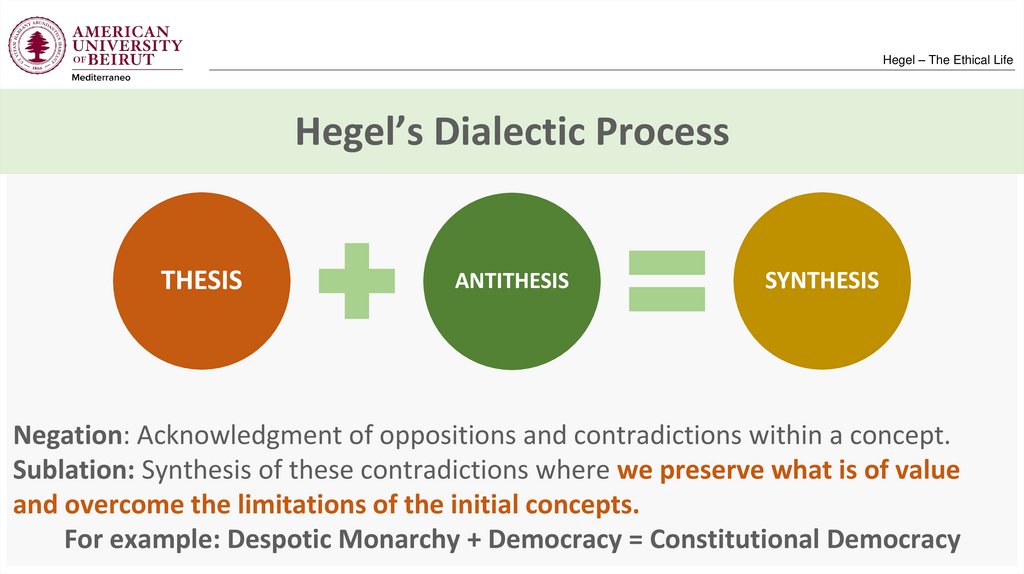
Hegel – The Ethical LifeHegel’s Dialectic Process
THESIS
ANTITHESIS
SYNTHESIS
Negation: Acknowledgment of oppositions and contradictions within a concept.
Sublation: Synthesis of these contradictions where we preserve what is of value
and overcome the limitations of the initial concepts.
For example: Despotic Monarchy + Democracy = Constitutional Democracy
8.
Hegel – The Ethical LifeMaster – Servant Dialectic
In Phenomenology of Spirit par.178 and forward.
Self-consciousness emerges through being faced with another consciousness, the “other”.
Consciousness of the self
(Being-for-self)
Self-existence acknowledged
by other human beings
(Being-for-others)
MASTER
SERVANT
9.
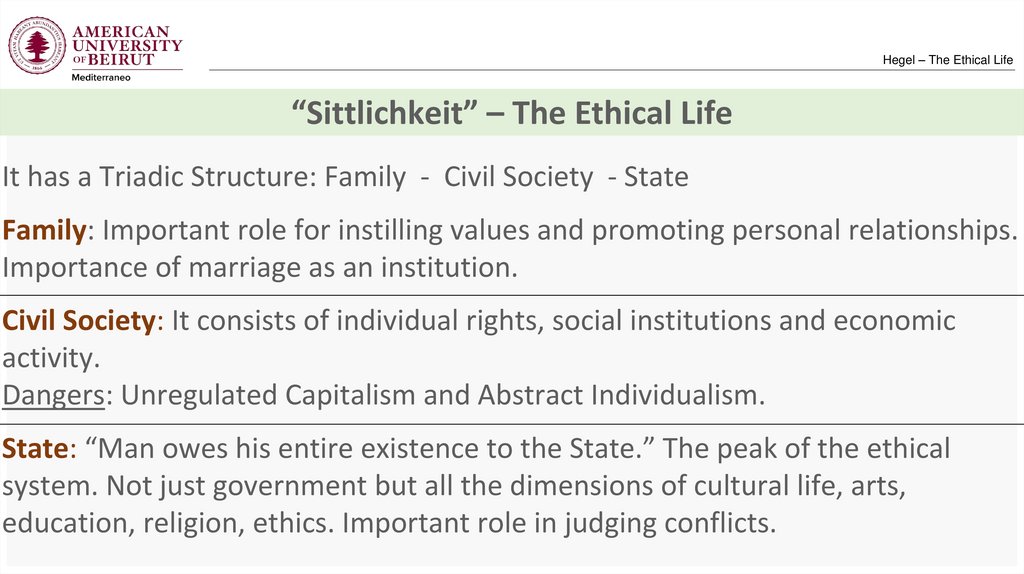
Hegel – The Ethical Life“Sittlichkeit” – The Ethical Life
It has a Triadic Structure: Family - Civil Society - State
Family: Important role for instilling values and promoting personal relationships.
Importance of marriage as an institution.
Civil Society: It consists of individual rights, social institutions and economic
activity.
Dangers: Unregulated Capitalism and Abstract Individualism.
State: “Man owes his entire existence to the State.” The peak of the ethical
system. Not just government but all the dimensions of cultural life, arts,
education, religion, ethics. Important role in judging conflicts.
10.
Hegel – The Ethical Life11.
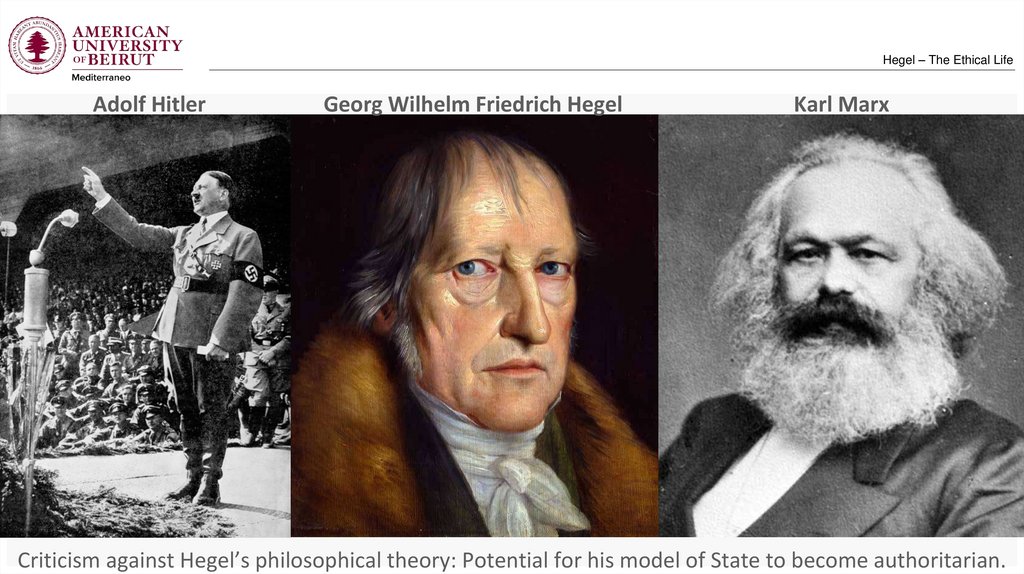
Hegel – The Ethical LifeAdolf Hitler
Georg Wilhelm Friedrich Hegel
Karl Marx
Criticism against Hegel’s philosophical theory: Potential for his model of State to become authoritarian.
12.
Hegel – The Ethical LifePhilosophy of Right
“Negative Freedom”: the ability to free our self from everything and
think of myself as a pure ‘I’.
“Abstract Right”: it belongs to those who know themselves to be
free beings. That have the right to be treated as someone that can
have rights.
“Moral Freedom”: Decides itself what counts as good.
“Ethical Freedom”: Accepts the objective goodness of the
institutions in which it lives.
“Ethical Life”: Constituted from the freedom and good found in the
law and institutions.
13.
Hegel – The Ethical LifeStructures and Institutions which promote freedom so that Ethical Life is
possible (because not all social or political institutions count as ethical)
family life founded on love (not violence).
a civil society in which the right to own and exchange property, and the
freedom to pursue the occupation of one’s own choice, are guaranteed.
courts of law in which justice is upheld in public and on the basis of
published laws.
a public authority and corporations that protect members of society and
defend their rights.
a state in which the monarchical, executive, and legislative powers are
distinguished and we have assemblies responsible for legislation.