




 english
Similar presentations:








Grammar and Functions
1.
and functions2.
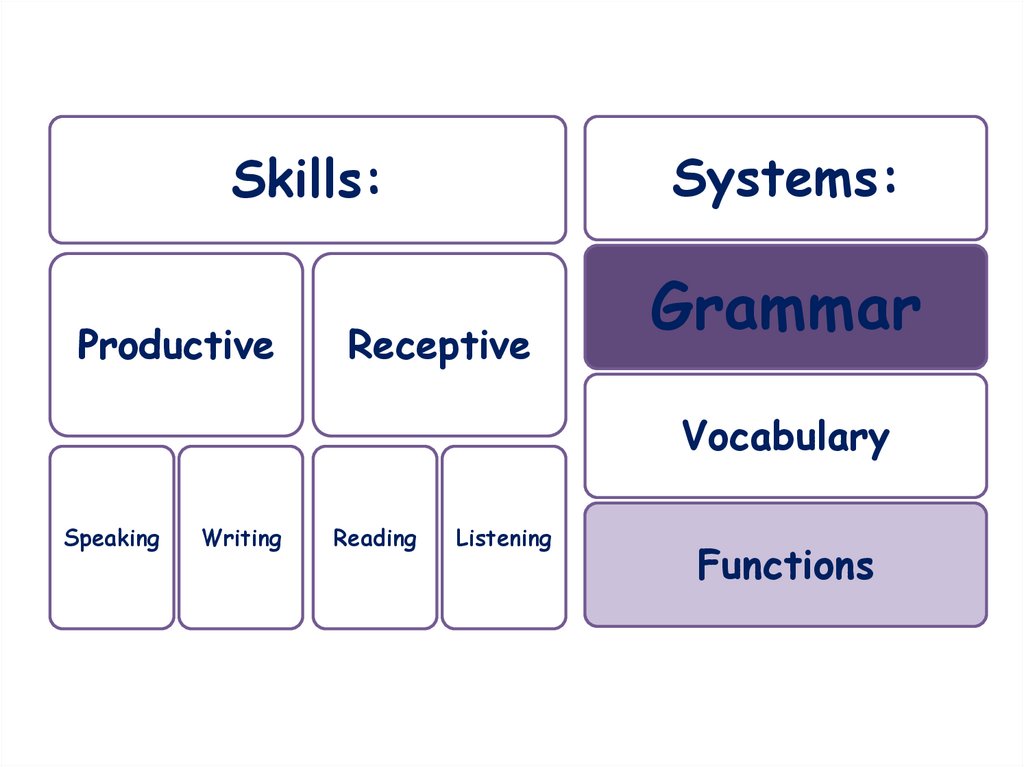
Systems:Skills:
Productive
Receptive
Grammar
Vocabulary
Speaking
Writing
Reading
Listening
Functions
3.
We will talk about:what grammar is
approaches to teaching grammar
lesson frameworks
lesson plan + example lesson
concept checking questions
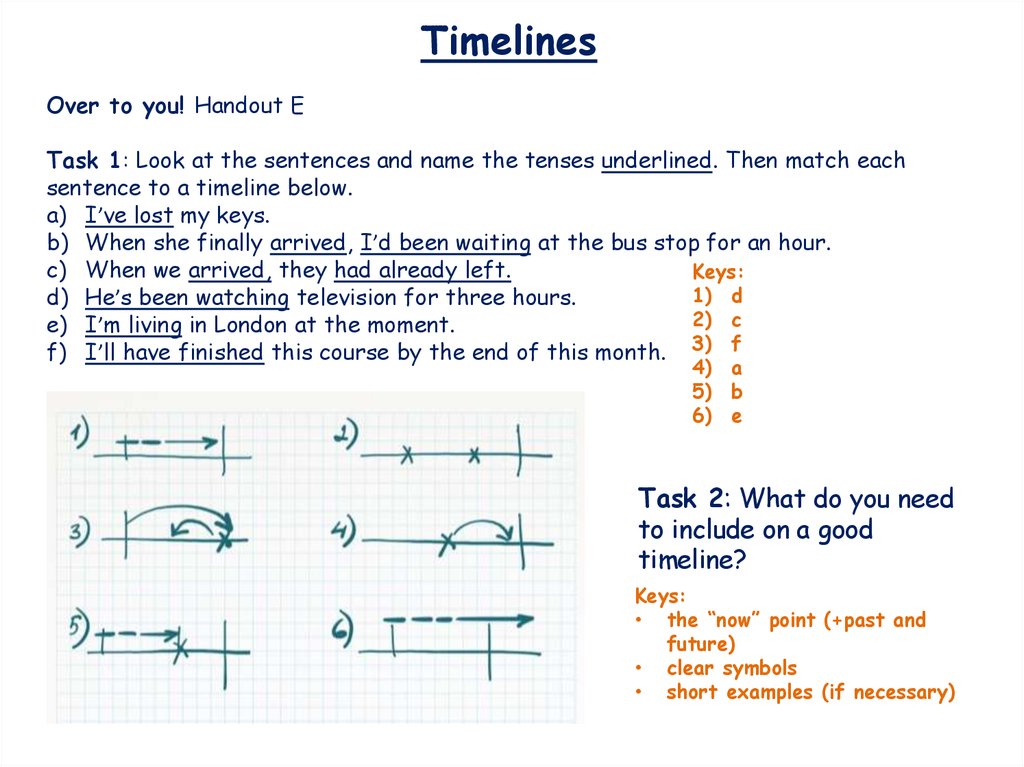
timelines
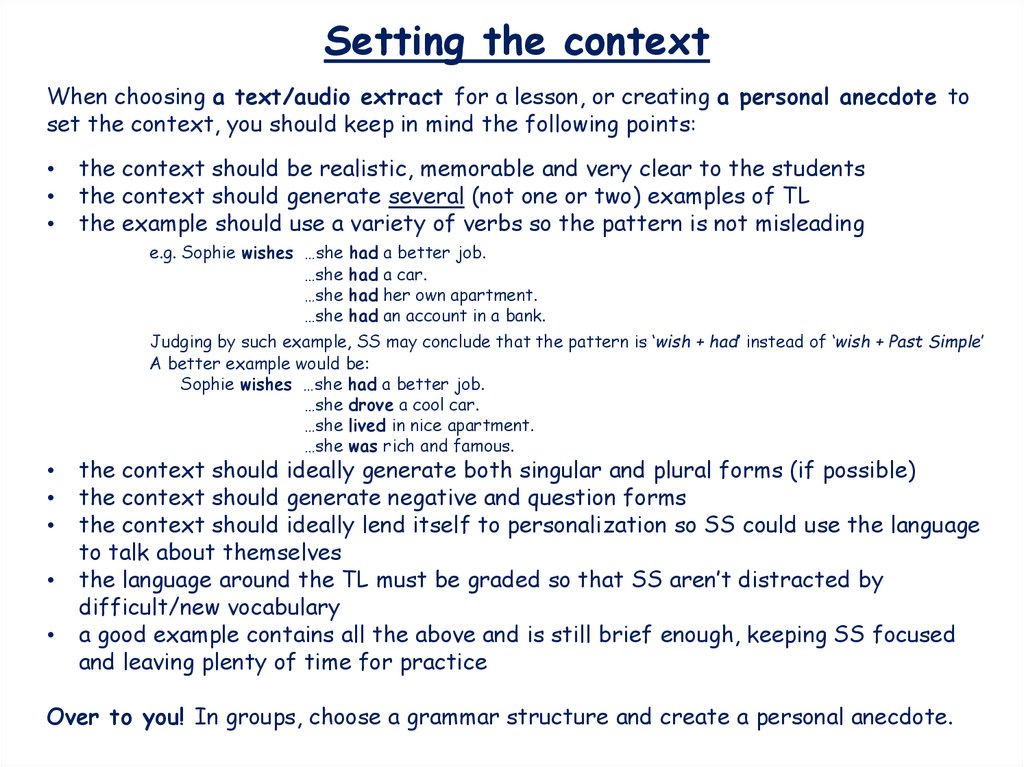
setting the context
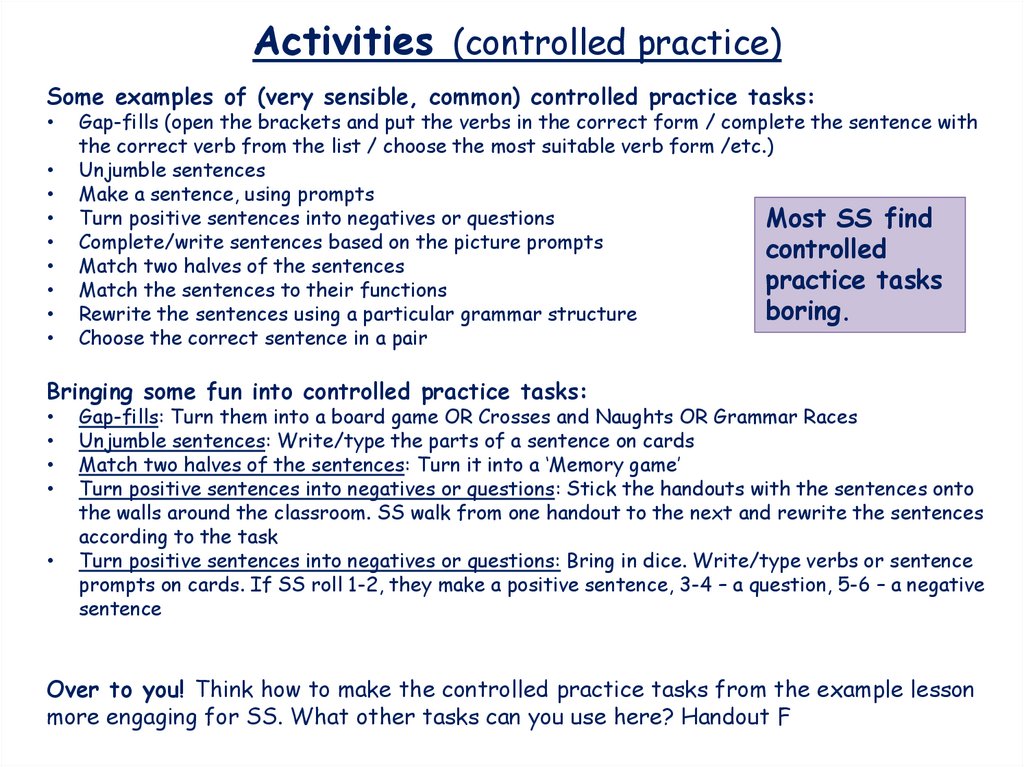
activities (controlled practice)
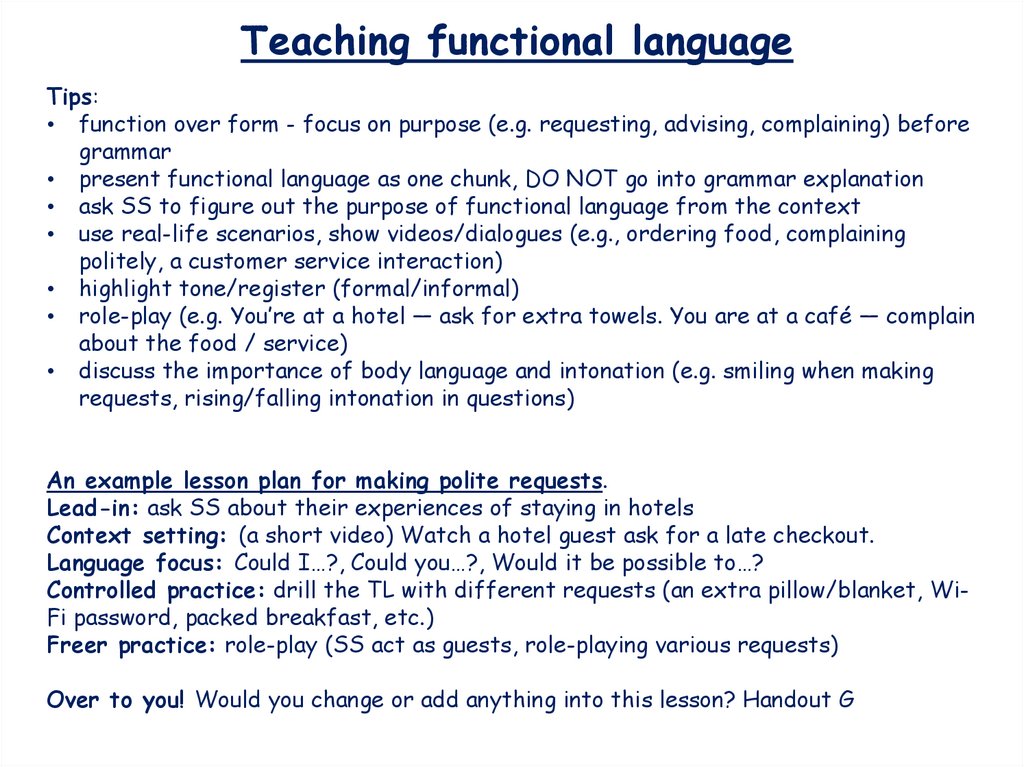
4.
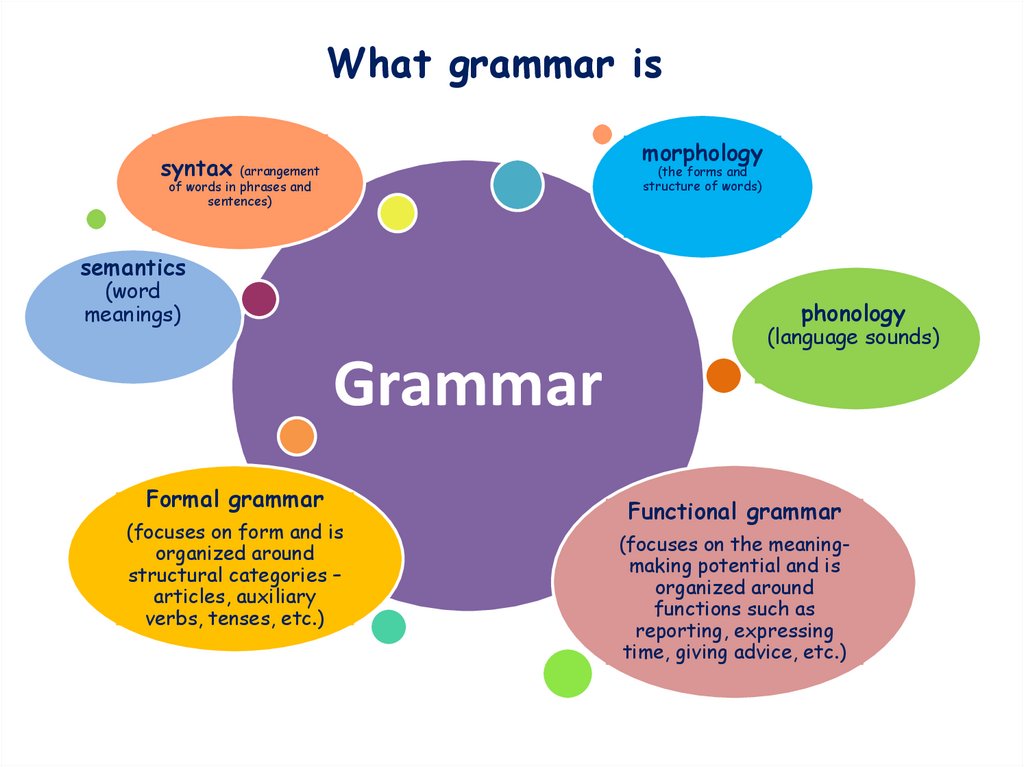
What grammar ismorphology
syntax (arrangement
(the forms and
structure of words)
of words in phrases and
sentences)
semantics
(word
meanings)
phonology
(language sounds)
Grammar
Formal grammar
(focuses on form and is
organized around
structural categories –
articles, auxiliary
verbs, tenses, etc.)
Functional grammar
(focuses on the meaningmaking potential and is
organized around
functions such as
reporting, expressing
time, giving advice, etc.)
5.
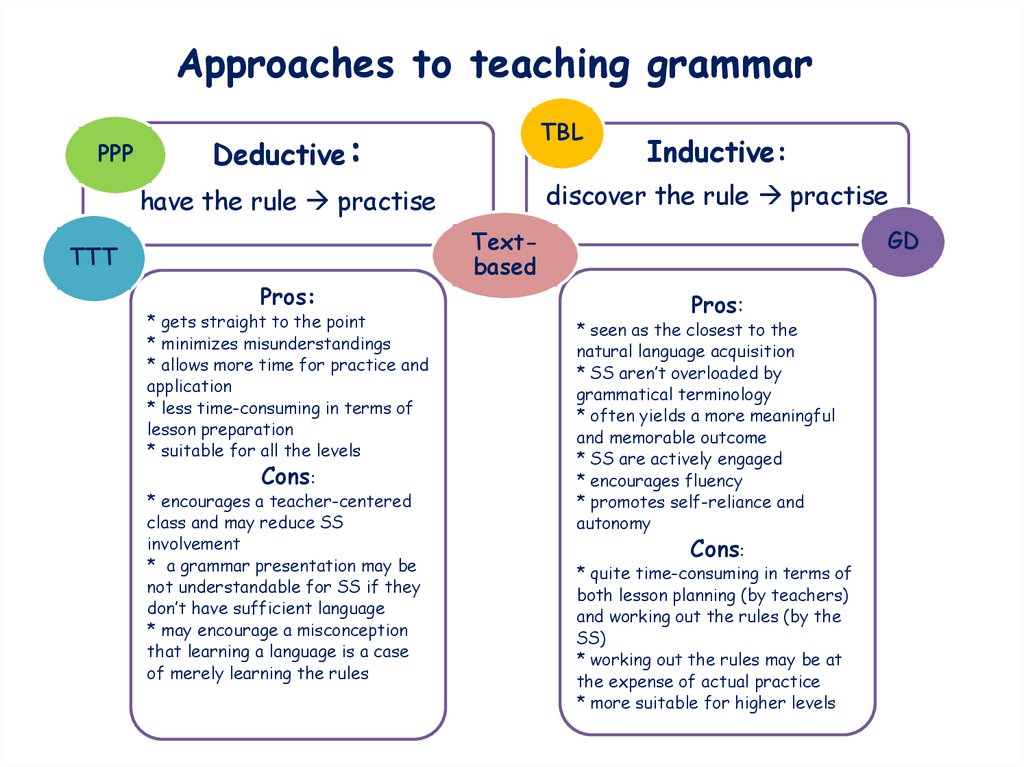
Approaches to teaching grammarPPP
TBL
Deductive:
discover the rule practise
have the rule practise
TTT
Pros:
* gets straight to the point
* minimizes misunderstandings
* allows more time for practice and
application
* less time-consuming in terms of
lesson preparation
* suitable for all the levels
Cons:
* encourages a teacher-centered
class and may reduce SS
involvement
* a grammar presentation may be
not understandable for SS if they
don’t have sufficient language
* may encourage a misconception
that learning a language is a case
of merely learning the rules
Inductive:
GD
Textbased
Pros:
* seen as the closest to the
natural language acquisition
* SS aren’t overloaded by
grammatical terminology
* often yields a more meaningful
and memorable outcome
* SS are actively engaged
* encourages fluency
* promotes self-reliance and
autonomy
Cons:
* quite time-consuming in terms of
both lesson planning (by teachers)
and working out the rules (by the
SS)
* working out the rules may be at
the expense of actual practice
* more suitable for higher levels
6.
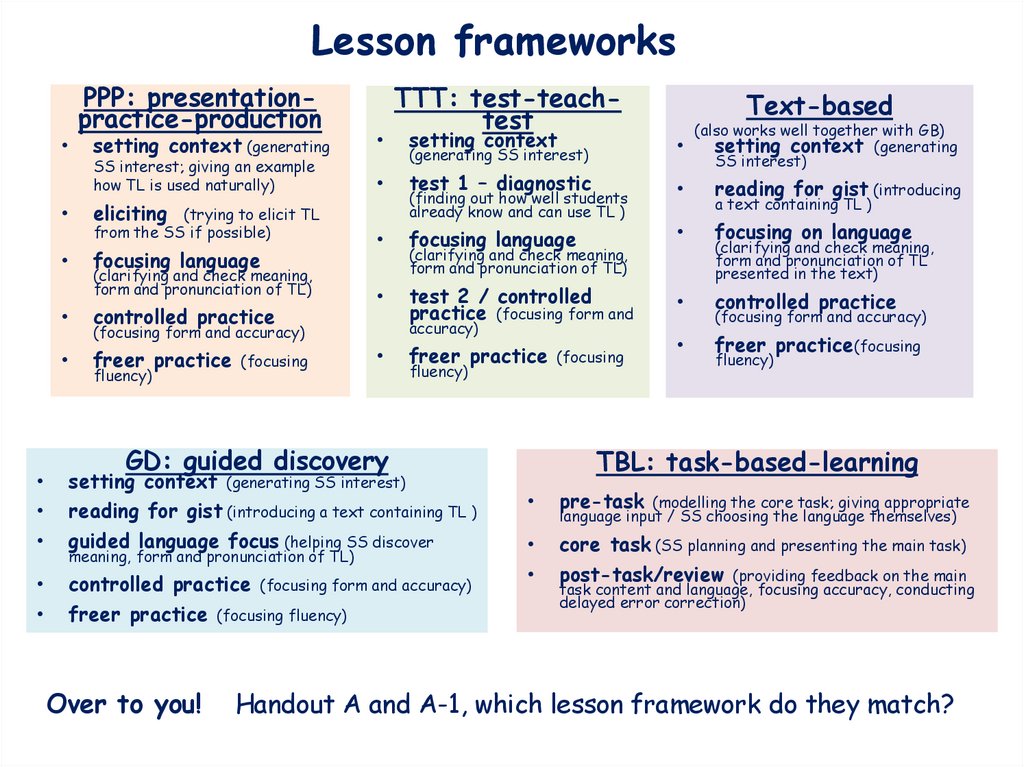
Lesson frameworksPPP: presentationpractice-production
setting context (generating
SS interest; giving an example
how TL is used naturally)
focusing language
(clarifying and check meaning,
form and pronunciation of TL)
controlled practice
freer practice (focusing
test 1 – diagnostic
(also works well together with GB)
setting context (generating
SS interest)
reading for gist (introducing
focusing language
focusing on language
test 2 / controlled
practice (focusing form and
controlled practice
freer practice (focusing
freer practice(focusing
(generating SS interest)
(finding out how well students
already know and can use TL )
(clarifying and check meaning,
form and pronunciation of TL)
accuracy)
(focusing form and accuracy)
fluency)
fluency)
GD: guided discovery
setting context (generating SS interest)
reading for gist (introducing a text containing TL )
guided language focus (helping SS discover
controlled practice (focusing form and accuracy)
freer practice (focusing fluency)
meaning, form and pronunciation of TL)
Over to you!
Text-based
setting context
eliciting
(trying to elicit TL
from the SS if possible)
TTT: test-teachtest
a text containing TL )
(clarifying and check meaning,
form and pronunciation of TL
presented in the text)
(focusing form and accuracy)
fluency)
TBL: task-based-learning
pre-task (modelling the core task; giving appropriate
core task (SS planning and presenting the main task)
post-task/review (providing feedback on the main
language input / SS choosing the language themselves)
task content and language, focusing accuracy, conducting
delayed error correction)
Handout A and A-1, which lesson framework do they match?
7.
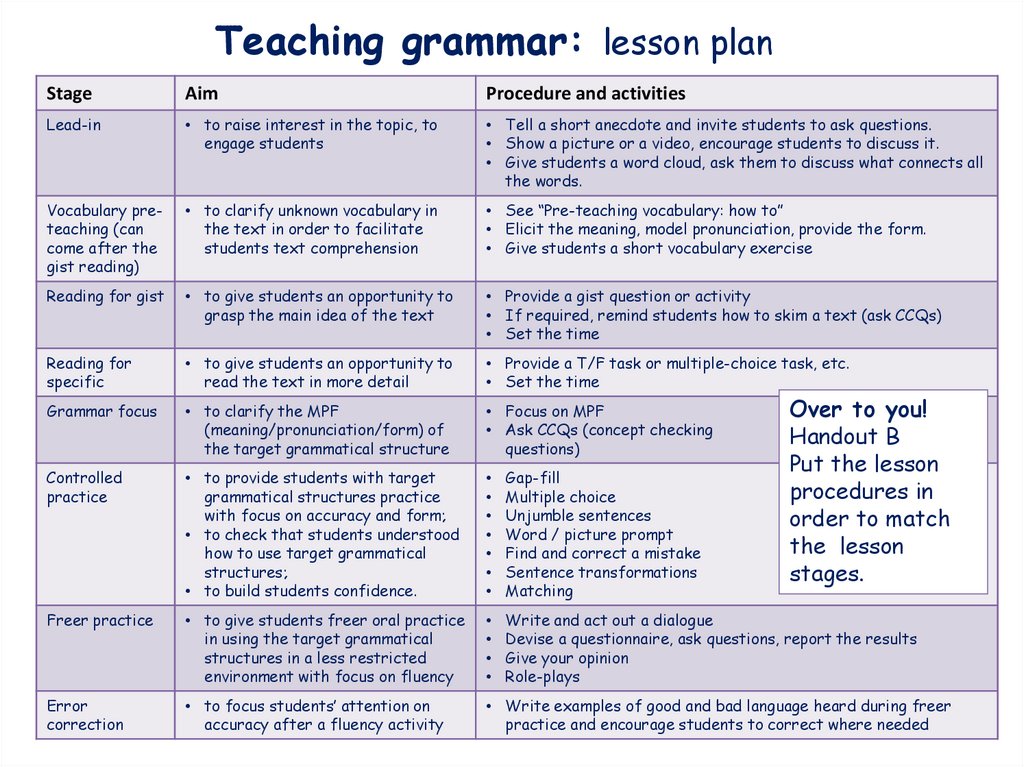
Teaching grammar: lesson planStage
Aim
Procedure and activities
Lead-in
• to raise interest in the topic, to
engage students
• Tell a short anecdote and invite students to ask questions.
• Show a picture or a video, encourage students to discuss it.
• Give students a word cloud, ask them to discuss what connects all
the words.
Vocabulary preteaching (can
come after the
gist reading)
• to clarify unknown vocabulary in
the text in order to facilitate
students text comprehension
• See “Pre-teaching vocabulary: how to”
• Elicit the meaning, model pronunciation, provide the form.
• Give students a short vocabulary exercise
Reading for gist
• to give students an opportunity to
grasp the main idea of the text
• Provide a gist question or activity
• If required, remind students how to skim a text (ask CCQs)
• Set the time
Reading for
specific
• to give students an opportunity to
read the text in more detail
• Provide a T/F task or multiple-choice task, etc.
• Set the time
Grammar focus
• to clarify the MPF
(meaning/pronunciation/form) of
the target grammatical structure
• Focus on MPF
• Ask CCQs (concept checking
questions)
Controlled
practice
• to provide students with target
grammatical structures practice
with focus on accuracy and form;
• to check that students understood
how to use target grammatical
structures;
• to build students confidence.
Gap-fill
Multiple choice
Unjumble sentences
Word / picture prompt
Find and correct a mistake
Sentence transformations
Matching
Freer practice
• to give students freer oral practice
in using the target grammatical
structures in a less restricted
environment with focus on fluency
Write and act out a dialogue
Devise a questionnaire, ask questions, report the results
Give your opinion
Role-plays
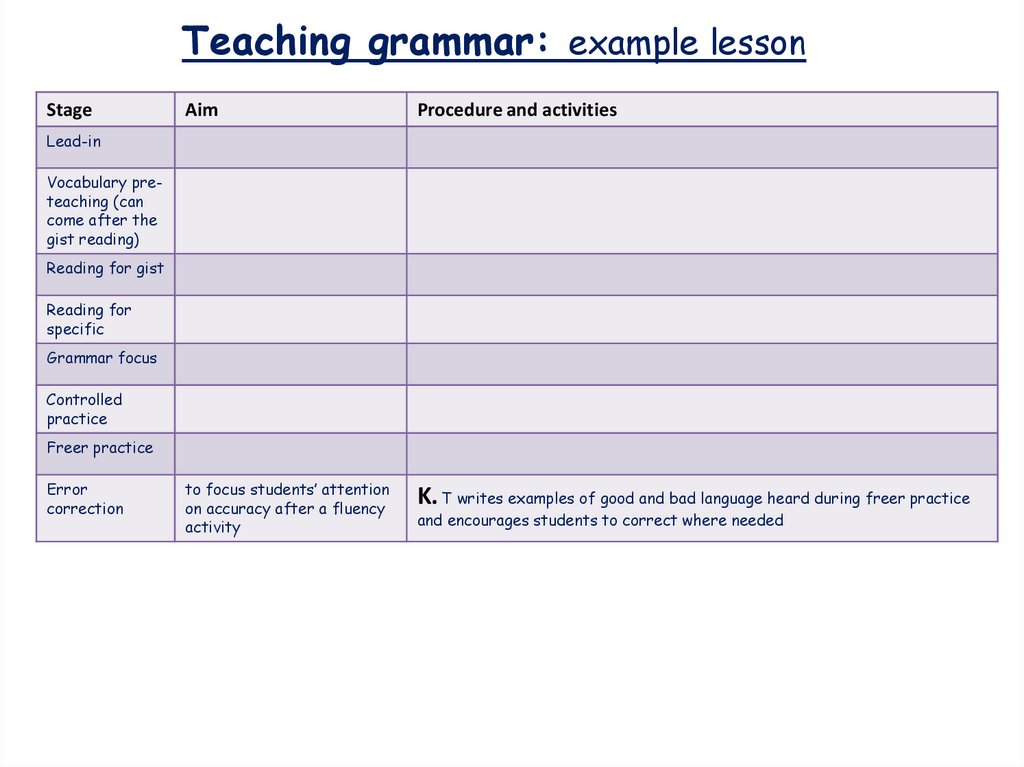
Error
correction
• to focus students’ attention on
accuracy after a fluency activity
• Write examples of good and bad language heard during freer
practice and encourage students to correct where needed
Over to you!
Handout B
Put the lesson
procedures in
order to match
the lesson
stages.
8.
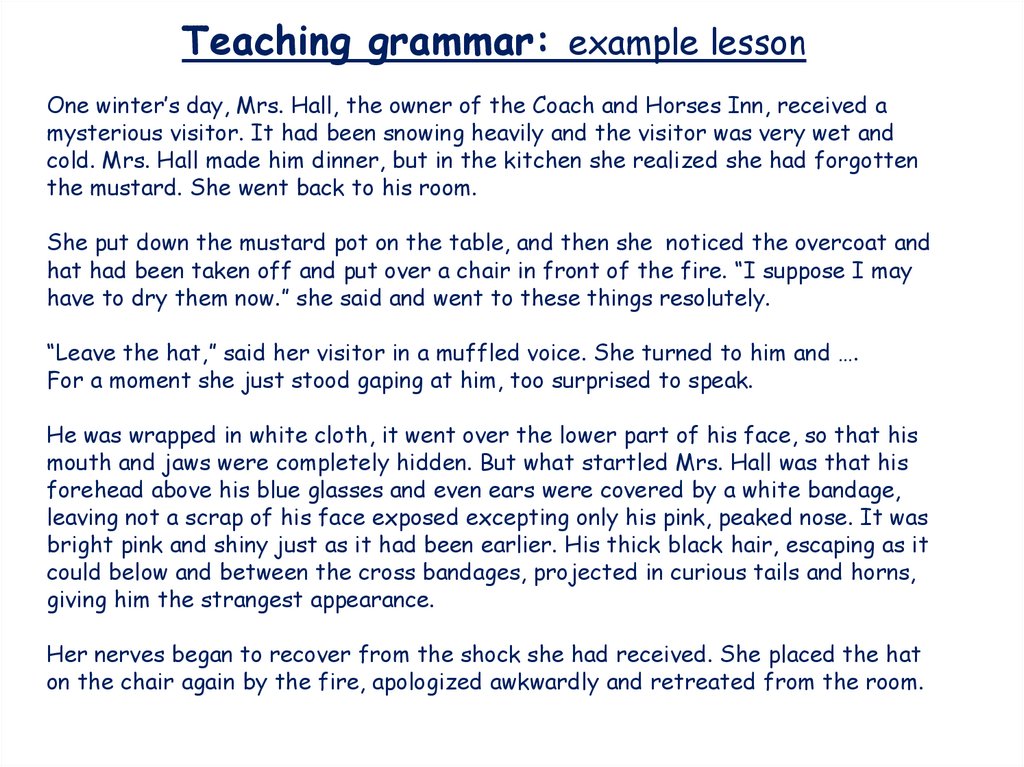
Teaching grammar: example lessonOne winter’s day, Mrs. Hall, the owner of the Coach and Horses Inn, received a
mysterious visitor. It had been snowing heavily and the visitor was very wet and
cold. Mrs. Hall made him dinner, but in the kitchen she realized she had forgotten
the mustard. She went back to his room.
She put down the mustard pot on the table, and then she noticed the overcoat and
hat had been taken off and put over a chair in front of the fire. “I suppose I may
have to dry them now.” she said and went to these things resolutely.
“Leave the hat,” said her visitor in a muffled voice. She turned to him and ….
For a moment she just stood gaping at him, too surprised to speak.
He was wrapped in white cloth, it went over the lower part of his face, so that his
mouth and jaws were completely hidden. But what startled Mrs. Hall was that his
forehead above his blue glasses and even ears were covered by a white bandage,
leaving not a scrap of his face exposed excepting only his pink, peaked nose. It was
bright pink and shiny just as it had been earlier. His thick black hair, escaping as it
could below and between the cross bandages, projected in curious tails and horns,
giving him the strangest appearance.
Her nerves began to recover from the shock she had received. She placed the hat
on the chair again by the fire, apologized awkwardly and retreated from the room.
9.
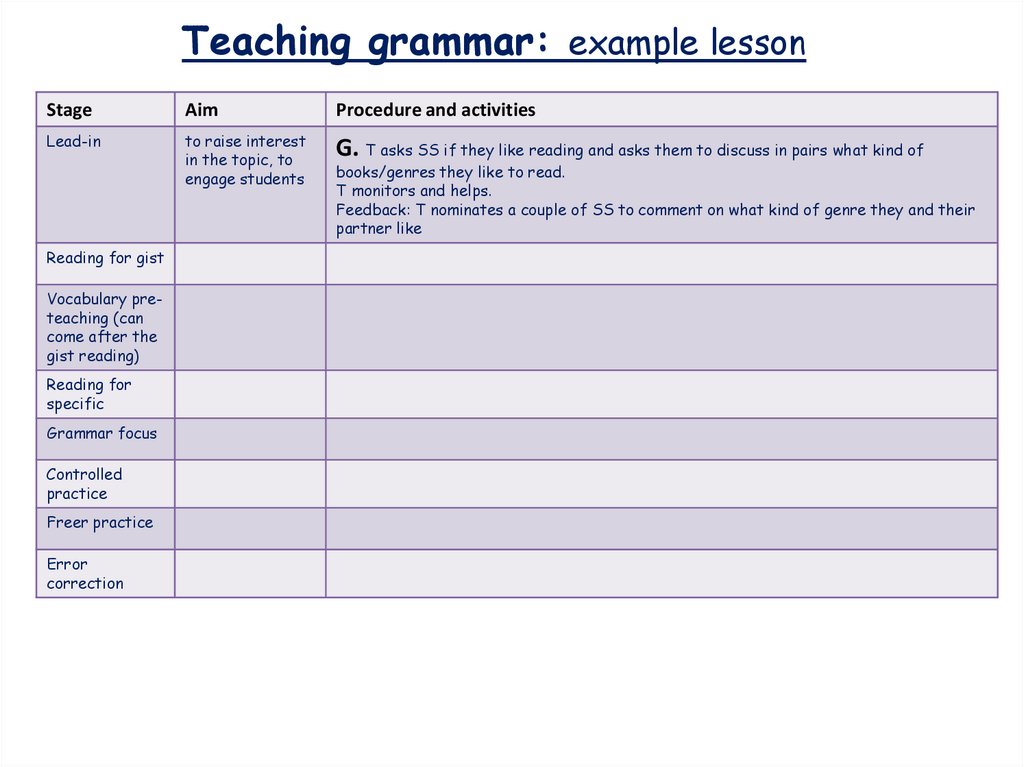
Teaching grammar: example lessonStage
Aim
Procedure and activities
Lead-in
to raise interest
in the topic, to
engage students
G. T asks SS if they like reading and asks them to discuss in pairs what kind of
Reading for gist
Vocabulary preteaching (can
come after the
gist reading)
Reading for
specific
Grammar focus
Controlled
practice
Freer practice
Error
correction
books/genres they like to read.
T monitors and helps.
Feedback: T nominates a couple of SS to comment on what kind of genre they and their
partner like
10.
Teaching grammar: example lessonStage
Aim
Procedure and activities
to give
students an
opportunity to
grasp the main
idea of the
text
C. Task: Read the extract from a famous English story and decide which title is more
Lead-in
Reading for gist
appropriate:
A. The Invisible man
B. A day in winter
C. Injury at the Coach and Horses Inn
T tells SS they are going to read the text quickly (1 min) and decide on the best title. T
asks:
Will you read quickly or slowly? (quickly)
Will you try to understand every word? (no)
How long do you have? (1 min)
T monitors
Pair check
Feedback: T collects ideas and encourages SS to justify their answers
Vocabulary preteaching (can
come after the
gist reading)
Reading for
specific
Grammar focus
Controlled
practice
Freer practice
Error
11.
Teaching grammar: example lessonStage
Aim
Procedure and activities
to clarify
unknown
vocabulary in
the text in
order to
facilitate
students text
comprehension
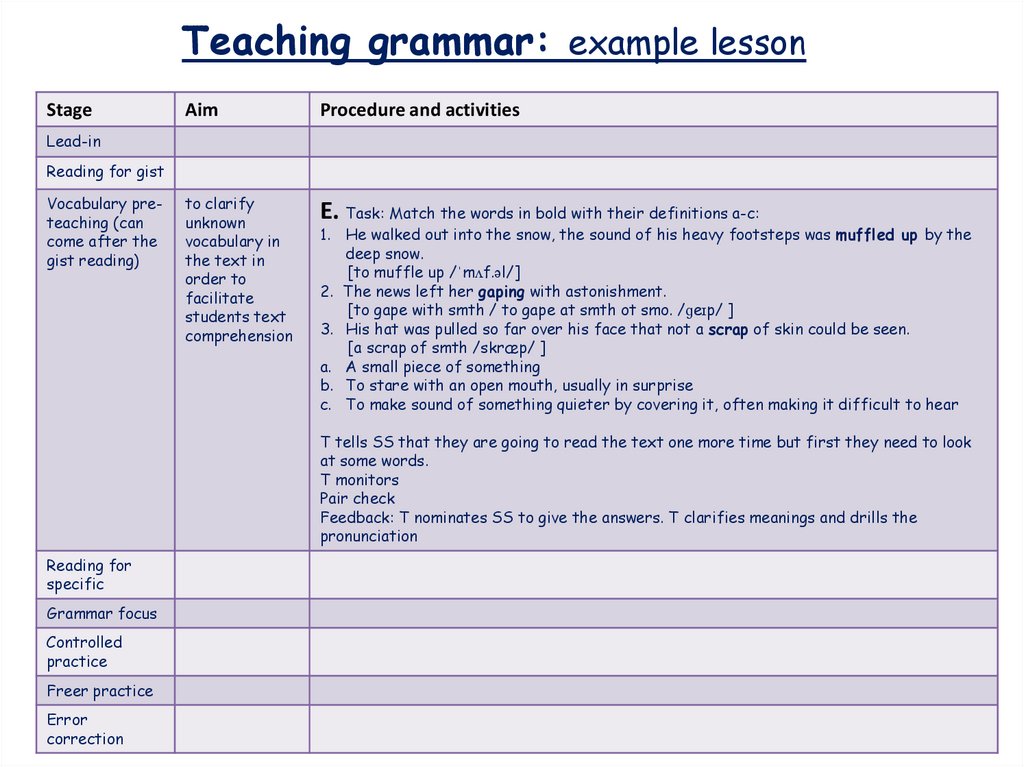
E. Task: Match the words in bold with their definitions a-c:
Lead-in
Reading for gist
Vocabulary preteaching (can
come after the
gist reading)
1. He walked out into the snow, the sound of his heavy footsteps was muffled up by the
deep snow.
[to muffle up /ˈmʌf.əl/]
2. The news left her gaping with astonishment.
[to gape with smth / to gape at smth ot smo. /ɡeɪp/ ]
3. His hat was pulled so far over his face that not a scrap of skin could be seen.
[a scrap of smth /skræp/ ]
a. A small piece of something
b. To stare with an open mouth, usually in surprise
c. To make sound of something quieter by covering it, often making it difficult to hear
T tells SS that they are going to read the text one more time but first they need to look
at some words.
T monitors
Pair check
Feedback: T nominates SS to give the answers. T clarifies meanings and drills the
pronunciation
Reading for
specific
Grammar focus
Controlled
practice
Freer practice
Error
correction
12.
Teaching grammar: example lessonStage
Aim
Procedure and activities
to give
students an
opportunity to
grasp the main
idea of the
text
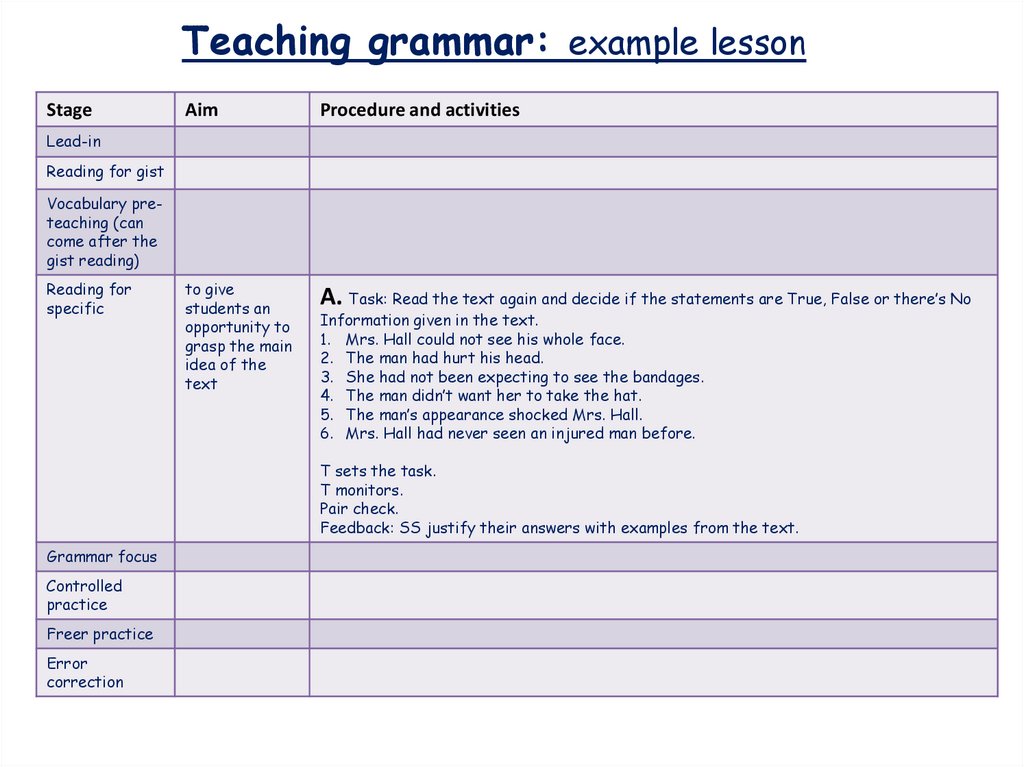
A. Task: Read the text again and decide if the statements are True, False or there’s No
Lead-in
Reading for gist
Vocabulary preteaching (can
come after the
gist reading)
Reading for
specific
Information given in the text.
1. Mrs. Hall could not see his whole face.
2. The man had hurt his head.
3. She had not been expecting to see the bandages.
4. The man didn’t want her to take the hat.
5. The man’s appearance shocked Mrs. Hall.
6. Mrs. Hall had never seen an injured man before.
T sets the task.
T monitors.
Pair check.
Feedback: SS justify their answers with examples from the text.
Grammar focus
Controlled
practice
Freer practice
Error
correction
13.
Teaching grammar: example lessonStage
Aim
Procedure and activities
Grammar
focus
to clarify the
MPF of the
target
grammatical
structure
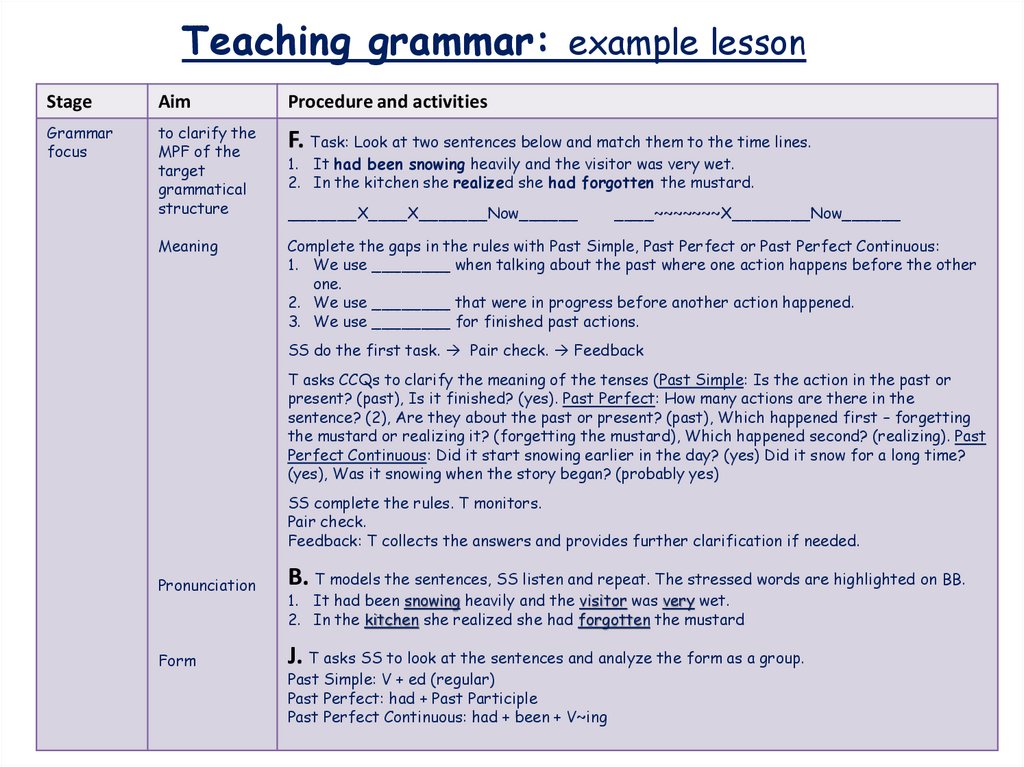
F. Task: Look at two sentences below and match them to the time lines.
Meaning
Complete the gaps in the rules with Past Simple, Past Perfect or Past Perfect Continuous:
1. We use ________ when talking about the past where one action happens before the other
one.
2. We use ________ that were in progress before another action happened.
3. We use ________ for finished past actions.
1. It had been snowing heavily and the visitor was very wet.
2. In the kitchen she realized she had forgotten the mustard.
_______X____X_______Now______
____~~~~~~~X________Now______
SS do the first task. Pair check. Feedback
T asks CCQs to clarify the meaning of the tenses (Past Simple: Is the action in the past or
present? (past), Is it finished? (yes). Past Perfect: How many actions are there in the
sentence? (2), Are they about the past or present? (past), Which happened first – forgetting
the mustard or realizing it? (forgetting the mustard), Which happened second? (realizing). Past
Perfect Continuous: Did it start snowing earlier in the day? (yes) Did it snow for a long time?
(yes), Was it snowing when the story began? (probably yes)
SS complete the rules. T monitors.
Pair check.
Feedback: T collects the answers and provides further clarification if needed.
Pronunciation
B. T models the sentences, SS listen and repeat. The stressed words are highlighted on BB.
Form
J. T asks SS to look at the sentences and analyze the form as a group.
1. It had been snowing heavily and the visitor was very wet.
2. In the kitchen she realized she had forgotten the mustard
Past Simple: V + ed (regular)
Past Perfect: had + Past Participle
Past Perfect Continuous: had + been + V~ing
14.
Teaching grammar: example lessonStage
Aim
Procedure and activities
Controlled
practice
to provide students
with target
grammatical
structures practice
with focus on
accuracy and form;
to check that
students
understood how to
use target
grammatical
structures;
to build students
confidence.
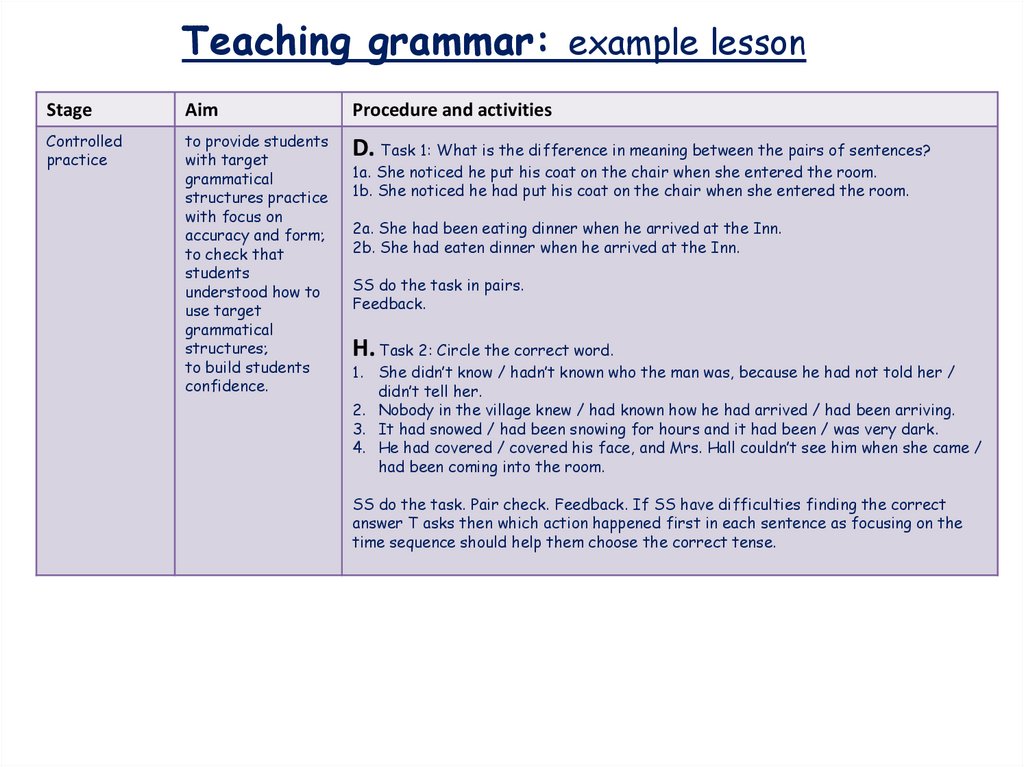
D. Task 1: What is the difference in meaning between the pairs of sentences?
1a. She noticed he put his coat on the chair when she entered the room.
1b. She noticed he had put his coat on the chair when she entered the room.
2a. She had been eating dinner when he arrived at the Inn.
2b. She had eaten dinner when he arrived at the Inn.
SS do the task in pairs.
Feedback.
H. Task 2: Circle the correct word.
1. She didn’t know / hadn’t known who the man was, because he had not told her /
didn’t tell her.
2. Nobody in the village knew / had known how he had arrived / had been arriving.
3. It had snowed / had been snowing for hours and it had been / was very dark.
4. He had covered / covered his face, and Mrs. Hall couldn’t see him when she came /
had been coming into the room.
SS do the task. Pair check. Feedback. If SS have difficulties finding the correct
answer T asks then which action happened first in each sentence as focusing on the
time sequence should help them choose the correct tense.
15.
Teaching grammar: example lessonStage
Aim
Procedure and activities
to give students freer oral
practice in using the target
grammatical structures in a
less restricted environment
with focus on fluency
I. Task: Choose two of the sentences below and complete them with true
Lead-in
Vocabulary preteaching (can
come after the
gist reading)
Reading for gist
Reading for
specific
Grammar focus
Controlled
practice
Freer practice
information about yourself.
• I had been living in ____ for ____ years when I met _____.
• Why did I choose to study English? It must have been because ___.
• I had been studying ___ for ____ when I decided I wanted to ___.
• I had never understood ____ until I ____ .
• I could have been a ____ but it the end I decided to ____ .
Share your sentences with a partner and give more background information
about these events.
SS do the task. T monitors and helps if needed.
Feedback. T nominates a couple of students to report back.
Error
correction
16.
Teaching grammar: example lessonStage
Aim
Procedure and activities
to focus students’ attention
on accuracy after a fluency
activity
K. T writes examples of good and bad language heard during freer practice
Lead-in
Vocabulary preteaching (can
come after the
gist reading)
Reading for gist
Reading for
specific
Grammar focus
Controlled
practice
Freer practice
Error
correction
and encourages students to correct where needed
17.
Teaching grammar: over to youOver to you! Handout C
• What is this lesson missing?
• What activities or stages would you add?
• What else would you change?
18.
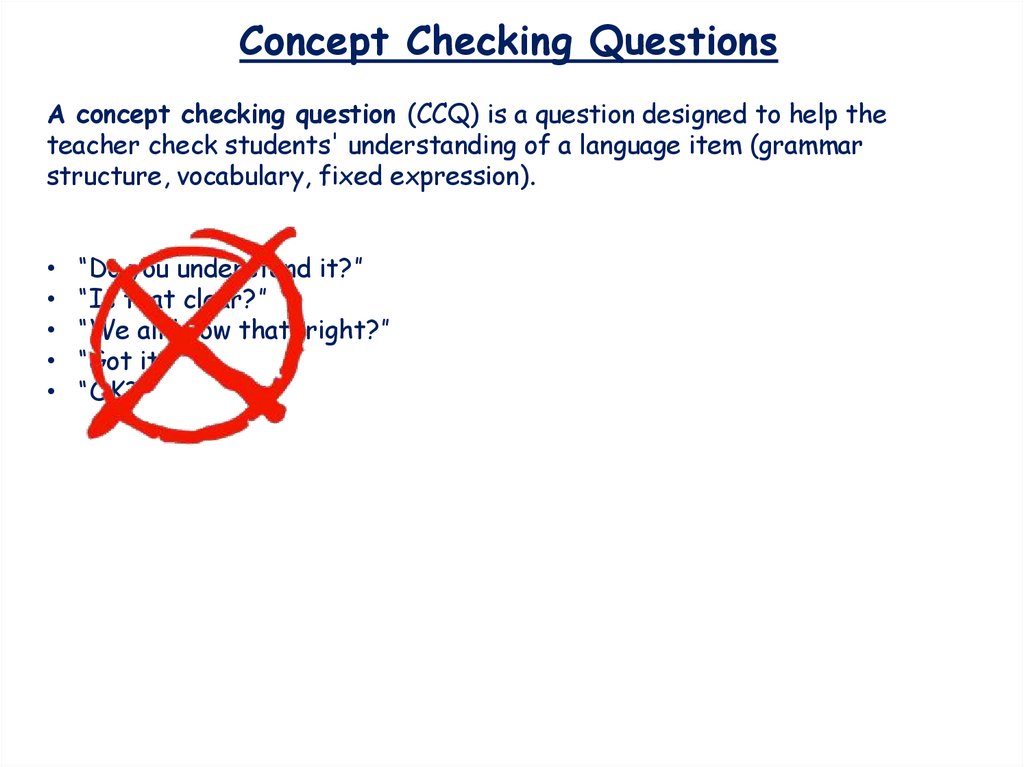
Concept Checking QuestionsA concept checking question (CCQ) is a question designed to help the
teacher check students' understanding of a language item (grammar
structure, vocabulary, fixed expression).
“Do you understand it?”
“Is that clear?”
“We all know that, right?”
“Got it?”
“OK?”
19.
Concept Checking QuestionsGood CCQs …
…shouldn’t use TL* to check itself (esp. if it’s a tense/structure)
…should be graded so that the language in the question is simpler than
TL
…should just check TL, not something else in the sentence
…shouldn’t become a guessing game
…should cover all the areas of concept and potential confusion
…should be limited in number (2 or 3 is enough)
…should have clear answers
* TL – target language (a language that is being or is to be learnt)
20.
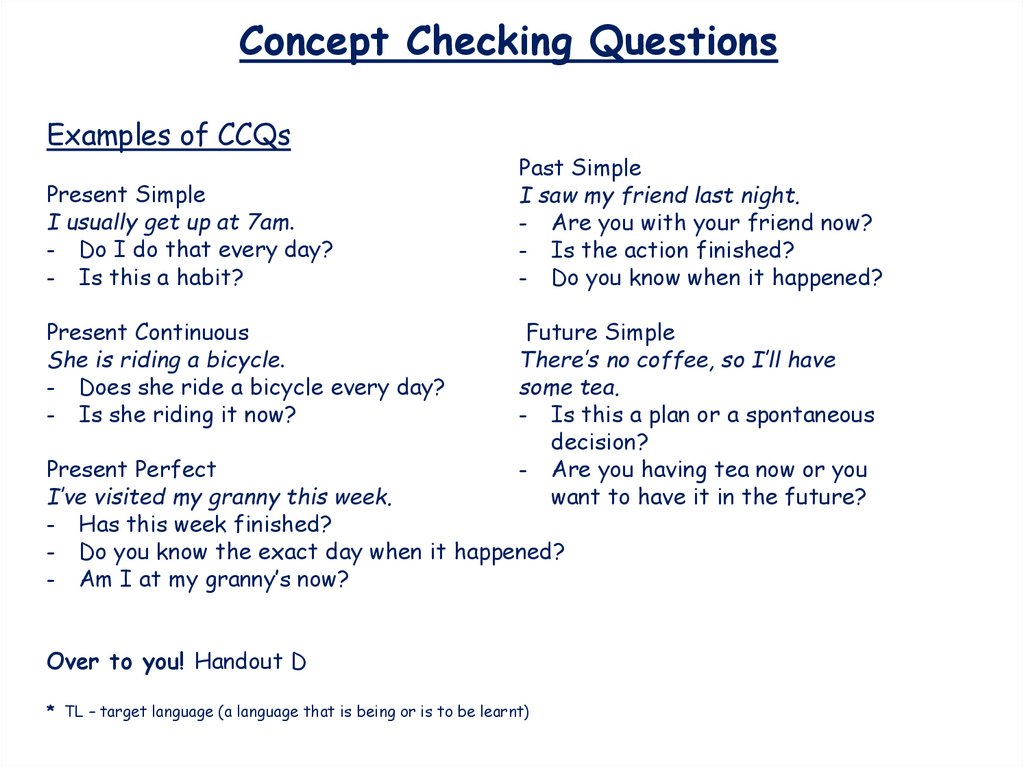
Concept Checking QuestionsExamples of CCQs
Present Simple
I usually get up at 7am.
- Do I do that every day?
- Is this a habit?
Present Continuous
She is riding a bicycle.
- Does she ride a bicycle every day?
- Is she riding it now?
Past Simple
I saw my friend last night.
- Are you with your friend now?
- Is the action finished?
- Do you know when it happened?
Future Simple
There’s no coffee, so I’ll have
some tea.
- Is this a plan or a spontaneous
decision?
- Are you having tea now or you
want to have it in the future?
Present Perfect
I’ve visited my granny this week.
- Has this week finished?
- Do you know the exact day when it happened?
- Am I at my granny’s now?
Over to you! Handout D
* TL – target language (a language that is being or is to be learnt)
21.
TimelinesOver to you! Handout E
Task 1: Look at the sentences and name the tenses underlined. Then match each
sentence to a timeline below.
a) I’ve lost my keys.
b) When she finally arrived, I’d been waiting at the bus stop for an hour.
c) When we arrived, they had already left.
Keys:
1) d
d) He’s been watching television for three hours.
2) c
e) I’m living in London at the moment.
f) I’ll have finished this course by the end of this month. 3) f
4) a
5) b
6) e
Task 2: What do you need
to include on a good
timeline?
Keys:
• the “now” point (+past and
future)
• clear symbols
• short examples (if necessary)
22.
Setting the contextWhen choosing a text/audio extract for a lesson, or creating a personal anecdote to
set the context, you should keep in mind the following points:
the context should be realistic, memorable and very clear to the students
the context should generate several (not one or two) examples of TL
the example should use a variety of verbs so the pattern is not misleading
e.g. Sophie wishes …she had a better job.
…she had a car.
…she had her own apartment.
…she had an account in a bank.
Judging by such example, SS may conclude that the pattern is ‘wish + had’ instead of ‘wish + Past Simple’
A better example would be:
Sophie wishes …she had a better job.
…she drove a cool car.
…she lived in nice apartment.
…she was rich and famous.
the context should ideally generate both singular and plural forms (if possible)
the context should generate negative and question forms
the context should ideally lend itself to personalization so SS could use the language
to talk about themselves
the language around the TL must be graded so that SS aren’t distracted by
difficult/new vocabulary
a good example contains all the above and is still brief enough, keeping SS focused
and leaving plenty of time for practice
Over to you! In groups, choose a grammar structure and create a personal anecdote.
23.
Activities (controlled practice)Some examples of (very sensible, common) controlled practice tasks:
Gap-fills (open the brackets and put the verbs in the correct form / complete the sentence with
the correct verb from the list / choose the most suitable verb form /etc.)
Unjumble sentences
Make a sentence, using prompts
Turn positive sentences into negatives or questions
Most SS find
Complete/write sentences based on the picture prompts
controlled
Match two halves of the sentences
practice tasks
Match the sentences to their functions
boring.
Rewrite the sentences using a particular grammar structure
Choose the correct sentence in a pair
Bringing some fun into controlled practice tasks:
Gap-fills: Turn them into a board game OR Crosses and Naughts OR Grammar Races
Unjumble sentences: Write/type the parts of a sentence on cards
Match two halves of the sentences: Turn it into a ‘Memory game’
Turn positive sentences into negatives or questions: Stick the handouts with the sentences onto
the walls around the classroom. SS walk from one handout to the next and rewrite the sentences
according to the task
Turn positive sentences into negatives or questions: Bring in dice. Write/type verbs or sentence
prompts on cards. If SS roll 1-2, they make a positive sentence, 3-4 – a question, 5-6 – a negative
sentence
Over to you! Think how to make the controlled practice tasks from the example lesson
more engaging for SS. What other tasks can you use here? Handout F
24.
Teaching functional languageTips:
• function over form - focus on purpose (e.g. requesting, advising, complaining) before
grammar
• present functional language as one chunk, DO NOT go into grammar explanation
• ask SS to figure out the purpose of functional language from the context
• use real-life scenarios, show videos/dialogues (e.g., ordering food, complaining
politely, a customer service interaction)
• highlight tone/register (formal/informal)
• role-play (e.g. You’re at a hotel — ask for extra towels. You are at a café — complain
about the food / service)
• discuss the importance of body language and intonation (e.g. smiling when making
requests, rising/falling intonation in questions)
An example lesson plan for making polite requests.
Lead-in: ask SS about their experiences of staying in hotels
Context setting: (a short video) Watch a hotel guest ask for a late checkout.
Language focus: Could I…?, Could you…?, Would it be possible to…?
Controlled practice: drill the TL with different requests (an extra pillow/blanket, WiFi password, packed breakfast, etc.)
Freer practice: role-play (SS act as guests, role-playing various requests)
Over to you! Would you change or add anything into this lesson? Handout G
25.
26.
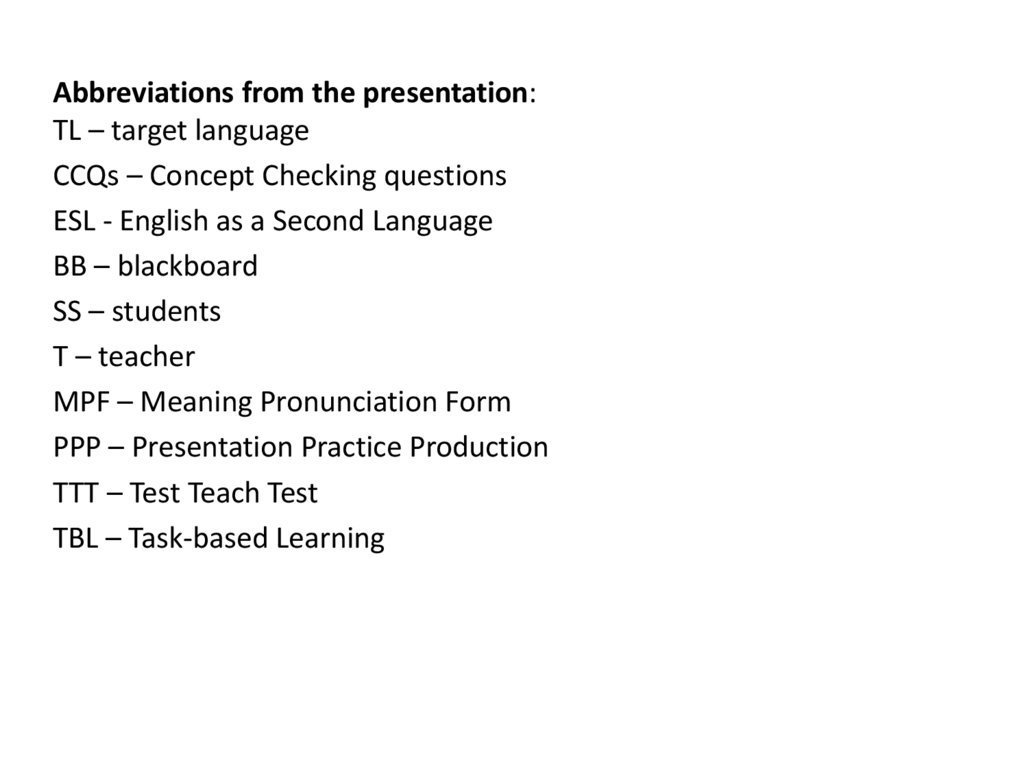
Abbreviations from the presentation:TL – target language
CCQs – Concept Checking questions
ESL - English as a Second Language
BB – blackboard
SS – students
T – teacher
MPF – Meaning Pronunciation Form
PPP – Presentation Practice Production
TTT – Test Teach Test
TBL – Task-based Learning