 english
Similar presentations:


Assessment criteria and descriptors in English language teaching
1.
Assessment criteria anddescriptors in English language
teaching
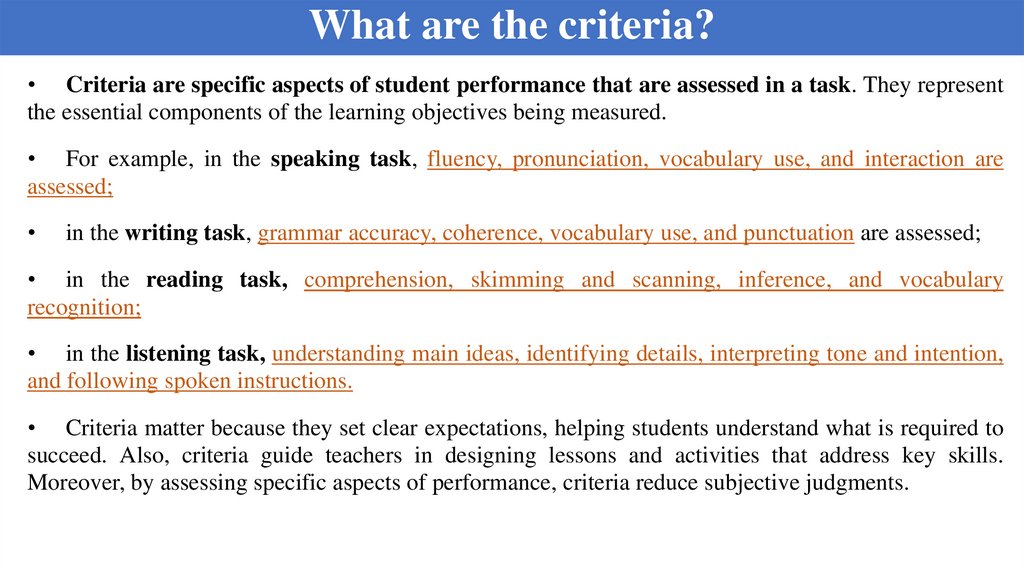
2. What are the criteria?
• Criteria are specific aspects of student performance that are assessed in a task. They representthe essential components of the learning objectives being measured.
• For example, in the speaking task, fluency, pronunciation, vocabulary use, and interaction are
assessed;
in the writing task, grammar accuracy, coherence, vocabulary use, and punctuation are assessed;
• in the reading task, comprehension, skimming and scanning, inference, and vocabulary
recognition;
• in the listening task, understanding main ideas, identifying details, interpreting tone and intention,
and following spoken instructions.
• Criteria matter because they set clear expectations, helping students understand what is required to
succeed. Also, criteria guide teachers in designing lessons and activities that address key skills.
Moreover, by assessing specific aspects of performance, criteria reduce subjective judgments.
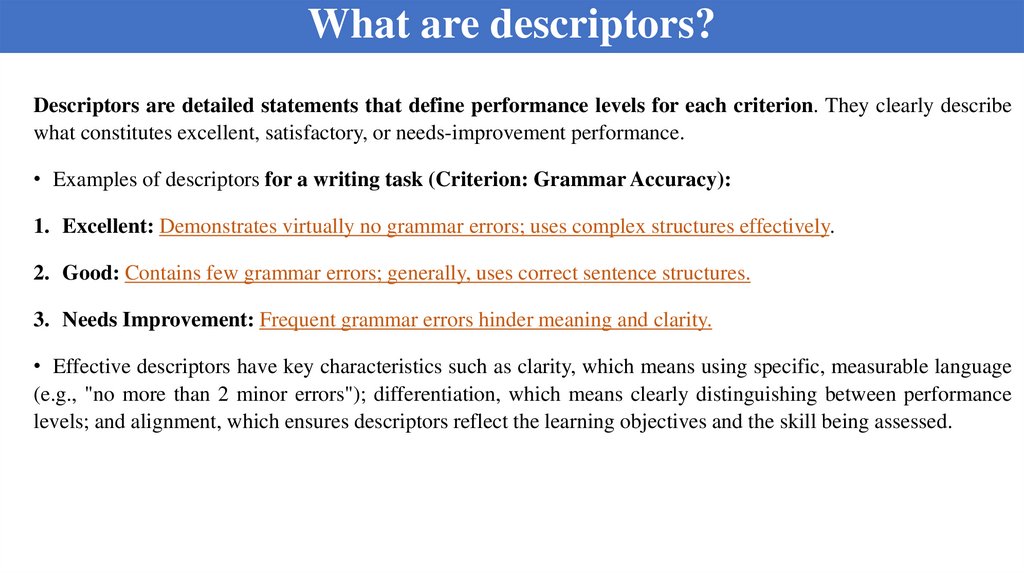
3. What are descriptors?
Descriptors are detailed statements that define performance levels for each criterion. They clearly describewhat constitutes excellent, satisfactory, or needs-improvement performance.
• Examples of descriptors for a writing task (Criterion: Grammar Accuracy):
1. Excellent: Demonstrates virtually no grammar errors; uses complex structures effectively.
2. Good: Contains few grammar errors; generally, uses correct sentence structures.
3. Needs Improvement: Frequent grammar errors hinder meaning and clarity.
• Effective descriptors have key characteristics such as clarity, which means using specific, measurable language
(e.g., "no more than 2 minor errors"); differentiation, which means clearly distinguishing between performance
levels; and alignment, which ensures descriptors reflect the learning objectives and the skill being assessed.
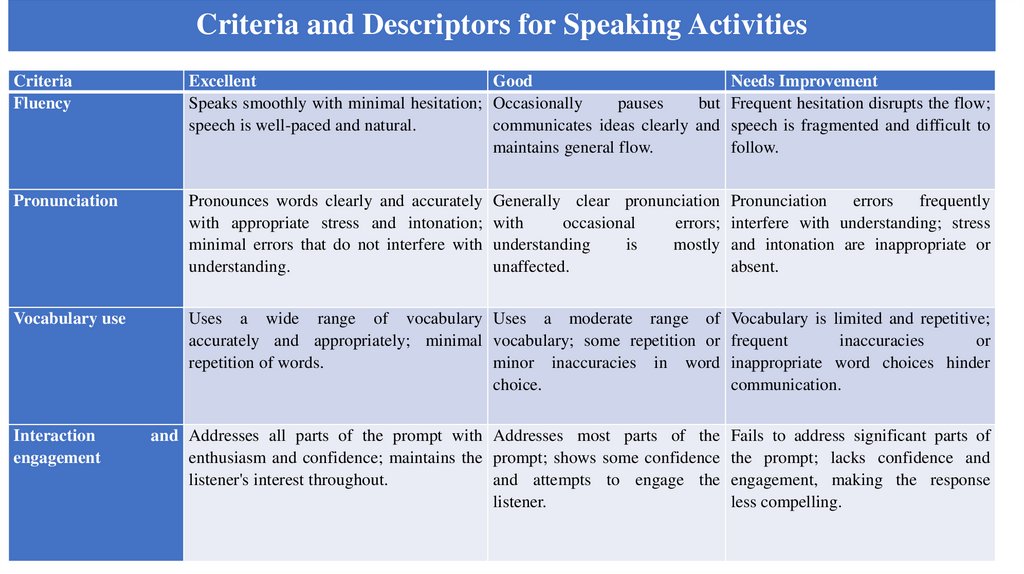
4. Criteria and Descriptors for Speaking Activities
CriteriaFluency
Excellent
Good
Needs Improvement
Speaks smoothly with minimal hesitation; Occasionally
pauses
but Frequent hesitation disrupts the flow;
speech is well-paced and natural.
communicates ideas clearly and speech is fragmented and difficult to
maintains general flow.
follow.
Pronunciation
Pronounces words clearly and accurately Generally clear pronunciation Pronunciation
errors
frequently
with appropriate stress and intonation; with
occasional
errors; interfere with understanding; stress
minimal errors that do not interfere with understanding
is
mostly and intonation are inappropriate or
understanding.
unaffected.
absent.
Vocabulary use
Uses a wide range of vocabulary Uses a moderate range of Vocabulary is limited and repetitive;
accurately and appropriately; minimal vocabulary; some repetition or frequent
inaccuracies
or
repetition of words.
minor inaccuracies in word inappropriate word choices hinder
choice.
communication.
Interaction
engagement
and Addresses all parts of the prompt with Addresses most parts of the Fails to address significant parts of
enthusiasm and confidence; maintains the prompt; shows some confidence the prompt; lacks confidence and
listener's interest throughout.
and attempts to engage the engagement, making the response
listener.
less compelling.
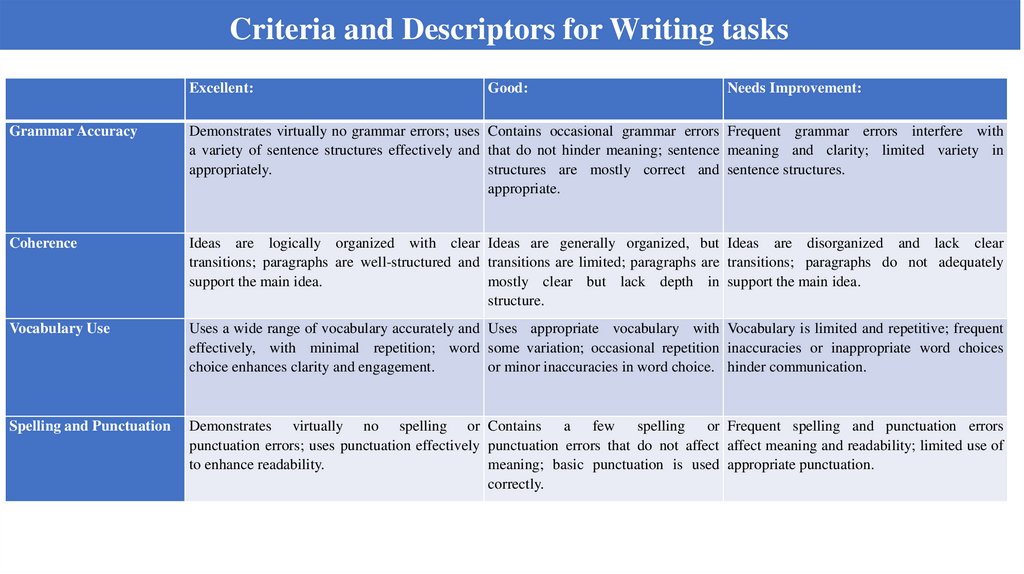
5. Criteria and Descriptors for Writing tasks
Excellent:Good:
Needs Improvement:
Grammar Accuracy
Demonstrates virtually no grammar errors; uses Contains occasional grammar errors Frequent grammar errors interfere with
a variety of sentence structures effectively and that do not hinder meaning; sentence meaning and clarity; limited variety in
appropriately.
structures are mostly correct and sentence structures.
appropriate.
Coherence
Ideas are logically organized with clear Ideas are generally organized, but Ideas are disorganized and lack clear
transitions; paragraphs are well-structured and transitions are limited; paragraphs are transitions; paragraphs do not adequately
support the main idea.
mostly clear but lack depth in support the main idea.
structure.
Vocabulary Use
Uses a wide range of vocabulary accurately and Uses appropriate vocabulary with Vocabulary is limited and repetitive; frequent
effectively, with minimal repetition; word some variation; occasional repetition inaccuracies or inappropriate word choices
choice enhances clarity and engagement.
or minor inaccuracies in word choice. hinder communication.
Spelling and Punctuation
Demonstrates virtually no spelling or Contains a few spelling or Frequent spelling and punctuation errors
punctuation errors; uses punctuation effectively punctuation errors that do not affect affect meaning and readability; limited use of
to enhance readability.
meaning; basic punctuation is used appropriate punctuation.
correctly.
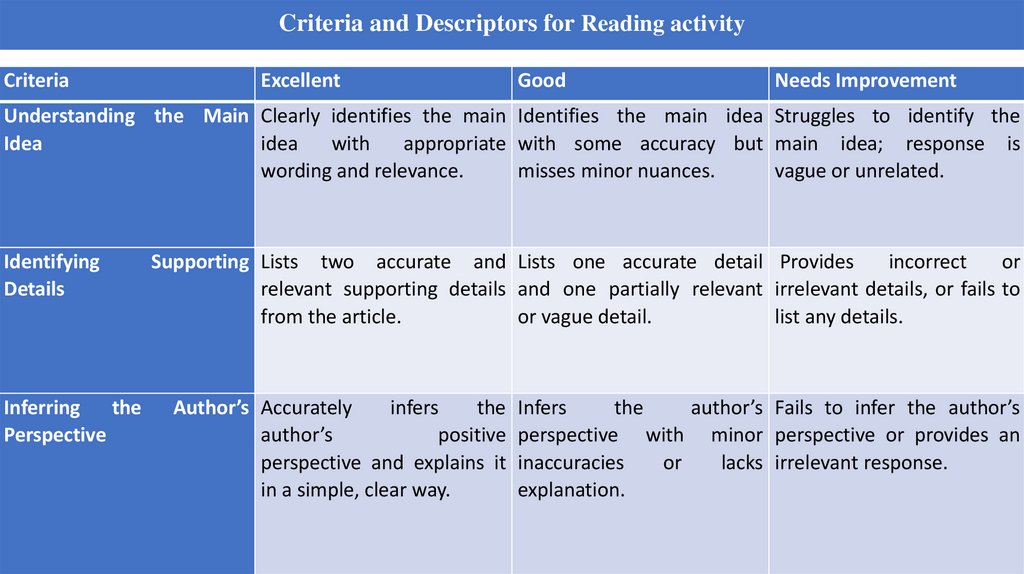
6. Criteria and Descriptors for Reading activity
CriteriaExcellent
Good
Needs Improvement
Understanding the Main Clearly identifies the main Identifies the main idea Struggles to identify the
Idea
idea
with
appropriate with some accuracy but main idea; response is
wording and relevance.
misses minor nuances.
vague or unrelated.
Identifying
Details
Inferring the
Perspective
Supporting Lists two accurate and Lists one accurate detail Provides
incorrect
or
relevant supporting details and one partially relevant irrelevant details, or fails to
from the article.
or vague detail.
list any details.
Author’s Accurately
infers
the Infers
the
author’s Fails to infer the author’s
author’s
positive perspective with minor perspective or provides an
perspective and explains it inaccuracies
or
lacks irrelevant response.
in a simple, clear way.
explanation.
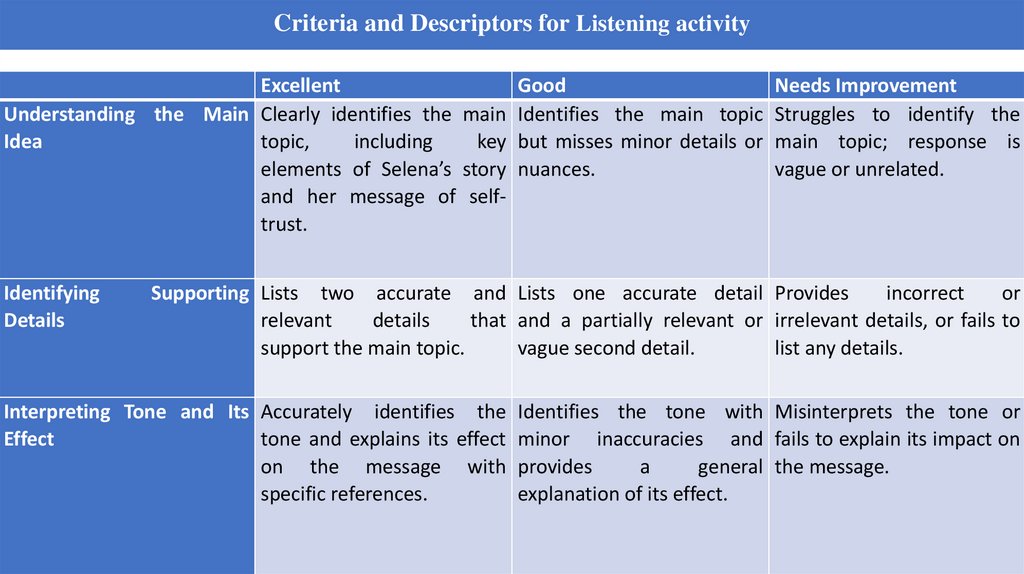
7. Criteria and Descriptors for Listening activity
ExcellentGood
Needs Improvement
Understanding the Main Clearly identifies the main Identifies the main topic Struggles to identify the
Idea
topic,
including
key but misses minor details or main topic; response is
elements of Selena’s story nuances.
vague or unrelated.
and her message of selftrust.
Identifying
Details
Supporting Lists two accurate and Lists one accurate detail Provides
incorrect
or
relevant
details
that and a partially relevant or irrelevant details, or fails to
support the main topic.
vague second detail.
list any details.
Interpreting Tone and Its Accurately identifies the Identifies the tone with Misinterprets the tone or
Effect
tone and explains its effect minor inaccuracies and fails to explain its impact on
on the message with provides
a
general the message.
specific references.
explanation of its effect.