
 lingvistics
Similar presentations:



Historical Methods of Foreign Language Teaching
1. Historical Methods of Foreign Language Teaching
Khairullayev Alisher2. Introduction
•Why study historical teaching methods?•How have they influenced modern approaches?
•Key stages in the development of language teaching
methodology
3. Grammar-Translation Method (Classical Method)
•Based on teaching Latin and Ancient Greek•Main features:
•Memorizing grammar rules
•Translating texts
•Focus on written language
•Pros: develops analytical skills
•Cons: weak communicative competence
4. Direct Method
•Emerged in the late 19th – early 20th century•No translation; instruction in the target language only
•Focus on speaking, intuitive grammar acquisition
•Key figures: François Gouin, Maximilian Berlitz
5. Audio-Lingual Method
•Popular in the 1940s–1960s in the USA•Based on behaviorist theory: repetition and reinforcement
•Structured dialogues, drills
•Criticism: mechanical learning without understanding; lacks creativity
6. Suggestopedia
• Developed by Georgi Lozanov• Creates a relaxed, trustful atmosphere
• Uses music, dramatization, suggestion
• Goal: remove psychological barriers to learning
7. Communicative Language Teaching (CLT
•Emerged in the 1970s•Goal: develop the ability to communicate in real-life situations
•Emphasis on meaning rather than form
•Interactive tasks, group work
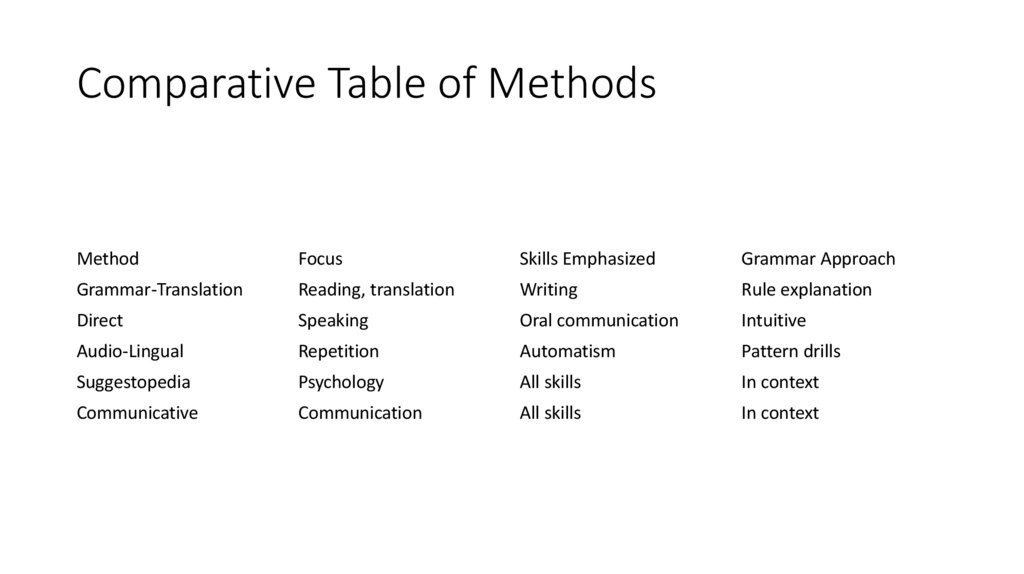
8. Comparative Table of Methods
MethodFocus
Skills Emphasized
Grammar Approach
Grammar-Translation
Reading, translation
Writing
Rule explanation
Direct
Speaking
Oral communication
Intuitive
Audio-Lingual
Repetition
Automatism
Pattern drills
Suggestopedia
Psychology
All skills
In context
Communicative
Communication
All skills
In context
9. Conclusion
•Each method reflects its time and pedagogical beliefs•Modern approaches often combine elements from previous methods
•Understanding historical methods helps teachers make informed choices
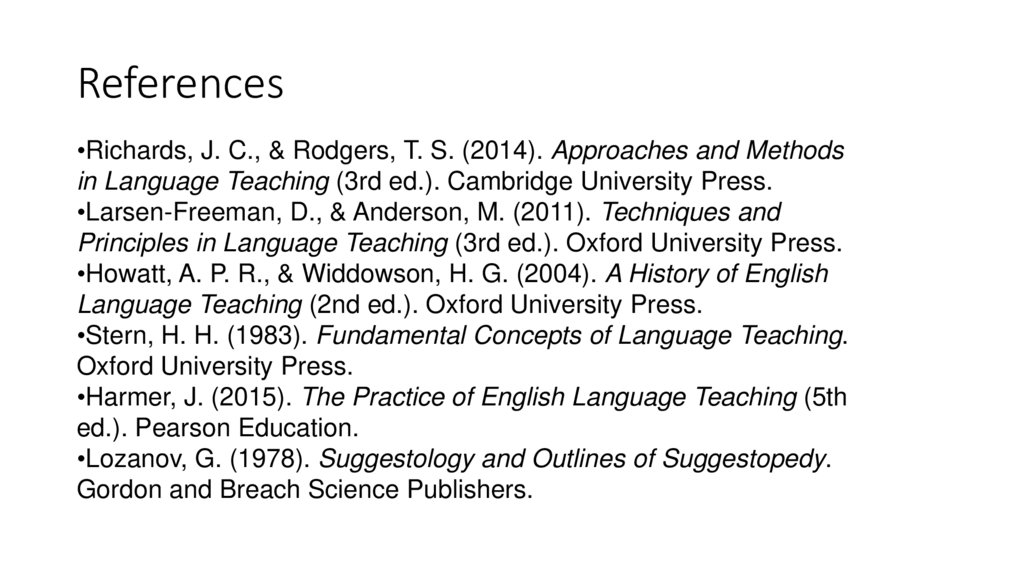
10. References
•Richards, J. C., & Rodgers, T. S. (2014). Approaches and Methodsin Language Teaching (3rd ed.). Cambridge University Press.
•Larsen-Freeman, D., & Anderson, M. (2011). Techniques and
Principles in Language Teaching (3rd ed.). Oxford University Press.
•Howatt, A. P. R., & Widdowson, H. G. (2004). A History of English
Language Teaching (2nd ed.). Oxford University Press.
•Stern, H. H. (1983). Fundamental Concepts of Language Teaching.
Oxford University Press.
•Harmer, J. (2015). The Practice of English Language Teaching (5th
ed.). Pearson Education.
•Lozanov, G. (1978). Suggestology and Outlines of Suggestopedy.
Gordon and Breach Science Publishers.