
 education
Similar presentations:




Planning Lessons for Diverse Learners: Age Appropriate Strategies
1.
Planning Lessons forDiverse Learners: AgeAppropriate Strategies
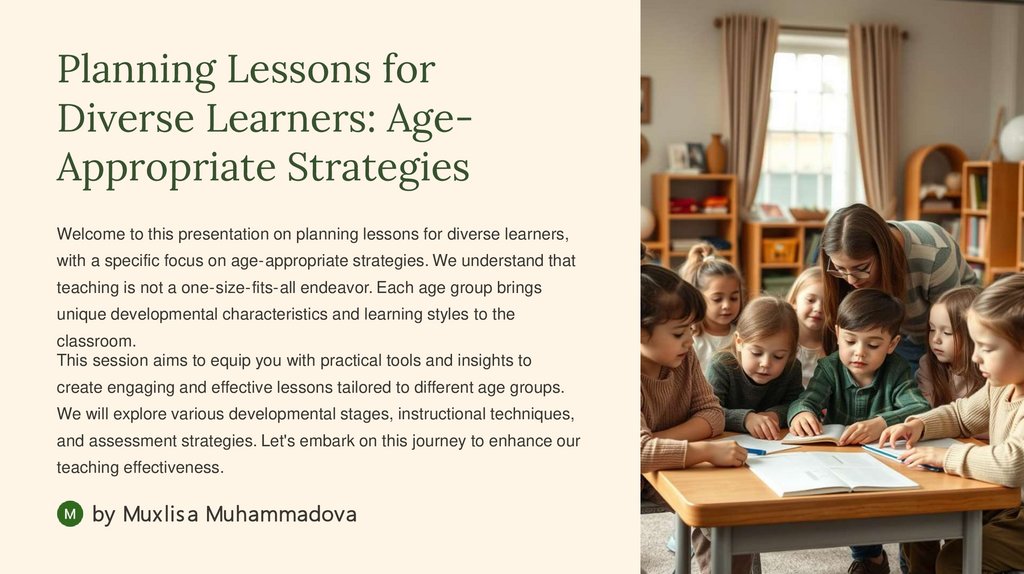
Welcome to this presentation on planning lessons for diverse learners,
with a specific focus on age-appropriate strategies. We understand that
teaching is not a one-size-fits-all endeavor. Each age group brings
unique developmental characteristics and learning styles to the
classroom.
This session aims to equip you with practical tools and insights to
create engaging and effective lessons tailored to different age groups.
We will explore various developmental stages, instructional techniques,
and assessment strategies. Let's embark on this journey to enhance our
teaching effectiveness.
by Mux lis a Muhammadova
2.
Understanding Developmental Stages: A QuickOverview
Cognitive Development
Social-Emotional
Development
Focuses on how children think,
Physical Development
Refers to the growth and
explore, and solve problems. As
Involves learning how to interact with
development of the body, including
children grow, their cognitive abilities
others, understand emotions, and
motor skills and physical
expand, enabling them to process
develop empathy. Social-emotional
coordination. Physical development
information and understand complex
skills are vital for building
impacts a child's ability to engage in
concepts.
relationships and navigating social
various activities and tasks.
situations.
3.
Early Childhood (Ages 3-5): PlayBased Learning and SensoryActivities
Play-Based Learning
Sensory Activities
Incorporate games, dramatic
E ngage children's senses with
play, and creative activities to
activities like painting, sand play,
foster learning through
and water play to stimulate
exploration and imagination.
learning.
Storytelling and Music
Use stories, songs, and rhymes to enhance language development and
memory skills.
E arly childhood is a critical period for development. P lay-based learning and
sensory activities are highly effective strategies for this age group. These methods
stimulate curiosity and creativity, creating a fun and engaging learning
environment.
4.
Elementary School (Ages 6-12): Hands-on Projects andCollaborative Learning
Group Projects
1
2
3
Promote teamwork
Science Experiments
Engage curiosity
Art Integration
Encourage creativity
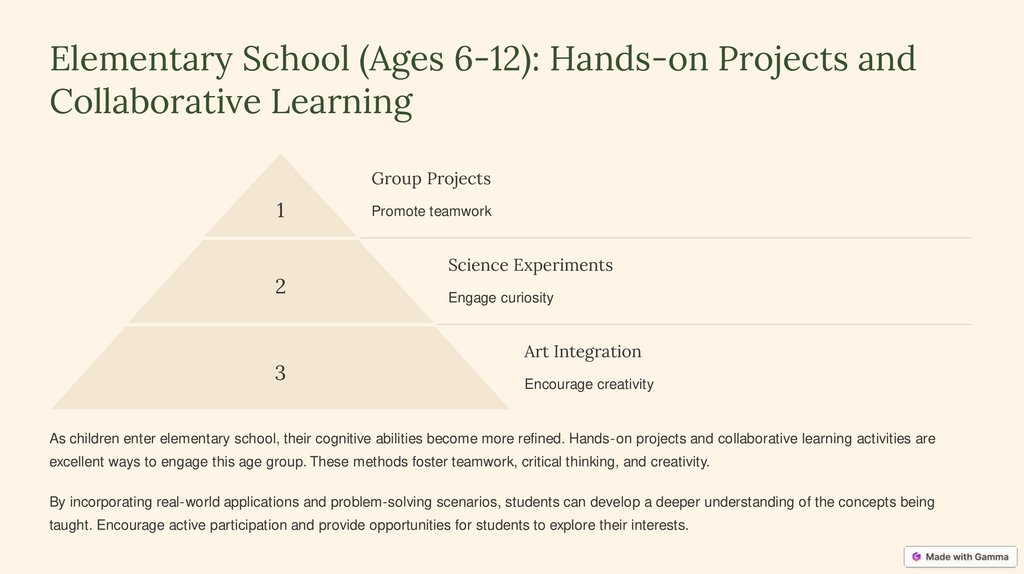
As children enter elementary school, their cognitive abilities become more refined. Hands-on projects and collaborative learning activities are
excellent ways to engage this age group. These methods foster teamwork, critical thinking, and creativity.
By incorporating real-world applications and problem-solving scenarios, students can develop a deeper understanding of the concepts being
taught. Encourage active participation and provide opportunities for students to explore their interests.
5.
Middle School (Ages 13-15): Inquiry-BasedLearning and Real-World Applications
Pose a Question
Start with a thought-provoking question or problem
Research & Explore
Guide students to research and gather information
Discuss & Reflect
Encourage discussion and critical reflection
Apply Learning
Encourage application of newfound knowledge
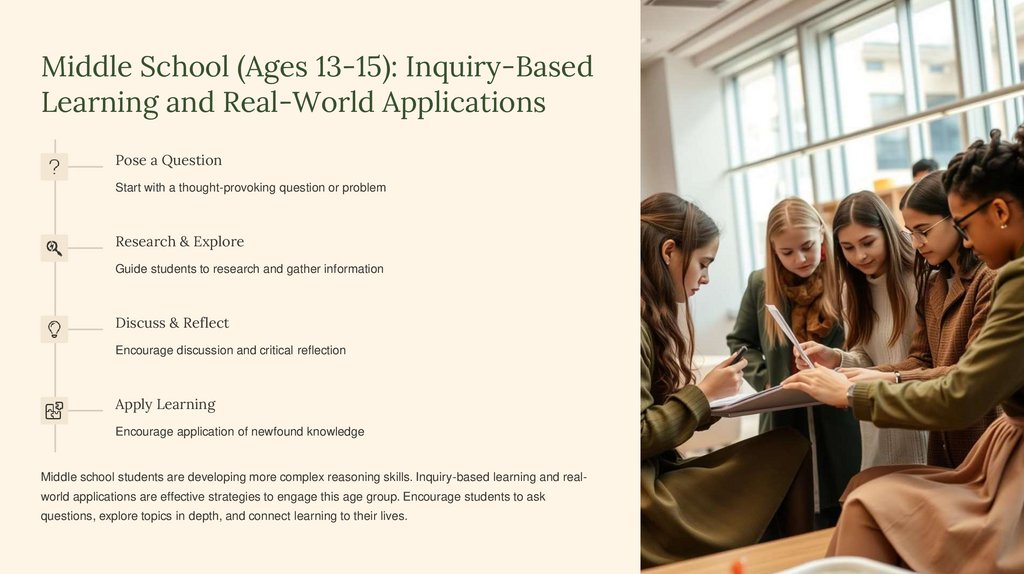
Middle school students are developing more complex reasoning skills. Inquiry-based learning and realworld applications are effective strategies to engage this age group. Encourage students to ask
questions, explore topics in depth, and connect learning to their lives.
6.
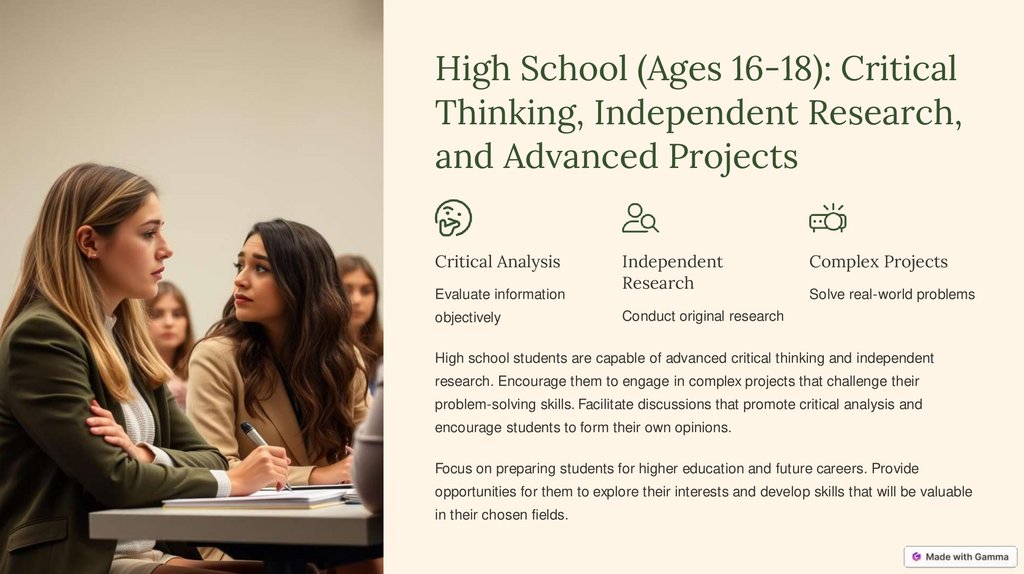
High School (Ages 16-18): CriticalThinking, Independent Research,
and Advanced Projects
Critical Analysis
Evaluate information
objectively
Independent
Research
Complex Projects
Solve real-world problems
Conduct original research
High school students are capable of advanced critical thinking and independent
research. Encourage them to engage in complex projects that challenge their
problem-solving skills. Facilitate discussions that promote critical analysis and
encourage students to form their own opinions.
Focus on preparing students for higher education and future careers. Provide
opportunities for them to explore their interests and develop skills that will be valuable
in their chosen fields.
7.
Adapting Content: Differentiated Instruction TechniquesAssess Readiness
E valuate student knowledge and skills
Modify Content
Adjust complexity of material
Vary Activities
Offer diverse learning tasks
Evaluate Outcomes
Measure student learning
Differentiated instruction involves adapting content, process, and products to meet the diverse needs of learners. This approach recognizes that students learn at different paces and in different ways. By
differentiating instruction, teachers can create a more inclusive and effective learning environment.
Assess student readiness, modify content to match their abilities, offer a variety of learning activities, and evaluate outcomes to measure student progress.
8.
Addressing Diverse Learning Styles:Visual, Auditory, Kinesthetic
Visual Learners
Auditory Learners
Use diagrams and charts
Facilitate discussions
Incorporate visual aids
Use audio recordings
E ncourage note-taking
Provide verbal instructions
Kinesthetic Learners
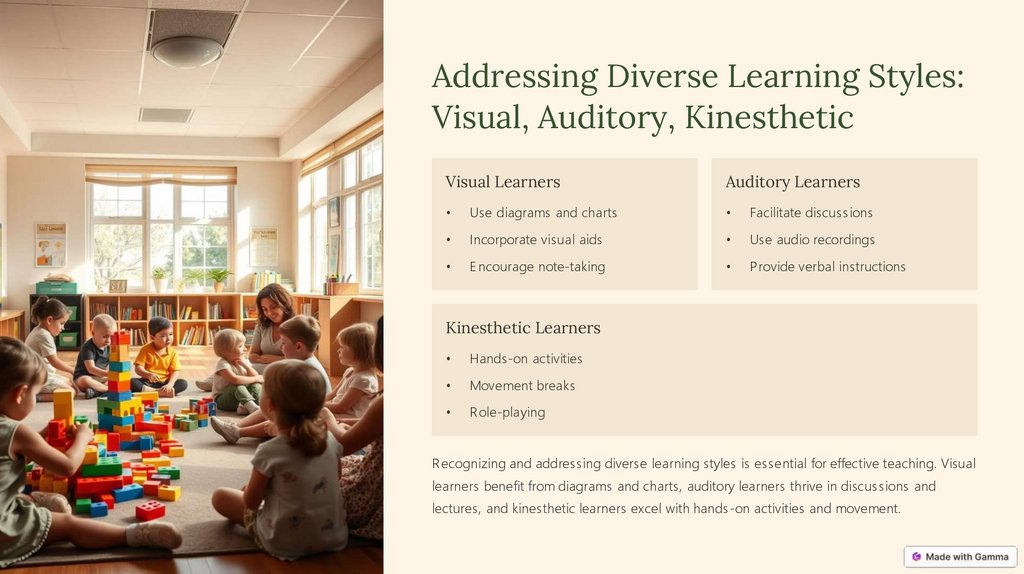
Hands-on activities
Movement breaks
R ole-playing
R ecognizing and addressing diverse learning styles is essential for effective teaching. Visual
learners benefit from diagrams and charts, auditory learners thrive in discussions and
lectures, and kinesthetic learners excel with hands-on activities and movement.
9.
Assessment Strategies forDifferent Age Groups
Age Group
Assessment Strategies
Early Childhood
Observations, portfolios, anecdotal
records
Elementary School
Quizzes, tests, projects, presentations
Middle School
Essays, research papers, debates,
group projects
High School
Exams, research papers,
presentations, capstone projects
Assessment strategies should align with the developmental stage and learning
objectives of each age group. Early childhood assessments focus on observations
and portfolios, while elementary and middle school assessments incorporate quizzes,
tests, and projects. High school assessments often include exams and research
papers.
10.
Conclusion: CreatingEngaging and Effective
Lessons for All Ages
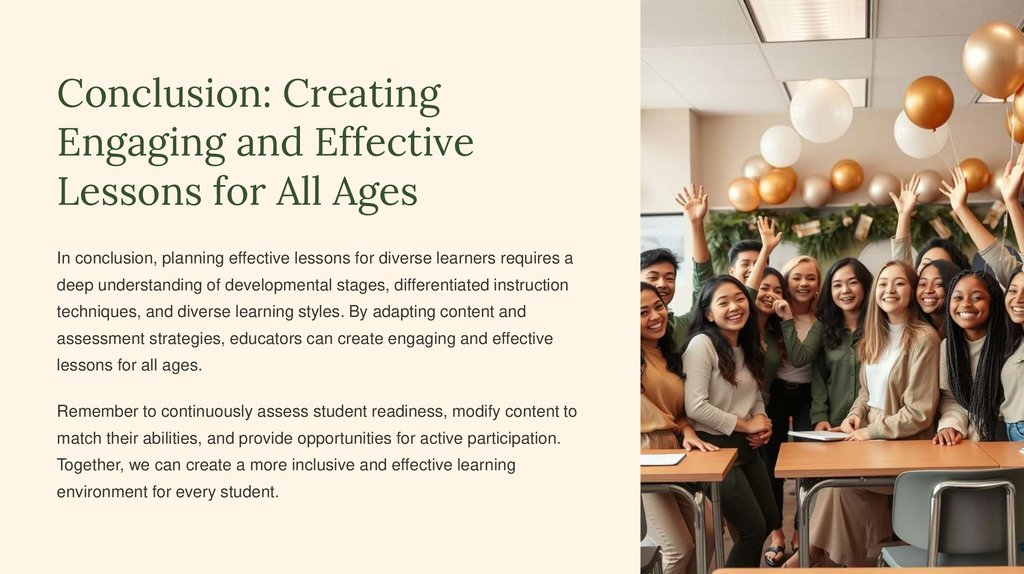
In conclusion, planning effective lessons for diverse learners requires a
deep understanding of developmental stages, differentiated instruction
techniques, and diverse learning styles. By adapting content and
assessment strategies, educators can create engaging and effective
lessons for all ages.
Remember to continuously assess student readiness, modify content to
match their abilities, and provide opportunities for active participation.
Together, we can create a more inclusive and effective learning
environment for every student.