


 biography
Similar presentations:






John Maynard Keynes
1. John Maynard Keynes
Completed by: Yakimenko DianaStudent of group 215
2. Biography
BIOGRAPHYJohn Maynard Keynes, 1st
Baron Keynes CB - English
economist, founder of the
Keynesian school of economic
science.
3. Personal and family life
Date of birth: 5 June 1883Place of birth: Cambridge,
England, UK
Date of death: 21 April 1946
(age 62)
Place of death: Firle[vd],
Lewes, East Sussex[vd], East
Sussex, UK
4. Personal and family life
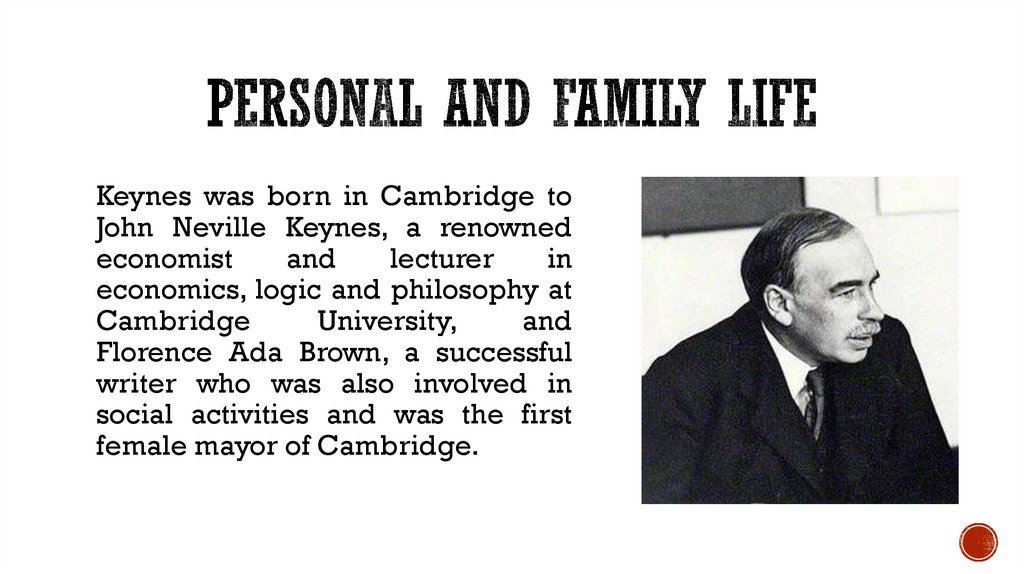
Keynes was born in Cambridge toJohn Neville Keynes, a renowned
economist
and
lecturer
in
economics, logic and philosophy at
Cambridge
University,
and
Florence Ada Brown, a successful
writer who was also involved in
social activities and was the first
female mayor of Cambridge.
5. Personal and family life
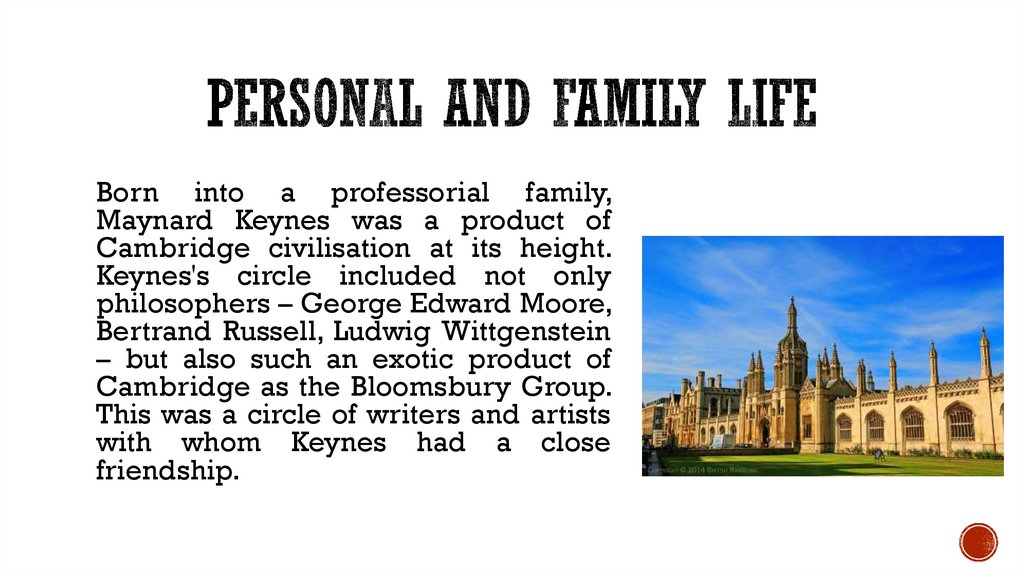
Born into a professorial family,Maynard Keynes was a product of
Cambridge civilisation at its height.
Keynes's circle included not only
philosophers – George Edward Moore,
Bertrand Russell, Ludwig Wittgenstein
– but also such an exotic product of
Cambridge as the Bloomsbury Group.
This was a circle of writers and artists
with whom Keynes had a close
friendship.
6. Personal and family life
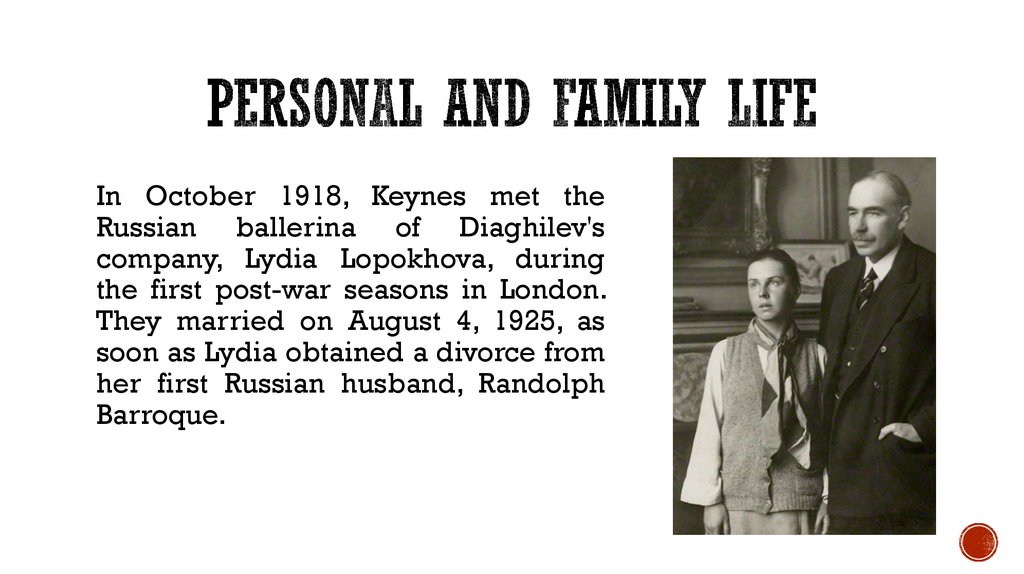
In October 1918, Keynes met theRussian ballerina of Diaghilev's
company, Lydia Lopokhova, during
the first post-war seasons in London.
They married on August 4, 1925, as
soon as Lydia obtained a divorce from
her first Russian husband, Randolph
Barroque.
7. Education
Keynes studied at Eton, King's College, Cambridge from 1902to 1906. In addition to economics, Keynes was interested in
politics, and won the presidency of the Cambridge Students'
Union in 1905. In Cambridge, Keynes took an active part in the
work of a scientific circle, which was led by the philosopher
George Moore, who was popular among young people, and
was a member of the philosophical club "Apostles", where he
became acquainted with many of his future friends, who later
became members of the Bloomsbury Circle of intellectuals,
created in 1905-1906.
8. Major works
MAJOR WORKS"A Treatise on Probability" (1921): An
early work on the philosophy of
probability and inductive logic. In it,
Keynes
explores
the
nature
of
probability and its role in decision
making under uncertainty.
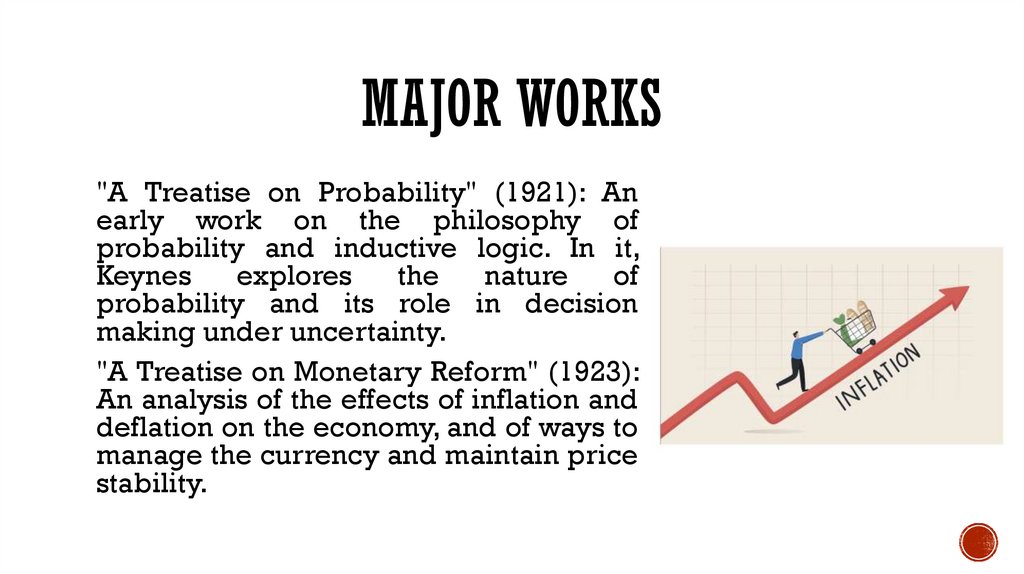
"A Treatise on Monetary Reform" (1923):
An analysis of the effects of inflation and
deflation on the economy, and of ways to
manage the currency and maintain price
stability.
9. Major works
MAJOR WORKS"The End of Laissez-Faire" (1926): A
critique of classical economic theory
and
a
case
for
government
intervention in the economy to solve
social problems.
"A Treatise on Money" (1930): A twovolume work devoted to the theory of
money and credit. Keynes examines
the role of the banking system in the
creation of money and its impact on
economic activity.
10. Major works
MAJOR WORKSThe General Theory of Employment, Interest, and
Money (1936): Keynes' most famous and
influential work. In it, he outlines his theory of
macroeconomics, explaining the causes of
economic crises and proposing methods of
government
regulation
to
achieve
full
employment.
" How to pay for the war?" (1940): An analysis of
the economic problems of wartime and a
proposal for methods of financing military
expenditures without excessive inflation.
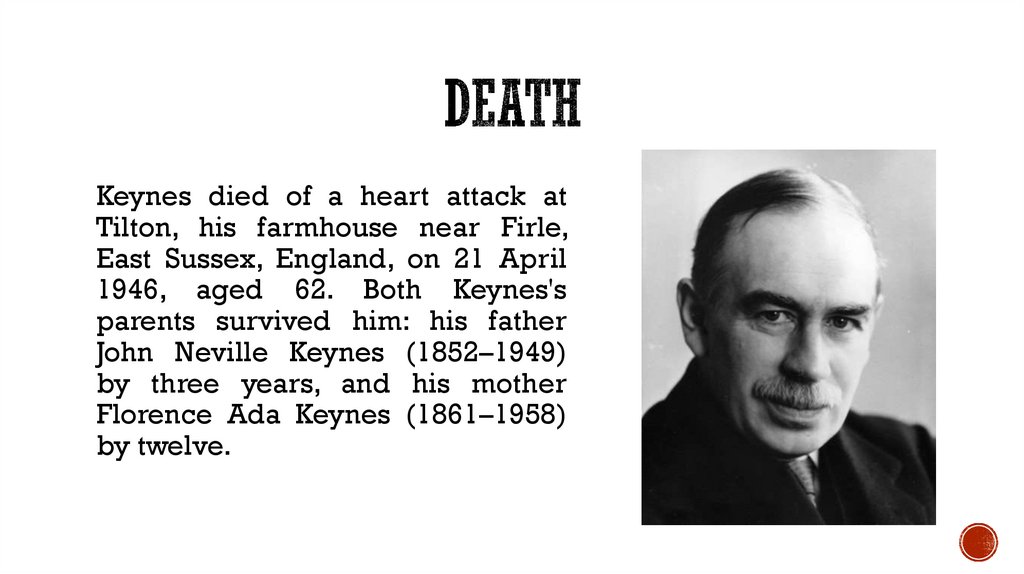
11. Death
Keynes died of a heart attack atTilton, his farmhouse near Firle,
East Sussex, England, on 21 April
1946, aged 62. Both Keynes's
parents survived him: his father
John Neville Keynes (1852–1949)
by three years, and his mother
Florence Ada Keynes (1861–1958)
by twelve.
12. Thank you for your attention !
THANK YOU FOR YOURATTENTION !