 medicine
Similar presentations:





The Role of Artificial Intelligence in Improving Healthcare Diagnostics
1.
The Role of Artificial Intelligence inImproving Healthcare Diagnostics
A Study on Early Disease Detection
2.
1.1 Background and Context• AI has emerged as a transformative
technology in healthcare, enhancing
diagnostic accuracy, reducing human error,
and improving patient outcomes. Despite
rapid advancements, there is a gap in
understanding its effective integration into
existing healthcare systems, especially in
resource-limited settings.
3.
1.2 Problem Statement• Traditional diagnostic methods are timeconsuming and prone to errors. AI can
automate data analysis and provide more
accurate results, but research on its
effectiveness, limitations, and ethical
implications is still limited.
4.
1.3 Research Objectives• 1. Evaluate AI's effectiveness in early disease
detection.
• 2. Identify challenges in AI adoption in
healthcare diagnostics.
• 3. Explore ethical and regulatory
considerations.
5.
1.4 Research Questions• 1. How does AI's diagnostic accuracy compare
to traditional methods?
• 2. What barriers exist to AI adoption in
healthcare?
• 3. What ethical and regulatory frameworks are
needed?
6.
1.5 Significance of the Study• This study evaluates AI's role in diagnostics
and provides insights for healthcare providers,
policymakers, and technology developers,
while addressing ethical concerns to ensure
responsible AI use.
7.
1.6 Structure of the Thesis• Chapter 2: Literature Review
• Chapter 3: Research Methodology
• Chapter 4: Results
• Chapter 5: Discussion
• Chapter 6: Conclusion and Recommendations
8.
Abstract• AI is transforming healthcare by improving
diagnostics, treatment planning, and patient care.
This article explores AI’s applications in medical
imaging, predictive analytics, and robotic surgery,
while addressing ethical and regulatory concerns.
Using a theoretical approach, it examines AI’s impact
on healthcare efficiency and the challenges of
algorithmic bias and data privacy. The study
concludes that AI must be integrated responsibly to
ensure ethical and equitable healthcare solutions.
9.
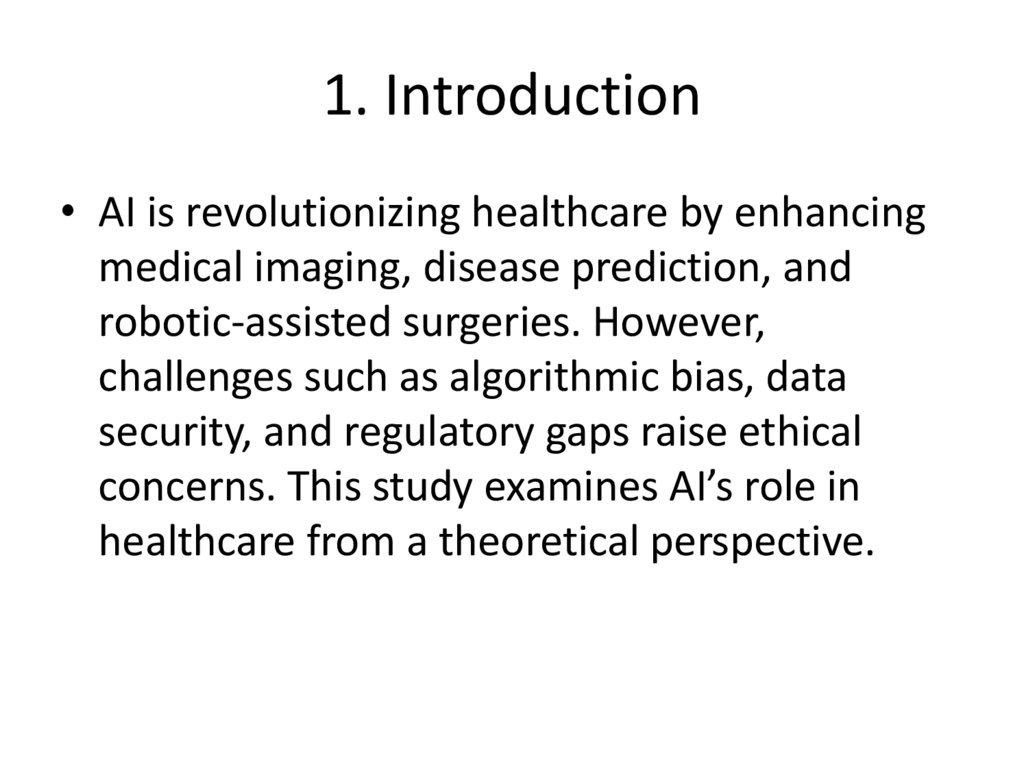
1. Introduction• AI is revolutionizing healthcare by enhancing
medical imaging, disease prediction, and
robotic-assisted surgeries. However,
challenges such as algorithmic bias, data
security, and regulatory gaps raise ethical
concerns. This study examines AI’s role in
healthcare from a theoretical perspective.
10.
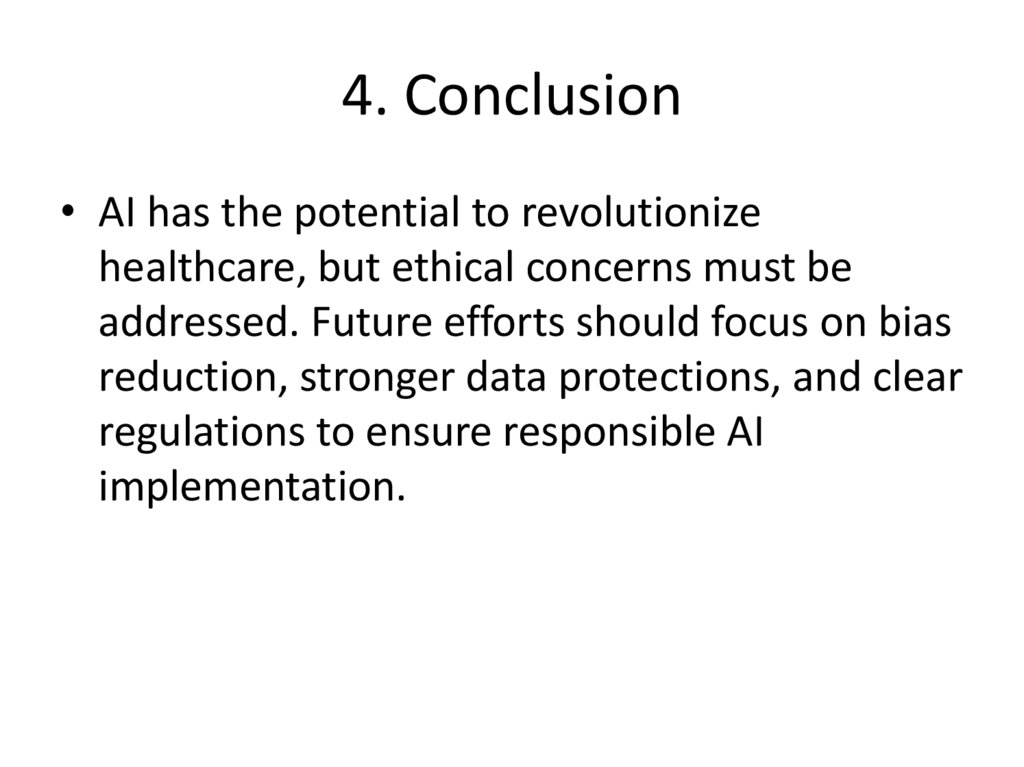
4. Conclusion• AI has the potential to revolutionize
healthcare, but ethical concerns must be
addressed. Future efforts should focus on bias
reduction, stronger data protections, and clear
regulations to ensure responsible AI
implementation.