 english
Similar presentations:







Upcycling
1.
UpcyclingClassroom presentation
www.britishcouncil.org/climate-connection
#TheClimateConnection
2.
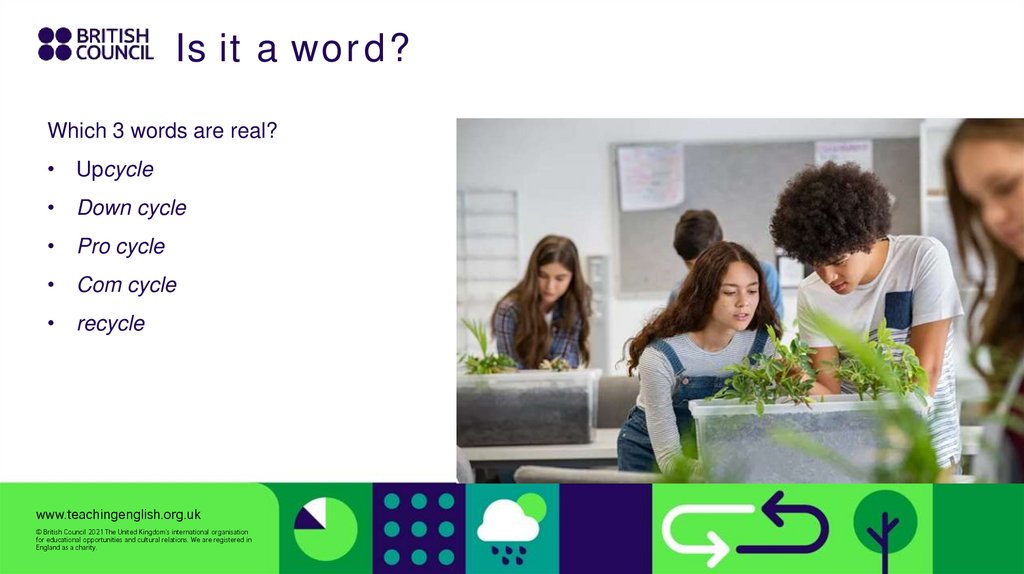
Is it a word?Which 3 words are real?
• Upcycle
• Down cycle
• Pro cycle
• Com cycle
• recycle
www.teachingenglish.org.uk
© British Council 2021 The United Kingdom’s international organisation
for educational opportunities and cultural relations. We are registered in
England as a charity.
3.
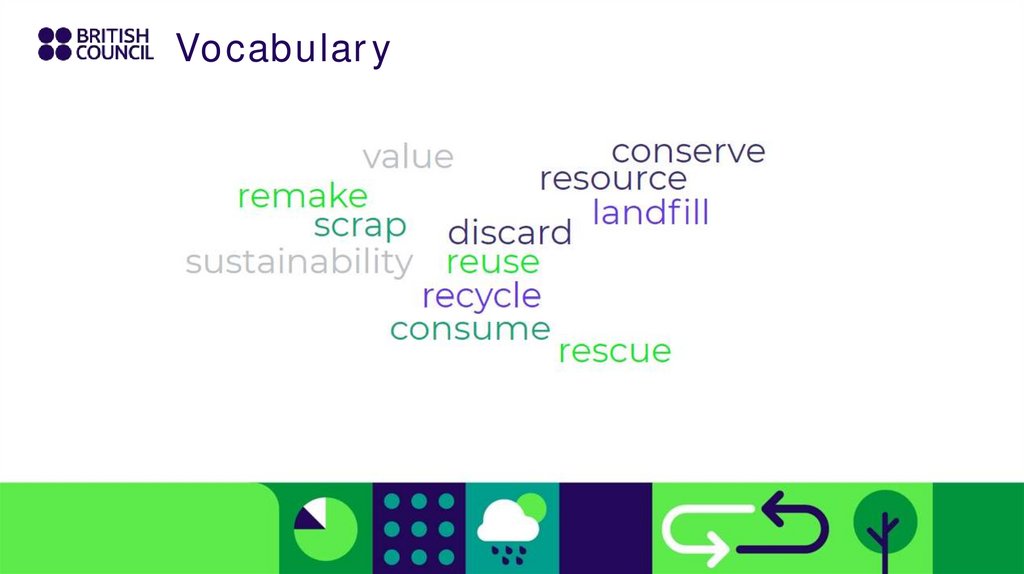
Vocabulary4.
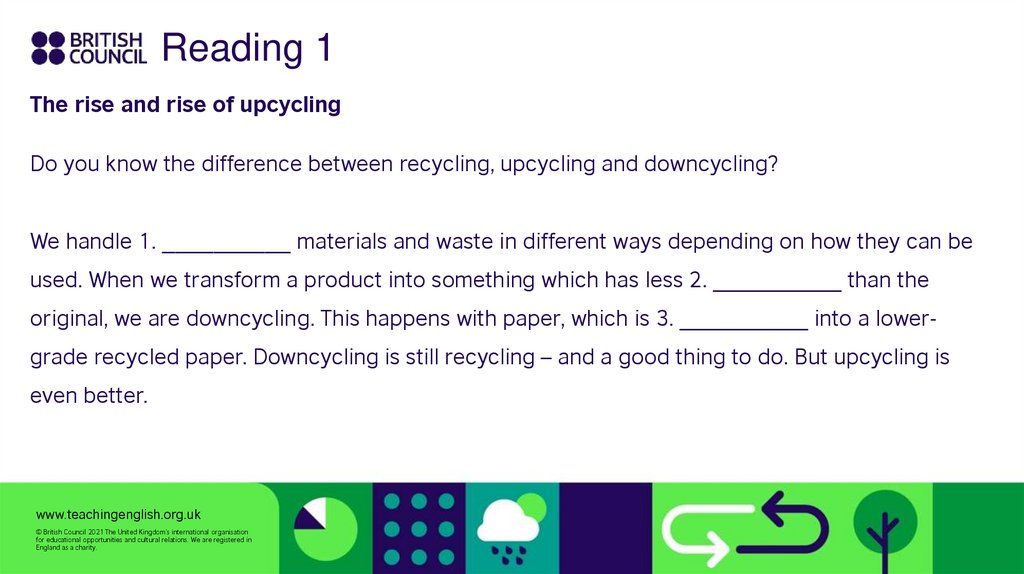
Reading 1The rise and rise of upcycling
Do you know the difference between recycling, upcycling and downcycling?
We handle 1. __________ materials and waste in different ways depending on how they can be
used. When we transform a product into something which has less 2. __________ than the
original, we are downcycling. This happens with paper, which is 3. __________ into a lowergrade recycled paper. Downcycling is still recycling – and a good thing to do. But upcycling is
even better.
www.teachingenglish.org.uk
© British Council 2021 The United Kingdom’s international organisation
for educational opportunities and cultural relations. We are registered in
England as a charity.
5.
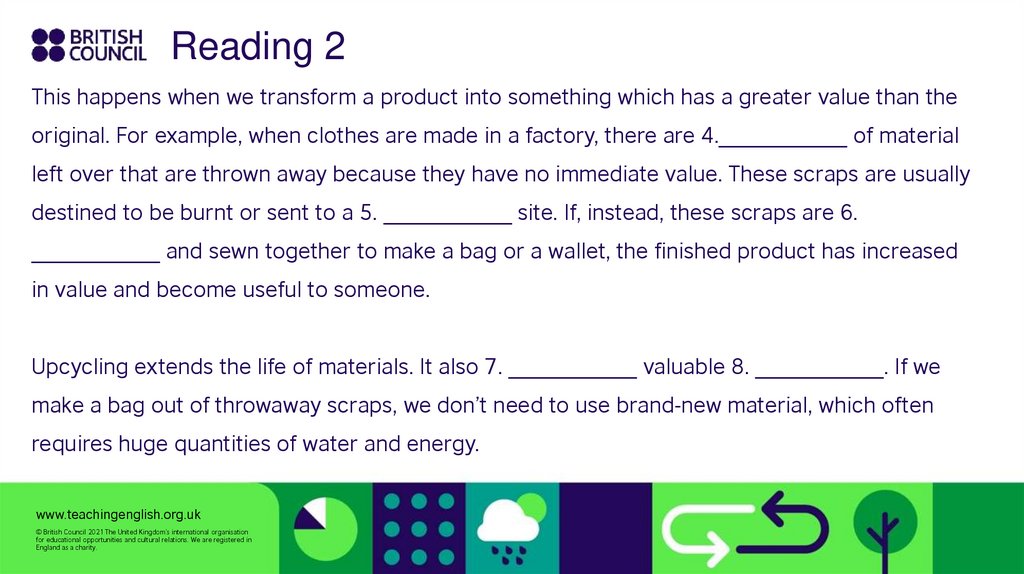
Reading 2This happens when we transform a product into something which has a greater value than the
original. For example, when clothes are made in a factory, there are 4.__________ of material
left over that are thrown away because they have no immediate value. These scraps are usually
destined to be burnt or sent to a 5. __________ site. If, instead, these scraps are 6.
__________ and sewn together to make a bag or a wallet, the finished product has increased
in value and become useful to someone.
Upcycling extends the life of materials. It also 7. __________ valuable 8. __________. If we
make a bag out of throwaway scraps, we don’t need to use brand-new material, which often
requires huge quantities of water and energy.
www.teachingenglish.org.uk
© British Council 2021 The United Kingdom’s international organisation
for educational opportunities and cultural relations. We are registered in
England as a charity.
6.
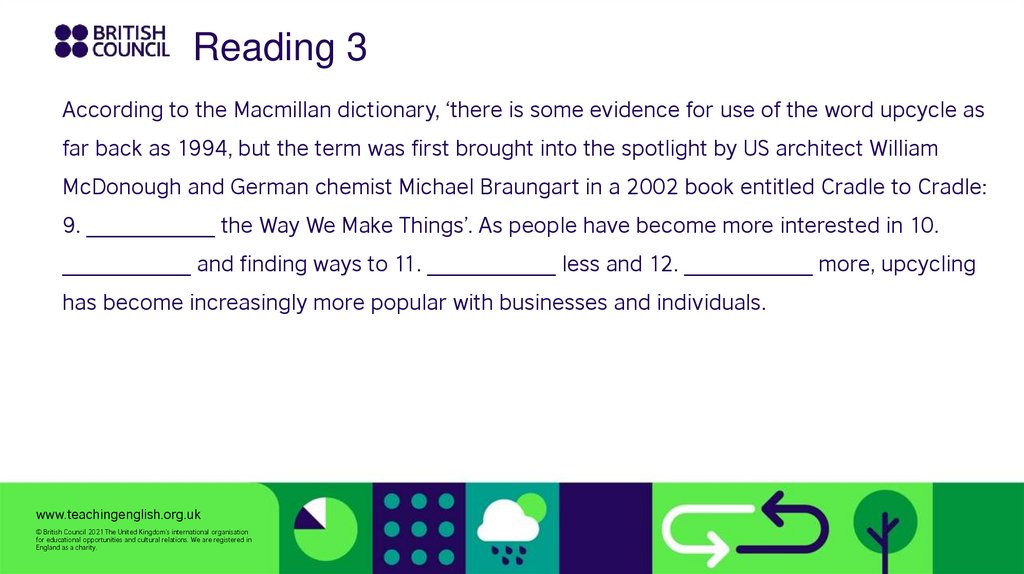
Reading 3According to the Macmillan dictionary, ‘there is some evidence for use of the word upcycle as
far back as 1994, but the term was first brought into the spotlight by US architect William
McDonough and German chemist Michael Braungart in a 2002 book entitled Cradle to Cradle:
9. __________ the Way We Make Things’. As people have become more interested in 10.
__________ and finding ways to 11. __________ less and 12. __________ more, upcycling
has become increasingly more popular with businesses and individuals.
www.teachingenglish.org.uk
© British Council 2021 The United Kingdom’s international organisation
for educational opportunities and cultural relations. We are registered in
England as a charity.
7.
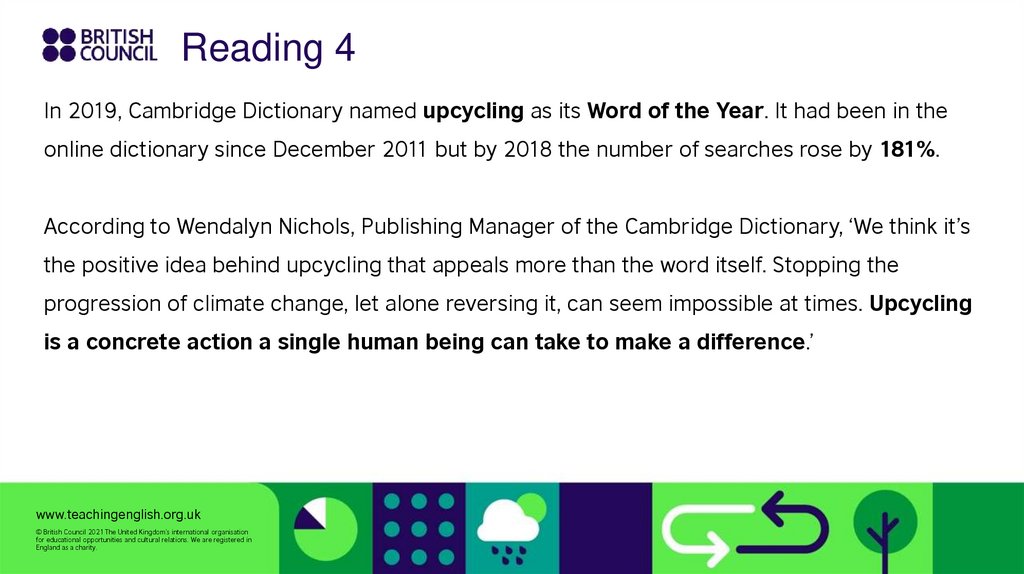
Reading 4In 2019, Cambridge Dictionary named upcycling as its Word of the Year. It had been in the
online dictionary since December 2011 but by 2018 the number of searches rose by 181%.
According to Wendalyn Nichols, Publishing Manager of the Cambridge Dictionary, ‘We think it’s
the positive idea behind upcycling that appeals more than the word itself. Stopping the
progression of climate change, let alone reversing it, can seem impossible at times. Upcycling
is a concrete action a single human being can take to make a difference.’
www.teachingenglish.org.uk
© British Council 2021 The United Kingdom’s international organisation
for educational opportunities and cultural relations. We are registered in
England as a charity.
8.
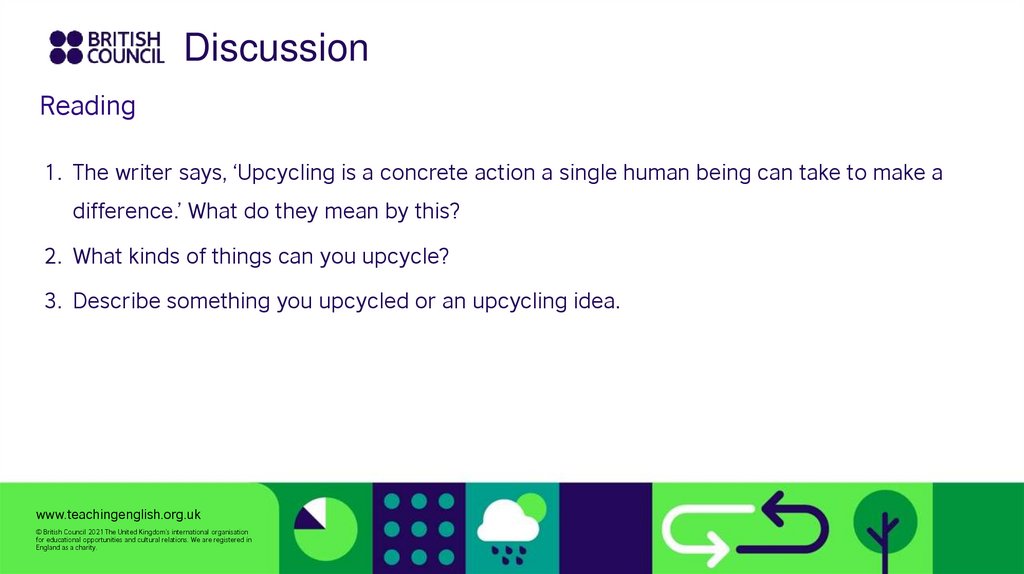
DiscussionReading
1. The writer says, ‘Upcycling is a concrete action a single human being can take to make a
difference.’ What do they mean by this?
2. What kinds of things can you upcycle?
3. Describe something you upcycled or an upcycling idea.
www.teachingenglish.org.uk
© British Council 2021 The United Kingdom’s international organisation
for educational opportunities and cultural relations. We are registered in
England as a charity.
9.
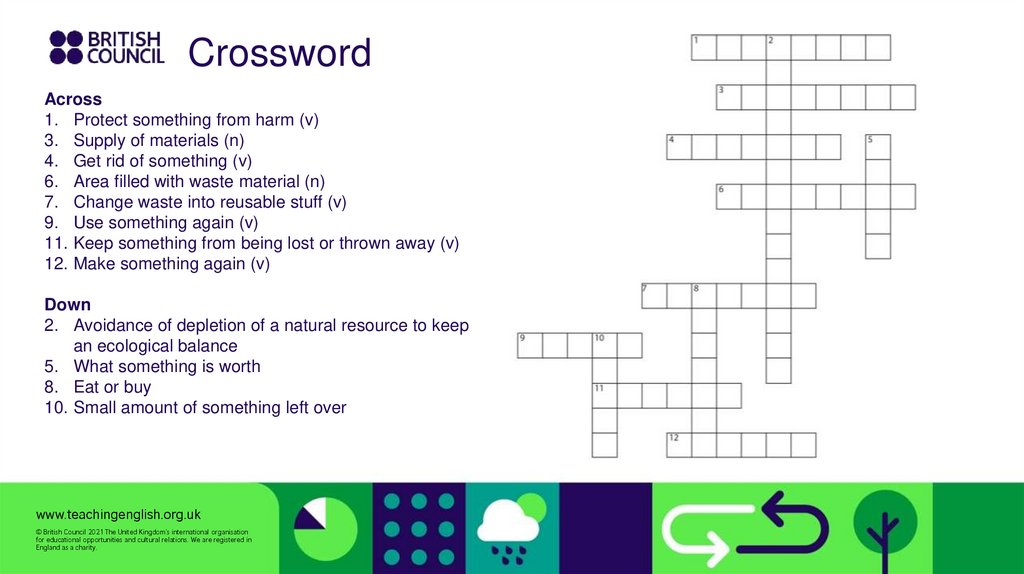
CrosswordAcross
1. Protect something from harm (v)
3. Supply of materials (n)
4. Get rid of something (v)
6. Area filled with waste material (n)
7. Change waste into reusable stuff (v)
9. Use something again (v)
11. Keep something from being lost or thrown away (v)
12. Make something again (v)
Down
2. Avoidance of depletion of a natural resource to keep
an ecological balance
5. What something is worth
8. Eat or buy
10. Small amount of something left over
www.teachingenglish.org.uk
© British Council 2021 The United Kingdom’s international organisation
for educational opportunities and cultural relations. We are registered in
England as a charity.
10.
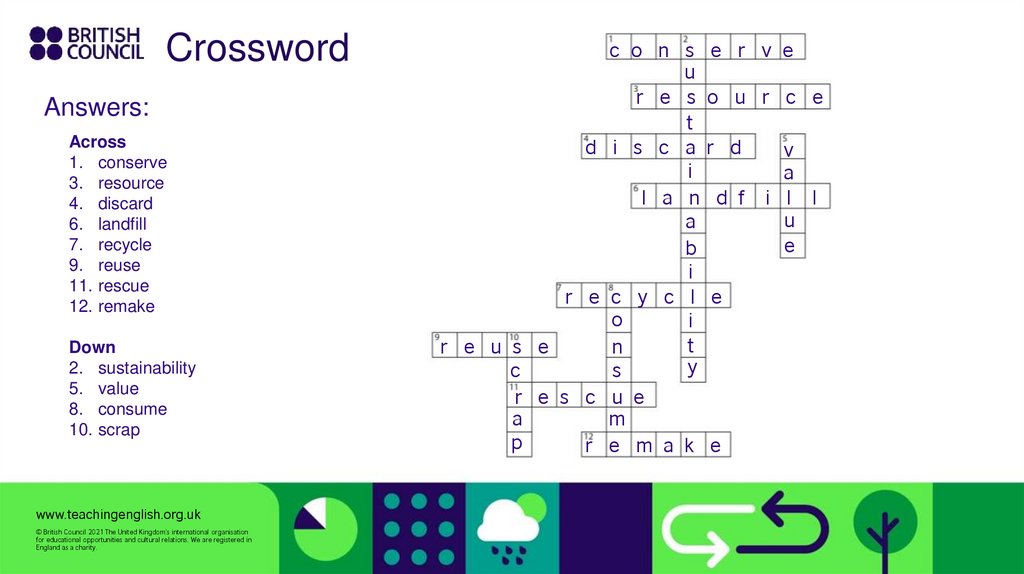
CrosswordAnswers:
Across
1. conserve
3. resource
4. discard
6. landfill
7. recycle
9. reuse
11. rescue
12. remake
Down
2. sustainability
5. value
8. consume
10. scrap
www.teachingenglish.org.uk
© British Council 2021 The United Kingdom’s international organisation
for educational opportunities and cultural relations. We are registered in
England as a charity.
r e u s
c
r
a
p
c o n s e r v e
u
r e s o u r c e
t
d i s c a r d
v
i
a
l a n d f i l l
u
a
e
b
i
r e c y c l e
o
i
t
e
n
y
s
e s c u e
m
r e m a k e
11.
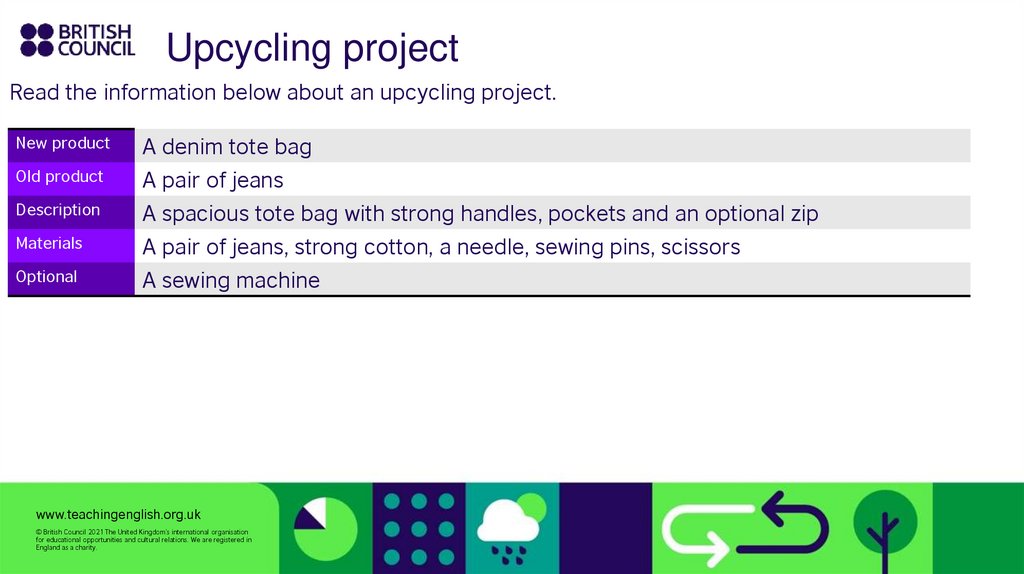
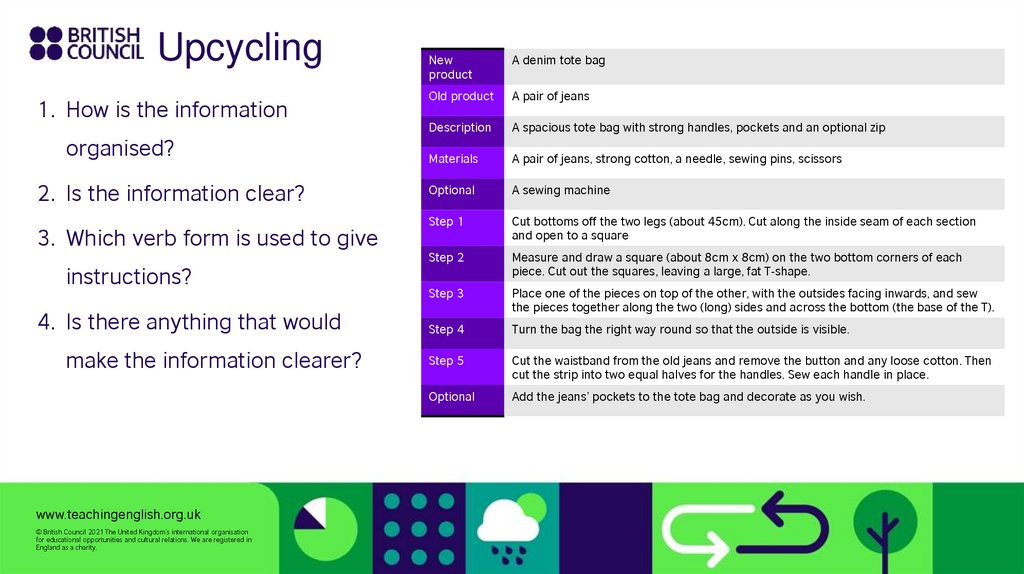
Upcycling projectRead the information below about an upcycling project.
New product
A denim tote bag
Old product
A pair of jeans
Description
A spacious tote bag with strong handles, pockets and an optional zip
Materials
A pair of jeans, strong cotton, a needle, sewing pins, scissors
Optional
A sewing machine
www.teachingenglish.org.uk
© British Council 2021 The United Kingdom’s international organisation
for educational opportunities and cultural relations. We are registered in
England as a charity.
12.
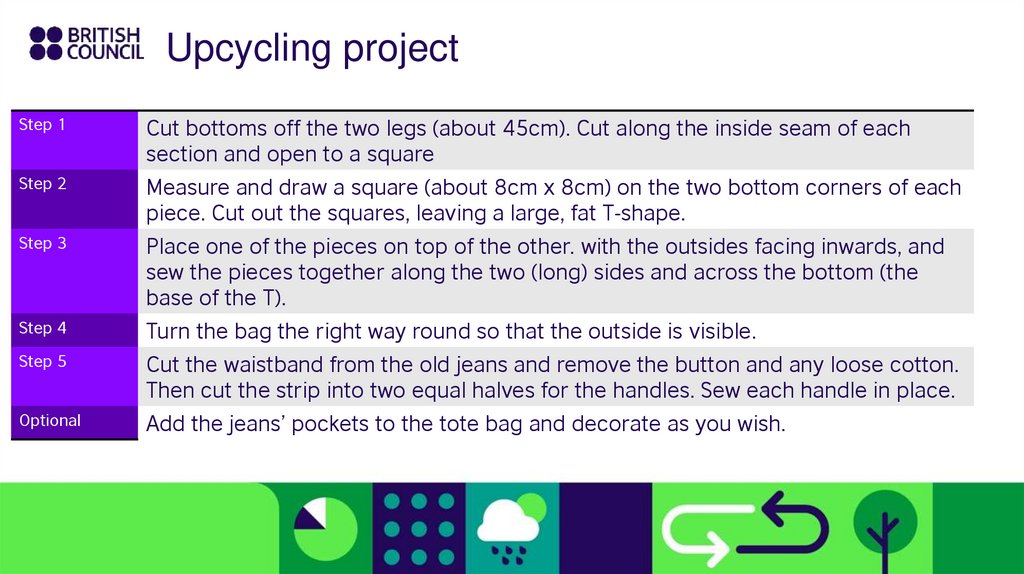
Upcycling projectStep 1
Cut bottoms off the two legs (about 45cm). Cut along the inside seam of each
section and open to a square
Step 2
Measure and draw a square (about 8cm x 8cm) on the two bottom corners of each
piece. Cut out the squares, leaving a large, fat T-shape.
Step 3
Place one of the pieces on top of the other. with the outsides facing inwards, and
sew the pieces together along the two (long) sides and across the bottom (the
base of the T).
Step 4
Turn the bag the right way round so that the outside is visible.
Step 5
Cut the waistband from the old jeans and remove the button and any loose cotton.
Then cut the strip into two equal halves for the handles. Sew each handle in place.
Optional
Add the jeans’ pockets to the tote bag and decorate as you wish.
13.
Upcycling1. How is the information
organised?
2. Is the information clear?
3. Which verb form is used to give
instructions?
4. Is there anything that would
make the information clearer?
www.teachingenglish.org.uk
© British Council 2021 The United Kingdom’s international organisation
for educational opportunities and cultural relations. We are registered in
England as a charity.
New
product
A denim tote bag
Old product
A pair of jeans
Description
A spacious tote bag with strong handles, pockets and an optional zip
Materials
A pair of jeans, strong cotton, a needle, sewing pins, scissors
Optional
A sewing machine
Step 1
Cut bottoms off the two legs (about 45cm). Cut along the inside seam of each section
and open to a square
Step 2
Measure and draw a square (about 8cm x 8cm) on the two bottom corners of each
piece. Cut out the squares, leaving a large, fat T-shape.
Step 3
Place one of the pieces on top of the other, with the outsides facing inwards, and sew
the pieces together along the two (long) sides and across the bottom (the base of the T).
Step 4
Turn the bag the right way round so that the outside is visible.
Step 5
Cut the waistband from the old jeans and remove the button and any loose cotton. Then
cut the strip into two equal halves for the handles. Sew each handle in place.
Optional
Add the jeans’ pockets to the tote bag and decorate as you wish.
14.
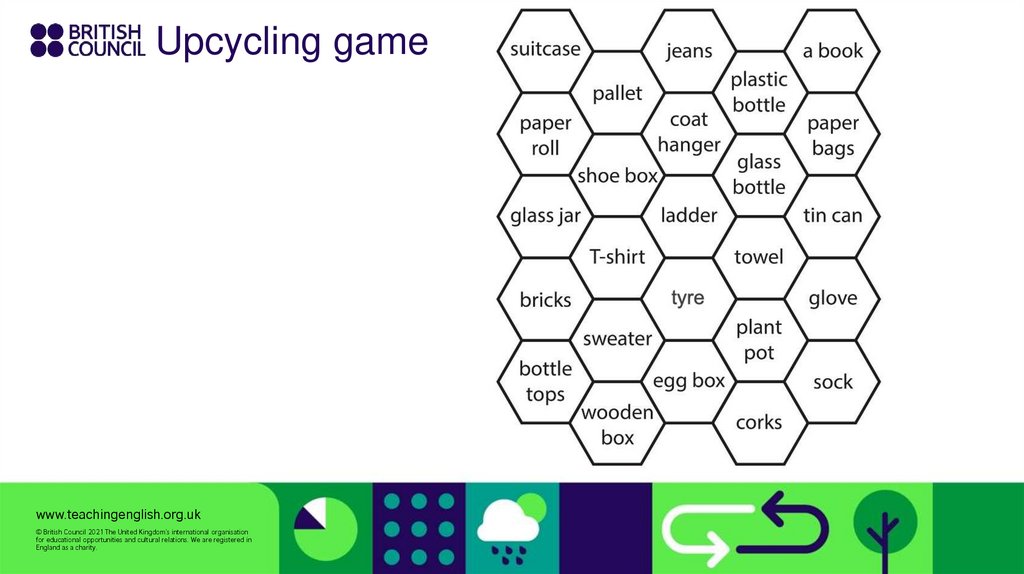
Upcycling gamewww.teachingenglish.org.uk
© British Council 2021 The United Kingdom’s international organisation
for educational opportunities and cultural relations. We are registered in
England as a charity.
15.
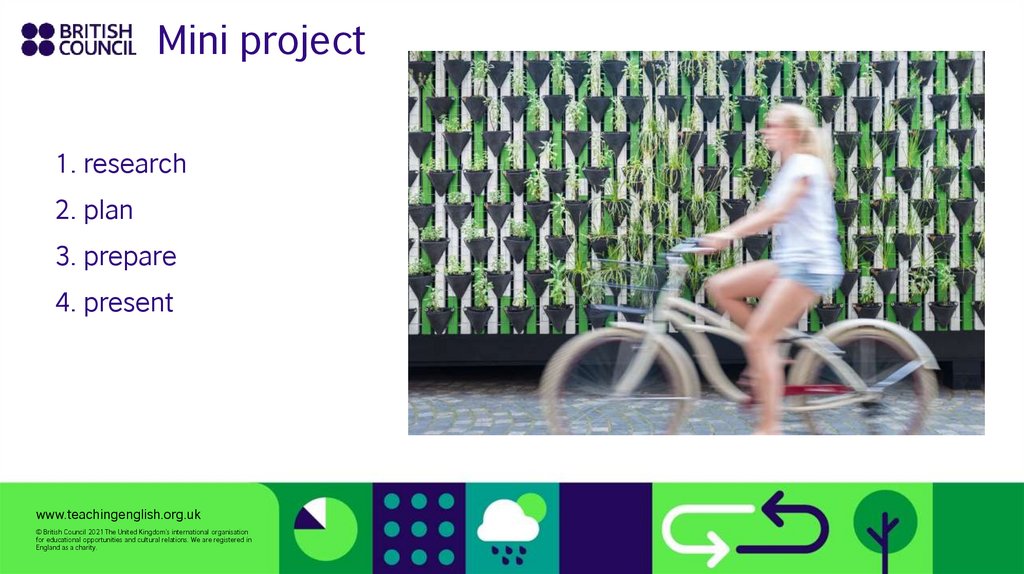
Mini project1. research
2. plan
3. prepare
4. present
www.teachingenglish.org.uk
© British Council 2021 The United Kingdom’s international organisation
for educational opportunities and cultural relations. We are registered in
England as a charity.
16.
Upcyclingwww.teachingenglish.org.uk
© British Council 2021 The United Kingdom’s international organisation
for educational opportunities and cultural relations. We are registered in
England as a charity.