 psychology
Similar presentations:




Professional burnout of university teachers with different levels of reflexivity and motivation
1.
Presentation«Professional burnout of university teachers with
different levels of reflexivity and motivation»
COMPLETED BY:
MASTER'S STUDENT
GROUP 202440: ANISIMOV M.V.
2. Theory
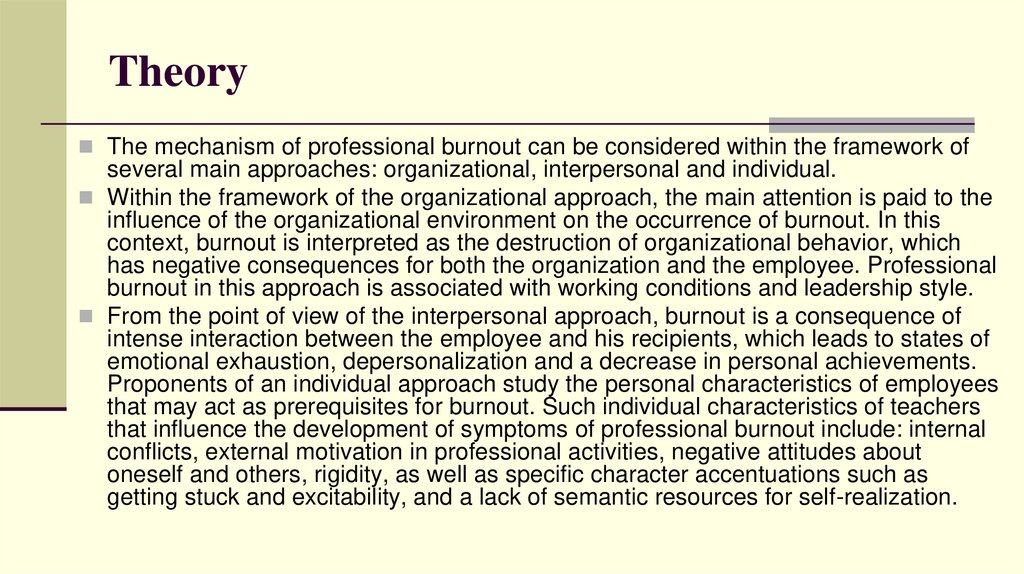
The mechanism of professional burnout can be considered within the framework ofseveral main approaches: organizational, interpersonal and individual.
Within the framework of the organizational approach, the main attention is paid to the
influence of the organizational environment on the occurrence of burnout. In this
context, burnout is interpreted as the destruction of organizational behavior, which
has negative consequences for both the organization and the employee. Professional
burnout in this approach is associated with working conditions and leadership style.
From the point of view of the interpersonal approach, burnout is a consequence of
intense interaction between the employee and his recipients, which leads to states of
emotional exhaustion, depersonalization and a decrease in personal achievements.
Proponents of an individual approach study the personal characteristics of employees
that may act as prerequisites for burnout. Such individual characteristics of teachers
that influence the development of symptoms of professional burnout include: internal
conflicts, external motivation in professional activities, negative attitudes about
oneself and others, rigidity, as well as specific character accentuations such as
getting stuck and excitability, and a lack of semantic resources for self-realization.
3. Famous researchers
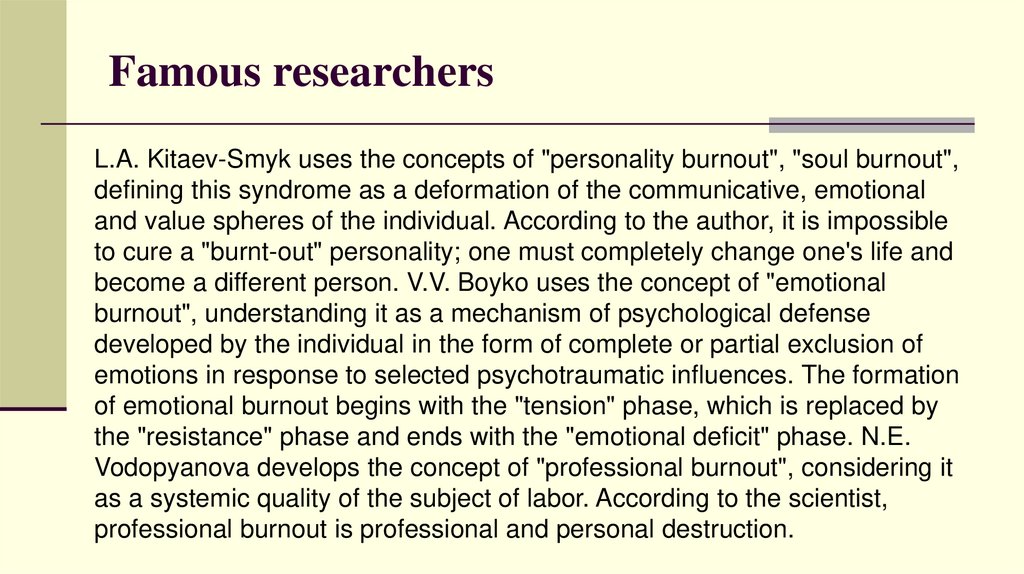
L.A. Kitaev-Smyk uses the concepts of "personality burnout", "soul burnout",defining this syndrome as a deformation of the communicative, emotional
and value spheres of the individual. According to the author, it is impossible
to cure a "burnt-out" personality; one must completely change one's life and
become a different person. V.V. Boyko uses the concept of "emotional
burnout", understanding it as a mechanism of psychological defense
developed by the individual in the form of complete or partial exclusion of
emotions in response to selected psychotraumatic influences. The formation
of emotional burnout begins with the "tension" phase, which is replaced by
the "resistance" phase and ends with the "emotional deficit" phase. N.E.
Vodopyanova develops the concept of "professional burnout", considering it
as a systemic quality of the subject of labor. According to the scientist,
professional burnout is professional and personal destruction.
4. Phenomenon
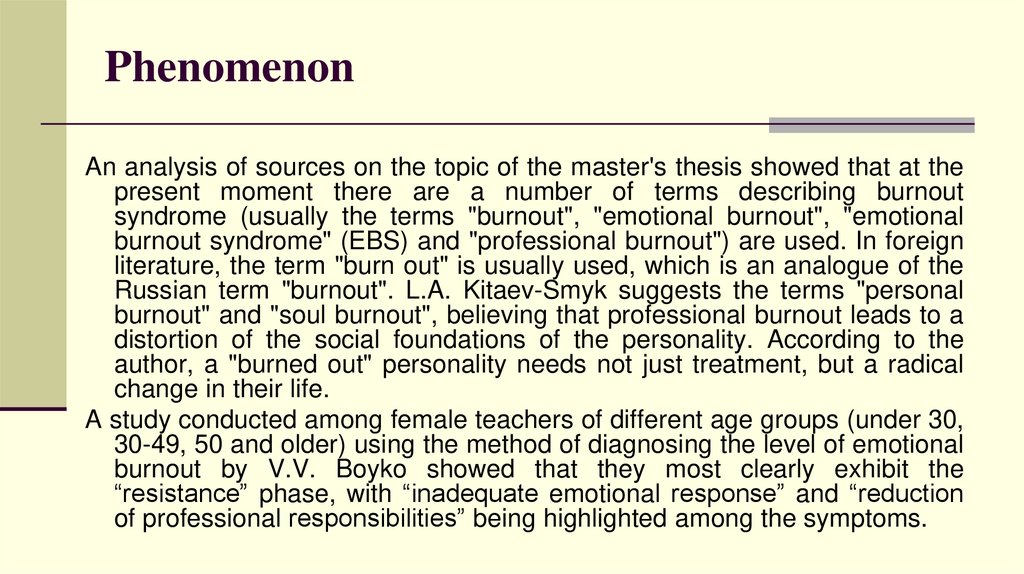
An analysis of sources on the topic of the master's thesis showed that at thepresent moment there are a number of terms describing burnout
syndrome (usually the terms "burnout", "emotional burnout", "emotional
burnout syndrome" (EBS) and "professional burnout") are used. In foreign
literature, the term "burn out" is usually used, which is an analogue of the
Russian term "burnout". L.A. Kitaev-Smyk suggests the terms "personal
burnout" and "soul burnout", believing that professional burnout leads to a
distortion of the social foundations of the personality. According to the
author, a "burned out" personality needs not just treatment, but a radical
change in their life.
A study conducted among female teachers of different age groups (under 30,
30-49, 50 and older) using the method of diagnosing the level of emotional
burnout by V.V. Boyko showed that they most clearly exhibit the
“resistance” phase, with “inadequate emotional response” and “reduction
of professional responsibilities” being highlighted among the symptoms.