 literature
Similar presentations:








Introductions, counterarguments & conclusions
1.
INTRODUCTIONS,COUNTERARGUMENTS &
CONCLUSIONS
Hooking the reader,
capitalizing on ethos & the
“So what?” factor
2.
ROLE OF AN INTRODUCTION• Engages your reader
• Establishes your purpose
• Provides context & space
for your topic
• States your thesis
3.
TECHNIQUES FOR WRITING A “HOOK”• Begin essay with a quotation, surprising fact, or a statistic from your sources
that relates to the focus of your topic (it better be really interesting!)
• Describe a problem, dilemma, or controversy associated with your topic (keep
it brief!)
• Make a statement that provokes a response
• Ask a question (it better be good!)
• Make a historical comparison or contrast
Do you always need a hook? Opinions vary. My take? Don’t insert a hook just to
have one present; if it doesn’t actually hook the reader’s interest, it’s just acting
as filler. If you can’t come up with a strong hook, I prefer students just write a
well crafted, direct initial sentence instead.
4.
EXAMPLE: INTRODUCTIONThe good life is the simple life. Among philosophical ideas about how we
should live, this one is a hardy perennial; from Socrates to Thoreau, from the Buddha
to Wendell Berry, thinkers have been peddling it for more than two millennia. And it
still has plenty of adherents. Magazines such as Real Simple call out to us from the
supermarket checkout; Oprah Winfrey regularly interviews fans of simple living such
as Jack Kornfield, a teacher of Buddhist mindfulness; the Slow Movement, which
advocates a return to pre-industrial basics, attracts followers across continents.
Through much of human history, frugal simplicity was not a choice but a necessity –
and since necessary, it was also deemed a moral virtue. But with the advent of
industrial capitalism and a consumer society, a system arose that was committed to
relentless growth, and with it grew a population (aka ‘the market’) that was enabled
and encouraged to buy lots of stuff that, by traditional standards, was surplus to
requirements. As a result, people have forgotten traditional values, become
disconnected with others, and are experiencing and increase in mental health issues.
5.
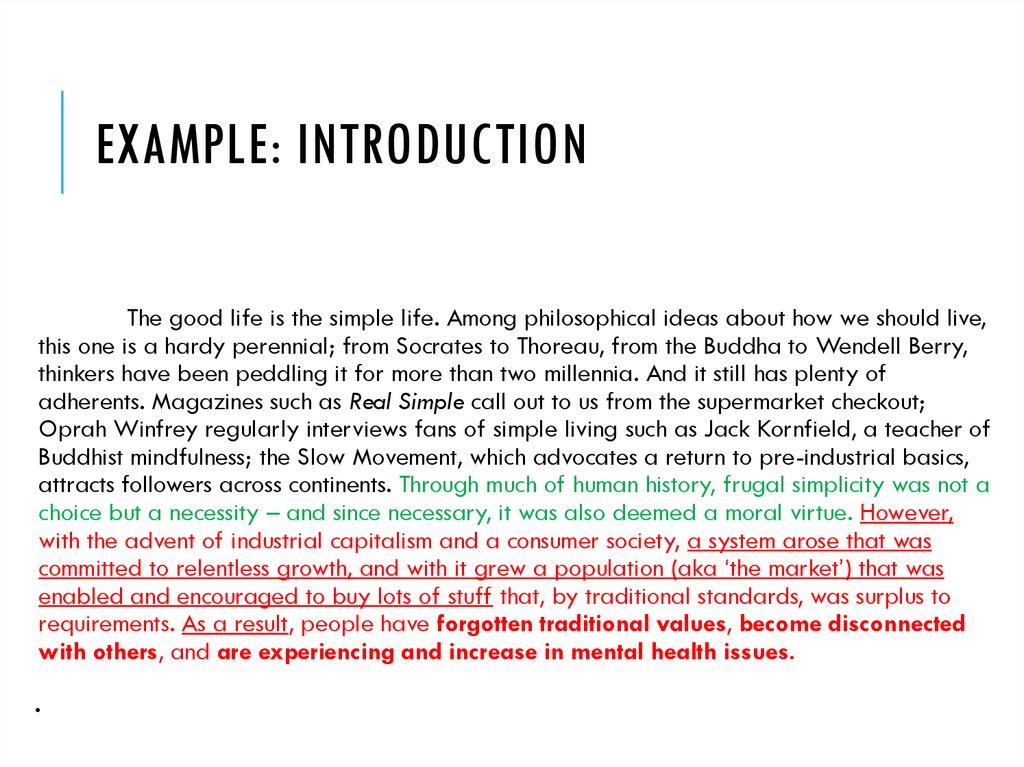
EXAMPLE: INTRODUCTIONThe good life is the simple life. Among philosophical ideas about how we should live,
this one is a hardy perennial; from Socrates to Thoreau, from the Buddha to Wendell Berry,
thinkers have been peddling it for more than two millennia. And it still has plenty of
adherents. Magazines such as Real Simple call out to us from the supermarket checkout;
Oprah Winfrey regularly interviews fans of simple living such as Jack Kornfield, a teacher of
Buddhist mindfulness; the Slow Movement, which advocates a return to pre-industrial basics,
attracts followers across continents. Through much of human history, frugal simplicity was not a
choice but a necessity – and since necessary, it was also deemed a moral virtue. However,
with the advent of industrial capitalism and a consumer society, a system arose that was
committed to relentless growth, and with it grew a population (aka ‘the market’) that was
enabled and encouraged to buy lots of stuff that, by traditional standards, was surplus to
requirements. As a result, people have forgotten traditional values, become disconnected
with others, and are experiencing and increase in mental health issues.
.
6.
WHAT TO AVOID IN AN INTRODUCTION• Making sweeping, generalizing statements like “Everyone knows…”,
“Since the beginning of time…”, “All over the world…”
• Letting your introduction ramble on and overwhelm the paper
(general rule: no more than 10% of the paper)
• Arguing your point in the introduction (i.e. inserting quotations and
explaining how they act as “evidence”—that comes later)
• Neglecting to insert a clear, specific thesis at the end of the
paragraph.
7.
ROLE OF A COUNTERARGUMENT• “When you counterargue, you consider a possible argument against your thesis or some aspect of your
reasoning. This is a good way to test your ideas when drafting, while you still have time to revise them. And
in the finished essay, it can be a persuasive and disarming tactic. It allows you to anticipate doubts and
pre-empt objections that a skeptical reader might have; it presents you as the kind of person who weighs
alternatives before arguing for one, who confronts difficulties instead of sweeping them under the rug, who
is more interested in discovering the truth than winning a point.”
• Presenting a counterargument is a classic rhetorical appeal to ethos, and lends you, the author, a sense of
sincerity, credibility, and well-roundedness in terms of research & argumentation.
• Location: In classic argumentation papers, counterarguments can be placed into the paper in various ways;
however, for this course I will require it to always be located as the second to last, i.e. penultimate,
paragraph of your essays.
Two-Part Organization of Counterargument
1). Countergument (“the turn against”): as explained above, this is where you present an opposing
argument(s) to your own.
2). Rebuttal (“the turn back” or “refutation”): a return to your own argument, where you point out the ways in
which the counterargument(s) is ultimately less valid or important than your own.
8.
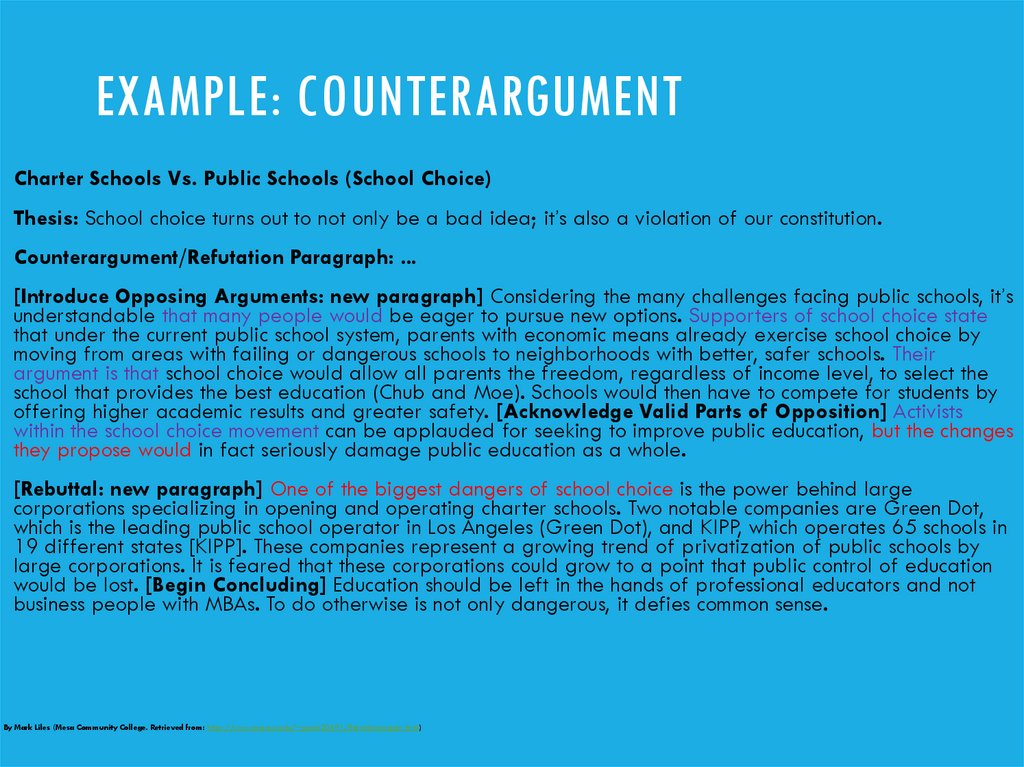
EXAMPLE: COUNTERARGUMENTCharter Schools Vs. Public Schools (School Choice)
Thesis: School choice turns out to not only be a bad idea; it’s also a violation of our constitution.
Counterargument/Refutation Paragraph: ...
[Introduce Opposing Arguments: new paragraph] Considering the many challenges facing public schools, it’s
understandable that many people would be eager to pursue new options. Supporters of school choice state
that under the current public school system, parents with economic means already exercise school choice by
moving from areas with failing or dangerous schools to neighborhoods with better, safer schools. Their
argument is that school choice would allow all parents the freedom, regardless of income level, to select the
school that provides the best education (Chub and Moe). Schools would then have to compete for students by
offering higher academic results and greater safety. [Acknowledge Valid Parts of Opposition] Activists
within the school choice movement can be applauded for seeking to improve public education, but the changes
they propose would in fact seriously damage public education as a whole.
[Rebuttal: new paragraph] One of the biggest dangers of school choice is the power behind large
corporations specializing in opening and operating charter schools. Two notable companies are Green Dot,
which is the leading public school operator in Los Angeles (Green Dot), and KIPP, which operates 65 schools in
19 different states [KIPP]. These companies represent a growing trend of privatization of public schools by
large corporations. It is feared that these corporations could grow to a point that public control of education
would be lost. [Begin Concluding] Education should be left in the hands of professional educators and not
business people with MBAs. To do otherwise is not only dangerous, it defies common sense.
By Mark Liles (Mesa Community College. Retrieved from: https://www.mesacc.edu/~paoih30491/Refutationpgphs.html)
9.
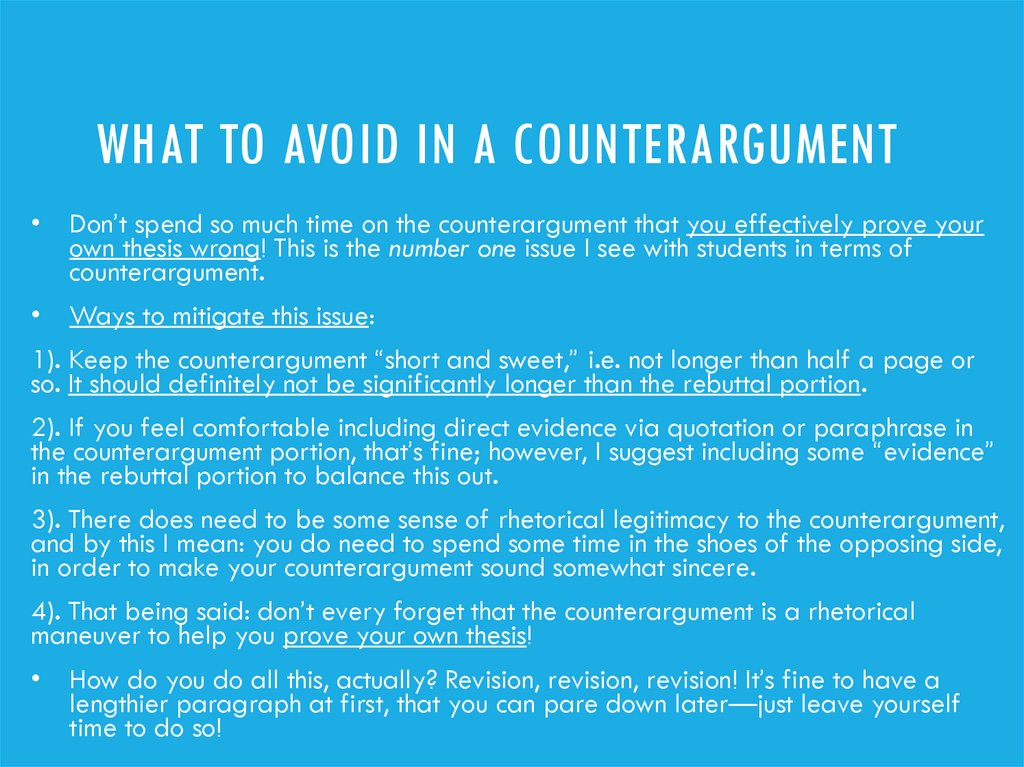
WHAT TO AVOID IN A COUNTERARGUMENT• Don’t spend so much time on the counterargument that you effectively prove your
own thesis wrong! This is the number one issue I see with students in terms of
counterargument.
• Ways to mitigate this issue:
1). Keep the counterargument “short and sweet,” i.e. not longer than half a page or
so. It should definitely not be significantly longer than the rebuttal portion.
2). If you feel comfortable including direct evidence via quotation or paraphrase in
the counterargument portion, that’s fine; however, I suggest including some “evidence”
in the rebuttal portion to balance this out.
3). There does need to be some sense of rhetorical legitimacy to the counterargument,
and by this I mean: you do need to spend some time in the shoes of the opposing side,
in order to make your counterargument sound somewhat sincere.
4). That being said: don’t every forget that the counterargument is a rhetorical
maneuver to help you prove your own thesis!
• How do you do all this, actually? Revision, revision, revision! It’s fine to have a
lengthier paragraph at first, that you can pare down later—just leave yourself
time to do so!
10.
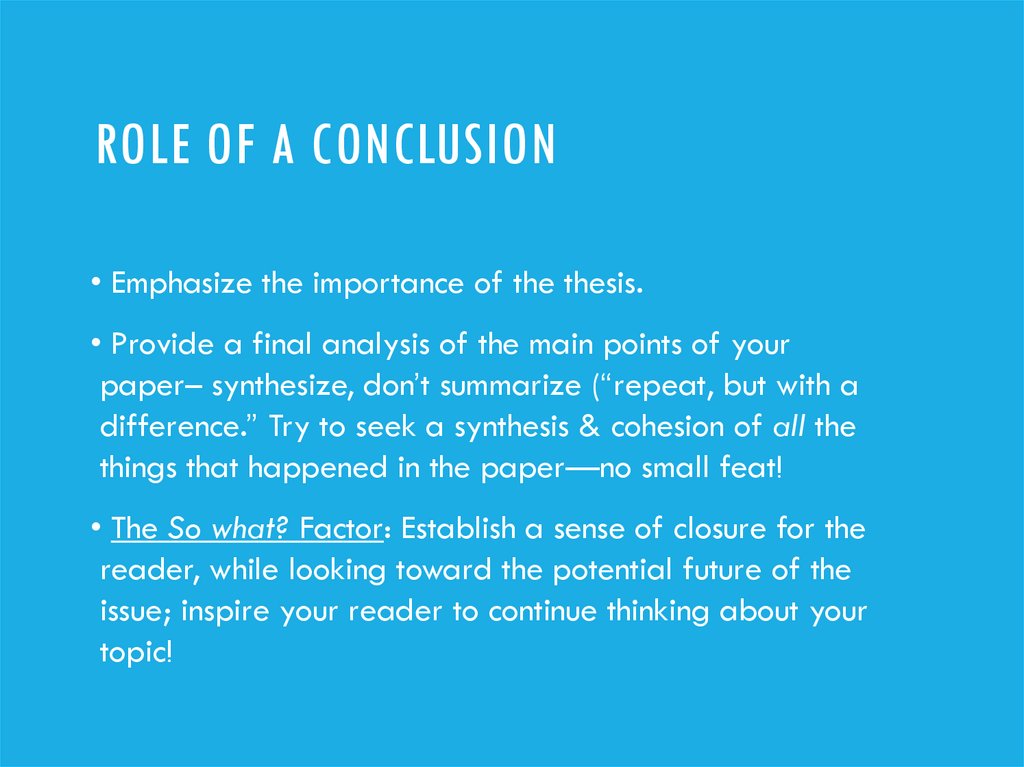
ROLE OF A CONCLUSION• Emphasize the importance of the thesis.
• Provide a final analysis of the main points of your
paper– synthesize, don’t summarize (“repeat, but with a
difference.” Try to seek a synthesis & cohesion of all the
things that happened in the paper—no small feat!
• The So what? Factor: Establish a sense of closure for the
reader, while looking toward the potential future of the
issue; inspire your reader to continue thinking about your
topic!
11.
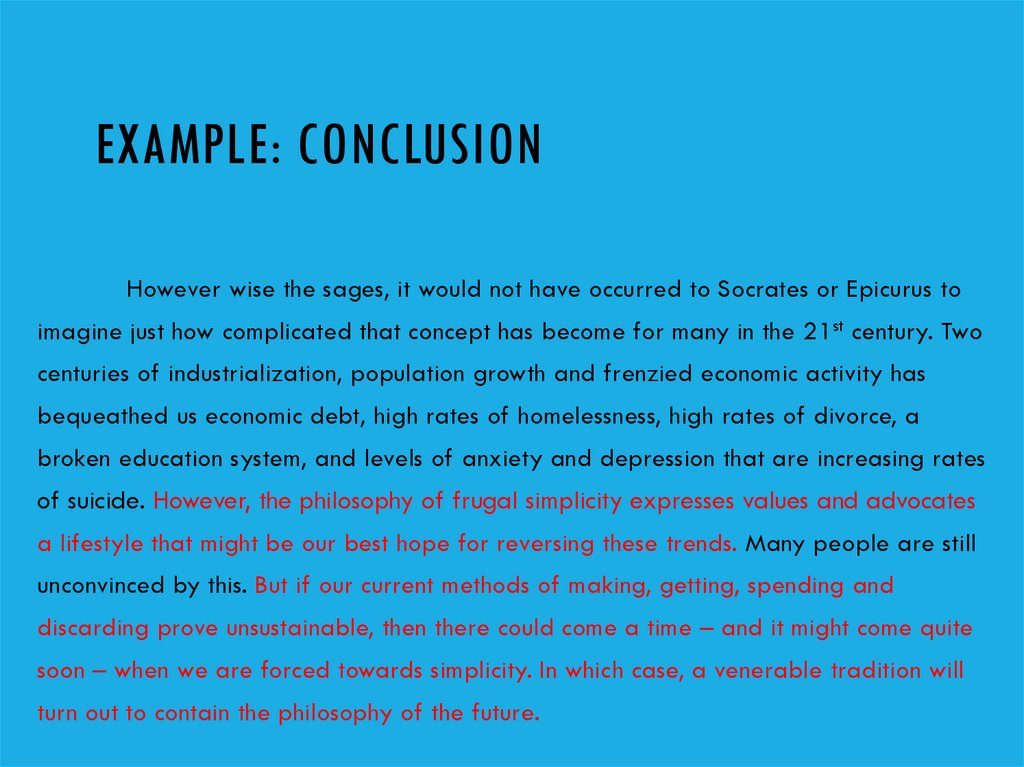
EXAMPLE: CONCLUSIONHowever wise the sages, it would not have occurred to Socrates or Epicurus to
imagine just how complicated that concept has become for many in the 21st century. Two
centuries of industrialization, population growth and frenzied economic activity has
bequeathed us economic debt, high rates of homelessness, high rates of divorce, a
broken education system, and levels of anxiety and depression that are increasing rates
of suicide. However, the philosophy of frugal simplicity expresses values and advocates
a lifestyle that might be our best hope for reversing these trends. Many people are still
unconvinced by this. But if our current methods of making, getting, spending and
discarding prove unsustainable, then there could come a time – and it might come quite
soon – when we are forced towards simplicity. In which case, a venerable tradition will
turn out to contain the philosophy of the future.
12.
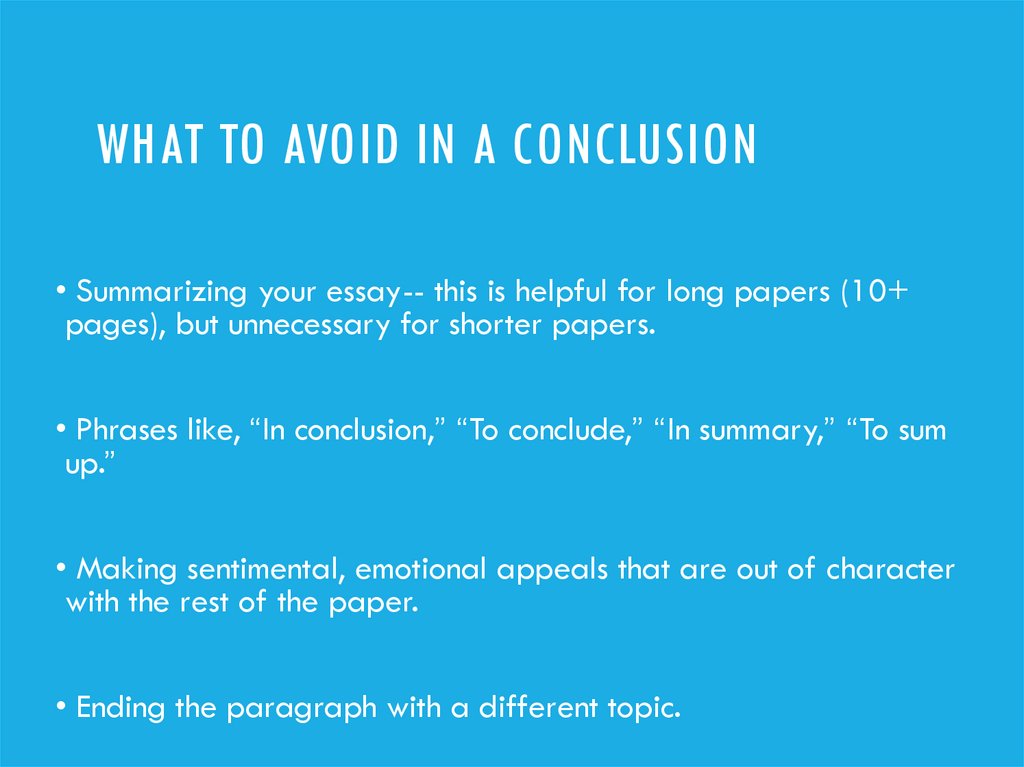
WHAT TO AVOID IN A CONCLUSION• Summarizing your essay-- this is helpful for long papers (10+
pages), but unnecessary for shorter papers.
• Phrases like, “In conclusion,” “To conclude,” “In summary,” “To sum
up.”
• Making sentimental, emotional appeals that are out of character
with the rest of the paper.
• Ending the paragraph with a different topic.
13.
THIS WEEK: TSIS CHAPTER 6 WILL HELP WITHCOUNTERARGUMENT & CHAPTER 7 WILL HELP YOU
CONSIDER THE OVERALL PURPOSE (SO WHAT?) OF
YOUR PAPER.
Happy writing!