 literature
Similar presentations:





Rhetorical analysis assignment
1.
Rhetorical Analysis AssignmentAnalyzing how another writer employs rhetorical appeals to create a persuasive argument
2.
Opening Freewrite1). What is Shermer's main claim in “Utopia is a Dangerous Ideal"?
2). What are some rhetorical "appeals" Shermer uses to convey his argument?
Find one example each of TWO different “modes of persuasion.”
3). What do you make of his tone? As a reader, do you find his argument and approach
compelling, or not? Be prepared to elaborate and provide specific examples.
3.
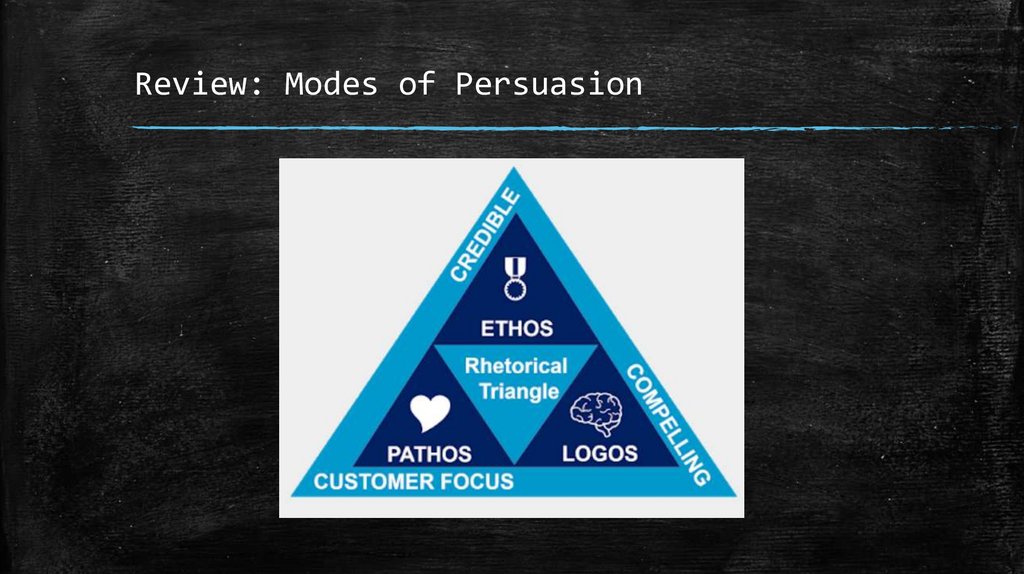
Review: Modes of Persuasion4.
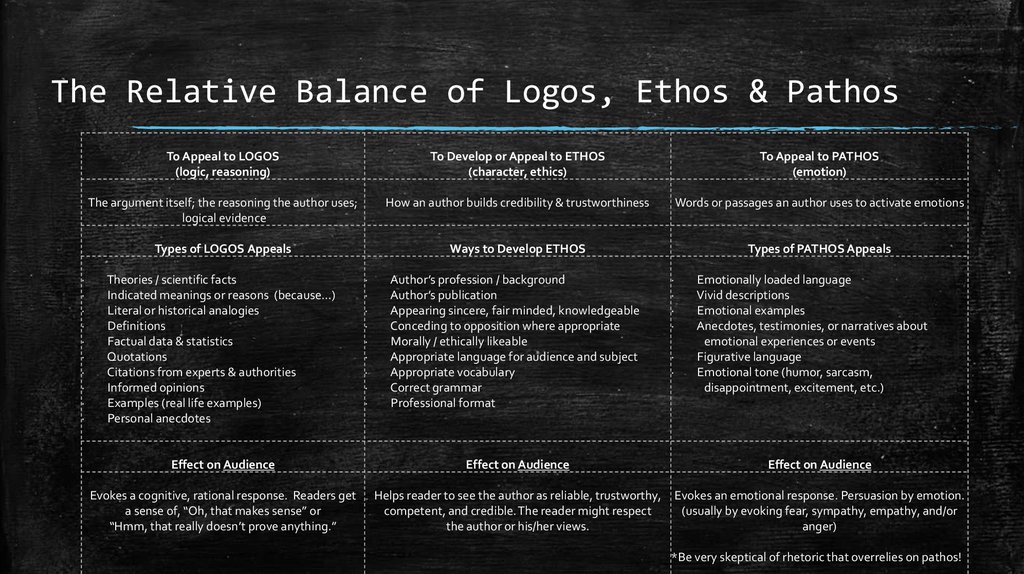
The Relative Balance of Logos, Ethos & Pathos·
·
·
·
·
·
·
·
·
·
To Appeal to LOGOS
(logic, reasoning)
To Develop or Appeal to ETHOS
(character, ethics)
To Appeal to PATHOS
(emotion)
The argument itself; the reasoning the author uses;
logical evidence
How an author builds credibility & trustworthiness
Words or passages an author uses to activate emotions
Types of LOGOS Appeals
Ways to Develop ETHOS
Types of PATHOS Appeals
Theories / scientific facts
Indicated meanings or reasons (because…)
Literal or historical analogies
Definitions
Factual data & statistics
Quotations
Citations from experts & authorities
Informed opinions
Examples (real life examples)
Personal anecdotes
·
·
·
·
·
·
·
·
·
Author’s profession / background
Author’s publication
Appearing sincere, fair minded, knowledgeable
Conceding to opposition where appropriate
Morally / ethically likeable
Appropriate language for audience and subject
Appropriate vocabulary
Correct grammar
Professional format
·
·
·
·
·
·
Emotionally loaded language
Vivid descriptions
Emotional examples
Anecdotes, testimonies, or narratives about
emotional experiences or events
Figurative language
Emotional tone (humor, sarcasm,
disappointment, excitement, etc.)
Effect on Audience
Effect on Audience
Effect on Audience
Evokes a cognitive, rational response. Readers get
a sense of, “Oh, that makes sense” or
“Hmm, that really doesn’t prove anything.”
Helps reader to see the author as reliable, trustworthy,
competent, and credible. The reader might respect
the author or his/her views.
Evokes an emotional response. Persuasion by emotion.
(usually by evoking fear, sympathy, empathy, and/or
anger)
*Be very skeptical of rhetoric that overrelies on pathos!
5.
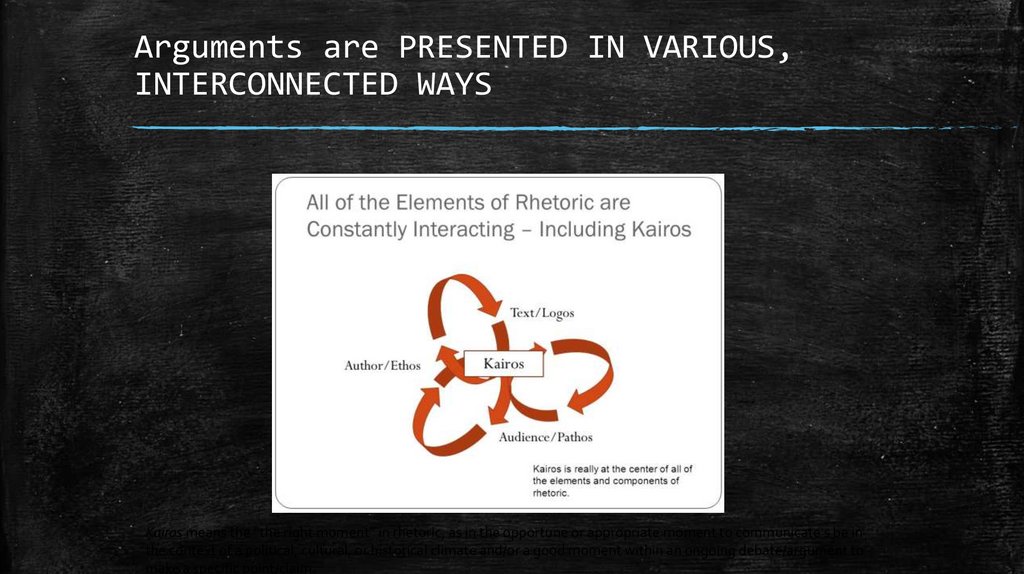
Arguments are PRESENTED IN VARIOUS,INTERCONNECTED WAYS
Kairos means the “the right moment” in rhetoric, as in the opportune or appropriate moment to communicate s be in
the context of a political, cultural, or historical climate and/or a good moment within an ongoing debate/argument to
make a specific point/claim.
6.
How does TONE work with all this?Tone: the way the author wants the reader to perceive and experience the content.
Do they feel they’re learning something? Being accused or indicted of something? Being
told something funny? Being themselves made fun of? Is what they’re being told a
demand? A suggestion? Is the text inciting in the reader a strong sense of moral
obligation?
These are not mutually exclusive experiences—more than one can occur simultaneously.
In addition to various presentations of logos, ethos, pathos, and kairos, tone is
influenced/created by voice, diction, structure (organizational set-up and flow), among
others.
7.
Rhetorical Analysis Reminders• You first need to explain the rhetorical situation of the text to your reader.
• You need to make a claim about the text’s use of rhetorical appeals—your claim should be
presented in a simple, concise thesis.
• “You are not merely pointing out a particular rhetorical strategy the author has employed but,
more importantly, making a particular claim about how that strategy acts as a vehicle to propel
the overall argument forward. You are looking at the local choices an author has made and
making an argument about its global significance.” This is analysis and argument.
• You must incorporate specific text examples using paraphrase and quotation, with APA
citations.
• Proofread! Always, always, always read your work aloud before deeming it “complete.”
**Let’s look at a model of the Rhetorical Analysis assignment!
8.
More tips for the Rhetorical Analysis▪ Choose rhetorical items that stand out in terms of their importance or impact. These should be passages that you find interesting or
meaningful. Do not pick a passage unless you personally find its content/style engaging. If it is boring (to you) to read, it will be
tedious to analyze, and your lack of enthusiasm will surely be evident in your analysis.
▪ Do not merely give an example of rhetorical choice; evaluate it in terms of how it is used to establish or illustrate a key point
that supports the author’s objectives and its ultimate effectiveness. Consider the target audience, the perceived purpose or
the text, and the author’s point of view as you develop your analysis.
▪ Bear in mind that, as you identify and analyze the use of rhetorical appeals, the lack of certain appeals, or the overuse of others may
also be significant.
▪ Make sure each and every sentence leads necessarily and logically to the next and every paragraph leads necessarily and logically to
the next.
▪ Make sure you consistently cite the text by paraphrasing using key signal phrases, in-text citations, and direct quotations.
▪ Write clearly, and specifically. Write so that your reader cannot misunderstand you.
▪ Successful essays will make a claim about the ultimate effectiveness of the rhetorical strategy they are discussing with a thesis that
is arguable, interesting, compelling, unique, specific, and with a clear sense of relevance.
9.
Next Steps1). Read TSIS chapters 1 & 2 & resources
(if you haven’t already) (Week 1). Also: (re)view
all rhetorical modes of persuasion under Week 2.
2). (Re)read Rhetorical Analysis guidelines &
rubric.