 programming
Similar presentations:







Parallel Examples
1. Parallel Examples
2. Agenda
Array ProcessingPI Calculation
Simple Heat Equation
1-D Wave Equation
Page 2
Introduction to High Performance Computing
3. Array Processing
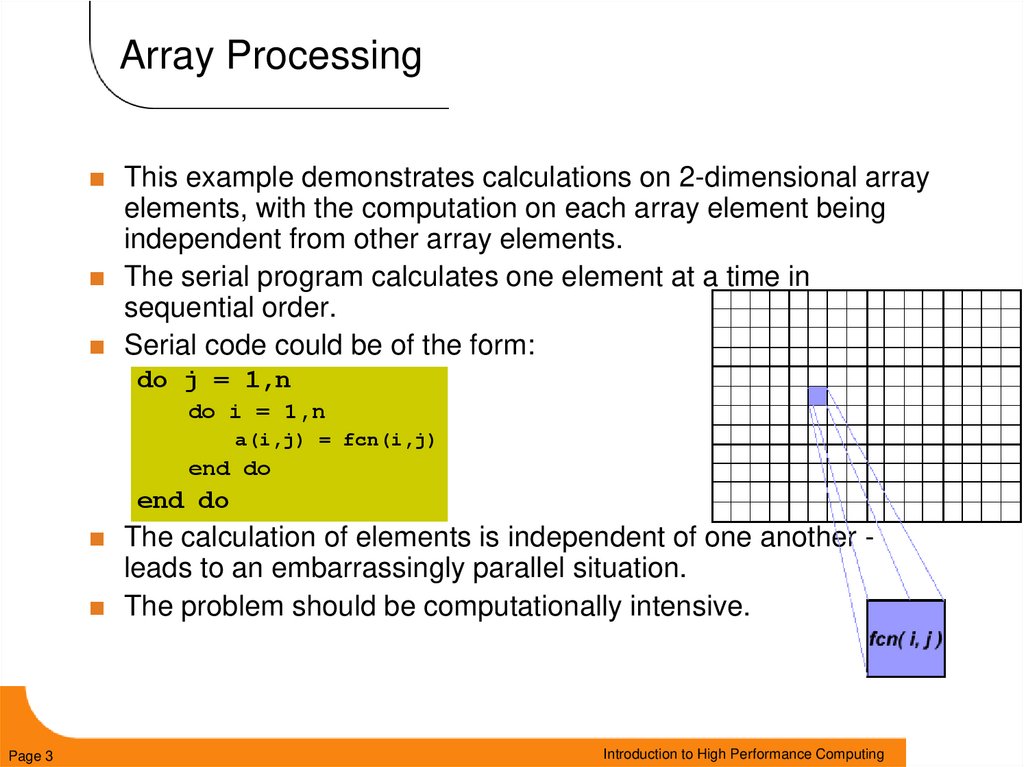
This example demonstrates calculations on 2-dimensional arrayelements, with the computation on each array element being
independent from other array elements.
The serial program calculates one element at a time in
sequential order.
Serial code could be of the form:
do j = 1,n
do i = 1,n
a(i,j) = fcn(i,j)
end do
end do
The calculation of elements is independent of one another -
leads to an embarrassingly parallel situation.
The problem should be computationally intensive.
Page 3
Introduction to High Performance Computing
4. Array Processing Solution 1
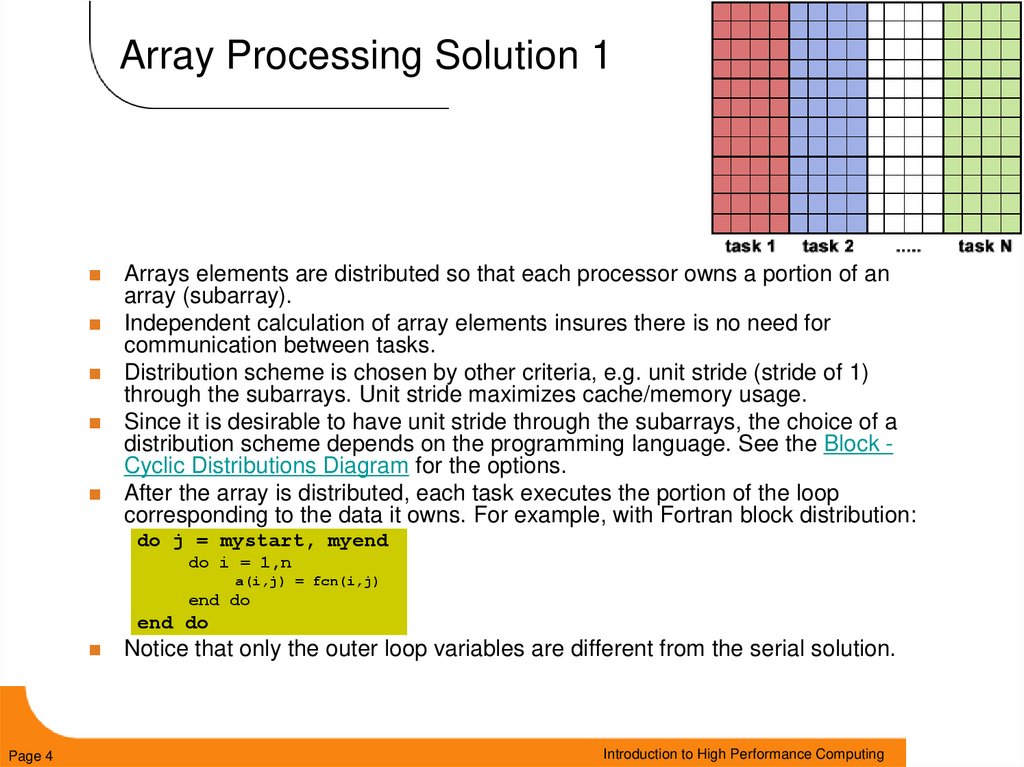
Arrays elements are distributed so that each processor owns a portion of anarray (subarray).
Independent calculation of array elements insures there is no need for
communication between tasks.
Distribution scheme is chosen by other criteria, e.g. unit stride (stride of 1)
through the subarrays. Unit stride maximizes cache/memory usage.
Since it is desirable to have unit stride through the subarrays, the choice of a
distribution scheme depends on the programming language. See the Block Cyclic Distributions Diagram for the options.
After the array is distributed, each task executes the portion of the loop
corresponding to the data it owns. For example, with Fortran block distribution:
do j = mystart, myend
do i = 1,n
a(i,j) = fcn(i,j)
end do
end do
Page 4
Notice that only the outer loop variables are different from the serial solution.
Introduction to High Performance Computing
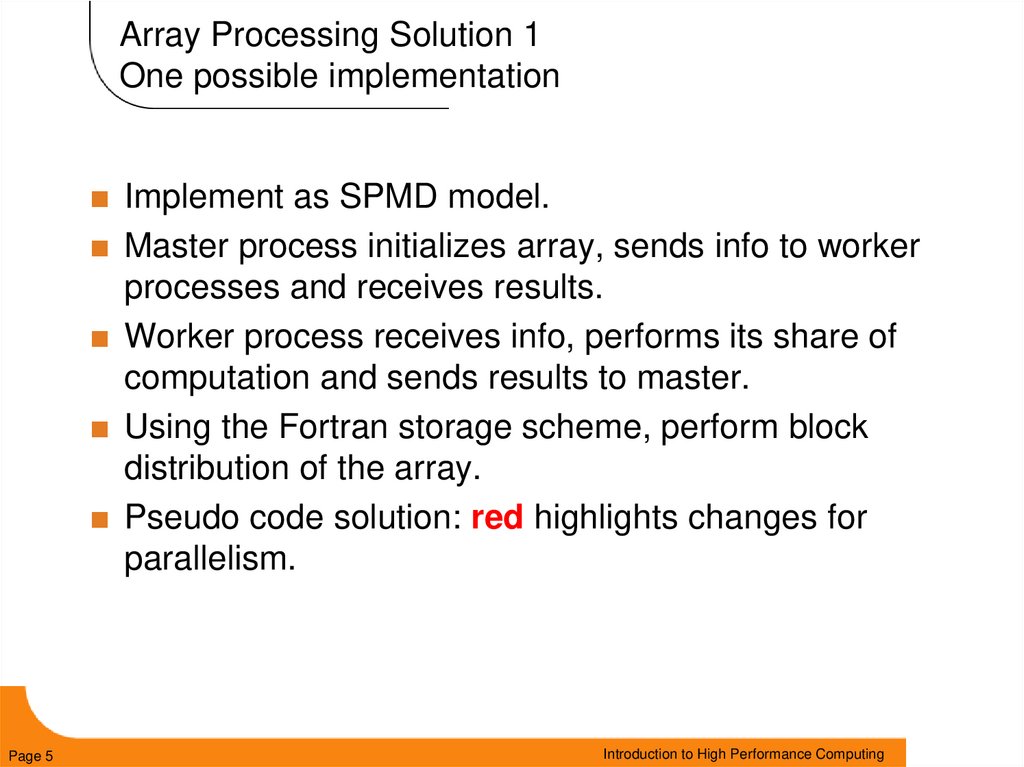
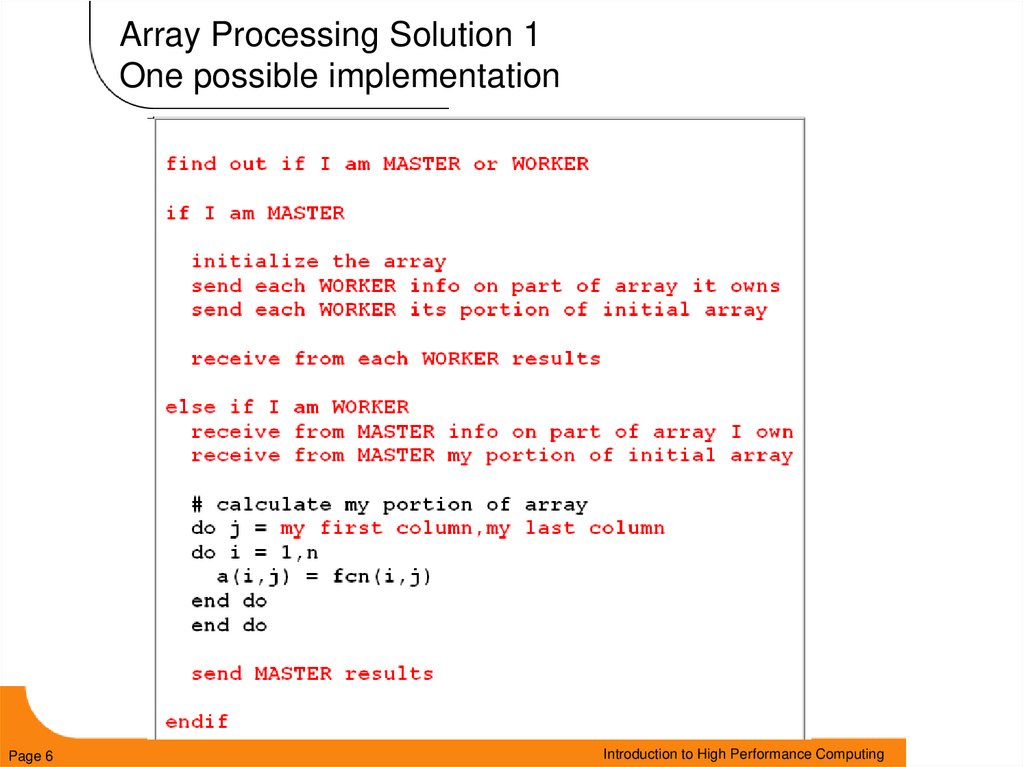
5. Array Processing Solution 1 One possible implementation
Implement as SPMD model.Master process initializes array, sends info to worker
processes and receives results.
Worker process receives info, performs its share of
computation and sends results to master.
Using the Fortran storage scheme, perform block
distribution of the array.
Pseudo code solution: red highlights changes for
parallelism.
Page 5
Introduction to High Performance Computing
6. Array Processing Solution 1 One possible implementation
Page 6Introduction to High Performance Computing
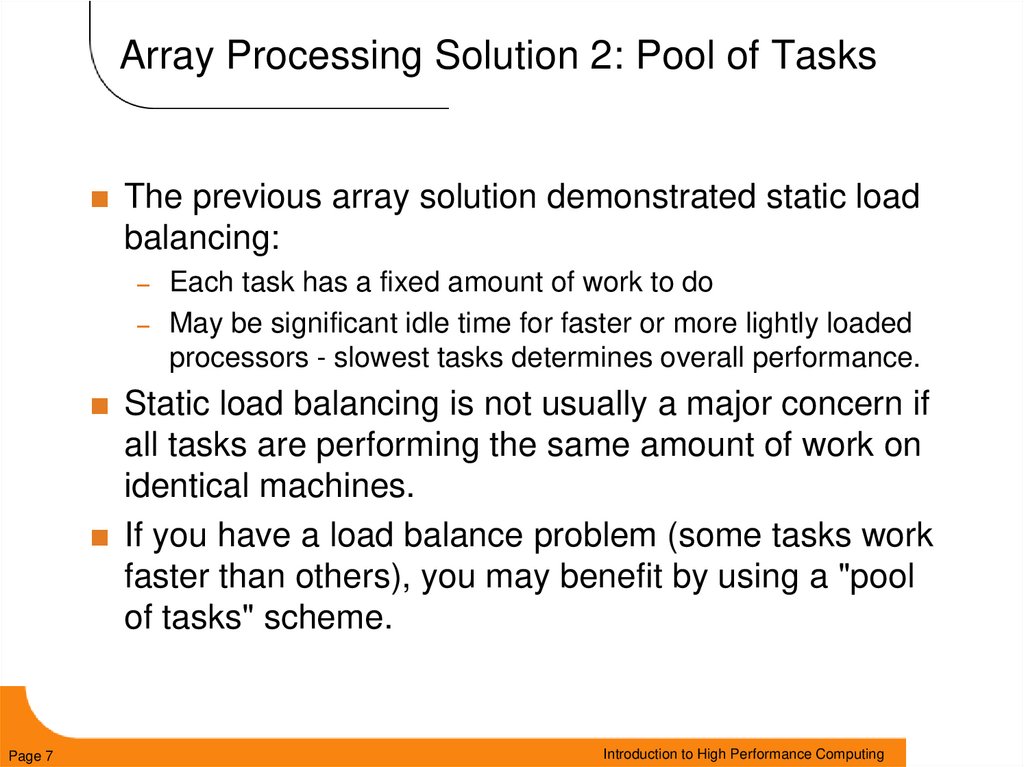
7. Array Processing Solution 2: Pool of Tasks
The previous array solution demonstrated static loadbalancing:
–
Each task has a fixed amount of work to do
– May be significant idle time for faster or more lightly loaded
processors - slowest tasks determines overall performance.
Static load balancing is not usually a major concern if
all tasks are performing the same amount of work on
identical machines.
If you have a load balance problem (some tasks work
faster than others), you may benefit by using a "pool
of tasks" scheme.
Page 7
Introduction to High Performance Computing
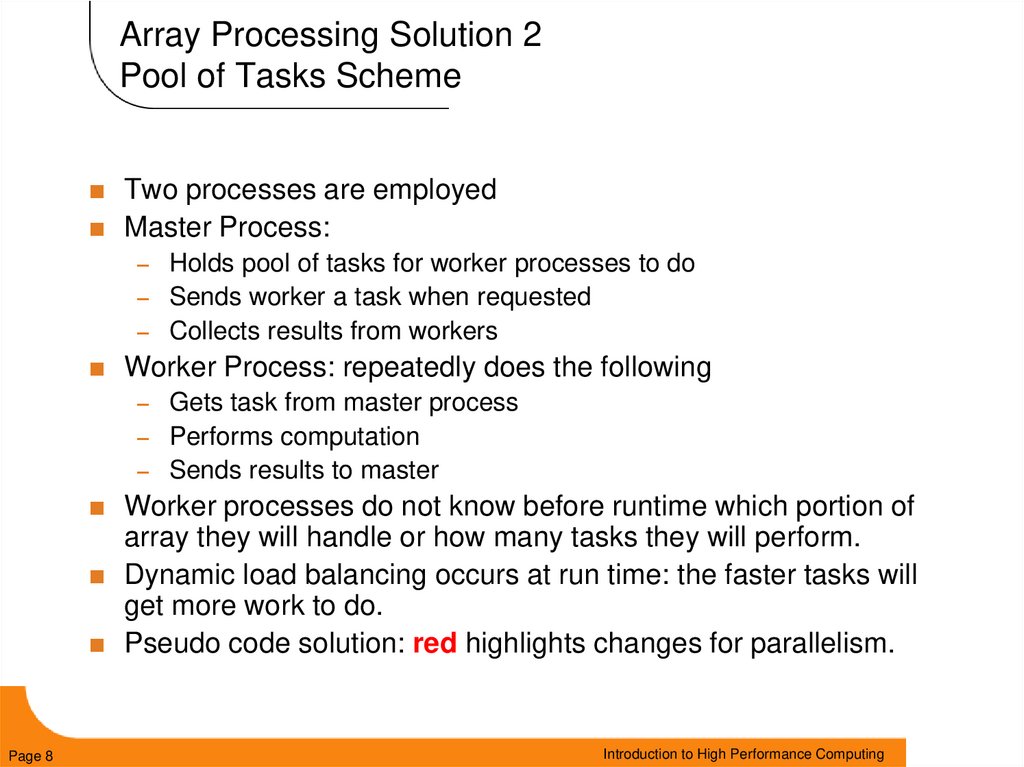
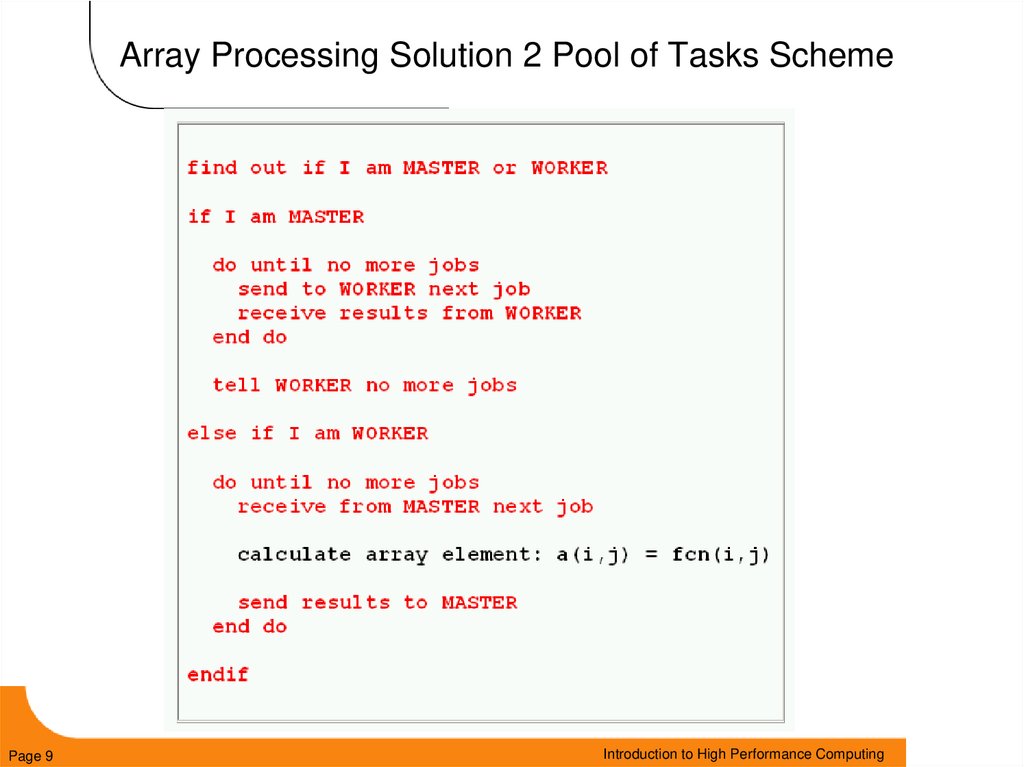
8. Array Processing Solution 2 Pool of Tasks Scheme
Two processes are employedMaster Process:
–
Holds pool of tasks for worker processes to do
– Sends worker a task when requested
– Collects results from workers
Worker Process: repeatedly does the following
–
Gets task from master process
– Performs computation
– Sends results to master
Worker processes do not know before runtime which portion of
array they will handle or how many tasks they will perform.
Dynamic load balancing occurs at run time: the faster tasks will
get more work to do.
Pseudo code solution: red highlights changes for parallelism.
Page 8
Introduction to High Performance Computing
9. Array Processing Solution 2 Pool of Tasks Scheme
Page 9Introduction to High Performance Computing
10. Pi Calculation
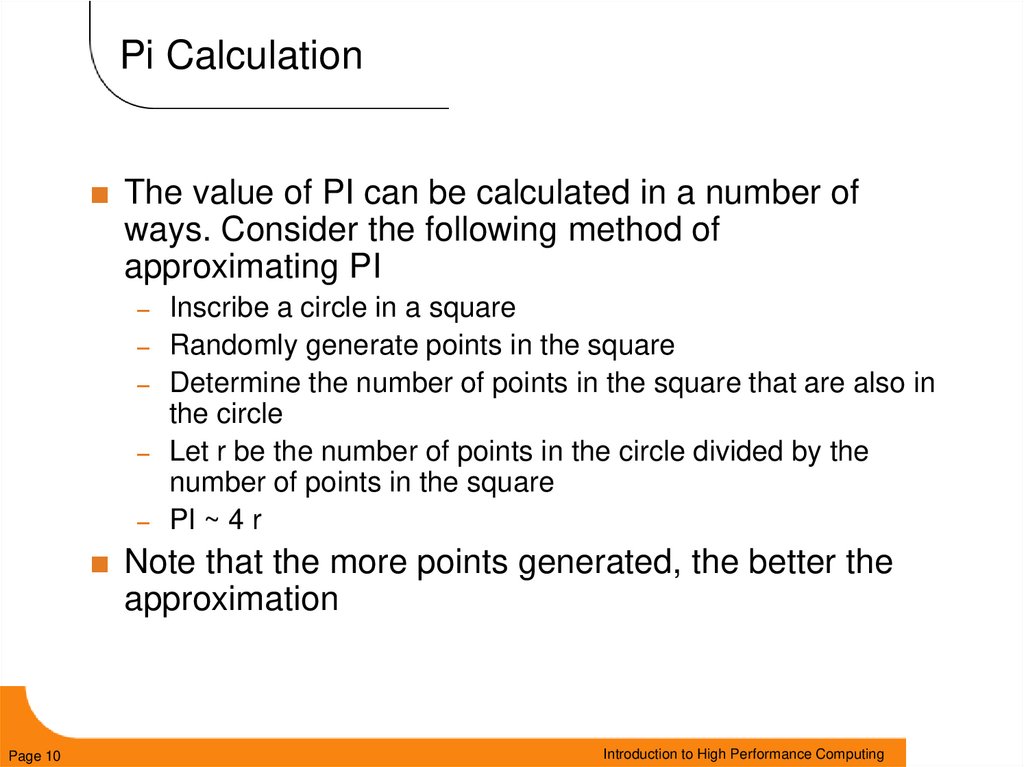
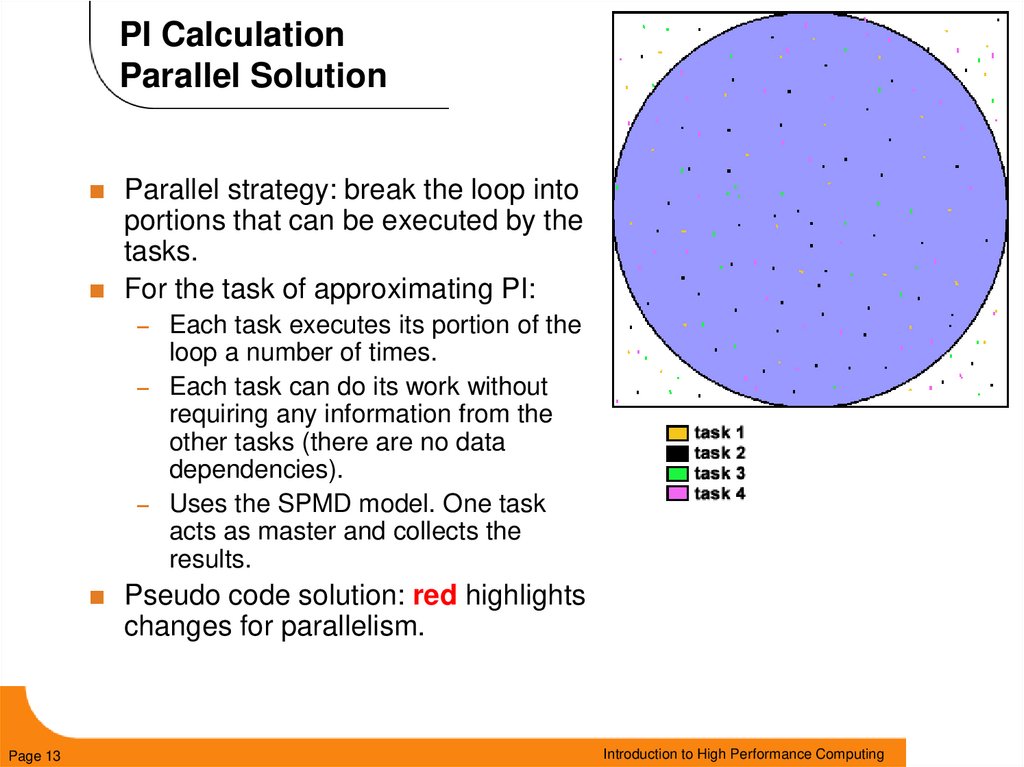
The value of PI can be calculated in a number ofways. Consider the following method of
approximating PI
–
Inscribe a circle in a square
– Randomly generate points in the square
– Determine the number of points in the square that are also in
the circle
– Let r be the number of points in the circle divided by the
number of points in the square
– PI ~ 4 r
Note that the more points generated, the better the
approximation
Page 10
Introduction to High Performance Computing
11. Discussion
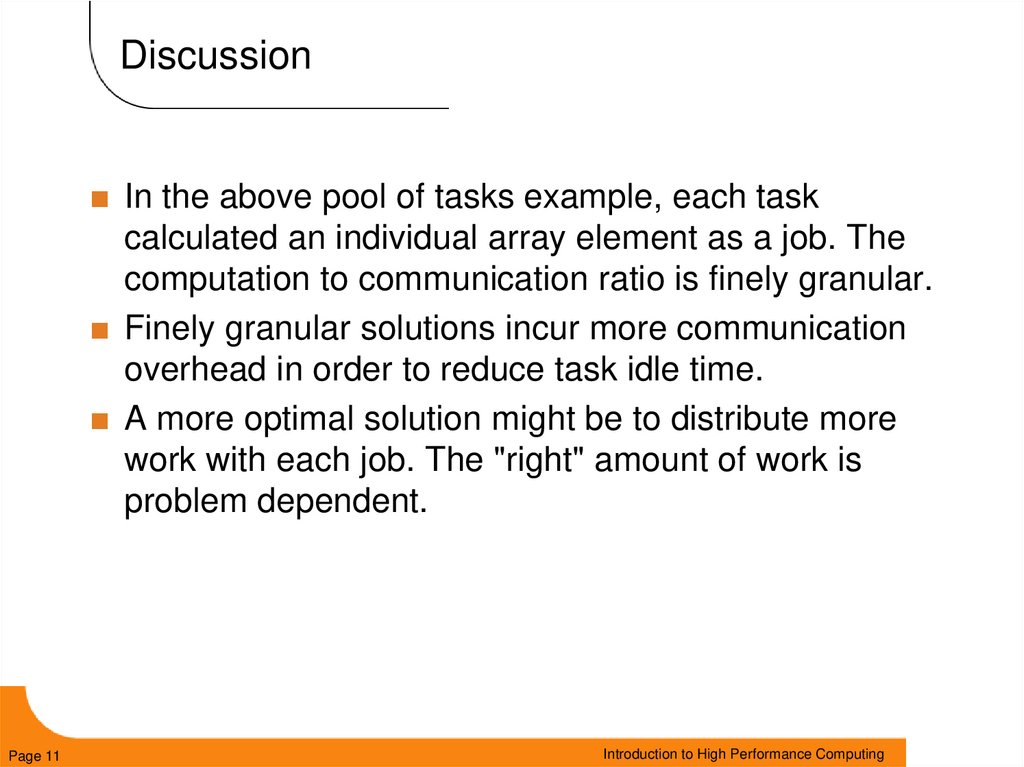
In the above pool of tasks example, each taskcalculated an individual array element as a job. The
computation to communication ratio is finely granular.
Finely granular solutions incur more communication
overhead in order to reduce task idle time.
A more optimal solution might be to distribute more
work with each job. The "right" amount of work is
problem dependent.
Page 11
Introduction to High Performance Computing
12. Algorithm
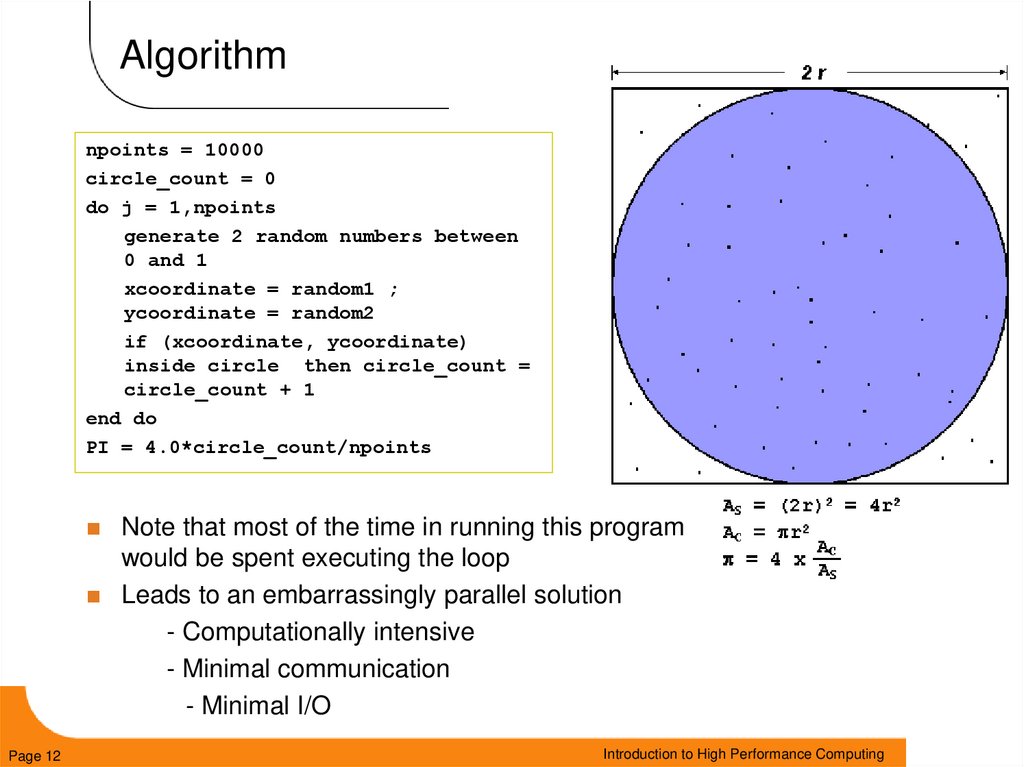
npoints = 10000circle_count = 0
do j = 1,npoints
generate 2 random numbers between
0 and 1
xcoordinate = random1 ;
ycoordinate = random2
if (xcoordinate, ycoordinate)
inside circle then circle_count =
circle_count + 1
end do
PI = 4.0*circle_count/npoints
Note that most of the time in running this program
would be spent executing the loop
Leads to an embarrassingly parallel solution
- Computationally intensive
- Minimal communication
- Minimal I/O
Page 12
Introduction to High Performance Computing
13. PI Calculation Parallel Solution
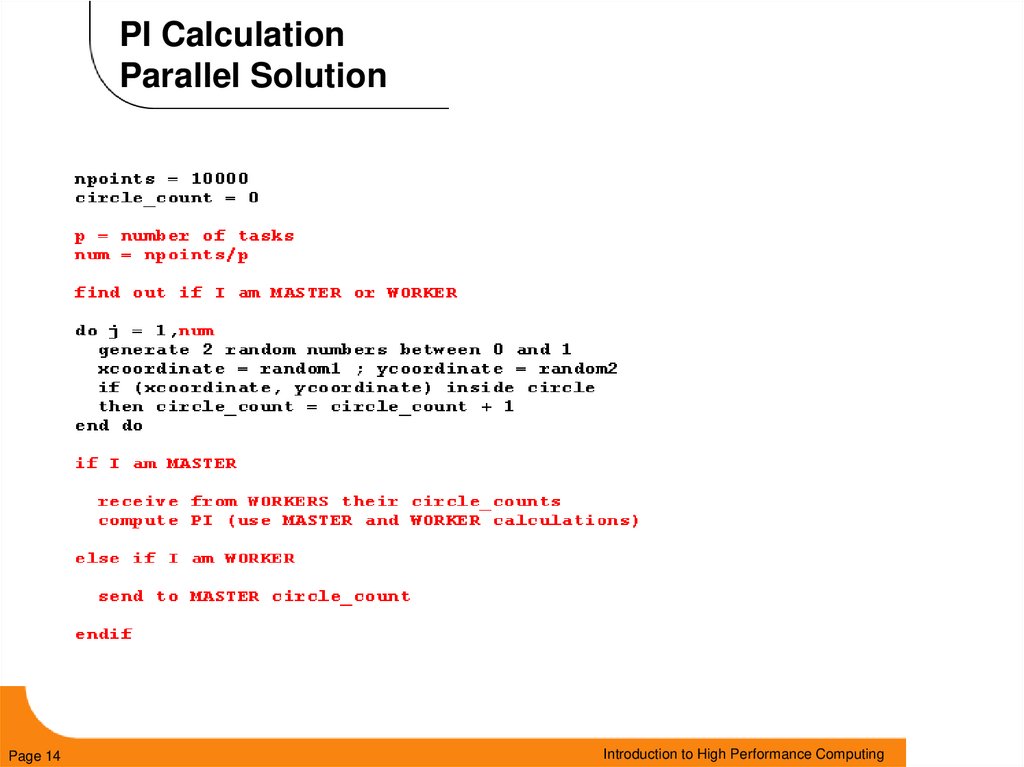
Parallel strategy: break the loop intoportions that can be executed by the
tasks.
For the task of approximating PI:
–
Each task executes its portion of the
loop a number of times.
– Each task can do its work without
requiring any information from the
other tasks (there are no data
dependencies).
– Uses the SPMD model. One task
acts as master and collects the
results.
Pseudo code solution: red highlights
changes for parallelism.
Page 13
Introduction to High Performance Computing
14. PI Calculation Parallel Solution
Page 14Introduction to High Performance Computing
15. Simple Heat Equation
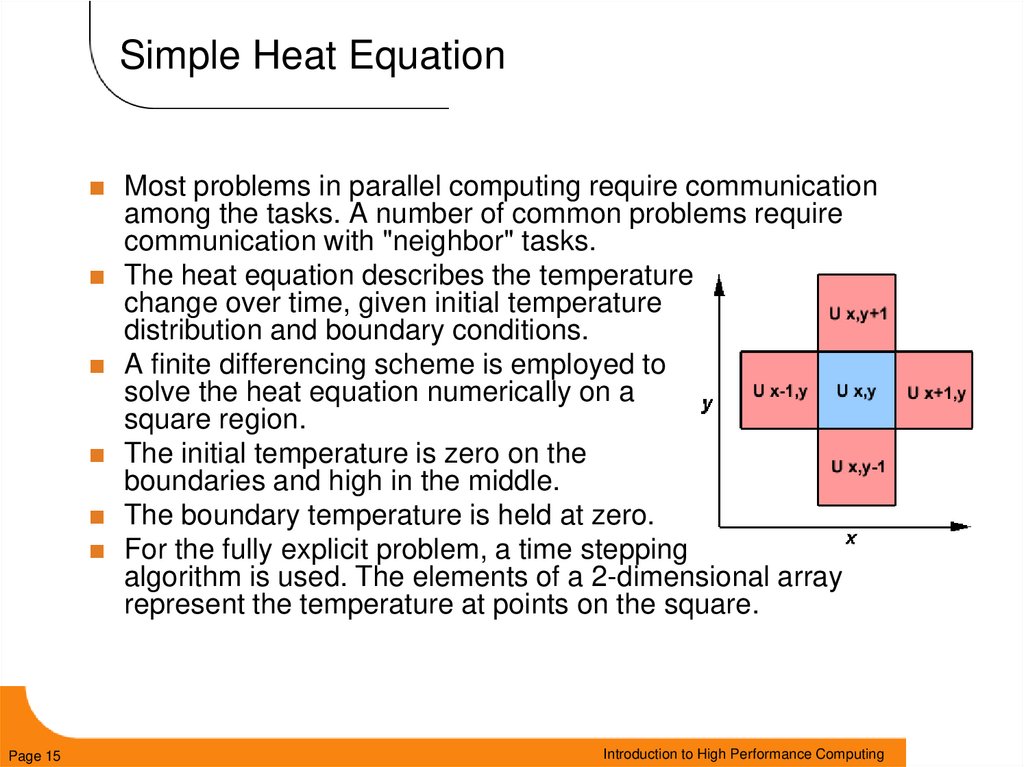
Most problems in parallel computing require communicationamong the tasks. A number of common problems require
communication with "neighbor" tasks.
The heat equation describes the temperature
change over time, given initial temperature
distribution and boundary conditions.
A finite differencing scheme is employed to
solve the heat equation numerically on a
square region.
The initial temperature is zero on the
boundaries and high in the middle.
The boundary temperature is held at zero.
For the fully explicit problem, a time stepping
algorithm is used. The elements of a 2-dimensional array
represent the temperature at points on the square.
Page 15
Introduction to High Performance Computing
16. Simple Heat Equation
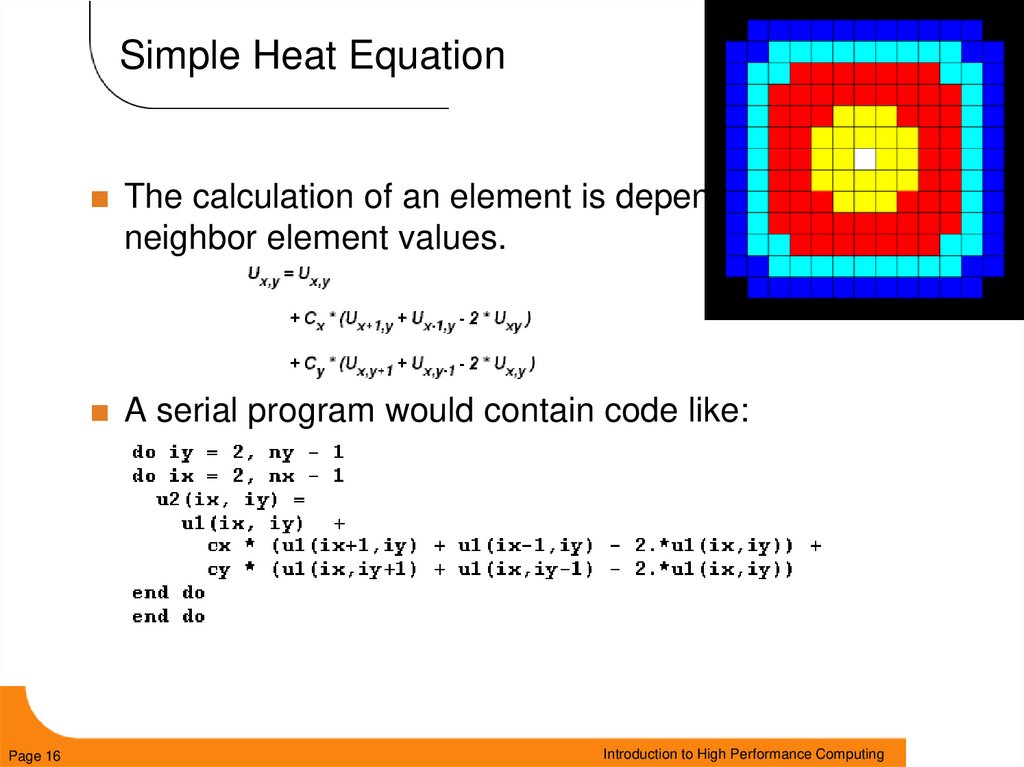
The calculation of an element is dependent uponneighbor element values.
A serial program would contain code like:
Page 16
Introduction to High Performance Computing
17. Parallel Solution 1
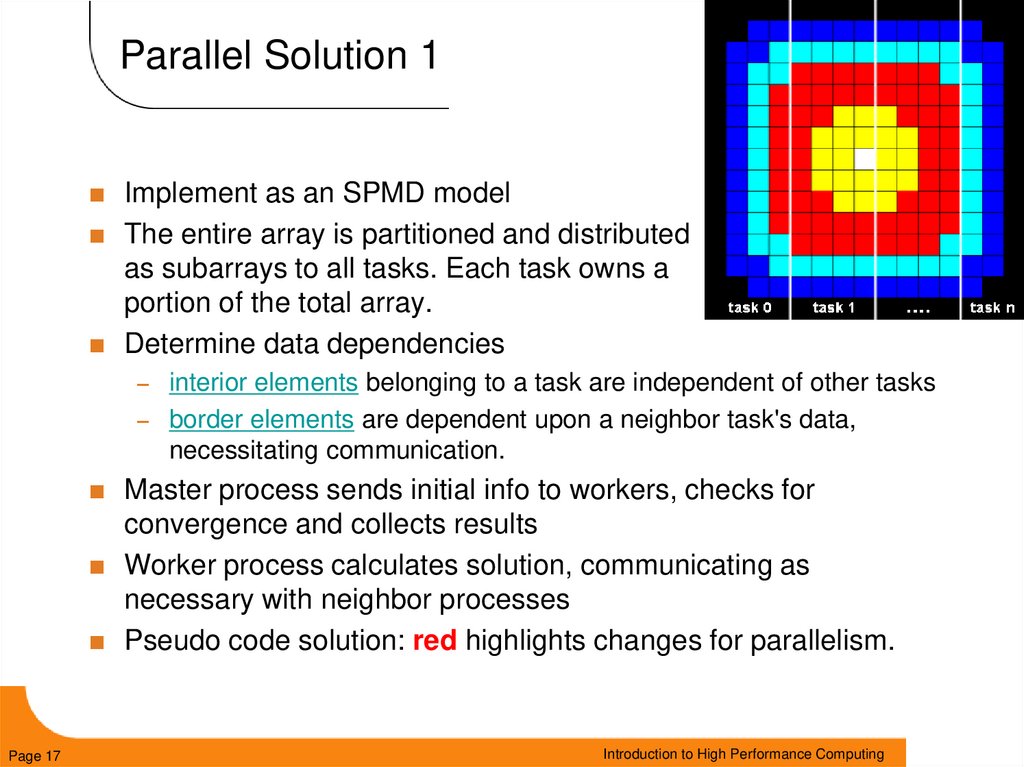
Implement as an SPMD modelThe entire array is partitioned and distributed
as subarrays to all tasks. Each task owns a
portion of the total array.
Determine data dependencies
–
interior elements belonging to a task are independent of other tasks
– border elements are dependent upon a neighbor task's data,
necessitating communication.
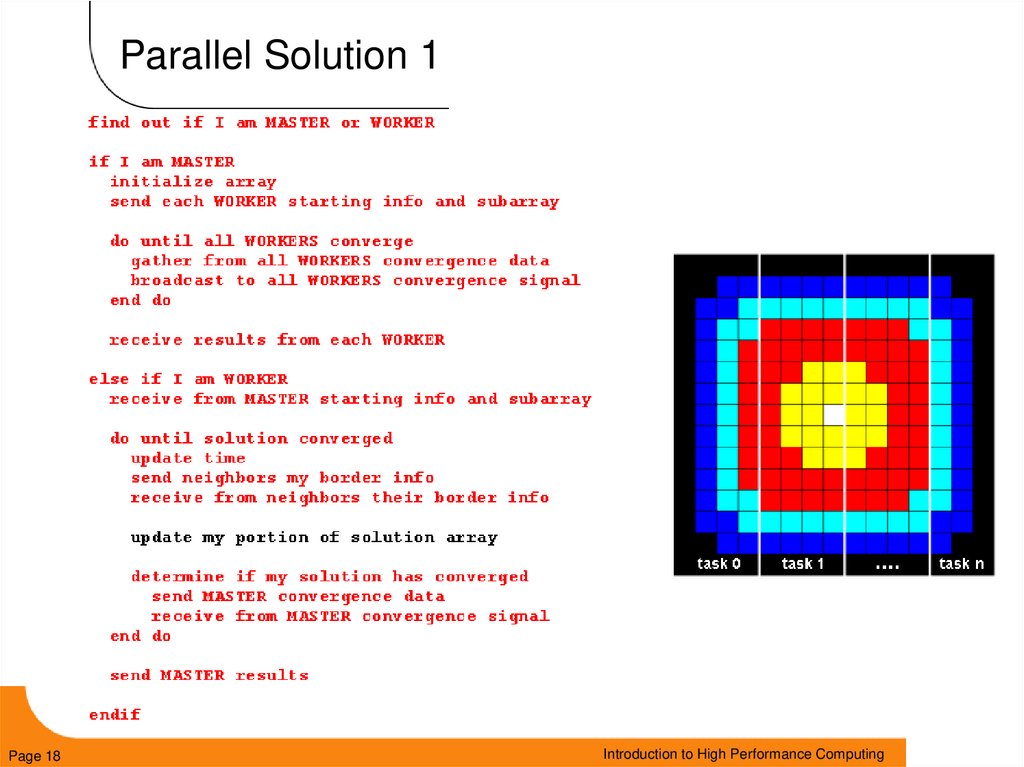
Master process sends initial info to workers, checks for
convergence and collects results
Worker process calculates solution, communicating as
necessary with neighbor processes
Pseudo code solution: red highlights changes for parallelism.
Page 17
Introduction to High Performance Computing
18. Parallel Solution 1
Page 18Introduction to High Performance Computing
19. Parallel Solution 2 Overlapping Communication and Computation
In the previous solution, it was assumed that blockingcommunications were used by the worker tasks. Blocking
communications wait for the communication process to
complete before continuing to the next program instruction.
In the previous solution, neighbor tasks communicated border
data, then each process updated its portion of the array.
Computing times can often be reduced by using non-blocking
communication. Non-blocking communications allow work to be
performed while communication is in progress.
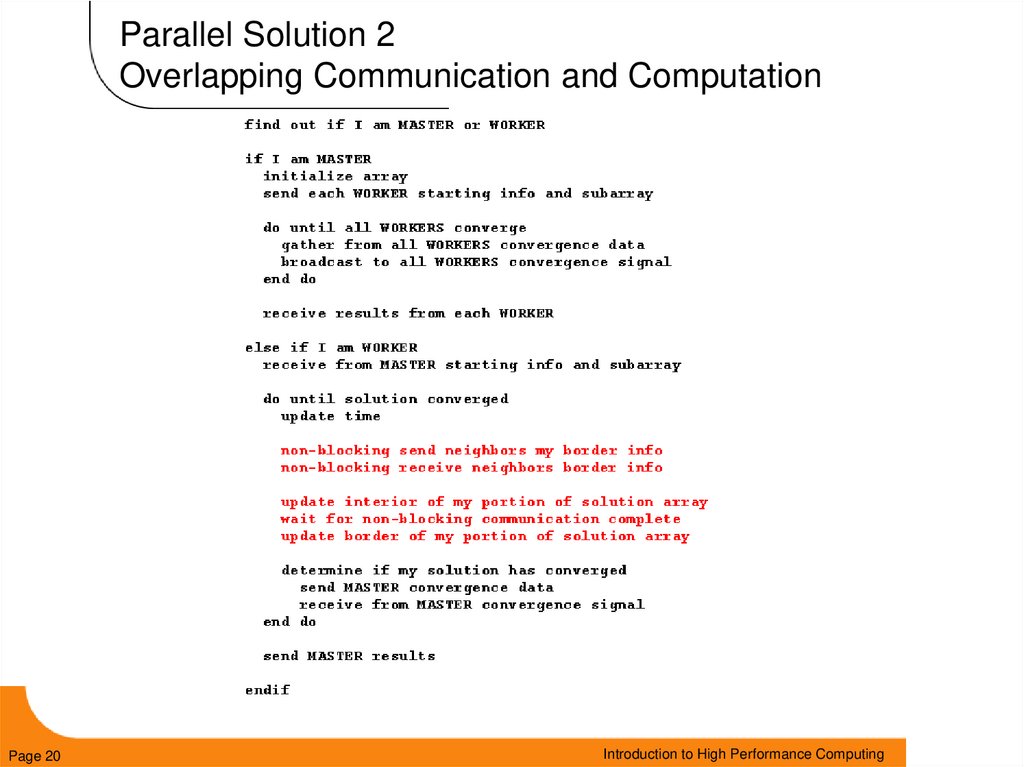
Each task could update the interior of its part of the solution
array while the communication of border data is occurring, and
update its border after communication has completed.
Pseudo code for the second solution: red highlights changes for
non-blocking communications.
Page 19
Introduction to High Performance Computing
20. Parallel Solution 2 Overlapping Communication and Computation
Page 20Introduction to High Performance Computing
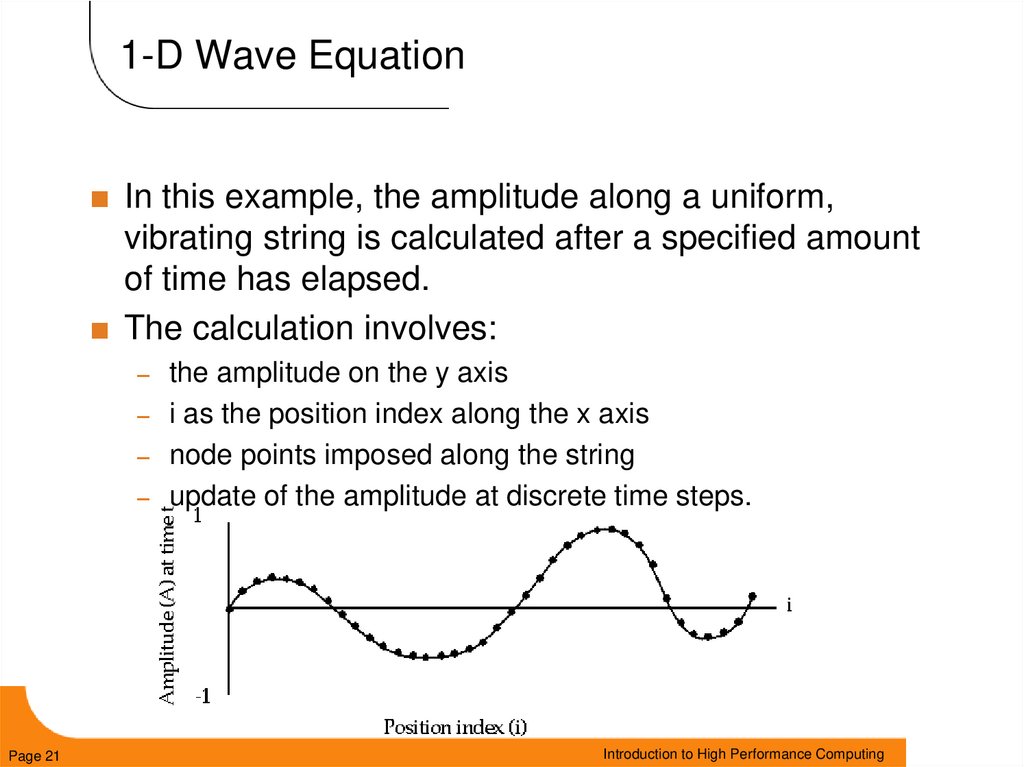
21. 1-D Wave Equation
In this example, the amplitude along a uniform,vibrating string is calculated after a specified amount
of time has elapsed.
The calculation involves:
–
the amplitude on the y axis
– i as the position index along the x axis
– node points imposed along the string
– update of the amplitude at discrete time steps.
Page 21
Introduction to High Performance Computing
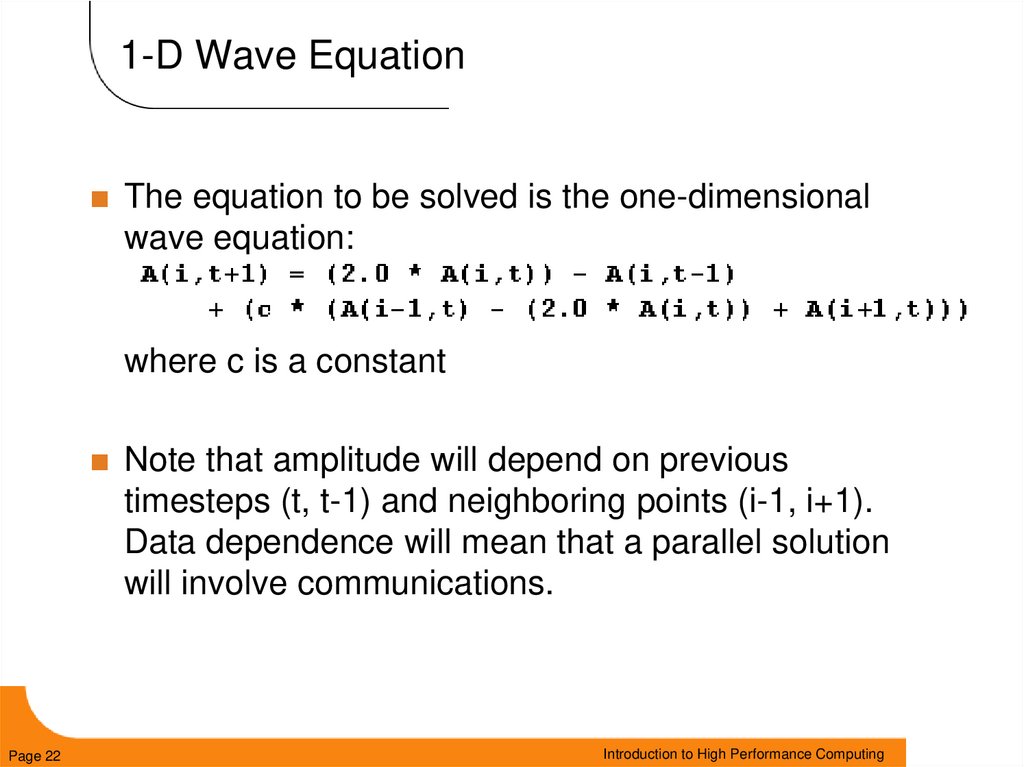
22. 1-D Wave Equation
The equation to be solved is the one-dimensionalwave equation:
where c is a constant
Note that amplitude will depend on previous
timesteps (t, t-1) and neighboring points (i-1, i+1).
Data dependence will mean that a parallel solution
will involve communications.
Page 22
Introduction to High Performance Computing
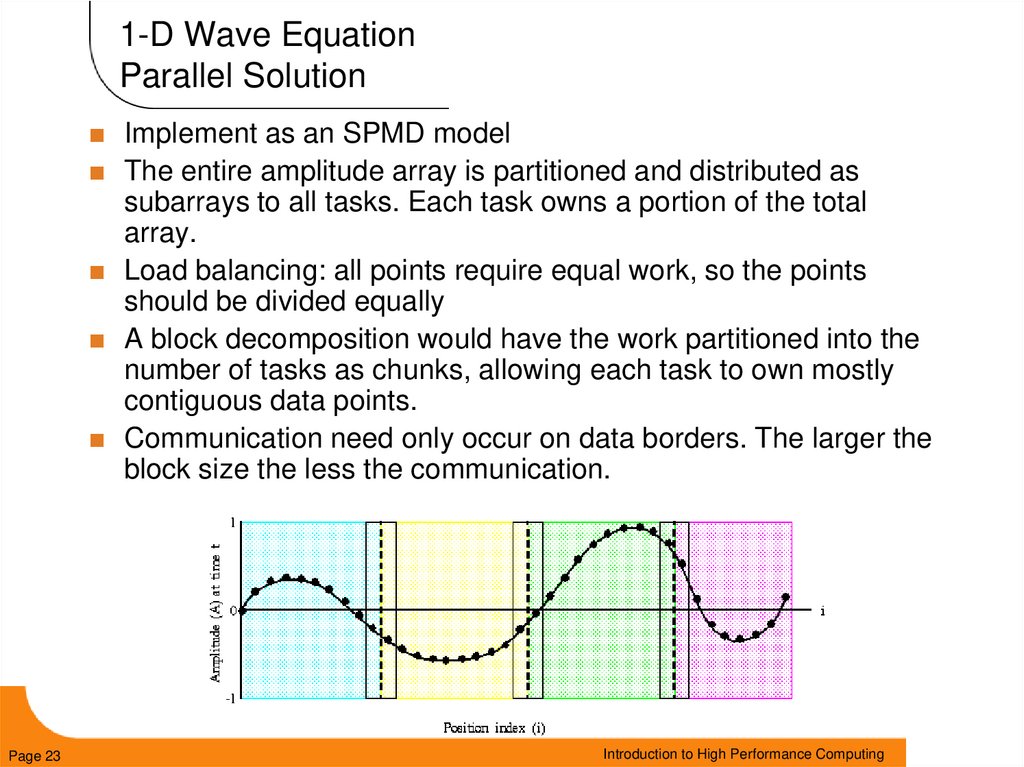
23. 1-D Wave Equation Parallel Solution
Implement as an SPMD modelThe entire amplitude array is partitioned and distributed as
subarrays to all tasks. Each task owns a portion of the total
array.
Load balancing: all points require equal work, so the points
should be divided equally
A block decomposition would have the work partitioned into the
number of tasks as chunks, allowing each task to own mostly
contiguous data points.
Communication need only occur on data borders. The larger the
block size the less the communication.
Page 23
Introduction to High Performance Computing
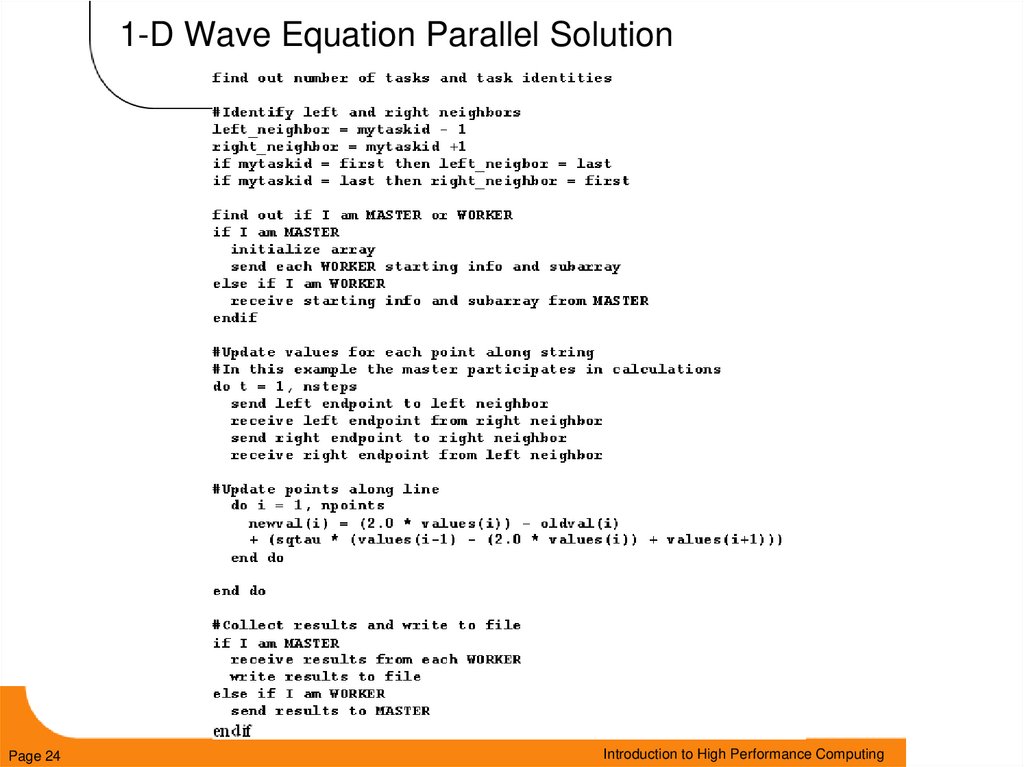
24. 1-D Wave Equation Parallel Solution
Page 24Introduction to High Performance Computing
25.
This ends this tutorialPage 25
Introduction to High Performance Computing