
 management
Similar presentations:







Corporate Strategy
1.
Corporate Strategy1. What is Corporate Strategy?
Catherine Magelssen
London Business School
April 23, 2018
2.
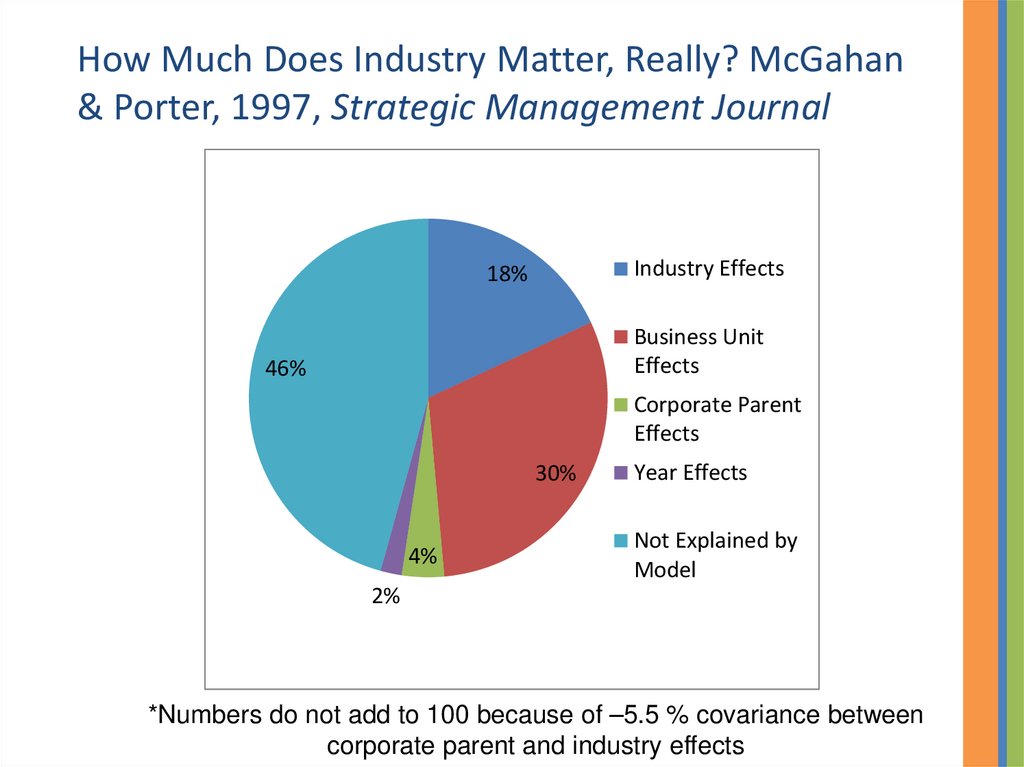
How Much Does Industry Matter, Really? McGahan& Porter, 1997, Strategic Management Journal
Industry Effects
18%
Business Unit
Effects
46%
Corporate Parent
Effects
30%
4%
Year Effects
Not Explained by
Model
2%
*Numbers do not add to 100 because of –5.5 % covariance between
corporate parent and industry effects
3.
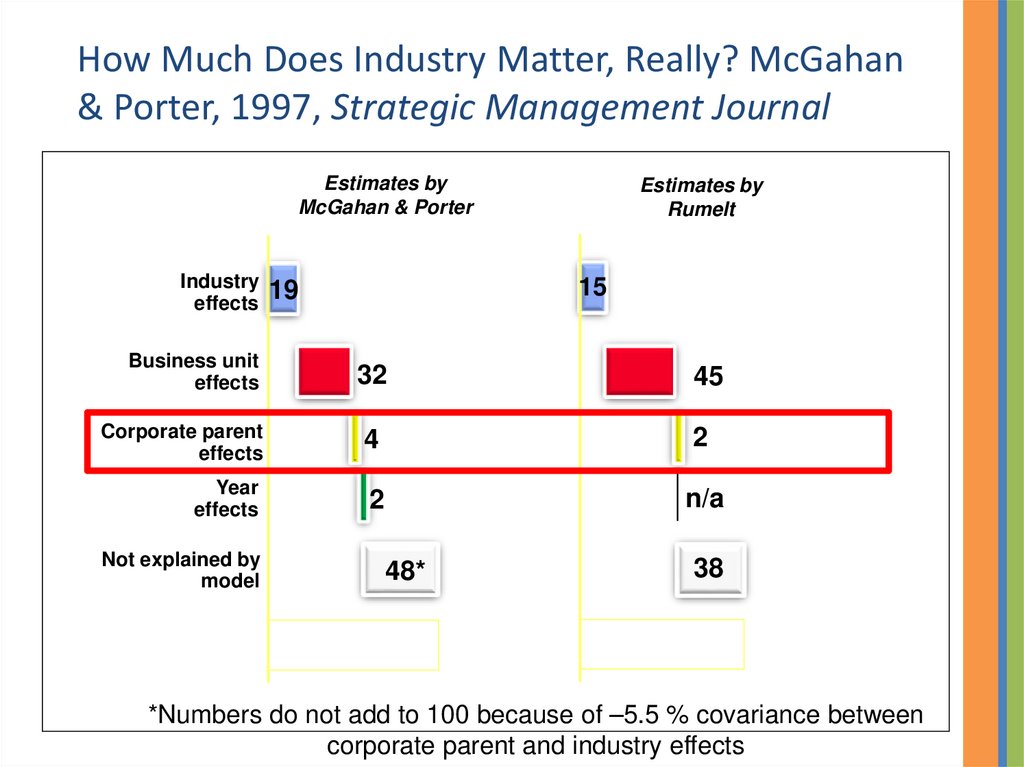
How Much Does Industry Matter, Really? McGahan& Porter, 1997, Strategic Management Journal
Estimates by
McGahan & Porter
Industry
19
effects
Estimates by
Rumelt
15
Business unit
effects
32
45
Corporate parent
effects
4
2
Year
effects
2
n/a
Not explained by
model
48*
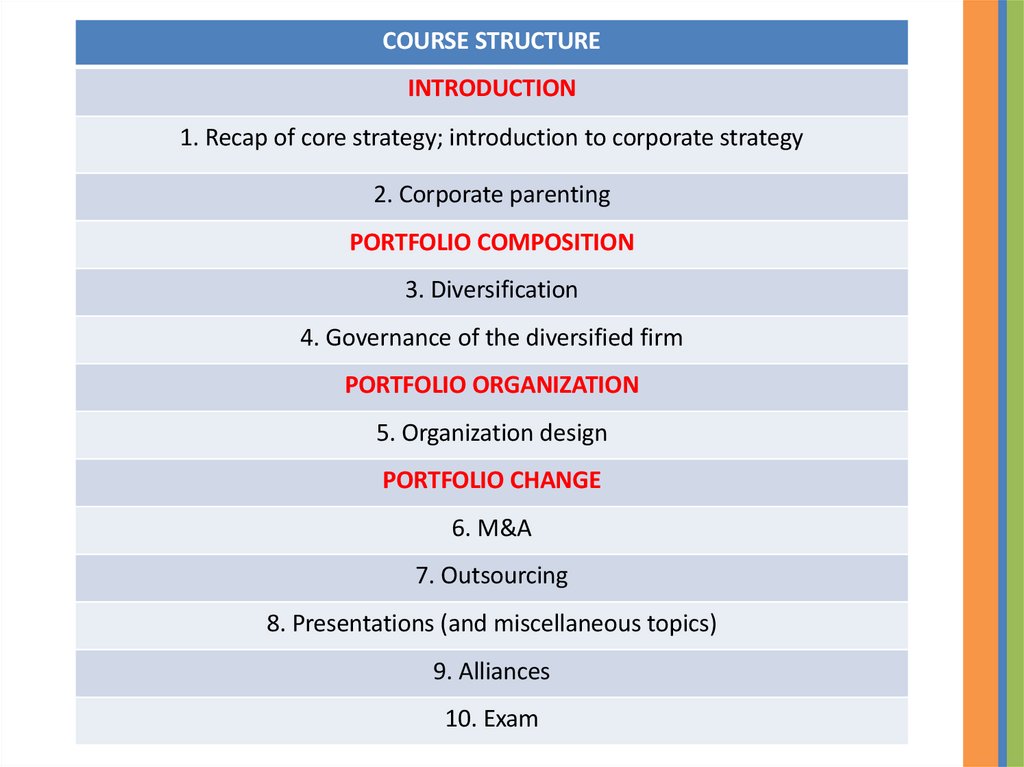
38
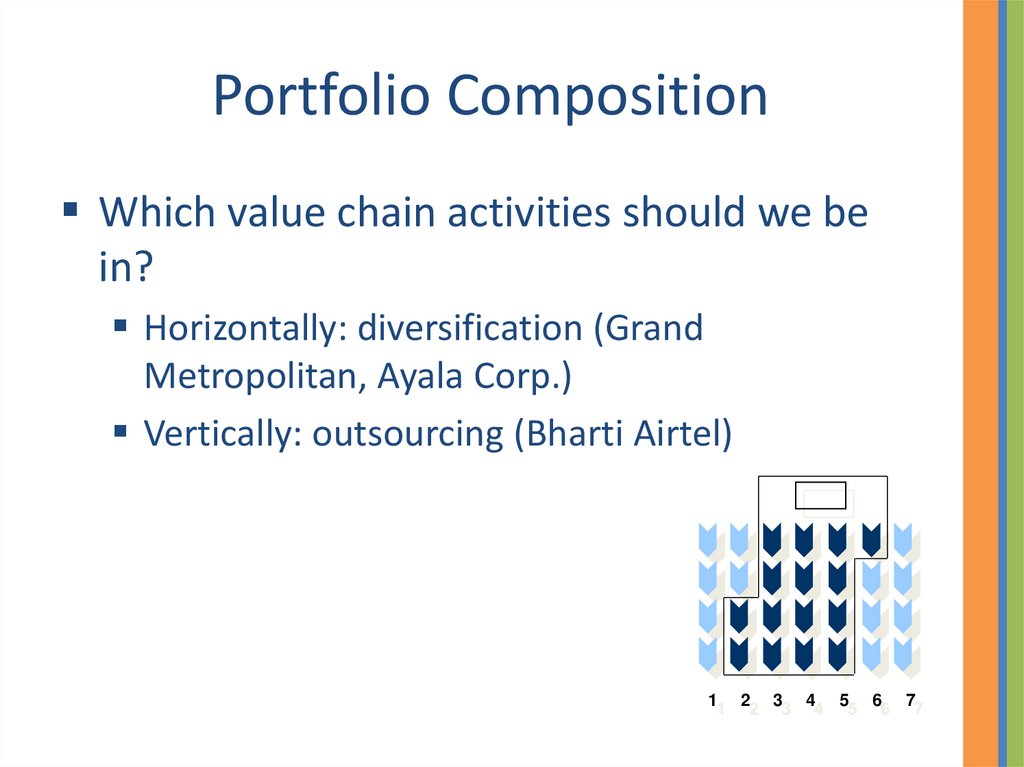
*Numbers do not add to 100 because of –5.5 % covariance between
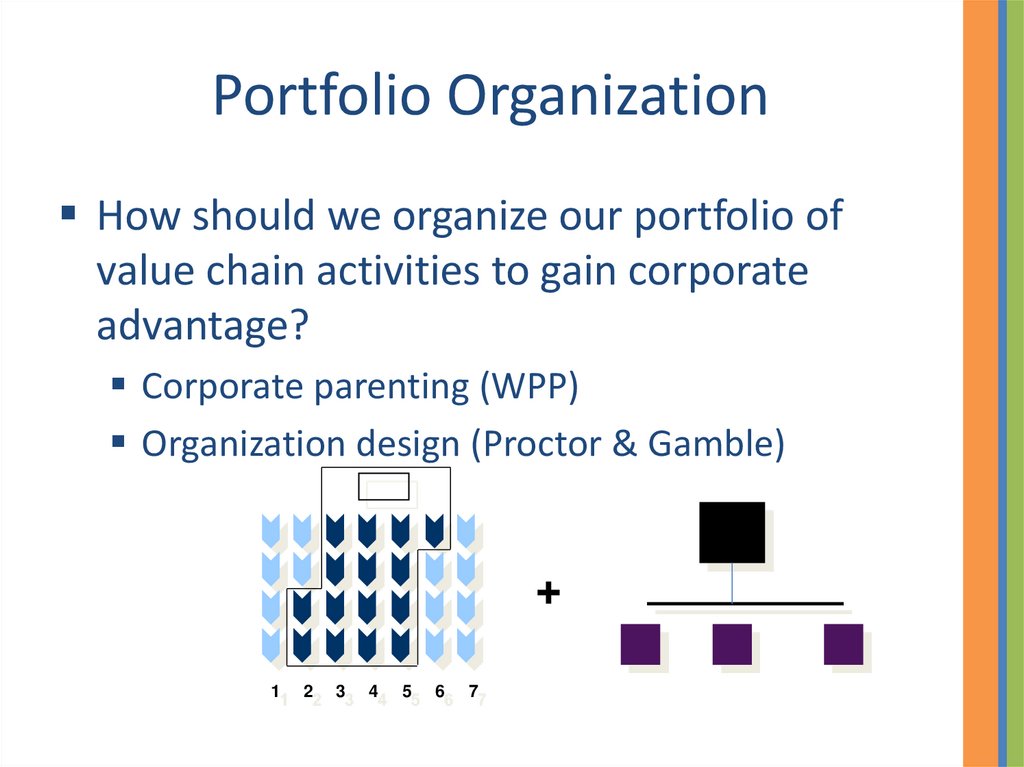
corporate parent and industry effects
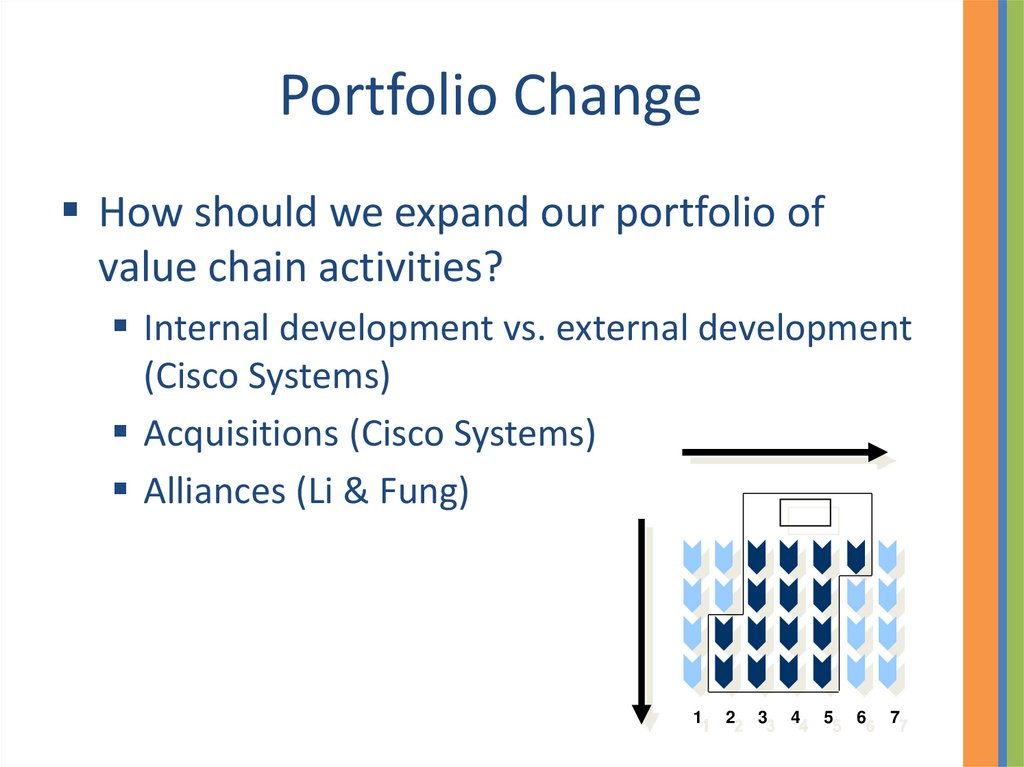
4.
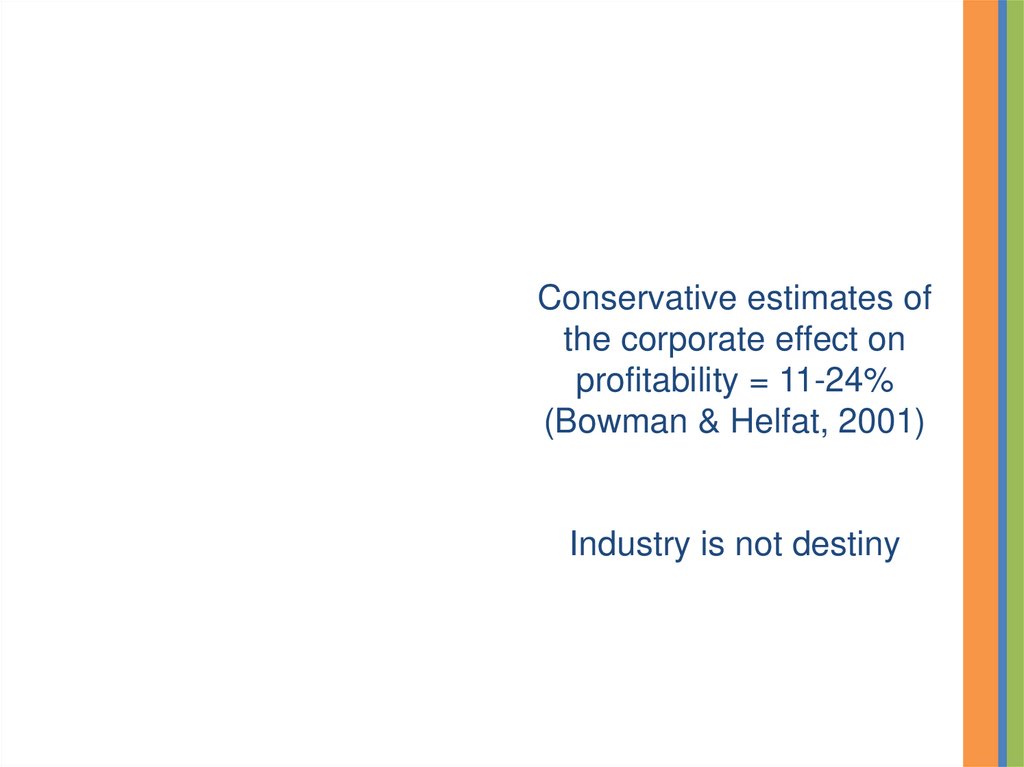
Conservative estimates ofthe corporate effect on
profitability = 11-24%
(Bowman & Helfat, 2001)
Industry is not destiny
5.
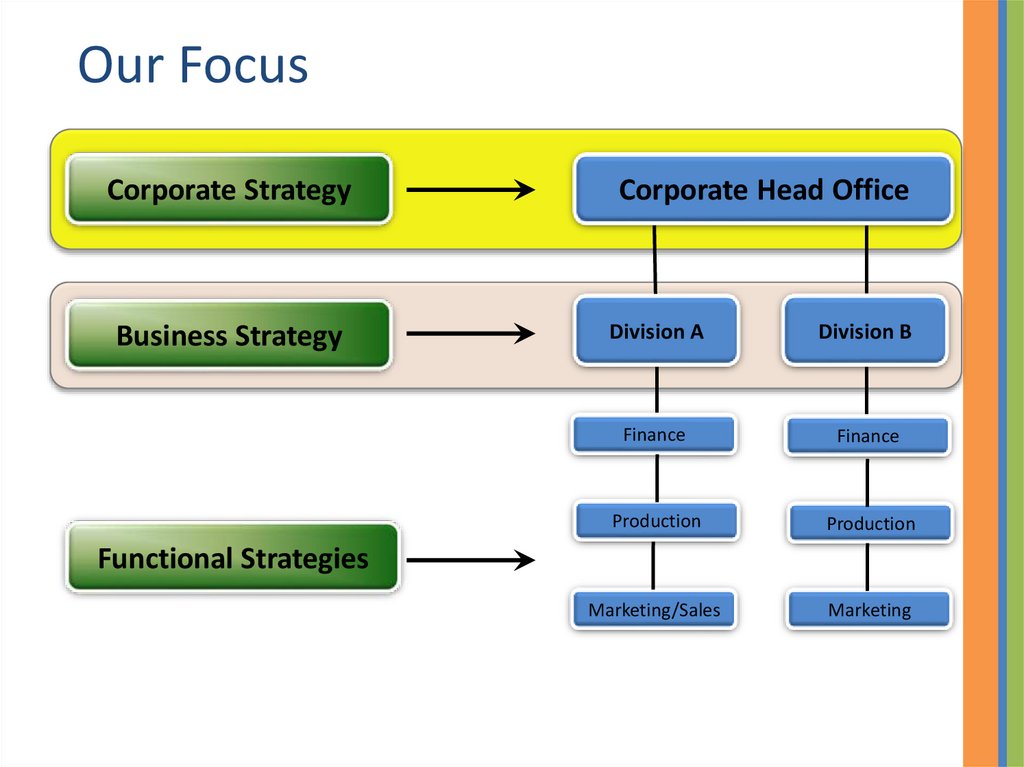
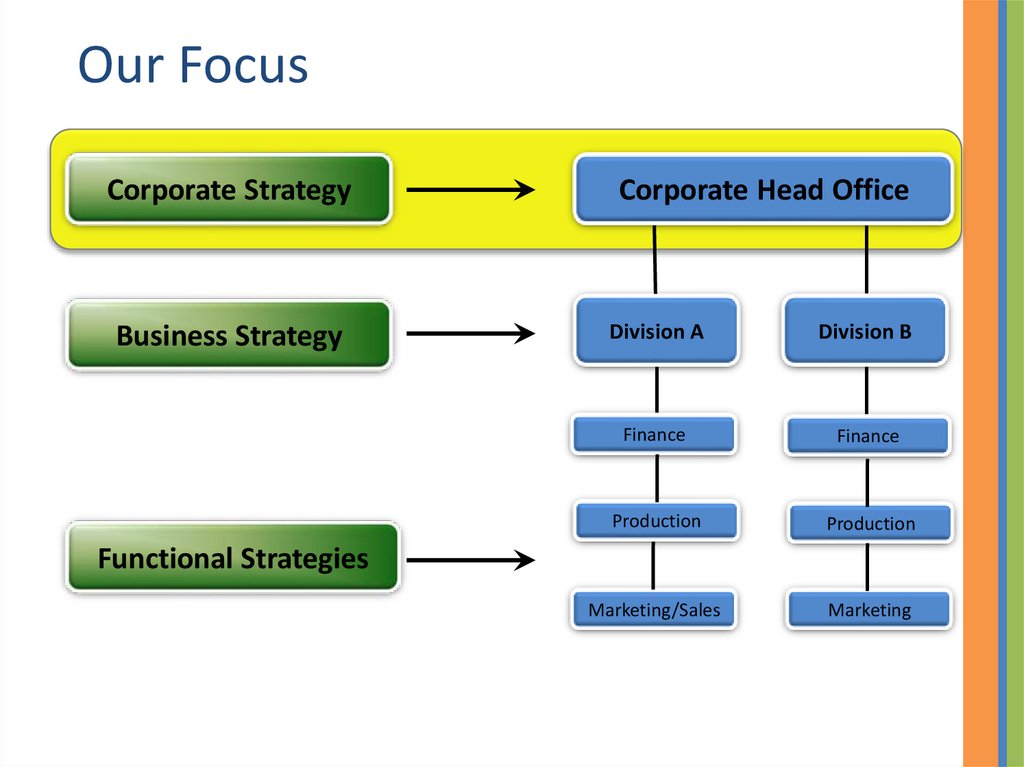
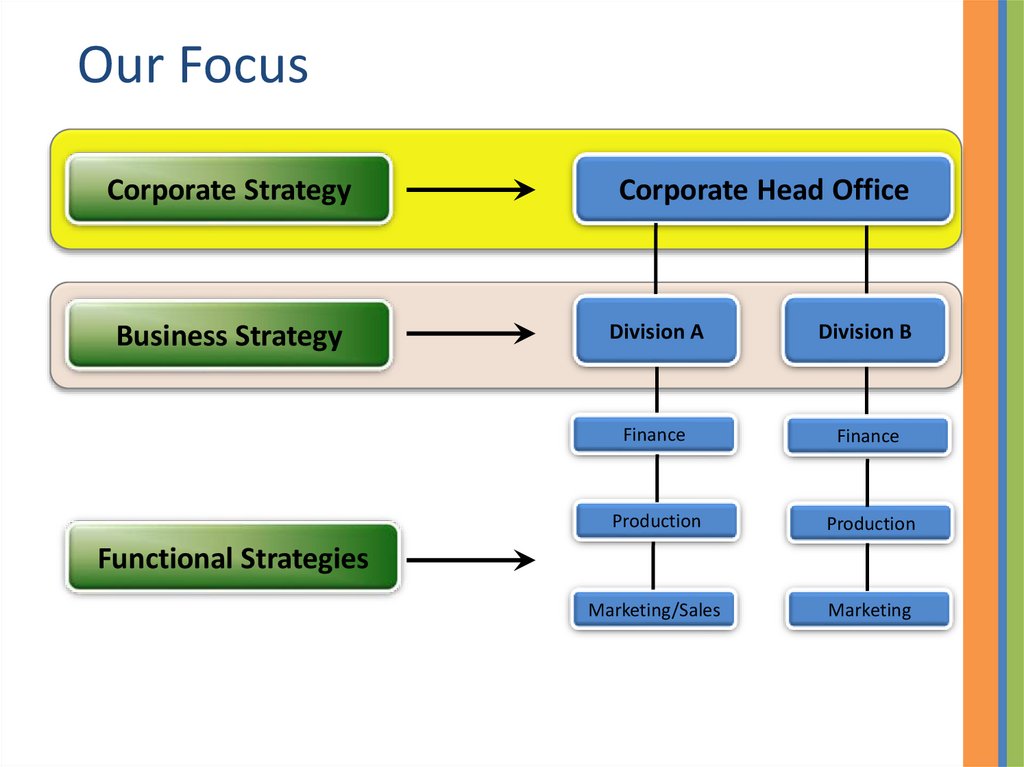
Our FocusCorporate Strategy
Corporate Head Office
Business Strategy
Division A
Division B
Finance
Finance
Production
Production
Marketing/Sales
Marketing
Functional Strategies
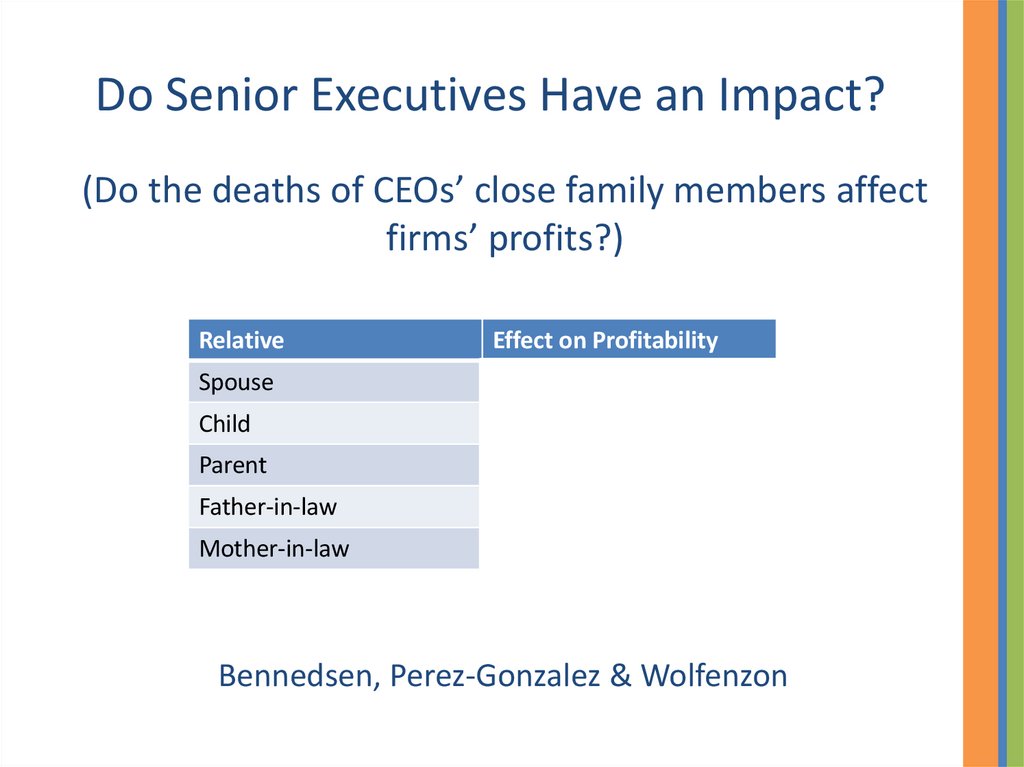
6. Do Senior Executives Have an Impact?
(Do the deaths of CEOs’ close family members affectfirms’ profits?)
Relative
Effect on Profitability
Spouse
Negative
Child
Negative
Parent
Negative
Father-in-law
Negative
Mother-in-law
Positive
Bennedsen, Perez-Gonzalez & Wolfenzon
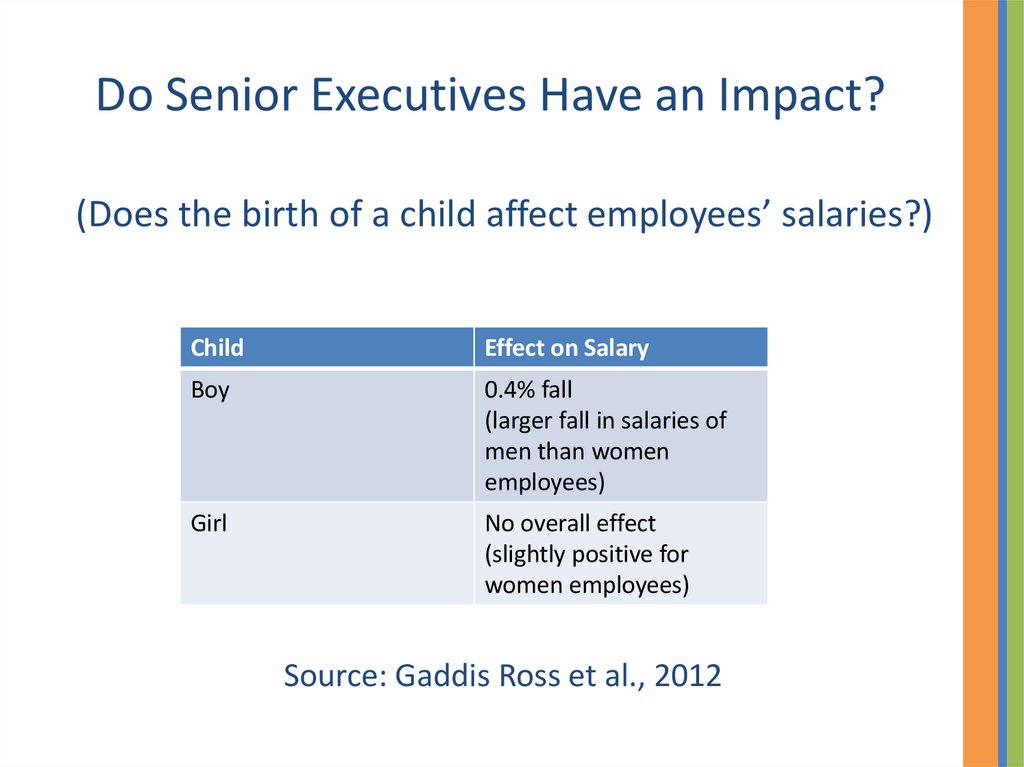
7. Do Senior Executives Have an Impact?
(Does the birth of a child affect employees’ salaries?)Child
Effect on Salary
Boy
0.4% fall
(larger fall in salaries of
men than women
employees)
Girl
No overall effect
(slightly positive for
women employees)
Source: Gaddis Ross et al., 2012
8.
Main Themes in Corporate Strategy9.
1. Portfolio CompositionWhat business(es) are you in?
10.
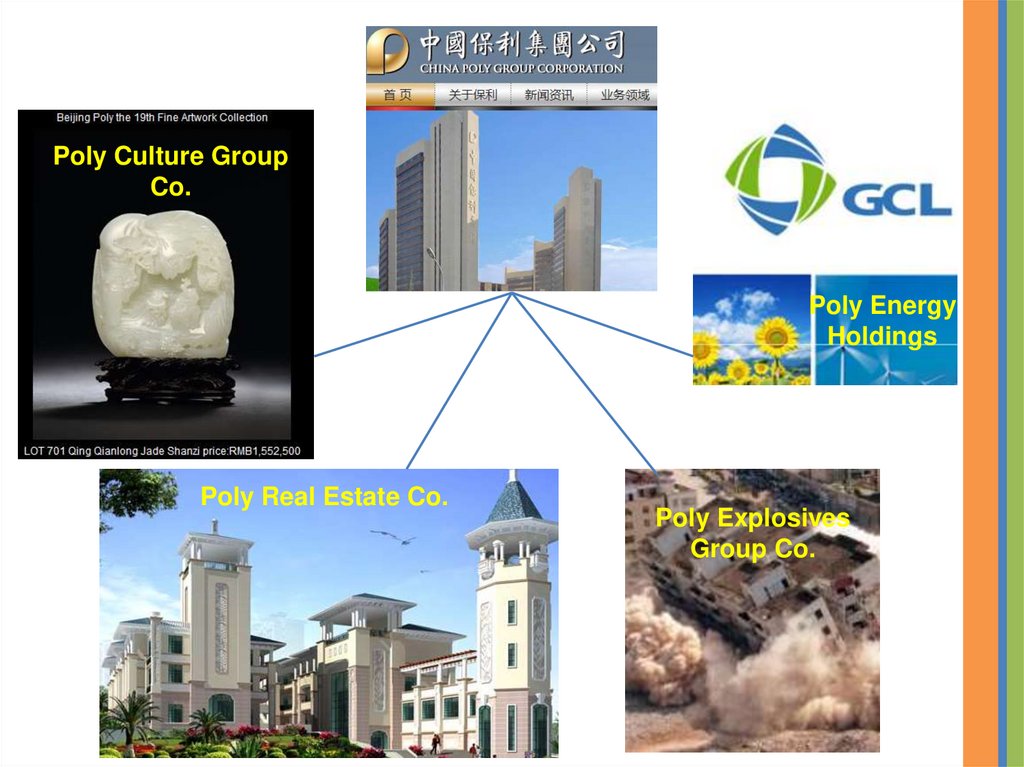
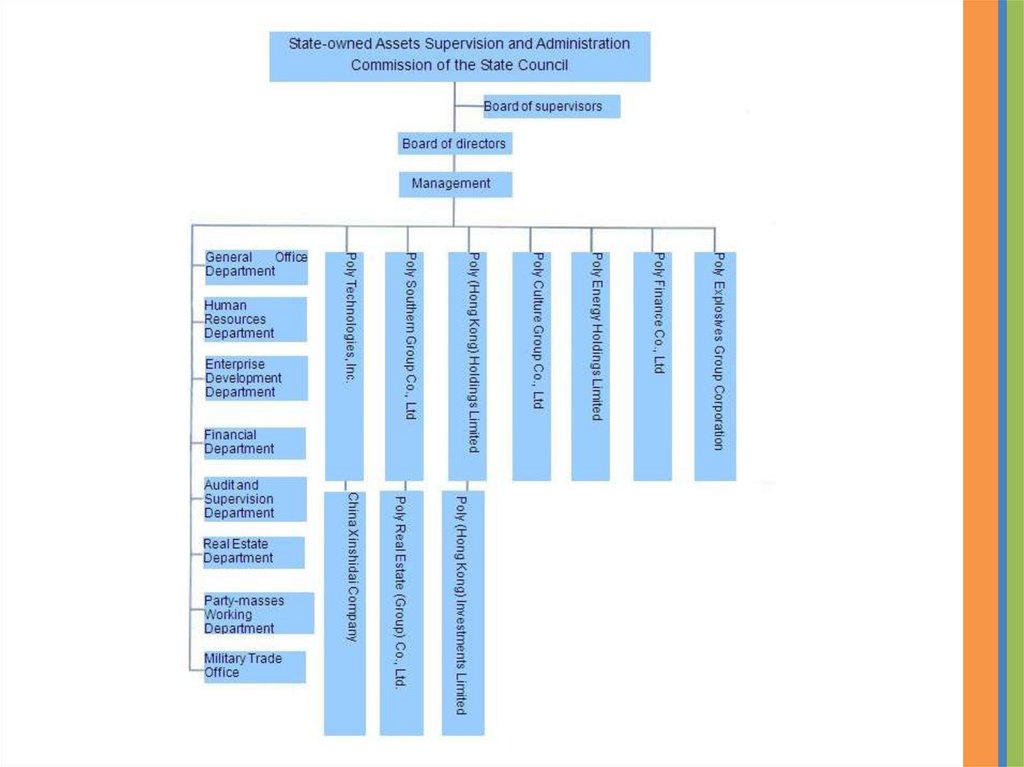
Poly Culture GroupCo.
Poly Energy
Holdings
Poly Real Estate Co.
Poly Explosives
Group Co.
11.
2. Change in PortfolioHow to add or divest businesses?
12.
13.
3. Organization DesignHow to structure an organization?
14.
15.
Our FocusCorporate Strategy
Corporate Head Office
Business Strategy
Division A
Division B
Finance
Finance
Production
Production
Marketing/Sales
Marketing
Functional Strategies
16.
REVIEW OF BASIC STRATEGY FRAMEWORKS17.
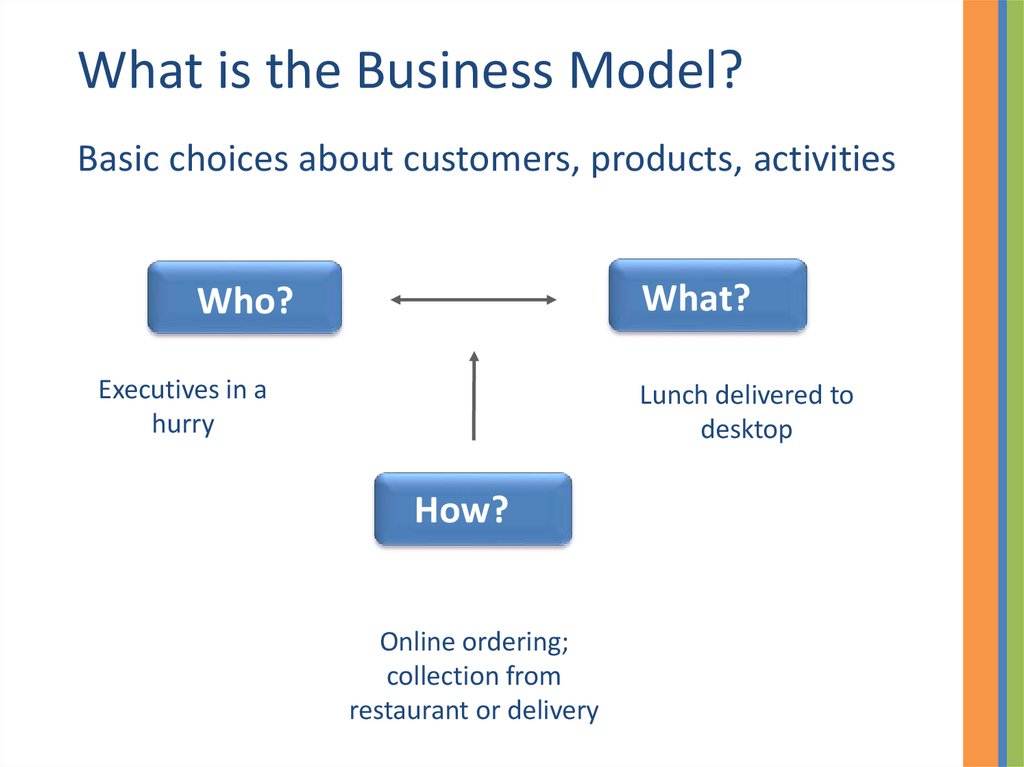
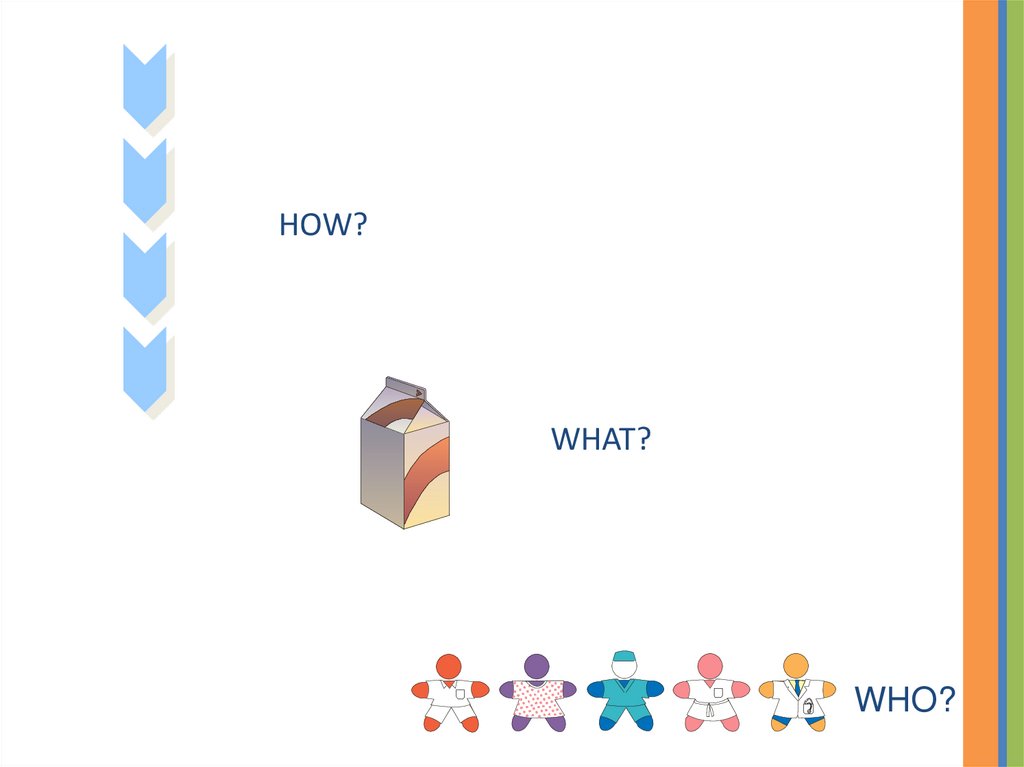
What is the Business Model?Basic choices about customers, products, activities
What?
Who?
Executives in a
hurry
Lunch delivered to
desktop
How?
Online ordering;
collection from
restaurant or delivery
18.
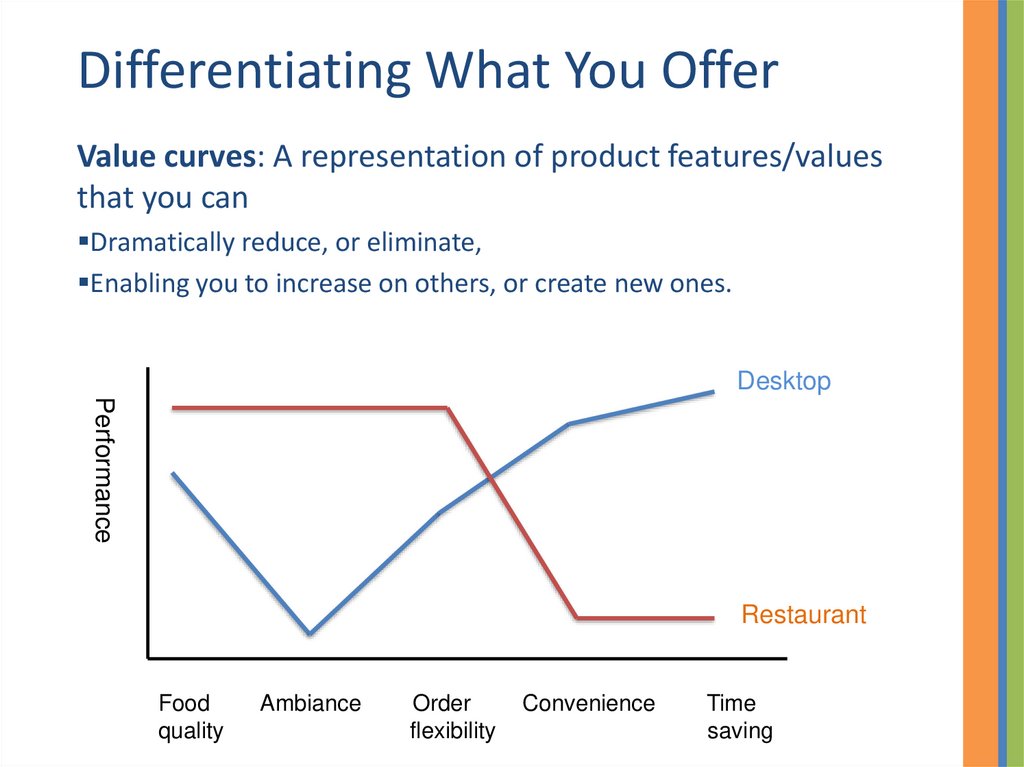
Differentiating What You OfferValue curves: A representation of product features/values
that you can
Dramatically reduce, or eliminate,
Enabling you to increase on others, or create new ones.
Desktop
Performance
Restaurant
Food
quality
Ambiance
Order
flexibility
Convenience
Time
saving
19.
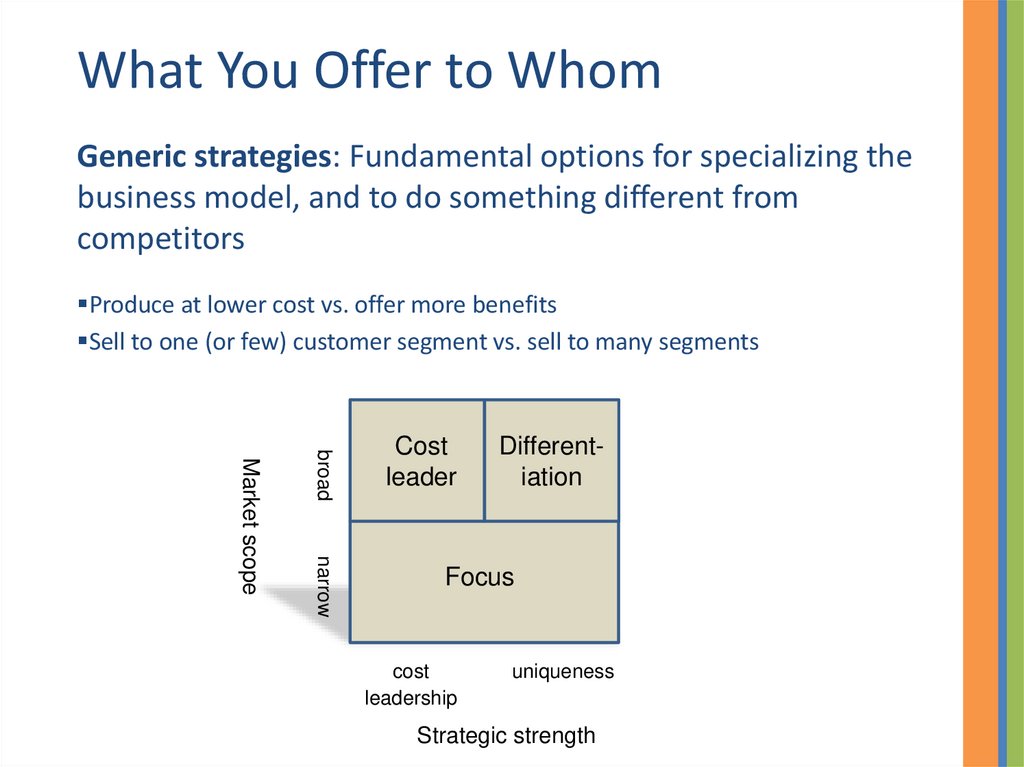
What You Offer to WhomGeneric strategies: Fundamental options for specializing the
business model, and to do something different from
competitors
Produce at lower cost vs. offer more benefits
Sell to one (or few) customer segment vs. sell to many segments
broad
narrow
Market scope
Cost
leader
Differentiation
Focus
cost
leadership
uniqueness
Strategic strength
20.
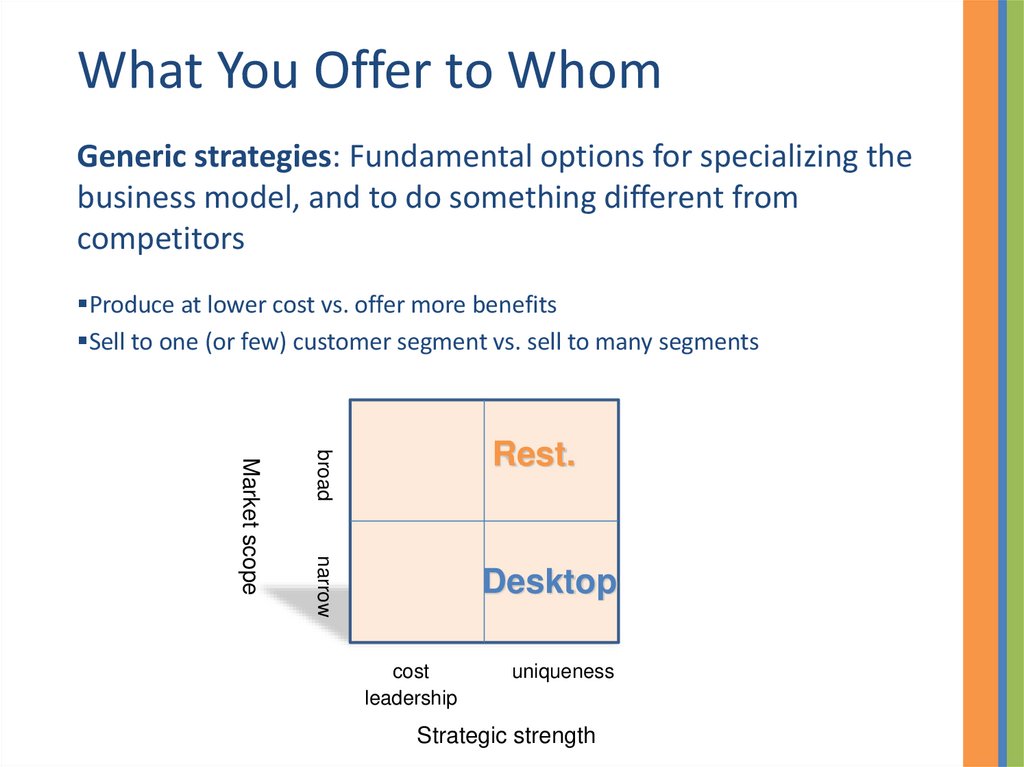
What You Offer to WhomGeneric strategies: Fundamental options for specializing the
business model, and to do something different from
competitors
Produce at lower cost vs. offer more benefits
Sell to one (or few) customer segment vs. sell to many segments
broad
narrow
Market scope
Rest.
Desktop
cost
leadership
uniqueness
Strategic strength
21.
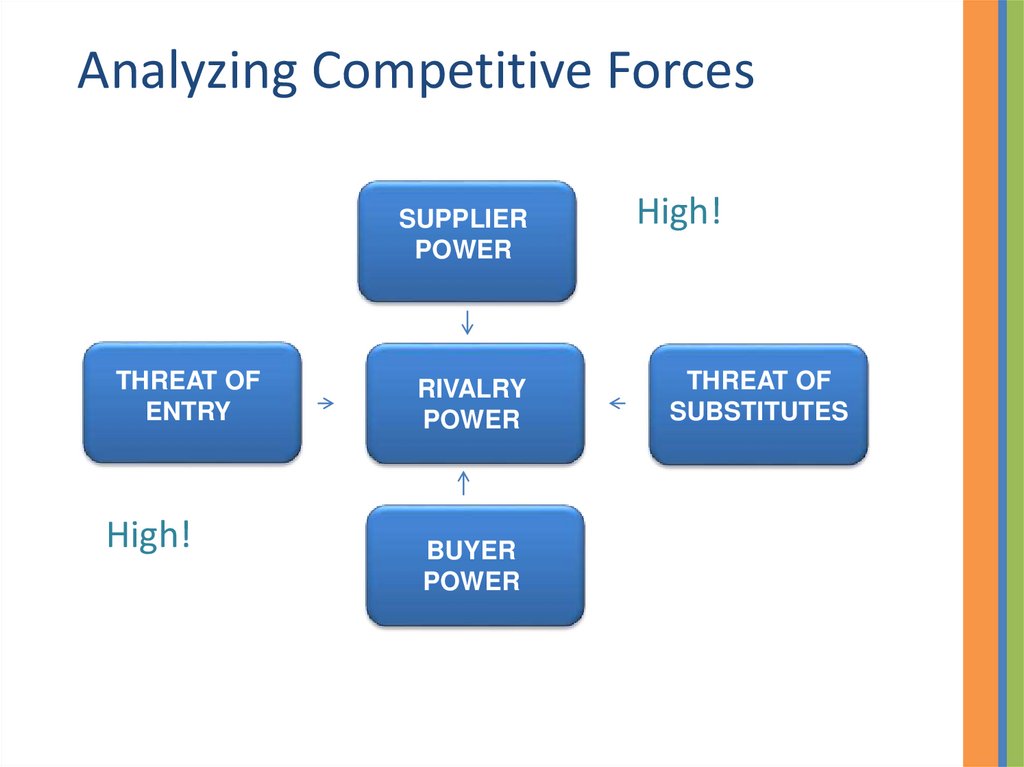
Analyzing Competitive ForcesSUPPLIER
POWER
THREAT OF
ENTRY
High!
RIVALRY
POWER
BUYER
POWER
High!
THREAT OF
SUBSTITUTES
22.
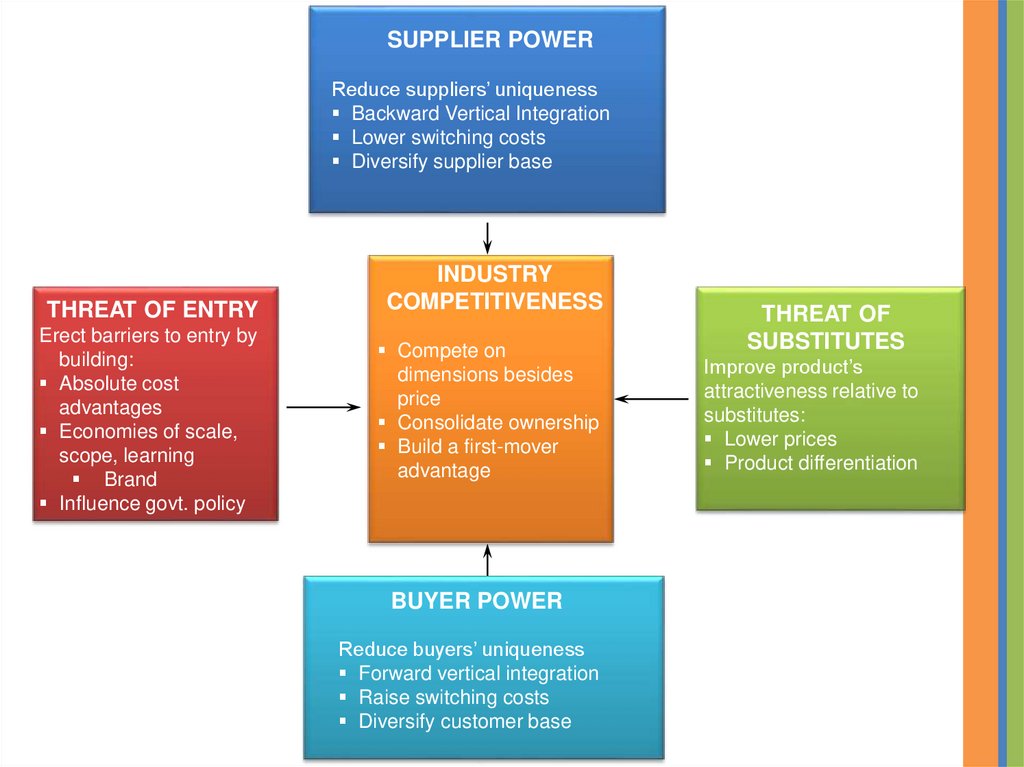
SUPPLIER POWERReduce suppliers’ uniqueness
Backward Vertical Integration
Lower switching costs
Diversify supplier base
THREAT OF ENTRY
Erect barriers to entry by
building:
Absolute cost
advantages
Economies of scale,
scope, learning
Brand
Influence govt. policy
INDUSTRY
COMPETITIVENESS
Compete on
dimensions besides
price
Consolidate ownership
Build a first-mover
advantage
BUYER POWER
Reduce buyers’ uniqueness
Forward vertical integration
Raise switching costs
Diversify customer base
THREAT OF
SUBSTITUTES
Improve product’s
attractiveness relative to
substitutes:
Lower prices
Product differentiation
23.
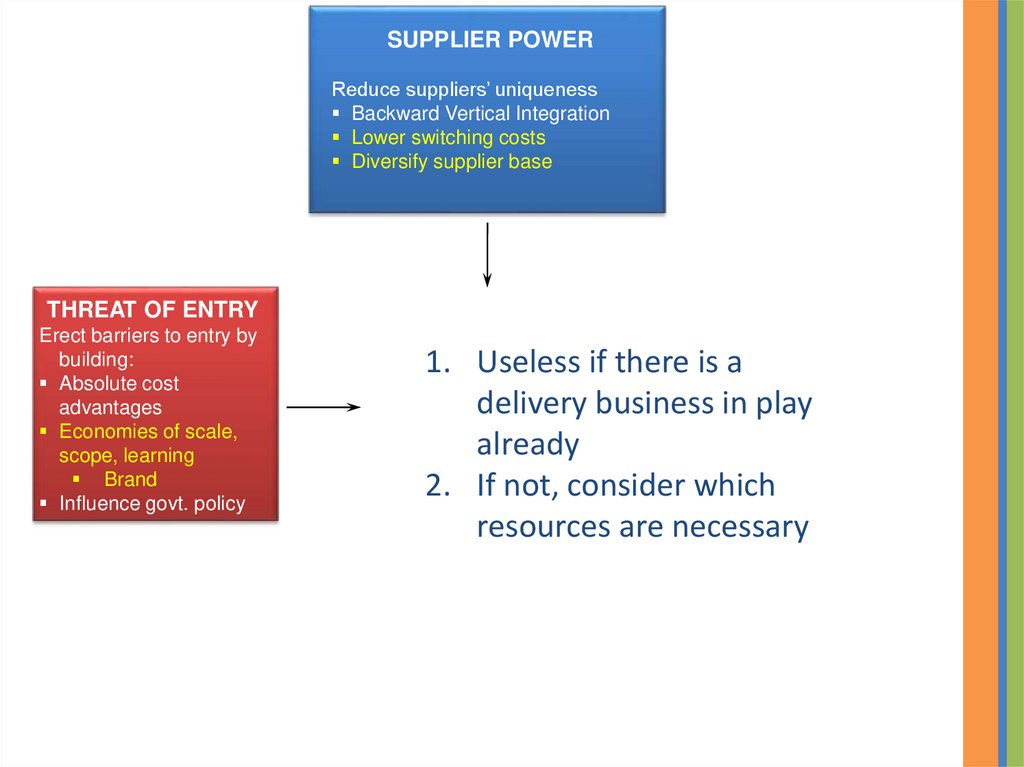
SUPPLIER POWERReduce suppliers’ uniqueness
Backward Vertical Integration
Lower switching costs
Diversify supplier base
THREAT OF ENTRY
Erect barriers to entry by
building:
Absolute cost
advantages
Economies of scale,
scope, learning
Brand
Influence govt. policy
INDUSTRY
COMPETITIVENESS
• Compete on
dimensions besides
price
• Consolidate ownership
• Build a first-mover
advantage
THREAT OF
SUBSTITUTES
1. Useless if there isImprove
a product’s
relative to
delivery businessattractiveness
in
play
substitutes:
• Lower prices
already
• Product differentiation
2. If not, consider which
resources are necessary
BUYER POWER
Reduce buyers’ uniqueness
• Forward vertical integration
• Raise switching costs
• Diversify customer base
24.
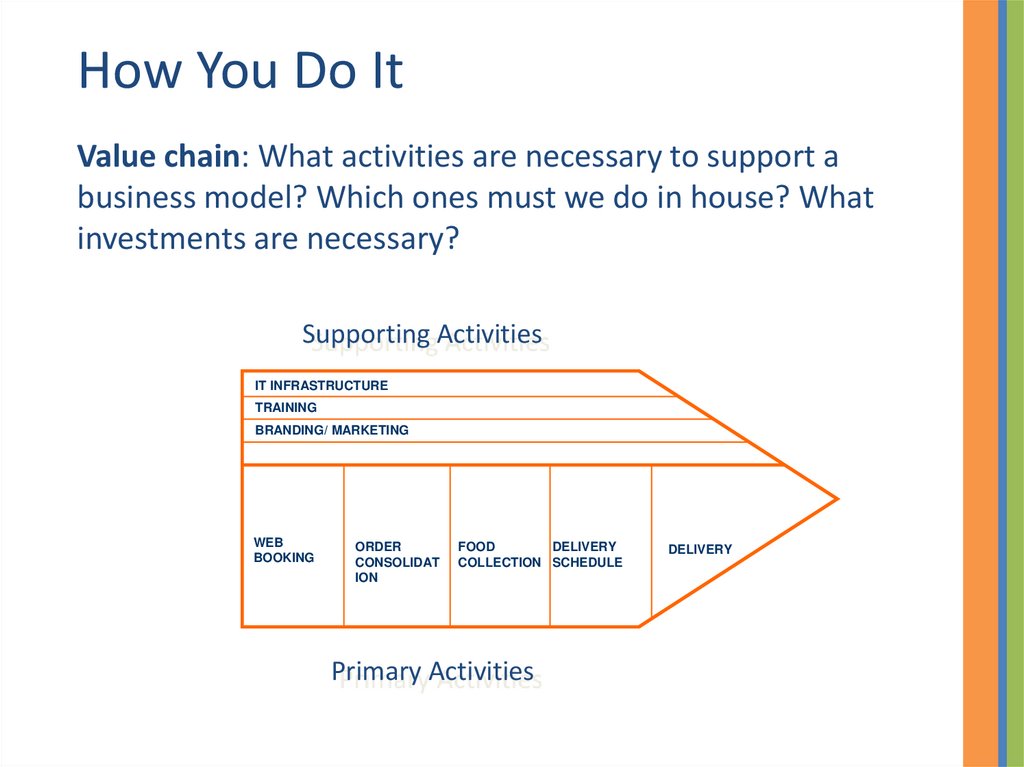
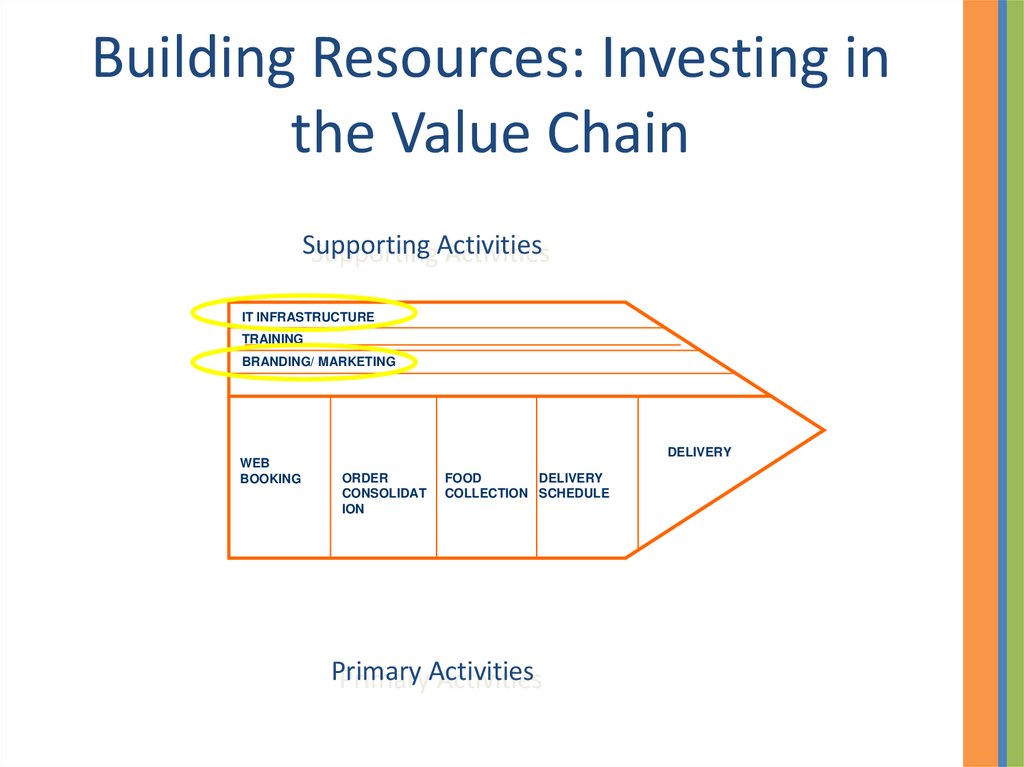
How You Do ItValue chain: What activities are necessary to support a
business model? Which ones must we do in house? What
investments are necessary?
Supporting Activities
IT INFRASTRUCTURE
TRAINING
BRANDING/ MARKETING
WEB
BOOKING
ORDER
CONSOLIDAT
ION
FOOD
DELIVERY
COLLECTION SCHEDULE
Primary Activities
DELIVERY
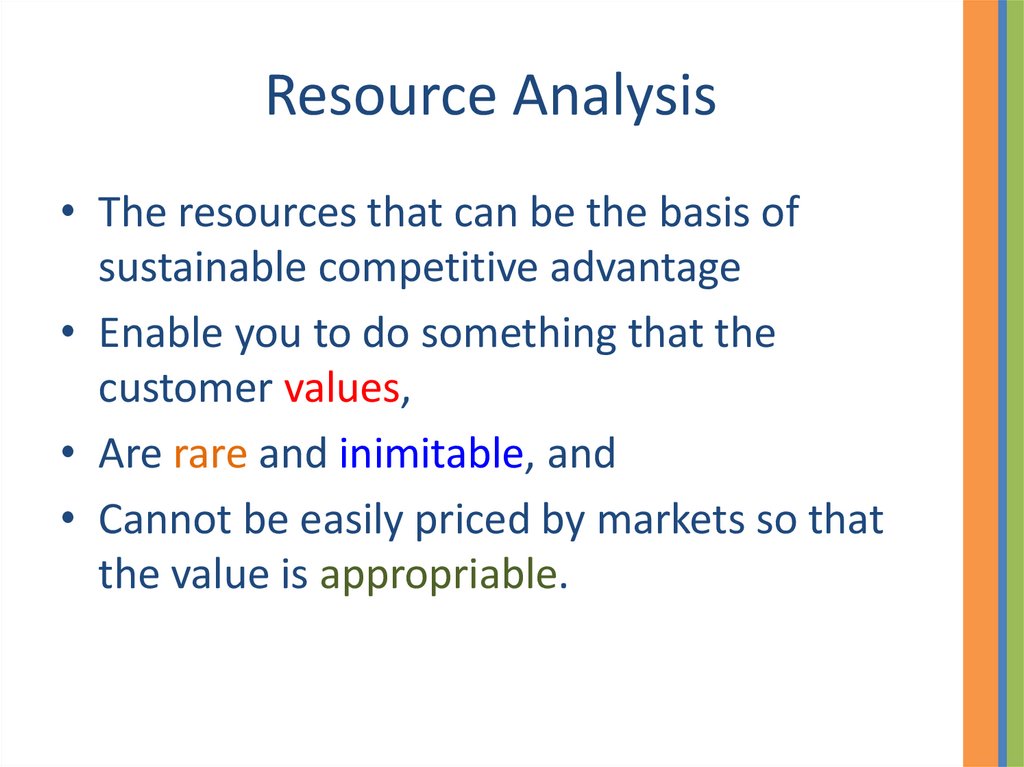
25. Resource Analysis
• The resources that can be the basis ofsustainable competitive advantage
• Enable you to do something that the
customer values,
• Are rare and inimitable, and
• Cannot be easily priced by markets so that
the value is appropriable.
26. Building Resources: Investing in the Value Chain
Supporting ActivitiesIT INFRASTRUCTURE
TRAINING
BRANDING/ MARKETING
WEB
BOOKING
DELIVERY
ORDER
CONSOLIDAT
ION
FOOD
DELIVERY
COLLECTION SCHEDULE
Primary Activities
27.
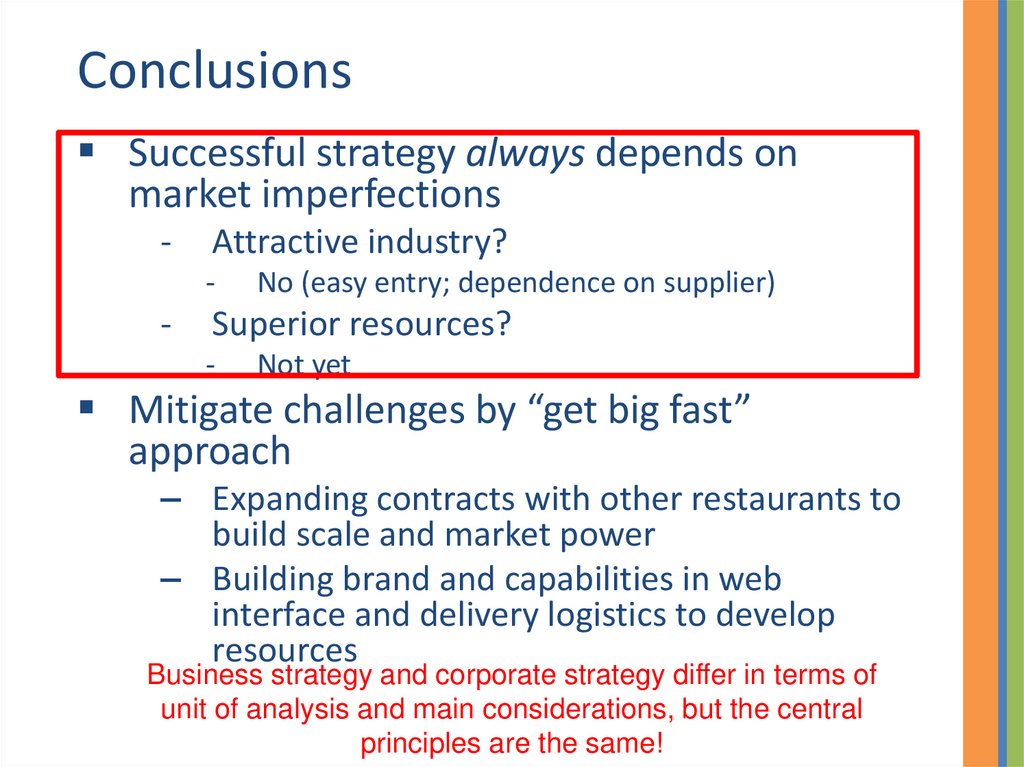
ConclusionsSuccessful strategy always depends on
market imperfections
-
Attractive industry?
-
-
No (easy entry; dependence on supplier)
Superior resources?
-
Not yet
Mitigate challenges by “get big fast”
approach
– Expanding contracts with other restaurants to
build scale and market power
– Building brand and capabilities in web
interface and delivery logistics to develop
resources
Business strategy and corporate strategy differ in terms of
unit of analysis and main considerations, but the central
principles are the same!
28.
Corporate Strategy at GrandMetropolitan
Case discussion
29.
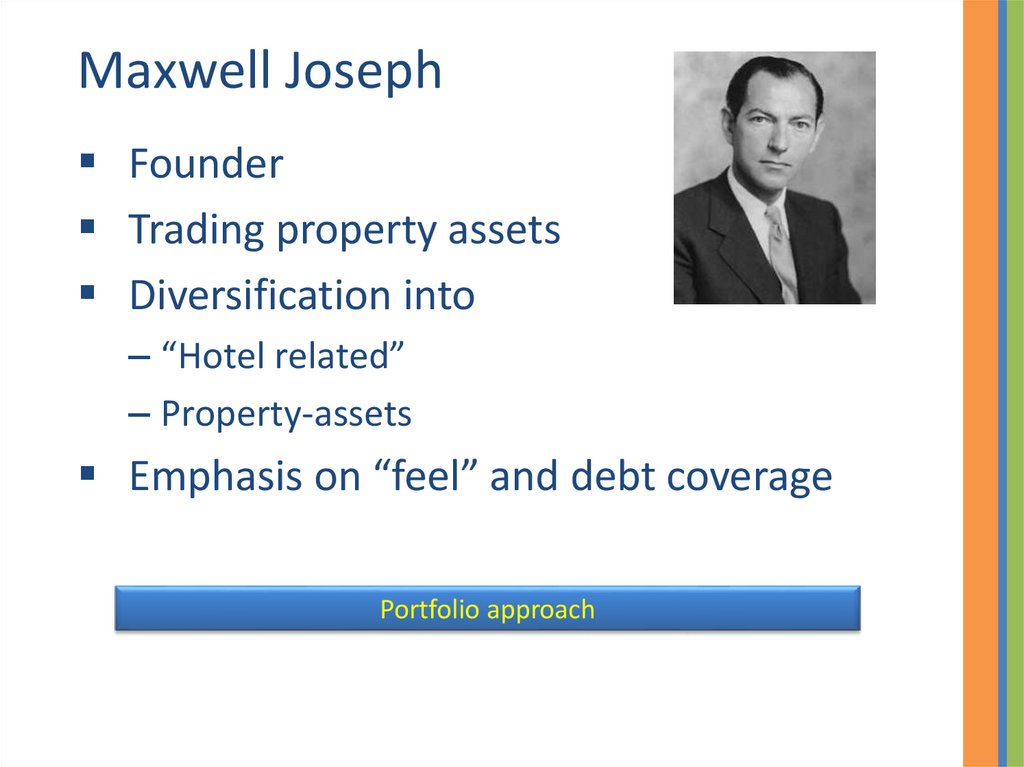
Maxwell JosephFounder
Trading property assets
Diversification into
– “Hotel related”
– Property-assets
Emphasis on “feel” and debt coverage
Portfolio approach
30.
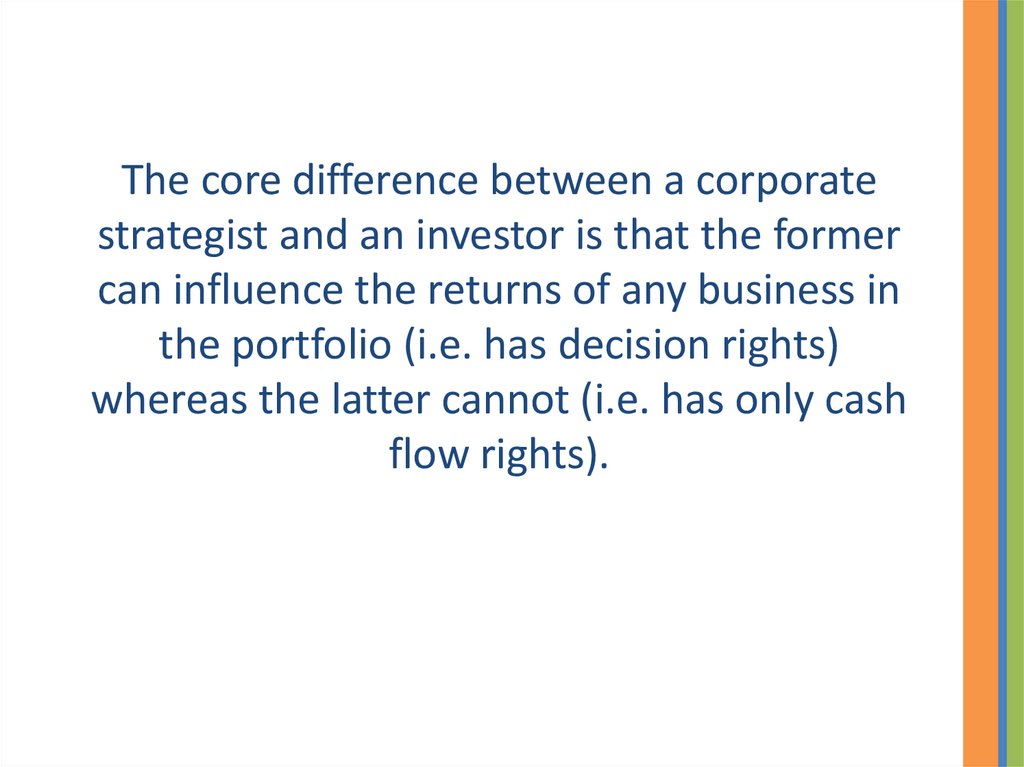
The core difference between a corporatestrategist and an investor is that the former
can influence the returns of any business in
the portfolio (i.e. has decision rights)
whereas the latter cannot (i.e. has only cash
flow rights).
31.
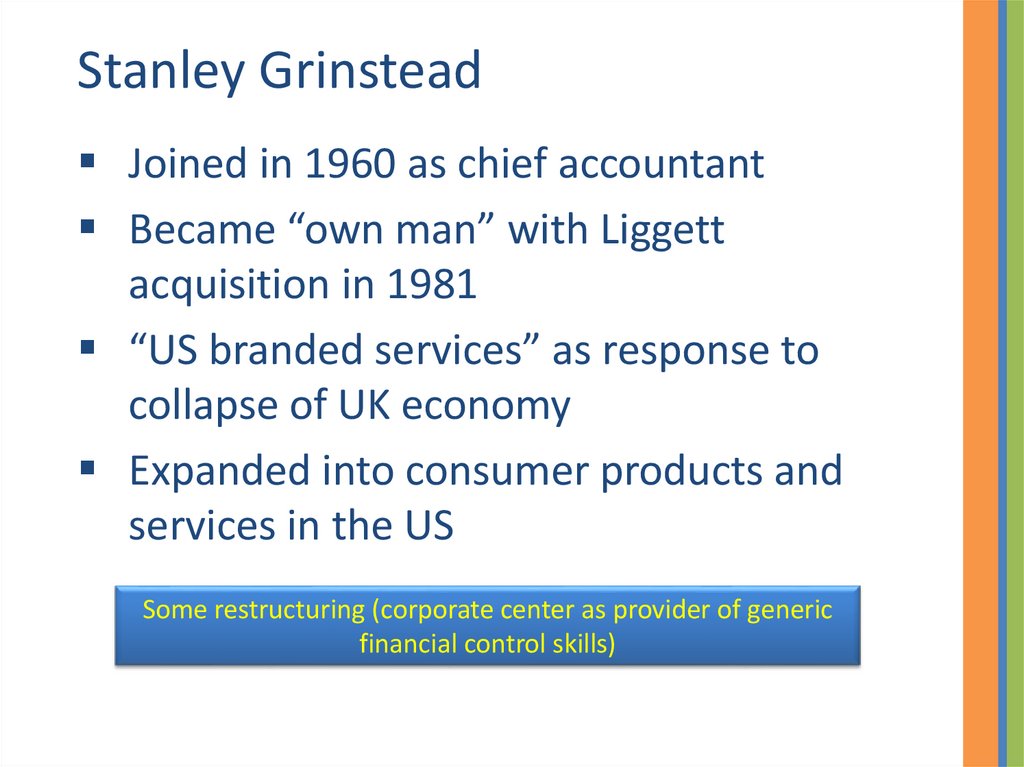
Stanley GrinsteadJoined in 1960 as chief accountant
Became “own man” with Liggett
acquisition in 1981
“US branded services” as response to
collapse of UK economy
Expanded into consumer products and
services in the US
Some restructuring (corporate center as provider of generic
financial control skills)
32.
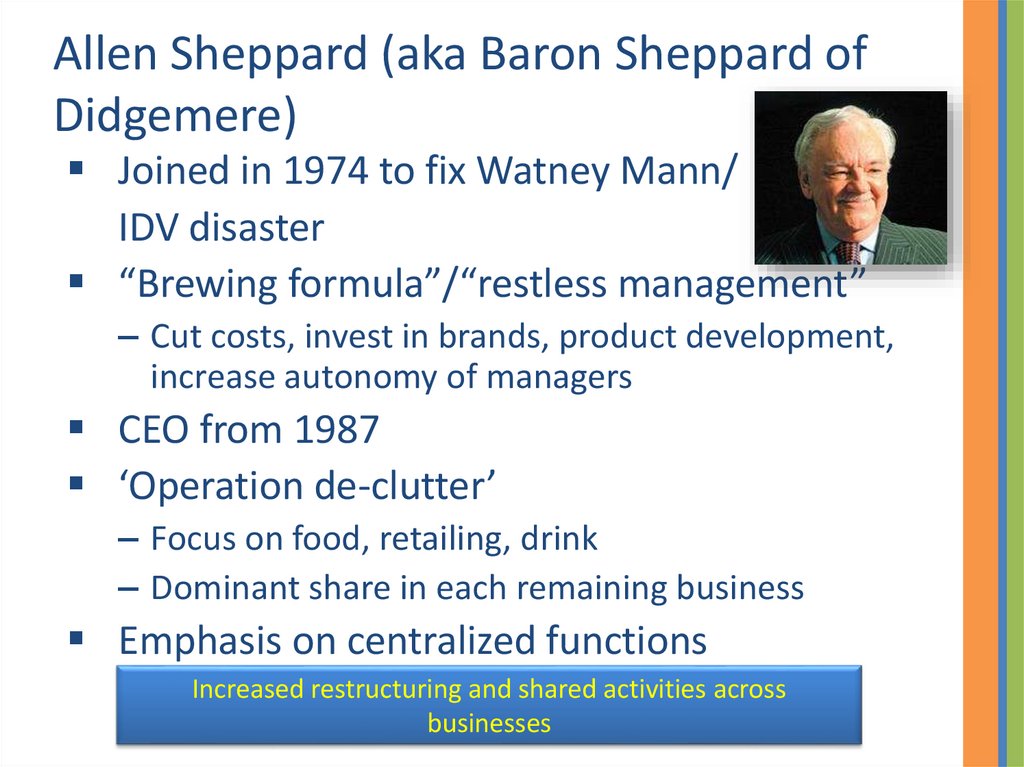
Allen Sheppard (aka Baron Sheppard ofDidgemere)
Joined in 1974 to fix Watney Mann/
IDV disaster
“Brewing formula”/“restless management”
– Cut costs, invest in brands, product development,
increase autonomy of managers
CEO from 1987
‘Operation de-clutter’
– Focus on food, retailing, drink
– Dominant share in each remaining business
Emphasis on centralized functions
Increased restructuring and shared activities across
businesses
33.
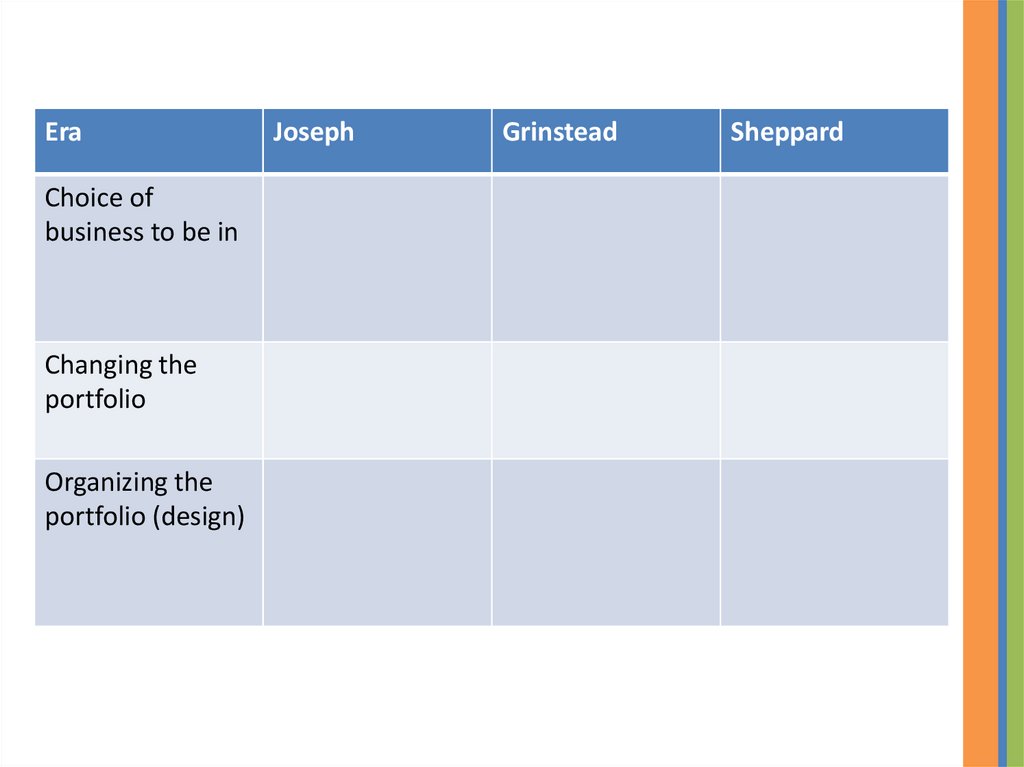
EraChoice of
business to be in
Changing the
portfolio
Organizing the
portfolio (design)
Joseph
Grinstead
Sheppard
34.
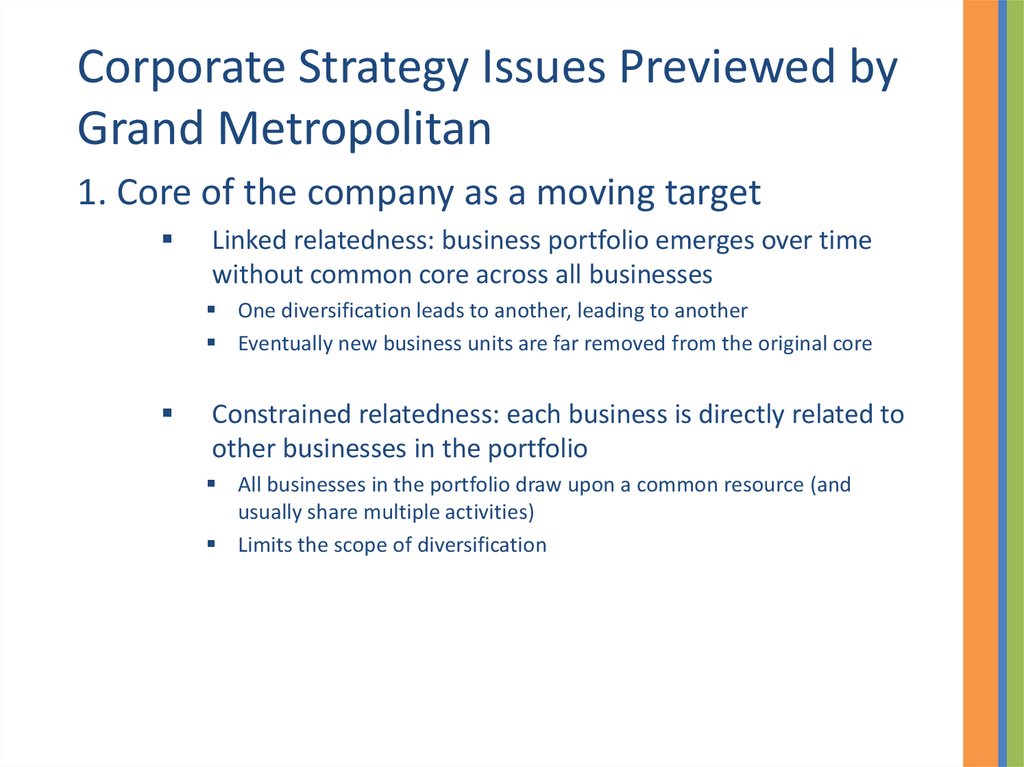
Corporate Strategy Issues Previewed byGrand Metropolitan
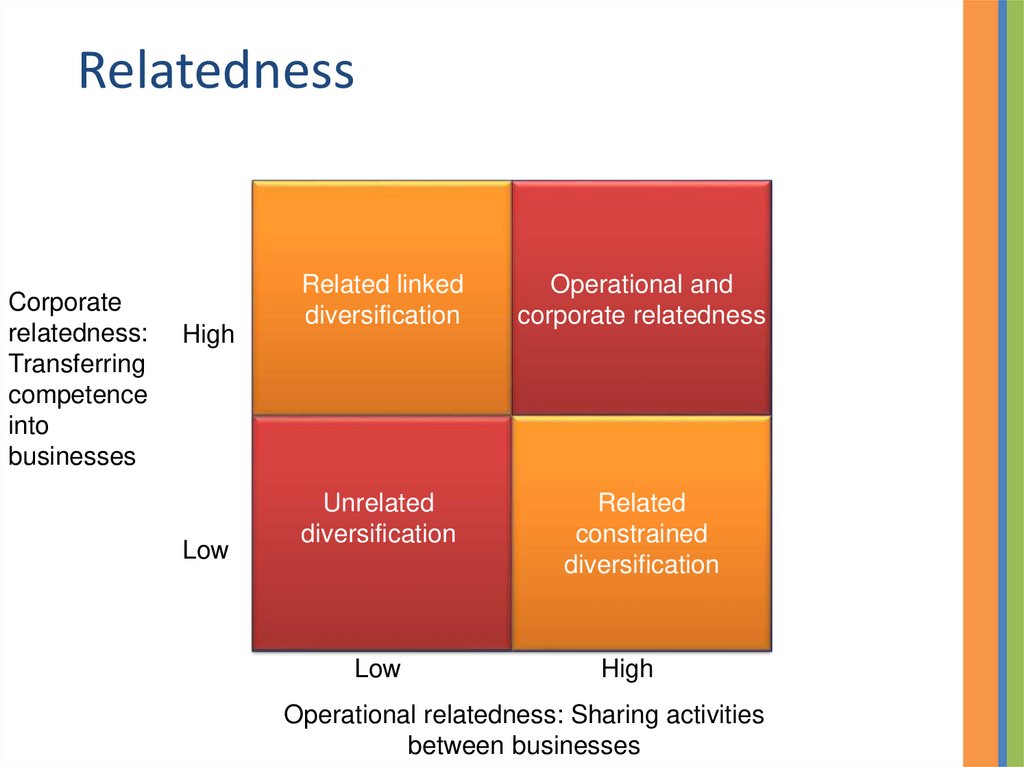
1. Core of the company as a moving target
Linked relatedness: business portfolio emerges over time
without common core across all businesses
One diversification leads to another, leading to another
Eventually new business units are far removed from the original core
Constrained relatedness: each business is directly related to
other businesses in the portfolio
All businesses in the portfolio draw upon a common resource (and
usually share multiple activities)
Limits the scope of diversification
35.
RelatednessCorporate
relatedness:
Transferring
competence
into
businesses
High
Low
Related linked
diversification
Operational and
corporate relatedness
Unrelated
diversification
Related
constrained
diversification
Low
High
Operational relatedness: Sharing activities
between businesses
36.
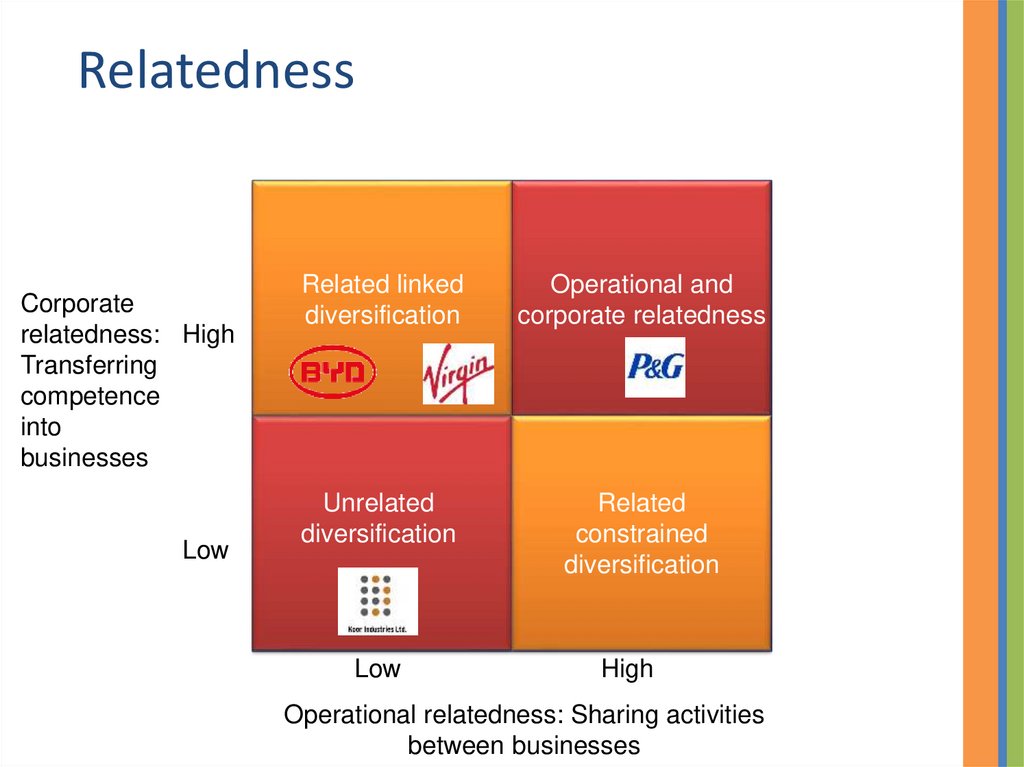
RelatednessCorporate
relatedness: High
Transferring
competence
into
businesses
Low
Related linked
diversification
Operational and
corporate relatedness
Unrelated
diversification
Related
constrained
diversification
Low
High
Operational relatedness: Sharing activities
between businesses
37.
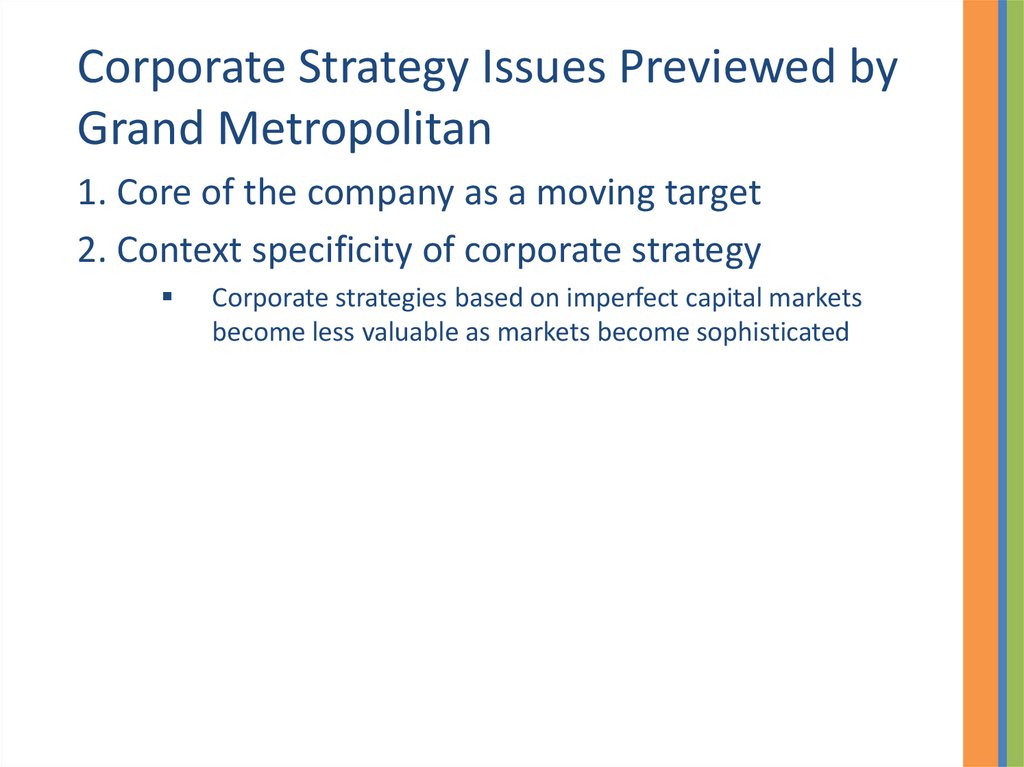
Corporate Strategy Issues Previewed byGrand Metropolitan
1. Core of the company as a moving target
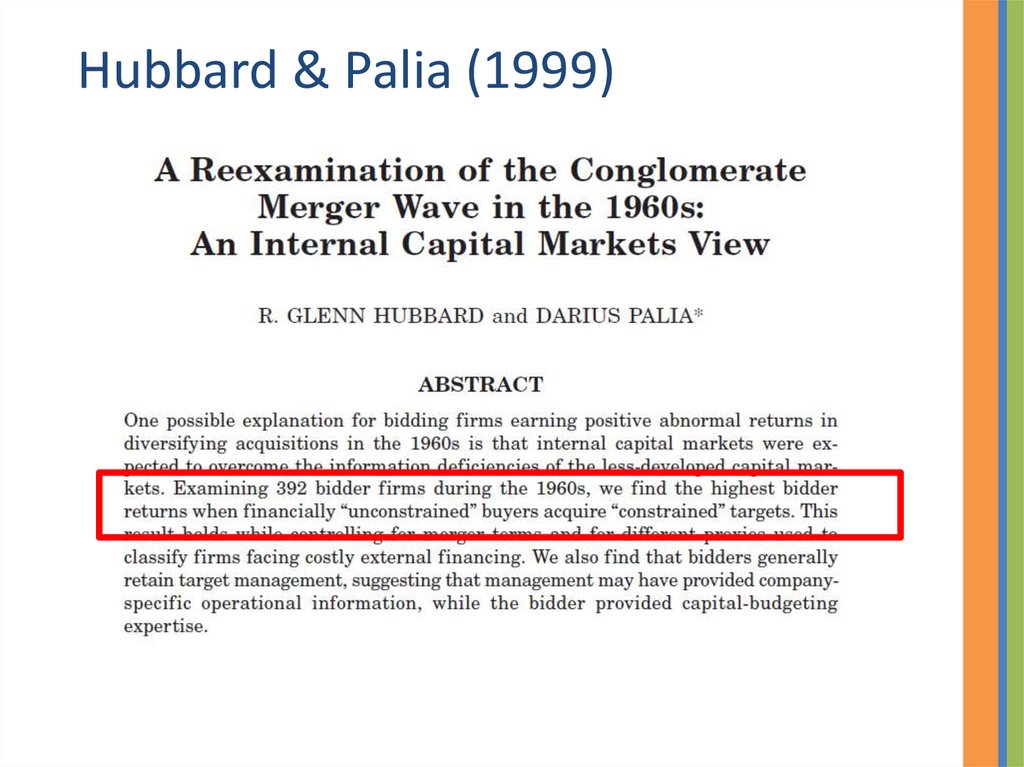
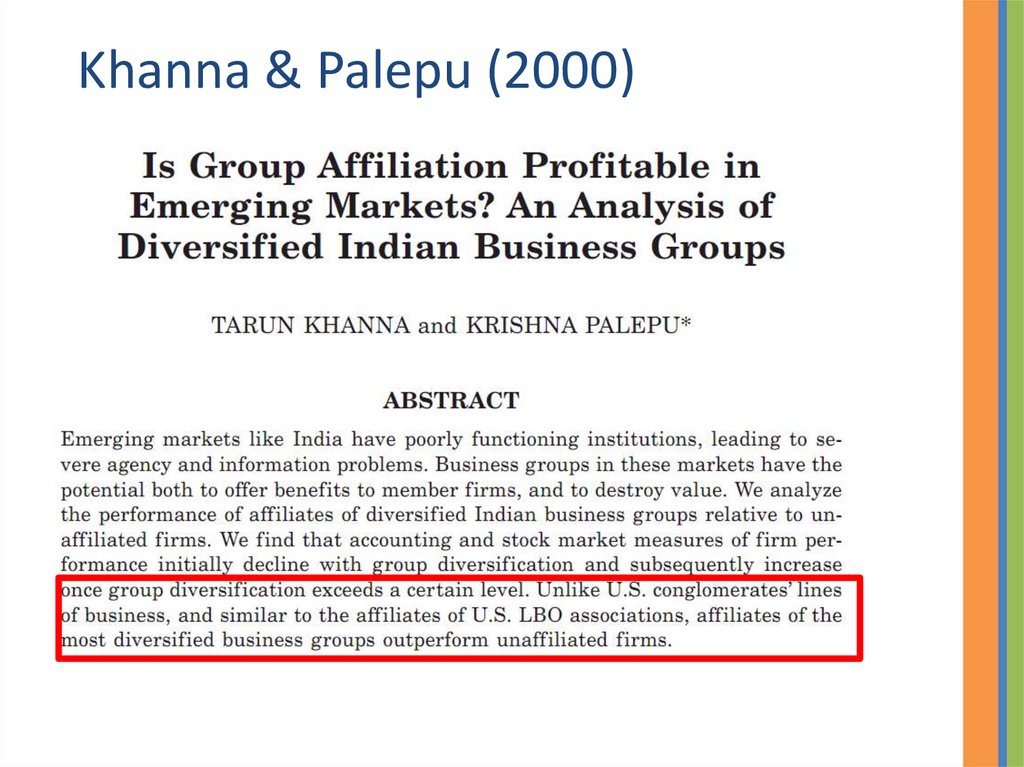
2. Context specificity of corporate strategy
Corporate strategies based on imperfect capital markets
become less valuable as markets become sophisticated
38.
Hubbard & Palia (1999)39.
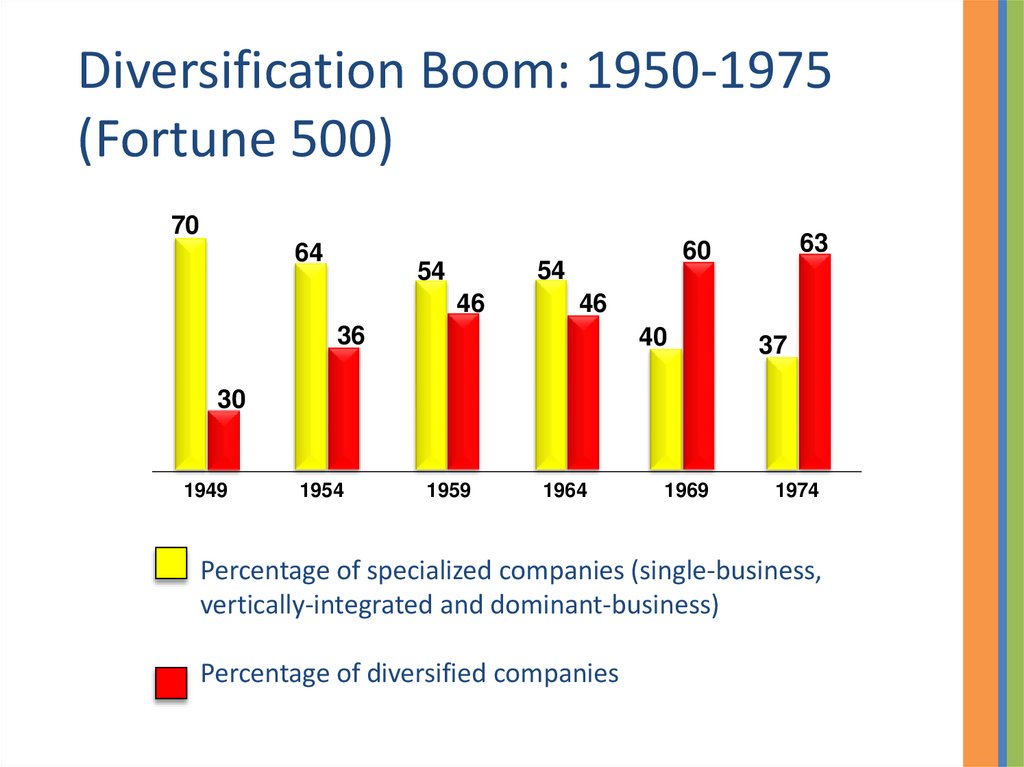
Diversification Boom: 1950-1975(Fortune 500)
70
64
54
54
46
63
60
46
36
40
37
30
1949
1954
1959
1964
1969
1974
Percentage of specialized companies (single-business,
vertically-integrated and dominant-business)
Percentage of diversified companies
40.
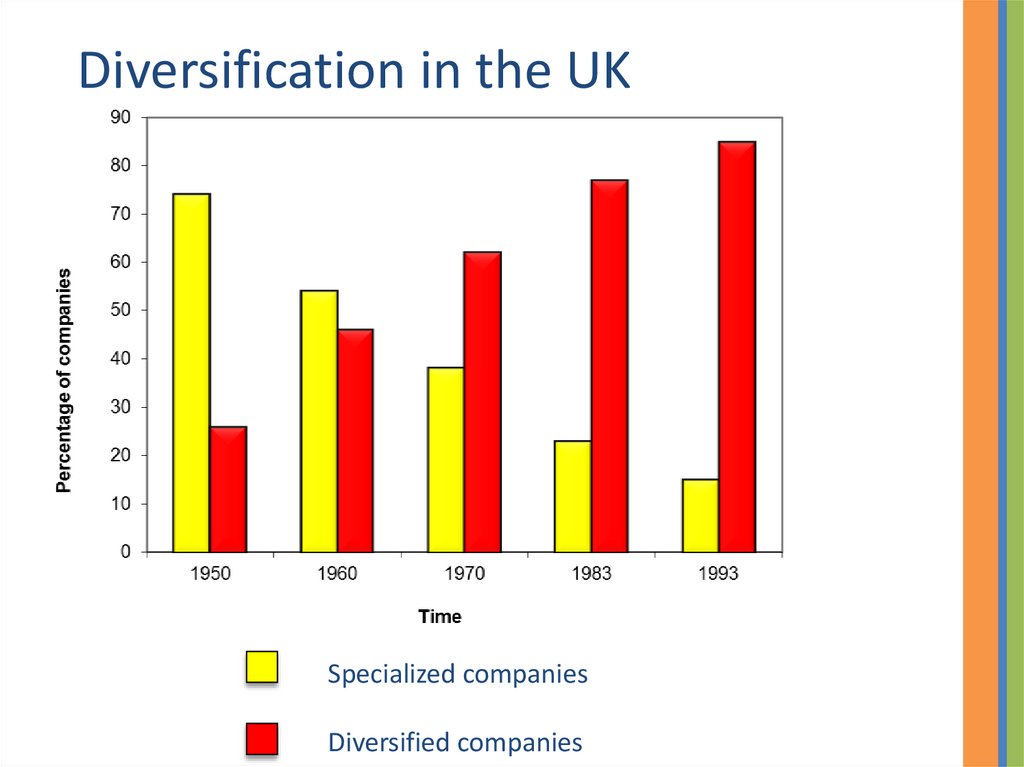
Diversification in the UKSpecialized companies
Diversified companies
41.
Khanna & Palepu (2000)42.
Corporate Strategy Issues Previewed byGrand Metropolitan
1. Core of the company as a moving target
2. Context specificity of corporate strategy
3. Changing CEOs may be easier than getting the
CEO to change strategy
Management style matters for acquisitions and
diversification
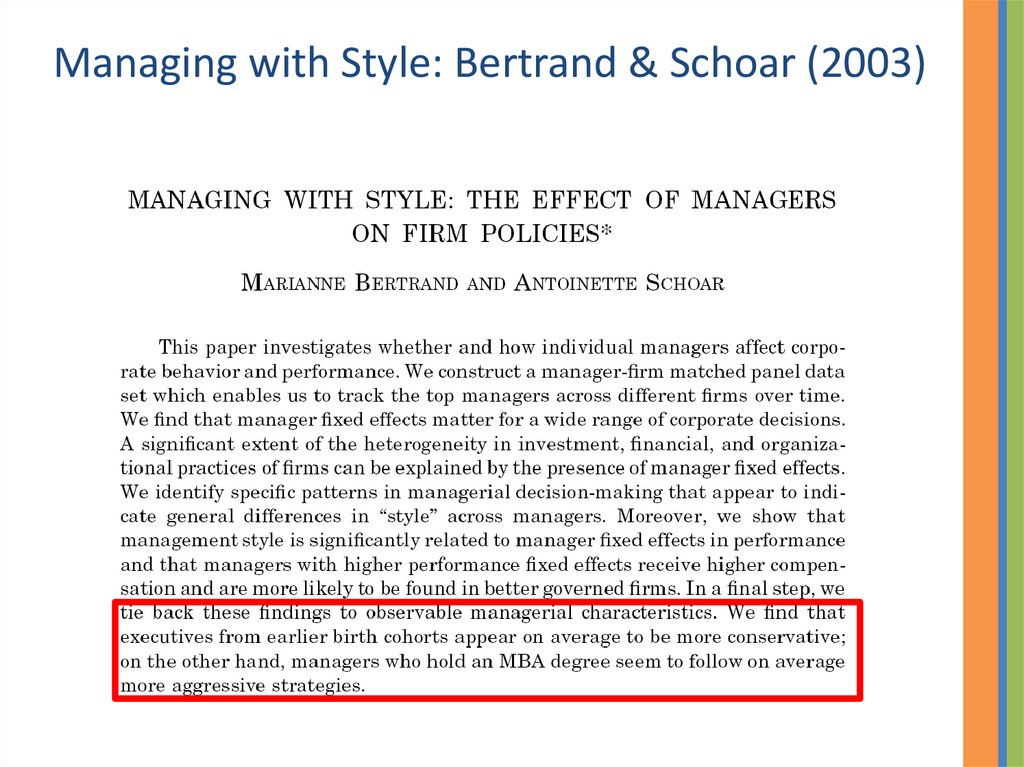
MBA holders – more aggressive
Managers do not change their style
43.
Managing with Style: Bertrand & Schoar (2003)44.
Our FocusCorporate Strategy
Corporate Head Office
Business Strategy
Division A
Division B
Finance
Finance
Production
Production
Marketing/Sales
Marketing
Functional Strategies
45.
HOW?WHAT?
WHO?
46.
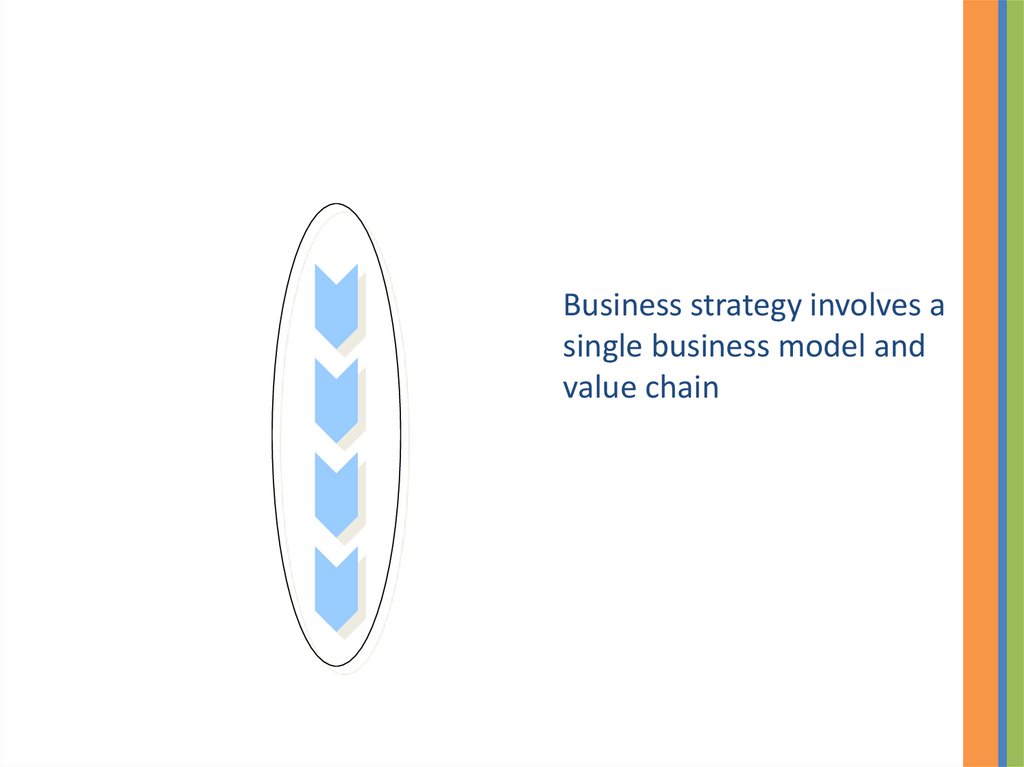
Business strategy involves asingle business model and
value chain
47.
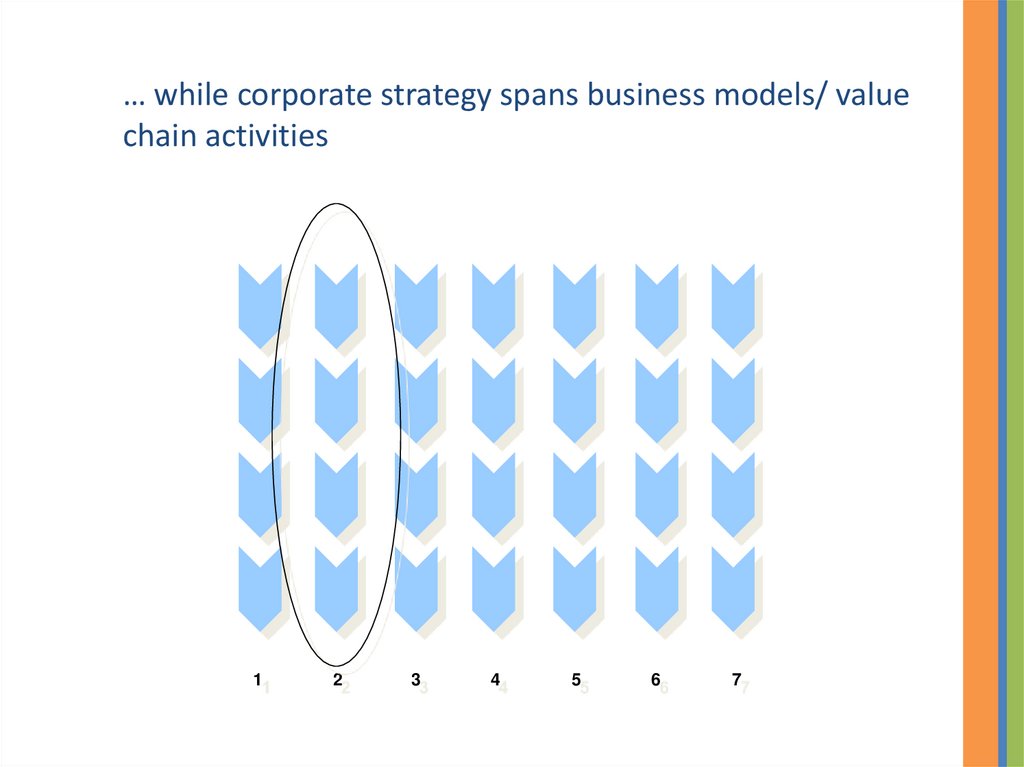
… while corporate strategy spans business models/ valuechain activities
1
2
3
4
5
6
7
48.
HQ1
2
3
4
5
6
7
49.
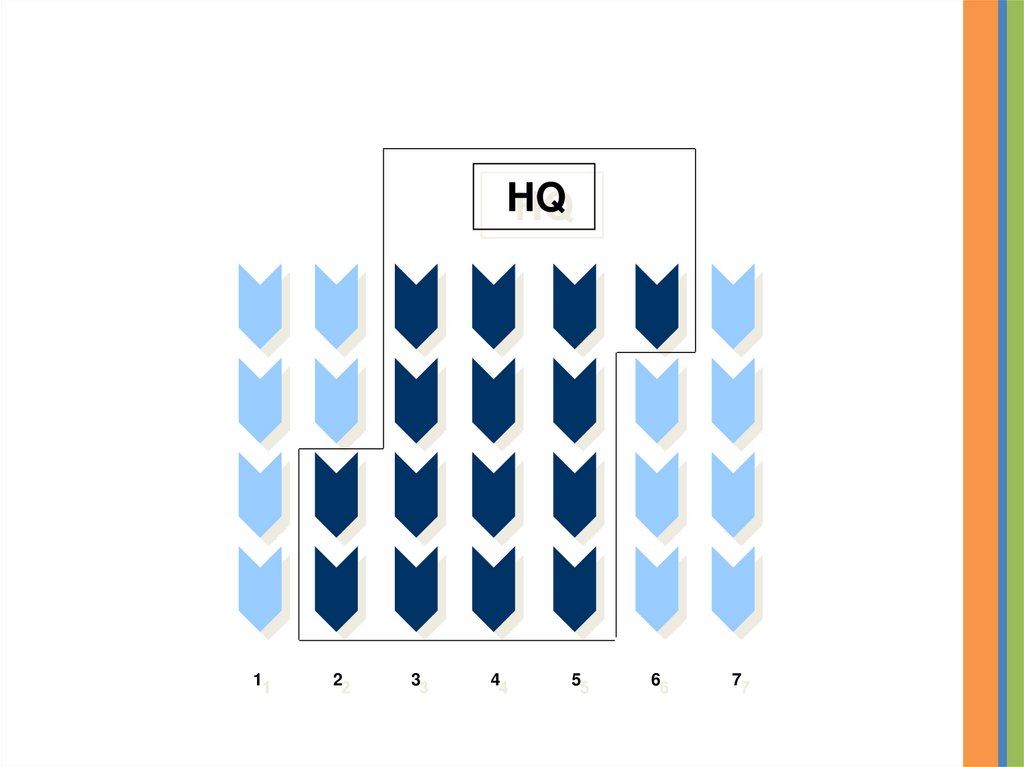
A corporation is a portfolio of value chainactivities
Corporate advantage exists if portfolio
performance exceeds the sum of performance
of individual activities
50.
COURSE STRUCTUREINTRODUCTION
1. Recap of core strategy; introduction to corporate strategy
2. Corporate parenting
PORTFOLIO COMPOSITION
3. Diversification
4. Governance of the diversified firm
PORTFOLIO ORGANIZATION
5. Organization design
PORTFOLIO CHANGE
6. M&A
7. Outsourcing
8. Presentations (and miscellaneous topics)
9. Alliances
10. Exam
51. Portfolio Composition
Which value chain activities should we bein?
Horizontally: diversification (Grand
Metropolitan, Ayala Corp.)
Vertically: outsourcing (Bharti Airtel)
1
2
3
4
5
6
7
52. Portfolio Organization
How should we organize our portfolio ofvalue chain activities to gain corporate
advantage?
Corporate parenting (WPP)
Organization design (Proctor & Gamble)
+
1
2
3
4
5
6
7
53. Portfolio Change
How should we expand our portfolio ofvalue chain activities?
Internal development vs. external development
(Cisco Systems)
Acquisitions (Cisco Systems)
Alliances (Li & Fung)
1
2
3
4
5
6
7
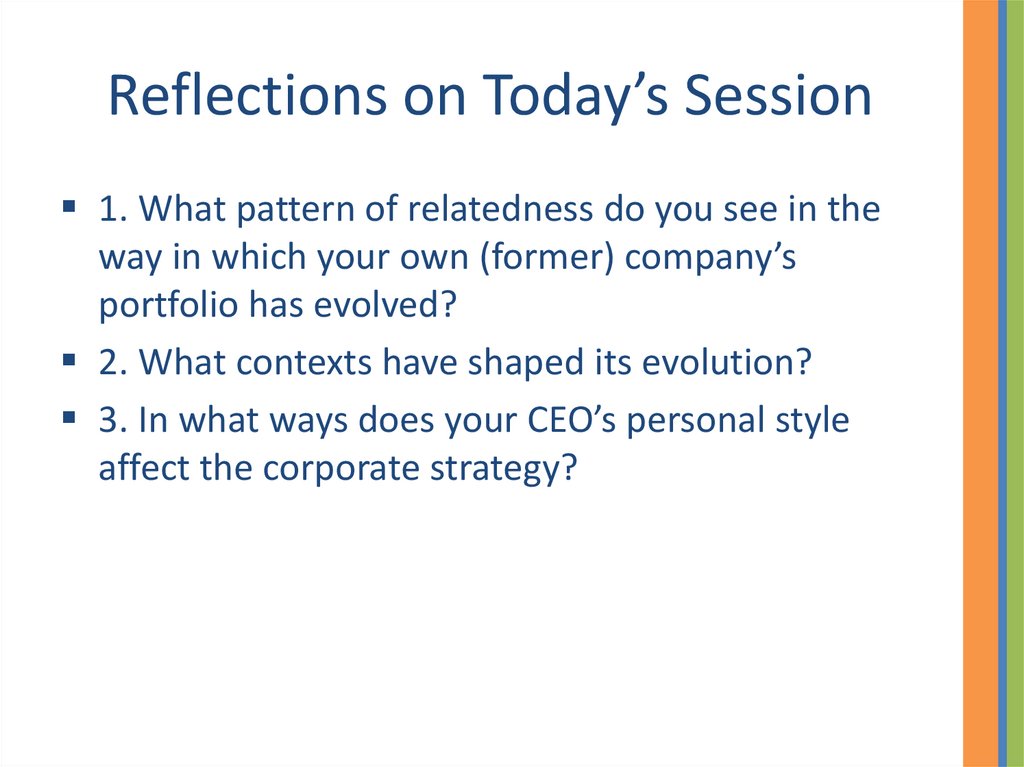
54. Reflections on Today’s Session
1. What pattern of relatedness do you see in theway in which your own (former) company’s
portfolio has evolved?
2. What contexts have shaped its evolution?
3. In what ways does your CEO’s personal style
affect the corporate strategy?
55. Next Session
What is the role of the corporate parentin a multi-business company?
56.
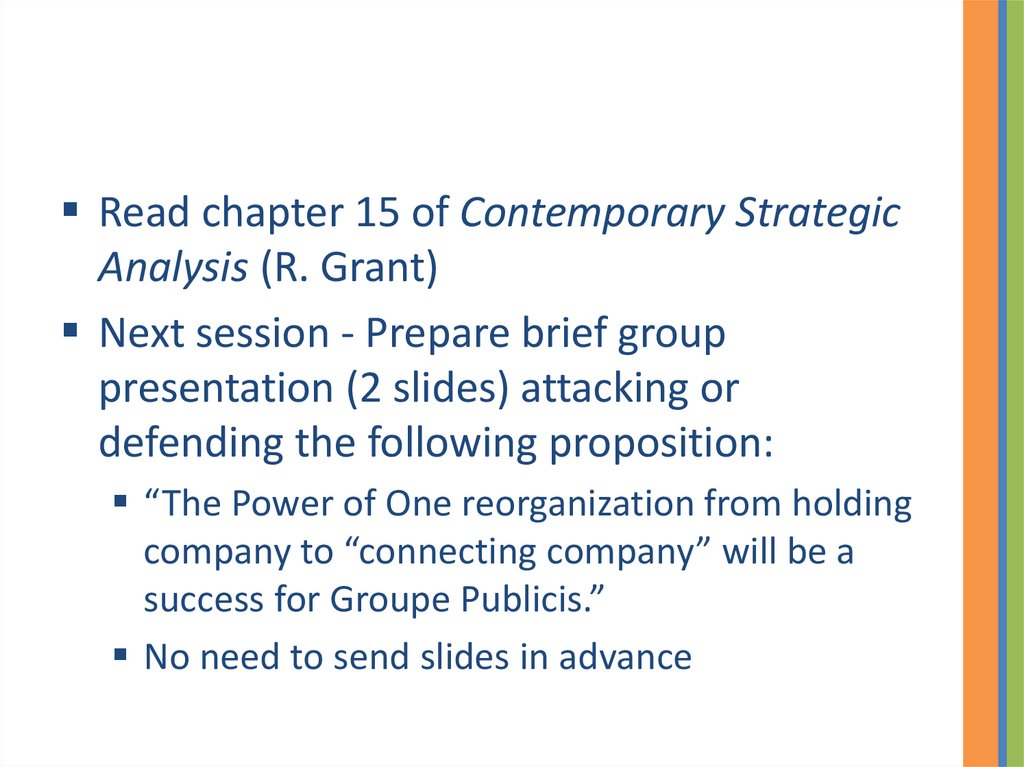
Read chapter 15 of Contemporary StrategicAnalysis (R. Grant)
Next session - Prepare brief group
presentation (2 slides) attacking or
defending the following proposition:
“The Power of One reorganization from holding
company to “connecting company” will be a
success for Groupe Publicis.”
No need to send slides in advance
57.
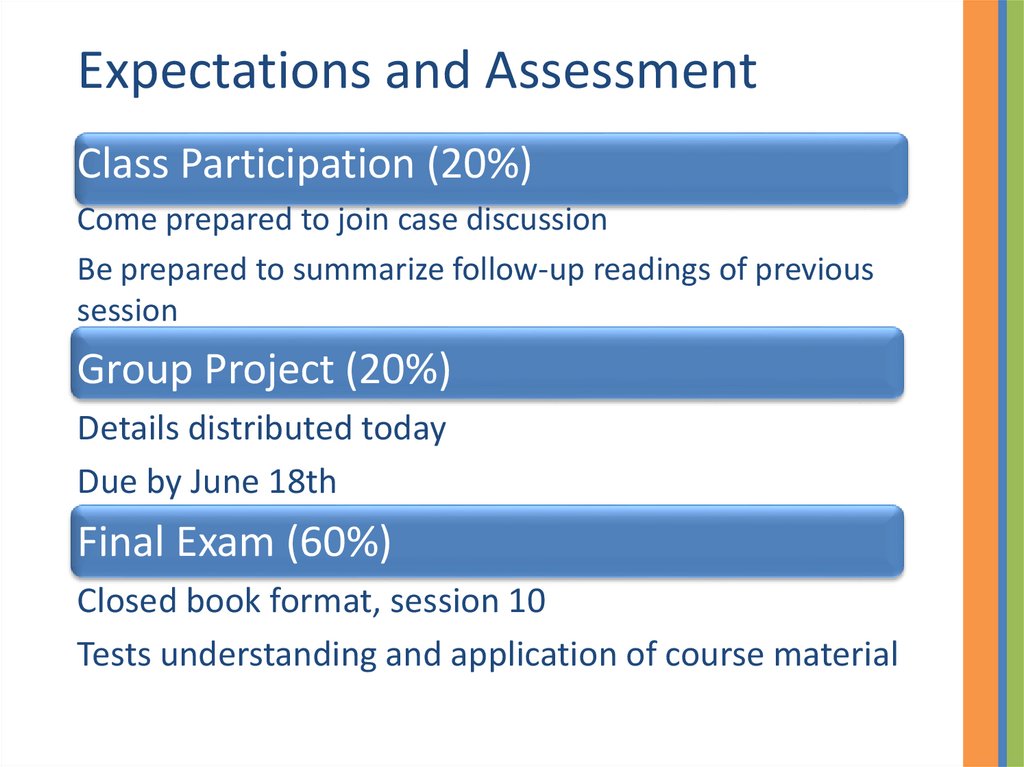
Expectations and AssessmentClass Participation (20%)
Come prepared to join case discussion
Be prepared to summarize follow-up readings of previous
session
Group Project (20%)
Details distributed today
Due by June 18th
Final Exam (60%)
Closed book format, session 10
Tests understanding and application of course material
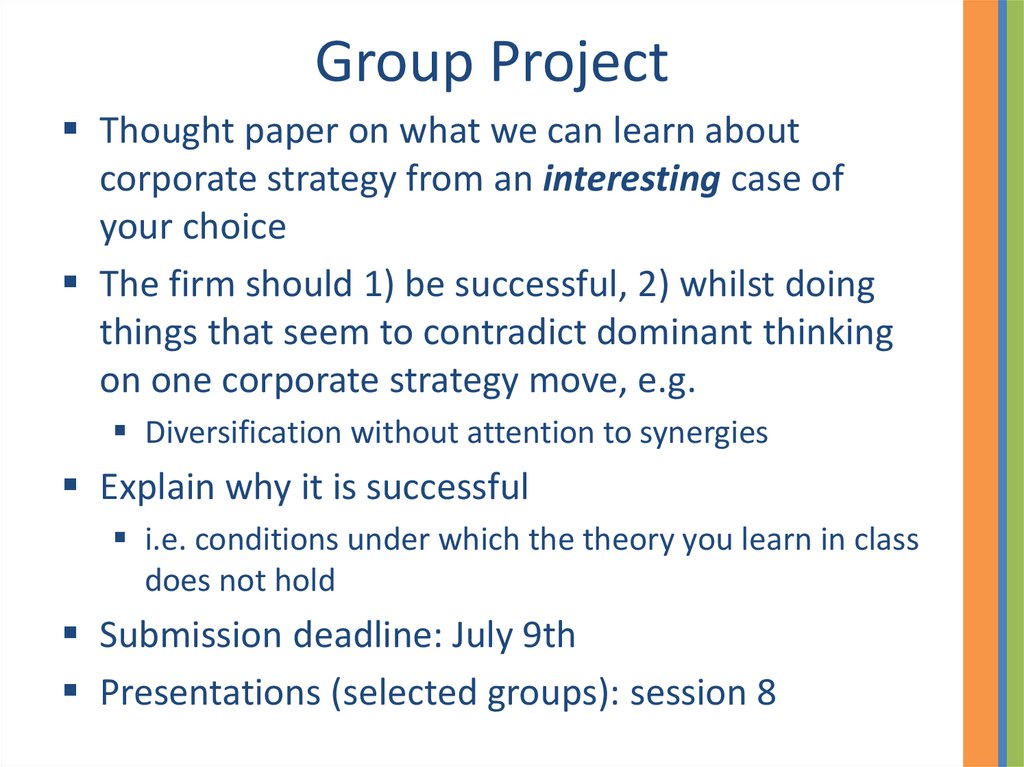
58. Group Project
Thought paper on what we can learn aboutcorporate strategy from an interesting case of
your choice
The firm should 1) be successful, 2) whilst doing
things that seem to contradict dominant thinking
on one corporate strategy move, e.g.
Diversification without attention to synergies
Explain why it is successful
i.e. conditions under which the theory you learn in class
does not hold
Submission deadline: July 9th
Presentations (selected groups): session 8