

 management
Similar presentations:




6.Strategy development in business administration
1. 6. Strategy development in business administration
USTSINOVICH IRINAMANAGERIAL ECONOMICS
6. STRATEGY DEVELOPMENT IN BUSINESS
ADMINISTRATION
2. 6. Strategy development in business administration
6. STRATEGY DEVELOPMENT IN BUSINESS ADMINISTRATION1. Procurement policy at the manufacturing enterprise
2. Choosing a strategy to work with suppliers
3. Schemes to work with suppliers
4. Company’s reorganization: directions and forms
Ustsinovich I.V.
3. 1. Procurement policy at the manufacturing enterprise
1. PROCUREMENT POLICY AT THE MANUFACTURING ENTERPRISEUstsinovich I.V.
4. Supply conditions, supply systems at the enterprise
SUPPLY CONDITIONS, SUPPLY SYSTEMS AT THE ENTERPRISEUsing a method of fully accounting for direct and indirect procurement costs.
Horizontally integrated procurement management process: all consumers within the
company should be connected to it.
Suppliers must be highly qualified and loyal to the management and owners of the
company.
Using effective analytical tools.
Obtaining the information about consumption processes within the company and the
supply market and supplier economy.
In order to reduce abuse, suppliers must have appropriate wages.
Ustsinovich I.V.
5. Total cost of ownership
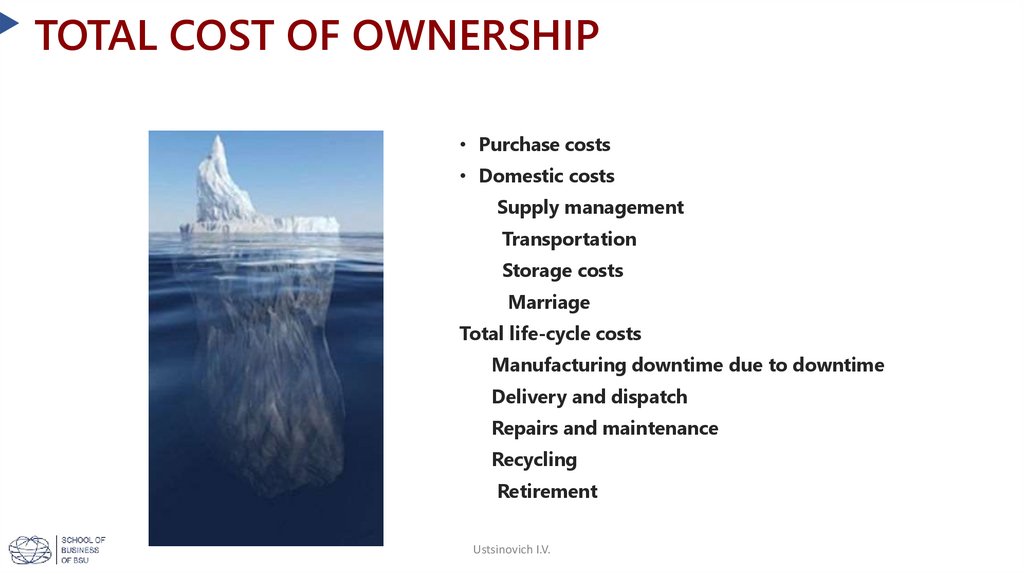
TOTAL COST OF OWNERSHIP• Purchase costs
• Domestic costs
Supply management
Transportation
Storage costs
Marriage
Total life-cycle costs
Manufacturing downtime due to downtime
Delivery and dispatch
Repairs and maintenance
Recycling
Retirement
Ustsinovich I.V.
6. 2. Choosing a strategy to work with suppliers
2. CHOOSING A STRATEGY TO WORK WITH SUPPLIERSUstsinovich I.V.
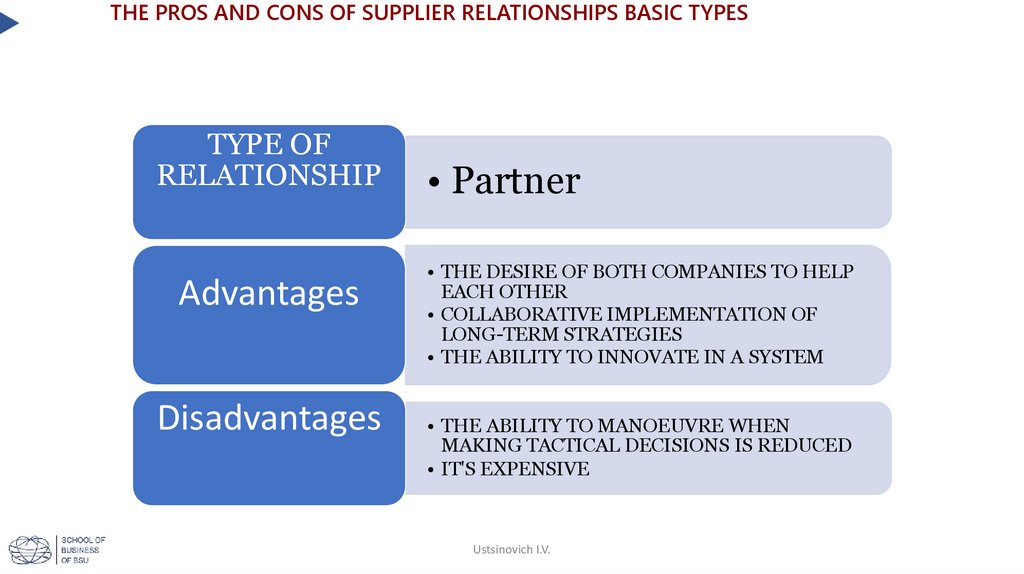
7. THE PROS AND CONS OF SUPPLIER RELATIONSHIPS BASIC TYPES
TYPE OFRELATIONSHIP
Advantages
Disadvantages
• Partner
• THE DESIRE OF BOTH COMPANIES TO HELP
EACH OTHER
• COLLABORATIVE IMPLEMENTATION OF
LONG-TERM STRATEGIES
• THE ABILITY TO INNOVATE IN A SYSTEM
• THE ABILITY TO MANOEUVRE WHEN
MAKING TACTICAL DECISIONS IS REDUCED
• IT'S EXPENSIVE
Ustsinovich I.V.
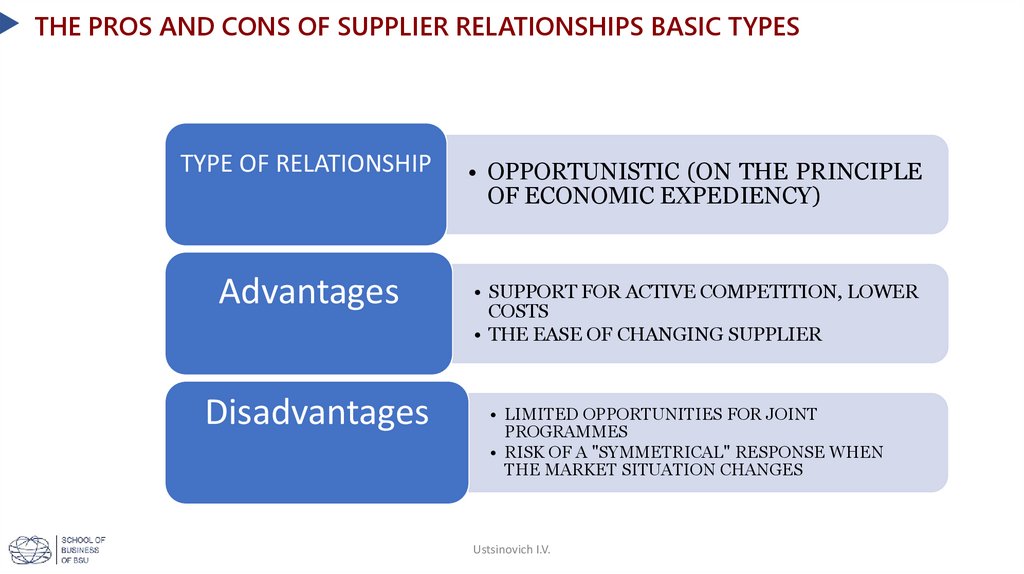
8. THE PROS AND CONS OF SUPPLIER RELATIONSHIPS BASIC TYPES
TYPE OF RELATIONSHIP• OPPORTUNISTIC (ON THE PRINCIPLE
OF ECONOMIC EXPEDIENCY)
Advantages
• SUPPORT FOR ACTIVE COMPETITION, LOWER
COSTS
• THE EASE OF CHANGING SUPPLIER
Disadvantages
• LIMITED OPPORTUNITIES FOR JOINT
PROGRAMMES
• RISK OF A "SYMMETRICAL" RESPONSE WHEN
THE MARKET SITUATION CHANGES
Ustsinovich I.V.
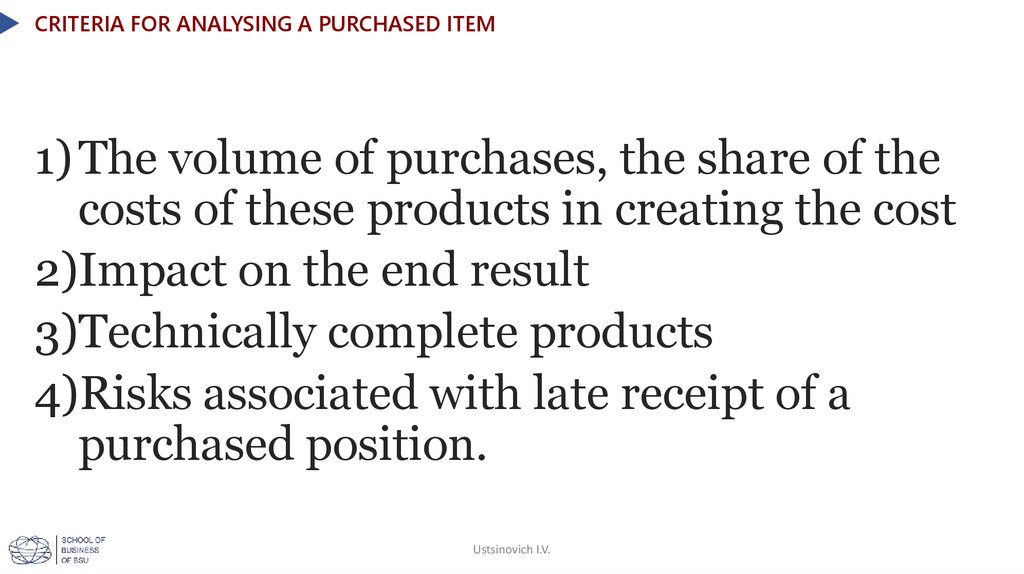
9. CRITERIA FOR ANALYSING A PURCHASED ITEM
1) The volume of purchases, the share of thecosts of these products in creating the cost
2)Impact on the end result
3)Technically complete products
4)Risks associated with late receipt of a
purchased position.
Ustsinovich I.V.
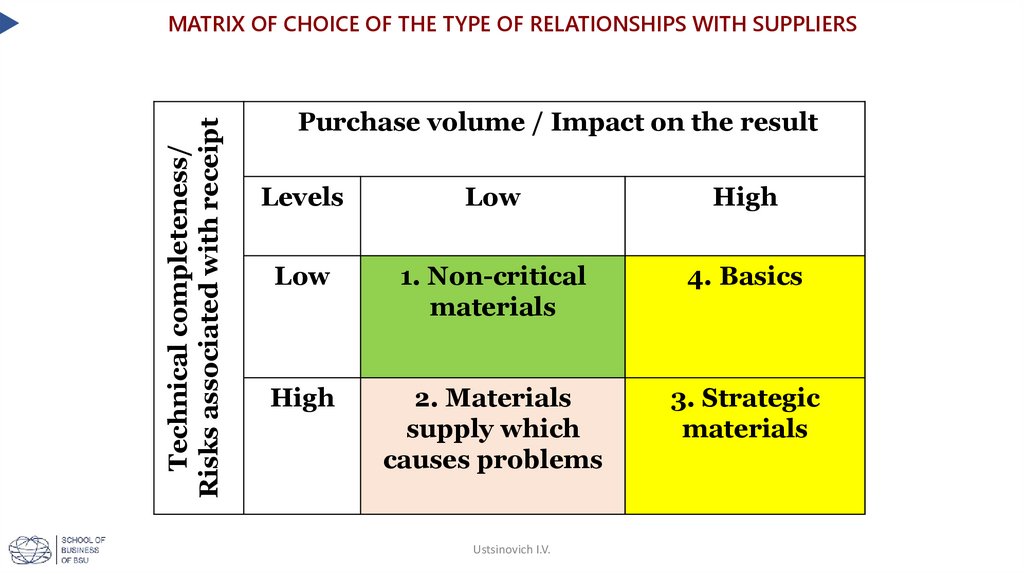
10. Matrix of choice of the type of relationships with suppliers
Technical completeness/Risks associated with receipt
MATRIX OF CHOICE OF THE TYPE OF RELATIONSHIPS WITH SUPPLIERS
Purchase volume / Impact on the result
Levels
Low
High
Low
1. Non-critical
materials
4. Basics
High
2. Materials
supply which
causes problems
3. Strategic
materials
Ustsinovich I.V.
11. 3. Schemes to work with suppliers
3. SCHEMES TO WORK WITH SUPPLIERSUstsinovich I.V.
12. Schemes to work with suppliers
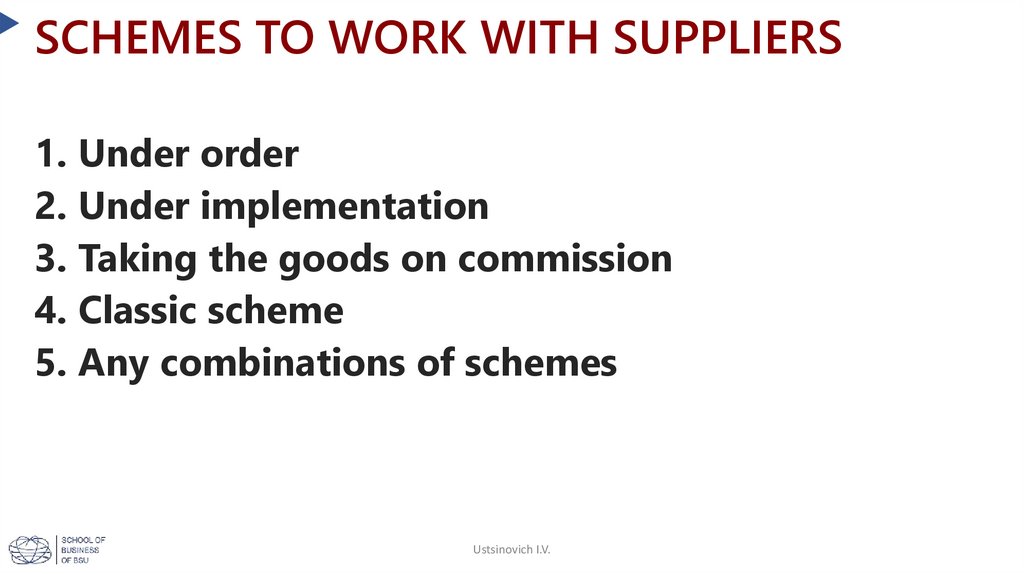
SCHEMES TO WORK WITH SUPPLIERS1. Under order
2. Under implementation
3. Taking the goods on commission
4. Classic scheme
5. Any combinations of schemes
Ustsinovich I.V.
13. Dropshipping scheme
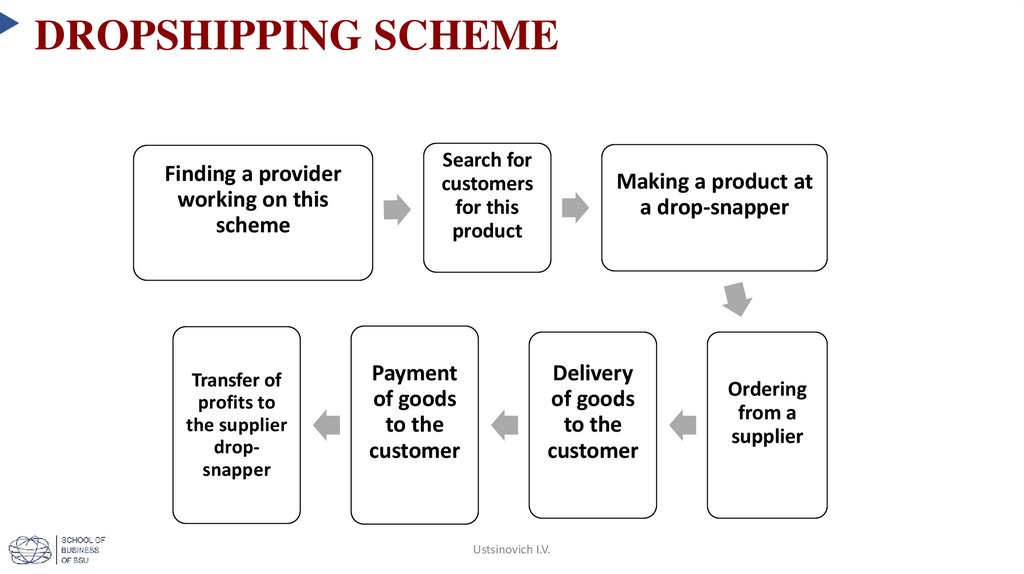
DROPSHIPPING SCHEMEFinding a provider
working on this
scheme
Transfer of
profits to
the supplier
dropsnapper
Search for
customers
for this
product
Payment
of goods
to the
customer
Making a product at
a drop-snapper
Delivery
of goods
to the
customer
Ustsinovich I.V.
Ordering
from a
supplier
14. Dropship 2
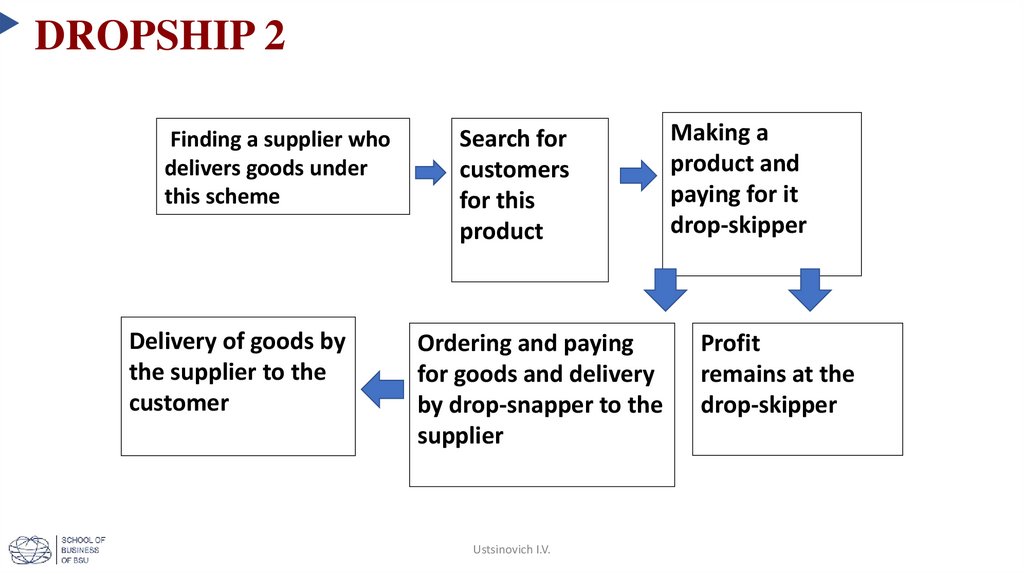
DROPSHIP 2Finding a supplier who
delivers goods under
this scheme
Delivery of goods by
the supplier to the
customer
Search for
customers
for this
product
Ordering and paying
for goods and delivery
by drop-snapper to the
supplier
Ustsinovich I.V.
Making a
product and
paying for it
drop-skipper
Profit
remains at the
drop-skipper
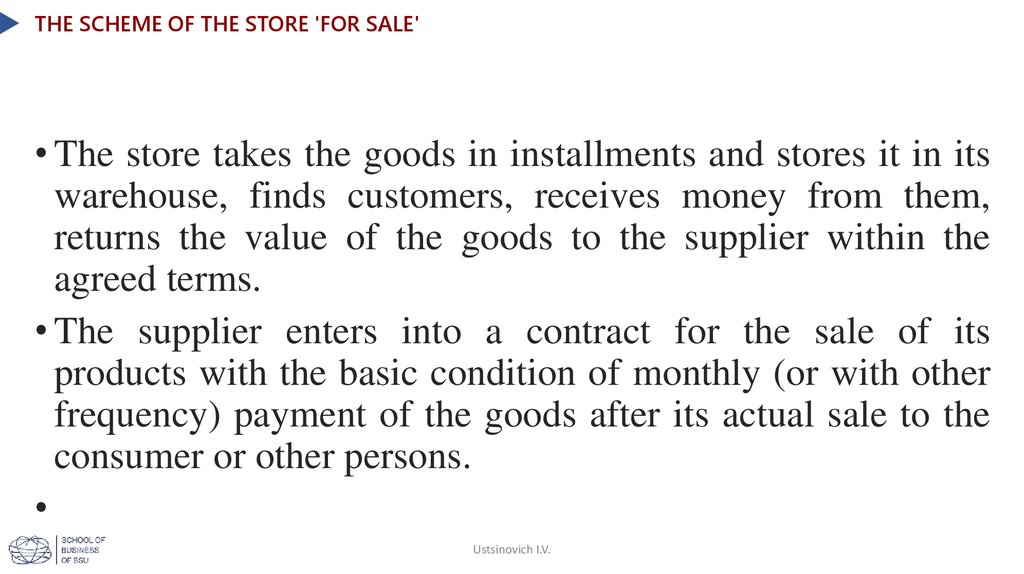
15. The scheme of the store 'for sale'
THE SCHEME OF THE STORE 'FOR SALE'• The store takes the goods in installments and stores it in its
warehouse, finds customers, receives money from them,
returns the value of the goods to the supplier within the
agreed terms.
• The supplier enters into a contract for the sale of its
products with the basic condition of monthly (or with other
frequency) payment of the goods after its actual sale to the
consumer or other persons.
Ustsinovich I.V.
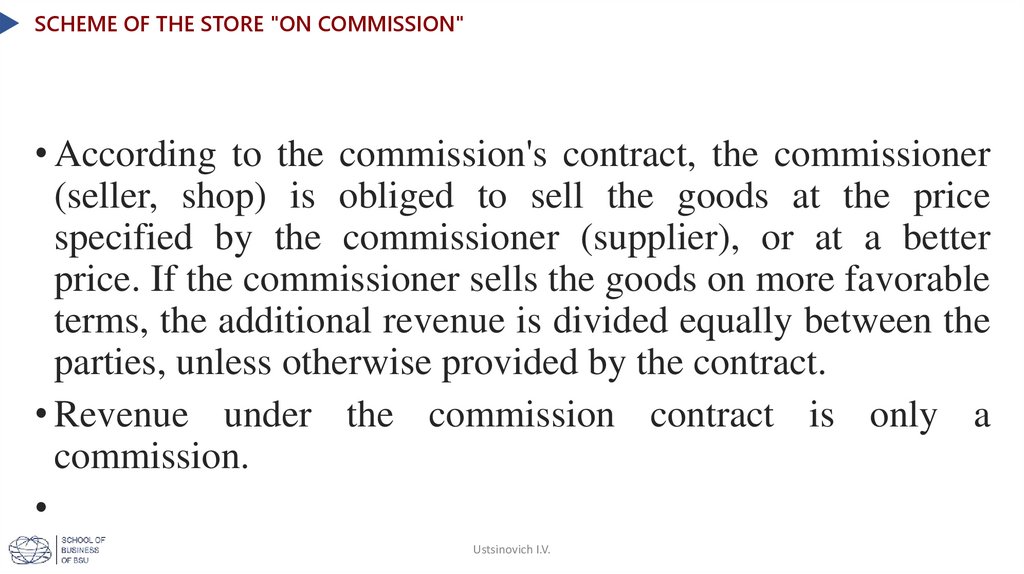
16. Scheme of the store "on commission"
SCHEME OF THE STORE "ON COMMISSION"• According to the commission's contract, the commissioner
(seller, shop) is obliged to sell the goods at the price
specified by the commissioner (supplier), or at a better
price. If the commissioner sells the goods on more favorable
terms, the additional revenue is divided equally between the
parties, unless otherwise provided by the contract.
• Revenue under the commission contract is only a
commission.
Ustsinovich I.V.
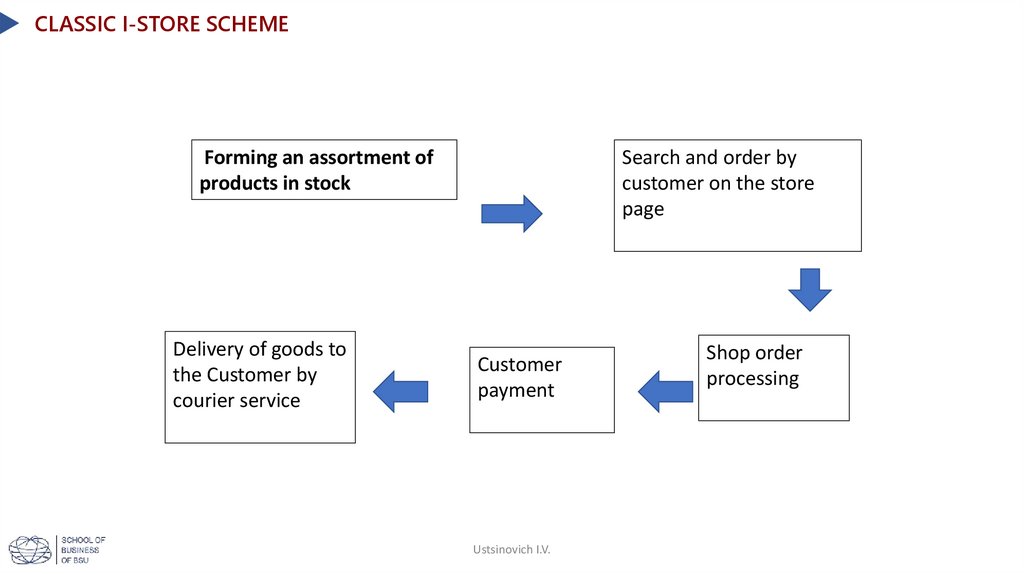
17. Classic I-store scheme
CLASSIC I-STORE SCHEMEForming an assortment of
products in stock
Delivery of goods to
the Customer by
courier service
Search and order by
customer on the store
page
Customer
payment
Ustsinovich I.V.
Shop order
processing
18. 4. Company’s reorganization: directions and forms
4. COMPANY’S REORGANIZATION: DIRECTIONS AND FORMSUstsinovich I.V.
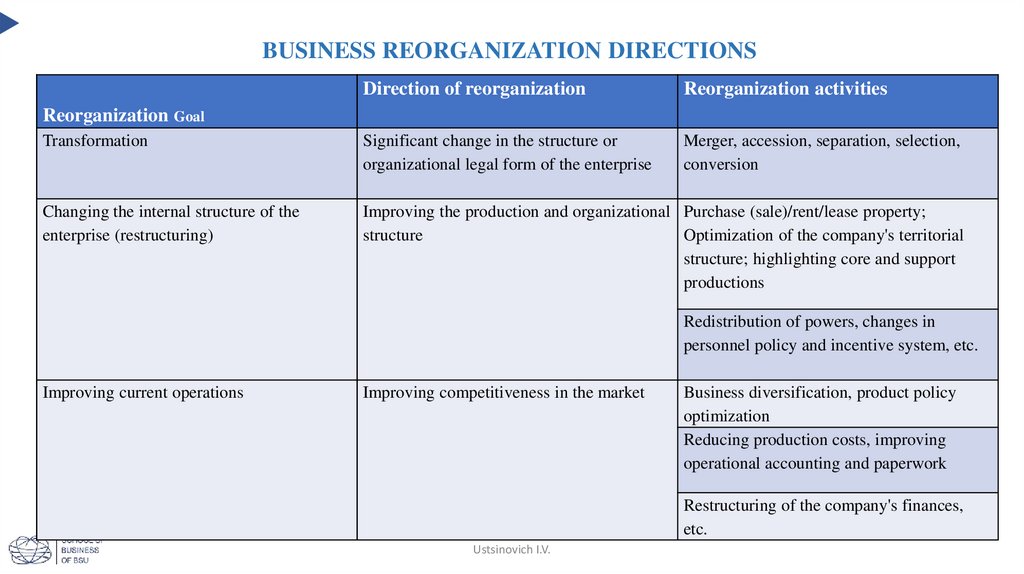
19. Business reorganization directions
BUSINESS REORGANIZATION DIRECTIONSDirection of reorganization
Reorganization activities
Transformation
Significant change in the structure or
organizational legal form of the enterprise
Merger, accession, separation, selection,
conversion
Changing the internal structure of the
enterprise (restructuring)
Improving the production and organizational Purchase (sale)/rent/lease property;
structure
Optimization of the company's territorial
structure; highlighting core and support
productions
Reorganization Goal
Redistribution of powers, changes in
personnel policy and incentive system, etc.
Improving current operations
Improving competitiveness in the market
Business diversification, product policy
optimization
Reducing production costs, improving
operational accounting and paperwork
Restructuring of the company's finances,
etc.
Ustsinovich I.V.
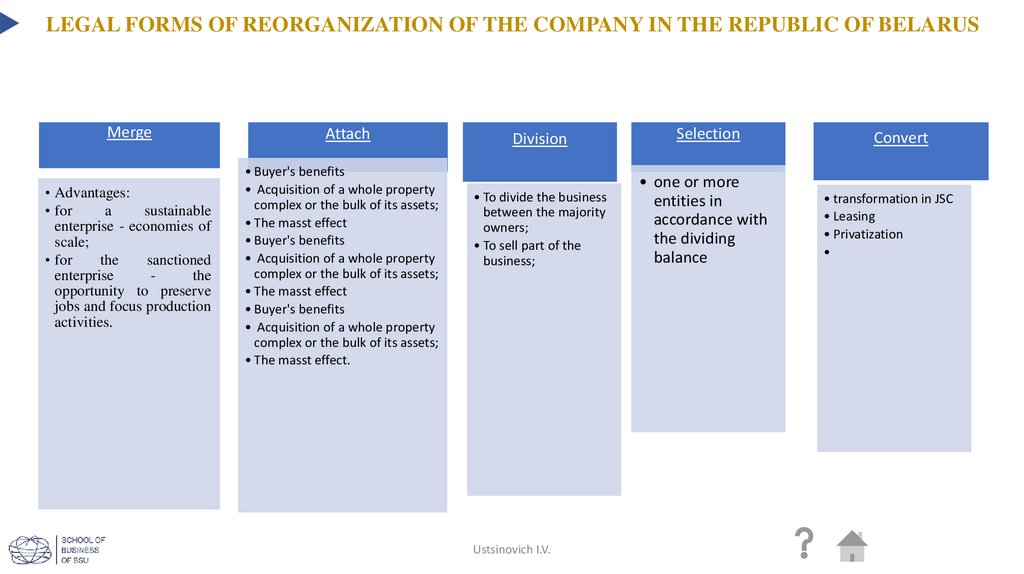
20. LEGAL FORMS OF REORGANIZATION OF THE COMPANY IN THE REPUBLIC OF BELARUS
Merge• Advantages:
• for
a
sustainable
enterprise - economies of
scale;
• for
the
sanctioned
enterprise
the
opportunity to preserve
jobs and focus production
activities.
Attach
• Buyer's benefits
• Acquisition of a whole property
complex or the bulk of its assets;
• The masst effect
• Buyer's benefits
• Acquisition of a whole property
complex or the bulk of its assets;
• The masst effect
• Buyer's benefits
• Acquisition of a whole property
complex or the bulk of its assets;
• The masst effect.
Division
Selection
• To divide the business
between the majority
owners;
• To sell part of the
business;
• one or more
entities in
accordance with
the dividing
balance
Ustsinovich I.V.
Convert
• transformation in JSC
• Leasing
• Privatization
21. Thank you for your attention!
THANK YOU FOR YOUR ATTENTION!Irina Valeryevna Ustsinovitch, Ph.D. in Economics, Associate Professor
+375 (29) 7785456
i.ustinovich@yandex.ru
Ustsinovich I.V.