

 english
Similar presentations:








Comparison of British and American English
1.
Comparison of British andAmerican English
Author: Rostislavs Nikolajevs 9C
Adviser: Marina Nozdračeva
2.
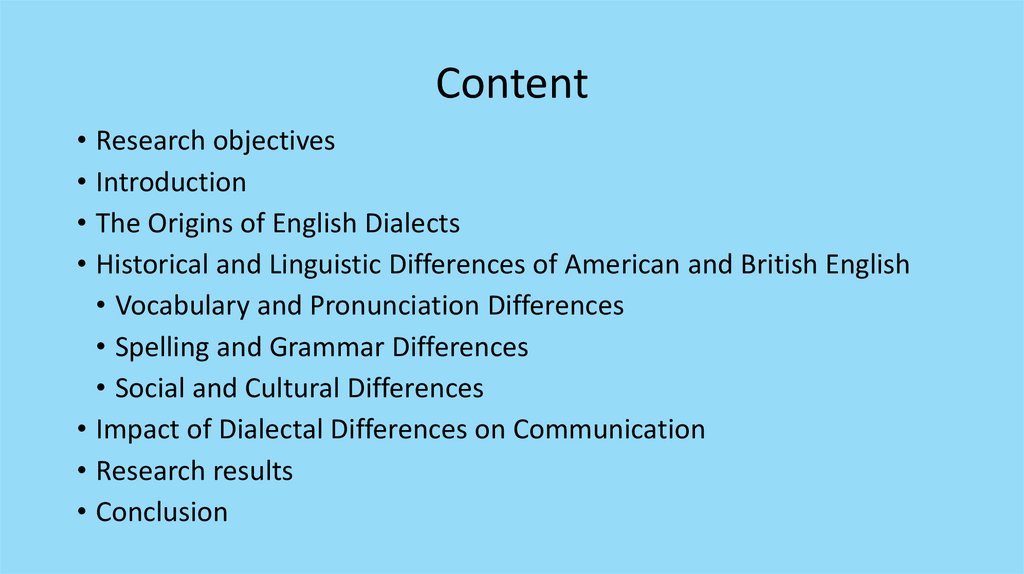
Content• Research objectives
• Introduction
• The Origins of English Dialects
• Historical and Linguistic Differences of American and British English
• Vocabulary and Pronunciation Differences
• Spelling and Grammar Differences
• Social and Cultural Differences
• Impact of Dialectal Differences on Communication
• Research results
• Conclusion
3.
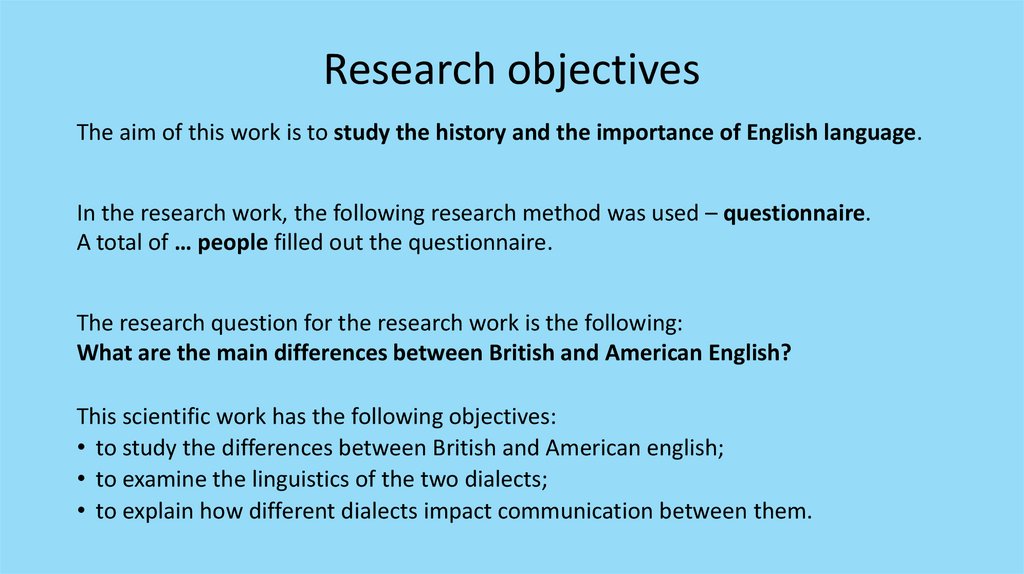
Research objectivesThe aim of this work is to study the history and the importance of English language.
In the research work, the following research method was used – questionnaire.
A total of … people filled out the questionnaire.
The research question for the research work is the following:
What are the main differences between British and American English?
This scientific work has the following objectives:
• to study the differences between British and American english;
• to examine the linguistics of the two dialects;
• to explain how different dialects impact communication between them.
4.
IntroductionEnglish is the most widely spoken language globally, with various
dialects, including British and American English. These dialects differ in
linguistics and cultural references, sometimes causing
miscommunication between the speakers. Understanding these
differences is crucial for effective communication, especially in
literature, media, and business. As globalization continues, the
relationship between British and American English will evolve,
impacting cross-cultural interactions.
5.
The Origins of English DialectsEnglish evolved through various dialects influenced by history,
geography, and social changes. Old English had four main dialects, with
West Saxon becoming dominant after the Viking invasions. The Norman
Conquest introduced French and Latin vocabulary, leading to the rise of
Middle English. As English developed into Modern English, global
dialects emerged, shaped by regional languages and colonization, yet
they remain largely mutually intelligible.
6.
Historical and Linguistic Differences ofAmerican and British English
British and American English differ due to historical influences, like
French on British English and Noah Webster’s changes to American
spelling. The United Kingdom’s higher classes softened their
pronunciation of ‘r’ sounds, while Americans kept them. Vocabulary,
grammar, pronunciation, and spelling vary between the two. Despite
these differences, mutual understanding remains strong, thanks to
global media exposure.
7.
Vocabulary and Pronunciation DifferencesBritish and American English share many words but differ in some
vocabulary, like "football“, which is “soccer” in British, and “garbage“,
which is “rubbish” in British. Accents also vary; American English is
rhotic, while British is non-rhotic, and Americans use a wider pitch
range. British English often ends sentences with falling intonation,
while American English may use rising intonation.
8.
Spelling and Grammar DifferencesEnglish spelling shows mainly British and
American differences, such as British -ise and
American -ize, and –our/-or endings. Consonant
doubling also varies; British English doubles in
past participles, while American English
doesn't. Other differences include noun endings
and past tense forms. Grammar distinctions
include collective nouns, past perfect usage,
and the use of "got" and "gotten“. Additionally,
American English often form compound nouns with
a verb and noun, while British English combine a
9.
Social and Cultural DifferencesAmerican and British cultures differ in
communication, humor, and traditions. Americans
are open and direct, while Brits are reserved
and subtle. In customer service, Americans are
approachable and proactive, whereas Brits value
personal space. Americans favor optimistic humor
and Brits prefer sarcasm. Patriotism is louder
in the United States but quieter in United
Kingdom. Pubs are central in the United Kingdom,
bars more commercial in the United States, and
sports preferences also vary.
10.
Impact of Dialectal Differences onCommunication
American and British English differ in
pronunciation, vocabulary, grammar, and idioms,
often causing misunderstandings. Words like
"schedule” that is pronounced differently in
both dialects, and terms like "biscuit”, which
means “cookie” in British and “bread roll in
American, highlight these contrasts. Regional
accents, idioms, and cultural nuances further
complicate communication. Global media and
technology have improved understanding, but
challenges remain.