 lingvistics
Similar presentations:






Linguistic Typology: Exploring Language Diversity
1.
Linguistic Typology:Exploring Language
Diversity
Linguistic typology is a branch of linguistics
that examines the similarities and differences
across languages, grouping them based on
specific characteristics. This field delves into
the intricate categorization of languages,
examining both broad linguistic families and
individual language traits that contribute to
their unique identities.
2.
Plan of the lecture:Key Parameters in Typological studies
Comparative Approaches
Applications of Typological studies
3.
On the basis of analysis of works written by Russianand foreign typologists such as Greenberg J.H.,
Bondarko A.V. and others the following parameters
modifying the subject matter and branches of
Linguistic Typology were suggested.
4.
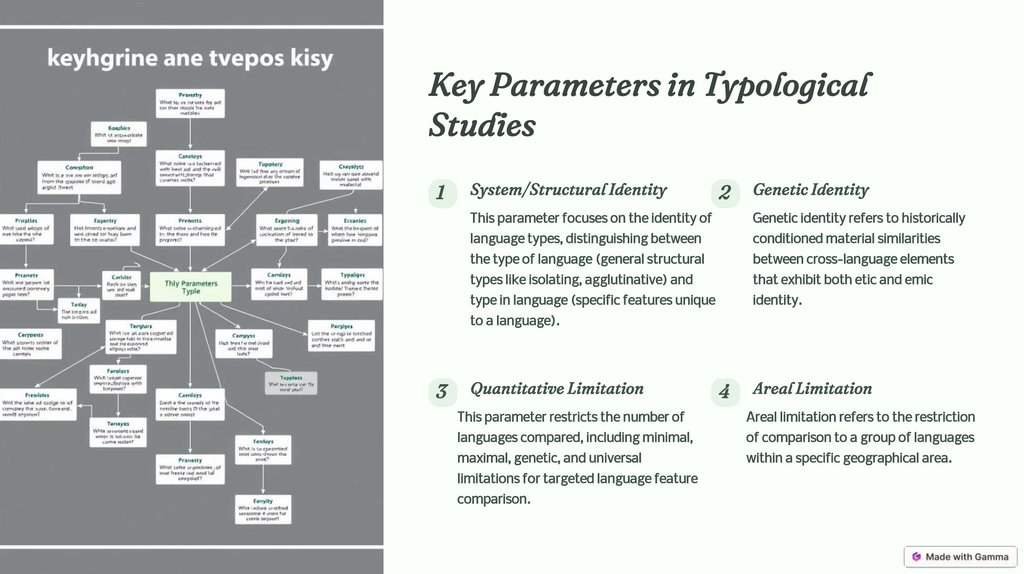
Key Parameters in TypologicalStudies
1
System/Structural Identity
2
Genetic Identity
This parameter focuses on the identity of
Genetic identity refers to historically
language types, distinguishing between
conditioned material similarities
the type of language (general structural
between cross-language elements
types like isolating, agglutinative) and
that exhibit both etic and emic
type in language (specific features unique
identity.
to a language).
3
Quantitative Limitation
4
Areal Limitation
This parameter restricts the number of
Areal limitation refers to the restriction
languages compared, including minimal,
of comparison to a group of languages
maximal, genetic, and universal
within a specific geographical area.
limitations for targeted language feature
comparison.
5.
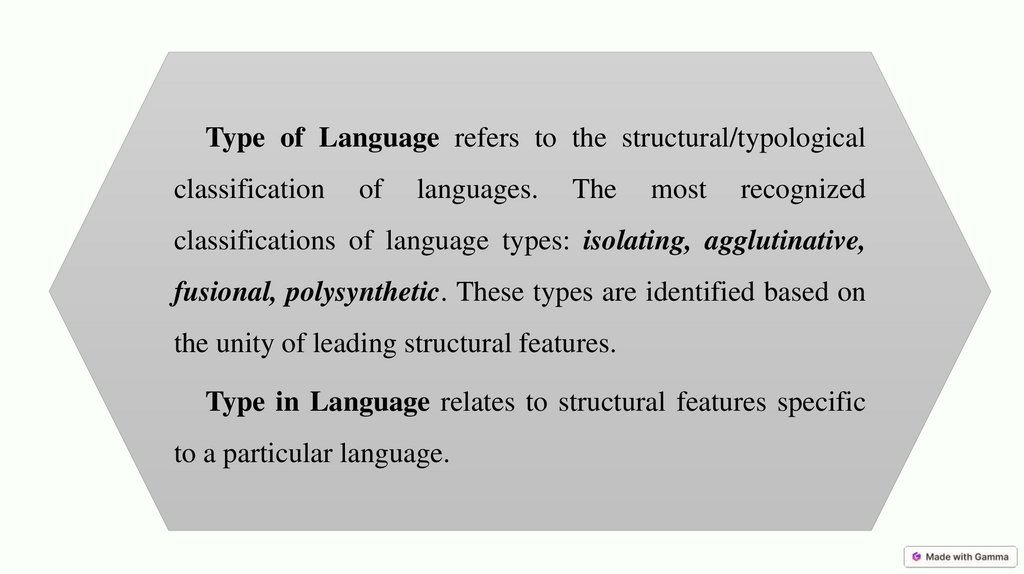
Type of Language refers to the structural/typologicalclassification
of
languages.
The
most
recognized
classifications of language types: isolating, agglutinative,
fusional, polysynthetic. These types are identified based on
the unity of leading structural features.
Type in Language relates to structural features specific
to a particular language.
6.
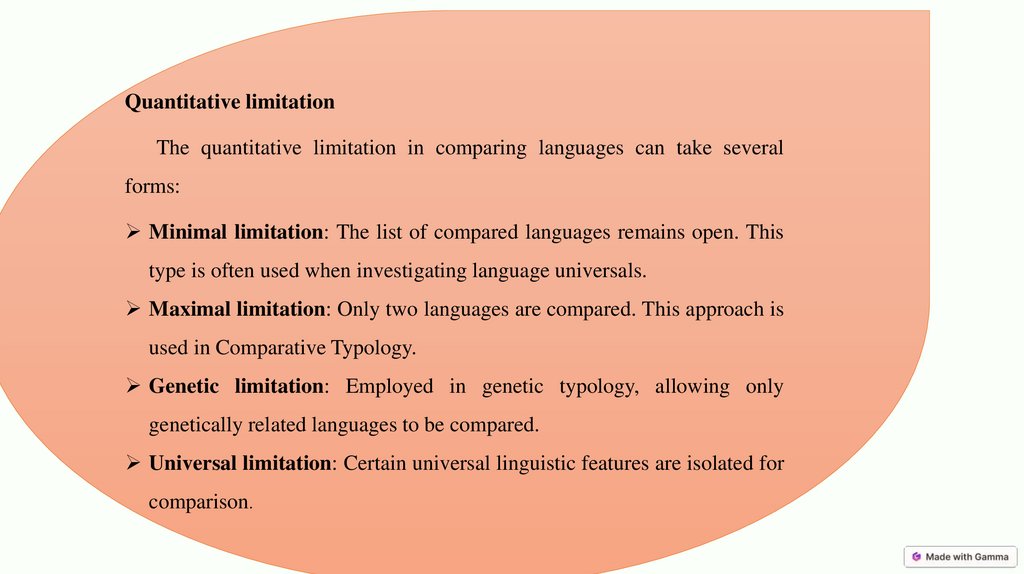
Quantitative limitationThe quantitative limitation in comparing languages can take several
forms:
Minimal limitation: The list of compared languages remains open. This
type is often used when investigating language universals.
Maximal limitation: Only two languages are compared. This approach is
used in Comparative Typology.
Genetic limitation: Employed in genetic typology, allowing only
genetically related languages to be compared.
Universal limitation: Certain universal linguistic features are isolated for
comparison.
7.
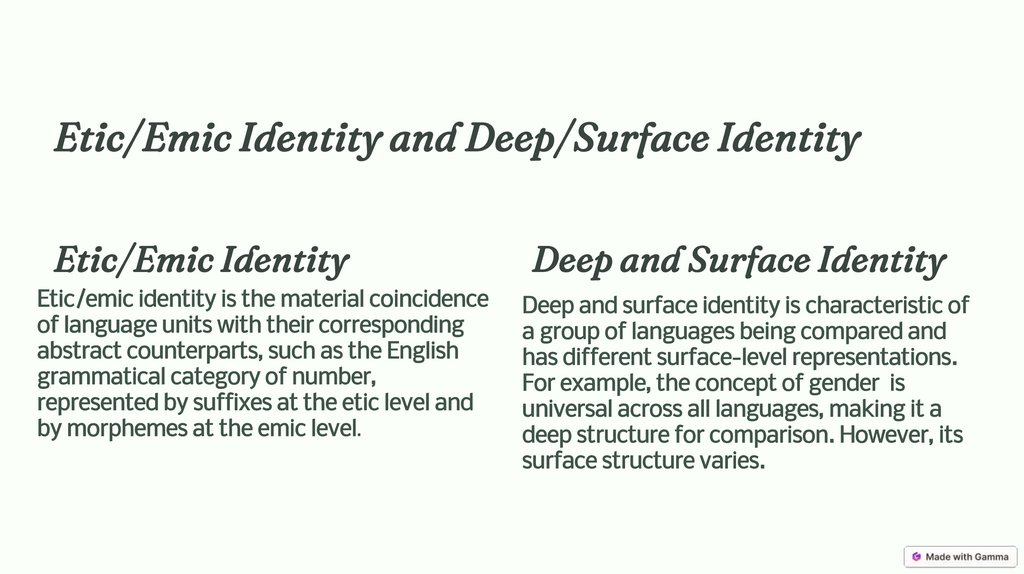
Etic/Emic Identity and Deep/Surface IdentityEtic/Emic Identity
Etic/emic identity is the material coincidence
of language units with their corresponding
abstract counterparts, such as the English
grammatical category of number,
represented by suffixes at the etic level and
by morphemes at the emic level.
Deep and Surface Identity
Deep and surface identity is characteristic of
a group of languages being compared and
has different surface-level representations.
For example, the concept of gender is
universal across all languages, making it a
deep structure for comparison. However, its
surface structure varies.
8.
One-Level and Cross-LevelApproaches to Comparison
One-Level Approach
The term "level isolation" was introduced to linguistics in
the 1 9th century. All language phenomena were studied at
one level of linguistic hierarchy, mainly on phonetic and
morphological levels.
Cross-Level Approach
Cross-level approach to comparison is opposed to
level isolation and was introduced as a method of
linguistic comparison. It presupposes the
investigation of all possible means of expression of a
chosen categorical notion in the system of
compared languages.
9.
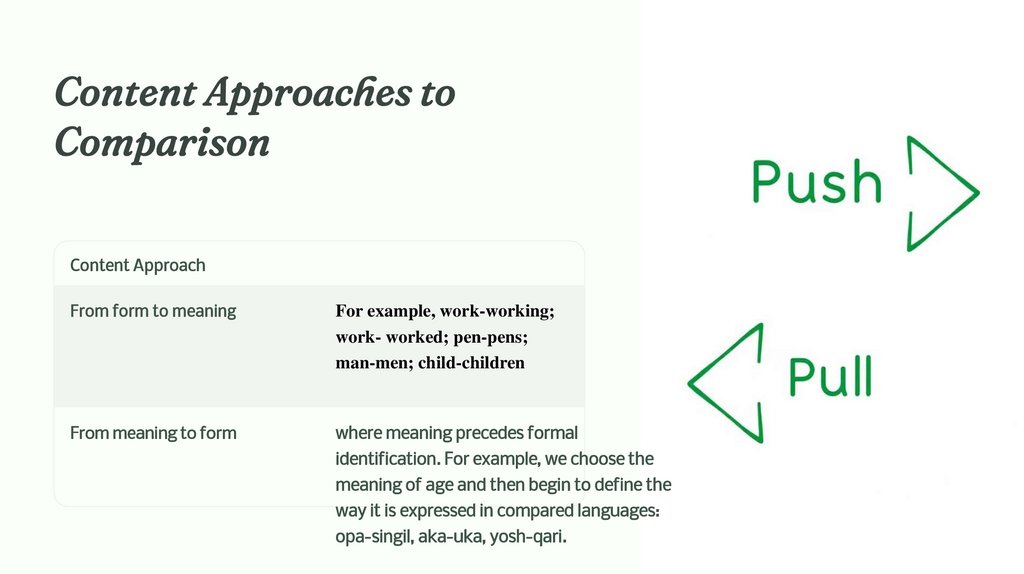
Content Approaches toComparison
Content Approach
From form to meaning
For example, work-working;
work- worked; pen-pens;
man-men; child-children
From meaning to form
where meaning precedes formal
identification. For example, we choose the
meaning of age and then begin to define the
way it is expressed in compared languages:
opa-singil, aka-uka, yosh-qari.
10.
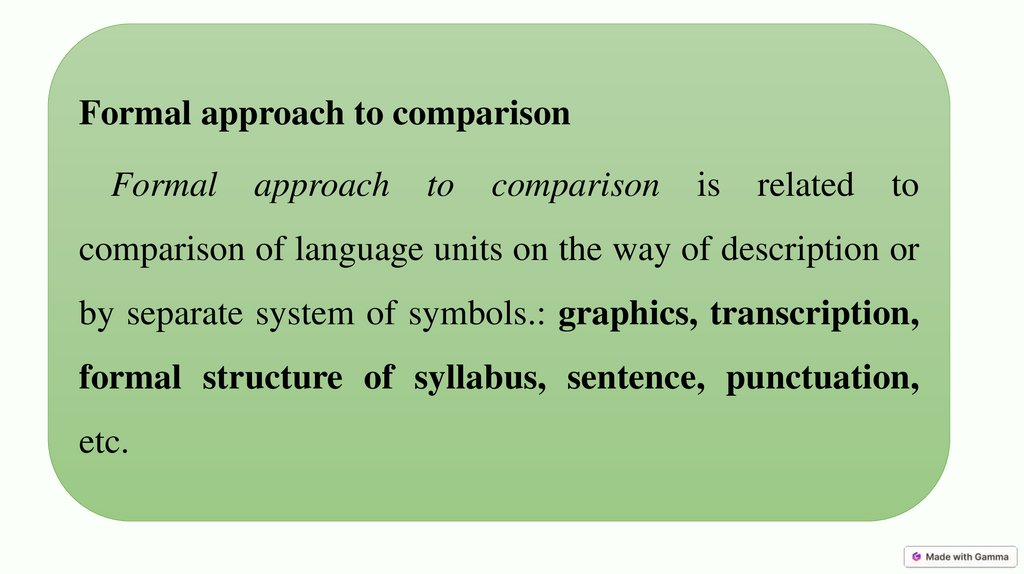
Formal approach to comparisonFormal
approach
to
comparison
is
related
to
comparison of language units on the way of description or
by separate system of symbols.: graphics, transcription,
formal structure of syllabus, sentence, punctuation,
etc.
11.
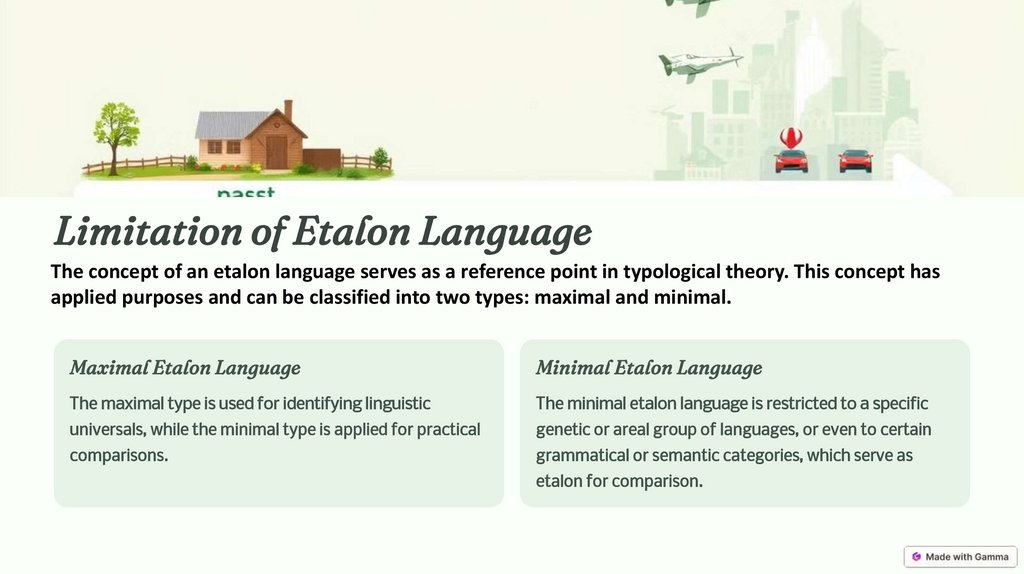
Limitation of Etalon LanguageThe concept of an etalon language serves as a reference point in typological theory. This concept has
applied purposes and can be classified into two types: maximal and minimal.
Maximal Etalon Language
Minimal Etalon Language
The maximal type is used for identifying linguistic
The minimal etalon language is restricted to a specific
universals, while the minimal type is applied for practical
genetic or areal group of languages, or even to certain
comparisons.
grammatical or semantic categories, which serve as
etalon for comparison.
12.
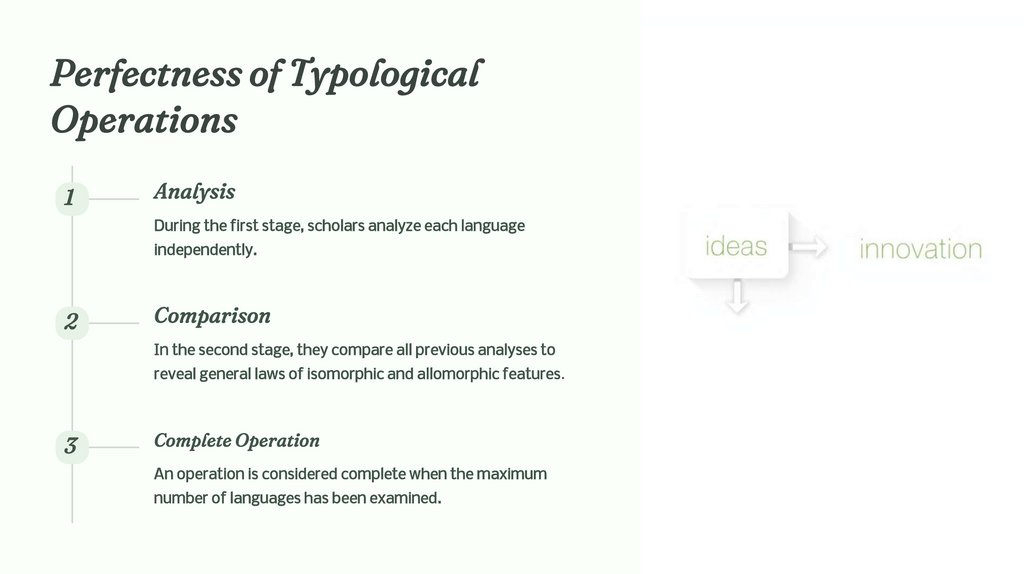
Perfectness of TypologicalOperations
1
Analysis
During the first stage, scholars analyze each language
independently.
2
Comparison
In the second stage, they compare all previous analyses to
reveal general laws of isomorphic and allomorphic features.
3
Complete Operation
An operation is considered complete when the maximum
number of languages has been examined.
13.
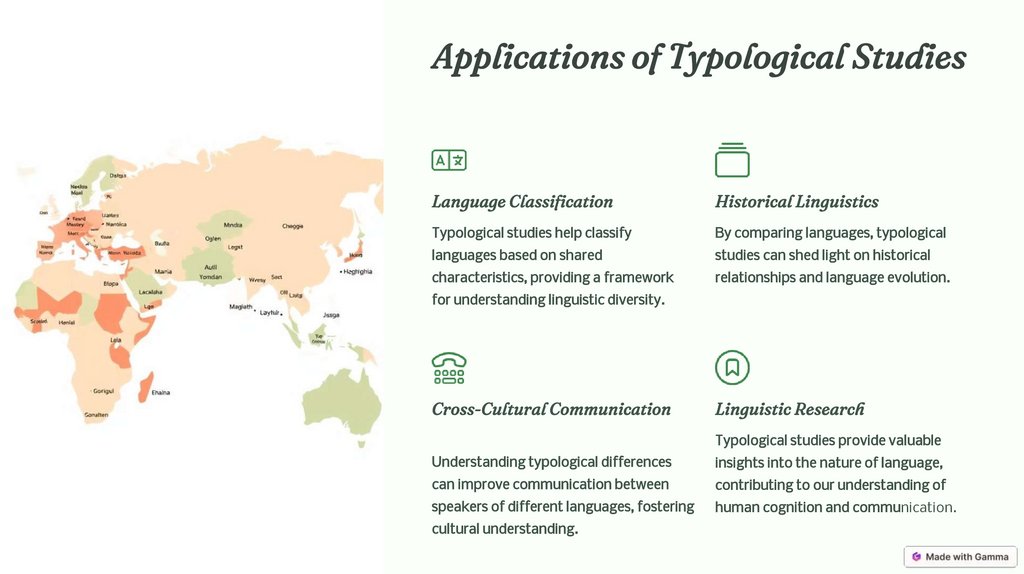
Applications of Typological StudiesLanguage Classification
Historical Linguistics
Typological studies help classify
By comparing languages, typological
languages based on shared
studies can shed light on historical
characteristics, providing a framework
relationships and language evolution.
for understanding linguistic diversity.
Cross-Cultural Communication
Linguistic Research
Typological studies provide valuable
Understanding typological differences
insights into the nature of language,
can improve communication between
contributing to our understanding of
speakers of different languages, fostering
human cognition and communication.
cultural understanding.
14.
Typological Identity: AFramework for
Understanding Language
Diversity
Typological identity in linguistics offers a systematic
approach to understanding the diversity of
languages by categorizing and comparing them
across structural, genetic, and geographical
dimensions. By examining aspects like etic/emic
identity, deep and surface structures, and
typological operations, linguists can uncover
universal principles that transcend individual
languages.
15.
Conclusion: EmbracingLinguistic Diversity
This comparative framework not only aids in
classifying languages based on shared
characteristics but also in recognizing the
uniqueness of each language within its
cultural and social context. Through these
methods, we can observe how languages
evolve, connect, and differ, enhancing our
appreciation of linguistic diversity and the
complex systems of human communication.