






 psychology
Similar presentations:









Teens and their unusual problems
1.
A PROJECT REPORT ONTEENS AND THEIR UNUSUAL PROBLEMS
FOR
ALS PROJECT TERM II
ENGLISH CORE
SESSION 2024-25
Class: XII
BY: Vaishnavi Gauttam
2.
Contents◦ Acknowledgment
◦ Certificate
◦ Objective
◦ Blueprint
◦ A Close Approach
◦ Questionnaire
◦ Research
◦ Report Summary
◦ Research Credits
3.
ACKNOWLEDGMENTThanks to the Almighty who gave me the strength to accomplish the project with
sheer hard work and honesty.
This research venture has been made possible due to the generous co-operation
of various persons.
To list them all is not practicable, even to repay them in words is beyond the
domain of my lexicon. May I observe the protocol to show my deep gratitude to
the venerated Faculty-in-charge Mrs. Renupreet Sethi, for her kind gesture in
allotting me such a wonderful and elucidating research topic.
4.
CERTIFICATEDAV PUBLIC SCHOOL, KOTA
THIS IS CERITIFY THAT THE
BONAFIDE WORK OF THE
STUDENTS OF CLASS XII
5.
OBJECTIVEThe objective of this report is to:
•Identify and Analyze Unusual Problems: To identify the unique and sometimes
less-discussed problems that teenagers face in today’s world, such as social
media pressure, cyberbullying, identity crises, academic stress, substance
abuse, and body image issues.
•Understand Causes and Effects: To explore the underlying causes of these
problems and analyze their effects on teenagers’ mental health, physical wellbeing, and social lives.
•Raise Awareness: To raise awareness among students, educators, and parents
about the challenges faced by teenagers and encourage a deeper
understanding of the complex issues they encounter during adolescence.
6.
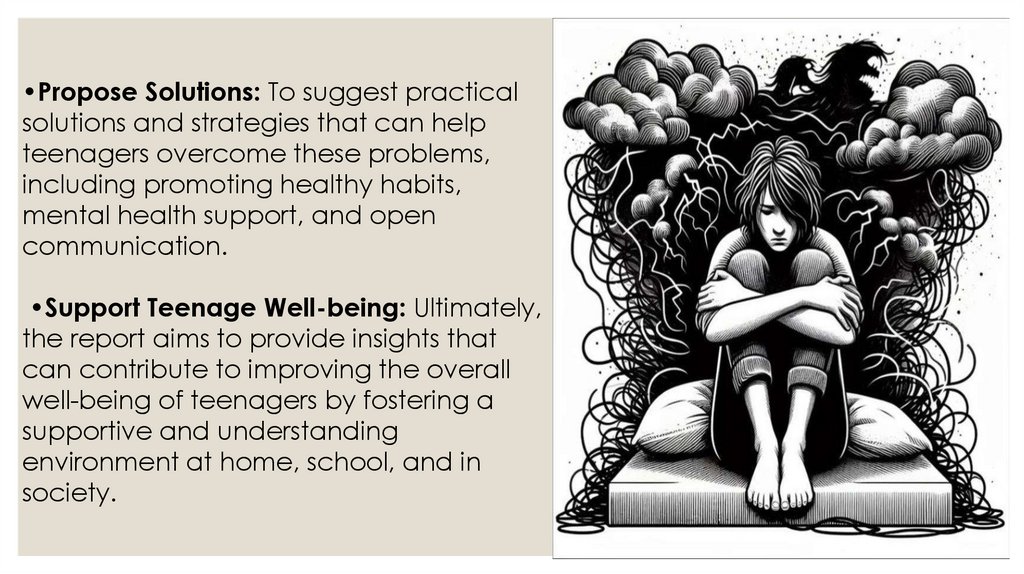
•Propose Solutions: To suggest practicalsolutions and strategies that can help
teenagers overcome these problems,
including promoting healthy habits,
mental health support, and open
communication.
•Support Teenage Well-being: Ultimately,
the report aims to provide insights that
can contribute to improving the overall
well-being of teenagers by fostering a
supportive and understanding
environment at home, school, and in
society.
7.
BlueprintGoal: To reflect ideas about teen struggles of adolescence.
Team Objectives: Conduct surveys and interviews with teens.
•Who? : Kavya Ridhima Riyanshi Tushar Tanmay Shivam Sanidhya Vaishnavi
•What? : We will perform survey and interviews with various teens in order for in depth idea of their
unseen struggles.
•Where? : In the school campus, and family.
•Why? : We think taking interviews covers all the major concerns most teens have and it will be
easier for us to take genuine opinions.
•How? : By interacting with teens of different mentalities.
•Equipments: Camera, Microphone, Smartphone, Recorder.
•Materials: Pen, Pencil, Papers, File.
•Information: Internet.
•Resources: Local People, Friends
8.
A Close ApproachTraditional struggles
•Teenagers today encounter
unique challenges compared
to past generations.
Traditional struggles like:
•Peer pressure
•Self-discovery
•Academic stress
These persist alongside new,
modern issues.
Modern Challenges
Impact of COVID-19
Increased complexity
in life due to:
Pandemic's unique
challenges:
• School closures
• Social isolation
• Uncertainty about
the future
Resulted in:
Anxiety
Difficulty adapting to a
"new normal"
•Social media
influence
•Advancing
technology
•Societal expectations
9.
Why Teens Face Unusual ProblemsTeens face unusual problems due to various factors, including:
◦ 1. Biological Changes:
• Hormonal fluctuations: Puberty's physical and emotional transformations.
• Brain development: Maturation of brain regions, influencing emotions and decision-making.
◦ 2. Social and Environmental Factors:
• Peer pressure: Influence from friends, social media, and cultural norms.
• Family dynamics: Conflicts, expectations, and generational gaps.
• School stress: Academic demands, bullying, and social hierarchies.
• Technological advancements: Social media, online harassment, and digital distractions.
• Socioeconomic conditions: Poverty, inequality, and access to resources.
10.
Why?◦ 3. Psychological Development:
•Identity formation: Exploring self, values, and beliefs.
•Emotional regulation: Learning to manage emotions, impulsivity, and stress.
•Independence seeking: Balancing autonomy and responsibility.
•Self-discovery: Exploring interests, passions, and purpose.
◦ 4. Lack of Support and Resources:
•Inadequate mental health services and stigma.
•Insufficient guidance on relationships, sex, and identity.
•Limited access to education and career opportunities.
•Unsupportive family or community environments.
•Family conflicts, divorce, or separation.
11.
What Are The Challenges Faced By Teens?•Social Media Pressure and Mental Health: Teenagers are heavily influenced by social
media, which often leads to issues like anxiety, depression, and low self-esteem due to
the constant comparison with idealized portrayals of others’ lives. This has been
exacerbated by the “FOMO” (Fear of Missing Out) phenomenon. Difficulties with
friendships and relationships in real life.
•Cyberbullying: Unlike traditional bullying, cyberbullying occurs in digital spaces, making
it more pervasive and sometimes anonymous. This type of bullying can have serious
emotional and psychological impacts on teenagers, including isolation, depression, and
in extreme cases, suicidal thoughts.
12.
What?•Academic Pressure and Overachievement: Many teenagers face immense pressure to
excel academically, often leading to stress, burnout, and a decrease in overall well-being.
The competitive nature of educational systems, combined with high parental expectations,
can further intensify these challenges. Including Difficulty with time management and
organization, Learning disabilities (ADHD, dyslexia, etc.), Career uncertainty and exploration,
Financial constraints and scholarships and Balancing school and extracurricular activities.
•Identity Crisis and Self-Discovery: Adolescence is a period of intense self-exploration, which
can sometimes lead to an identity crisis. Teenagers often face confusion about their sexual
orientation, gender identity, and personal beliefs, leading to emotional distress and a lack of
self-acceptance. Romantic relationship problems.
13.
What?•Substance Abuse and Addiction: Peer pressure, emotional distress, and curiosity can lead teenagers to
experiment with substances like alcohol, drugs, and tobacco. This can result in addiction, health problems, and a
range of social and academic difficulties.
•Unhealthy Body Image and Eating Disorders: The portrayal of unrealistic body standards in media and society
contributes to body dissatisfaction among teenagers, often leading to unhealthy behaviours such as eating
disorders and a negative self-image. These things can also lead to Physical and Health Issues like :
-Sleep deprivation and fatigue.
-Nutrition and exercise concerns.
-Chronic illnesses (diabetes, epilepsy, etc.).
-Mental health stigma and seeking help.
-Sexually transmitted infections (STIs).
-Pregnancy and parenting.
-Self-care and wellness.
-Abusive Behaviour.
14.
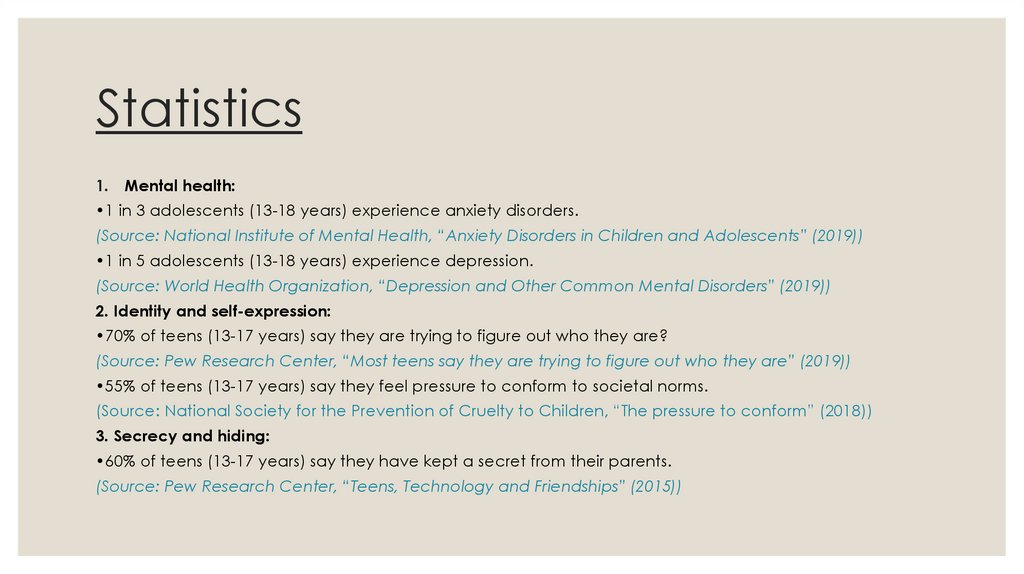
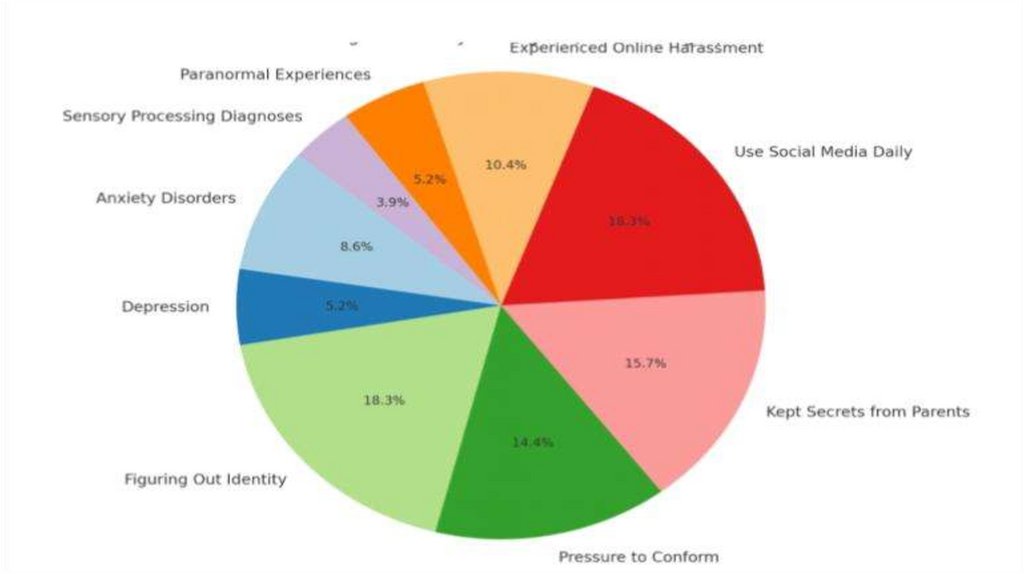
Statistics1. Mental health:
•1 in 3 adolescents (13-18 years) experience anxiety disorders.
(Source: National Institute of Mental Health, “Anxiety Disorders in Children and Adolescents” (2019))
•1 in 5 adolescents (13-18 years) experience depression.
(Source: World Health Organization, “Depression and Other Common Mental Disorders” (2019))
2. Identity and self-expression:
•70% of teens (13-17 years) say they are trying to figure out who they are?
(Source: Pew Research Center, “Most teens say they are trying to figure out who they are” (2019))
•55% of teens (13-17 years) say they feel pressure to conform to societal norms.
(Source: National Society for the Prevention of Cruelty to Children, “The pressure to conform” (2018))
3. Secrecy and hiding:
•60% of teens (13-17 years) say they have kept a secret from their parents.
(Source: Pew Research Center, “Teens, Technology and Friendships” (2015))
15.
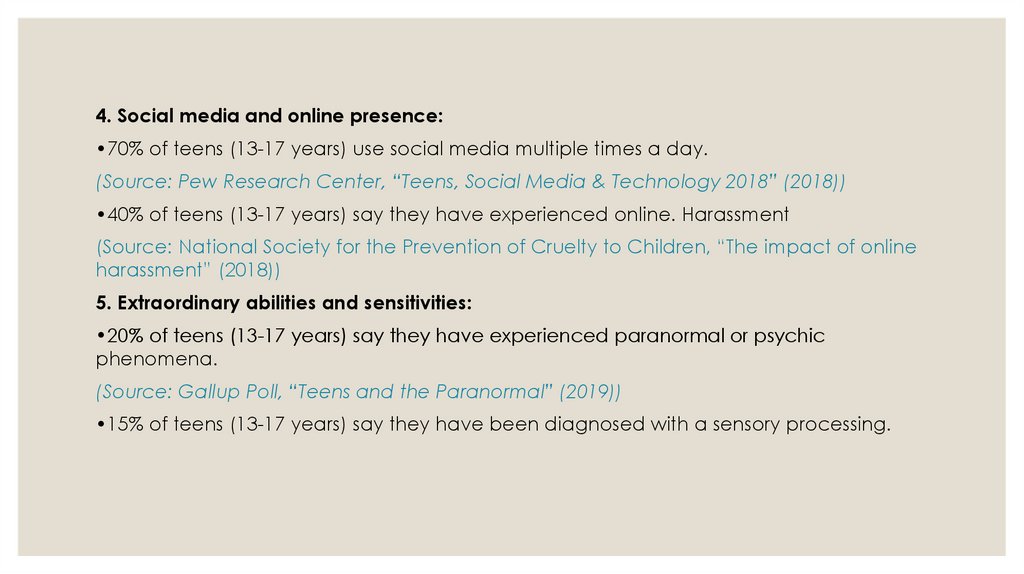
4. Social media and online presence:•70% of teens (13-17 years) use social media multiple times a day.
(Source: Pew Research Center, “Teens, Social Media & Technology 2018” (2018))
•40% of teens (13-17 years) say they have experienced online. Harassment
(Source: National Society for the Prevention of Cruelty to Children, “The impact of online
harassment” (2018))
5. Extraordinary abilities and sensitivities:
•20% of teens (13-17 years) say they have experienced paranormal or psychic
phenomena.
(Source: Gallup Poll, “Teens and the Paranormal” (2019))
•15% of teens (13-17 years) say they have been diagnosed with a sensory processing.
16.
17.
Questionnaire18.
19.
20.
21.
22.
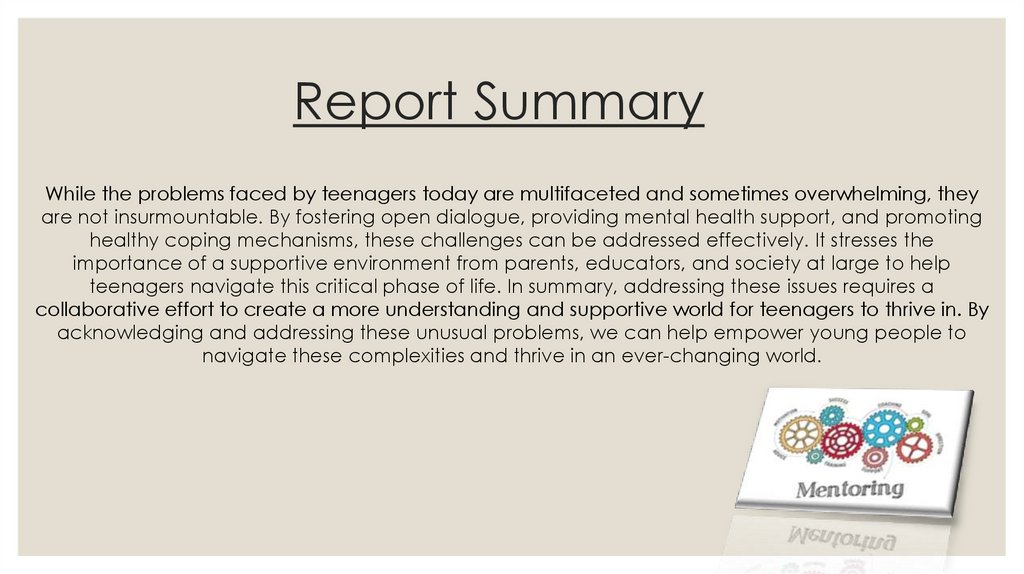
Report SummaryWhile the problems faced by teenagers today are multifaceted and sometimes overwhelming, they
are not insurmountable. By fostering open dialogue, providing mental health support, and promoting
healthy coping mechanisms, these challenges can be addressed effectively. It stresses the
importance of a supportive environment from parents, educators, and society at large to help
teenagers navigate this critical phase of life. In summary, addressing these issues requires a
collaborative effort to create a more understanding and supportive world for teenagers to thrive in. By
acknowledging and addressing these unusual problems, we can help empower young people to
navigate these complexities and thrive in an ever-changing world.
23.
How To Stop?/SolutionsHere are some potential solutions to address the unseen struggles of adolescence:
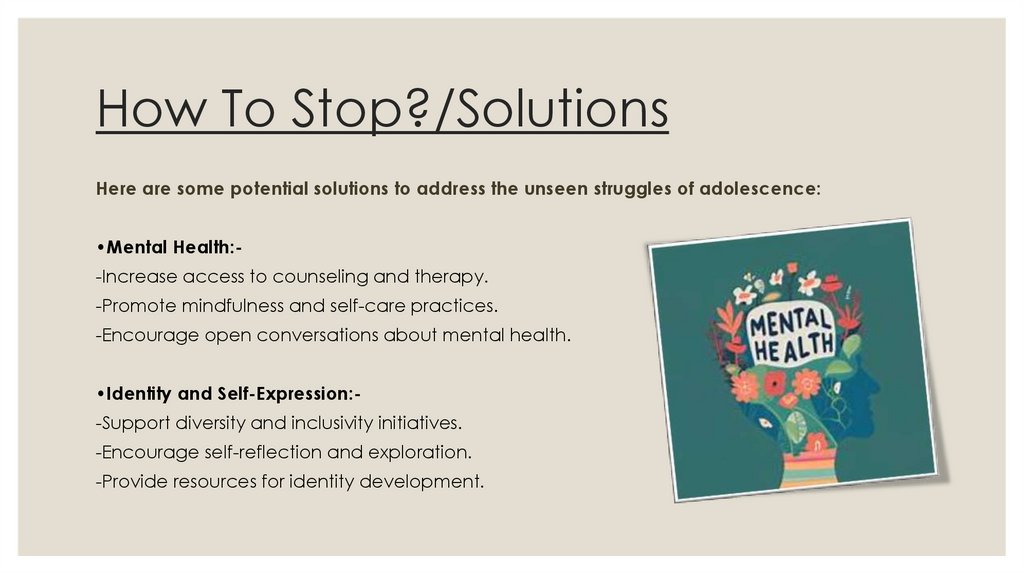
•Mental Health:-Increase access to counseling and therapy.
-Promote mindfulness and self-care practices.
-Encourage open conversations about mental health.
•Identity and Self-Expression:-Support diversity and inclusivity initiatives.
-Encourage self-reflection and exploration.
-Provide resources for identity development.
24.
•Secrecy and Hiding:-Create safe spaces for teens to share secrets and concerns.-Foster trust and open communication with adults.
-Promote empathy and understanding.
•Social Media and Online Presence:-Educate teens about online safety and digital citizenship.
-Encourage responsible social media use.
-Promote offline activities and connections.
•Extraordinary Abilities and Sensitivities:-Provide resources and support for teens with exceptional abilities.
-Encourage self-awareness and self-regulation.
-Foster a culture of acceptance and understanding.
25.
Some additional solutions that can be applied across multiple areas include:-Increasing adult support and mentorship.-Fostering a sense of community and belonging.
-Encouraging self-expression and creativity.
-Promoting media literacy and critical thinking.
-Supporting policy changes that benefit teen well-being.
“Every individual is unique, and solutions should be
tailored to meet their specific needs and
circumstances.”
26.
Research Credits“You are stronger than you seem, braver than you believe, and smarter than you think.
But it’s okay to not be okay, and it’s okay to ask for help. Mental health is just as
important as physical health. Let’s break the stigma and support each other. You don’t
have to struggle in silence. Reach out, speak up, and know that you are loved and
supported. It’s okay to take a break, prioritize yourself, and focus on your mental
wellbeing. You are worth it. Remember, mental health is a journey, not a destination. Be
patient, kind, and compassionate with yourself and others.”
Credit goes to the following personalities:
And a big thank you to my group mates for taking
such interviews and creating awareness amongst
others on such an underrated issue.