 english
Similar presentations:





What is a Valve?
1.
2.
What is a Valve?When it comes to controlling the flow of liquids or
gases in various industries, valves play a crucial role. A
valve is a mechanical device designed to regulate,
direct, or control the flow of fluids (liquids, gases, or
even slurries) by opening, closing, or partially
obstructing passages. Valves are essential components
in a wide range of applications, ensuring efficient and
precise management of fluid movement.
3.
What is the Function of a Valve?The primary function of a valve is to control the flow
of fluids within a system. This control can be achieved
by varying the valve's position to allow, restrict, or halt
the flow, depending on the requirements of the
specific application. Valves are used to start and stop
the flow, regulate the rate of flow, control the direction
of flow, and even mix fluids in some cases. The proper
selection and use of valves are vital for optimizing the
performance and efficiency of many industrial
processes.
4.
Types of Valves and TheirFunctions: Five Common Types
Ball Valves: Ball valves feature a spherical closure element with a hole through its center.
When the hole is aligned with the pipe, fluid can flow through, and when the valve is
closed, the hole is perpendicular to the flow, blocking it entirely. These valves are
commonly used for shutoff applications, providing tight sealing.
Gate Valves: Gate valves are designed to open and close fully, with a flat gate that lifts out
of the flow path when open and seals the path when closed. They are ideal for on/off
service and are often used in applications where a straight-line flow of fluid and minimal
pressure drop are essential.
Butterfly Valves: Butterfly valves use a disc as the closing mechanism. The disc is
positioned in the center of the pipe and can be rotated to control flow. Butterfly valves
are versatile, cost-effective, and offer quick operation, making them suitable for largescale applications.
Globe Valves: Globe valves provide precise control of flow, making them suitable for
applications where throttling and regulation are necessary. They have a disc that moves
up and down perpendicular to the flow, allowing for fine-tuned adjustments.
Check Valves: Check valves, also known as non-return valves, are designed to prevent
backflow in a pipeline. These valves automatically close when the flow reverses, ensuring
that the fluid can only move in one direction.
5.
Advantages and Disadvantages ofValves
Each type of valve has its advantages and
disadvantages based on the specific application. For
example, ball valves provide tight shutoff capabilities,
but they might not be suitable for throttling. Gate
valves have low pressure drops but may take longer to
operate compared to other types. Butterfly valves are
quick to operate but might not be ideal for
applications requiring precise regulation.
6.
What is Compressor?A compressor is a device used to compress air or other
gases to pressures higher than atmosphere pressure. It
compresses the air taken from the atmosphere and
increases its pressure. Compressors are used in many
different industries such as the automotive, chemical
and petrochemical, textile, food, energy, healthcare
and glass.
7.
Types and Specifications of theCompressor
Compressor types are divided into two in regard to the method to be
used: Positive displacement compressors and turbo compressors. Positive
displacement compressors are based on the principle of increasing the pressure
by compressing the air in a certain volume. This type of compressors are
divided into types according to their piston, cylinder, rotor and body shapes or
numbers. And, the others work on the principle of increasing the speed of the
air with the help of turbines and then obtaining pressure by reducing its speed.
Compressor types are divided into 6 separate groups according to their working
principle.
Piston compressors
Screw compressors
Centrifugal compressors
Axial flow compressors
Rotary positive displacement compressors
Jet compressors
8.
Piston CompressorsCompressed air in piston compressors is obtained as a
result of the piston’s compressing the air or gas with its
forward-backward movement. Compression process
takes place between the piston and the cylinder, the
intake and the discharge valves.
9.
Screw CompressorsThe compression movement of screw compressors
takes place in the screw block formed by the coupling
of two rotors placed in a body. Air is taken from the
suction port to the compression chamber. The tooth
spaces of the rotors are filled with air. The rotors
rotating in the reverse direction close the suction
opening for the sucked air and create a compression
area between the body and the rotor tooth spaces.
With the reverse rotation of the rotors, the air moves
in the direction of the tooth gaps in the gradually
decreasing volume. Compressed air is expelled from
the screw block outlet.
10.
Centrifugal CompressorsAccording to the working principle of the centrifugal
compressors, the air is taken into the annular chamber
centrally and the air accelerates under the centrifugal
force as a result of the rotational motion inside the
circular centre. But, when it reaches to the outer side,
it slows down. A decrease in speed also provides an
increase in pressure. The air is taken into the
collection ring and is expelled.
11.
Axial Flow CompressorsEIn the operating system of axial flow compressors, the air puts into
operation parallel to the rotational axis and proceeds helically. Thus,
the pressure increases continuously. The working principle of such a
compressor is suitable for the reverse of the turbine.
Parts of the axial flow compressors:
The part that has the impeller or turbine blades and generates the
inner wall of the compressor
The bearing part that forms the outlet section and supports the
rotating sections
The part that is at a standstill and generates the outer walls of the
compressor. It is produced by the compressor firms in the shape of a
half-round. There are ducts inside that are helical and compatible with
the impeller parts.
During production, the entering air is accelerated and then this speed
is reduced. Thus, the pressure rises.
12.
Rotary Positive DisplacementCompressors
The working principle of the rotary positive
displacement compressors is as follows; the air is
converted into small successive volumes by the
external central pumps. As the volume decreases, it is
ensured that the pressure increases. The rotating part
of the engine draws the fluid from its inlet, rotates the
fluid circularly around it and transfers it to the high
pressure part at its outlet
13.
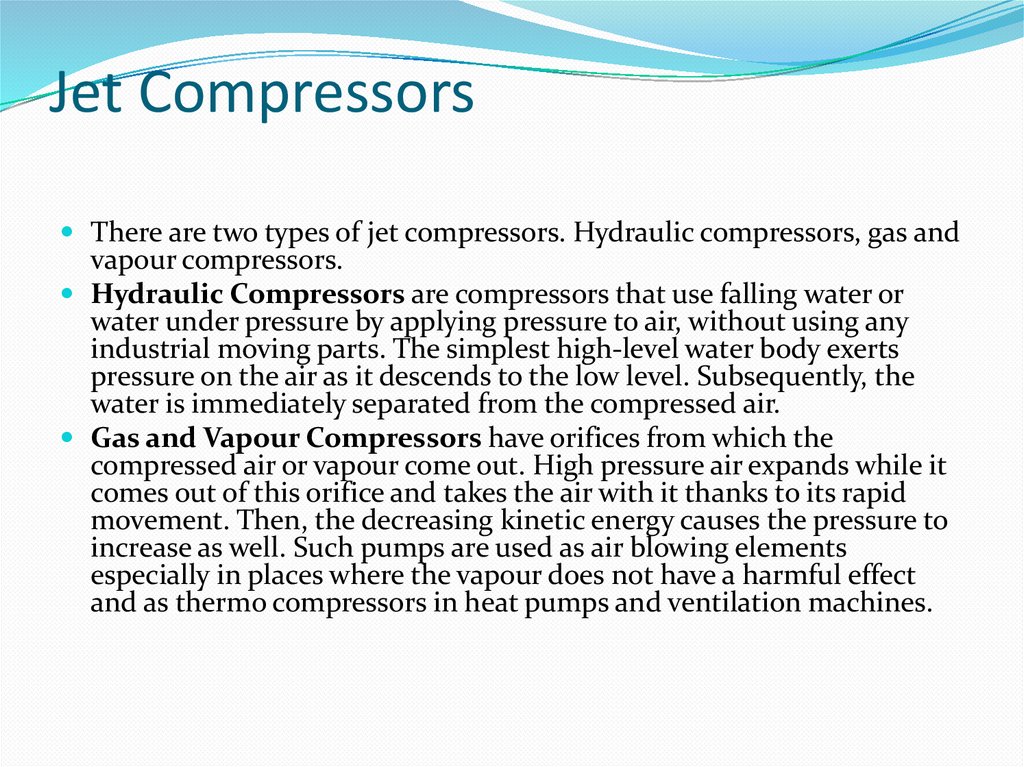
Jet CompressorsThere are two types of jet compressors. Hydraulic compressors, gas and
vapour compressors.
Hydraulic Compressors are compressors that use falling water or
water under pressure by applying pressure to air, without using any
industrial moving parts. The simplest high-level water body exerts
pressure on the air as it descends to the low level. Subsequently, the
water is immediately separated from the compressed air.
Gas and Vapour Compressors have orifices from which the
compressed air or vapour come out. High pressure air expands while it
comes out of this orifice and takes the air with it thanks to its rapid
movement. Then, the decreasing kinetic energy causes the pressure to
increase as well. Such pumps are used as air blowing elements
especially in places where the vapour does not have a harmful effect
and as thermo compressors in heat pumps and ventilation machines.