
 life safety
Similar presentations:









Training safety
1. Folie 1
Training: The rules of safetyby Ronald Eschmann, Service Center Hamburg
- General safety rules
- Safety markings and their meaning
- Correct usage / intended use
- Non-compliance with the intended use
- Basic operating principles
- Operations on the separator
- Demands on the operating and maintenance personnel
- Spare part requirements
- Assembly
- Electrical installation
- Before start-up
- Starting
- Shut-down and “Emergency-Off”
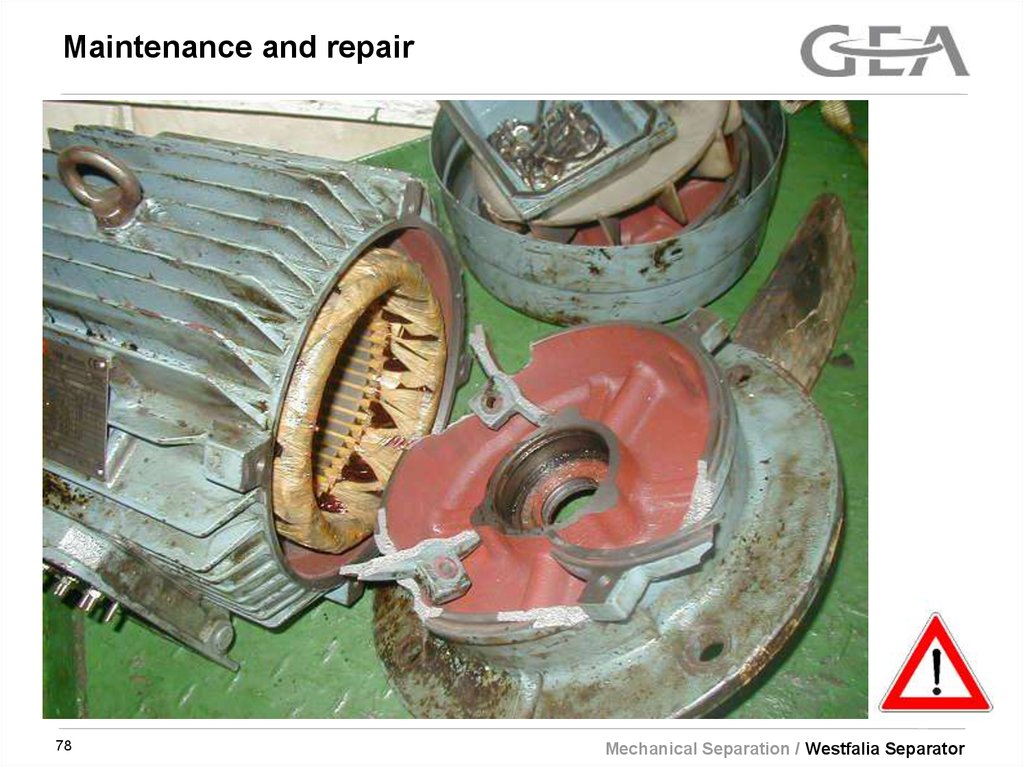
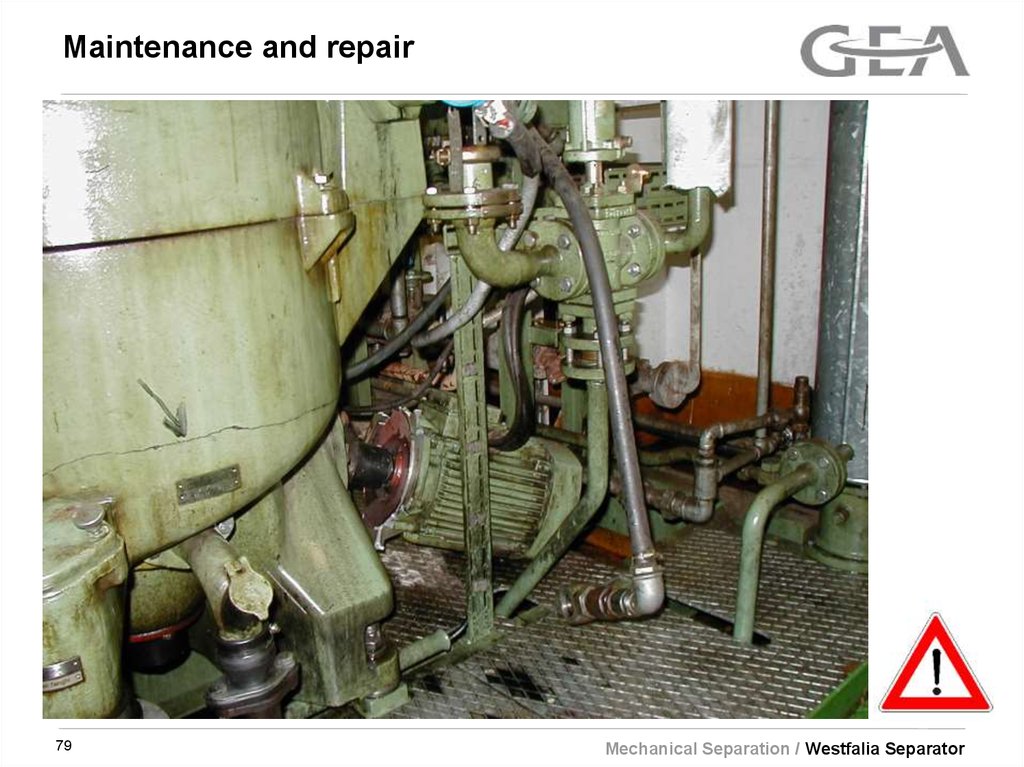
- Maintenance and repair
- Corrosion, Erosion
- The health hazards involved when handling HFO and LO
- Code of practice and personal protective measures
- Cleaning
Rules of safety
1
Mechanical Separation / Westfalia Separator
2. Safety rules
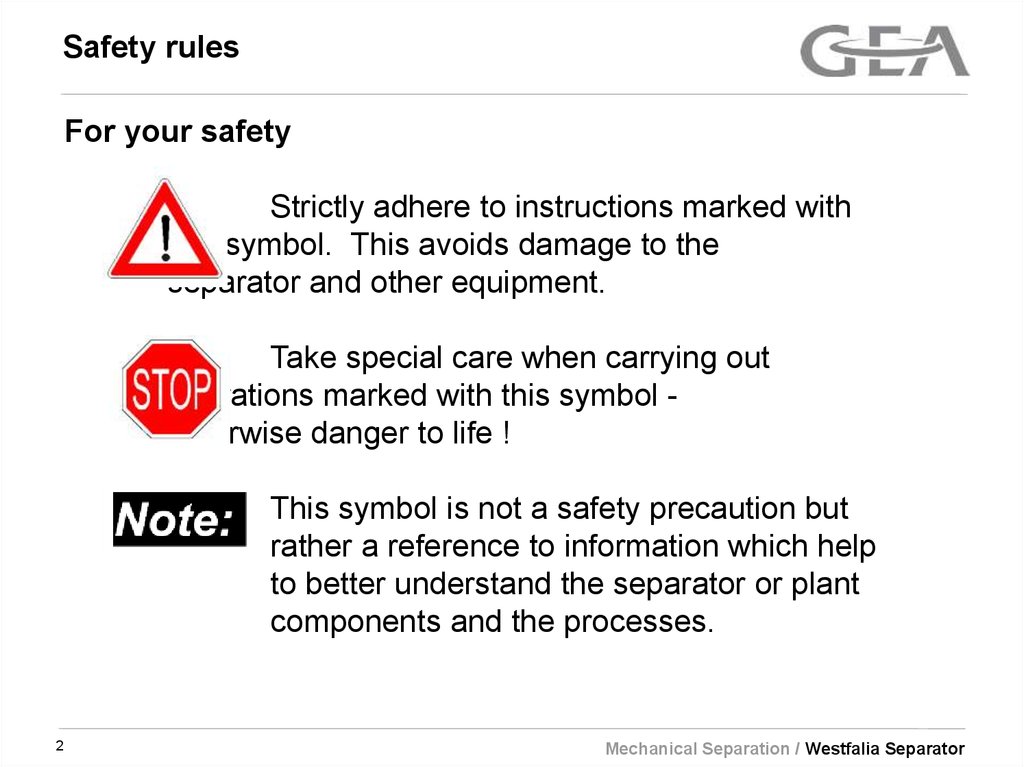
For your safetyStrictly adhere to instructions marked with
this symbol. This avoids damage to the
separator and other equipment.
Take special care when carrying out
operations marked with this symbol otherwise danger to life !
This symbol is not a safety precaution but
rather a reference to information which help
to better understand the separator or plant
components and the processes.
2
Mechanical Separation / Westfalia Separator
3. Safety rules
Observe the accident prevention regulations !The local safety and accident prevention regulations apply
unconditionally to the operation of the separator. The plant
operator must ensure compliance with these regulations.
When operating electrical apparatus, certain parts carry
dangerous voltage. Before working in electrical components,
take adequate preventive measures according to the national
provisions (in Germany in accordance with the rules and
regulations of the VDE (Verein Deutscher Elektrotechnik /
Association of German Electrical Engineering) or of the local
electric power company. Non-compliance with the protective
measures can result in serious damage to persons or property.
Any work on electrical components may only be carried out by an
authorized electrician.
3
Mechanical Separation / Westfalia Separator
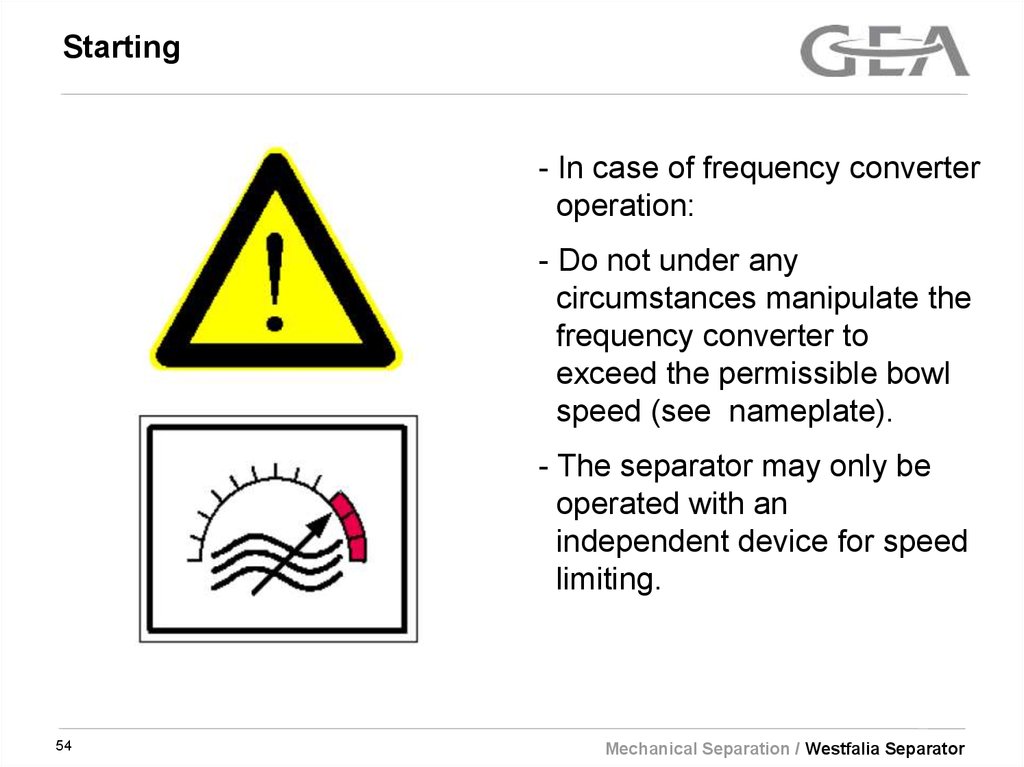
4. Safety rules
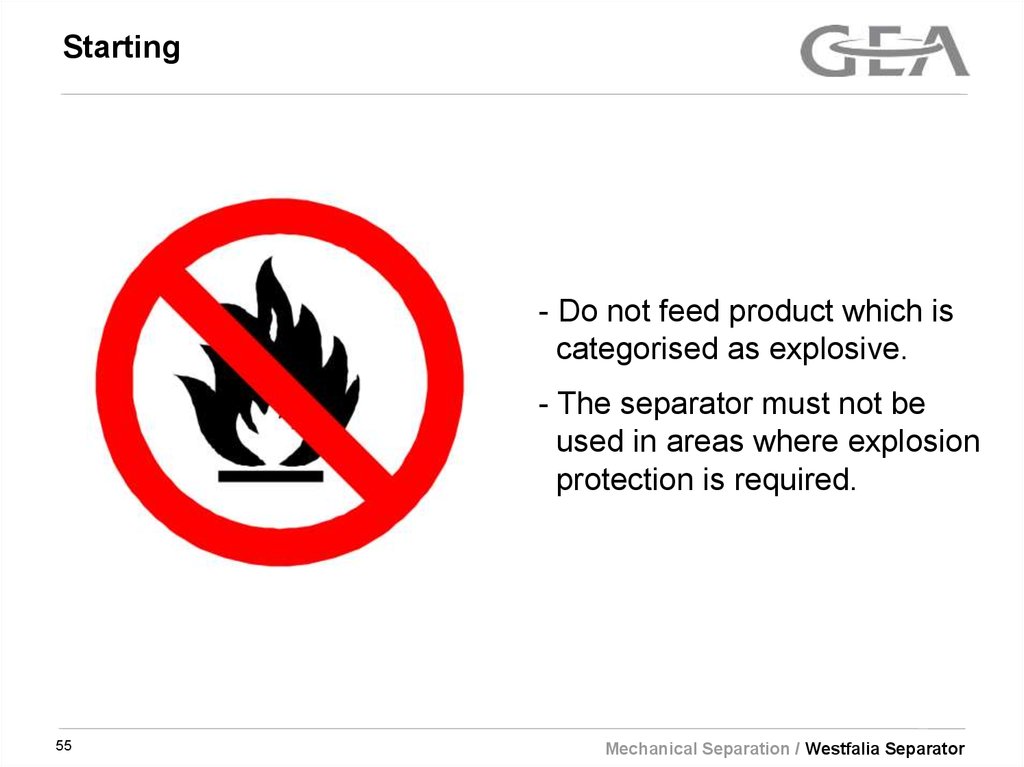
Only qualified or authorized specialized staff may operate,maintain and repair the separator. Corresponding training
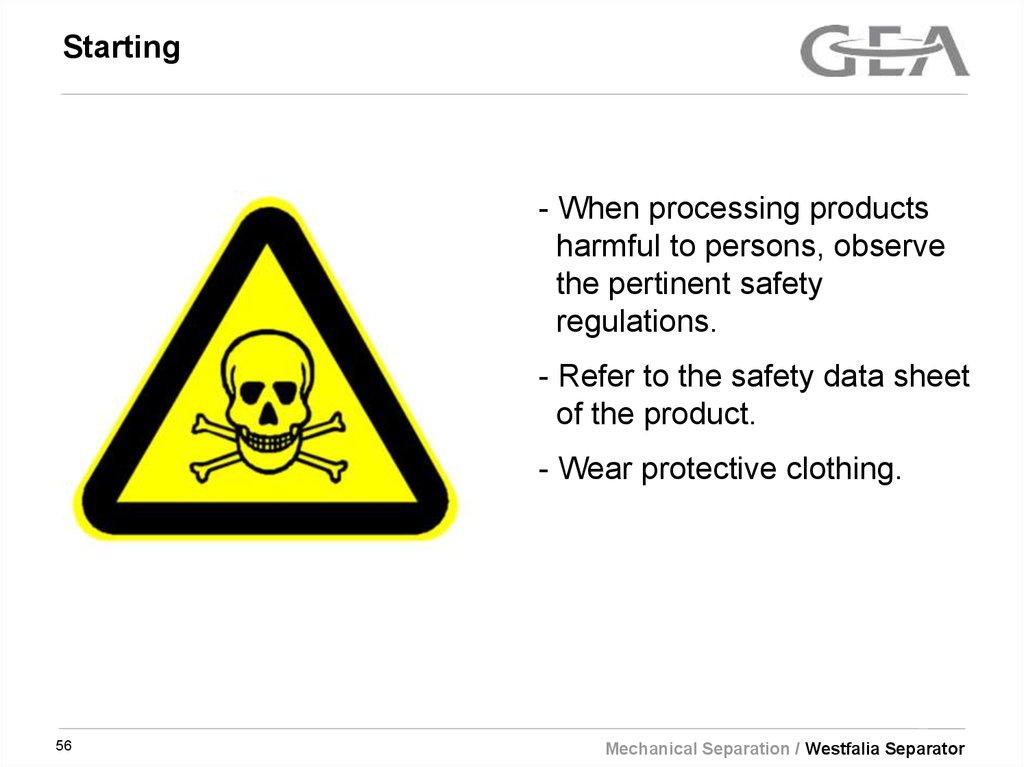
courses take place in the manufacturer’s plant or are held on
site by the manufacturer.
Follow the instructions in the manual. Follow only the
instructions given in the manual. Repair and maintenance work
that goes beyond the scope described in this manual may not
be carried out.
Operate the separator only in accordance with agreed
process and operating parameters.
Maintain the separator as specified in the manual.
Carry out safety checks on the separator.
4
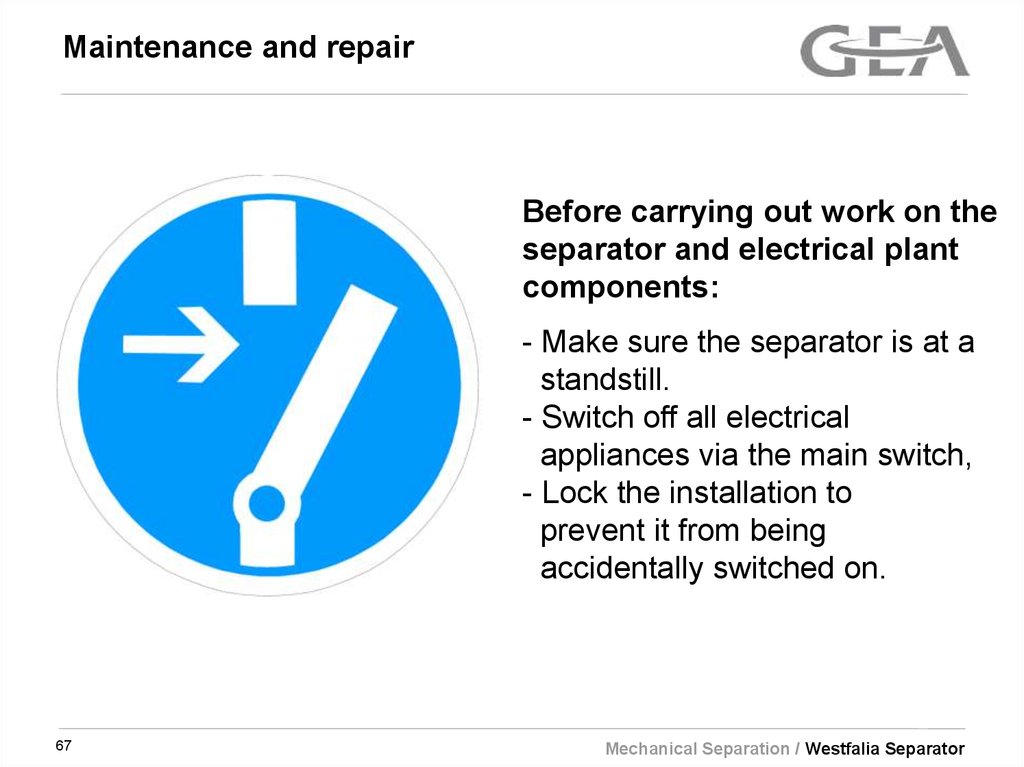
Mechanical Separation / Westfalia Separator
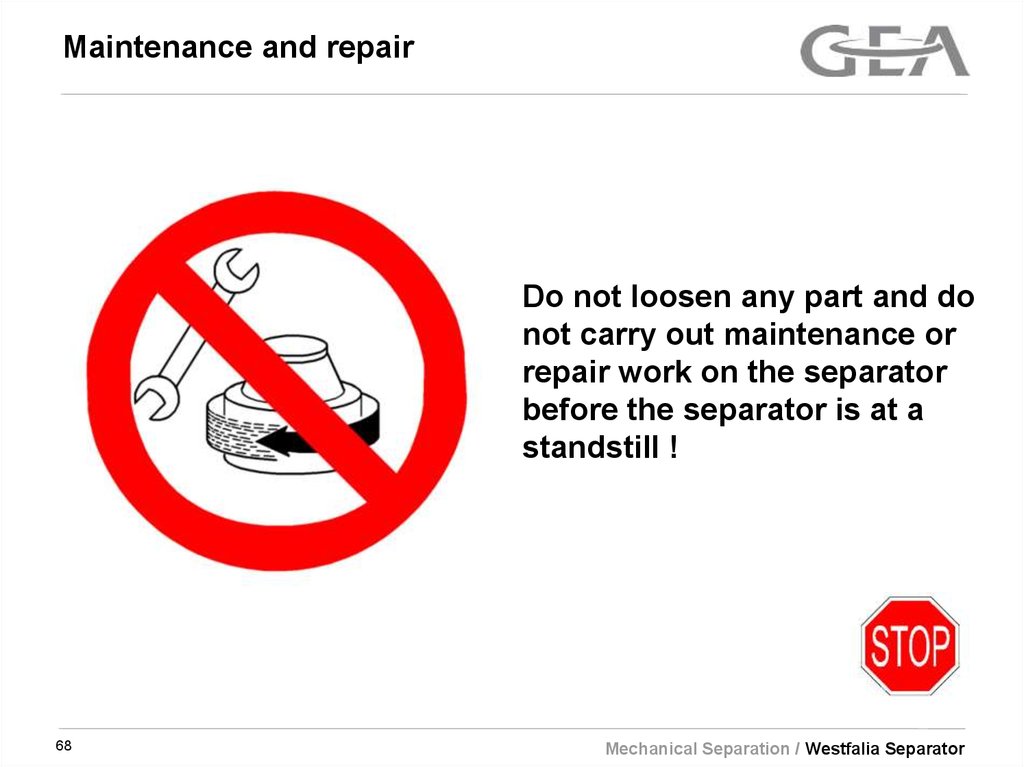
5. Safety markings
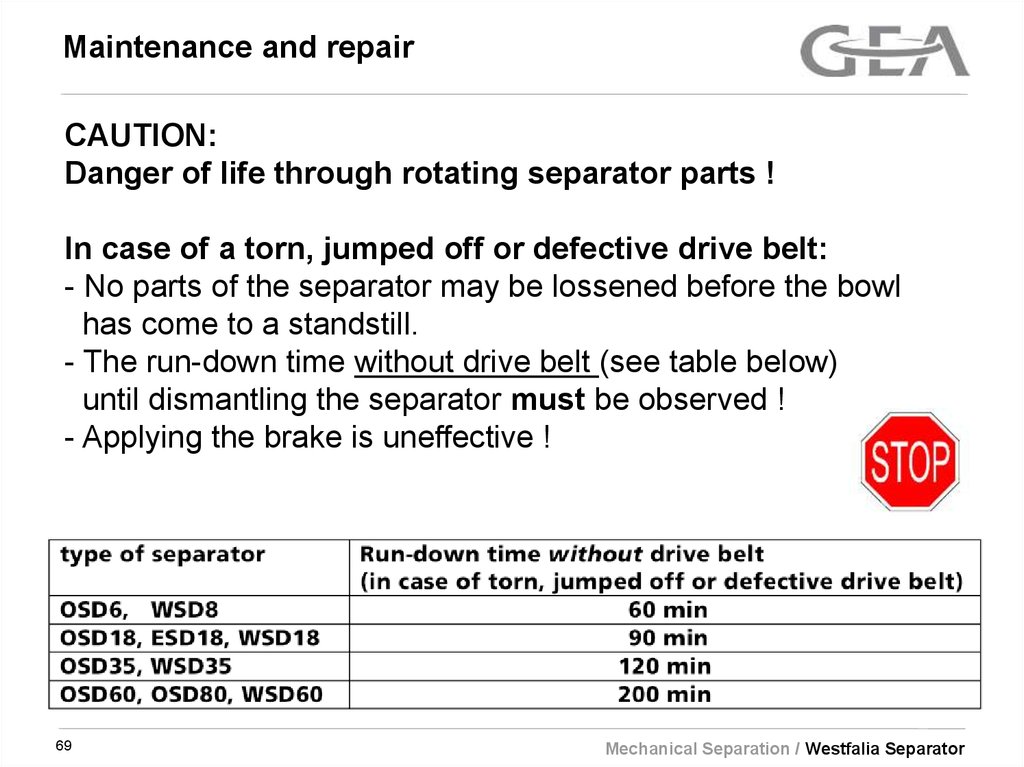
The safety markings (adhesive and metal plates) are attached toall separators on the hood and frame of the respective separator
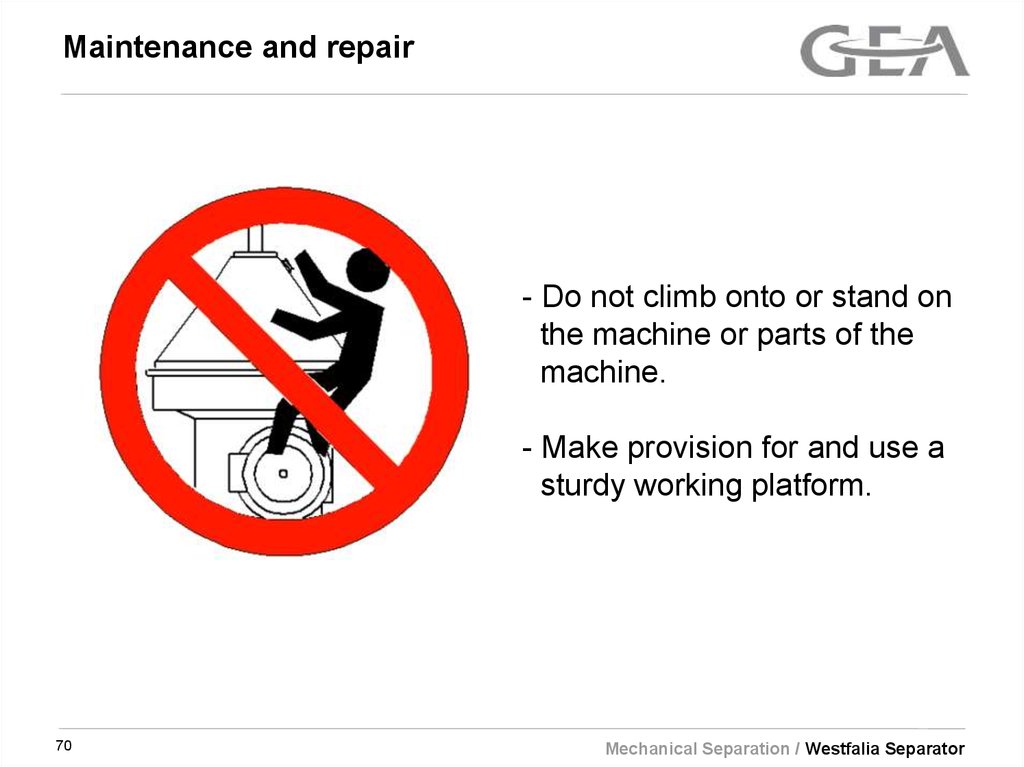
in such a way that they are clearly visible. All safety markings on
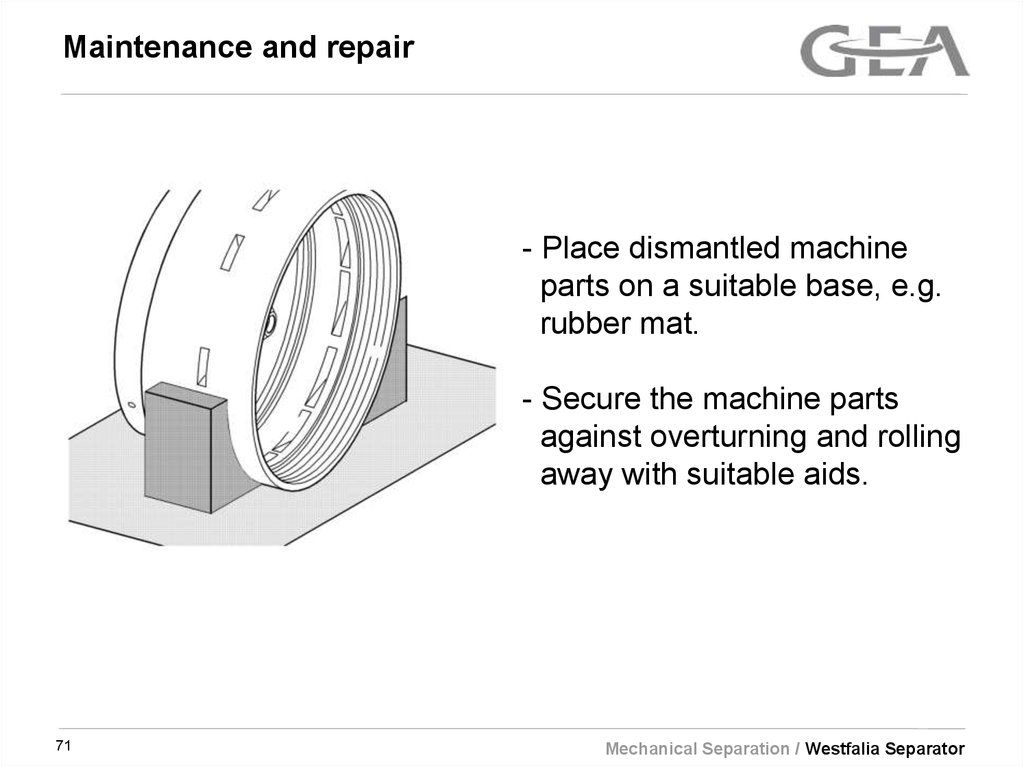
the separator, control system and plant components must
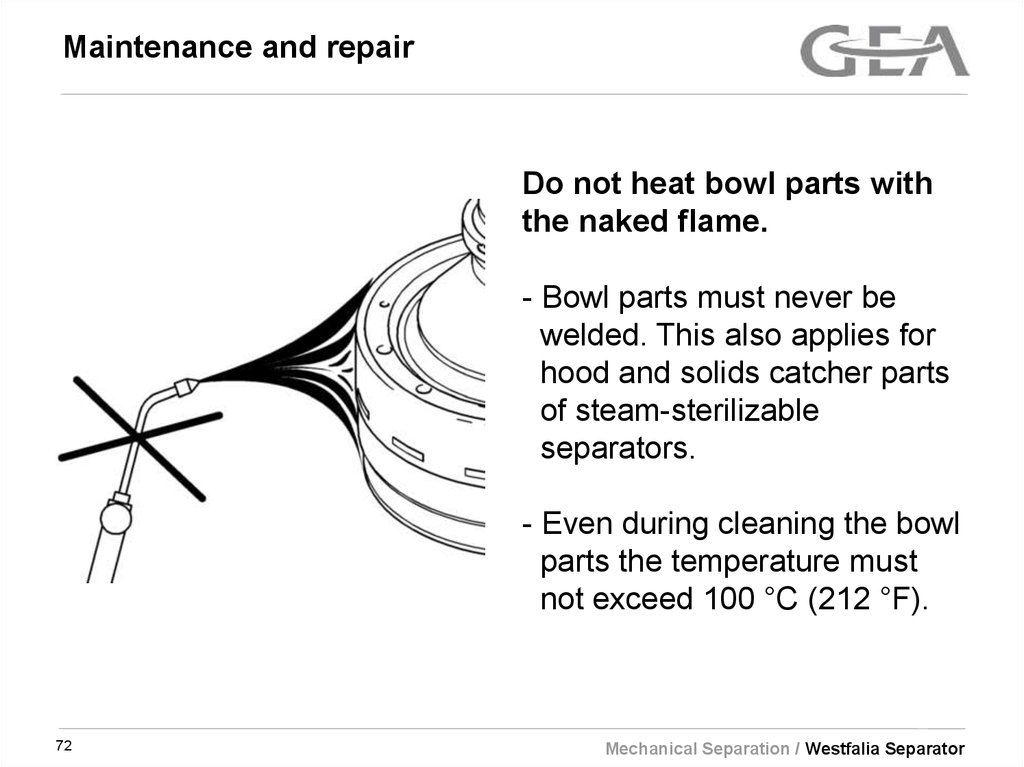
always be in perfect condition.
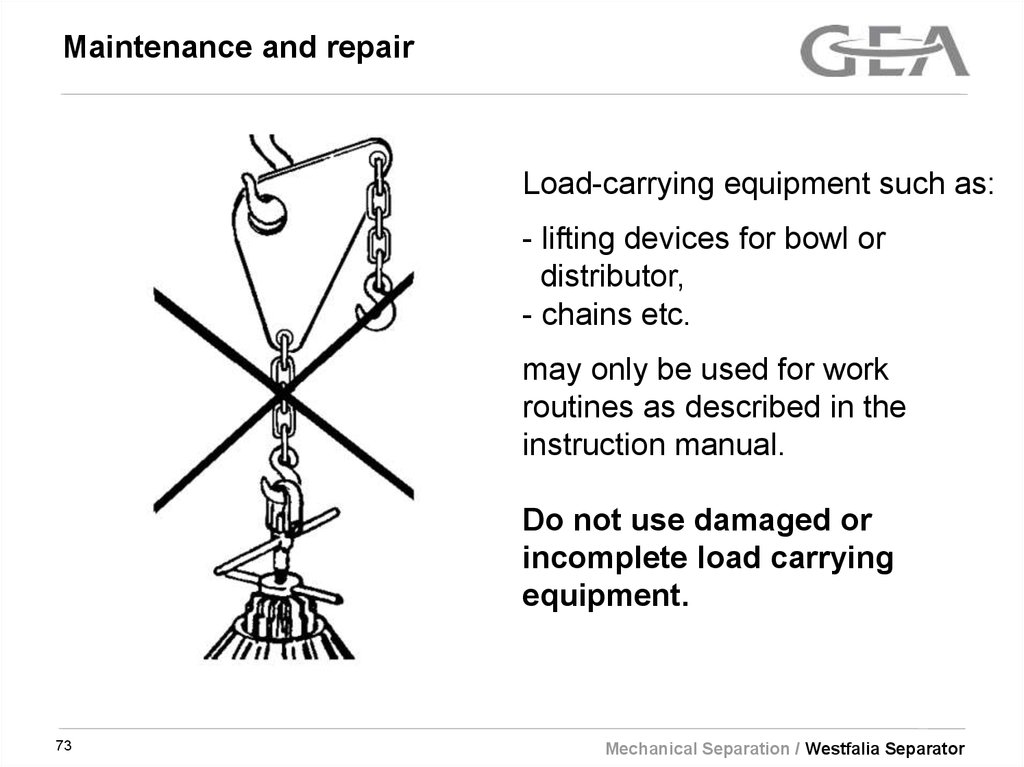
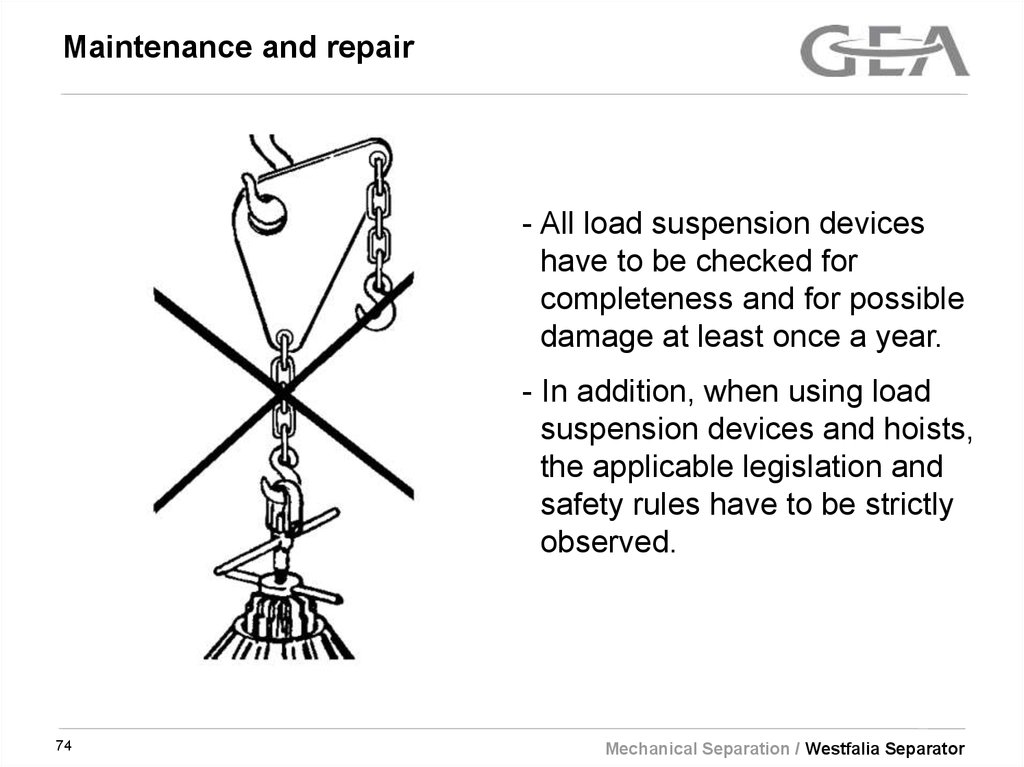
- Clean dirty safety markings.
- Replace damaged safety markings.
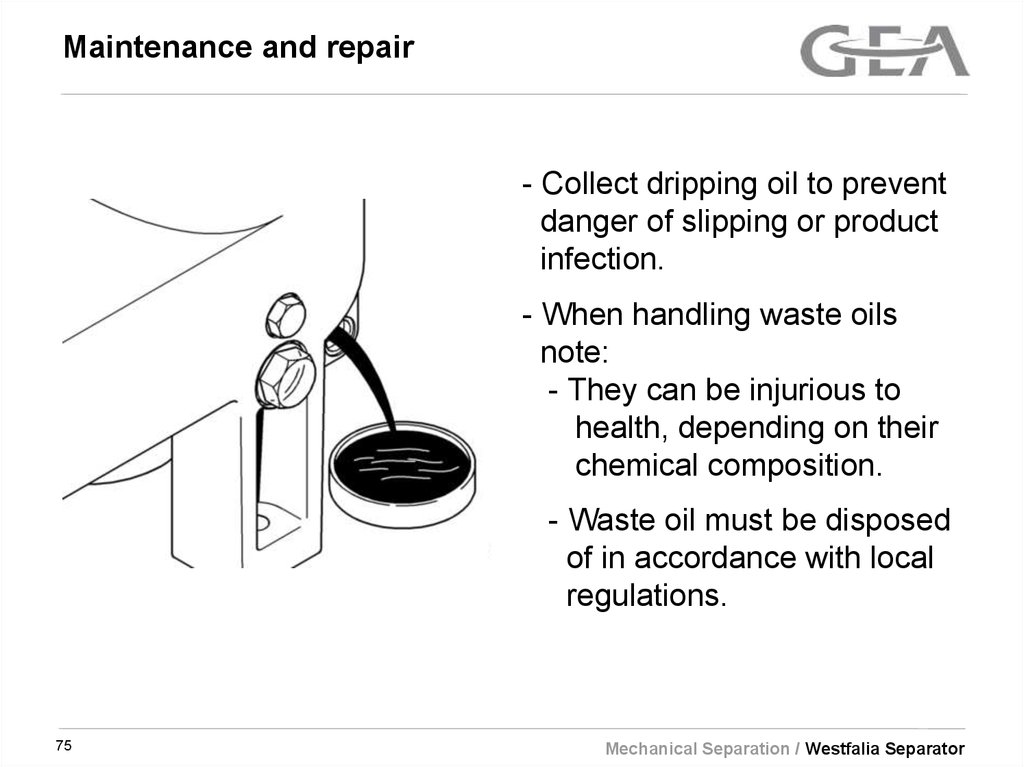
5
Mechanical Separation / Westfalia Separator
6. Safety markings
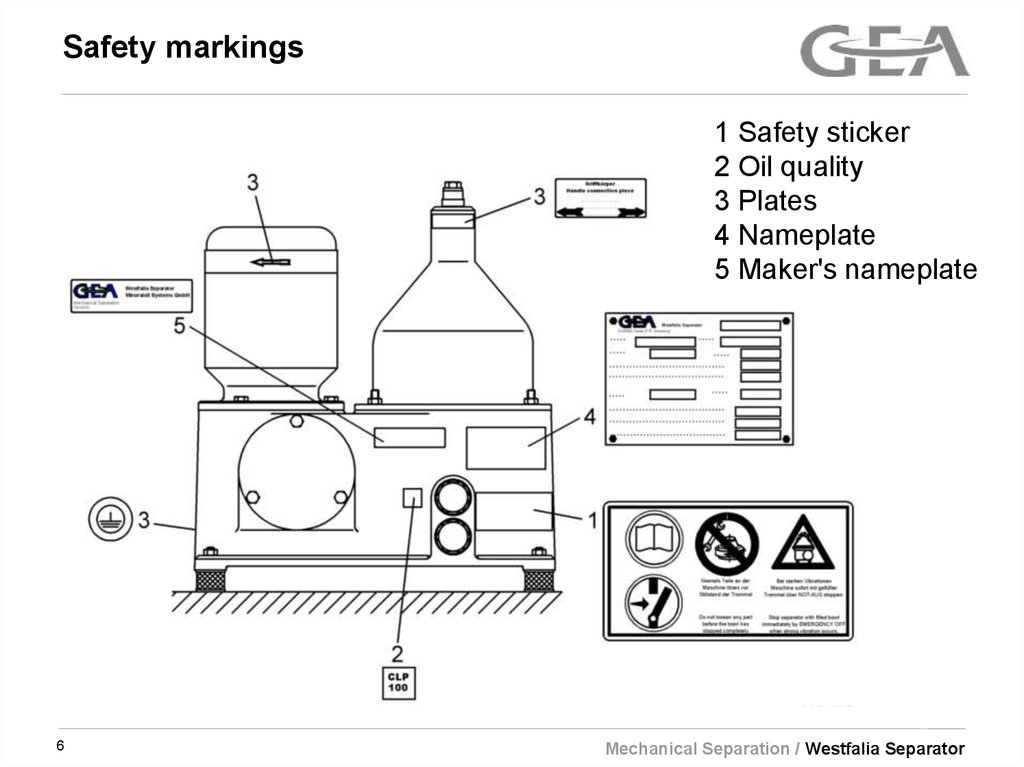
1 Safety sticker2 Oil quality
3 Plates
4 Nameplate
5 Maker's nameplate
6
Mechanical Separation / Westfalia Separator
7. Safety markings
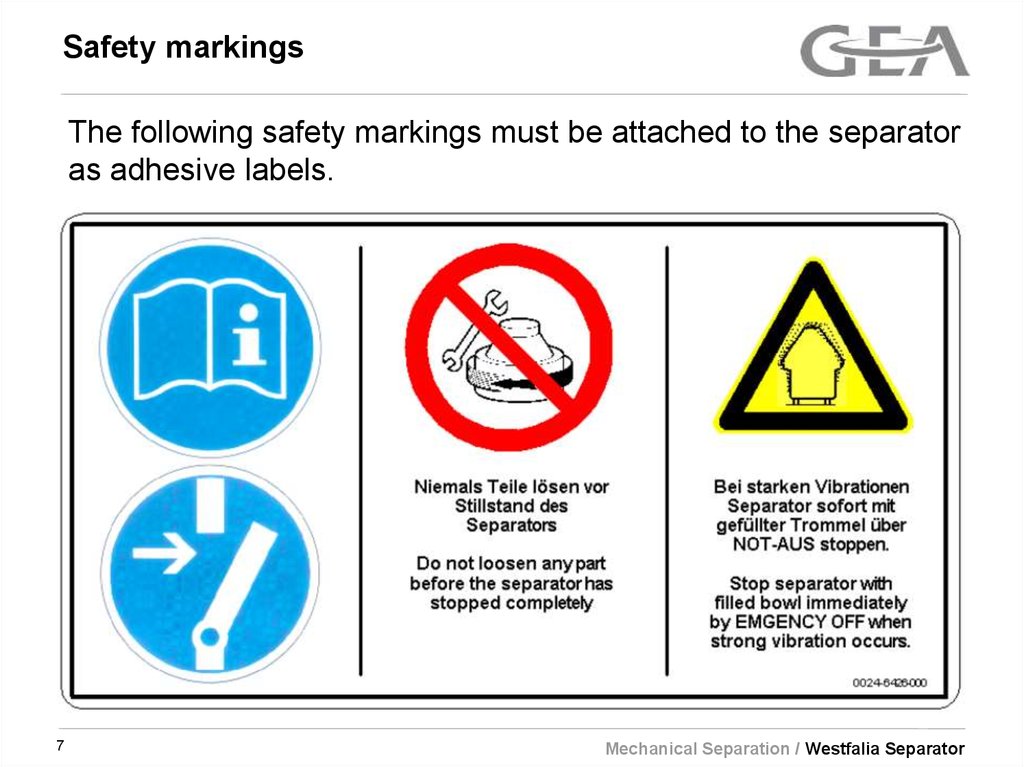
The following safety markings must be attached to the separatoras adhesive labels.
7
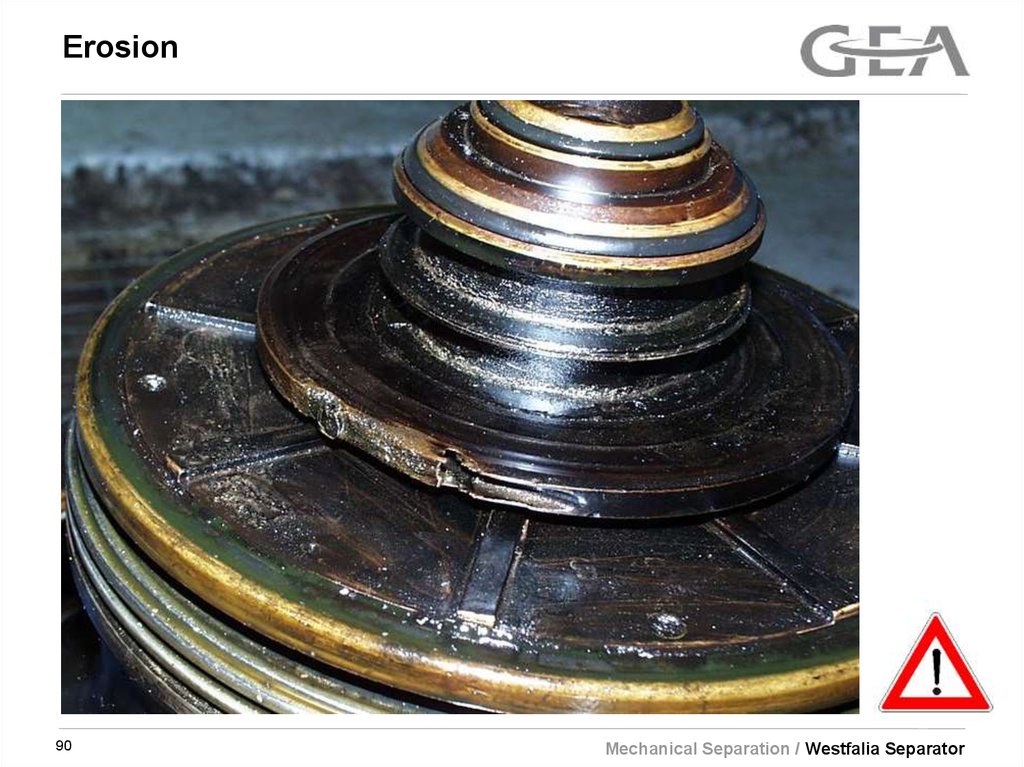
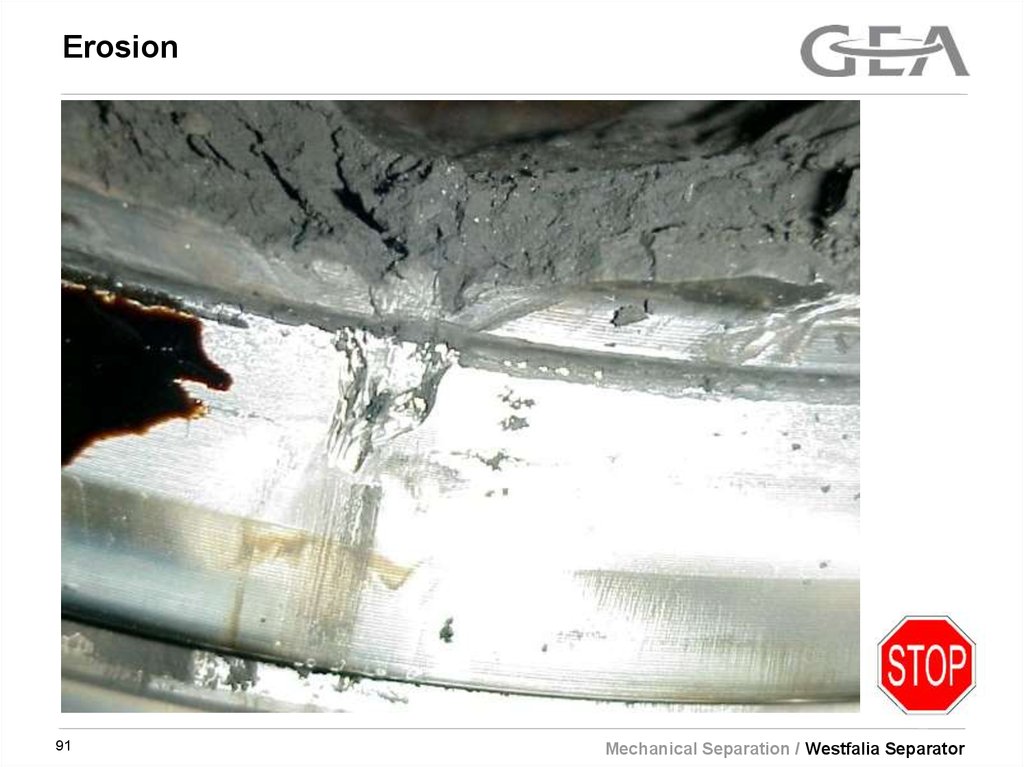
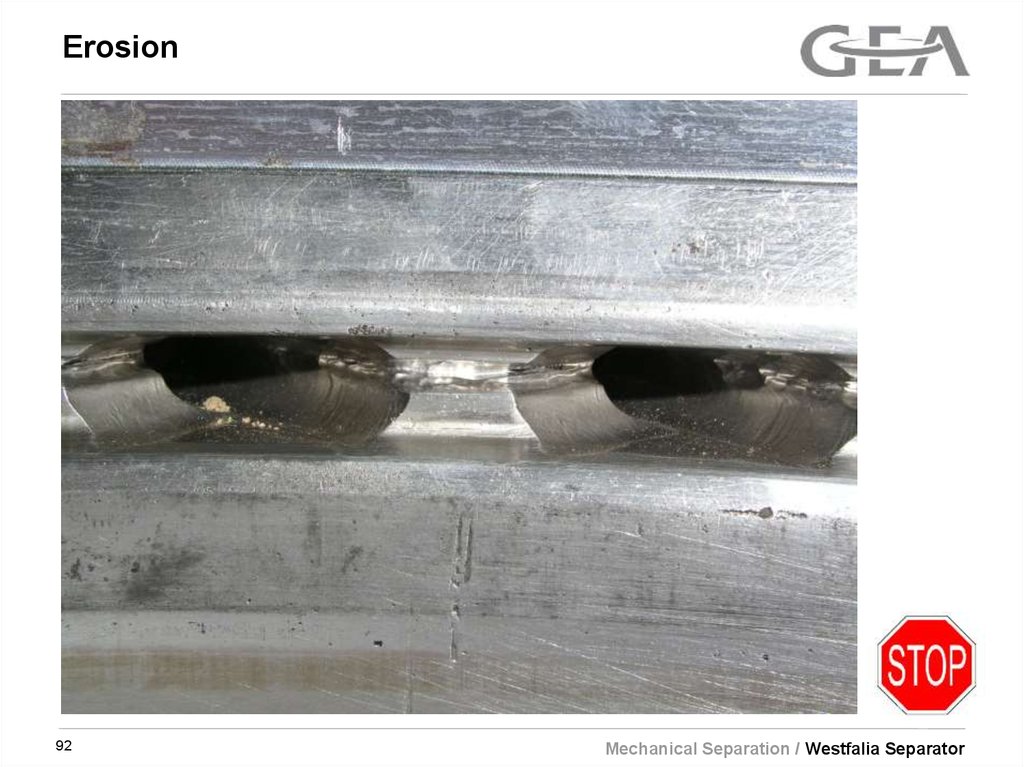
Mechanical Separation / Westfalia Separator
8. Safety markings
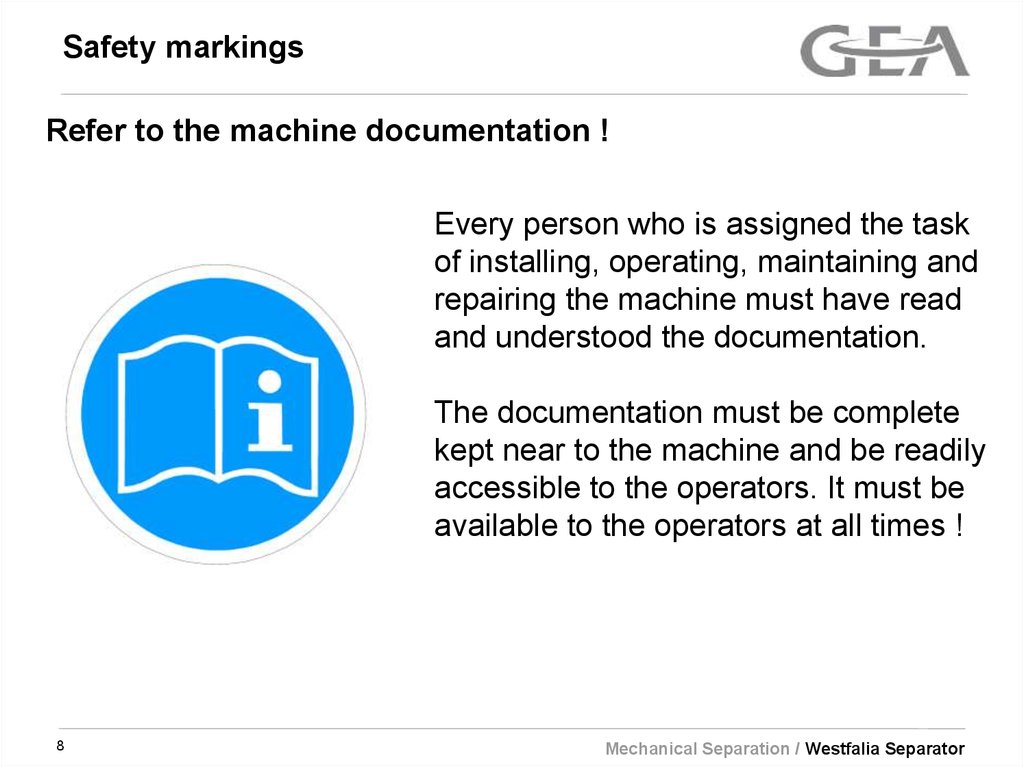
Refer to the machine documentation !Every person who is assigned the task
of installing, operating, maintaining and
repairing the machine must have read
and understood the documentation.
The documentation must be complete
kept near to the machine and be readily
accessible to the operators. It must be
available to the operators at all times !
8
Mechanical Separation / Westfalia Separator
9. Safety markings
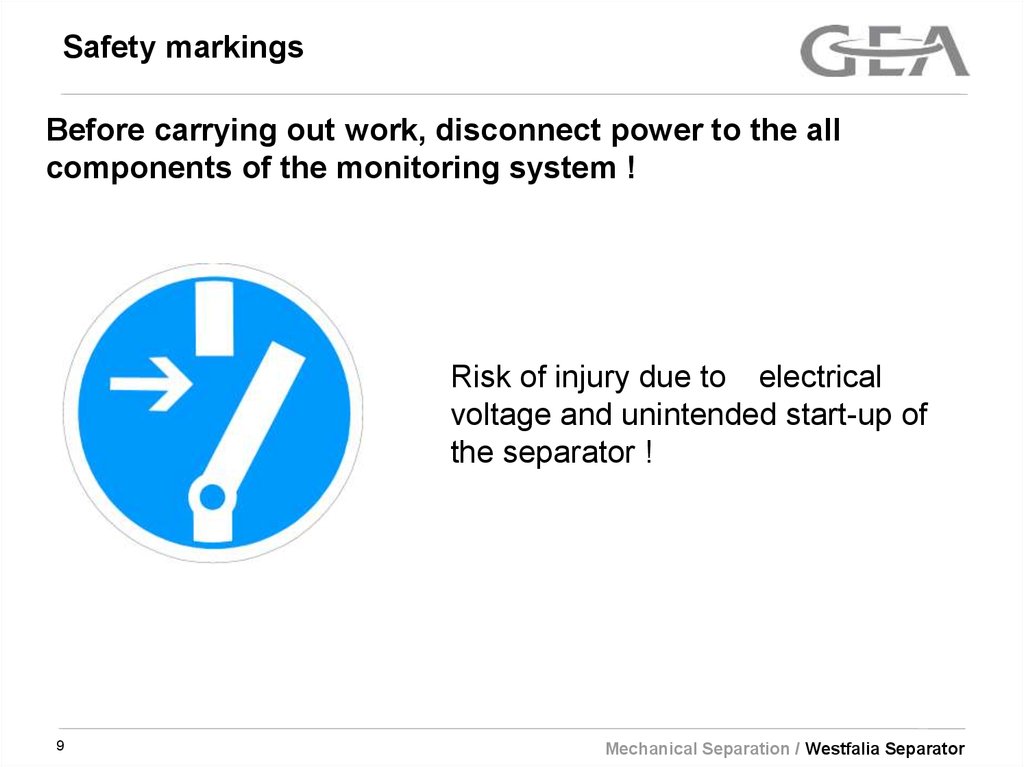
Before carrying out work, disconnect power to the allcomponents of the monitoring system !
Risk of injury due to electrical
voltage and unintended start-up of
the separator !
9
Mechanical Separation / Westfalia Separator
10. Safety markings
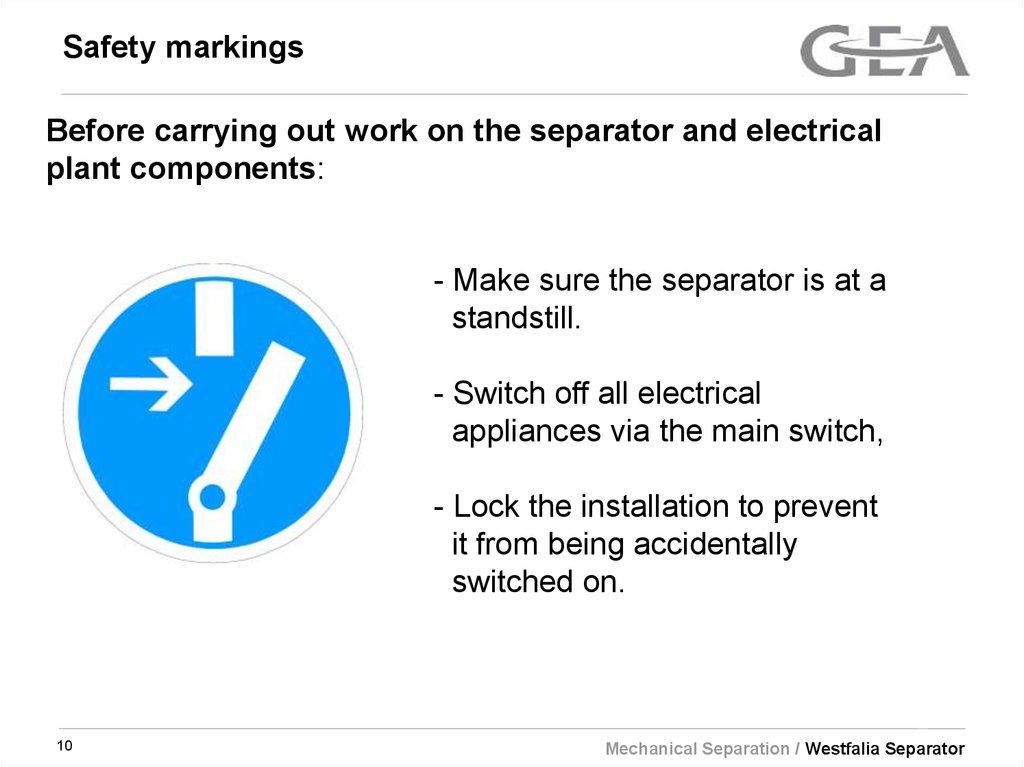
Before carrying out work on the separator and electricalplant components:
- Make sure the separator is at a
standstill.
- Switch off all electrical
appliances via the main switch,
- Lock the installation to prevent
it from being accidentally
switched on.
10
Mechanical Separation / Westfalia Separator
11. Safety markings
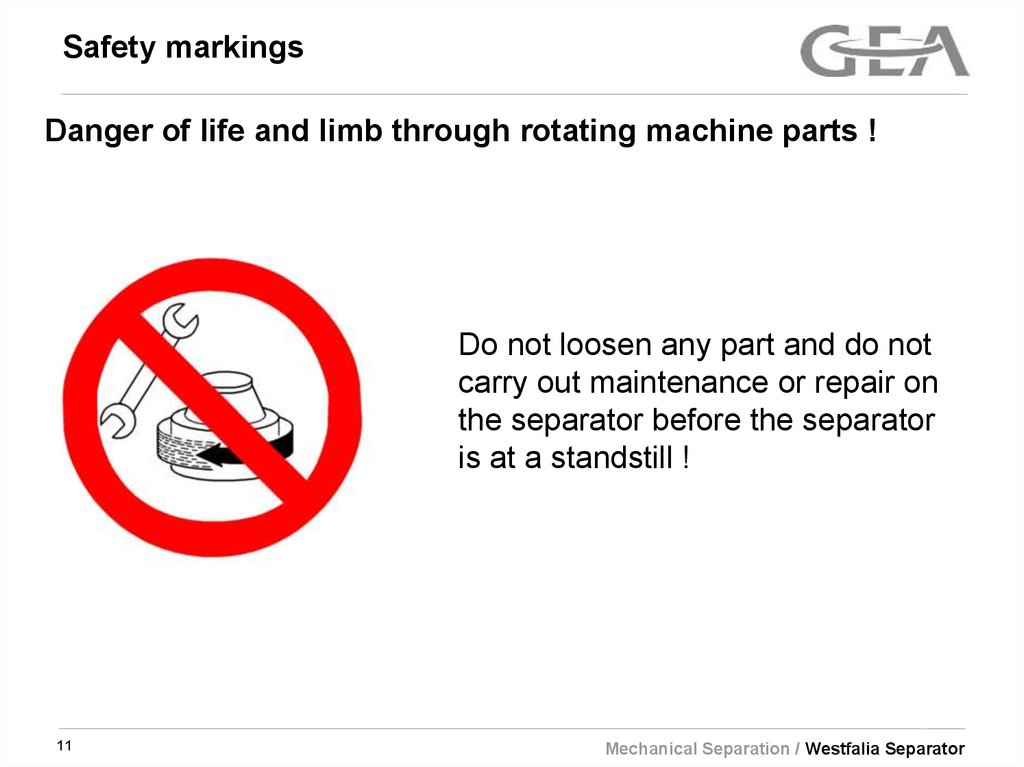
Danger of life and limb through rotating machine parts !Do not loosen any part and do not
carry out maintenance or repair on
the separator before the separator
is at a standstill !
11
Mechanical Separation / Westfalia Separator
12. Safety markings
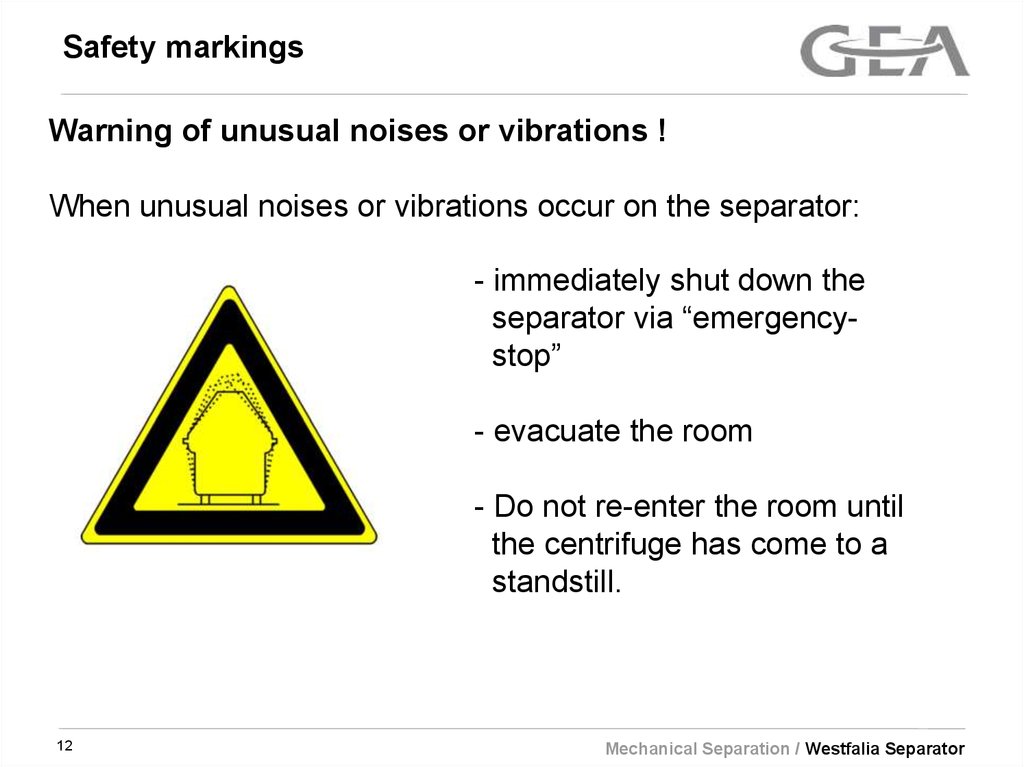
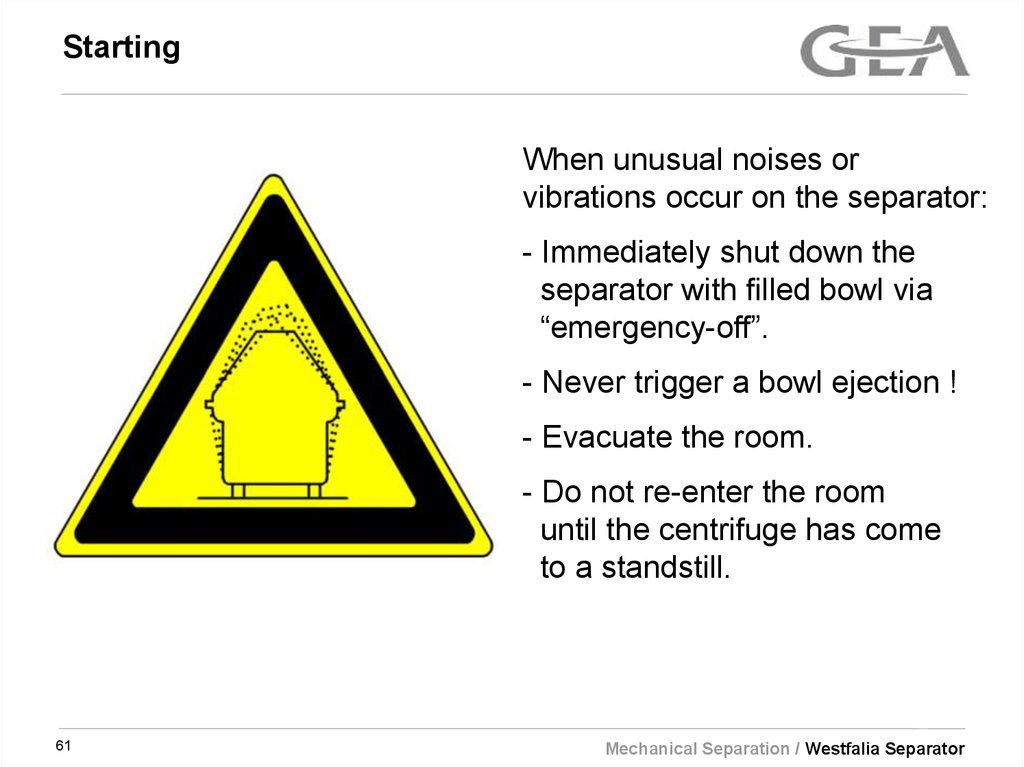
Warning of unusual noises or vibrations !When unusual noises or vibrations occur on the separator:
- immediately shut down the
separator via “emergencystop”
- evacuate the room
- Do not re-enter the room until
the centrifuge has come to a
standstill.
12
Mechanical Separation / Westfalia Separator
13. Safety markings
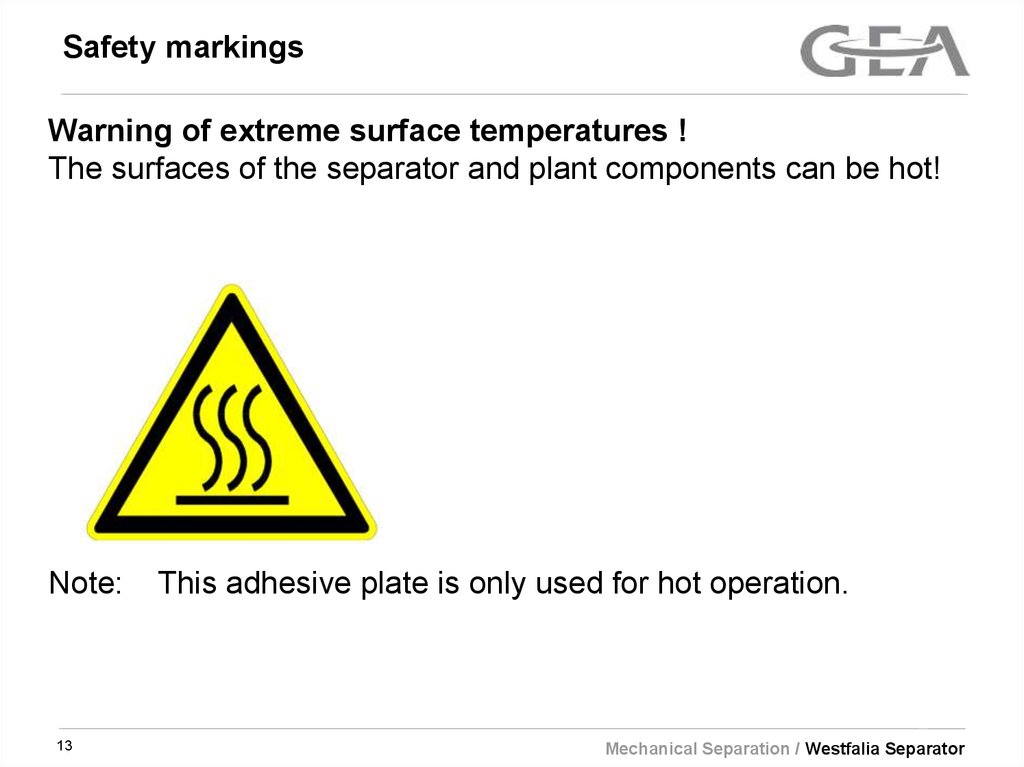
Warning of extreme surface temperatures !The surfaces of the separator and plant components can be hot!
Note:
13
This adhesive plate is only used for hot operation.
Mechanical Separation / Westfalia Separator
14. Safety rules
Liability for the function of the machine passes to the owner.Liability for the function of the machine passes unconditionally to
the owner or operator irrespective of existing warranty periods in
so far as the machine is improperly maintained or serviced by
persons other than Westfalia Separator service personnel or if the
machine is not applied in accordance with the intended use.
Westfalia Separator shall not be liable for damage which occurs
as a result of non-observance of the above. Warranty and liability
conditions in the Conditions of Sale and Delivery of Westfalia
Separator are not extended by the above.
14
Mechanical Separation / Westfalia Separator
15. Correct usage
The separator is designed:- for a very high bowl speed. The admissible bowl speed
depends on the chemical and physical properties of the
product:
- Temperature
- Density of the fluid and solid components.
- for products which contain no corrosive and erosive
components. The aggressiveness of the product influences
the careful selection of the bowl material. Only products
conforming to the specifications on the nameplate may be
processed.
15
Mechanical Separation / Westfalia Separator
16. Correct usage
The separator is designed:- in accordance with the method of application of the
separator agreed with Westfalia Separator. Refer to the
data sheet and contractually agreements.
- in accordance with the admissible utilities (cleaning agents,
lubricants, operating liquids etc.) specified in the
documentation or on the data sheet.
16
Mechanical Separation / Westfalia Separator
17. Intended use
intended use involves:- paying attention to the safety precautions, the instruction
manual of the separator and the safety markings on the
separator.
- adhering to the data on the nameplate, e.g. maximum
admissible bowl speed.
Further information on the intended use of the separator
such as
- agreed areas,
- density of the product,
- throughput capacities,
- temperatures, pressures etc.
is given in the documentation or the data sheet furnished with
the documentation.
17
Mechanical Separation / Westfalia Separator
18. Intended use
- The contractually agreed conditions agreed with WestfaliaSeparator on the intended use of the separator must be
passed on to the operating personnel by the plant operator.
Any operating mode deviating from this is not
intended use and can result in severe damage
to property and persons !
18
Mechanical Separation / Westfalia Separator
19. Non-compliance with the intended use
Any use that deviates from the intended use isconsidered to be non-compliant. Non-compliance with
intended use can result in severe damage to property and
persons !
The separator may not be operated by:
- Persons who have not read and understood these basic
safety precautions.
- Persons who have not read and understood the instruction
manual of the separator.
- Persons who have not been briefed on proper and correct
operation.
- Persons who have not been adequately trained.
- Persons who have not reached the minimum age of 18
years.
19
Mechanical Separation / Westfalia Separator
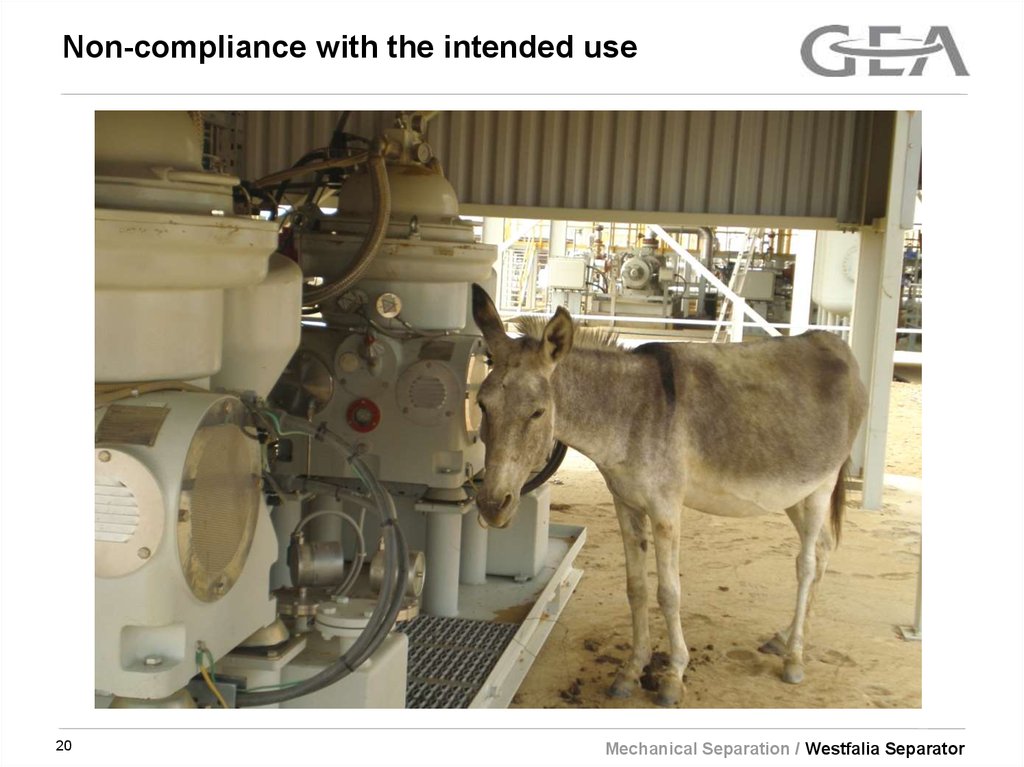
20. Non-compliance with the intended use
20Mechanical Separation / Westfalia Separator
21. Non-compliance with the intended use
The separator may not be operated by:- When the product does not conform to the specifications on
the nameplate.
- Product with excessively high density.
- Solids with excessively high density.
- Product with excessively high temperature.
- When the max. admissible bowl speed has been exceeded
through e.g. manipulation of the drive.
- in an incomplete state of assembly
- e.g. required supervisory equipment is not activated
or has been switched off.
- the required safety and/or protective covers have not
been installed.
- When the separator is operated with spare parts which does
not come from Westfalia Separator.
21
Mechanical Separation / Westfalia Separator
22. Basic operating principles
Separators are used for the separation of liquid mixtures orfor the separation of solids out of liquids or liquid mixtures.
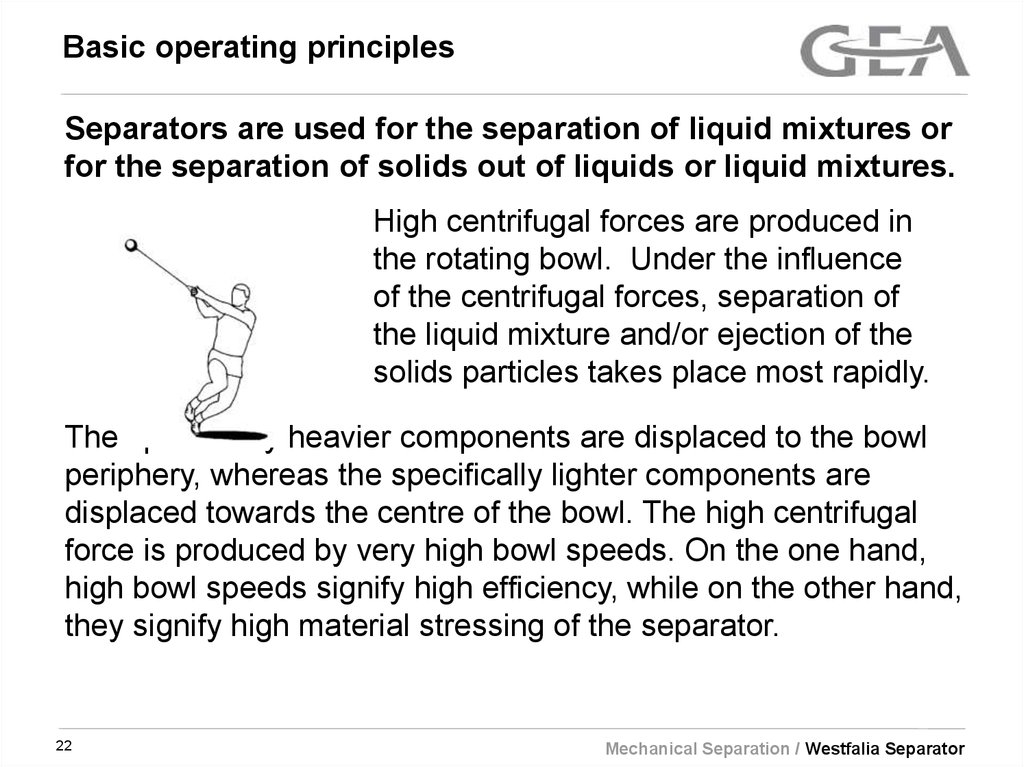
High centrifugal forces are produced in
the rotating bowl. Under the influence
of the centrifugal forces, separation of
the liquid mixture and/or ejection of the
solids particles takes place most rapidly.
The specifically heavier components are displaced to the bowl
periphery, whereas the specifically lighter components are
displaced towards the centre of the bowl. The high centrifugal
force is produced by very high bowl speeds. On the one hand,
high bowl speeds signify high efficiency, while on the other hand,
they signify high material stressing of the separator.
22
Mechanical Separation / Westfalia Separator
23. Operations on the separator
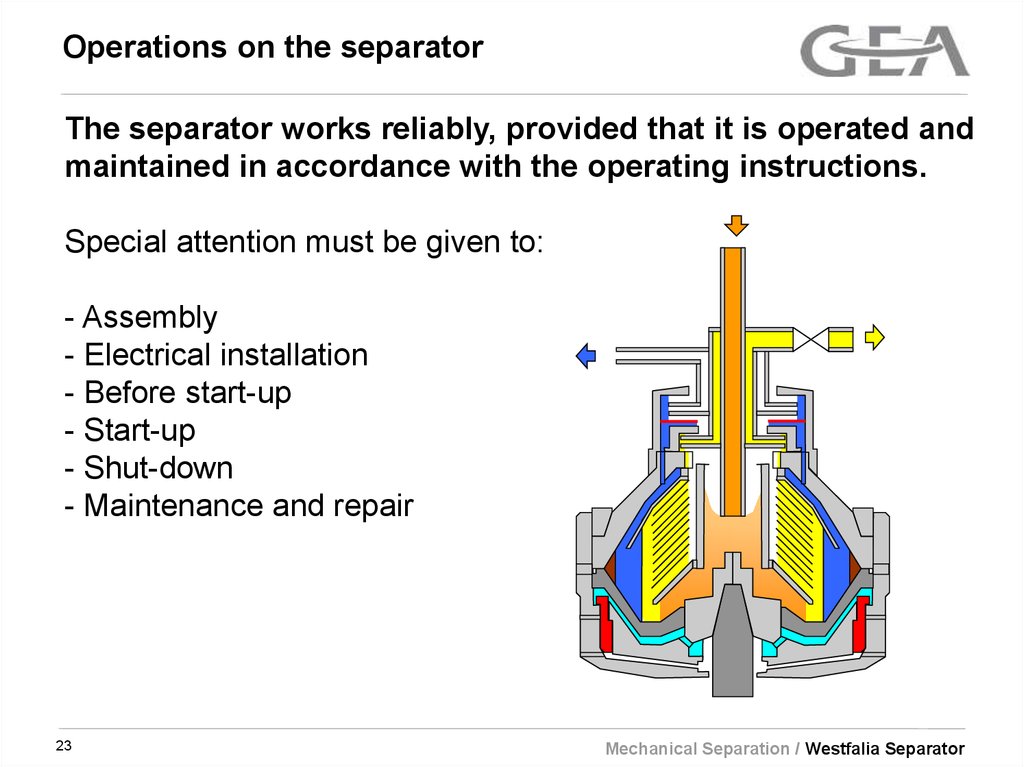
The separator works reliably, provided that it is operated andmaintained in accordance with the operating instructions.
Special attention must be given to:
- Assembly
- Electrical installation
- Before start-up
- Start-up
- Shut-down
- Maintenance and repair
23
Mechanical Separation / Westfalia Separator
24. Operations on the separator
Demands on the operating and maintenance personnel:Operating, maintaining or repairing the separator or the separator
plant requires specialized knowledge.
CAUTION ! Operating, maintenance or repair work by
unqualified or unauthorized personnel can lead to operating,
assembly and handling errors and severe damage to persons
and property.
Westfalia Separator accepts no liability for damage caused by
unqualified or unauthorized personnel !
24
Mechanical Separation / Westfalia Separator
25. Operations on the separator
Demands on the operating and maintenance personnel:The operator of the separator or separator plant:
- is responsible for the necessary skills and knowledge of the
personnel.
- is responsible for briefing and training the personnel.
- must be sure that the personnel have read and understood
the manuals necessary to carry out their work.
- Electrical work may only be carried out by an authorized
electrician !
Westfalia Separator offers an extensive range of training and
advanced training courses. You can obtain further information from
Westfalia Separator or from one of the authorized representatives.
25
Mechanical Separation / Westfalia Separator
26. Spare part requirements
Use only genuine spare parts from Westfalia Separator.The use of non-genuine parts leads to:
- safety risks,
- less durability and availability,
- increased service requirement.
If a safety risk occurs when using non-original spare parts,
this may have legal consequences for the responsible
persons. In such cases, Westfalia Separator accepts no
liability or warranty claims.
26
Mechanical Separation / Westfalia Separator
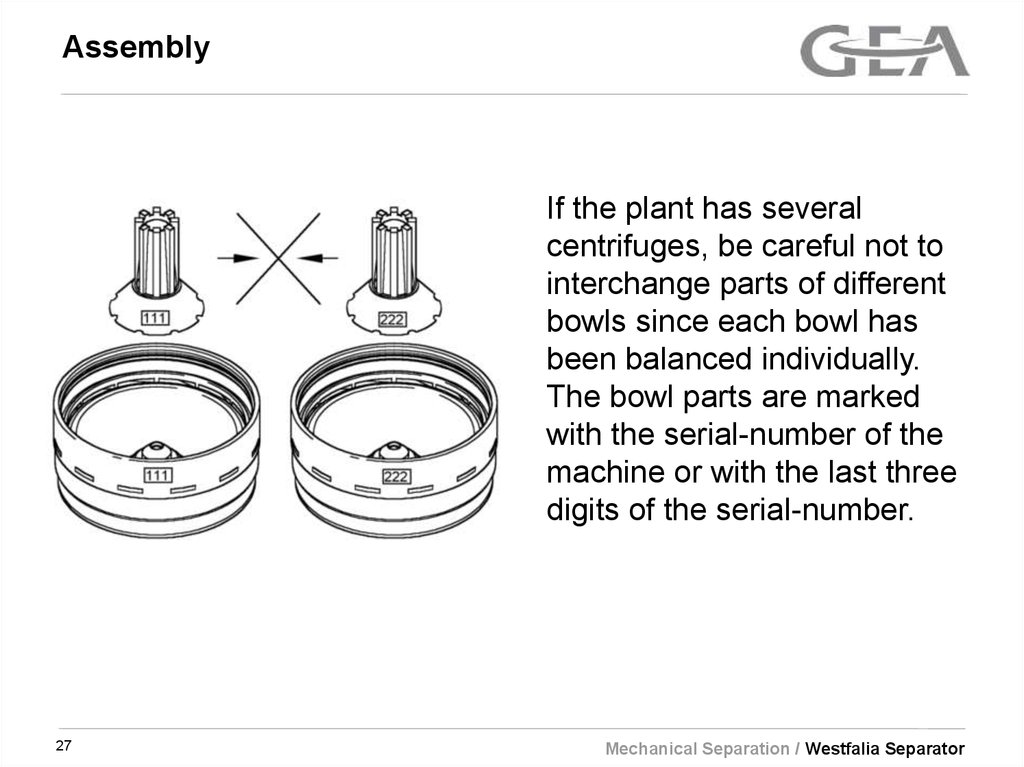
27. Assembly
If the plant has severalcentrifuges, be careful not to
interchange parts of different
bowls since each bowl has
been balanced individually.
The bowl parts are marked
with the serial-number of the
machine or with the last three
digits of the serial-number.
27
Mechanical Separation / Westfalia Separator
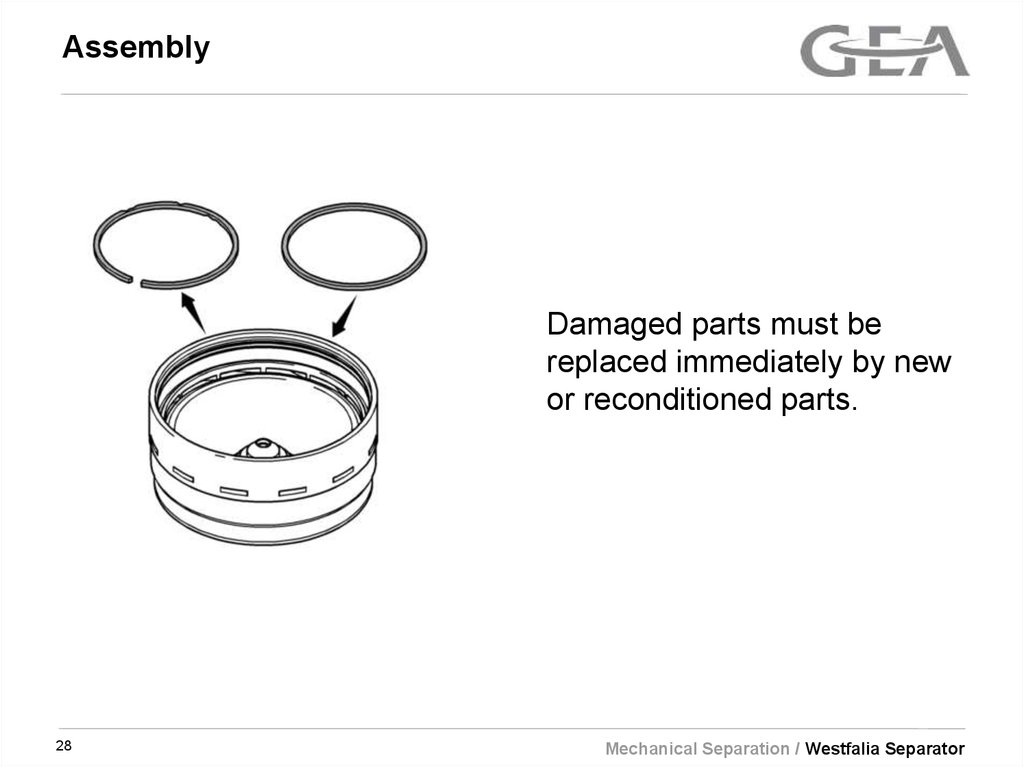
28. Assembly
Damaged parts must bereplaced immediately by new
or reconditioned parts.
28
Mechanical Separation / Westfalia Separator
29. Assembly
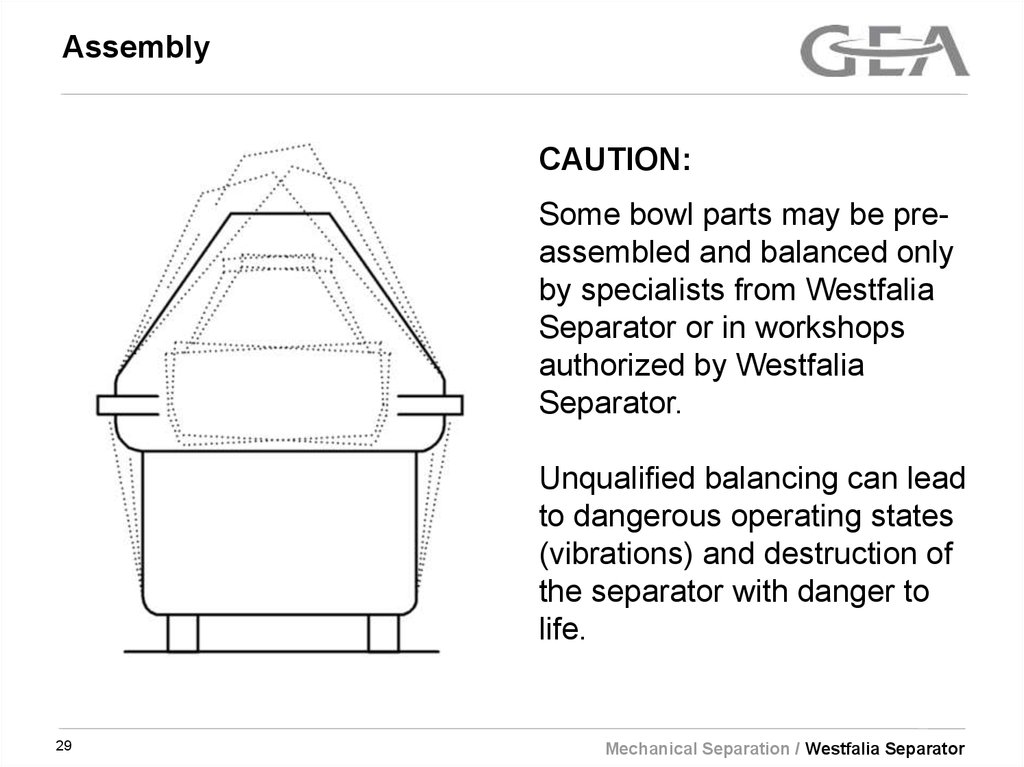
CAUTION:Some bowl parts may be preassembled and balanced only
by specialists from Westfalia
Separator or in workshops
authorized by Westfalia
Separator.
Unqualified balancing can lead
to dangerous operating states
(vibrations) and destruction of
the separator with danger to
life.
29
Mechanical Separation / Westfalia Separator
30. Assembly
CAUTION:To avoid unbalance, when
replacing some bowl parts
like:
- Lock ring
- Bowl top
- Distributor
- Bowl bottom
- Water chamber bottom
Westfalia Separator must be
consulted. These parts are
marked with a footnote in the
separator manual.
30
Mechanical Separation / Westfalia Separator
31. Assembly
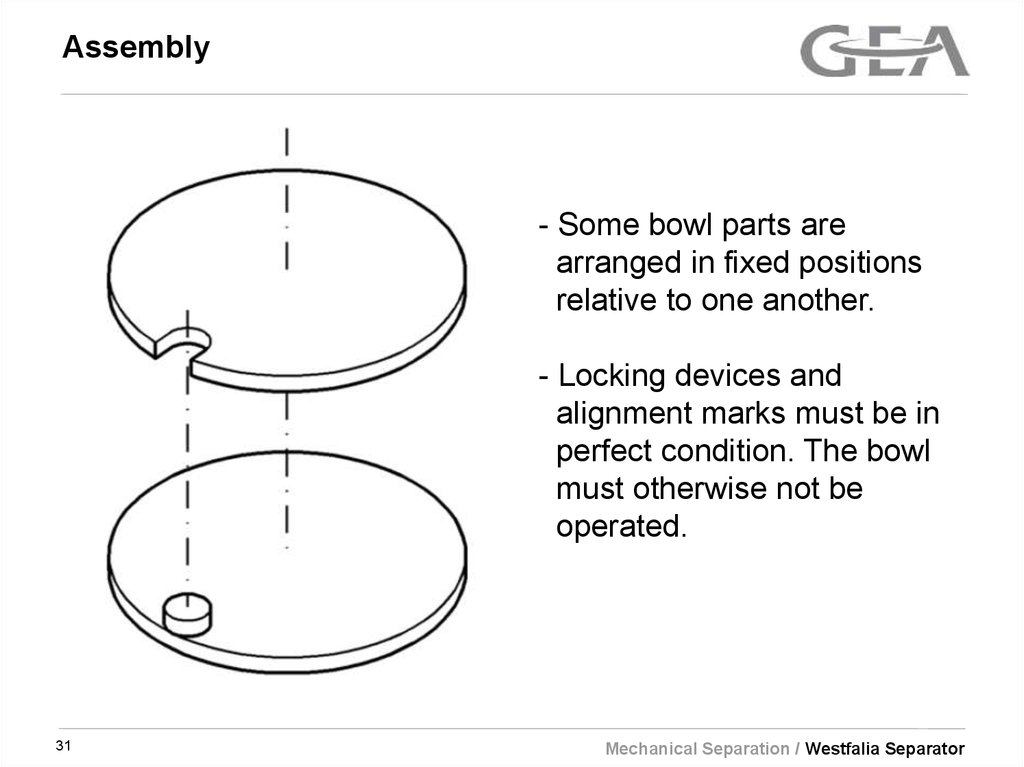
- Some bowl parts arearranged in fixed positions
relative to one another.
- Locking devices and
alignment marks must be in
perfect condition. The bowl
must otherwise not be
operated.
31
Mechanical Separation / Westfalia Separator
32. Assembly
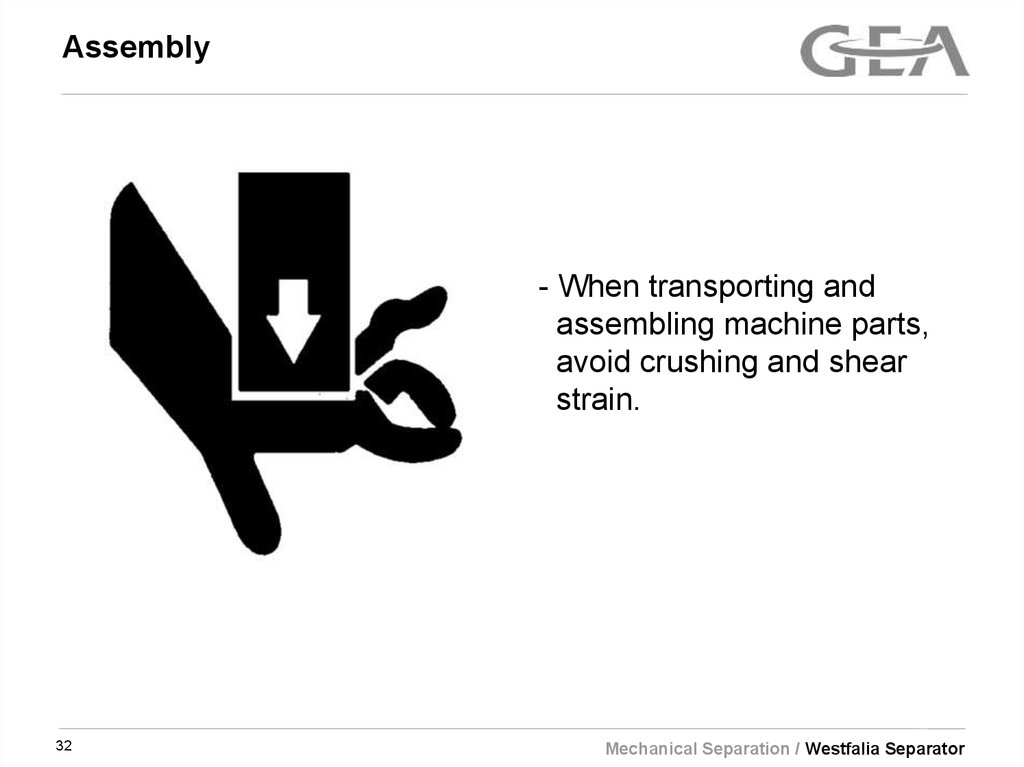
- When transporting andassembling machine parts,
avoid crushing and shear
strain.
32
Mechanical Separation / Westfalia Separator
33. Assembly
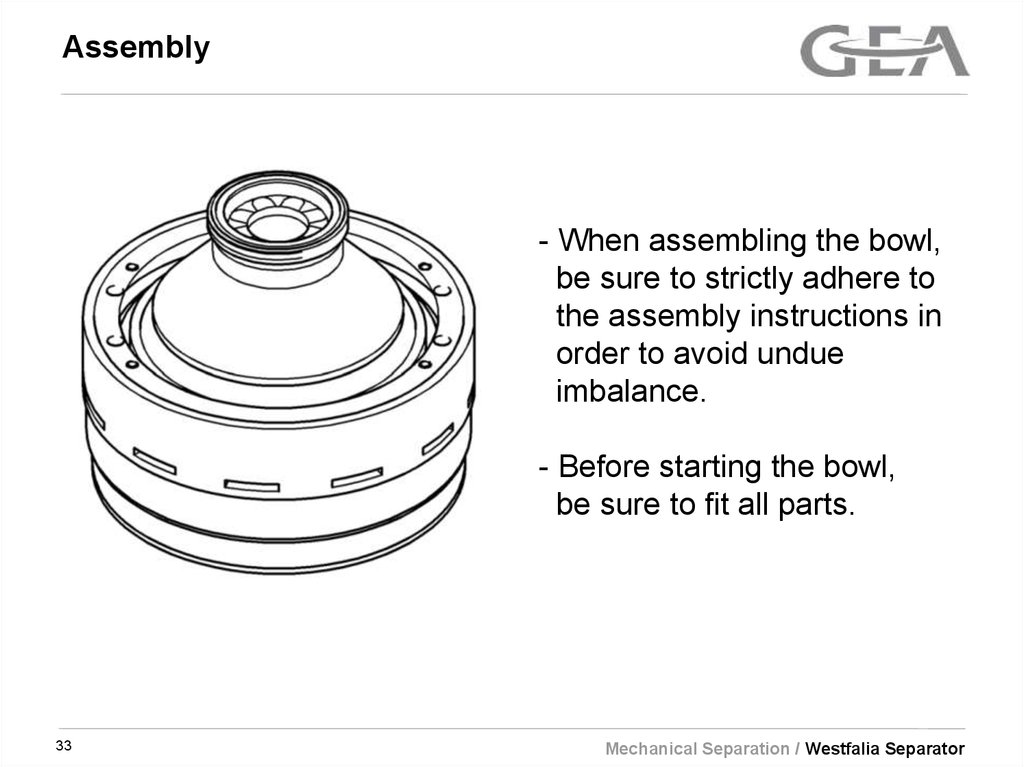
- When assembling the bowl,be sure to strictly adhere to
the assembly instructions in
order to avoid undue
imbalance.
- Before starting the bowl,
be sure to fit all parts.
33
Mechanical Separation / Westfalia Separator
34. Assembly
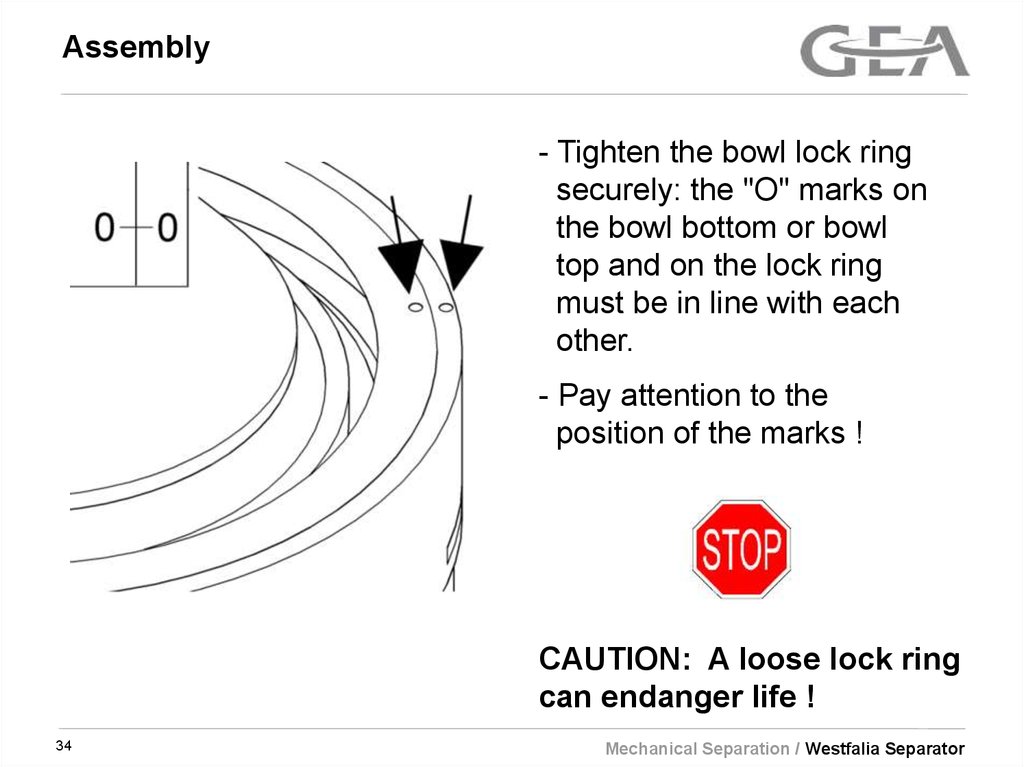
- Tighten the bowl lock ringsecurely: the "O" marks on
the bowl bottom or bowl
top and on the lock ring
must be in line with each
other.
- Pay attention to the
position of the marks !
CAUTION: A loose lock ring
can endanger life !
34
Mechanical Separation / Westfalia Separator
35. Assembly
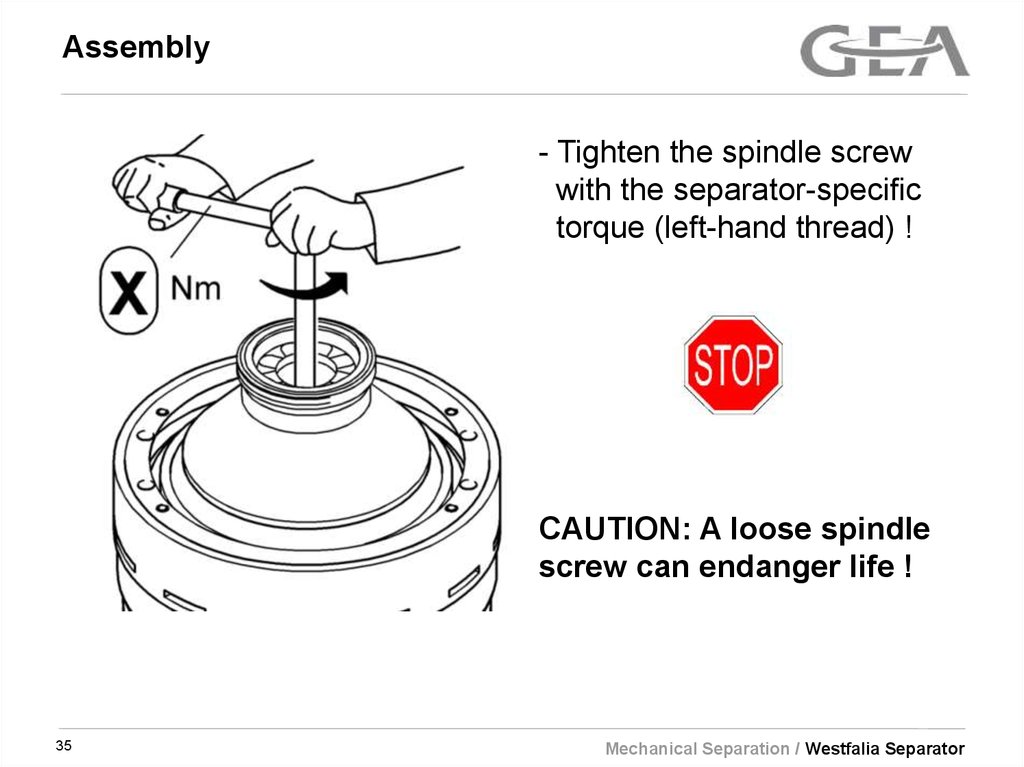
- Tighten the spindle screwwith the separator-specific
torque (left-hand thread) !
CAUTION: A loose spindle
screw can endanger life !
35
Mechanical Separation / Westfalia Separator
36. Assembly
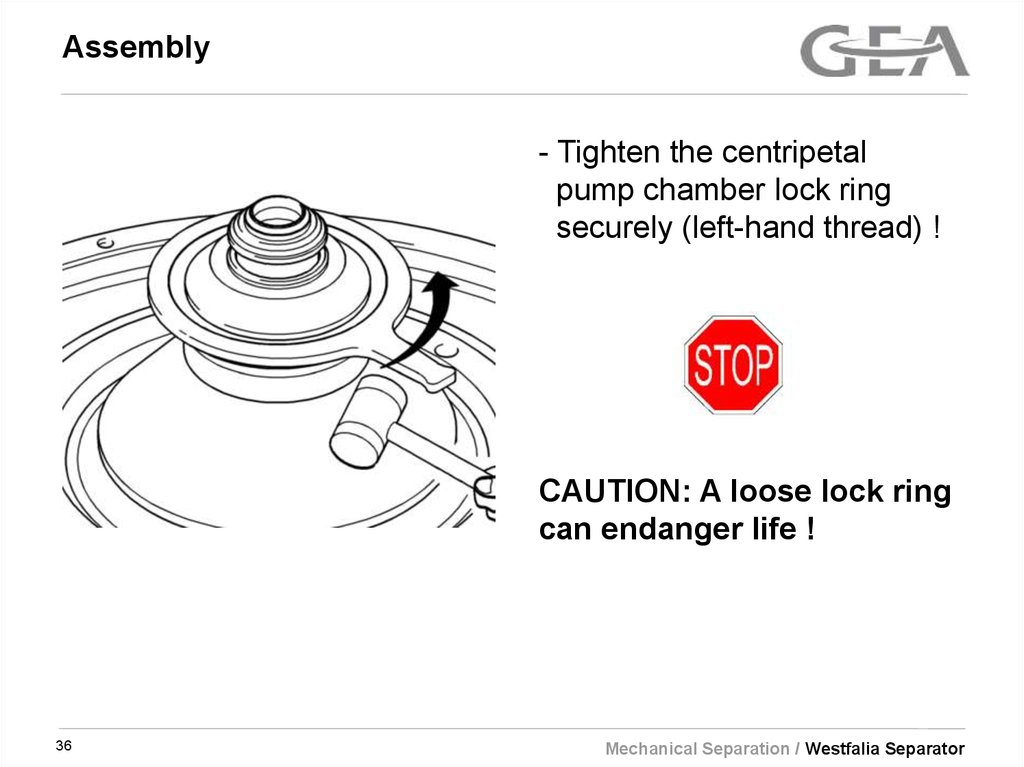
- Tighten the centripetalpump chamber lock ring
securely (left-hand thread) !
CAUTION: A loose lock ring
can endanger life !
36
Mechanical Separation / Westfalia Separator
37. Assembly
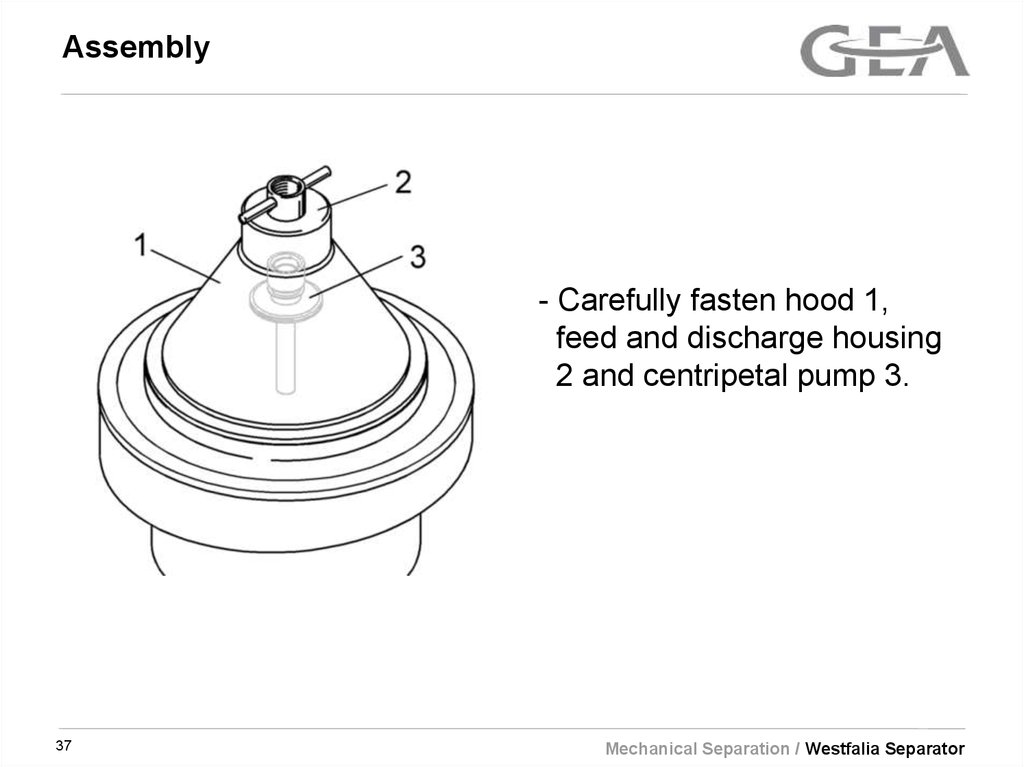
- Carefully fasten hood 1,feed and discharge housing
2 and centripetal pump 3.
37
Mechanical Separation / Westfalia Separator
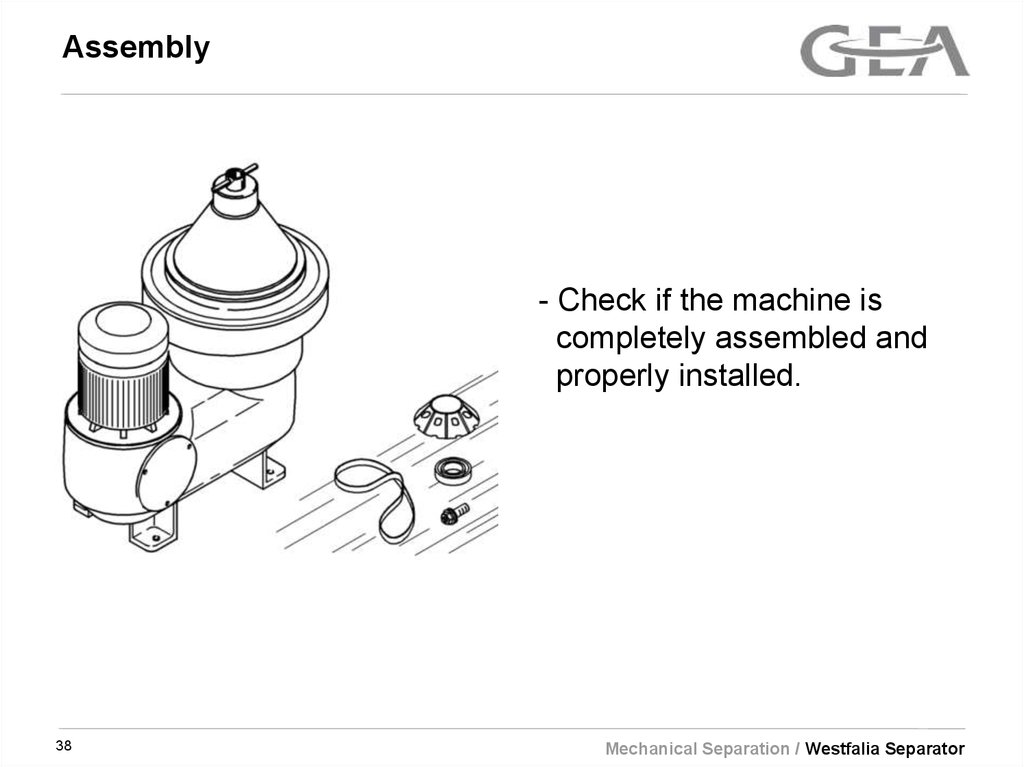
38. Assembly
- Check if the machine iscompletely assembled and
properly installed.
38
Mechanical Separation / Westfalia Separator
39. Assembly
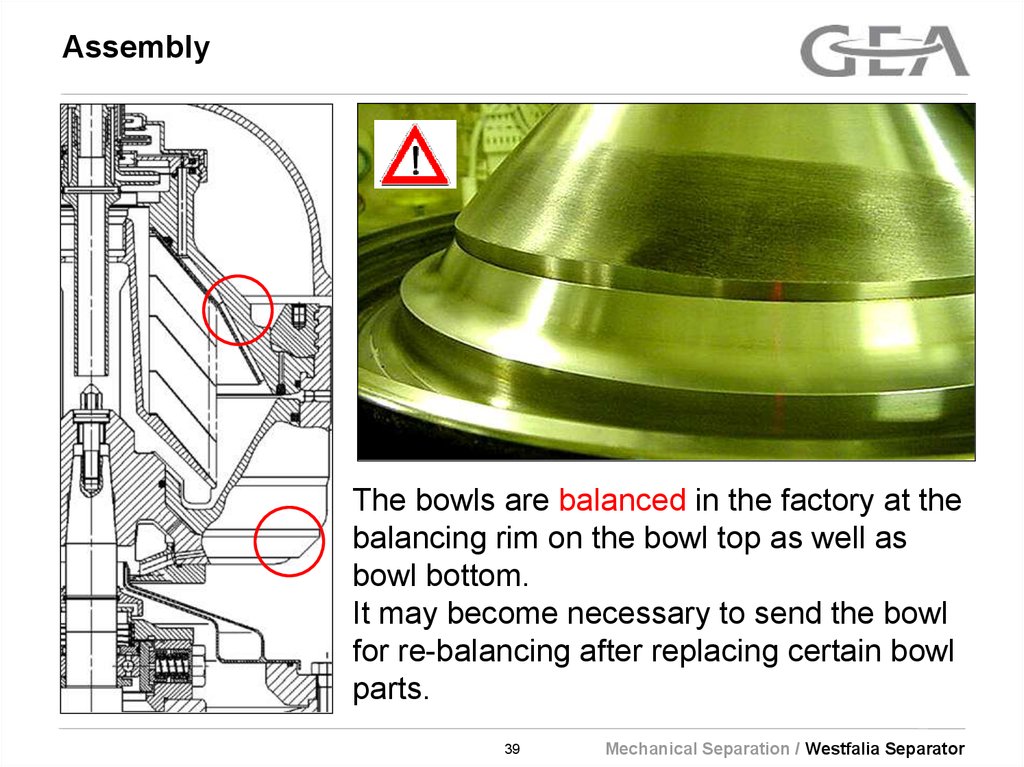
The bowls are balanced in the factory at thebalancing rim on the bowl top as well as
bowl bottom.
It may become necessary to send the bowl
for re-balancing after replacing certain bowl
parts.
39
Mechanical Separation / Westfalia Separator
40. Assembly
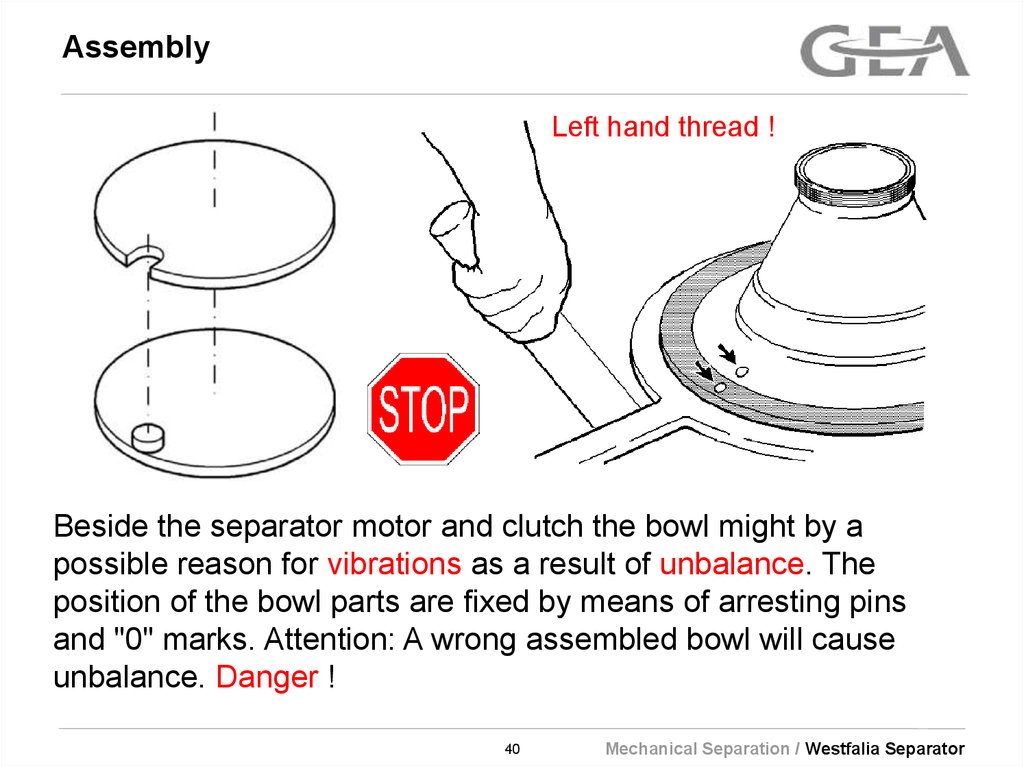
Left hand thread !Beside the separator motor and clutch the bowl might by a
possible reason for vibrations as a result of unbalance. The
position of the bowl parts are fixed by means of arresting pins
and "0" marks. Attention: A wrong assembled bowl will cause
unbalance. Danger !
40
Mechanical Separation / Westfalia Separator
41. Assembly
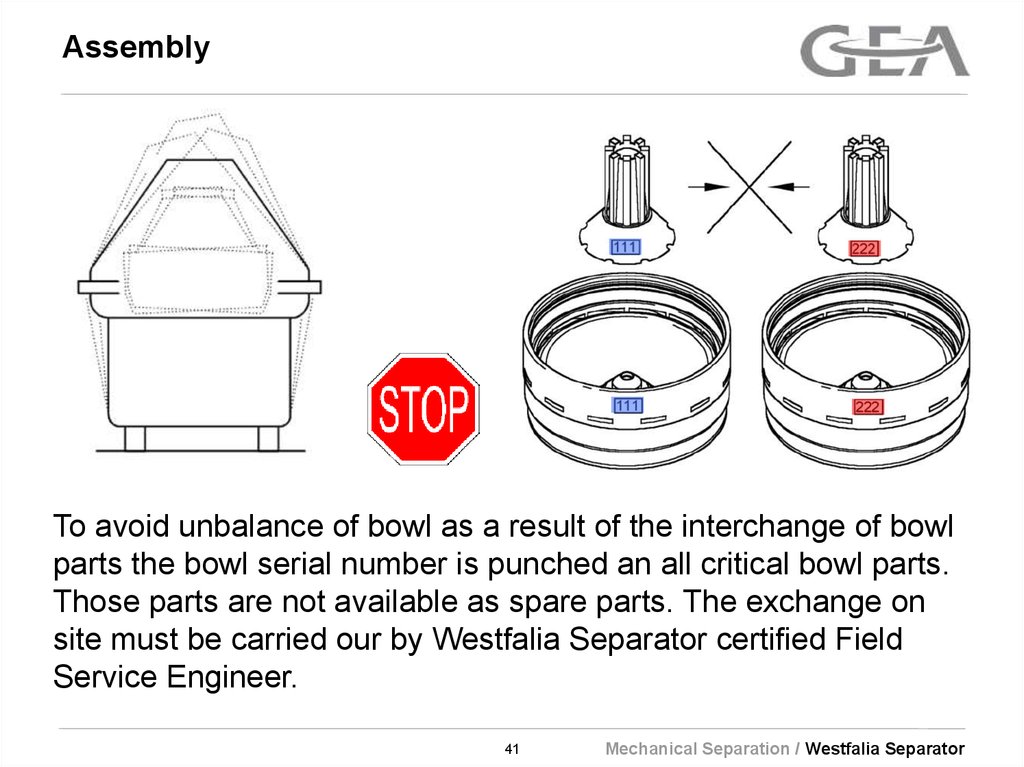
To avoid unbalance of bowl as a result of the interchange of bowlparts the bowl serial number is punched an all critical bowl parts.
Those parts are not available as spare parts. The exchange on
site must be carried our by Westfalia Separator certified Field
Service Engineer.
41
Mechanical Separation / Westfalia Separator
42. Assembly
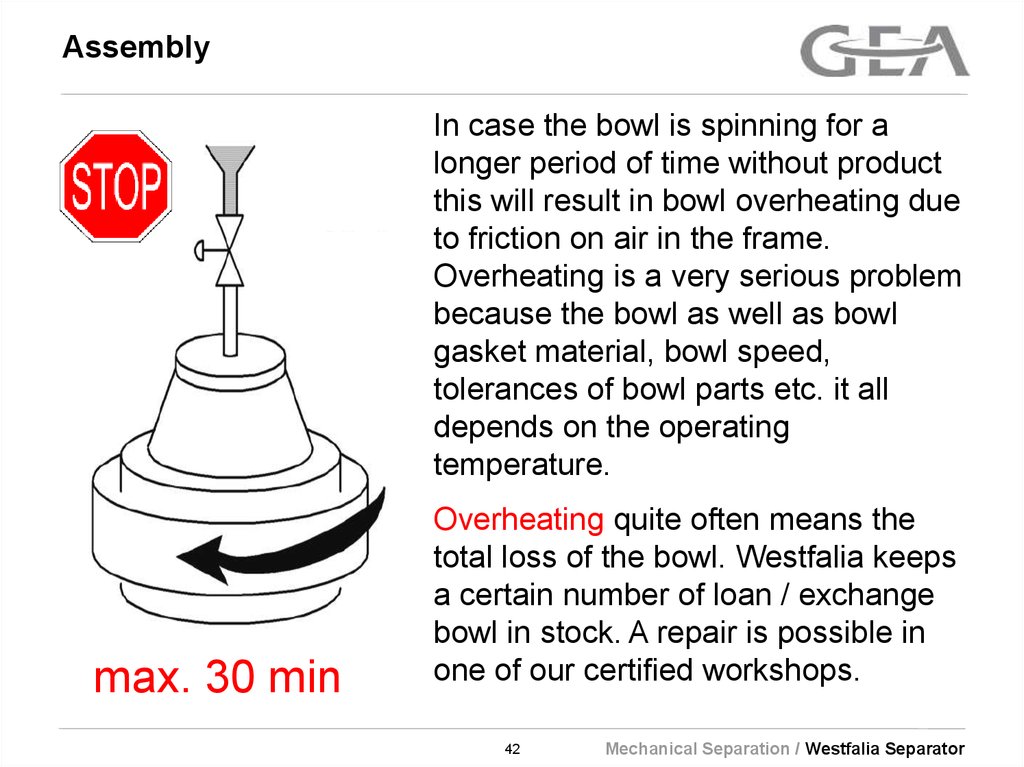
In case the bowl is spinning for alonger period of time without product
this will result in bowl overheating due
to friction on air in the frame.
Overheating is a very serious problem
because the bowl as well as bowl
gasket material, bowl speed,
tolerances of bowl parts etc. it all
depends on the operating
temperature.
max. 30 min
Overheating quite often means the
total loss of the bowl. Westfalia keeps
a certain number of loan / exchange
bowl in stock. A repair is possible in
one of our certified workshops.
42
Mechanical Separation / Westfalia Separator
43. Assembly
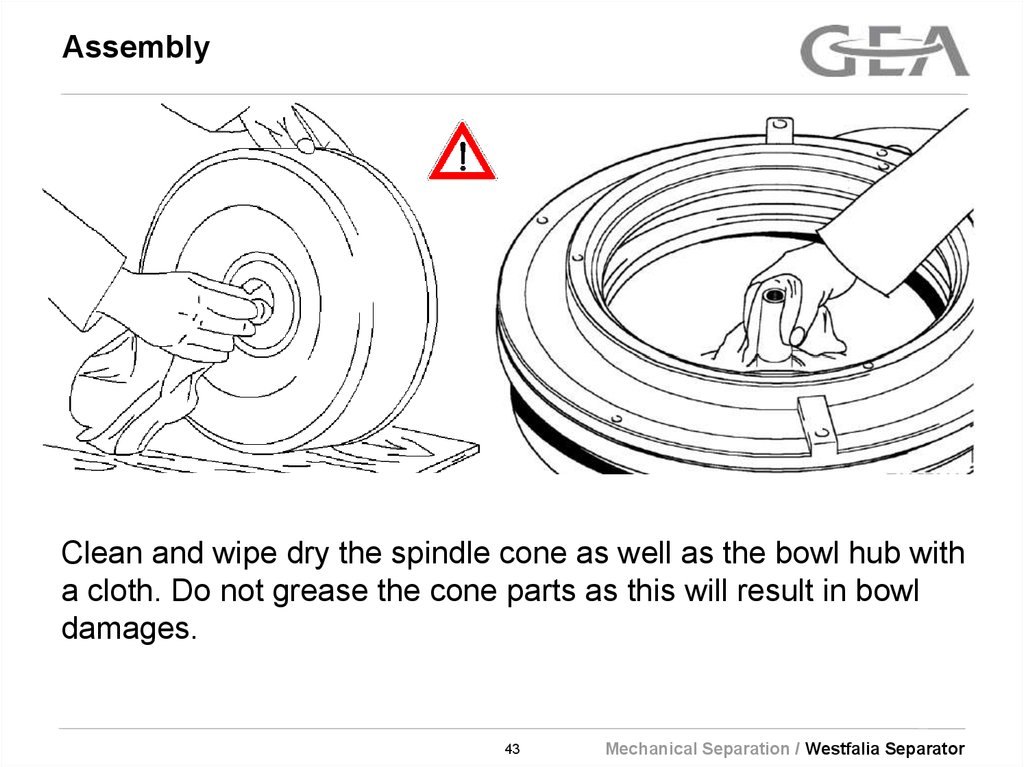
Clean and wipe dry the spindle cone as well as the bowl hub witha cloth. Do not grease the cone parts as this will result in bowl
damages.
43
Mechanical Separation / Westfalia Separator
44. Electrical installation
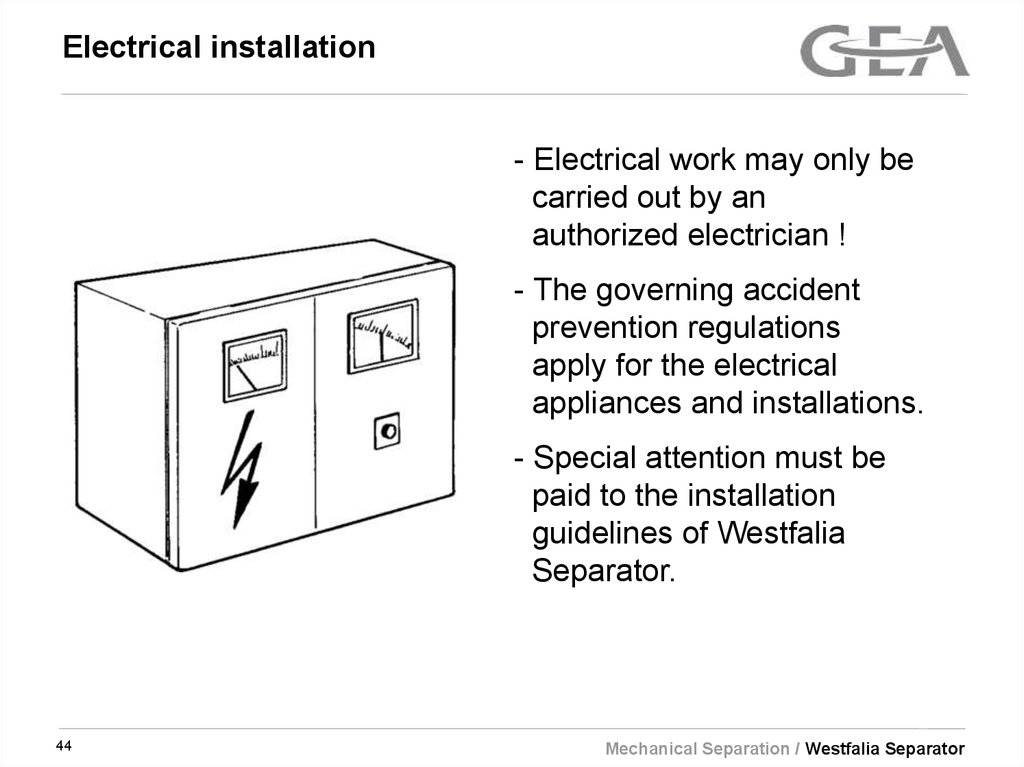
- Electrical work may only becarried out by an
authorized electrician !
- The governing accident
prevention regulations
apply for the electrical
appliances and installations.
- Special attention must be
paid to the installation
guidelines of Westfalia
Separator.
44
Mechanical Separation / Westfalia Separator
45. Electrical installation
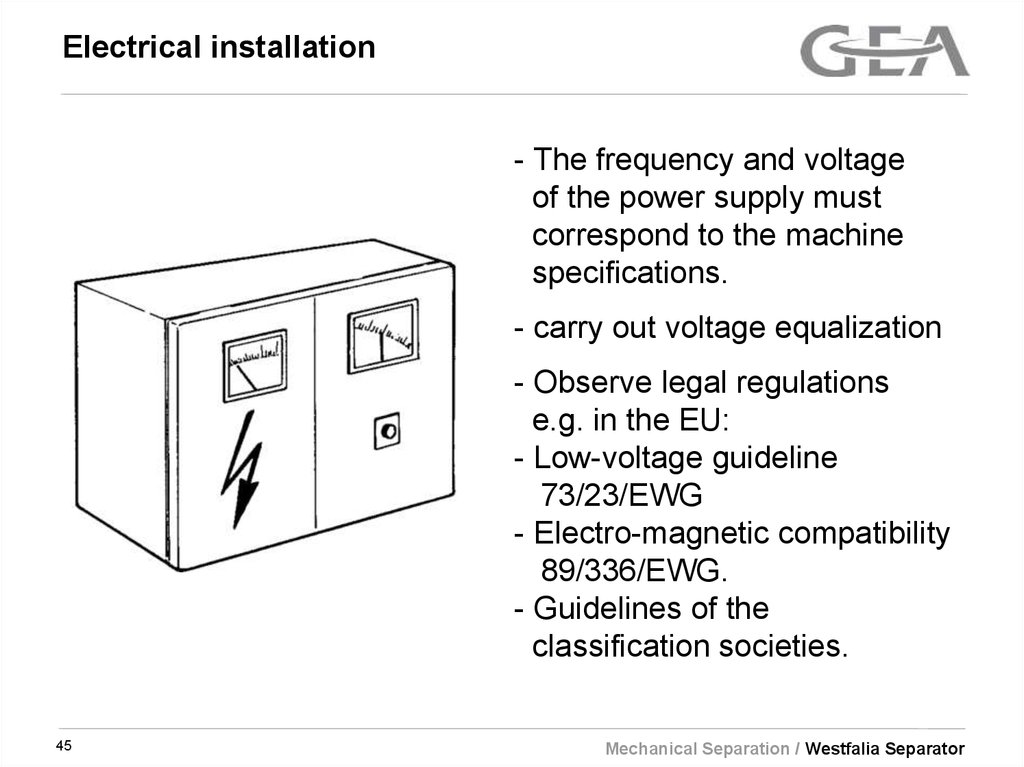
- The frequency and voltageof the power supply must
correspond to the machine
specifications.
- carry out voltage equalization
- Observe legal regulations
e.g. in the EU:
- Low-voltage guideline
73/23/EWG
- Electro-magnetic compatibility
89/336/EWG.
- Guidelines of the
classification societies.
45
Mechanical Separation / Westfalia Separator
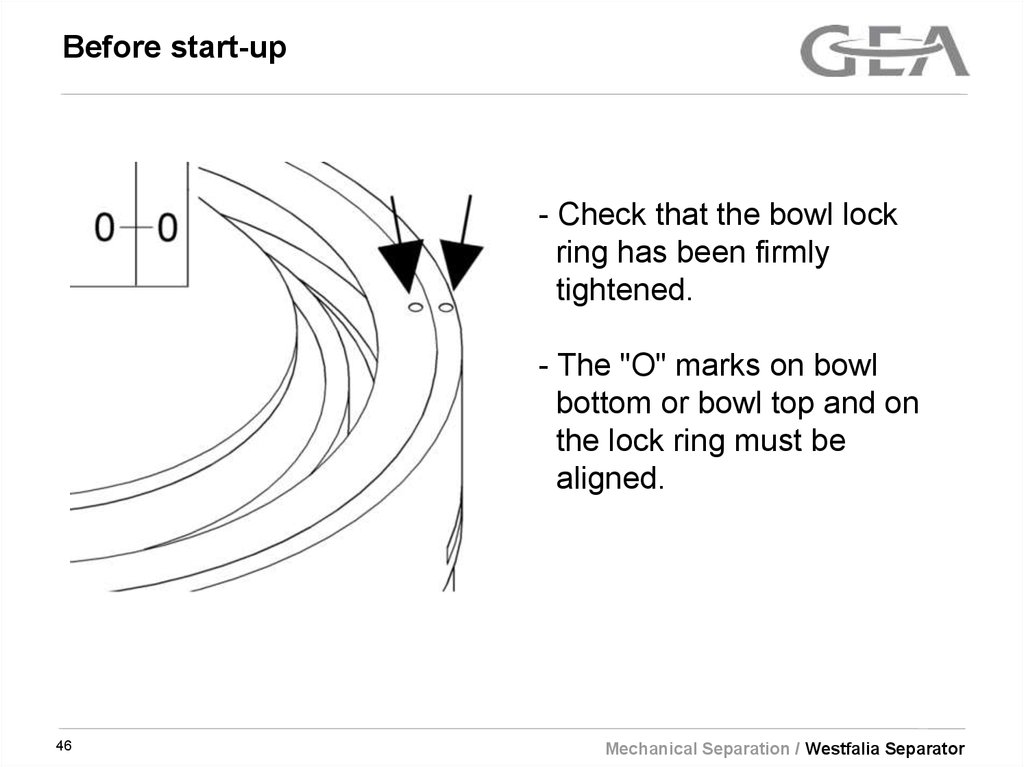
46. Before start-up
- Check that the bowl lockring has been firmly
tightened.
- The "O" marks on bowl
bottom or bowl top and on
the lock ring must be
aligned.
46
Mechanical Separation / Westfalia Separator
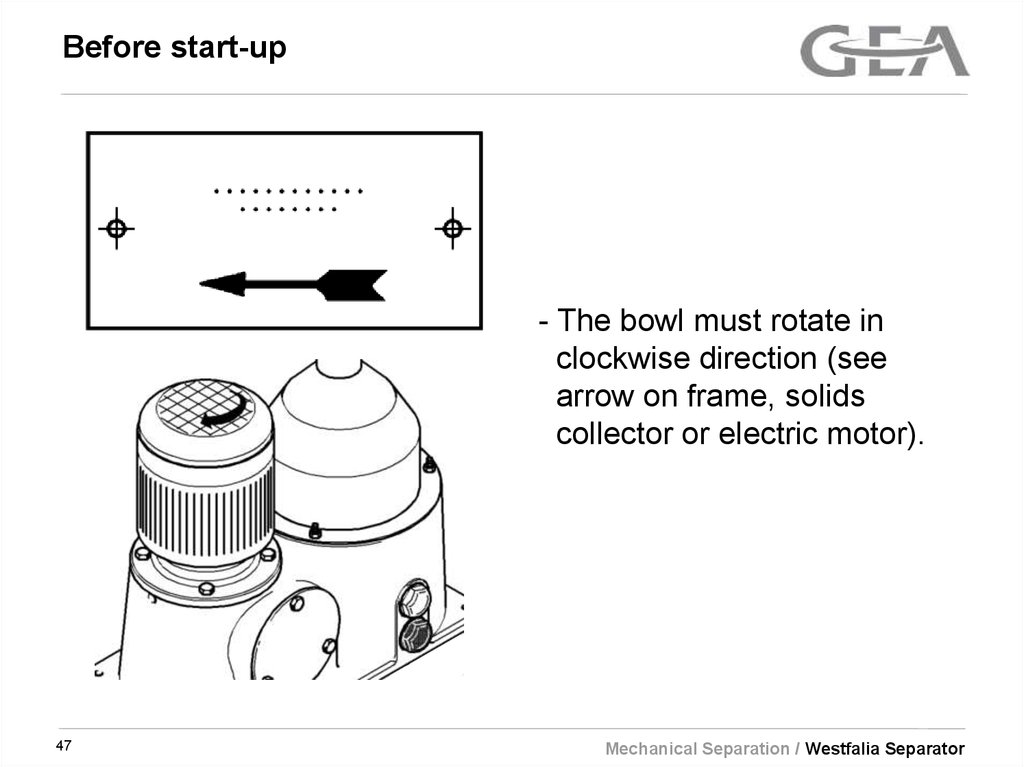
47. Before start-up
- The bowl must rotate inclockwise direction (see
arrow on frame, solids
collector or electric motor).
47
Mechanical Separation / Westfalia Separator
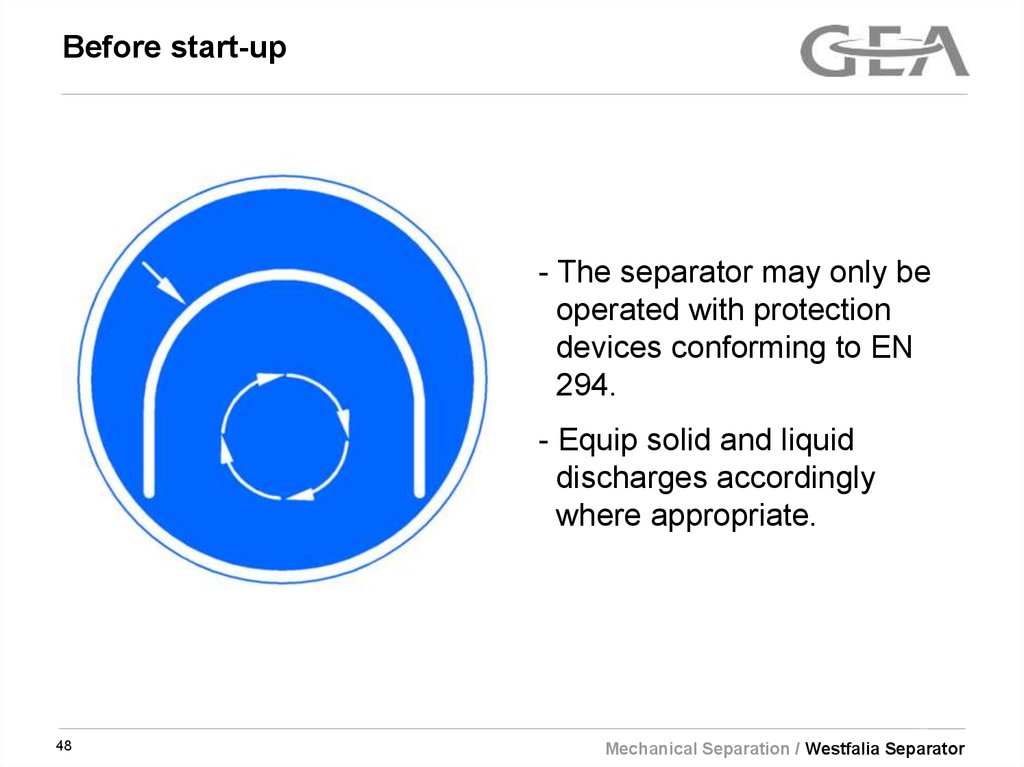
48. Before start-up
- The separator may only beoperated with protection
devices conforming to EN
294.
- Equip solid and liquid
discharges accordingly
where appropriate.
48
Mechanical Separation / Westfalia Separator
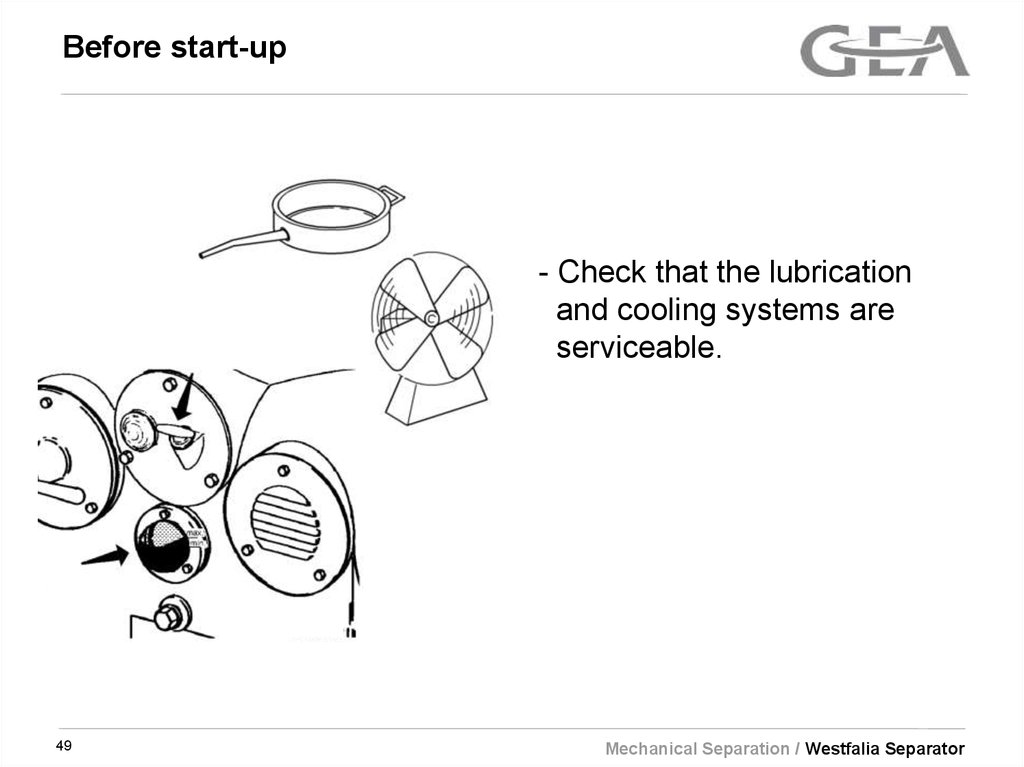
49. Before start-up
- Check that the lubricationand cooling systems are
serviceable.
49
Mechanical Separation / Westfalia Separator
50. Before start-up
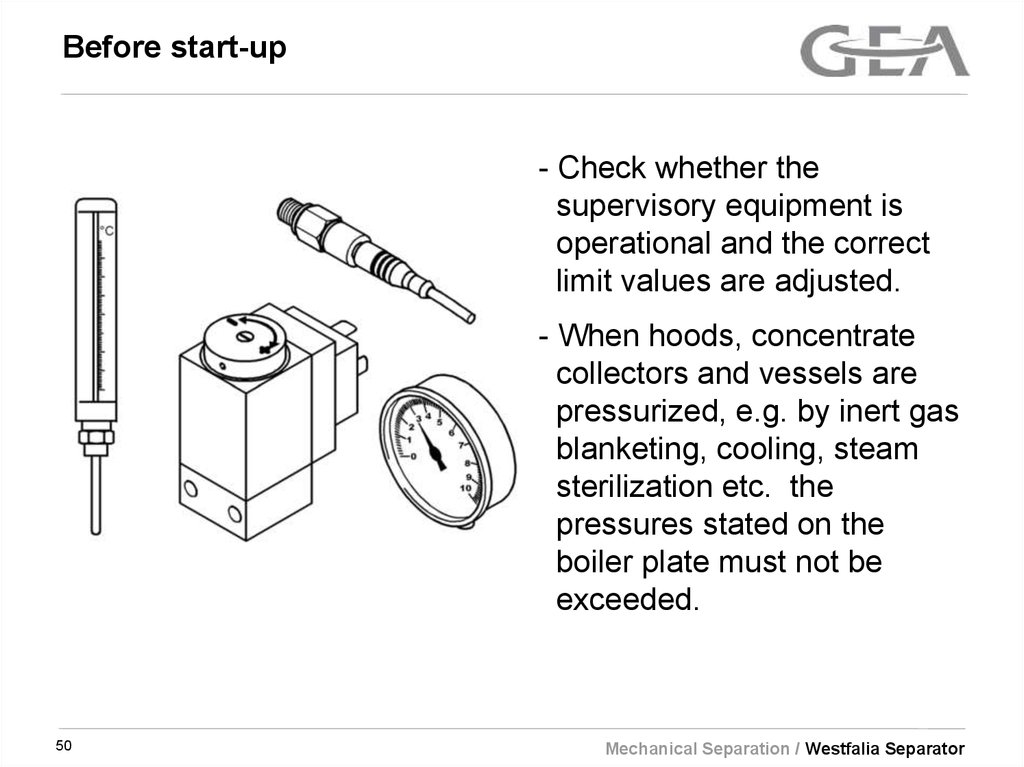
- Check whether thesupervisory equipment is
operational and the correct
limit values are adjusted.
- When hoods, concentrate
collectors and vessels are
pressurized, e.g. by inert gas
blanketing, cooling, steam
sterilization etc. the
pressures stated on the
boiler plate must not be
exceeded.
50
Mechanical Separation / Westfalia Separator
51. Before start-up
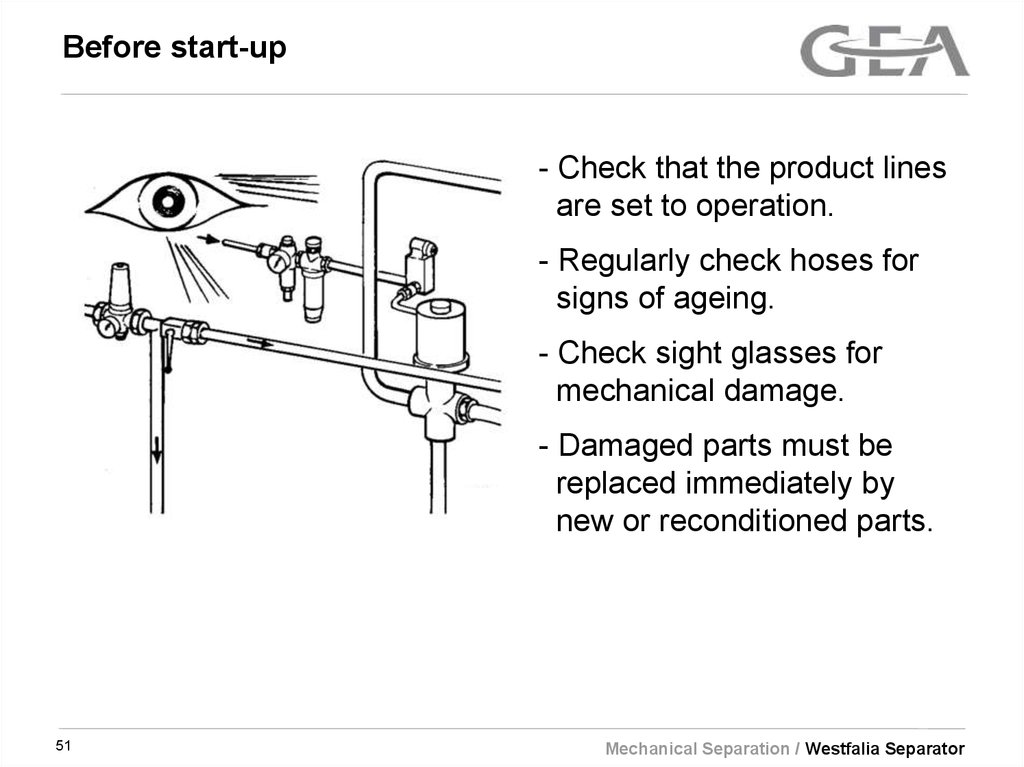
- Check that the product linesare set to operation.
- Regularly check hoses for
signs of ageing.
- Check sight glasses for
mechanical damage.
- Damaged parts must be
replaced immediately by
new or reconditioned parts.
51
Mechanical Separation / Westfalia Separator
52. Starting
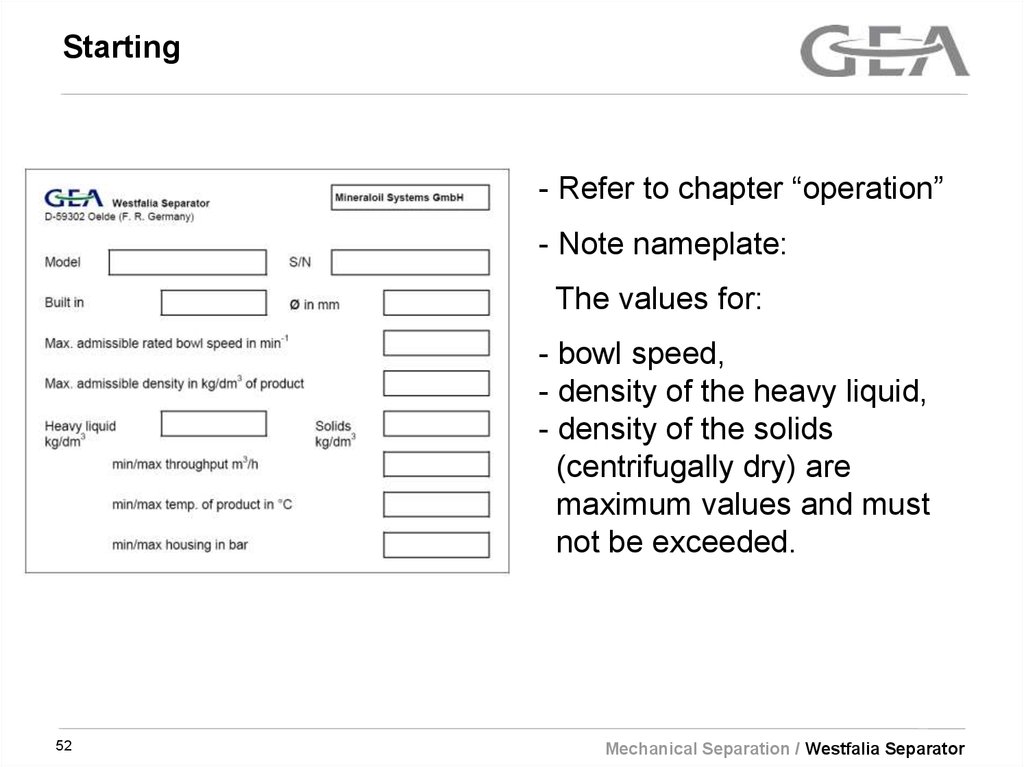
- Refer to chapter “operation”- Note nameplate:
The values for:
- bowl speed,
- density of the heavy liquid,
- density of the solids
(centrifugally dry) are
maximum values and must
not be exceeded.
52
Mechanical Separation / Westfalia Separator
53. Starting
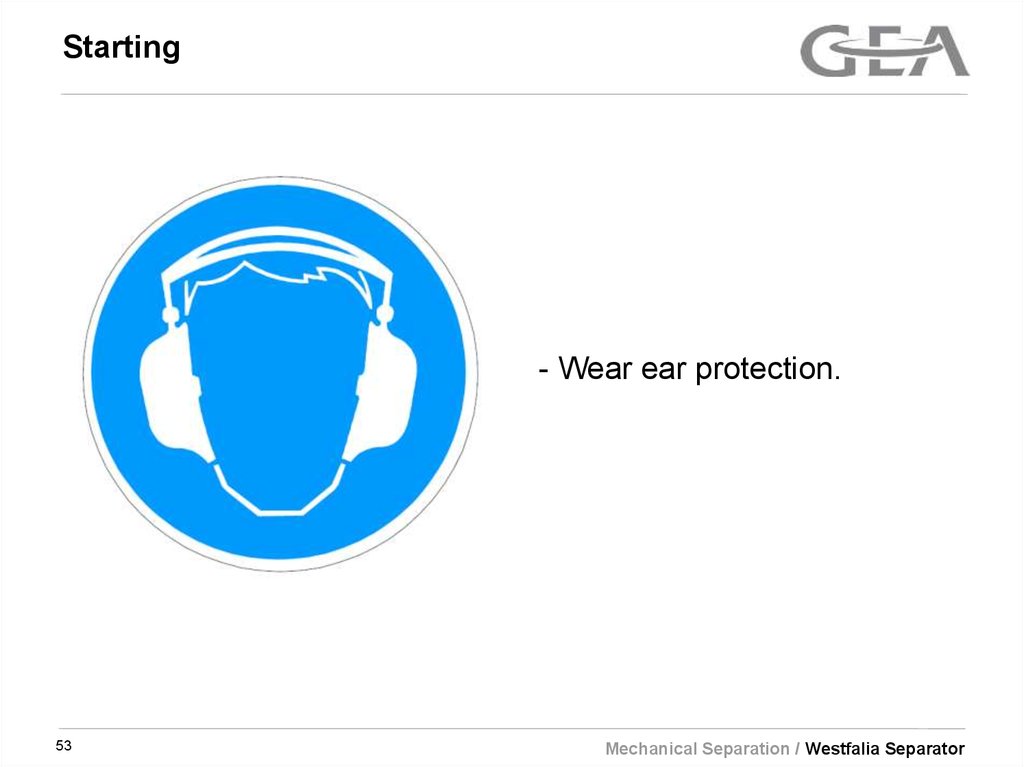
- Wear ear protection.53
Mechanical Separation / Westfalia Separator
54. Starting
- In case of frequency converteroperation:
- Do not under any
circumstances manipulate the
frequency converter to
exceed the permissible bowl
speed (see nameplate).
- The separator may only be
operated with an
independent device for speed
limiting.
54
Mechanical Separation / Westfalia Separator
55. Starting
- Do not feed product which iscategorised as explosive.
- The separator must not be
used in areas where explosion
protection is required.
55
Mechanical Separation / Westfalia Separator
56. Starting
- When processing productsharmful to persons, observe
the pertinent safety
regulations.
- Refer to the safety data sheet
of the product.
- Wear protective clothing.
56
Mechanical Separation / Westfalia Separator
57. Starting
The health hazards involved when handling heavy oils andlube oils
As a result of the deterioration in quality of fuel oils, the danger
has arisen that the heavy oils used on board contain greater
amounts of substances injurious to health. These include:
- polycyclic aromatic hydrocarbons,
- lead compounds,
- chemical residues.
57
Mechanical Separation / Westfalia Separator
58. Starting
The health hazards involved when handling heavy oils andlube oils
An increased amount of polycyclic aromatic hydrocarbons is
also present in used lube oils (waste oils). The health hazards
for the engine room staff depend to a large extent
- on the concentrations of the dangerous substances,
- the ambient air (inhalation of oil vapours/oil mist),
- the intensity and duration of the contact with the skin or
mucous membrane.
58
Mechanical Separation / Westfalia Separator
59. Starting
The health hazards involved when handling heavy oils andlube oils
Possible short-term effects:
- headaches, dizziness, nausea, itching or burning of the skin
Possible long-term effects:
- allergic reactions, especially skin allergies,
- festering inflammation of the skin pores (oil-acne),
- damage to the central nervous system after inhalation over
a long period,
- skin cancer caused by direct skin contact over a long
period,
- Lung cancer or cancer of the digestive organs after
inhalation over a long period (not certain as the causes are
difficult to separate from the effects of smoking and
alcohol).
59
Mechanical Separation / Westfalia Separator
60. Starting
Code of practice and personal protective measures- Avoid skin contact with heavy oils or lube oils if possible !
- Wear suitable protective gloves.
- Apply a protective ointment to the skin, especially if no
protective gloves are worn ! Personal hygiene is of the
utmost importance!
- Avoid breathing in oil vapours if possible !
- If possible, improve the air circulation in the room ! Fully
open the air regulation flaps in the outlets of the air
supply ducts in the centrifuge and filter area.
- Wash affected areas of skin frequently and thoroughly !
- Change dirty overalls regularly !
- Exercise special care when carrying out maintenance work
on and cleaning heavy oil and lube oil centrifuges and
filters !
60
Mechanical Separation / Westfalia Separator
61. Starting
When unusual noises orvibrations occur on the separator:
- Immediately shut down the
separator with filled bowl via
“emergency-off”.
- Never trigger a bowl ejection !
- Evacuate the room.
- Do not re-enter the room
until the centrifuge has come
to a standstill.
61
Mechanical Separation / Westfalia Separator
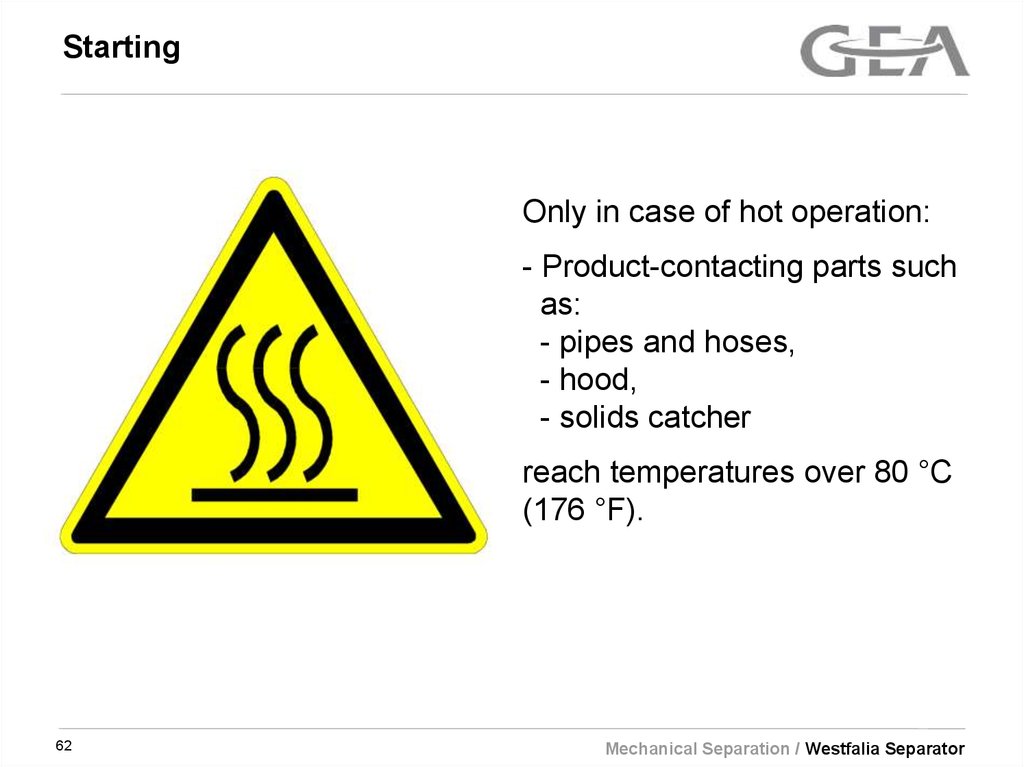
62. Starting
Only in case of hot operation:- Product-contacting parts such
as:
- pipes and hoses,
- hood,
- solids catcher
reach temperatures over 80 °C
(176 °F).
62
Mechanical Separation / Westfalia Separator
63. Shut-down and “Emergency-Off”
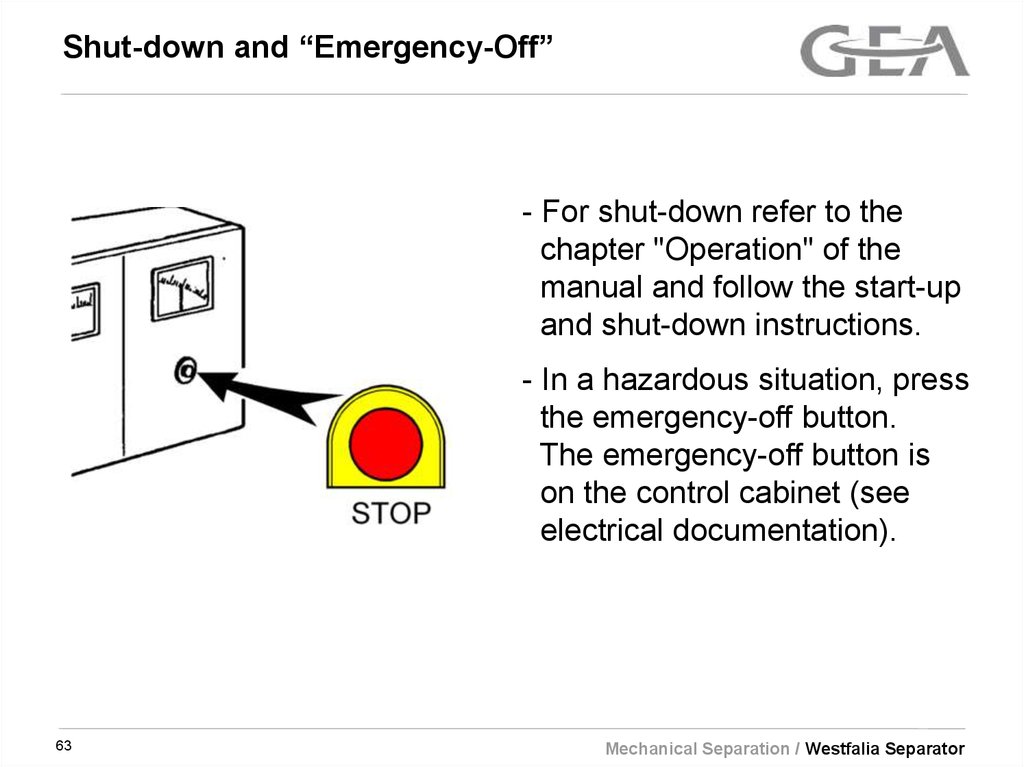
- For shut-down refer to thechapter "Operation" of the
manual and follow the start-up
and shut-down instructions.
- In a hazardous situation, press
the emergency-off button.
The emergency-off button is
on the control cabinet (see
electrical documentation).
63
Mechanical Separation / Westfalia Separator
64. Maintenance and repair
Unfavourable operating conditions may require shorter maintenanceintervals. The factors listed below are unfavourable because they
either attack the separator material directly or impair the
lubrication/cooling system:
- aggressive product (chemical or physical)
- high product temperature
- product with grease-decaying properties
- environment: temperature, dust, vapours
64
Mechanical Separation / Westfalia Separator
65. Maintenance and repair
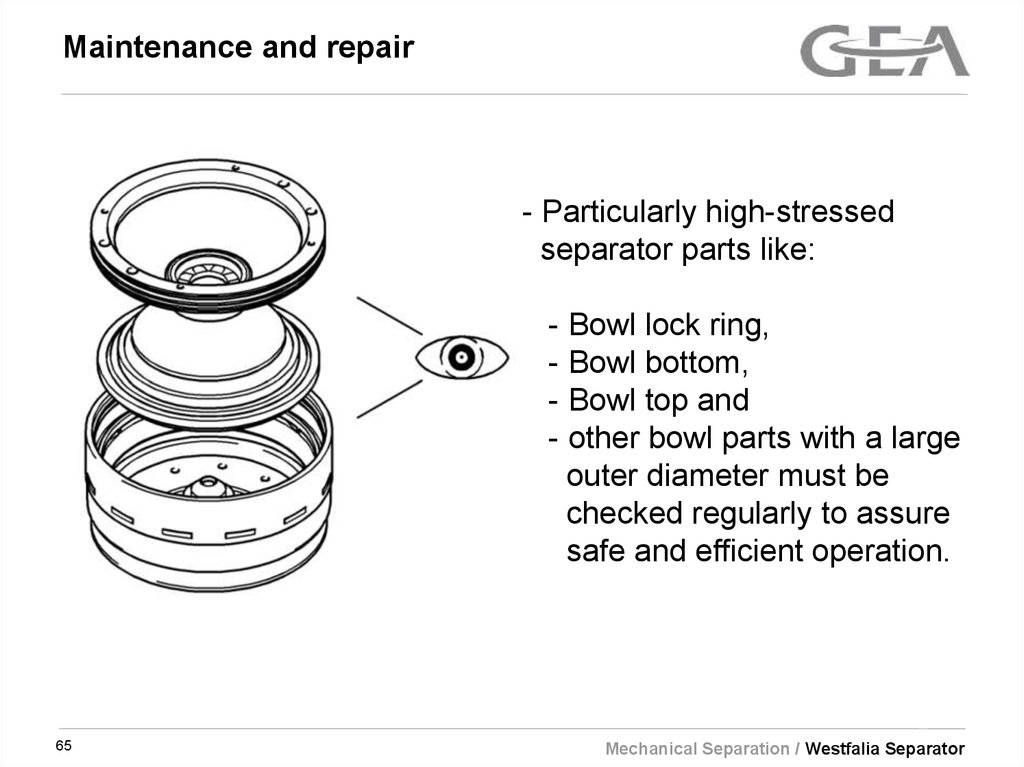
- Particularly high-stressedseparator parts like:
- Bowl lock ring,
- Bowl bottom,
- Bowl top and
- other bowl parts with a large
outer diameter must be
checked regularly to assure
safe and efficient operation.
65
Mechanical Separation / Westfalia Separator
66. Maintenance and repair
Timely maintenance of the separator and replacement of wornor damaged machine parts is essential for safe operation of
the machine.
- Use only genuine spare parts from Westfalia Separator.
Otherwise, safety risks may arise.
- Carry out the required cleaning thoroughly.
- One-sided solid deposits in the bowl cause severe unbalance !
Maintenance and repair work may only be carried out to the extent
described in the instruction manual. Maintenance and repair work
not described in this manual may only be carried out by the
manufacturer or by "repair shops" authorized by the manufacturer.
We, therefore, recommend in your own interest to have your
separator inspected by our service engineers at regular intervals.
These checks help to maintain the operating safety and avoid
unexpected downtime.
66
Mechanical Separation / Westfalia Separator
67. Maintenance and repair
Before carrying out work on theseparator and electrical plant
components:
- Make sure the separator is at a
standstill.
- Switch off all electrical
appliances via the main switch,
- Lock the installation to
prevent it from being
accidentally switched on.
67
Mechanical Separation / Westfalia Separator
68. Maintenance and repair
Do not loosen any part and donot carry out maintenance or
repair work on the separator
before the separator is at a
standstill !
68
Mechanical Separation / Westfalia Separator
69. Maintenance and repair
CAUTION:Danger of life through rotating separator parts !
In case of a torn, jumped off or defective drive belt:
- No parts of the separator may be lossened before the bowl
has come to a standstill.
- The run-down time without drive belt (see table below)
until dismantling the separator must be observed !
- Applying the brake is uneffective !
69
Mechanical Separation / Westfalia Separator
70. Maintenance and repair
- Do not climb onto or stand onthe machine or parts of the
machine.
- Make provision for and use a
sturdy working platform.
70
Mechanical Separation / Westfalia Separator
71. Maintenance and repair
- Place dismantled machineparts on a suitable base, e.g.
rubber mat.
- Secure the machine parts
against overturning and rolling
away with suitable aids.
71
Mechanical Separation / Westfalia Separator
72. Maintenance and repair
Do not heat bowl parts withthe naked flame.
- Bowl parts must never be
welded. This also applies for
hood and solids catcher parts
of steam-sterilizable
separators.
- Even during cleaning the bowl
parts the temperature must
not exceed 100 °C (212 °F).
72
Mechanical Separation / Westfalia Separator
73. Maintenance and repair
Load-carrying equipment such as:- lifting devices for bowl or
distributor,
- chains etc.
may only be used for work
routines as described in the
instruction manual.
Do not use damaged or
incomplete load carrying
equipment.
73
Mechanical Separation / Westfalia Separator
74. Maintenance and repair
- All load suspension deviceshave to be checked for
completeness and for possible
damage at least once a year.
- In addition, when using load
suspension devices and hoists,
the applicable legislation and
safety rules have to be strictly
observed.
74
Mechanical Separation / Westfalia Separator
75. Maintenance and repair
- Collect dripping oil to preventdanger of slipping or product
infection.
- When handling waste oils
note:
- They can be injurious to
health, depending on their
chemical composition.
- Waste oil must be disposed
of in accordance with local
regulations.
75
Mechanical Separation / Westfalia Separator
76. Maintenance and repair
76Mechanical Separation / Westfalia Separator
77. Maintenance and repair
77Mechanical Separation / Westfalia Separator
78. Maintenance and repair
78Mechanical Separation / Westfalia Separator
79. Maintenance and repair
79Mechanical Separation / Westfalia Separator
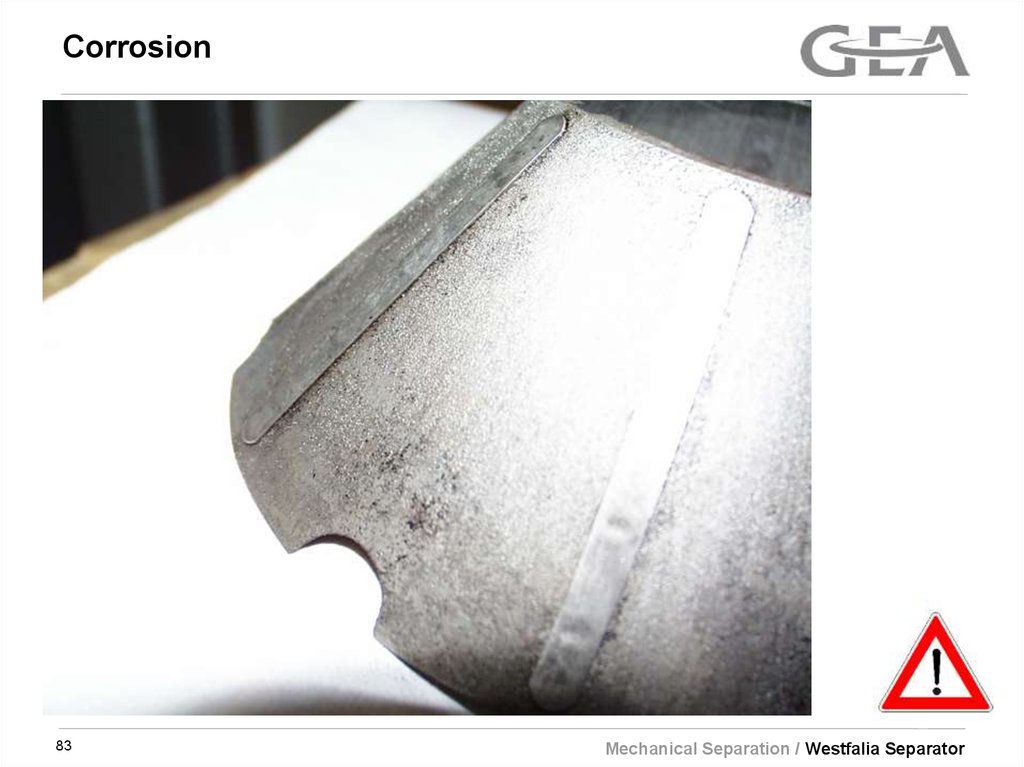
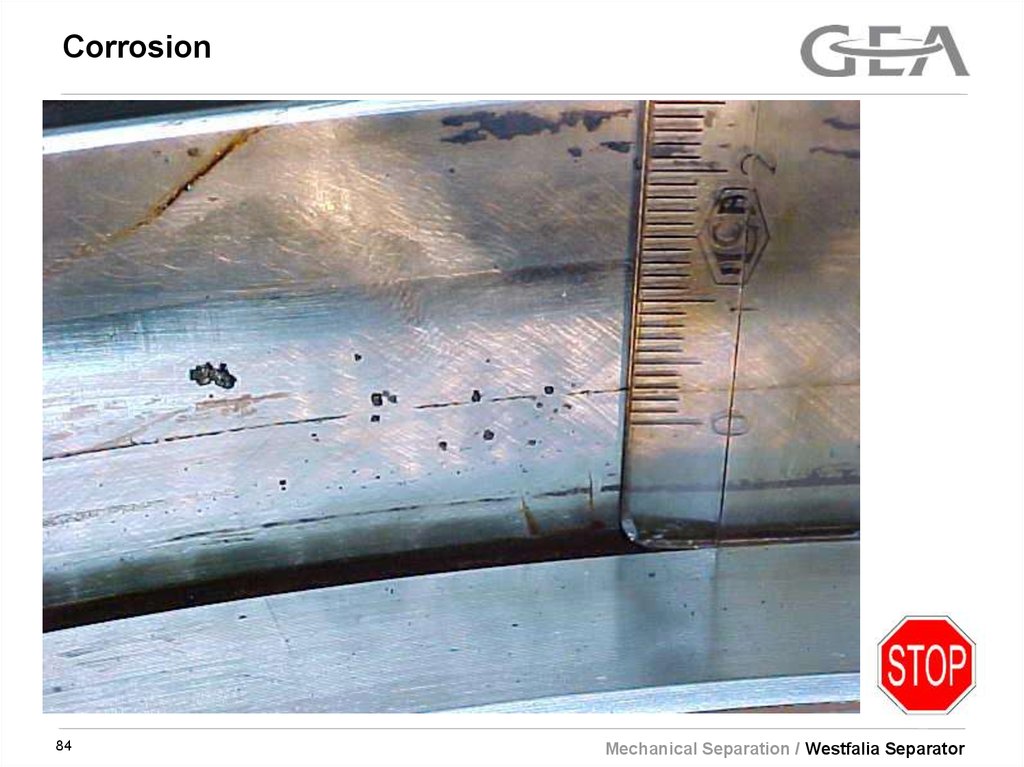
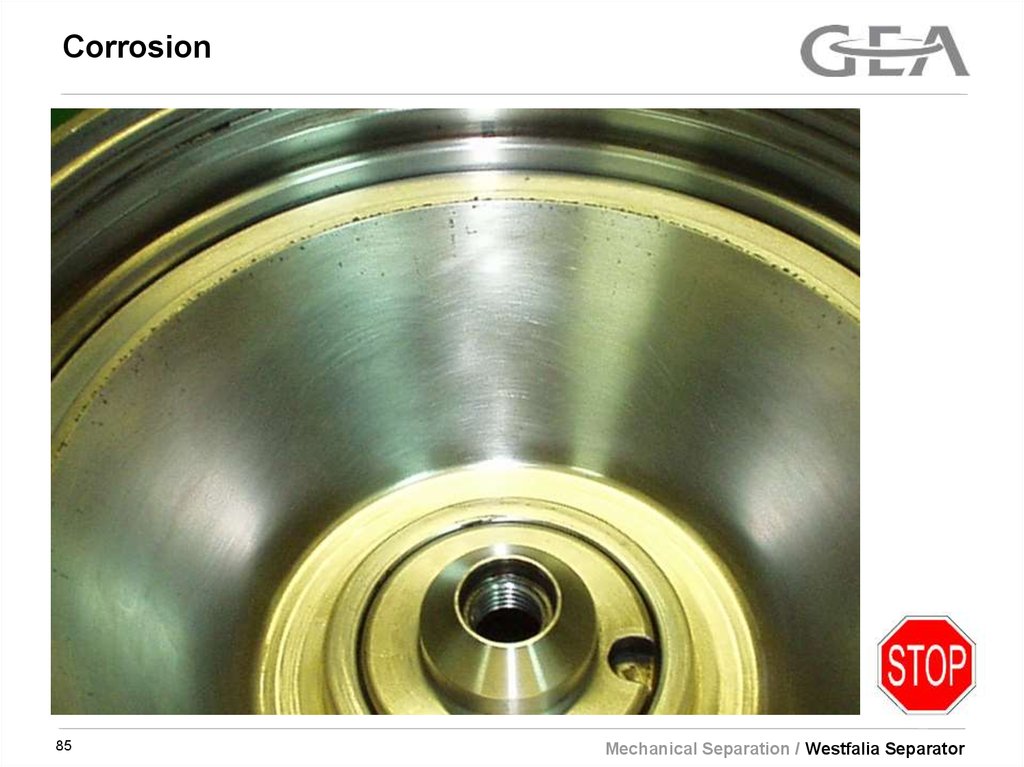
80. Corrosion
Corrosion can also affect bowl parts made of stainless steel. Thiscorrosion can be flat-spread or pit- or crack-shaped and merits
special attention.
Corrosion on stainless steel bowl material should be examined
thoroughly and documented. Flat-spread corrosion can usually
be measured (reduction of wall thickness).
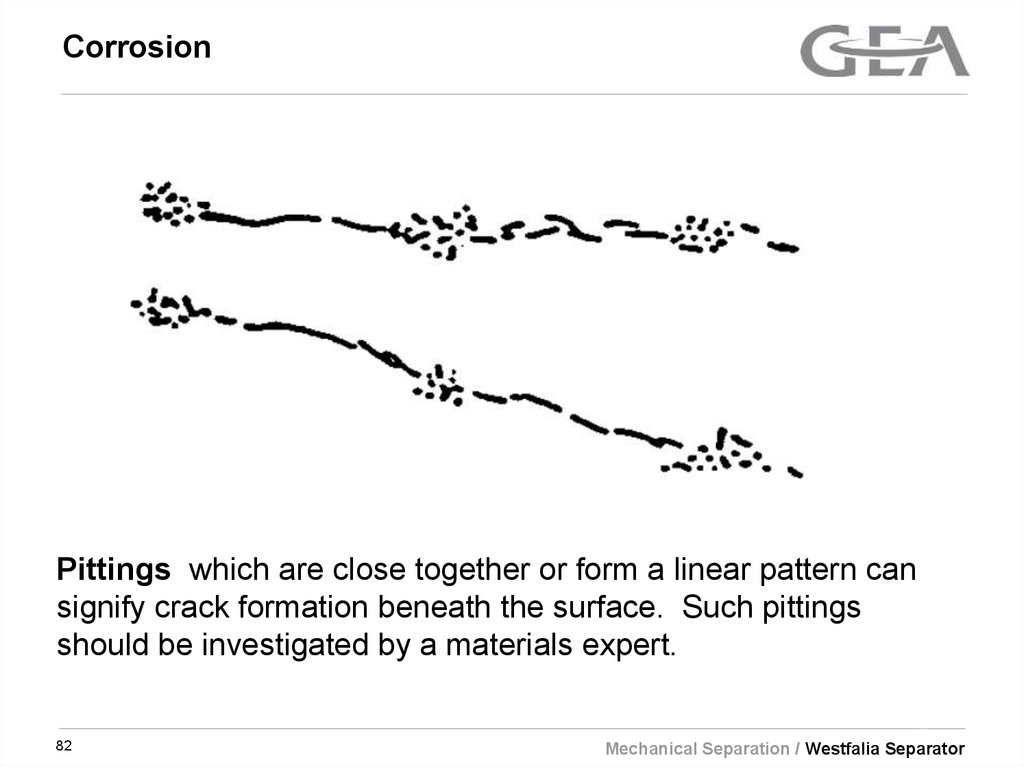
Pit- or crack-shaped corrosion cannot be measured without the
risk of damage. At the initial stage pit-shaped corrosion is
generally caused by chlorine ions (seawater !). Depending on the
stressing of the part, pit-shaped corrosion can result in crackshaped corrosion.
80
Mechanical Separation / Westfalia Separator
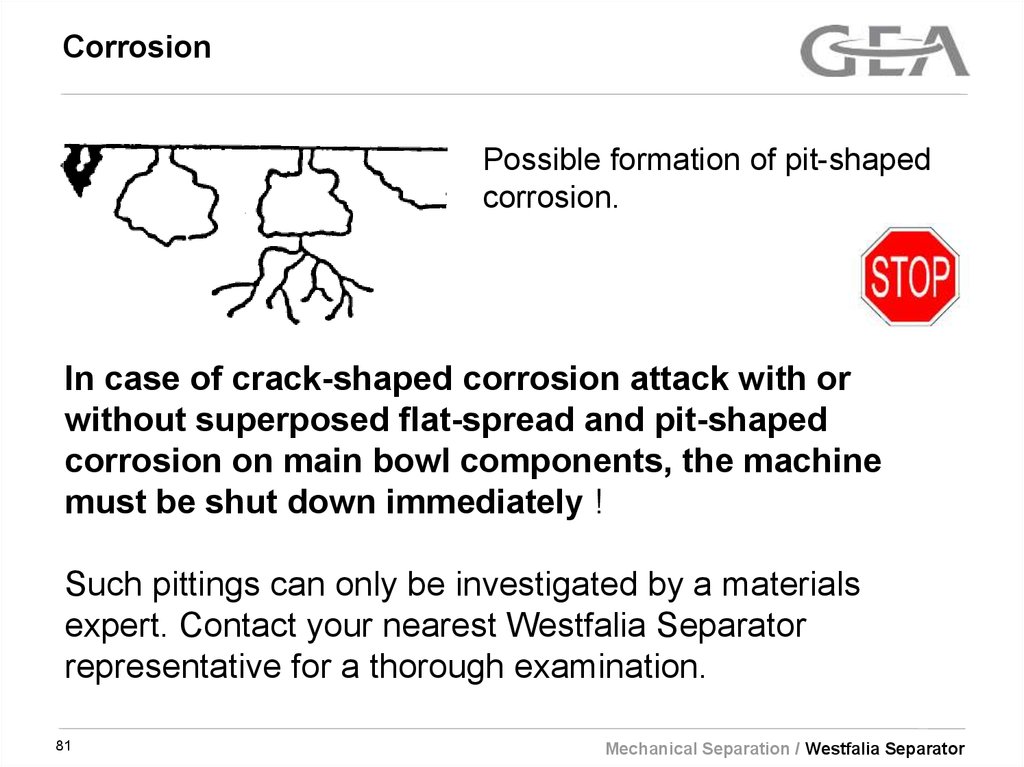
81. Corrosion
Possible formation of pit-shapedcorrosion.
In case of crack-shaped corrosion attack with or
without superposed flat-spread and pit-shaped
corrosion on main bowl components, the machine
must be shut down immediately !
Such pittings can only be investigated by a materials
expert. Contact your nearest Westfalia Separator
representative for a thorough examination.
81
Mechanical Separation / Westfalia Separator
82. Corrosion
Pittings which are close together or form a linear pattern cansignify crack formation beneath the surface. Such pittings
should be investigated by a materials expert.
82
Mechanical Separation / Westfalia Separator
83. Corrosion
83Mechanical Separation / Westfalia Separator
84. Corrosion
84Mechanical Separation / Westfalia Separator
85. Corrosion
85Mechanical Separation / Westfalia Separator
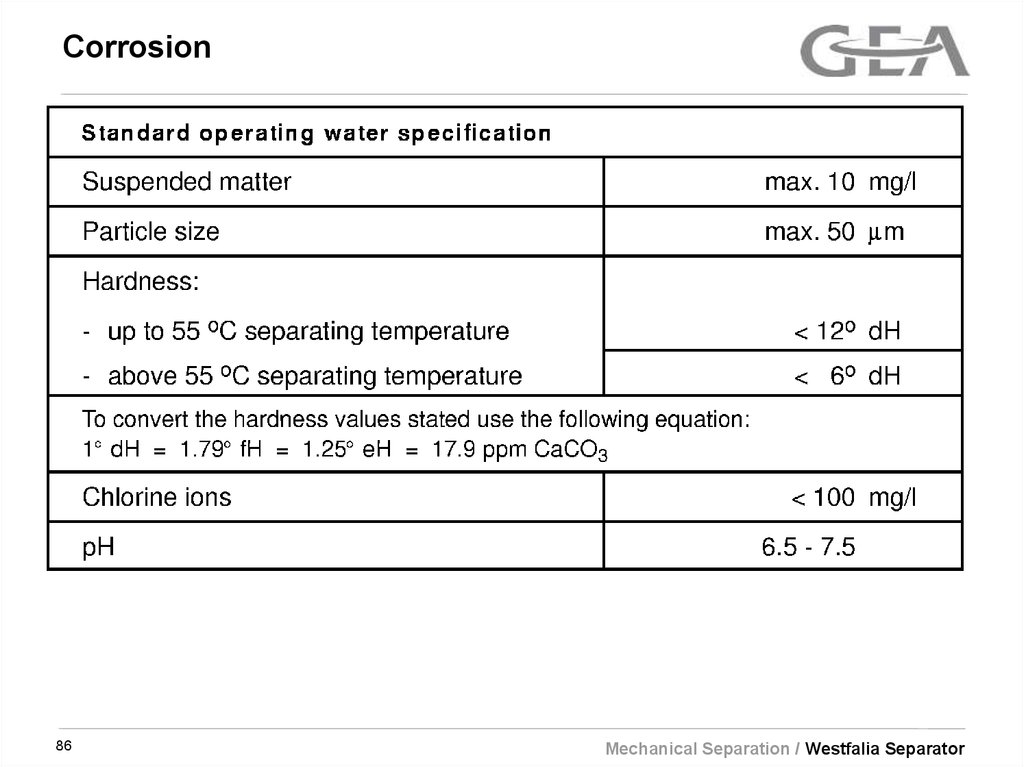
86. Corrosion
86Mechanical Separation / Westfalia Separator
87. Erosion
Erosion is caused by solid particles in the process liquid.These solid particles grind marks into the surfaces with which
they come into contact. The following factors favour the
occurrence of erosion:
- hard solids particles
- high throughput capacities
The first signs of erosion should be carefully observed and
documented. Erosion can deepen rapidly, thereby weakening
the bowl material.
Contact your nearest Westfalia Separator representative for a
thorough examination. Information on the nature of the damage
can be provided by photos, plaster casts or lead molds.
87
Mechanical Separation / Westfalia Separator
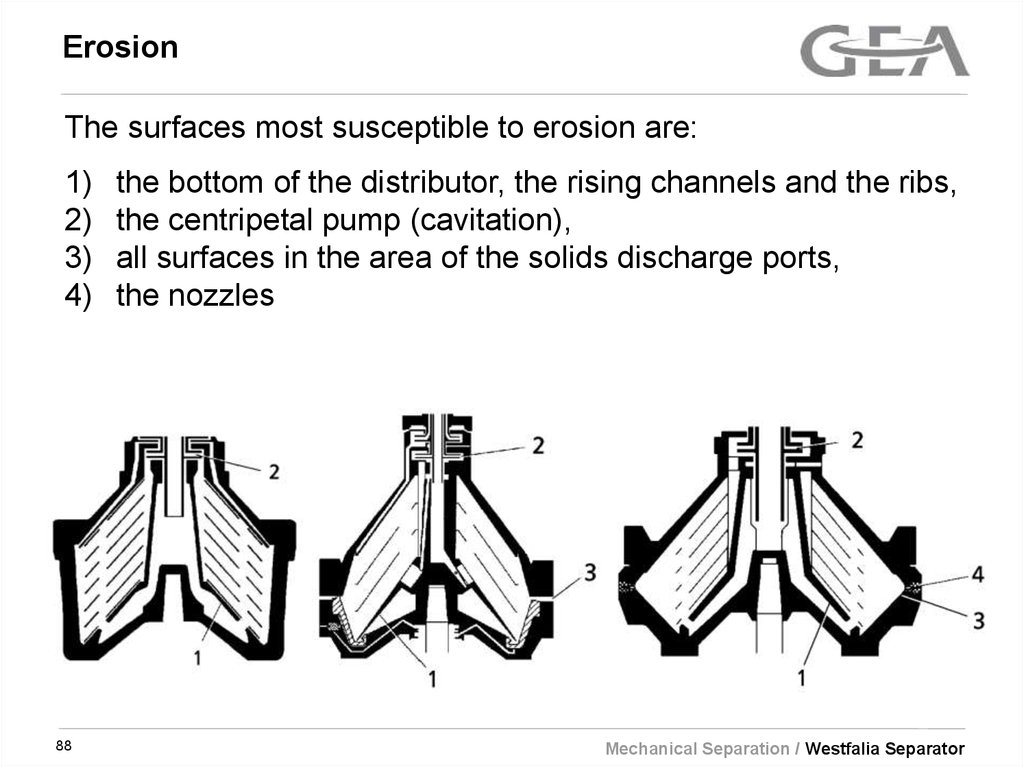
88. Erosion
The surfaces most susceptible to erosion are:1)
2)
3)
4)
88
the bottom of the distributor, the rising channels and the ribs,
the centripetal pump (cavitation),
all surfaces in the area of the solids discharge ports,
the nozzles
Mechanical Separation / Westfalia Separator
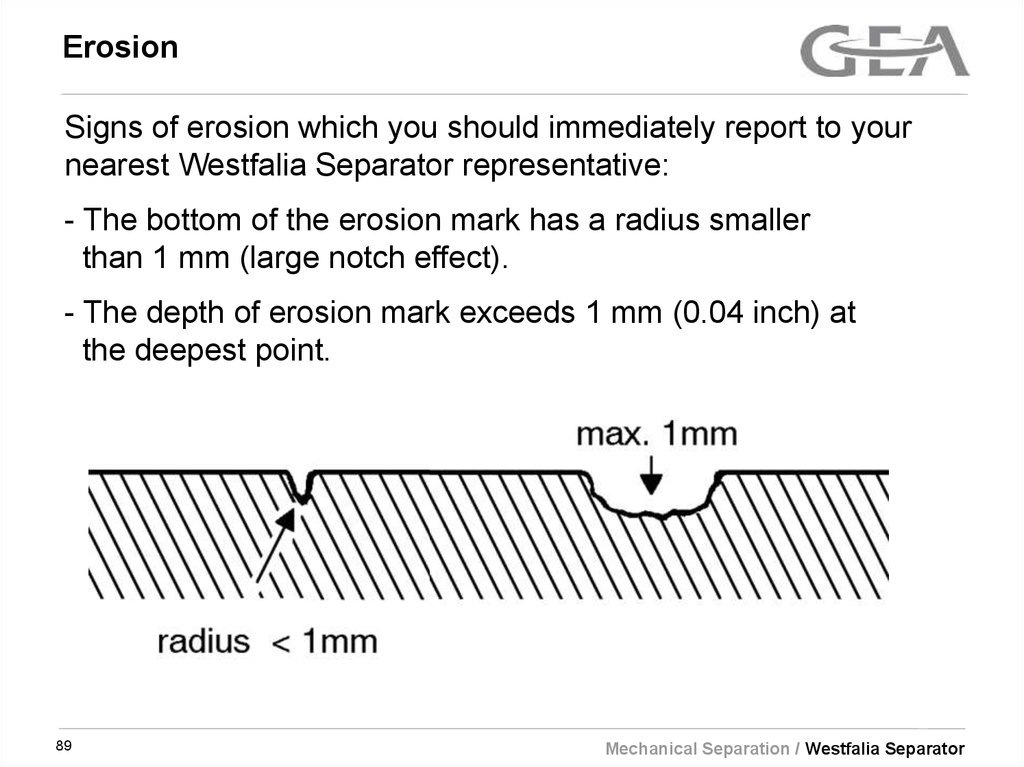
89. Erosion
Signs of erosion which you should immediately report to yournearest Westfalia Separator representative:
- The bottom of the erosion mark has a radius smaller
than 1 mm (large notch effect).
- The depth of erosion mark exceeds 1 mm (0.04 inch) at
the deepest point.
89
Mechanical Separation / Westfalia Separator
90. Erosion
90Mechanical Separation / Westfalia Separator
91. Erosion
91Mechanical Separation / Westfalia Separator
92. Erosion
92Mechanical Separation / Westfalia Separator
93. Cleaning the bowl
It is generally not necessary to dismantle self-cleaning bowls forcleaning after separation unless:
- The nature of the product makes it necessary,
- The separator is to be shut down for a lengthy period
- Dismantle and clean the bowl for checking from time to
time. See Maintenance schedule in the manual.
- Use only a cleaning agent that is approved for the field of
application !
Do not use acid or chloric cleaning agents. Chlorine attacks
stainless steel parts.
Dissolve dried scale with citric acid.
For cleaning the individual disks and bowl parts do not use
metal scrapers and metal brushes !
93
Mechanical Separation / Westfalia Separator
94. Cleaning the bowl
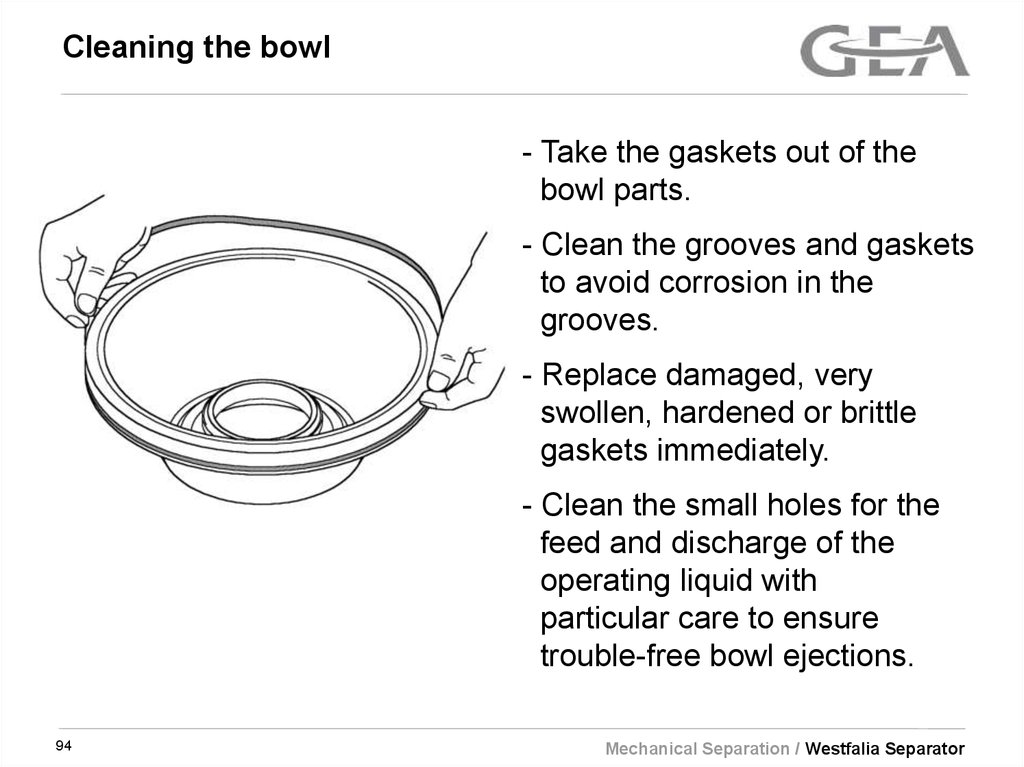
- Take the gaskets out of thebowl parts.
- Clean the grooves and gaskets
to avoid corrosion in the
grooves.
- Replace damaged, very
swollen, hardened or brittle
gaskets immediately.
- Clean the small holes for the
feed and discharge of the
operating liquid with
particular care to ensure
trouble-free bowl ejections.
94
Mechanical Separation / Westfalia Separator
95. Cleaning the bowl
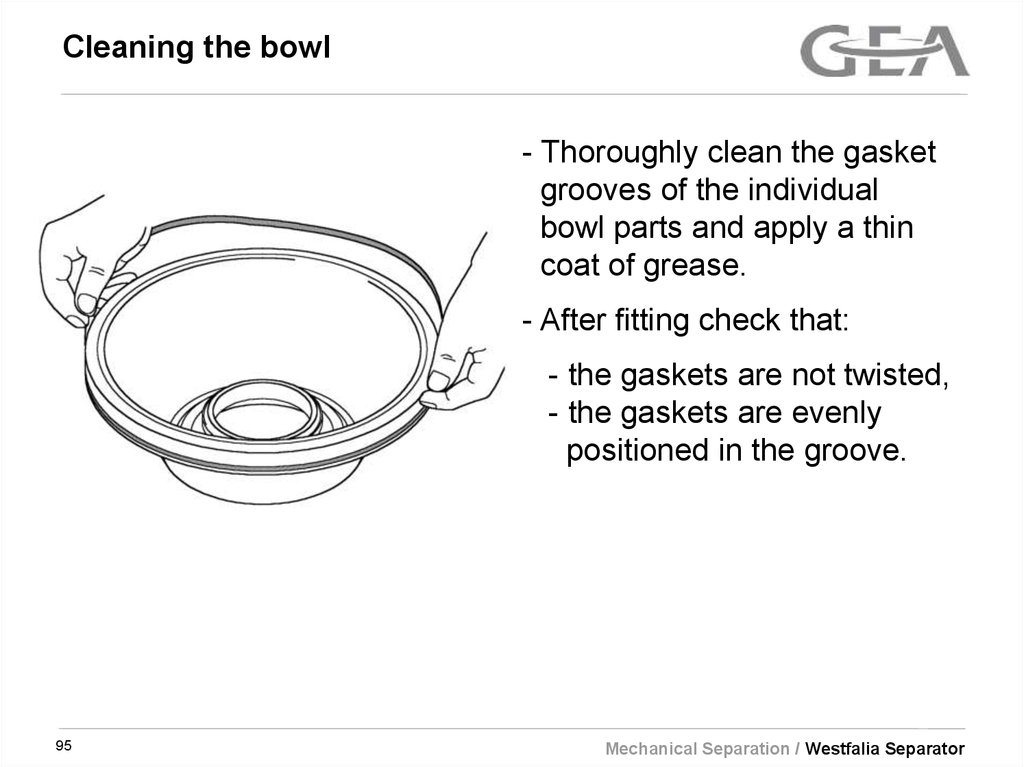
- Thoroughly clean the gasketgrooves of the individual
bowl parts and apply a thin
coat of grease.
- After fitting check that:
- the gaskets are not twisted,
- the gaskets are evenly
positioned in the groove.
95
Mechanical Separation / Westfalia Separator
96. Cleaning the bowl
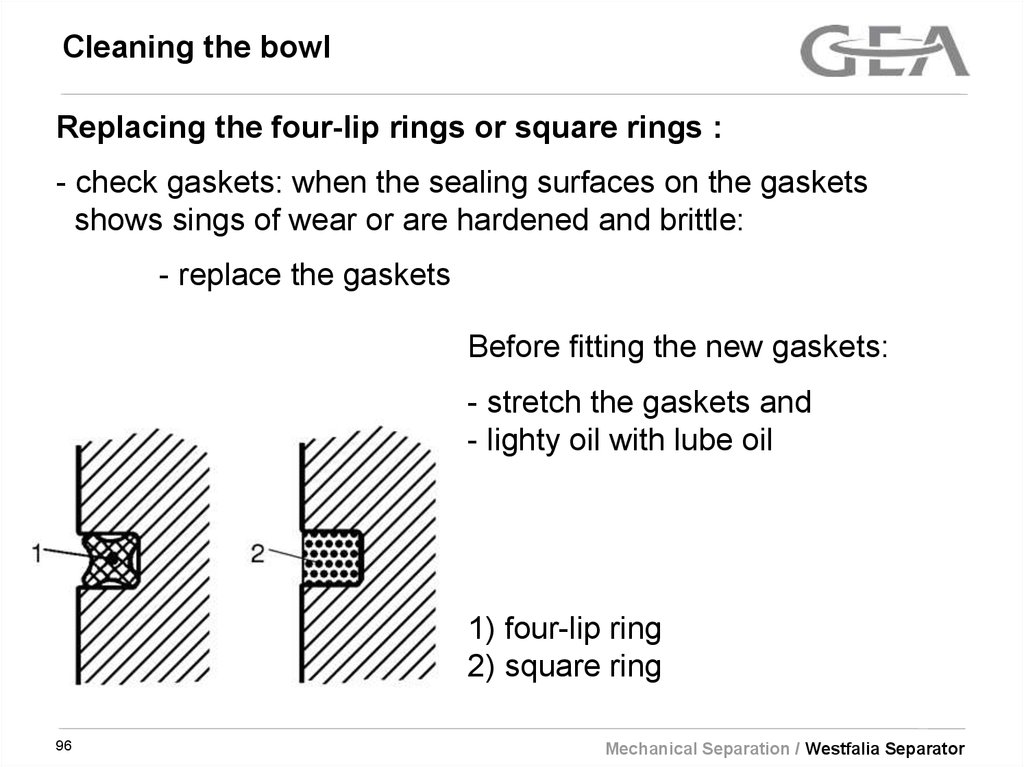
Replacing the four-lip rings or square rings :- check gaskets: when the sealing surfaces on the gaskets
shows sings of wear or are hardened and brittle:
- replace the gaskets
Before fitting the new gaskets:
- stretch the gaskets and
- lighty oil with lube oil
1) four-lip ring
2) square ring
96
Mechanical Separation / Westfalia Separator
97. Cleaning the bowl
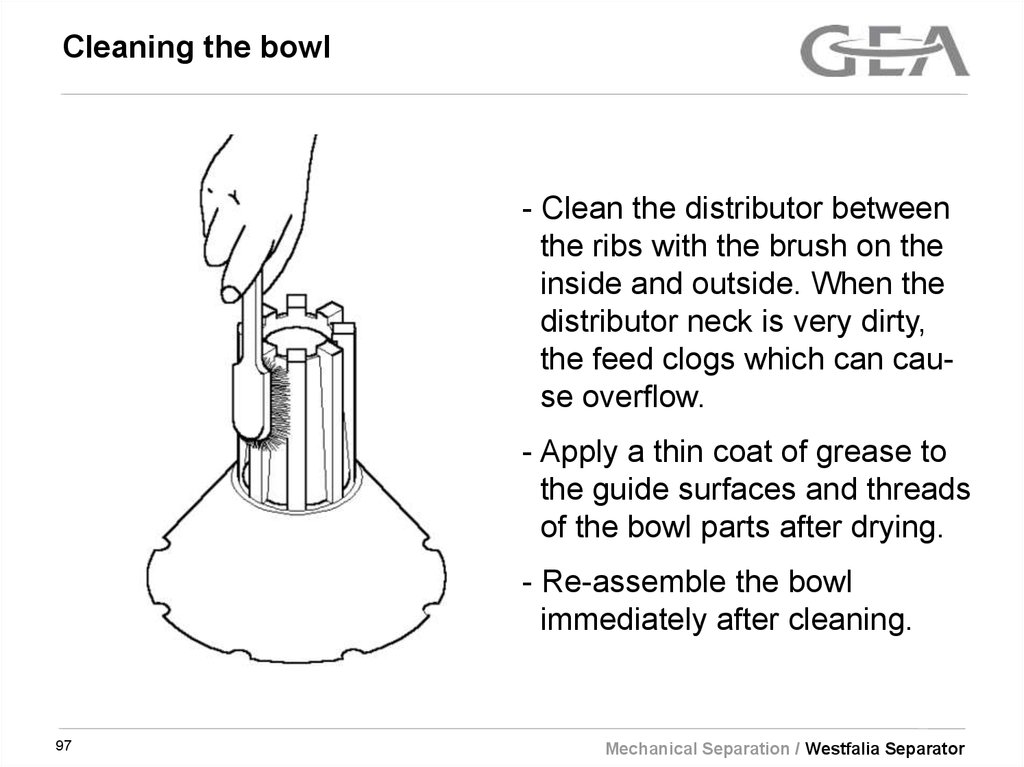
- Clean the distributor betweenthe ribs with the brush on the
inside and outside. When the
distributor neck is very dirty,
the feed clogs which can cause overflow.
- Apply a thin coat of grease to
the guide surfaces and threads
of the bowl parts after drying.
- Re-assemble the bowl
immediately after cleaning.
97
Mechanical Separation / Westfalia Separator
98. Cleaning the frame
CAUTION: Danger to life through electrical components !- Never rinse off the motor with a direct water jet.
- Use only approved cleaning agents, preferably a neutral
cleaning agent, benzene or diesel oil.
- Do not use chloric cleaning agents. Chlorine attacks stainless
steel parts.
- Dissolve dried scale with citric acid.
- Clean the inside of the upper section of the frame from time
to time.
98
Mechanical Separation / Westfalia Separator
99. Cleaning the frame
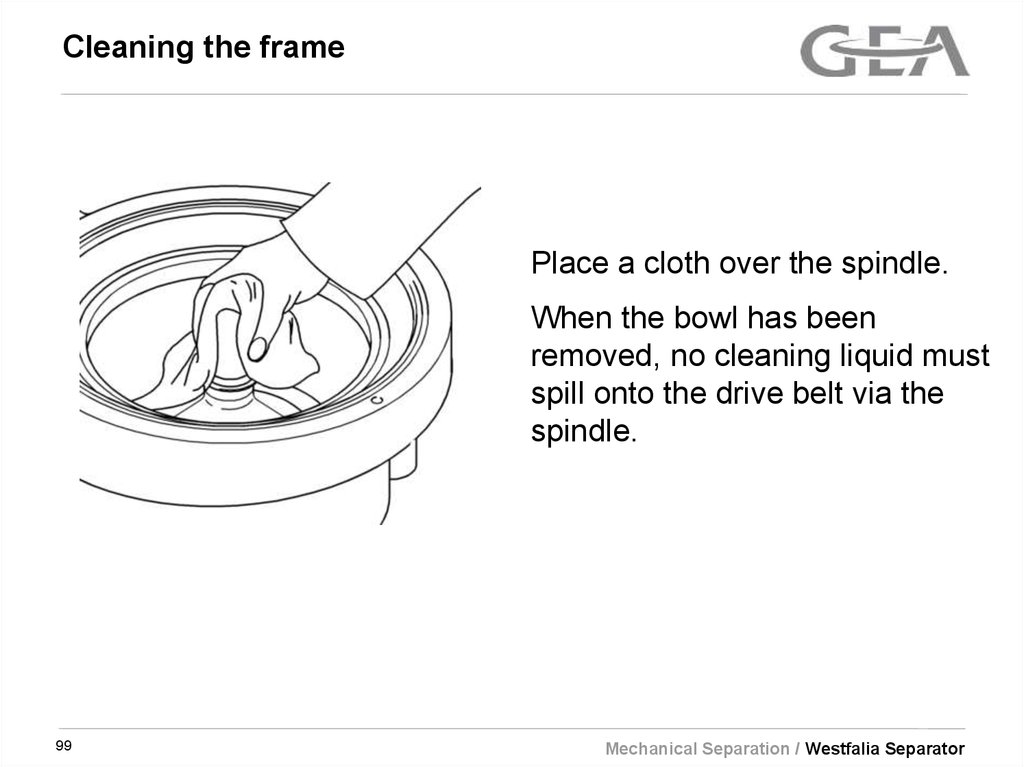
Place a cloth over the spindle.When the bowl has been
removed, no cleaning liquid must
spill onto the drive belt via the
spindle.
99
Mechanical Separation / Westfalia Separator
100. Cleaning the strainer
Cleaning the strainer and the operating water feeding systemThe strainer and the operating water feeding system must be
cleaned depending on the quality of the operating water and
overall load.
- Use citric acid in case of furring.
- Thoroughly clean the parts with water.
- Replacing or cleaning the filter element
- Close the main valve for operating water, filling and
displacement water !
CAUTION: Danger due to electrical current !
CAUTION: Danger of injury through very hot separator
parts !
100
Mechanical Separation / Westfalia Separator
101. Training Safety
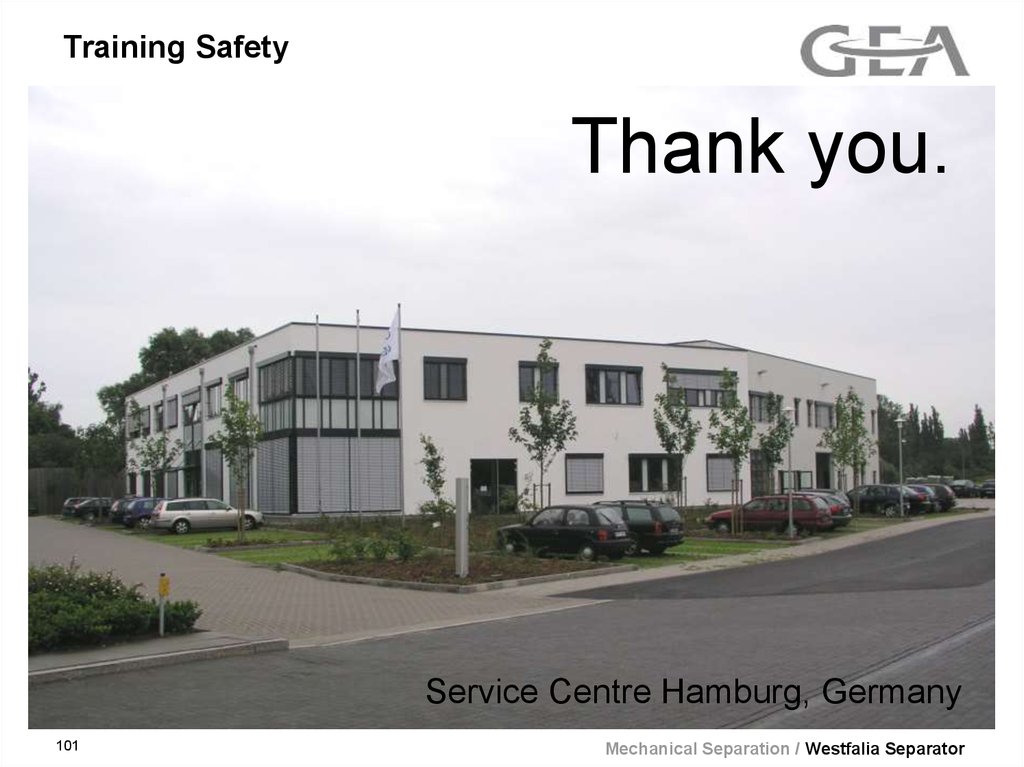
Thank you.Service Centre Hamburg, Germany
101
Mechanical Separation / Westfalia Separator