Similar presentations:



Digital Rights
1. Digital rights
DIGITAL RIGHTSSergey Klyushev
LLM student,
Institute of State and Law
Tumen State University
2. Greeting and introduction
GREETING AND INTRODUCTIONGood morning, everyone.
Thank you for coming to see my presentation.
Let me introduce myself. My name is Sergey Klyushev,
I am LLM student Institute of State and Law,
Tumen State University
3. Aim and main points
AIM AND MAIN POINTSThe aim of my presentation is to explain what digital rights
are for, the types that exist
Main points. I am going to discuss are as follows:
First, I will talk about what digital rights are for
Second, I will discuss types of digital rights
Finally , I will discuss about security and how to act if digital
rights are violated
4. what digital rights are?
WHAT DIGITAL RIGHTS ARE?Digital rights recognise the right of
individuals to access, use, create
and publish digital media, and the right of access to the
computers, electronic devices and telecommunications
networks necessary to exercise them.
In 1996, in an article entitled A Declaration of the
Independence of Cyberspace External Barlow highlighted
the discrepancy between the fundamental rights enshrined
in the US Constitution and the violation of citizens' rights on
the Internet. For example, in the 1990s the postal service was
inviolable, but email was not. The work defending these
cases in court laid the foundation for the international
recognition of digital rights.
5. types of digital rights
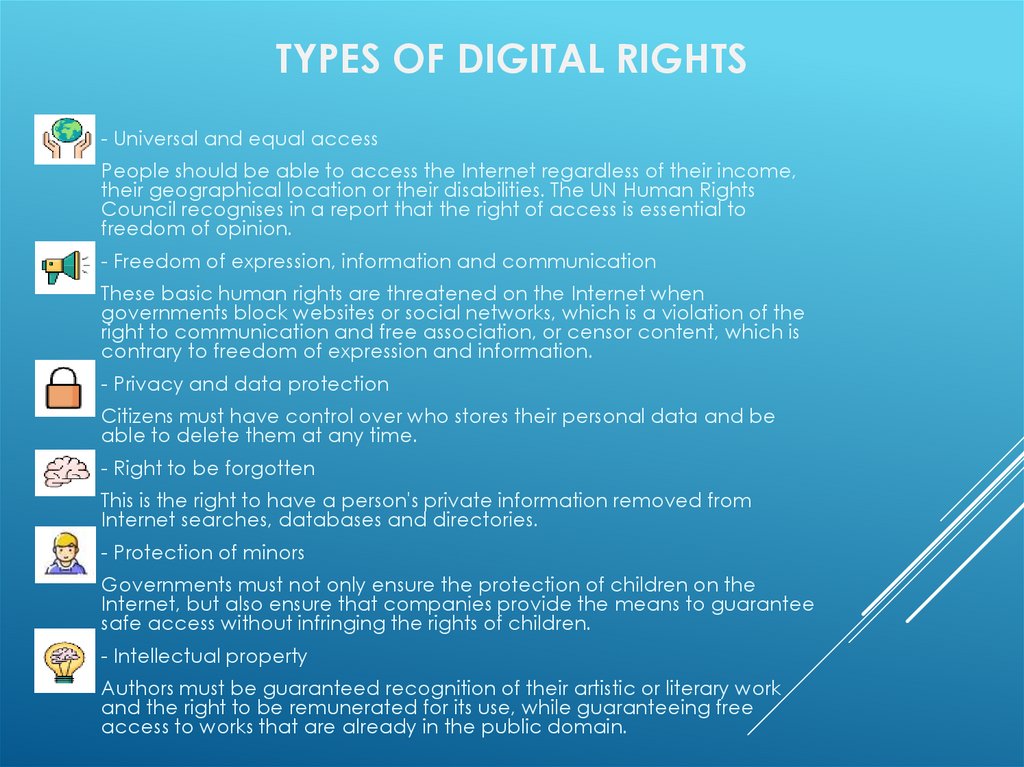
TYPES OF DIGITAL RIGHTS- Universal and equal access
People should be able to access the Internet regardless of their income,
their geographical location or their disabilities. The UN Human Rights
Council recognises in a report that the right of access is essential to
freedom of opinion.
- Freedom of expression, information and communication
These basic human rights are threatened on the Internet when
governments block websites or social networks, which is a violation of the
right to communication and free association, or censor content, which is
contrary to freedom of expression and information.
- Privacy and data protection
Citizens must have control over who stores their personal data and be
able to delete them at any time.
- Right to be forgotten
This is the right to have a person's private information removed from
Internet searches, databases and directories.
- Protection of minors
Governments must not only ensure the protection of children on the
Internet, but also ensure that companies provide the means to guarantee
safe access without infringing the rights of children.
- Intellectual property
Authors must be guaranteed recognition of their artistic or literary work
and the right to be remunerated for its use, while guaranteeing free
access to works that are already in the public domain.
6. Security and how to act if digital rights are violated
SECURITY AND HOW TO ACTIF DIGITAL RIGHTS ARE VIOLATED
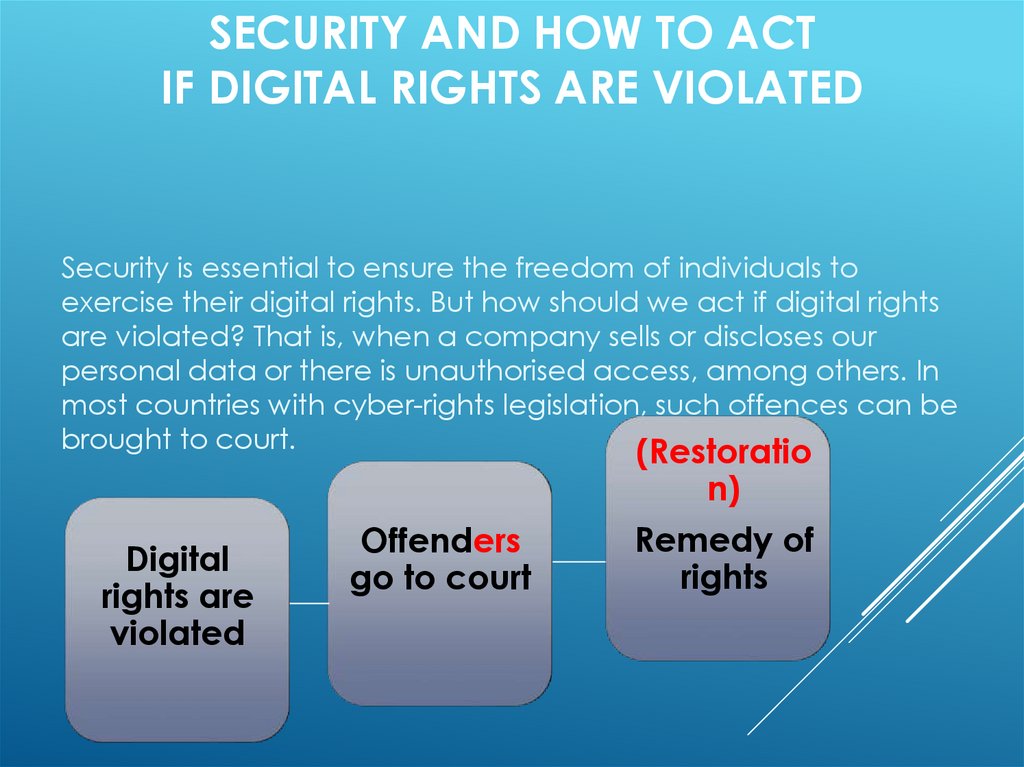
Security is essential to ensure the freedom of individuals to
exercise their digital rights. But how should we act if digital rights
are violated? That is, when a company sells or discloses our
personal data or there is unauthorised access, among others. In
most countries with cyber-rights legislation, such offences can be
brought to court.
(Restoratio
Digital
rights are
violated
Offenders
go to court
n)
Remedy of
rights
7. Conclusions
CONCLUSIONSIn the era of digitalisation, law needs to be
adapted to protect and safeguard
fundamental rights. Digital rights, closely linked
to freedom of expression and privacy, are
those that allow people to access, use, create
and publish digital media, as well as access
and use computers, other electronic devices
and communications networks.